Difficulty: 3/5 – Intermediate
One of the least known ants in the world: described in 2016 from a single worker from the Philippines, and its queen has still not been described. A visual hunter that climbs and pounces on its prey from above. In its genus, workers can mate and become gamergates: mated workers that lay eggs. 24–26 °C, high humidity at all times (60–80 %), live prey only and no diapause.
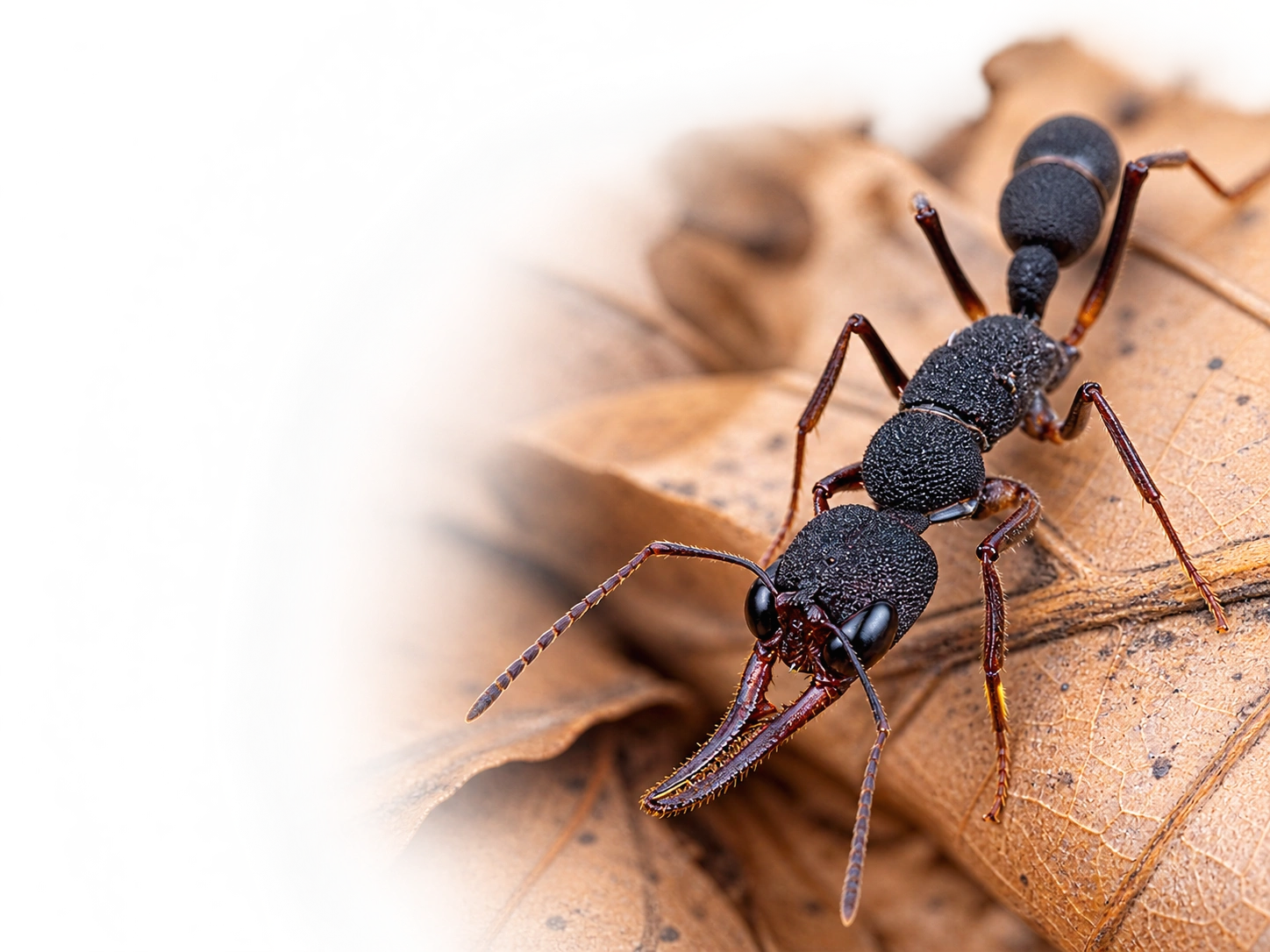
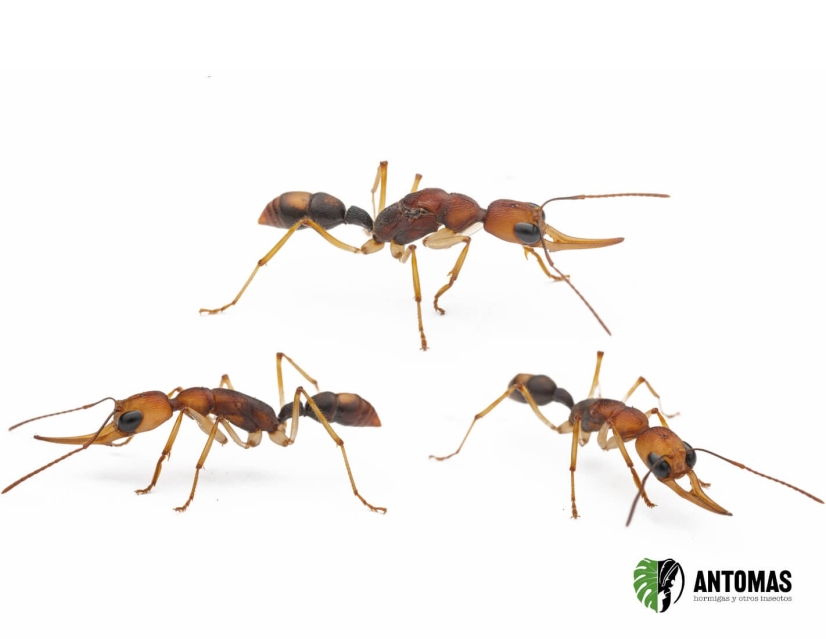
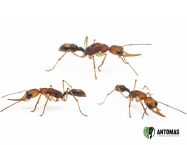
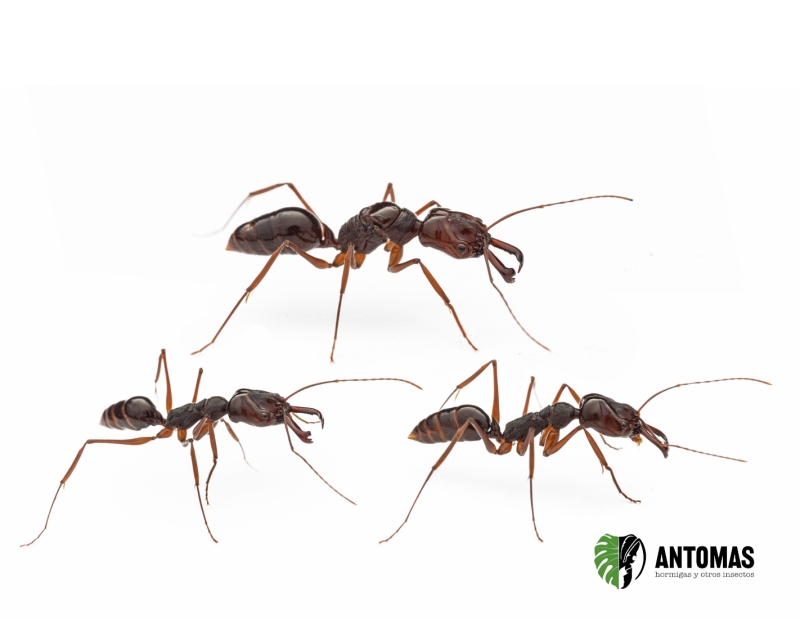
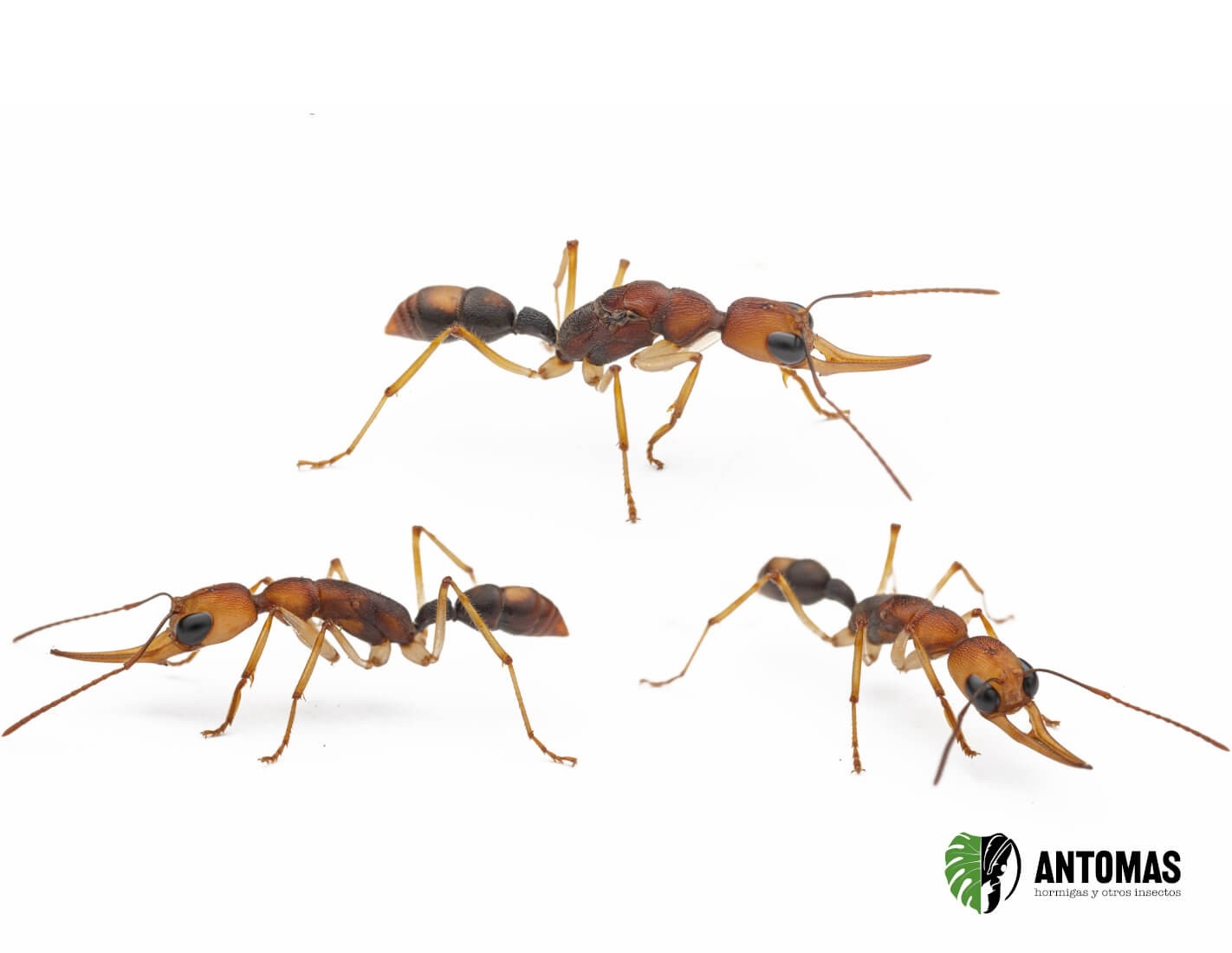
Harpegnathos are large ponerine ants from tropical Asia, impossible to mistake: long mandibles curved like pincers, huge eyes at the front corners of the head, a long tubular thorax and long, slender legs that they use to jump. They hunt alone and by sight, like small predators lying in wait. Harpegnathos honestoi General, 2016 is also one of the least known ants in the world: science described it from a single worker collected on Mount Isarog, on the island of Luzon (Philippines), and its queen and male are still undescribed. Antomas colonies come from the Philippines.
A word of warning before we start: all that is known about H. honestoi is its original description. Almost everything we know about the biology of the genus has been studied in H. saltator, its Indian relative and one of the most researched insects in genetics and ageing laboratories, and some of it in H. venator. We include it because it helps to understand this species, but we always say which species each fact comes from: nothing seen in other Harpegnathos has yet been confirmed in H. honestoi.
Biology
What is a gamergate?
A gamergate is a mated worker that lays eggs and acts as the reproductive in the colony. From the outside she is just another worker: she has no wings and no queen's thorax, but she has mated and her ovaries are active. The word comes from the Greek gámos, "marriage", and ergátēs, "worker": literally, "married worker". It was proposed by the myrmecologist W. L. Brown and first published in a paper by Peeters and Crewe (1984). Four years later, Peeters and Crozier (1988) defended it against other labels, such as "ergatoid queen", with an argument that sums up the idea: not all mated egg-layers are queens.
How does she differ from a queen? The genus Harpegnathos shows it very clearly, because both live in the same species. In H. saltator:
- The queen is born winged, with a thorax built for flight; she mates outside the nest with males from other colonies and is able to found a new colony on her own.
- The gamergate has never had wings; she mates inside the nest, often with her own brothers, cannot found a colony alone and lays roughly half as many eggs as a queen.
In H. saltator, when the queen grows old or dies, several mated workers take over as gamergates. Nobody has studied this in H. honestoi yet; at Antomas we know that new gamergates can appear in colonies of the genus kept at home. The colonies we sell have a queen, and if one day you see a gamergate arise in your H. honestoi, you will be watching something that nobody has described in this species.
Gamergate or ergatoid queen?
In the hobby the two terms are often used almost as synonyms, but they are not the same. A gamergate is a mated worker that lays fertilised eggs: she has the body and the development of a worker, a functional spermatheca, and cannot found a colony on her own. An ergatoid queen, on the other hand, is a permanently wingless queen: a queen caste with its own larval development, queen ovaries and an appearance intermediate between worker and winged queen, which replaces the winged queens in its species. And neither of them is an intercaste: abnormal intermediate individuals that hardly ever reproduce.
In Harpegnathos there are winged queens that found the colonies and, in addition, gamergates that take over from them; the classic example is H. saltator. In Diacamma, by contrast, there is no queen caste and only gamergates reproduce: that is why the word is so closely associated with that genus, although it is not exclusive to it. In H. honestoi the queen has not even been described, and Antomas colonies have a queen. If you ever see wingless egg-layers, they can be one of two things: queens that have shed their wings, like those of H. venator: in the field, many colonies have several mated dealate queens, and in the laboratory young queens have been seen to mate inside the nest with their brothers, shed their wings and stay in the colony; or gamergates. What is not known in the genus is ergatoid queens.
Why are they confused? At first glance both look like workers and both reproduce. Some early authors, such as Buschinger, spoke of "ergatomorphic queens", and some sources still refer loosely to "ergatoid reproductives". Peeters and Crozier warned long ago that calling mated workers "queens" hides their true origin.
An ant known from a single specimen
On 30 April 2002, the Filipino myrmecologist David Emmanuel M. General collected a Harpegnathos worker on Mount Isarog. He simply labelled it "Harpegnathos species 2" and took fourteen years to describe it: he published it in 2016 in the journal Halteres, with that single specimen as the holotype (National Museum of the Philippines). The sentence that closes the description says it all: "Known only from the holotype. Queen and male unknown."
It is not an isolated case. According to General himself, Philippine Harpegnathos, despite their diversity, "are rarely encountered", and each species in the archipelago is known only from its type locality. No study on H. honestoi has been published since 2016: only a few photos by naturalists on iNaturalist, taken between 2024 and 2026 around Mount Isarog and not reviewed by a taxonomist.
That makes anyone who keeps it more than just a hobbyist: the queen of H. honestoi has not been described by science, and her size, her behaviour, her laying rate and the growth of the colony are, for now, uncharted territory. What you see in your formicarium will be first-hand observation of a species about which almost nothing is known. It is not a scientific description, but it is an opportunity that very few ants offer.
Rescued from a spider's web: the first Harpegnathos that climbs
The story of the only known specimen reads almost like a novel. General found it alive, caught in the web of a spider from the cobweb spider family (Theridiidae), 1 m above the ground, in low vegetation. The spider was trying to wrap it in silk, and the author collected both the spider and its prey.
That detail carries scientific weight: because of it, H. honestoi is the first species of the genus known to be at least sub-arboreal, that is, it climbs into the vegetation. The other Harpegnathos hunt on the ground and in the leaf litter and nest underground. It is a deduction from a single specimen, but it fits what we see at Antomas: our H. honestoi are excellent climbers and hunt by climbing the walls or branches to pounce on their prey from above. And a final twist: in the same paper, General explains that a visit by the myrmecologist Gary Alpert to Mount Isarog is what turned his interest from spiders to ants. The man who rescued it from a spider had started out, precisely, studying spiders.
Honesto: a name from father to son
The name honestoi is a tribute: General "lovingly" dedicated it to his father, Honesto C. General, who had just celebrated his 90th birthday. The other species he described in the same paper, H. alperti, bears the name of his mentor, Gary D. Alpert. The genus name is more descriptive: Harpegnathos combines the Greek harpē, "sickle", and gnáthos, "jaw". "Sickle jaw": a name that says it all.
Two species on the same mountain: the treasure of Isarog
The holotype comes from Panicuason, in Naga City (Camarines Sur, southern Luzon), on the slopes of Mount Isarog, at 500–550 m above sea level. H. alperti, a black species, was collected less than 5 km away. According to General, this may be the only known case of two Harpegnathos species at a single location.
The author uses it as an argument for protecting the Isarog forest ("there is much to discover") and calls for more fieldwork, because the natural history of the Philippine Harpegnathos is practically unstudied. The coordinates he published are those of the base camp, deliberately given that way "to discourage poachers".
The climate of its home: a humid hillside forest that is never cold
There is no weather station on Mount Isarog, but its climate can be estimated from Daet, a station with official climate normals about 60 km away (PAGASA, 1991–2020), by subtracting about 3 °C for the altitude of the holotype, around 525 m. The result is a hillside forest that is humid and never cold: means of about 22.5–26.5 °C all year round, with nights of 18–21 °C in December–February; no dry season, because it rains all year, with a peak from November to January on the eastern side; and air humidity of 87–90 %. June to October is typhoon season, and day length barely changes: from 11 h 20 min to 12 h 55 min. It is an estimate, but it explains well what this species needs at home: mild, constant warmth and plenty of humidity.
Sickle mandibles with more than 50 teeth
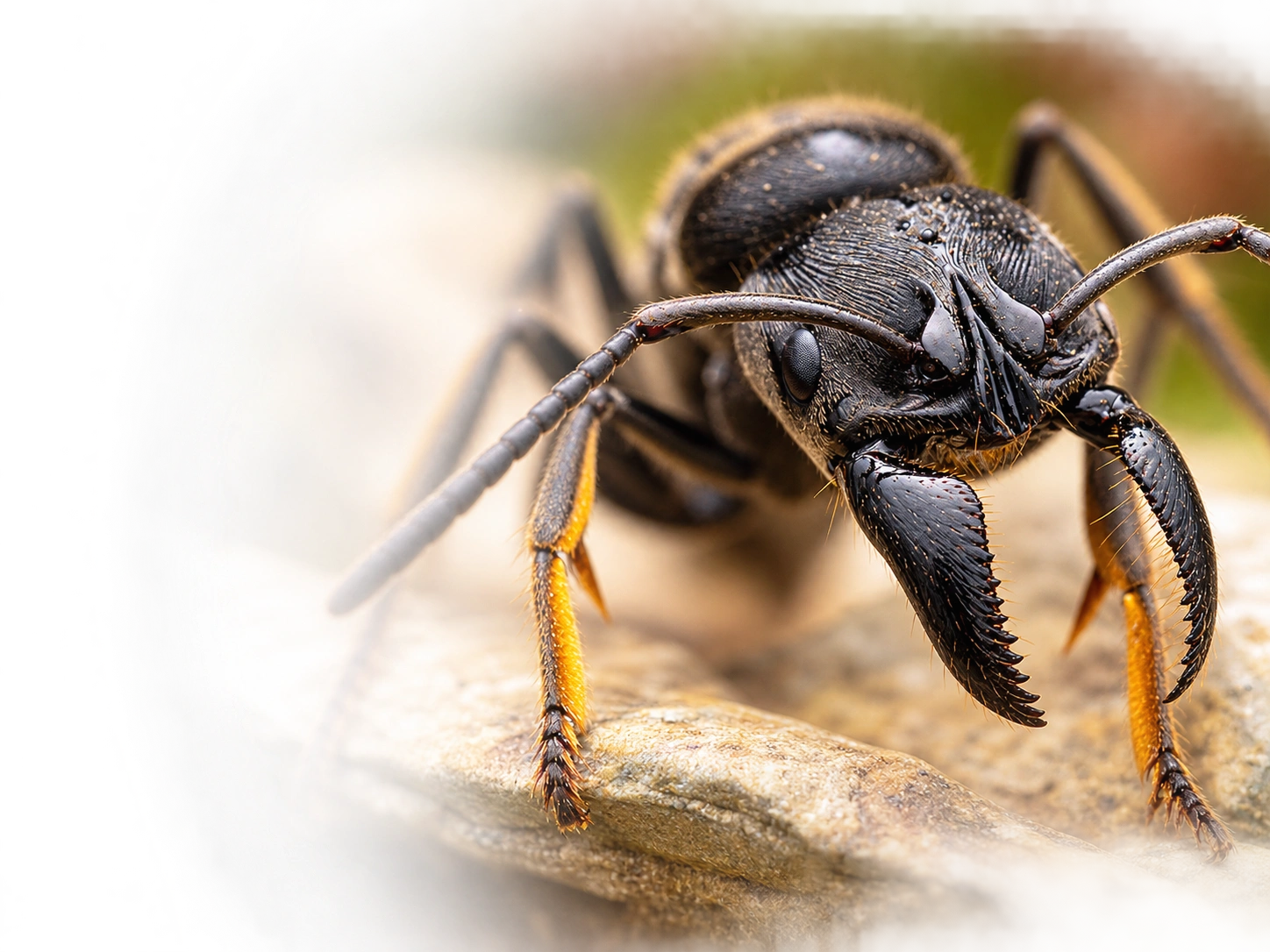
The mandibles of Harpegnathos are long, curved like pincers and armed with more than 50 sharp teeth. In H. honestoi they are especially long: 4.11 mm, 46 % longer than the head itself (2.81 mm), considerably more than in H. alperti, whose mandibles are only 26 % longer than the head.
They use them to hold the prey before stinging it and, in Antomas's experience with H. venator, also to handle eggs and larvae with precision. And although they might seem to get in the way, they do not stop them from drinking: in Antomas's experience, they drink without any problem from the damp cotton wool of a water tube.
Sniper's eyes
According to its description, the eyes of H. honestoi are "extremely large", oval and occupy the front corners of the head: each one measures 1.35 mm, almost half the length of the head. The workers also have ocelli, the small simple eyes on the forehead, an unusual feature in ponerine workers.
In the genus, hunting is solitary and visual: they do not follow pheromone trails; they locate their prey by sight, stalk it and launch themselves at it. Schmidt and Shattuck's review credits H. saltator with the highest number of ommatidia of all the ants examined. At Antomas we see it every day with H. venator: before attacking, the worker makes an excited movement of the gaster, of unknown meaning, like a sniper taking aim. In the only published keeping diary of H. honestoi, the keeper describes the queen moving her gaster while watching him through the glass.
Jumps to catch prey in mid-air
Harpegnathos are among the few ants that jump, and they do it in a particular way. In H. saltator it was shown that they power the jump with the second and third pairs of legs at the same time, a mechanism described as novel among insects. They reach about 2 cm in height and 10 cm in length. And they use it for everything: to escape, to move around, to hunt, even insects in mid-air, and in curious "group jumps", in which one worker jumps aimlessly and its neighbours copy it, for a purpose that is still unknown.
A 2023 study added that they have no spring or catapult mechanism: the jump comes from pure muscle power. The muscle that moves the trochanter is about 8 times larger in the middle legs and about 14 times larger in the hind legs than in a ponerine that does not jump, and forward jumping has evolved independently in four ant genera: Gigantiops, Harpegnathos, Myrmecia and Odontomachus. It has not been measured in H. honestoi. In Antomas's experience, they find it hard to jump upwards: their strategy is to climb and launch themselves from above onto their prey, like a predator lying in ambush on a branch.
A venom that paralyses without killing
H. honestoi has a functional sting. In the genus, the sting paralyses the prey permanently without killing it, and the colony can store it like that for a while, like a larder of fresh meat. That is why, as we explain in the feeding section, giving only dead prey is usually ineffective and even harmful.
The venom is not always ready, either. In H. saltator, workers are born with an empty venom sac, fill it gradually over their first weeks, up to about 57 days, and start going out to hunt from about 50 days of age; they can regenerate it at any age. The young ones look after the brood inside the nest and the veterans hunt.
Queen and gamergates under the same roof
The life cycle of H. saltator is one of the most curious known. A winged queen mates outside and founds the colony alone. When the colony produces males, they first mate with their worker sisters inside the nest and then go out to look for queens from other colonies. These mated workers do not lay while the queen is in good shape, but when she grows old or dies, they take over as gamergates. In excavations in southern India, 14 of the 15 colonies analysed had at least one mated worker; 7 no longer had a queen, 6 had the queen as the only egg-layer and 2 combined a queen and laying workers.
The succession is necessary because the queen is short-lived for an ant: in the laboratory, her average lifespan is about 1.8 years, although some exceed 5. Gamergates that die are replaced by others, so the colony is, in theory, immortal; it does not split, and colony fission is unknown. Colonies are small: in the wild, about 65 workers on average, and up to 200–300 in the laboratory. The title of Peeters and Hölldobler's classic paper sums it up: an ant with a valuable nest, so costly to build that it pays to keep it for generations.
Antennal duels: the tournament for succession
When the queen is missing in H. saltator, the chemical signal that held the workers back disappears and a tournament begins. The candidates face each other in antennal duels, rapid, ritualised blows that hardly ever cause injury. By the third day it is already possible to predict which ones will become gamergates with 86 % accuracy; the first eggs appear around day 10, and the tournament can go on for months. In the laboratory, 30 young workers produce 3 to 6 gamergates, and the full transition takes about 3 months.
Not everything goes: the other workers act as police. They jump on any aspirant who tries to lay too early and pin her down, in extreme cases for up to 24 hours, while the policed worker adopts a "pupal posture". Fertility is announced through the chemistry of the cuticle, the "signature" that ants read with their antennae: there is a compound that appears only in those that lay eggs. And a single brain molecule, corazonin, tips the balance: it is low in future gamergates, and if they are injected with it, they go back to hunting and stop duelling and laying.
A brain that shrinks and a life five times longer
Becoming a gamergate in H. saltator transforms the body from the inside. The brain shrinks by 19 %, especially in the visual areas that a hunter needs and an egg-layer does not; and, to the researchers' surprise, the change is reversible: if the gamergate goes back to being a worker, her brain recovers its size within 6–8 weeks. Life expectancy soars: from a median of about 7 months in workers to about 3 years in gamergates, around five times longer, thanks to an interplay of insulin signals between the brain and the ovary. If she reverts to being a worker, she loses that advantage.
Because of all this, H. saltator has become a laboratory model: its genome was sequenced in 2010 to study ageing and behaviour, and in 2017 it was one of the first ants to be modified with CRISPR, something possible precisely because a worker that becomes a gamergate can found her own line. H. honestoi belongs to the same genus, but none of these studies has been carried out on it.
"Wallpapered" nests built to withstand floods
In the wild, H. saltator builds a surprising underground nest: shallow chambers under a thick, domed roof, surrounded by an empty space that insulates it from the soil, a separate refuse chamber and walls "wallpapered" with strips of empty cocoons and other debris. It is a design built to withstand the floods of the plains of southern India, which is why the nest is so valuable. The entrance is closed at nightfall and reopened during the day. H. venator, on the other hand, builds nests of two disc-shaped chambers connected by a funnel-shaped opening.
And H. honestoi? Nobody has ever seen its nest. If it really does climb into the vegetation, it might nest differently; in the only published keeping diary, the queen worked hard on the coconut humus in the connecting tube and built a wall with it inside a chamber. Another open question for whoever keeps it.
Size and morphology
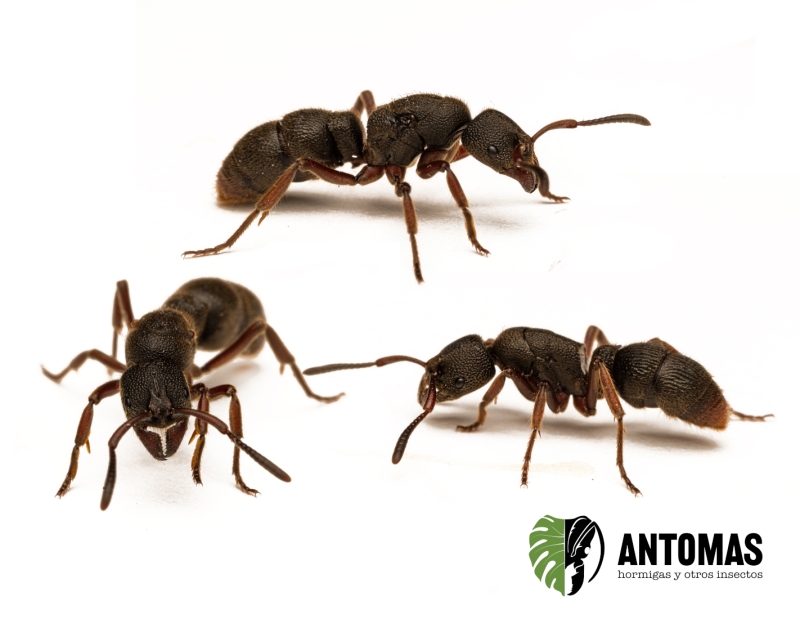
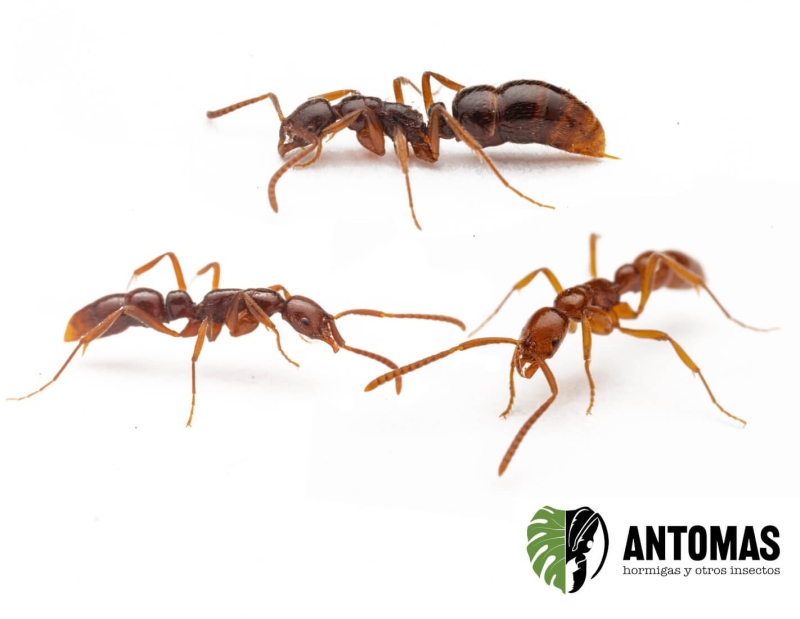
The H. honestoi worker is a typical Harpegnathos: long sickle-shaped mandibles, huge eyes, a long cylindrical mesosoma, long slender legs, an elongated gaster and a functional sting. According to the original description:
- Colouration. Head, mandibles, antennae and pronotum (the front part of the thorax) orange; the rest of the body blackish brown; the legs yellow. The mandibles are orange with a darkened base. Short, sparse hairs. In life, the contrast between the orange front, the blackish-brown body and the yellow legs is very striking.
- Sculpture. Head coarsely striate; pronotum and mesonotum with irregular, almost parallel striae; propodeum transversely striate; petiole reticulate above and on the sides; first and second gastral segments with coarse punctation over a finer one, one of the features that identify it.
- Head. Posterior margin straight; the antennal scape extends beyond that margin; eyes huge and oval; ocelli present in the worker.
- Petiole. Longer than high, with a small triangular process underneath. The tarsal claws have a median tooth.
- How to tell it apart. From H. alperti, the other species from Mount Isarog, by its colour (alperti is black, with chocolate-brown mandibles and antennae), by its striate rather than punctate head and by its mandibles, which are longer and converge gradually. From H. venator, almost entirely black with a punctate head and thorax, and from H. saltator, with a rusty-red head, thorax and petiole and a shiny black gaster, by the combination of an orange, striate head and a gaster with double punctation.
- Queen. She has not been described by science. In the genus, the queen is born winged and is very similar to the worker, only slightly larger; in H. saltator, the difference between queen and worker is minimal. In Antomas's experience, the H. honestoi queen is about the same size as a large worker, or up to about 2 mm longer. She can be recognised by her bulkier, flight-type thorax and by her wing scars; the ocelli are no help in telling her apart, because the workers have them too.
- Gamergate. If one appears, from the outside she is a worker: no measurement that distinguishes her has been published for H. saltator. She can be recognised by her behaviour: she stays inside the nest, next to the brood, and adopts a raised posture towards the others.
- Male. Not described.
Approximate measurements
- Worker: about 18–20 mm including mandibles (holotype; the original description gives 20.44 mm); without mandibles, about 14–16 mm
- Worker head: 2.81 mm long and 2.39 mm wide
- Mandible: 4.11 mm
- Mesosoma: 5.15 mm; hind femur: 3.64 mm; eye: 1.35 × 0.94 mm
- Queen: about 20–22 mm, according to Antomas's experience (not described by science)
- Gamergate (if one appears): like a worker
- Male: not described
All the scientific measurements come from a single specimen. On total length: the sum of the mandible, head, mesosoma, petiole and gaster given in the description itself is 18.05 mm, and the published 20.44 mm matches exactly that sum plus the head width (2.39 mm), which seems to have been added by mistake. As the gaster measurement also leaves out its first segment, the real length should be around 18–20 mm.
Care in captivity
Difficulty: 3/5 – Intermediate
At Antomas we keep it exactly like H. venator, and a Japanese breeder who sells it says the same. The parameters are simple: stable warmth and humidity, no diapause. But there are three things this species does not forgive: poorly managed humidity (it needs high humidity at all times, and letting it dry out is a serious mistake), skimping on live prey and sudden changes in temperature or humidity. What is more, there is hardly any published keeping experience: the only European diary we have found ended with the queen dead after the brood was lost to both too much and too little humidity.
And it is well worth it. Watching them climb, stalk and launch themselves at their prey from above is one of the finest sights in the hobby. And it is one of the rarest ants you can keep: a species whose queen has not been described, in which every one of your observations counts.
Recommended parameters
- Temperature: 24–26 °C, stable. This matches its origin: on Mount Isarog, 22–27 °C all year round. Avoid keeping them above 30 °C for long periods: it rarely gets that hot on their mountain.
- Nest humidity: 60–80 %, high and stable at all times, as in its forest, where air humidity is around 87–90 %.
- Water: always available, with a test tube of water and cotton wool in the foraging area.
- Nest type: natural materials that hold and spread humidity, ideally plaster. A dry nest is not suitable, nor is an acrylic one without a good hydration system.
- Light: a dark area in the nest; light in the foraging area (they hunt by sight and adapt well to it).
- Diapause: none. On their mountain there is no cold period and no dry season: it is active all year round.
The key word is stability: high humidity at all times and, above all, constant humidity, as keepers of the genus agree. Letting the colony dry out is a serious mistake: in a dry nest, larvae fail to moult and die; with too much water, condensation appears, wet cocoons fail to hatch and the colony may eat its brood. Water little and often: in the laboratory, with H. saltator, the plaster is kept damp but still able to absorb all the water, without puddles. Good ventilation prevents condensation and mites.
Recommended formicaria
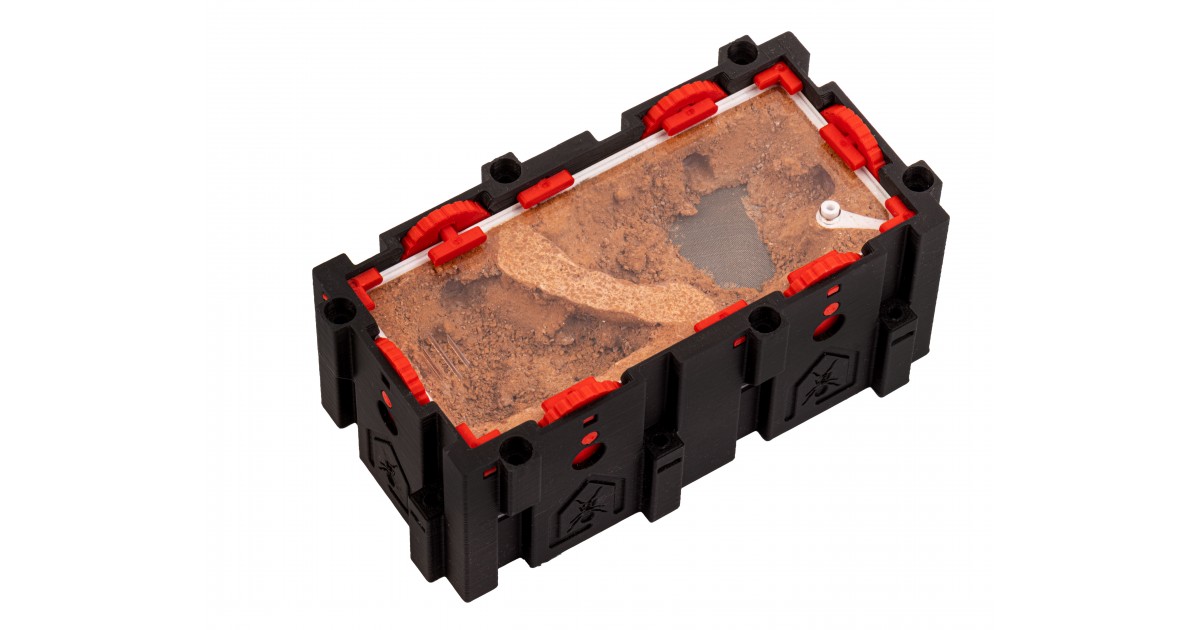
At Antomas we recommend the Anthouse Qbik Wild range, with plaster nests, and especially the Qbik Wild Duo P 2C Hybrid: an evaporation reservoir under a technical mesh plus a side drinking tube, which provides the high, stable humidity this species needs. As alternatives, the Duo P 2C Evaporation (the water never touches the chambers and a natural humidity gradient forms) and the standard Duo P 2C (refillable water tube).
Substrate for the cocoons. The larvae need fine particles to spin their cocoons, and the workers bring them over. At Antomas we place a thin layer of coconut fibre, fine soil or sawdust in the foraging area and in the nest, sterilised in the microwave or freezer so as not to bring in mites. In the laboratory, with H. saltator, a pinch of dry sawdust is added from time to time to help the larvae pupate.
Branches and relief in the foraging area. They are excellent climbers and hunt from above, so at Antomas we recommend adding branches, cork or other decoration to the foraging area: you will give them hunting posts and see their most spectacular behaviour.
Arrival of the colony and the first weeks
At Antomas we sell colonies with a queen and workers. The journey is the most delicate stage: when it arrives, set it up at a stable temperature, give it water straight away and remove any dead workers. The next day, the first live prey, a small one. From then on, enjoy it: with its dark area in the nest and a lit foraging area, it settles in quickly.
To move it to a new formicarium, at Antomas we do it by tipping it in: we tip the colony into the new formicarium and, if necessary, make them go inside, taking care not to lose sight of the queen.
Patience. The brood grows slowly: in H. saltator, it takes about 80 days from egg to adult in the laboratory, and keepers of H. venator speak of 2.5–3.5 months. It is normal to go weeks without new workers.
Gamergates at home and orphaned colonies
Gamergates appear in the genus Harpegnathos, and in Antomas's experience with the genus, they also appear in captivity. Males are not always needed: sometimes the workers are already mated, because in H. saltator they mate inside the nest with males from their own colony while the queen is still alive. This has not yet been documented in H. honestoi: if you see it in your colony, let us know. Some clues: antennal duels, workers pinning another down for hours, and a worker that no longer goes out, stays next to the brood and adopts an upright posture towards the others.
If the queen dies, do not give up on the colony: wait and see whether a worker is already mated and starts laying, or whether males even emerge and mate with a worker. In the genus Harpegnathos this happens fairly often, especially in H. saltator. Meanwhile, keep caring for and feeding the colony as usual, and if you have any doubts, contact us. What you cannot do is merge colonies: they do not accept each other. Nor should you keep it with other species.
Feeding
H. honestoi eats only protein. Do not offer it sugar, honey, nectar or sugar water: in the genus, laboratories do not use it and most keepers agree that the ants do not accept it.
Protein. At Antomas we recommend feeding it at least 3–4 times a week, mainly with live prey: crickets, cockroaches and flies, of a size they can overpower. Our favourite is the red runner cockroach, Shelfordella lateralis, because it carries less risk of mites, to which the genus is sensitive. Switch the type of insect from one week to the next so that they do not always eat the same thing.
Why live? Their venom paralyses without killing and keeps the prey "fresh"; hunting is also what activates the colony. They accept freshly paralysed prey, but giving only dead prey is usually ineffective and even harmful. Keepers of the genus agree: they hardly touch frozen or dried prey.
They eat a lot. One H. saltator keeper reported that his colony of 40 workers ate more than 20 crickets a week, and that with less food it did not raise brood. Lack of food is the most frequently cited reason for colonies eating their own brood.
The more food, the more they grow. At Antomas we are clear about this: the more a colony is fed, the better and faster it grows. If you do daily maintenance and remove leftovers, it is better to overfeed: the ants understand that they have more resources and raise more brood, more quickly. If you cannot clean often, do not overdo it, because leftover food brings mould and mites. Three or four feeds a week are the minimum, not the maximum.
Prey within reach of the larvae. The workers do not feed the larvae mouth to mouth: they place the prey in front of them and the larvae tear it up themselves. A well-fed larva is plump, greyish-white and shiny; an undernourished one is small, wrinkled and yellowish.
Beware of acaricides. Crickets treated with insecticides or acaricides can wipe out the colony. Buy from trusted breeders or breed your own cockroaches.
Water always available. For long-jawed species like this one, at Antomas we recommend a test tube with water and cotton wool in the foraging area: they drink from the cotton wool without any problem. And remember that they need high humidity at all times: letting them dry out is a serious mistake.
Behaviour in captivity
At Antomas we believe that ants are there to be enjoyed, observed and learnt from, not kept hidden away. All it takes is to leave them their dark area in the nest and a lit foraging area, and to watch them gently, intervening and stressing them as little as possible. With H. honestoi, moreover, every observation counts: whoever keeps it is a first-hand observer.
These are ants that watch. They patrol the foraging area alone, follow anything that moves with their eyes (an H. venator keeper said his ants followed him with their gaze around the room) and stalk before attacking. In Antomas's experience, H. honestoi hunts by climbing the walls of the foraging area or the branches and pouncing on its prey from above, which fits with the only known wild specimen, found 1 m above the ground. At first they may flee at a sudden movement, but with such good eyesight they soon get used to the light and to your presence. Within the colony, on the other hand, there is conflict: duels and hierarchies among workers. In the wild, H. saltator hunts mainly in the morning and late in the afternoon.
Escapes and barriers
They are excellent climbers: they climb the walls of the foraging area with no difficulty at all. But, in Antomas's experience, they are not escape artists, and they also find it hard to jump upwards. At Antomas we recommend a formicarium with a lid, ideally a ventilated one, which also helps prevent condensation. Check that it fits well and that plugs and connections have no gaps.
Handling and safety
It has a functional sting, but there is no need for alarm: in Antomas's experience, a Harpegnathos has never hurt us; in some people, the sting has caused slight redness and swelling, nothing more. Even so, always handle it with entomological tools (soft forceps or a brush), never with your hands, for its sake and for yours. Do not touch newly emerged workers, whose cuticle is still very soft, and work slowly so as not to lose the queen. People allergic to hymenopteran stings should take care. This is an exotic species: it must never be released.
What not to do
- Letting them dry out: they need high humidity and water at all times. This is a serious mistake.
- Waterlogging the nest or suddenly changing the temperature or humidity.
- Giving them sugar, honey or nectar: they eat only protein.
- Feeding them only dead or frozen prey.
- Skimping on food: hunger ends in brood cannibalism.
- Using crickets of doubtful origin, which may have been treated with acaricides.
- Leaving food remains from one feed to the next.
- Housing them in a dry nest or an acrylic one without hydration.
- Leaving the formicarium without a lid.
- Leaving the foraging area empty, without branches or relief to climb on.
- Intervening more than necessary: watch them gently and stress them as little as possible.
- Handling them with your hands.
- Trying to merge colonies or keeping them with other species.
Scientific sources
This care sheet is based on the original description of Harpegnathos honestoi, the scientific literature on the genus (above all H. saltator) and the experience of Antomas and European keepers. Main references:
- General, D. E. M. (2016). A review of the ant genus Harpegnathos Jerdon, 1851 (Hymenoptera: Formicidae) in the Philippines, with the description of two new species. Halteres 7: 99–105. doi:10.5281/zenodo.54873
- Peeters, C. & Crewe, R. (1984). Insemination controls the reproductive division of labour in a ponerine ant. Naturwissenschaften 71: 50–51. doi:10.1007/BF00365989
- Peeters, C. & Crozier, R. H. (1988). Caste and reproduction in ants: not all mated egg-layers are "queens". Psyche 95: 283–288. doi:10.1155/1988/52368
- Peeters, C. (1991). Ergatoid queens and intercastes in ants: two distinct adult forms which look morphologically intermediate between workers and winged queens. Insectes Sociaux 38: 1–15. doi:10.1007/BF01242708
- Aupanun, S., Jaitrong, W., Suttiprapan, P., Peeters, C. & Ito, F. (2022). Nest architecture, worker reproduction, and polygyny in the ponerine ant Harpegnathos venator. Insectes Sociaux 69: 185–195. doi:10.1007/s00040-022-00857-5
- Peeters, C. & Hölldobler, B. (1995). Reproductive cooperation between queens and their mated workers: the complex life history of an ant with a valuable nest. PNAS 92: 10977–10979. doi:10.1073/pnas.92.24.10977
- Schmidt, C. A. & Shattuck, S. O. (2014). The higher classification of the ant subfamily Ponerinae (Hymenoptera: Formicidae), with a review of ponerine ecology and behavior. Zootaxa 3817: 1–242. doi:10.11646/zootaxa.3817.1.1
- Baroni Urbani, C. et al. (1994). A novel mechanism for jumping in the Indian ant Harpegnathos saltator (Jerdon) (Formicidae, Ponerinae). Experientia 50: 63–71. doi:10.1007/BF01992052
- Peeters, C., Hölldobler, B., Moffett, M. & Musthak Ali, T. M. (1994). "Wall-papering" and elaborate nest architecture in the ponerine ant Harpegnathos saltator. Insectes Sociaux 41: 211–218. doi:10.1007/BF01240479
- Liebig, J., Peeters, C. & Hölldobler, B. (1999). Worker policing limits the number of reproductives in a ponerine ant. Proceedings of the Royal Society B 266: 1865–1870. doi:10.1098/rspb.1999.0858
- Opachaloemphan, C. et al. (2021). Early behavioral and molecular events leading to caste switching in the ant Harpegnathos. Genes & Development 35: 410–424. doi:10.1101/gad.343699.120
- Penick, C. A. et al. (2021). Reversible plasticity in brain size, behaviour and physiology characterizes caste transitions in a socially flexible ant (Harpegnathos saltator). Proceedings of the Royal Society B 288: 20210141. doi:10.1098/rspb.2021.0141
- Yan, H. et al. (2022). Insulin signaling in the long-lived reproductive caste of ants. Science 377: 1092–1099. doi:10.1126/science.abm8767
- Gospocic, J. et al. (2017). The neuropeptide corazonin controls social behavior and caste identity in ants. Cell 170: 748–759. doi:10.1016/j.cell.2017.07.014
- Yan, H. et al. (2017). An engineered orco mutation produces aberrant social behavior and defective neural development in ants. Cell 170: 736–747. doi:10.1016/j.cell.2017.06.051