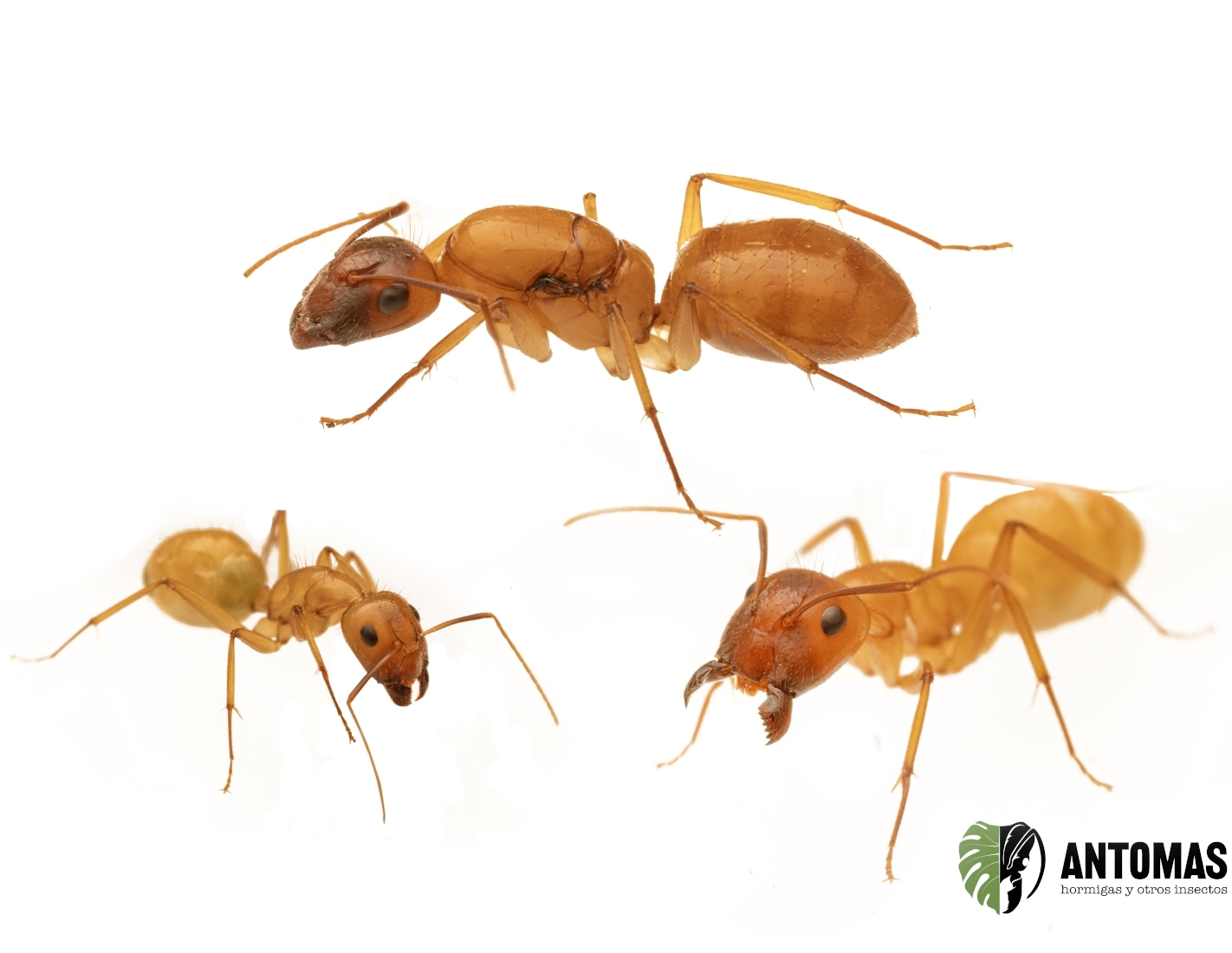
Difficulty: 2/5 – Beginner
An Asian Camponotus rarely seen in the hobby: the pale form described from Burma in the 19th century, a subspecies of C. variegatus, with workers of every size and largely crepuscular habits. Colonies with queen, workers and brood, ready to grow. QBIK ONE nest with medium galleries and humidity supplied through the tubes, 24–28 °C, sugar always available and plenty of varied protein. No cold diapause: at most, a gentle 6–8-week rest at 18–22 °C during our winter. They climb acrylic: use a paraffin oil or PTFE barrier.
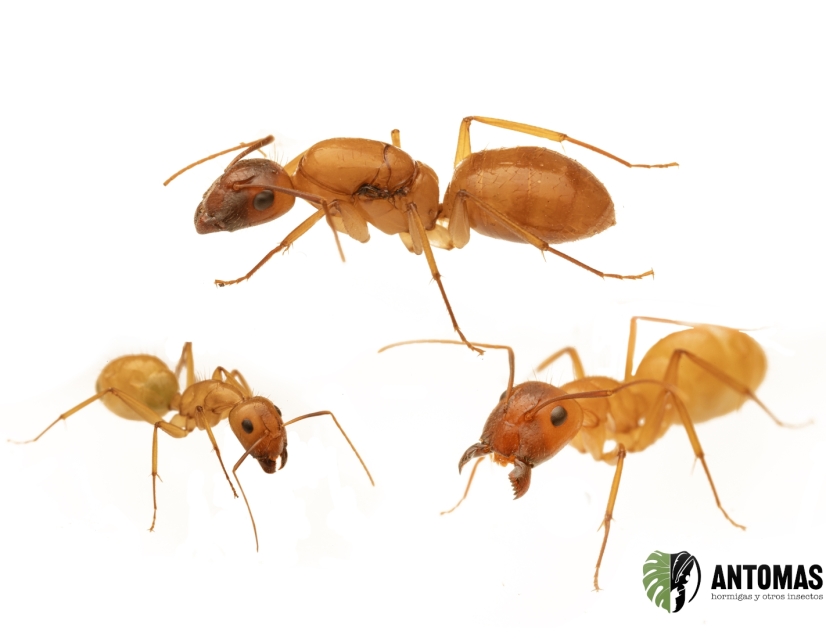
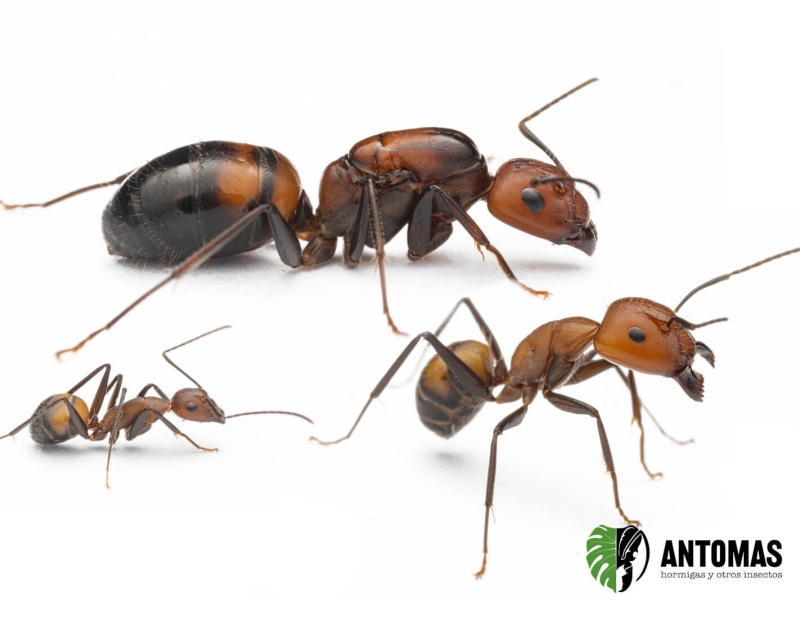
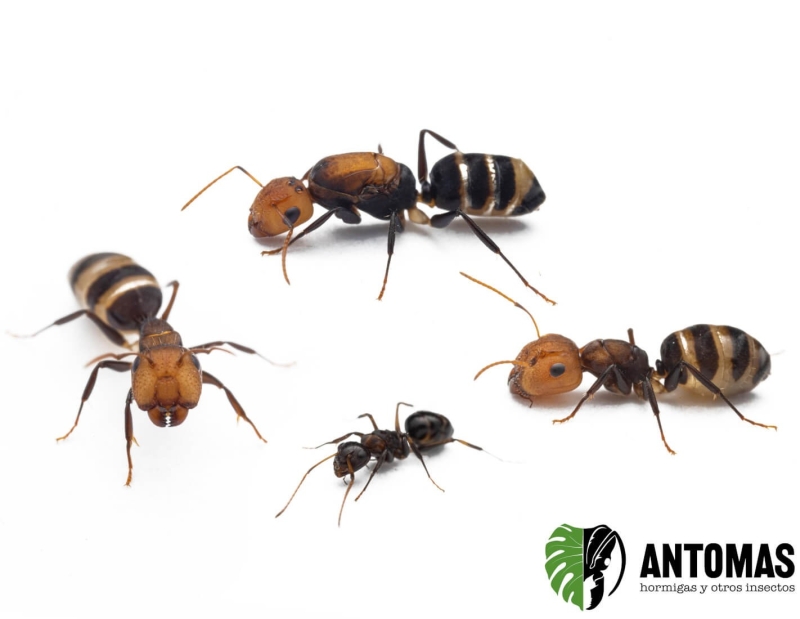
Camponotus variegatus dulcis Dalla Torre, 1893 is a carpenter ant from South and South-East Asia, one of the fifteen subspecies currently recognised within Camponotus variegatus (Smith, 1858), a species ranging from India and Sri Lanka to New Guinea. It is a medium-sized, polymorphic Camponotus, with small, medium and large workers living side by side in the same colony, and pale in colour: 19th-century naturalists had already set it apart as a “pale variety”.
It has no common name, and we are not going to invent one. Nor, as far as we know, has any study ever been devoted to its biology: there is only its description, a few lines in the catalogues and its presence on the ant checklists of several Asian countries. That is why we carefully separate what is documented for C. v. dulcis, what is known about its species and genus (and we say so), and what we have learned rearing it at Antomas. And we will let you in on a small mystery: much of what circulates online about “Camponotus variegatus” is not, in fact, about this ant at all.
Biology
A pale variety from Upper Burma
Its story begins with an explorer. Between 1885 and 1887, the Italian naturalist Leonardo Fea travelled through Burma, today’s Myanmar, and Tenasserim, collecting insects for the Civic Museum of Natural History in Genoa. The ants from that expedition were studied by the great Italian myrmecologist Carlo Emery, who in 1889 published “Formiche di Birmania e del Tenasserim raccolte da Leonardo Fea”. Among them was a pale-coloured Camponotus from the north of the country, which Emery named variety dulcis.
Emery’s name, however, is not valid under current rules, because he proposed it as a “variety” within a “race” of another species, a rank the code of nomenclature does not recognise. It was the Austrian Karl Wilhelm von Dalla Torre who, in 1893, made it available by listing it in his great world catalogue of Hymenoptera. That is why the official author is Dalla Torre, even though it was Emery who saw it first. The reference specimens, the syntypes, are kept in Genoa.
In 1903, the Briton Charles Thomas Bingham summed it up in a single sentence in The Fauna of British India: together with the variety comottoi, dulcis was one of the “pale varieties found in Burma”. Its name is Latin for “sweet”. As far as we know, nobody ever explained why; but for an ant that lives on sugary liquids, it is very fitting.
From a “race” of maculatus to a subspecies of variegatus
Its “surname” has changed several times. In the late 19th century, many Old World Camponotus were treated as “races” of a handful of gigantic species, such as C. maculatus or C. rubripes:
- Emery, 1889: C. rubripes race mitis variety dulcis (unavailable).
- Dalla Torre, 1893: C. mitis var. dulcis, the name that counts.
- Bingham, 1903: a variety of C. mitis, a “very variable” species extending as far as New Guinea.
- Emery, 1925: a subspecies of C. variegatus, subgenus Tanaemyrmex, the current combination.
The parent species was described by Frederick Smith in 1858 as Formica variegata, from material from Ceylon (Sri Lanka) and Singapore, and no single type specimen has been designated since. Its fifteen subspecies have never been revised with modern methods, and the subgenera of Camponotus, such as Tanaemyrmex, are old and partly artificial groupings, still awaiting redefinition following the reclassifications of 2016 and 2021. In short: the valid name is Camponotus variegatus dulcis, and a future revision could well raise it to species rank. If that happens, we will update this care sheet.
The Hawaiian mystery: the other C. variegatus
If you search online for “Camponotus variegatus”, almost everything you find is about Hawaii. There lives the “Hawaiian carpenter ant”, the largest ant in the archipelago, introduced and already common in Honolulu by around 1880, which nests in the walls of wooden houses. In 1967, E. O. Wilson and R. W. Taylor regarded it as an introduction of the Asian species and synonymised its local name, C. variegatus hawaiensis, with C. variegatus.
But in 2015 a DNA study of Indo-Pacific Camponotus found that the Hawaiian lineage is closely related to American Camponotus, from Florida and the New World, and not to the Asian ones. And, according to the Maui Invasive Species Committee, as yet unpublished work indicates that they are genetically identical to Camponotus zonatus, from Central America and northern South America. The practical conclusion: the Hawaiian data probably do not refer to our ant. We use them here only as a rough guide, and we say so.
From India to the coast of China
The only certain locality is that of its description, in northern Myanmar. In addition, scientific checklists record it from:
- India: the Andaman and Nicobar Islands and Maharashtra, according to the 2016 checklist of the ants of India.
- China: in the 2012 checklist of the ants of China and, since 2024, in the checklist of the insects of Macao.
- Others: some compilations cite the Philippines, Sri Lanka, Taiwan, Japan or Pakistan, unverified records that may be confusions with other subspecies.
In other words, an ant of South and South-East Asia, from India to the coast of southern China. Maps such as those on antmaps.org help to trace it, although for these old subspecies they mix identifications of very uneven quality. Nothing has been published on its habitat; judging by its species and subgenus, it is a Camponotus of warm lowlands that nests in cavities in dead wood, under bark and in the soil.
Monsoon summers, cool and dry winters
The climate of its range is tropical monsoon, with two very distinct seasons. Taking as a reference the interior of northern Myanmar, where it was described:
- Rainy season (May–October). Constant humid heat: averages of 28–29 °C, highs of 31–34 °C and nights of 22–25 °C, with very heavy rain from June to August, over 300 mm a month.
- Cool, dry season (December–February). Averages of 18–21 °C, highs of 26–29 °C and lows of 10–13 °C, with almost no rain and days of about 10.5–11 hours of light.
- Dry spring (March–April). The hottest month comes before the monsoon, with highs of around 34–35 °C.
On the coast of southern China the winter is somewhat cooler; in India, somewhat warmer. But the pattern is the same: hot, rainy summers and mild, dry winters, with no frost. It never experiences cold, but it does have a resting season (see “A gentle, optional winter rest”).
Workers of every size
In 1903 Bingham described the two extreme worker forms of its species, and they differ in more than size alone. The majors, with a large, subtriangular head, a robust thorax and a massive gaster, defend the nest and dismember prey. The minors, slender and narrow-headed, go out to forage. Between the two lies a whole range of intermediate sizes.
This is polymorphism. In a classic 1953 paper, Edward O. Wilson showed that in ants such as Camponotus the head grows faster than the rest of the body as size increases: a major is not an “enlarged” minor, but an ant with different proportions, its head packed with mandibular muscles. Which larva ends up as a major depends above all on how much it is fed, and that is why protein matters so much. Majors do not appear until the colony reaches a certain size: watching them arrive is one of the great moments of ant keeping.
An ant of the dusk
There is no study of the activity pattern of C. v. dulcis. The Hawaiian ant is nocturnal: it roams ceilings and walls from dinnertime onwards, and in surveys of the islands it was singled out as the only strictly nocturnal ant. A keeper who kept a diary of his C. variegatus noted the same: they only recruited to food in the dark.
Crepuscular and nocturnal activity is very common in medium and large Camponotus, and in their subgenus, Tanaemyrmex. Most likely C. v. dulcis is also more active at dusk, although this is an inference, not a measured fact. If you want to watch them at work, observe them as night falls.
A carpenter that doesn’t carve
They are called “carpenter ants”, but not all of them excavate wood. Of the Hawaiian C. variegatus, a 1931 handbook already stated that it probably does not bore into sound wood: it makes use of existing hollows in trunks, bark, walls or drawers. For keepers this is good news: ready-made chambers are all it needs, dark and of the right size, like those of a modern formicarium. A wooden nest adds nothing and goes mouldy easily.
A honeydew herder
Like almost all Camponotus, it lives largely on sugary liquids: nectar and, above all, honeydew, the sweet liquid excreted by aphids, scale insects and other hemipterans. In exchange for that honeydew, the ants protect their “herds” from predators and parasites. In Hawaii, the other C. variegatus tends aphids and mealybugs, which is why it sometimes causes minor problems in orchards and gardens. It also rounds off its diet with small insects and, indoors, with almost any food from the larder.
Blochmannia: the amino acid factory it carries inside
How can anything live on honeydew, which is almost pure sugar? All Camponotus carry a symbiotic bacterium, Blochmannia, in specialised gut cells and in the queen’s ovaries, which passes it on to her daughters inside the eggs. It produces almost all the essential amino acids and helps recycle nitrogen: in C. floridanus, colonies without the bacterium on a diet poor in amino acids raised far less brood.
The relationship is so ancient that a study published in Nature in 2020 presented it as a major evolutionary transition: the embryo integrates the bacterium into its own development. It is a trait of the whole genus, not studied in C. v. dulcis. One thing is clear, though: it is no excuse for skimping on protein; the larvae need insects, and the majors even more so.
Formic acid: weapon and disinfectant
Like all formicines, C. v. dulcis has no sting. Its weapon is formic acid, produced in the venom gland and sprayed through the acidopore, a small nozzle fringed with tiny hairs at the tip of the gaster. It bites, curls its gaster forwards and sprays the acid into the wound: the typical Camponotus defence.
And it has a second use, discovered in 2020: formicines swallow their own venom. While grooming they take up a few drops of acid, which keep the crop highly acidic (the “social stomach” where they store the food they share mouth to mouth), thereby filtering out microbes and curbing contagion. This was demonstrated in C. floridanus and other formicines: a venom that also disinfects the larder.
Flights on dark nights and a sealed-in foundress
Nothing has been published on the nuptial flights of C. v. dulcis. In its Hawaiian relative, males and winged queens leave the nest on dark, windless nights. In monsoon climates, most Camponotus fly during the hot, rainy season, and it is reasonable to assume that this one does too, although it is an inference.
After the flight, the queen sheds her wings and seals herself into a cavity. Camponotus colony foundation is claustral: the queen does not go out to feed and raises her first, small workers on her fat reserves and her flight muscles, which she gradually reabsorbs. With our colonies you skip that delicate stage (see “Foundation and growth”).
One queen per colony
There are no published data on the number of queens in C. v. dulcis. The norm in Camponotus is a single queen per colony, and ours are like that. In Hawaii, colonies of the other C. variegatus range from fewer than a hundred individuals to around 3,000 workers. Do not combine queens or colonies: monogynous Camponotus usually fight to the death.
Size and morphology
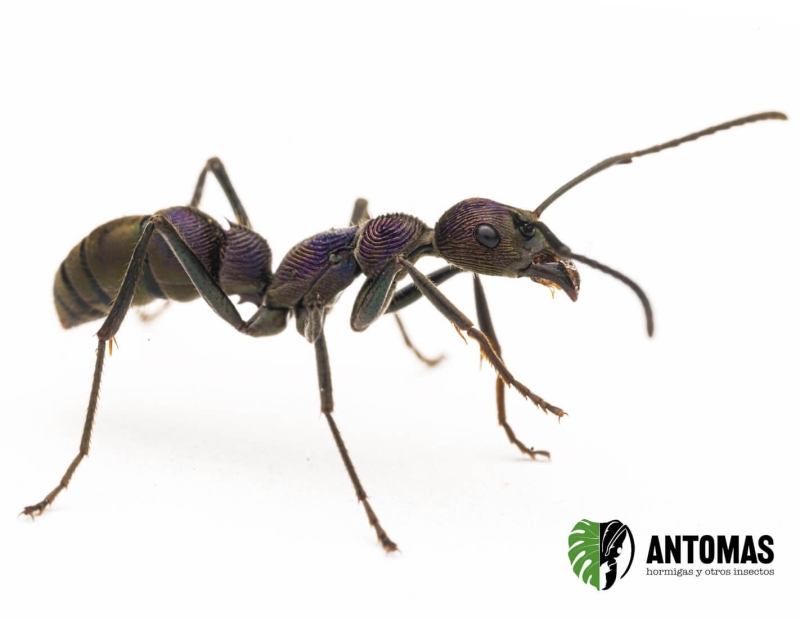
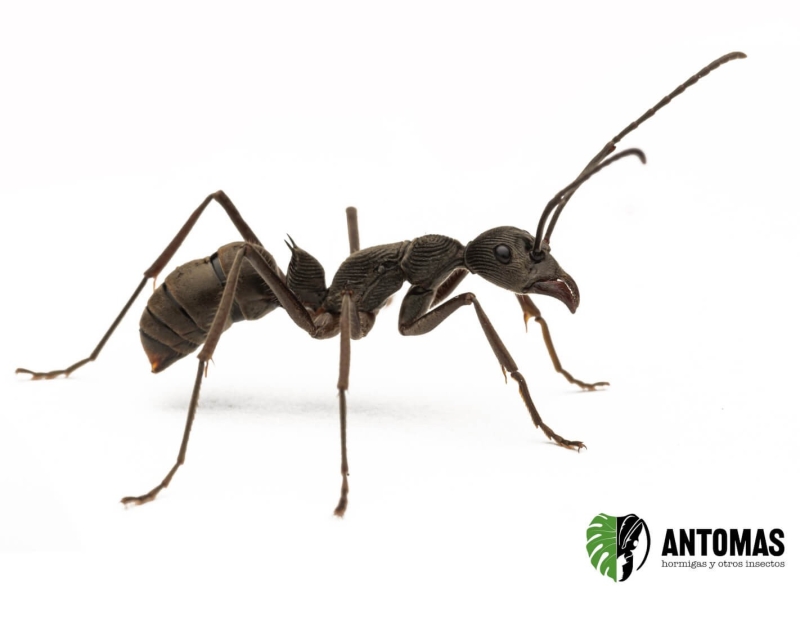
A medium-sized, polymorphic, pale-coloured Camponotus without a sting. There is no modern description of C. v. dulcis: the original descriptions are very brief, and what follows combines what Bingham said about its species in 1903, what is known about the genus and what we see in our colonies.
- Colouration. It is one of the “pale varieties” of its species. In the typical form described by Bingham, the major has a dark brown head, antennal scapes and gaster, with a yellowish-brown thorax and legs; the minors are a lighter, more uniform testaceous brown. Of dulcis, Bingham says only that it is paler than that typical form, and there is no more detailed description of its colour.
- Head. In majors, subtriangular, broad behind and emarginate at the posterior margin; in minors, rectangular, narrow and rounded behind.
- Thorax. Robust in majors, with moderately long legs and prismatic tibiae, each running with a groove.
- Petiole. A rather narrow node connecting the thorax to the gaster.
- Pilosity. Sparse erect hairs on the head and thorax, more abundant on the gaster; on the legs, short, dense, appressed hairs.
- Gaster. Long, broad and massive in majors; it ends in the acidopore. In the Hawaiian C. variegatus it is described as reddish brown with dark transverse bands.
- Queen. Similar to the major, but with more convex sides to the head and rounded posterior corners, a broader, flatter petiolar node and a very large, massive gaster. After the nuptial flight she retains the wing scars.
Approximate measurements
- Queen: 11–13 mm (Bingham, 1903, for its species in the broad sense)
- Major workers: 8–10 mm
- Minor workers: 6–7.5 mm
- Male: no published measurements
There are no published measurements for C. v. dulcis specifically. The figures above are Bingham’s (1903) for C. mitis, the name under which he grouped dulcis and the other forms that are now subspecies of C. variegatus: the closest published measurements. In the Hawaiian ant, probably a different species, workers of almost 7 mm and queens of about 12 mm were measured. The 15–18 mm figures for the queen that circulate on some websites have no scientific basis.
Care in captivity
Difficulty: 2/5 – Beginner
At Antomas we consider it suitable for beginners and a very good first tropical Camponotus: it arrives with the founding stage behind it, eats everything, is content with a warm nest at 24–28 °C and needs no cold diapause. Why not 1/5? Because, like every Camponotus, it grows slowly in its first year, and because it climbs acrylic and needs a barrier from day one (see “Escapes and barriers”).
And it is well worth it: a subspecies described more than 130 years ago about which almost nothing has been published, with a polymorphism that transforms the colony, pale tones and a crepuscular rhythm that is a joy to watch. Keeping it is also a way of helping us get to know it.
Recommended parameters
- Nest temperature: 24–28 °C during the active season. This matches the 28–29 °C averages of the rainy season in its range, without reaching its extremes. Below 22 °C it stays active but grows more slowly.
- Foraging area: at room temperature, or a little warmer at one end, so the colony can choose. Never strong heat inside the nest: more than 30 °C on a continuous basis does not suit it.
- Humidity: moderate. One part of the nest slightly moist and the rest dry, with the humidity supplied by the water tubes (see “Humidity through the tubes”). The foraging area, dry.
- Water: always available, in a test tube with water and cotton wool in the foraging area.
- Light: simply leave them a dark area in the nest and a lit foraging area, with a normal day–night cycle.
- Diapause: no cold diapause is needed. If you like, a gentle 6–8-week rest in winter, at 18–22 °C (see “A gentle, optional winter rest”).
Avoid direct sunlight, radiators and draughts: more than any exact figure, what they are after is a warm, stable nest.
Humidity through the tubes
In the wild it nests in wood cavities and under bark, neither swamp nor desert. In captivity, the rule is one slightly moist area and the rest dry, so the colony can choose: they usually carry the eggs and larvae to the moist area and the pupae to the dry one. In a Qbik Alpha, that humidity is supplied by the water tubes: always keep one connected, especially while the colony is small. Avoid soaking the whole nest (condensation, mould and mites) and also the opposite: a nest without a water tube dehydrates the brood.
Recommended formicaria
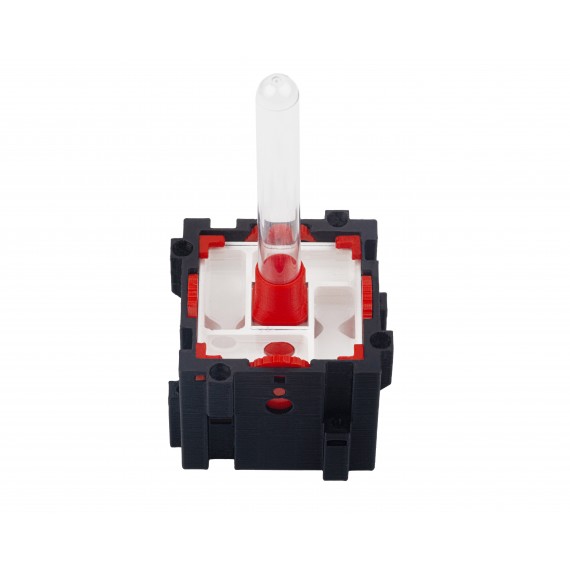
At Antomas we recommend the Qbik Alpha range by Anthouse: modular formicaria with a rather dry nest and humidity controlled from the tubes, which grow with the colony. For C. v. dulcis, with medium galleries at first and larger ones once the majors appear. To start with, a QBIK ONE:
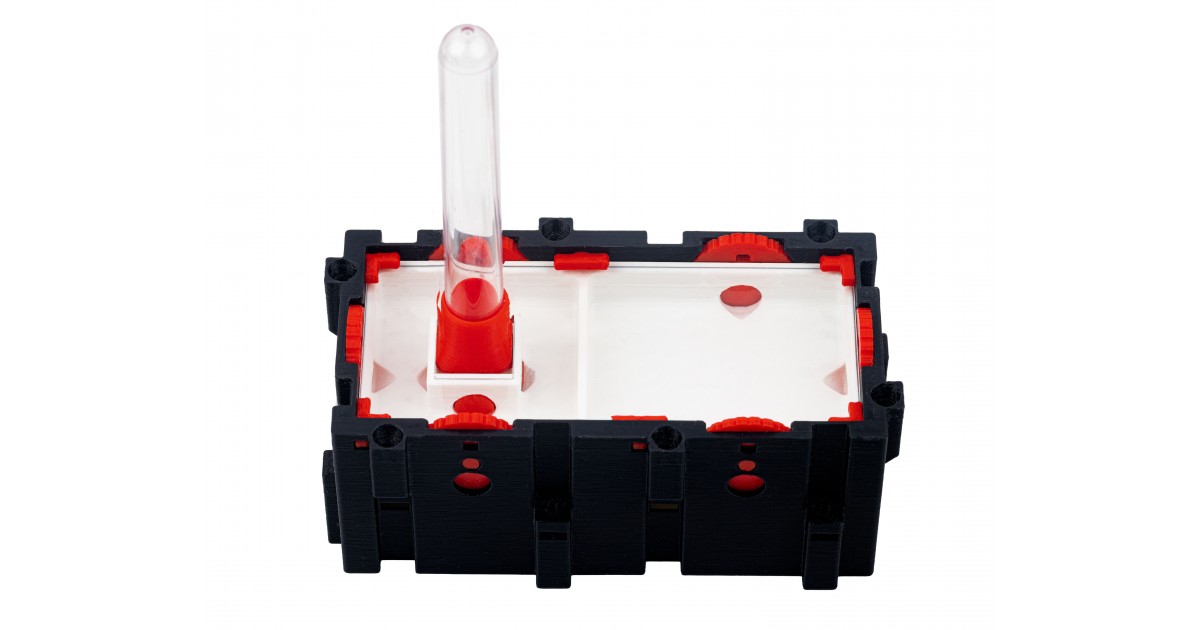
To expand, the QBIK DUO and, later, the larger formats in the same range:
If you prefer plaster, a good alternative is the Qbik Wild Duo P 2C Hybrid: a lower reservoir, separate from the galleries, transmits humidity through a mesh, so you can control exactly how much moisture you provide without wetting the chambers:
Expand when you see many workers idling in the foraging area with no room inside, but don’t jump the gun: in an enormous nest, the spare chambers end up as rubbish tips. Complete the set-up as follows:
- Anti-escape barrier: a band of paraffin oil or PTFE along the top of the foraging area walls, and a well-fitting lid (see “Escapes and barriers”).
- A dry foraging area, with a little sand, flat stones and a twig or piece of bark to climb on, with nothing that could act as a bridge to the barrier.
- Water always available, in a test tube with water and cotton wool.
- A feeder for sugary liquids, never on cotton wool (see “Feeding”).
- Gentle heat, only if needed, on one side of the nest and away from the feeder, with a thermostat.
Foundation and growth
At Antomas we sell C. v. dulcis as a colony with queen, 3 to 5 workers and brood: eggs, larvae or pupae, depending on the time of year. The queen has already completed her claustral foundation, the weeks-long period in which she seals herself in alone and raises her first workers on her reserves (see “Flights on dark nights and a sealed-in foundress”). Now the growth phase begins, and what speeds it up most is the right temperature and plenty of protein.
- The pace of a Camponotus. In this genus, it takes about 6–10 weeks from egg to worker, depending on temperature. Growth is slow at first; with more workers to tend the brood, it speeds up.
- Sizes change. Each generation brings slightly larger workers, and majors usually arrive from the second year onwards.
- Normal ups and downs. Egg-laying may slow down after the journey and during the cooler months.
When should you move it into the nest? After a few days’ rest, into a nest suited to its size, such as a QBIK ONE; sooner if the tube gets dirty or runs out of water. An oversized nest makes humidity and defence harder for a young colony.
Arrival and moving in
When you receive your colony, let it rest for a few days in a quiet, dark place at 24–26 °C, with water in the tube. To move it into the formicarium, at Antomas we do it by tipping: we open the tube in the foraging area, next to the nest entrance, and gently tip out the queen, the workers and the brood, helping any stragglers with a paintbrush. Three tips:
- Get everything ready beforehand: the formicarium assembled, with the barrier in place and the water tube connected.
- Work over a tray, in case a worker climbs up the tube or your tools.
- Keep the nest dark and the foraging area lit: after tipping, the workers gather up the brood and carry it into the nest straight away.
If you ever need to move the colony to a new formicarium, use the same method.
Feeding
Sugary liquids, always available. They are the basis of its energy, like honeydew in the wild. Vary the sugars: at Antomas we recommend Blue Sugar nectar by Anthouse 4–5 times a week and another sugary liquid or nectar 1–2 times a week. You can also add a little protein to the nectar. Always offer them in a feeder and never on cotton wool, because cotton wool goes mouldy and spoils the liquid very quickly. Use a traditional or home-made feeder, where the drop stays “spread out” and accessible, and replace it before it ferments.
Protein: the more, the better. It is the engine of its growth and what decides how many majors the colony will have. This is the Antomas philosophy: if you do daily maintenance and remove leftovers, it is better to overfeed, because the colony understands that it has more resources and grows faster and in greater numbers. If you won’t be able to clean often, better not to overfeed: leftover food rots and brings mould and mites. Change the type of insect from one week to the next, so they don’t always eat the same thing:
For young colonies, chopped or freshly killed prey is best; for large ones, small live prey too. And always use captive-bred insects, never ones collected outdoors: they may carry insecticides.
A tip for an ant of the dusk: put the protein in late in the afternoon, when they start to stir, and remove the leftovers the next morning.
Water: always, in the test tube with cotton wool in the foraging area. Even if the nest is on the dry side, they must never be without drinking water.
A gentle, optional winter rest
C. v. dulcis is a tropical ant and does not need a cold diapause like European species. But its range does have a cool, dry season, from December to February, with averages of 18–21 °C, nights of 10–13 °C and shorter days. That is why, at Antomas, we suggest a gentle, optional rest that mimics that winter:
- When and for how long: 6–8 weeks, for example from mid-December to mid-February.
- Temperature: 18–22 °C, with no heating in the nest. In many homes, simply switching off the heat cable is enough.
- Never below 15 °C: this is a gentle rest, not a cold diapause.
- During the rest: water always available, a little sugary liquid and less protein. Disturb the colony as little as possible.
- Afterwards: raise the temperature gradually and go back to plentiful protein as soon as you see activity and brood.
It mimics their natural cycle and can help synchronise egg-laying. If you would rather not do it, that’s fine: at 24–28 °C all year round, the colony keeps on growing.
Behaviour in captivity
Most active at dusk, with little movement around midday. Calm, but they defend the nest: if it is opened or knocked, they bite and may spray formic acid. The minors forage; the majors stay in the nest more and come out in response to a disturbance or large prey.
Watch without fear. At Antomas we believe ants are there to be enjoyed, observed and learned from, not kept hidden away. Simply leave them a dark area in the nest and a lit foraging area, and observe them gently, intervening and stressing them as little as possible. They get used to your presence.
Warning signs:
- Brood that stalls or disappears outside the winter rest: almost always a lack of protein or too low a temperature.
- Condensation on the walls or mould: too much humidity or forgotten leftovers.
- Larvae or pupae piled up next to the water tube: the rest of the nest is too dry.
- Many workers idling in the foraging area with no room inside: time to expand.
Escapes and barriers
C. v. dulcis climbs acrylic, glass and plastic, like almost all Camponotus, and the small workers squeeze through the tiniest gaps. Use a barrier from day one:
- A band of paraffin oil or PTFE (Fluon) along the top of the foraging area walls, thin and continuous. Renew it when you see it collecting dust or debris.
- A well-fitting lid, as a second line of defence.
- No gaps: check the connections, plugs and tubes.
- Nothing that could act as a bridge: no twigs or stones resting near the barrier.
- Take care when opening: open only as much as necessary, work calmly and close up when you finish, especially at dusk, when they are most active.
Handling and safety
They don’t sting: they have no sting. If they feel threatened, they bite (the majors more forcefully) and may spray formic acid, which stings a little on sensitive skin or a small cut. Nothing to worry about if you work calmly. Handle them with entomological tools, such as a soft paintbrush or soft forceps, not with your hands, and work slowly so as not to harm any worker, let alone the queen. Do not combine different queens or colonies, or keep them with other species. It is an exotic species: it must never be released into the wild.
What not to do
- Soak the whole nest or leave it without any water tube: moderate humidity, through the tubes.
- Give it a cold diapause as you would European ants: never below about 15 °C.
- Heat the nest above 30 °C on a continuous basis or place heat under the entire surface.
- Move it into a nest that is too big for its size.
- Leave gaps, loose connections or an unrenewed barrier: they climb acrylic.
- Put sugary liquids on cotton wool or let them run out.
- Always give them the same insect, skimp on protein or leave leftovers uncleaned.
- Combine different queens or colonies.
- Handle them with your hands.
Scientific sources
This care sheet has been compiled from the scientific literature on Camponotus variegatus, its subspecies and its genus, from distribution checklists and climate data for its range, and from the experience of Antomas and other keepers. Main references:
- Bingham, C. T. (1903). The Fauna of British India, including Ceylon and Burma. Hymenoptera, vol. II: Ants and cuckoo-wasps. Taylor & Francis, London: 355–356. PDF
- Clouse, R. M., Janda, M., Blanchard, B., Sharma, P. et al. (2015). Molecular phylogeny of Indo-Pacific carpenter ants (Hymenoptera: Formicidae, Camponotus) reveals waves of dispersal and colonization from diverse source areas. Cladistics 31: 424–437. doi:10.1111/cla.12099
- Ward, P. S., Blaimer, B. B. & Fisher, B. L. (2016). A revised phylogenetic classification of the ant subfamily Formicinae (Hymenoptera: Formicidae), with resurrection of the genera Colobopsis and Dinomyrmex. Zootaxa 4072: 343–357. doi:10.11646/zootaxa.4072.3.4
- Ward, P. S. & Boudinot, B. E. (2021). Grappling with homoplasy: taxonomic refinements and reassignments in the ant genera Camponotus and Colobopsis (Hymenoptera: Formicidae). Arthropod Systematics & Phylogeny 79: 37–56. doi:10.3897/asp.79.e66978
- Bharti, H., Guénard, B., Bharti, M. & Economo, E. P. (2016). An updated checklist of the ants of India with their specific distributions in Indian states (Hymenoptera, Formicidae). ZooKeys 551: 1–83. doi:10.3897/zookeys.551.6767
- Guénard, B. & Dunn, R. R. (2012). A checklist of the ants of China. Zootaxa 3558: 1–77. doi:10.11646/zootaxa.3558.1.1
- Xian, C., Leong, C. M., Luo, J., Jia, F., Han, H. & Xie, Q. (2024). Diversity pattern of insects from Macao based on an updated species checklist after 25 years. Biodiversity Data Journal 12: e118110. doi:10.3897/BDJ.12.e118110
- Hamer, M. T., Lee, J. H. C., Tse, C. Y. L., Silva, T. S. R. & Guénard, B. (2022). Remarkable diversity in a little red dot: a comprehensive checklist of known ant species in Singapore (Hymenoptera: Formicidae) with notes on ecology and taxonomy. Asian Myrmecology 15: e015006. doi:10.20362/am.015006
- Janicki, J., Narula, N., Ziegler, M., Guénard, B. & Economo, E. P. (2016). Visualizing and interacting with large-volume biodiversity data using client–server web-mapping applications: the design and implementation of antmaps.org. Ecological Informatics 32: 185–193. doi:10.1016/j.ecoinf.2016.02.006
- Wilson, E. O. (1953). The origin and evolution of polymorphism in ants. The Quarterly Review of Biology 28: 136–156. doi:10.1086/399512
- Feldhaar, H. et al. (2007). Nutritional upgrading for omnivorous carpenter ants by the endosymbiont Blochmannia. BMC Biology 5: 48. doi:10.1186/1741-7007-5-48
- Rafiqi, A. M., Rajakumar, A. & Abouheif, E. (2020). Origin and elaboration of a major evolutionary transition in individuality. Nature 585: 239–244. doi:10.1038/s41586-020-2653-6
- Tragust, S. et al. (2020). Formicine ants swallow their highly acidic poison for gut microbial selection and control. eLife 9: e60287. doi:10.7554/eLife.60287