This website uses its own and third-party cookies to improve our services and show you advertising related to your preferences by analyzing your browsing habits. To give your consent to its use, press the Accept button.
Functional cookies are strictly necessary to provide the services of the shop, as well as for its proper functioning, so it is not possible to refuse their use. They allow the user to browse through our website and use the different options or services that exist on it.
Cookie
Provider
Purpose
Expiry
PHP_SESSID
antomas.es
The PHPSESSID cookie is native to PHP and allows websites to store serialised status data. On the website it is used to establish a user session and to pass state data through a temporary cookie, which is commonly known as a session cookie. These Cookies will only remain on your computer until you close your browser.
Session
PrestaShop-#
antomas.es
This is a cookie used by Prestashop to store information and keep the user's session open. It stores information such as currency, language, customer ID, among other data necessary for the proper functioning of the shop.
These are cookies that collect information about the advertisements shown to users of the website. They can be anonymous, if they only collect information about the advertising spaces shown without identifying the user, or personalised, if they collect personal information about the user of the shop by a third party, for the personalisation of these advertising spaces.
Collect information about the user's browsing experience in the shop, usually anonymously, although sometimes they also allow the user to be uniquely and unequivocally identified in order to obtain reports on the user's interests in the products or services offered by the shop.
In the mountain ranges of the American south-west, every peak lays down its own law. In some, Myrmecocystus mendax lives with a single queen; in others, several unrelated queens share the throne for life and raise their workers and repletes together, living larders hanging from the ceiling, filled with nectar. Diurnal, dark-bodied and orange-faced, this “liar” also hides cryptic species that genetics is only just beginning to reveal. Colonies with 2 or 3 queens. Shipping across Europe, live arrival guaranteed.
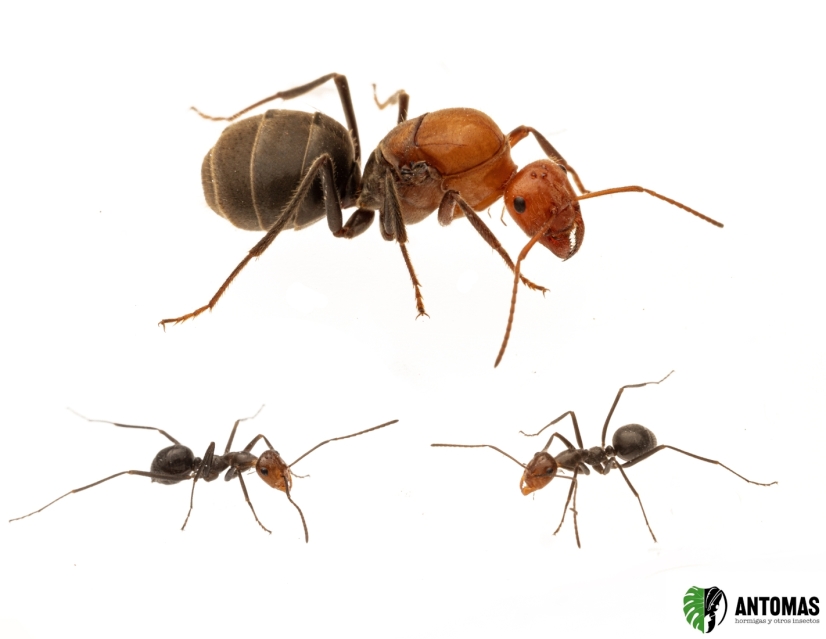
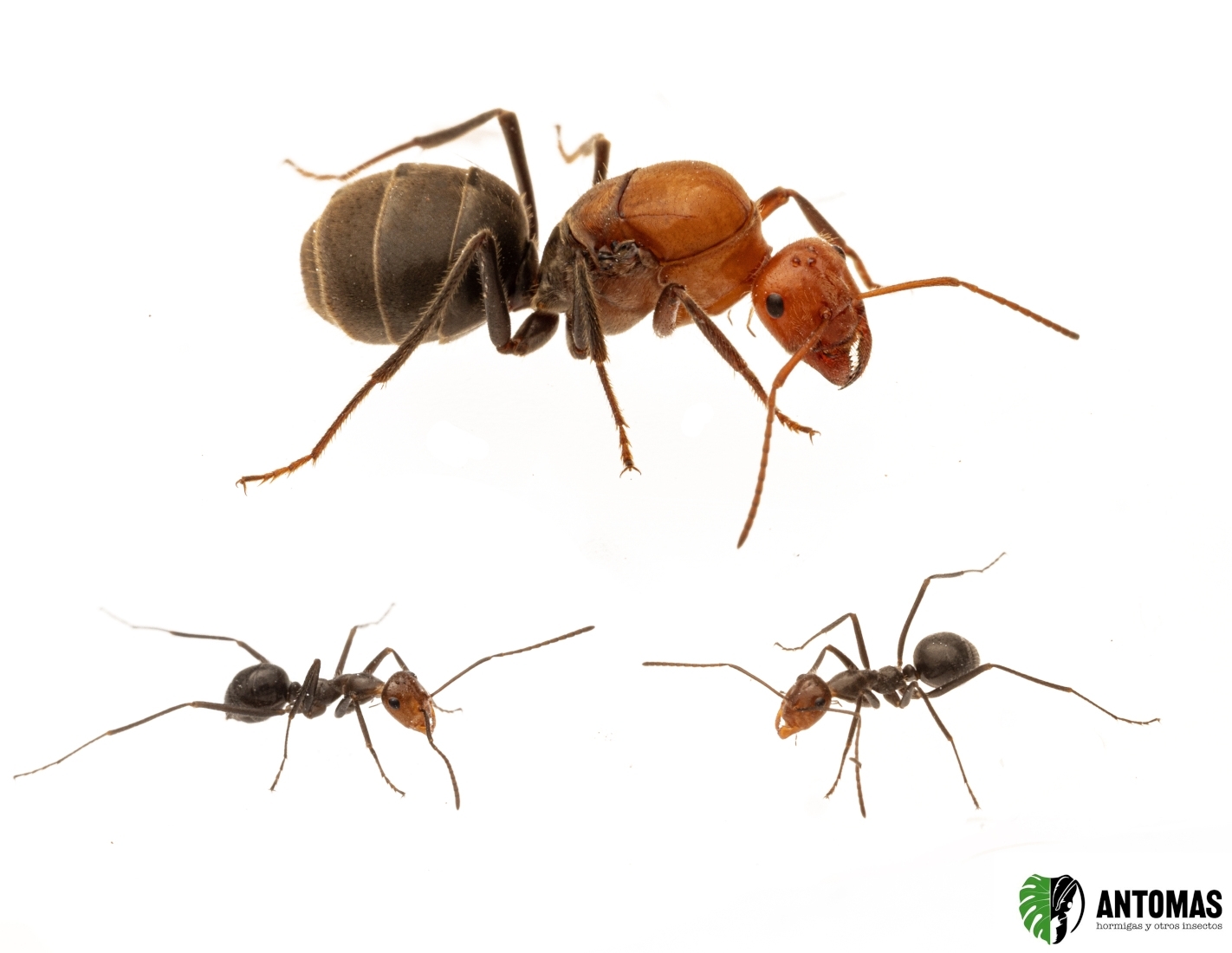
The honeypot ant of the mountain ranges: diurnal and dark (queen with an orange head and mesosoma and a greyish-black gaster; greyish-black workers with a reddish-orange face) and one of the few ants in which unrelated queens share the colony for life. Colonies with 2 or 3 queens, already established, that live together without fighting. A Qbik Wild nest with headroom for the repletes, ordinary room temperature (keepers use 24–31 °C), sugar by the dropper until the first repletes and freely after that, tiny prey every day and a diapause of about 4 months, from November to February, at 14–16 °C. Mineral oil as a barrier.
Myrmecocystus mendax Wheeler, 1908 is a diurnal honeypot ant of the mountain ranges and plateaus of the south-western United States and northern Mexico. Like the rest of the genus, it stores nectar in replete workers that hang from the nest ceiling. What makes it unique is its social life: depending on the mountain range it lives in, its colonies have a single queen or several queens that are not related and live together for life. And, as if that were not enough, genetics is discovering that more than one species hides under its name.
At Antomas we sell it as colonies with 2 or 3 queens that already live together. In this care sheet we explain what science says about that coexistence, what we have learnt by keeping it and how to care for a colony in which several queens live together without fighting.
Biology
A “liar” that baffles taxonomists
Mendax means “liar” in Latin. We do not know why William Morton Wheeler gave it that name in 1908, but it suits it perfectly, because few honeypot ants have misled specialists so much:
Wheeler described it as a subspecies of M. melliger, its closest relative, whose workers are almost identical in head shape, sculpture and petiole.
That same year he described orbiceps, a Texan honeypot ant with round-headed workers, which passed through melliger and placodops before Roy Snelling placed it within mendax in 1976.
The large, long-haired populations of New Mexico and Arizona, once called melliger or comatus, are now considered a hairy variant of mendax.
And the queens and males of mendax, melliger and placodops seem, quite simply, impossible to tell apart.
With this track record, it is no surprise that modern genetics has turned up some surprises (see “One species or several? The mendax cryptic complex”).
The mountain range decides how many queens
In 2019, Ti Eriksson, Bert Hölldobler, Jesse Taylor and Jürgen Gadau published a study that made M. mendax a textbook case. They compared two populations in Arizona and found two different societies:
In the Sierra Ancha, in the centre of the state, every mature colony sampled had several queens, with an average of 6.27 queens per colony.
In the Chiricahua Mountains, in the south-east, most mature colonies had a single queen.
The same species, with the same appearance, but with a social organisation that changes from one mountain to the next. The authors point to local ecological pressures, such as colony density or climate, and note that lasting cooperation between unrelated reproductives is rare in social insects and, where it occurs, is often restricted to certain areas.
So is it right to call it polygynous? The term describes our colonies, with 2 or 3 queens that live together without fighting, and populations such as the Sierra Ancha one well. That the species lives with a single queen in other ranges is natural variation between populations, not a trait of our colonies.
Queens that are not sisters: primary polygyny
Many ants with several queens obtain them by adopting their own daughters after the nuptial flight. This is secondary polygyny, and the queens of a colony are relatives. M. mendax from the Sierra Ancha does something rarer: the genetic relatedness between nestmates shows that its queens are not family. They joined forces when founding the colony and stayed together. This is primary polygyny.
To see how exceptional it is, compare it with its relative M. mimicus. There, the queens also often found in groups, but once the first workers emerge, the workers eliminate them until only one is left. In the Sierra Ancha, by contrast, the alliance holds: the queens go on laying side by side for the whole life of the colony.
Founding alone or as a team
The 2019 study also followed the founding queens, in the field and in the laboratory:
Queens from the Chiricahuas almost always found alone: this is haplometrosis.
Those from the Sierra Ancha can found alone or in groups, which is called facultative pleometrosis.
In the laboratory, Sierra Ancha founding queens established colonies together without eliminating one another after the first workers emerged, and colonies with several queens reared more first-generation workers and more workers that could act as repletes than single-queen colonies.
Chiricahua founding queens, by contrast, were highly aggressive when forced to found together.
In other words, the behaviour of founding queens changes from one population to another, as befits a species complex that is still being studied (see “One species or several? The mendax cryptic complex”). The colonies we sell at Antomas are polygynous: their queens live together without fighting (see “Truly polygynous: queens that do not fight”).
Brood wars and colonies that merge
Among young honeypot ant colonies, competition is fierce: workers from neighbouring colonies steal each other’s brood. In M. mimicus, that war ends with one colony taking everything and with the raids that made the species famous. In M. mendax, Eriksson’s team triggered brood raiding between incipient Sierra Ancha colonies in the laboratory and saw two outcomes:
In general, the queens of the colony with more workers were more likely to survive.
But in some cases the two rival colonies merged, and the queens of both went on laying together.
Fusion of incipient colonies is rare in ants, and the authors believe it may help explain why mature Sierra Ancha colonies have so many queens. In captivity, however, it is not something to put to the test (see “What not to do”).
Islands in the sky
M. mendax lives from central Colorado to Texas, westwards to the desert ranges of south-eastern California, and in northern Mexico. Records are concentrated in Arizona and New Mexico, followed by Texas and Colorado, with fewer in Nevada, California and Utah; in Mexico, mainly in Chihuahua, but also in Sonora, Zacatecas and Baja California.
It is not an ant of the hottest lowlands, but of mid-elevation mountains. In Colorado it lives at about 1,100–2,000 m, in piñon-juniper woodland and shortgrass prairie; in Texas, in piñon-oak and mesquite-acacia savannas. Some of its populations live in the so-called Madrean “sky islands”, such as the Chiricahua Mountains: isolated ranges in south-eastern Arizona and north-western Mexico that rise above the desert like islands, with forest on the summits and scrub in the valleys. That isolation encourages populations to diverge, and helps to understand what comes next.
One species or several? The mendax cryptic complex
In 2021, the large phylogeny of the genus by Tobias van Elst and colleagues, based on thousands of DNA fragments, already warned that several honeypot ants hide cryptic diversity: lineages that look the same but are genetically distinct. In 2026, a team led by Magnus Wolf, including several of the same authors, focused on M. mendax using 140 specimens and 2,508 regions of the genome. Their results, still a preprint awaiting peer review, are revealing:
They found five mendax-like lineages and two possible cryptic species: one among specimens that look like mendax and another among specimens that look like M. placodops.
Most mendax form a well-defined group, sister to M. melliger.
In the sky islands, along the US–Mexico border, there are signs of ongoing hybridisation between mendax and melliger.
Within the main group there are signs of adaptation to different environments.
In a 2022 study of honeypot ant eyes, the species even appears with a numbered label, “M. mendax-03”, a hint that researchers already distinguish lineages within it. The “liar” still has secrets to keep.
Under a stone, in clay soil
Its nests are discreet. According to Snelling, they are usually under stones, with an apparent preference for clay soils, and may or may not have a small crater of soil around the entrance. Other descriptions mention hard, stony ground, often on slopes, with one or several entrances of 2–3.5 cm, bare or surrounded by an irregular crater. Wheeler, under the name orbiceps, described mature colonies of up to about 500 workers.
For keeping, the interesting detail is the stone: under a slab, the soil keeps far more stable humidity and temperature than at the surface. A nest with a damp spot, a slightly warmer area and stable chambers free of condensation mimics those conditions well (see “Stable humidity, dry ceiling”).
Small eyes for the midday sun
M. mendax is a diurnal honeypot ant. It belongs to the group that Snelling called Endiodioctes, the “midday hunters”: dark or two-toned species that work in light and warmth, as opposed to the pale, nocturnal species of the M. mexicanus group. Its eyes give it away. In 2022, Robert Johnson and Ronald Rutowski compared pairs of similar-sized honeypot ants, one pale and one dark, and chose precisely M. mendax as the dark member of the large-species pair, against M. mexicanus:
The eye facets of M. mendax have a mean diameter of about 14.8 µm, against 20.8 µm in M. mexicanus, whose facets are 1.4 times larger.
In the large species, the front ocellus, a small simple “eye” on the forehead, is larger in the dark species than in the pale ones.
Smaller eyes and narrower facets: the kit of an ant that does not need to capture the faint light of night. Diurnal honeypot ants have another trait that matters for keeping: according to a 1978 study by Kay and Whitford, they are immobilised by cold at around 11–12 °C, while the nocturnal ones stay active at almost 0 °C (see “Mountain diapause: four months at 14–16 °C”).
Scavenger in full sun
M. mendax workers are active scavengers: they comb the ground in broad daylight for dead arthropods, catch live prey when they can and collect aphid honeydew and nectar when available. Snelling noted that the honeypot ants of its group are keen predators of small arthropods. It shows in captivity: although it is a “honeypot” ant, protein is the engine of its growth, all the more so in a colony with several queens laying at once (see “Feeding several queens: measured sugar, daily protein”).
Repletes for several queens
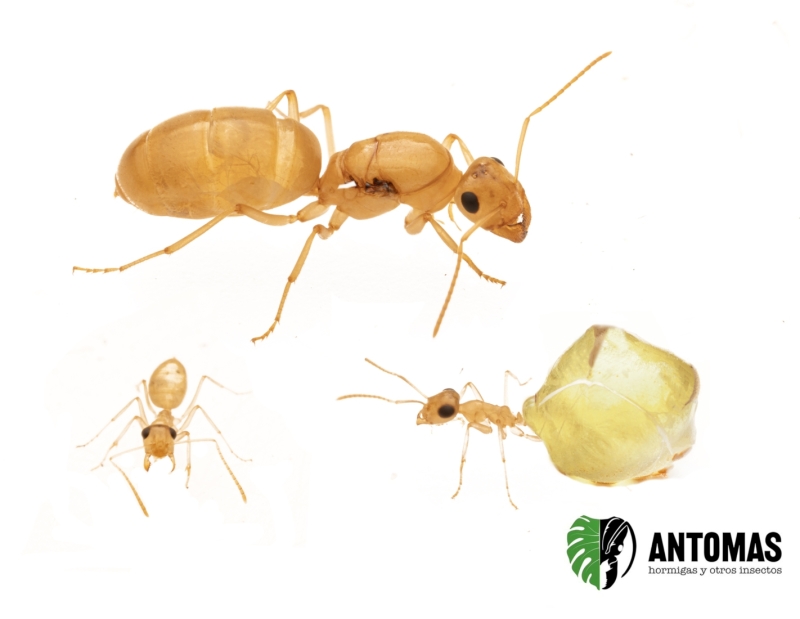
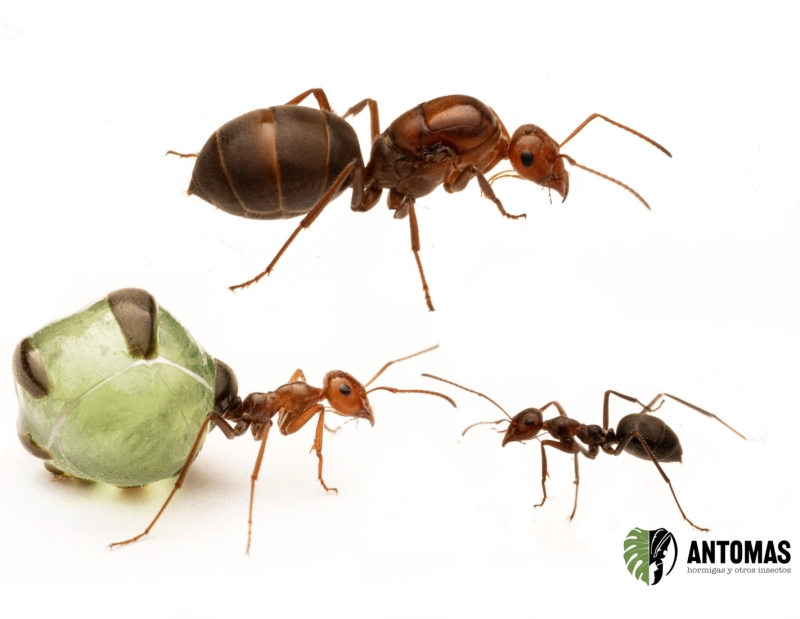
Like all honeypot ants, M. mendax stores nectar in repletes: large workers whose social crop, the part of the gut where shared food is kept, swells until it fills almost the whole gaster. They hang from the chamber ceilings like living larders and, in times of scarcity, hand the food back mouth to mouth to their nestmates. The genus even has clear repletes, almost pure water, which act as reservoirs for droughts.
In a colony with several queens, the repletes have more work to do: there are more mouths to feed and more brood. The 2019 study found that incipient colonies with several queens produced more workers able to act as repletes than single-queen colonies, and one keeper documented on a forum an M. mendax colony with about 42 workers and 5 repletes at six months, at 25–26 °C. It is a single experience, but it gives an idea of the pace.
Larders hanging from the ceiling: honeypot ant repletes in their chamber (in the video, its relative M. mimicus; Anthouse video).
Repletes come from large workers, so do not expect to see them in the first generation, which is small. And a curious detail: a replete’s colour depends on what it stores; in the genus, blue and red repletes have been obtained by giving colonies dyed sugar water.
Flights with the summer rains
M. mendax nuptial flights take place in the summer rainy season, when the storms of the North American monsoon soak the soil of the south-western ranges. After the flight, the queen sheds her wings and seals herself in to found her colony. Founding is claustral: she rears her first workers without going out to feed, on her own reserves.
It is in those first days that the type of colony is decided. In the Chiricahuas, each queen usually digs her own chamber. In the Sierra Ancha, some founding queens share a chamber and, unlike in other honeypot ants, stay together when the workers emerge. In the genus, the first workers are few and small, and they do not become repletes.
One honeypot ant among 29
Myrmecocystus is an exclusively North American genus, with 29 described species and a close relative of Lasius, the genus of the black garden ant. According to van Elst’s phylogeny, it diversified about 14 million years ago, as the deserts of the south-west were forming. M. mendax belongs to a group of large, diurnal honeypot ants together with M. melliger, its sister, and M. placodops. It also resembles M. mimicus, another diurnal species, from which it differs in its small eyes, hairs and colour. And the honeypot ants of Australia and other continents are not its relatives: they arrived on their own at the same idea, storing nectar in living workers.
Size and morphology
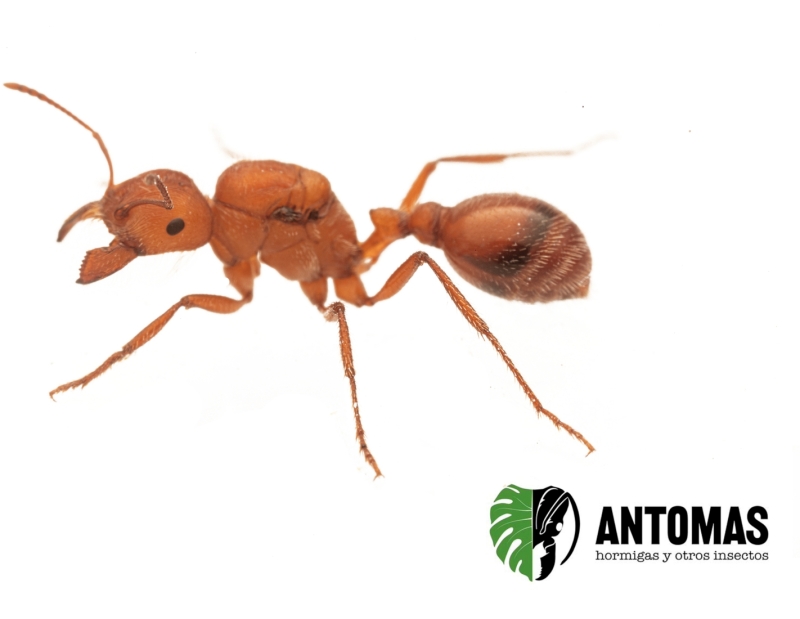
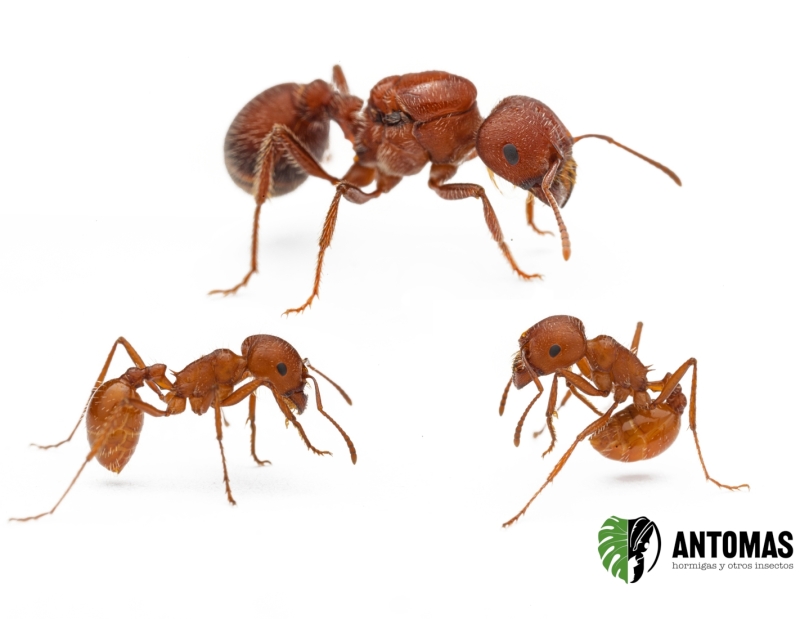
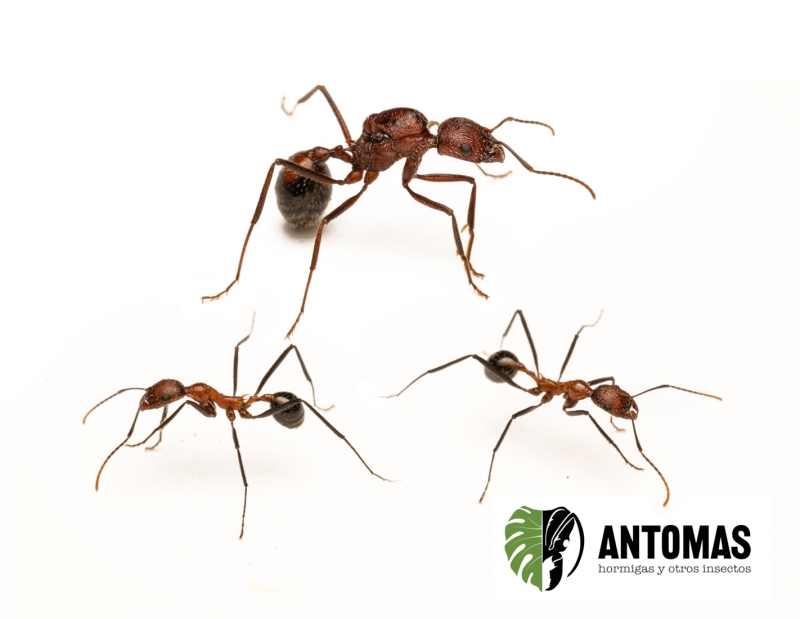
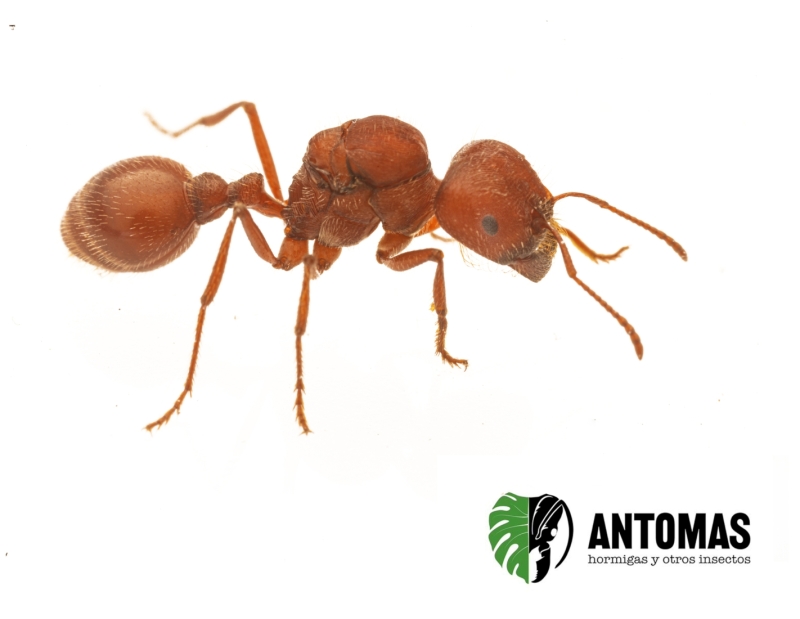
A large, robust, polymorphic honeypot ant, stingless and with very different colouring in the queen and the workers.
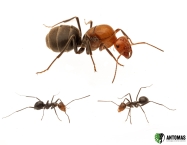
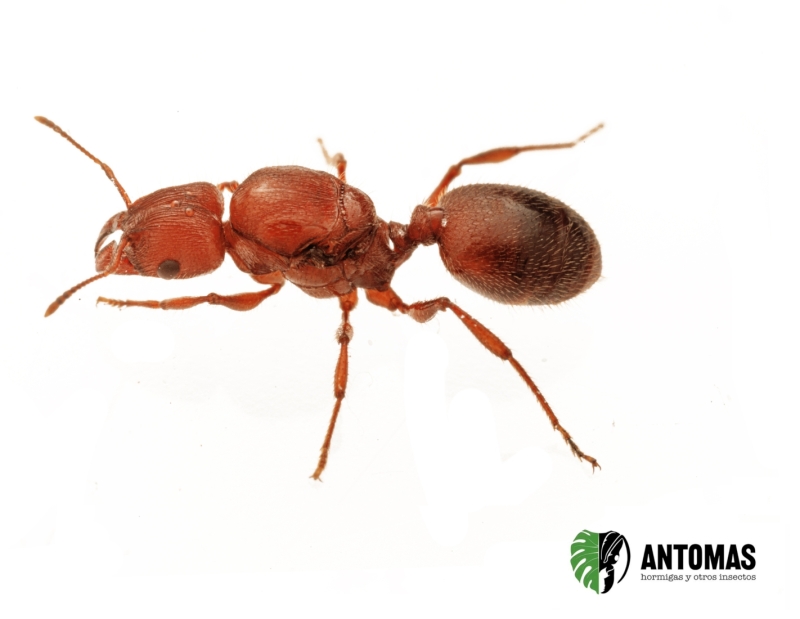
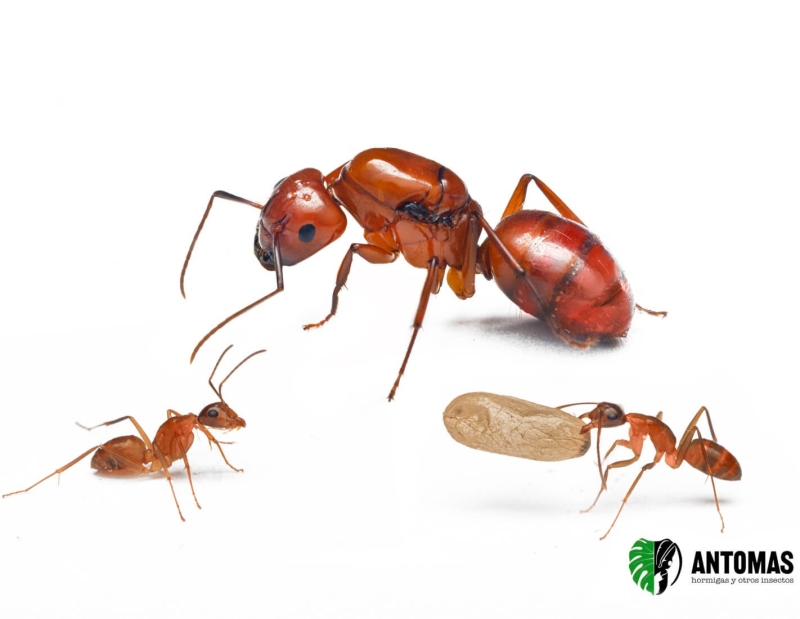
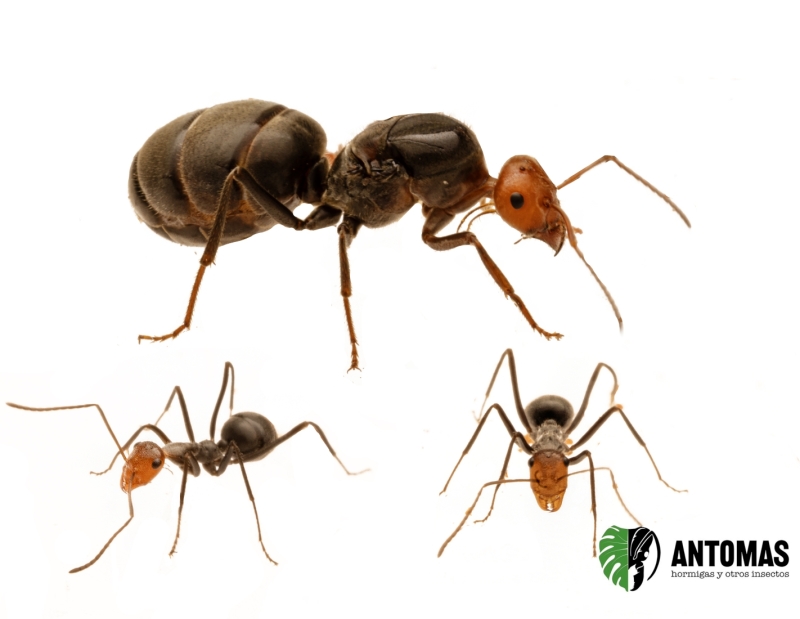
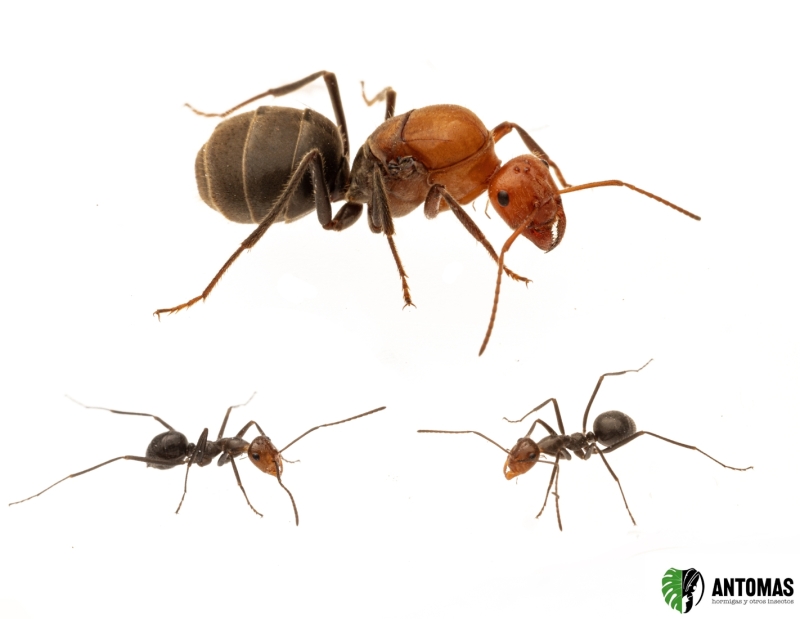
Queen of our colonies. Orange head and mesosoma (the thorax) and a greyish-black gaster.
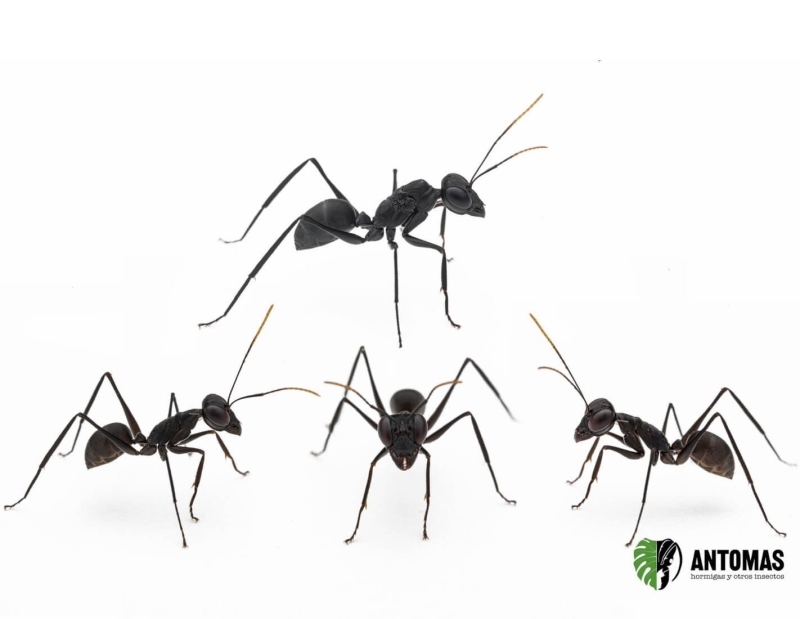
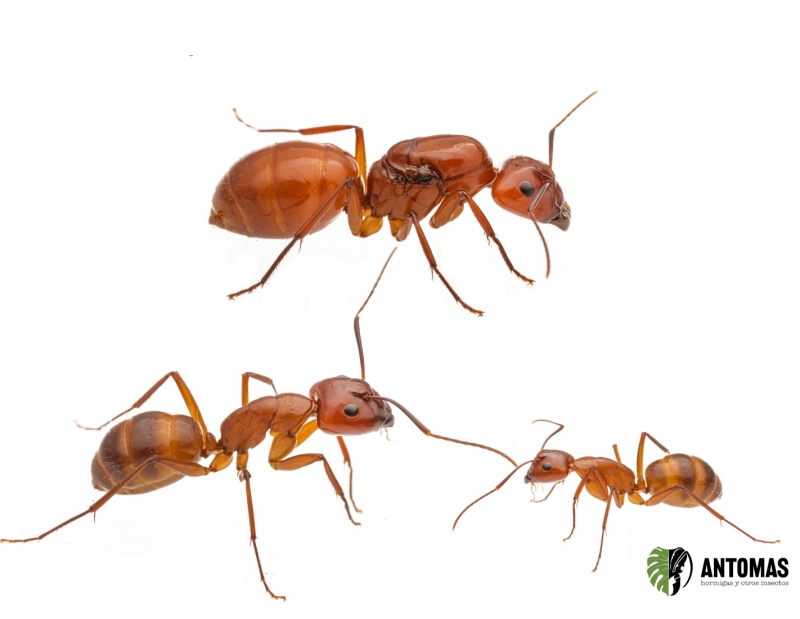
Workers of our colonies. Greyish black, with a reddish-orange face.
Colour according to science. Descriptions give a body ranging from yellow to ferruginous brown and a medium to dark brown gaster, varying between populations, and the 2022 study places it among the dark species. With cryptic lineages and long- and short-haired populations, it is no surprise that colour varies from one colony to another.
Hairs. Numerous erect hairs on the cheeks (the malar area). The long hairs on the pronotum and the second gaster segment are at least 0.6 times the eye diameter and taper gradually. Hair length varies from one area to another.
Eyes. Small, with narrow facets, as befits a diurnal species.
Polymorphism. Workers of very different sizes; the largest are the candidates to become repletes.
Defence. No sting: it bites and releases formic acid through the acidopore, at the tip of the gaster.
Approximate measurements
Workers: head width 0.9–1.9 mm (Snelling’s key)
Eye facets: mean diameter of about 14.8 µm (Johnson and Rutowski, 2022)
Total length of workers: no published measurement we have been able to access
Queen: no published measurement we have been able to access
Repletes: greatly distended gaster; in the genus, from the size of a pea to that of a cherry
Snelling’s 1976 revision of the genus, with the full measurements, has not been within our reach, so we do not give figures we cannot back up. As a guide, Wheeler measured 12 mm in the female of M. melliger, its closest relative, whose queens are almost impossible to distinguish from those of mendax.
Care in captivity
Difficulty: 4/5 – Advanced
At Antomas we consider it a species for experienced keepers, for the same reasons as the other honeypot ants and a few more:
A delicate start: young honeypot ant colonies are fragile and grow in spurts.
Rationed sugar until the first repletes appear, so that none of the queens turns into one.
Several queens: they live together without fighting, but they lay more than a single queen, and the colony needs more food.
Fragile repletes and a mild diapause, typical of a diurnal species.
In return, two or three queens laying at once usually mean faster growth than a single-queen colony, and watching them share the brood chamber is a sight very few ants offer. It is also a species under active research: you will be keeping a small scientific mystery.
Colonies with 2 or 3 queens: how they live together
At Antomas we sell M. mendax in two options: “2 Queens and 5/15 workers” and “3 Queens and 5/15 workers”. These are established colonies in which the queens have been together for some time and have reared workers in common. Our experience is clear: these are polygynous colonies, with 2 or 3 queens that live together for life and do not fight each other. In practice:
There is no need to separate or watch them: they share the brood chamber and lay on the same egg pile.
More queens mean more eggs: the colony grows faster, as long as it does not run short of protein.
There is no need to add queens: the colony already has its own. And, as with any species, do not combine different colonies: in the laboratory, young mendax colonies stole each other’s brood (see “Brood wars and colonies that merge”).
If one of the queens ever dies, the colony carries on with the others.
This fits what is known about the species: in the Sierra Ancha, colonies have on average more than six unrelated queens, and in the laboratory the founding queens from that population did not eliminate one another.
Truly polygynous: queens that do not fight
The fact that some wild populations have one queen and others several does not mean that M. mendax queens get on badly. It is natural variation between populations of a species complex that is still being studied: in the Sierra Ancha, founding queens join forces and stay together for life; in the Chiricahuas they found alone and, in the laboratory, became aggressive when forced to share a chamber. The same scientific name, with different social behaviour depending on the mountain range.
Our colonies are of the polygynous type. In Antomas’s experience, their 2 or 3 queens live together for life and do not fight each other: they share a chamber, lay together and raise a single colony. There is no need to separate them or to worry that one will eliminate another. That is exactly what makes this species unique: it is polygynous.
Recommended formicaria
For a honeypot ant, the ideal nest has chambers with a high, rough ceiling for the repletes to hang from, and stable humidity without droplets. With several queens the colony grows faster, so it pays to think about expansion from the start. Our recommended sequence:
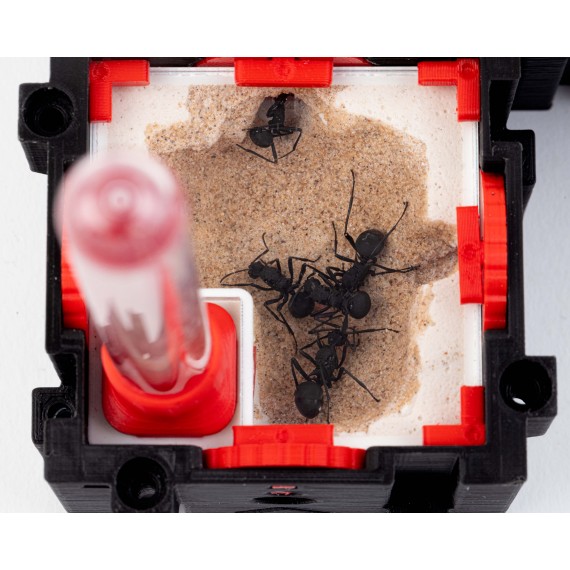
1. To start: Qbik Wild One P 1C. A small module, about 6.8 × 6.8 cm and 5 cm high, with a central humidity point, designed for young colonies of large ants. A colony of 2–3 queens and 5–15 workers fits easily, and its height leaves room for the first repletes.
2. To grow: we also recommend the hybrids. The Qbik Wild Duo P 2C Híbrido, twice the size, combines a lower reservoir that provides humidity by evaporation, with no water in contact with the chambers, and a side drinking tube. Stable humidity, without condensation to make the repletes fall, and water always available: just what they need. If you provide heat, do it from the side, never under the reservoir.
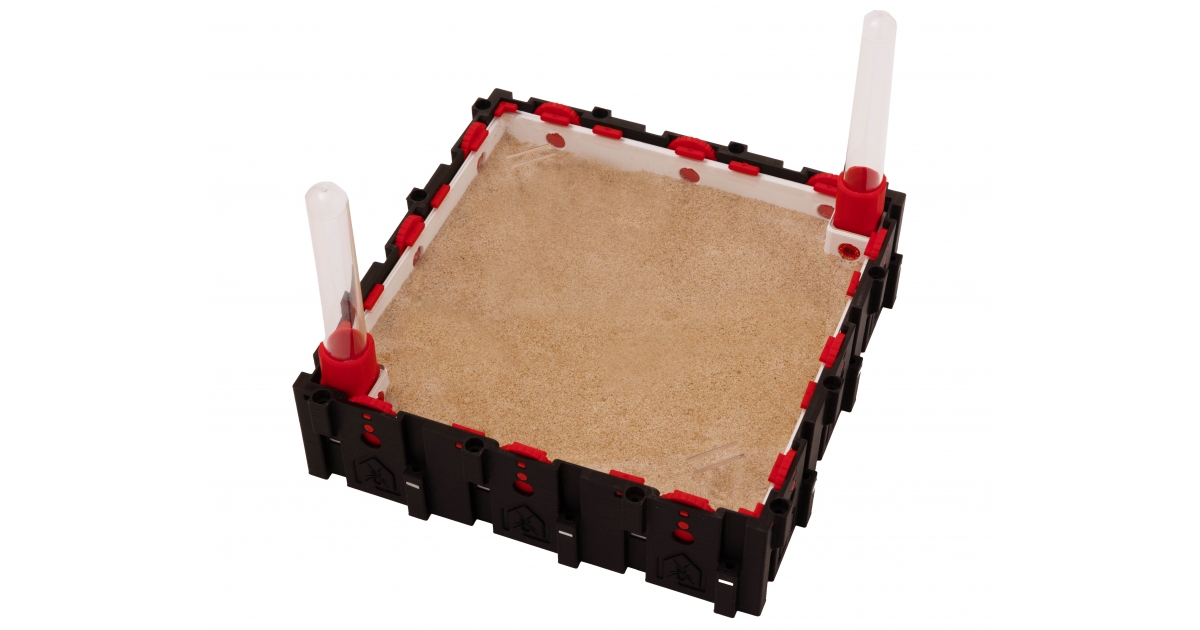
3. For mature colonies: Qbik Wild NoNa Diáfano. A large open-plan module, with no ready-made chambers, which is filled with substrate so that the colony can dig its own network, as under a stone in the mountains. Use a compact substrate that will not collapse, and moisten only one area. Keep it for large colonies.
Qbik nests are expanded by attaching modules, so the colony can grow without changing home. Complete the set-up with a dry foraging area, the water tube, a feeder and the mineral oil barrier.
Recommended parameters
Temperature: ordinary room temperature, as we keep them at Antomas. If you want to fine-tune, keepers who succeed with the genus use 24–31 °C, with a warm spot at one end, and point to about 29 °C as ideal. Being diurnal, it appreciates a warm, bright corner.
Repletes: in the stable area, away from the heat source.
Humidity: a fairly dry nest, with a damp spot next to the brood and no condensation.
Water: always, in a test tube with water and cotton wool in the foraging area or in the side drinking tube of the hybrid.
Foraging area: dry, ventilated and lit.
Queens: 2 or 3 per colony, which live together without fighting.
Diapause: about 4 months, from November to February, at 14–16 °C.
Stable humidity, dry ceiling
Under a stone, in clay soil, the M. mendax nest keeps a stable humidity without becoming waterlogged. That is the idea in captivity: a damp spot near the brood, because eggs and larvae must not dry out, and the rest of the nest drier, with chamber ceilings always free of droplets. Condensation is the great enemy of repletes: on a wet ceiling they lose their grip and fall, and a replete that falls can burst. If you see droplets, reduce the humidity for a few days; if you see mould, look for forgotten food leftovers.
On arrival: tube, calm and water
Your colony arrives in a test tube with its water reservoir behind the cotton wool, with its 2 or 3 queens, between 5 and 15 workers and brood. Let it rest in a quiet place, at room temperature and out of direct sun, and check that the reservoir has water. There is no need to move it into the nest on day one. The next day, offer a tiny drop of sugar and a tiny prey item. It is normal to see the queens together, close to the brood. When the tube becomes too small or dirty, move the colony into the Qbik Wild One by tipping (see “Moving by tipping, with the queens safe”).
Feeding several queens: measured sugar, daily protein
A colony with several queens lays more eggs and needs more food, above all protein. The Antomas routine:
Sugar, in two phases:
Until the first repletes, by the dropper: tiny drops that are finished quickly, several times a week, so that no queen turns into a replete (see “Three queens, no repletes: the sweet death”).
From the moment the first repletes appear, ad libitum: from then on, sugar must never run out.
Vary the sugars: at Antomas we recommend Anthouse’s Blue Sugar nectar 4–5 times a week and another sugary liquid or nectar 1–2 times a week; some protein can also be added to the nectar. Always in a feeder, with the drop “spread out” and accessible, and never on cotton wool, which goes mouldy and spoils the liquid.
Protein, daily and tiny at first.Drosophila, firebrats (Thermobia), termites and micro crickets, in exaggeratedly small pieces and, if possible, every day. As the colony grows, it accepts larger prey, such as flies, crickets or small cockroaches, and can be given more, but less often. Change the insect every week. As a diurnal scavenger, it will make better use of it if you put it in during the morning; remove leftovers the next day. If you clean daily, it is better to overfeed, because the colony grows faster when it understands there are resources; if you cannot clean often, do not overfeed, because leftovers bring mould and mites.
Honeypot ant larvae (M. placodops) receiving their protein ration at Antomas: the fuel of a growing colony (Antomas channel).
And water, separately: a tube with water and cotton wool in the foraging area, always full.
Three queens, no repletes: the sweet death
In honeypot ants, too much sugar in a colony without repletes has an unexpected victim: the queen. With no living larders in which to store the surplus, the workers give it to her, and her gaster swells until she becomes one more replete. A queen like that lays far fewer eggs or stops laying, and may die. In a colony with 2 or 3 queens, the risk is multiplied: any of them could end up like that. There are no scientific studies on it; it is rearing experience, and this Anthouse video shows it.
The sweet death: honeypot queens with gasters full of nectar, the reason for the dropper in young colonies (Anthouse video).
Hence the dropper: little sugar, often, until you see the first repletes hanging. If you notice that a queen’s gaster is more swollen than usual, cut down the sugar for a few days and keep up the protein.
Moving by tipping, with the queens safe
At Antomas they are moved by tipping: the tube is opened inside the foraging area of the new nest, next to the entrance, and the colony is gently tipped out. With a multi-queen honeypot ant:
Count the queens before and after, and make sure they all go into the nest. If one lags behind, guide her with a soft brush.
Move early, before there are many repletes, and tip from a low height onto sand.
Repletes, never with tweezers: they burst easily. Guide them with a brush, without squeezing the gaster, or let the workers drag them.
Prepare everything beforehand and keep the nest dark so that they move in straight away.
With Qbik nests, the colony grows by adding modules, so moves are few.
Behaviour in captivity
Diurnal. It is active with light and warmth: that is the time to watch it forage, gather prey and visit the feeder.
Queens together. In our colonies, it is normal to see the queens close to one another, next to the brood. They are polygynous and do not fight each other: it is one of the great attractions of the species.
Calm, but it defends its home. Day to day it is a calm ant; if the nest is opened or knocked, the workers come out to defend it, bite and may spray formic acid.
Watch without fear. At Antomas we believe ants are there to be enjoyed, watched and learnt from, not kept hidden away. Keep the nest area dark and the foraging area lit, and watch them calmly, intervening as little as possible: they get used to your presence.
Warning signs: a queen with a swollen gaster (too much sugar), repletes on the floor (condensation or knocks) and brood that does not progress outside diapause (lack of protein).
Mountain diapause: four months at 14–16 °C
M. mendax lives in mountain ranges with real winters, and appreciates its winter rest. At Antomas we give it a diapause of about 4 months, from November to February, somewhat shorter than that of our native species. Some shops say this species does not need one; we prefer to respect its cycle.
At what temperature? As a dark, diurnal honeypot ant, it is immobilised by cold at around 11–12 °C, while pale, nocturnal ones such as M. mexicanus stay active at almost 0 °C and tolerate a colder diapause. For M. mendax we suggest 14–16 °C as a guide figure: cool enough for the colony to rest and slow down egg-laying, and above the threshold at which it is paralysed. It is slightly cooler than what we recommend for the desert-dwelling diurnal M. mimicus, because mendax is a mountain species.
Lower the temperature gradually, over a couple of weeks, and raise it the same way at the end of February.
Water always and a little sugar available, by the dropper if there are no repletes yet.
Protein only if there are growing larvae.
At rest, the queens stop laying and the brood stops developing: this is normal.
Escapes, handling and safety
It is not much of an escape artist: a band of mineral oil on the upper part of the foraging area walls and a well-fitting lid are enough. Check connections and stoppers, and leave no twigs that could act as a bridge.
It has no sting. If it feels trapped, it bites and releases formic acid, which smarts on sensitive skin, nothing more. Handle it with a soft brush or soft tweezers, never with your hands, and do not touch the queens or the repletes unless absolutely necessary. It is an exotic species: it must never be released.
What not to do
Combine two different colonies.
Give sugar freely before there are repletes, or leave a colony that already has them without sugar.
Put the sugar on cotton wool.
Skimp on protein for a colony with several queens.
Pull repletes off with tweezers or tip the colony out from a height.
Let condensation form on the nest ceiling.
Give it a cold diapause: at around 12 °C it becomes immobile.
Scientific sources
This care sheet is based on the scientific literature on Myrmecocystus mendax and its genus, and on the experience of Antomas and other keepers. Main references:
Eriksson, T. H., Hölldobler, B., Taylor, J. E. & Gadau, J. (2019). Intraspecific variation in colony founding behavior and social organization in the honey ant Myrmecocystus mendax. Insectes Sociaux 66: 283–297. doi:10.1007/s00040-019-00687-y
Wolf, M., Rensing, N., Neuhaus, H., van Elst, T., Eriksson, T. H., Borowiec, M., Ward, P. S., Johnson, R. A. & Gadau, J. (2026). Understanding cryptic diversity within the honeypot ant species complex of Myrmecocystus mendax. bioRxiv (preprint). doi:10.64898/2026.04.20.719579
van Elst, T., Eriksson, T. H., Gadau, J., Johnson, R. A., Rabeling, C., Taylor, J. E. & Borowiec, M. L. (2021). Comprehensive phylogeny of Myrmecocystus honey ants highlights cryptic diversity and infers evolution during aridification of the American Southwest. Molecular Phylogenetics and Evolution 155: 107036. doi:10.1016/j.ympev.2020.107036
Johnson, R. A. & Rutowski, R. L. (2022). Color, activity period, and eye structure in four lineages of ants: pale, nocturnal species have evolved larger eyes and larger facets than their dark, diurnal congeners. PLoS ONE 17: e0257779. doi:10.1371/journal.pone.0257779
Kronauer, D. J. C., Hölldobler, B. & Gadau, J. (2004). Phylogenetics of the New World honey ants (genus Myrmecocystus) estimated from mitochondrial DNA sequences. Molecular Phylogenetics and Evolution 32: 416–421. doi:10.1016/j.ympev.2004.03.011
Kay, C. A. R. & Whitford, W. G. (1978). Critical thermal limits of desert honey ants: possible ecological implications. Physiological Zoology 51: 206–213. doi:10.1086/physzool.51.2.30157867
Bartz, S. H. & Hölldobler, B. (1982). Colony founding in Myrmecocystus mimicus Wheeler (Hymenoptera: Formicidae) and the evolution of foundress associations. Behavioral Ecology and Sociobiology 10: 137–147. doi:10.1007/BF00300174
Kronauer, D. J. C., Gadau, J. & Hölldobler, B. (2003). Genetic evidence for intra- and interspecific slavery in honey ants (genus Myrmecocystus). Proceedings of the Royal Society B 270: 805–810. doi:10.1098/rspb.2002.2288
Conway, J. R. (1977). Analysis of clear and dark amber repletes of the honey ant, Myrmecocystus mexicanus hortideorum. Annals of the Entomological Society of America 70: 367–369. doi:10.1093/aesa/70.3.367
Conway, J. R. (1986). The biology of honey ants. The American Biology Teacher 48: 335–343. doi:10.2307/4448321
Conway, J. R. (1994). Honey ants. American Entomologist 40: 229–234. doi:10.1093/ae/40.4.229
Dificultad
Experienced
1 Reviews
He comprado una colonia con dos reinas y me ha llegado perfecta, mucha prole y bastantes obreras, con la parte mas dificil ya hecha solo queda disfrutarlas!