Difficulty: 3/5 – Advanced
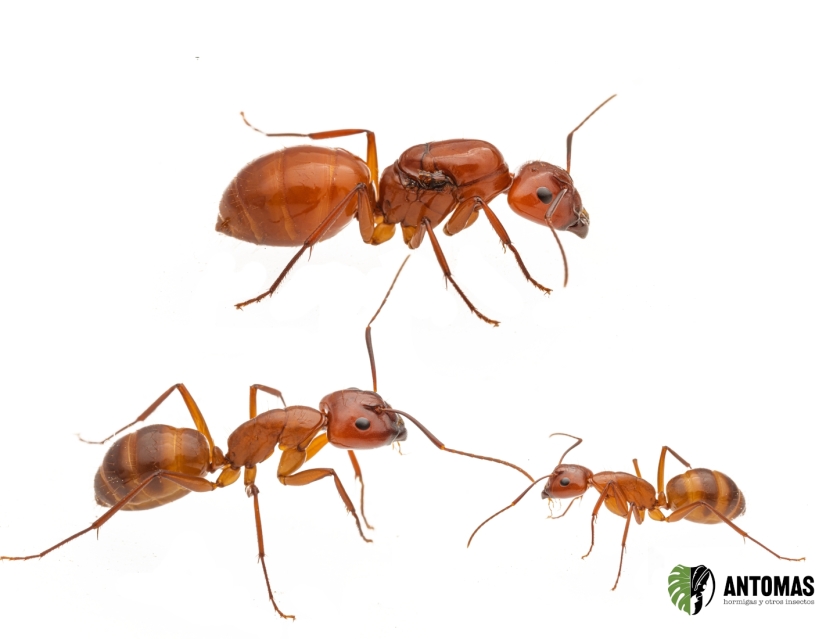
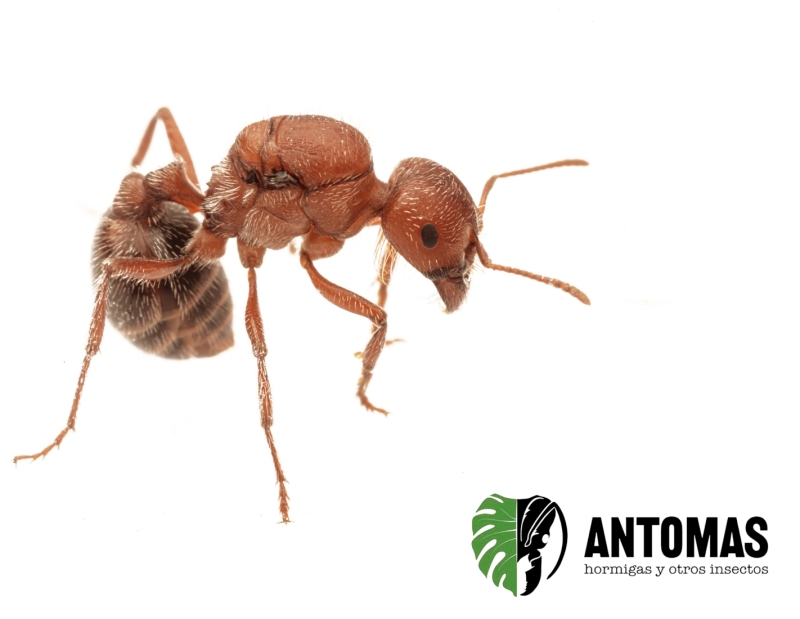
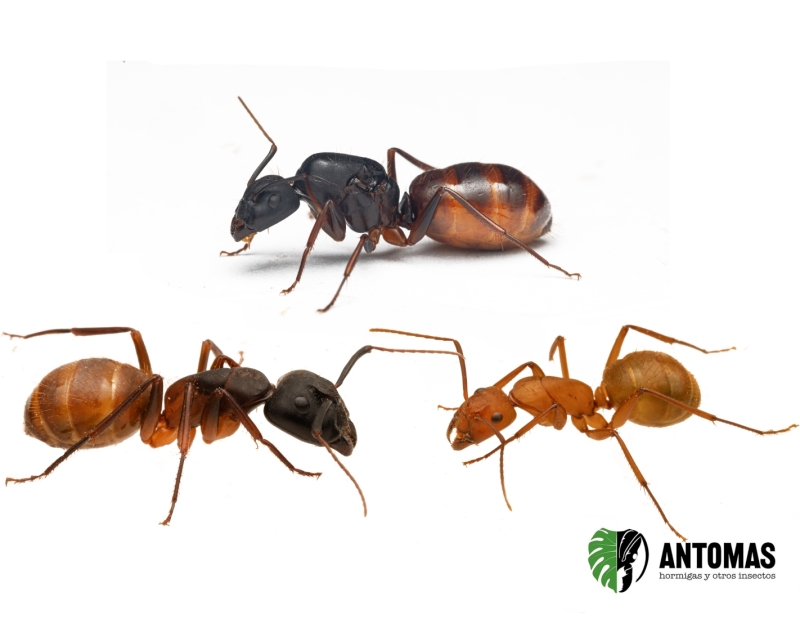
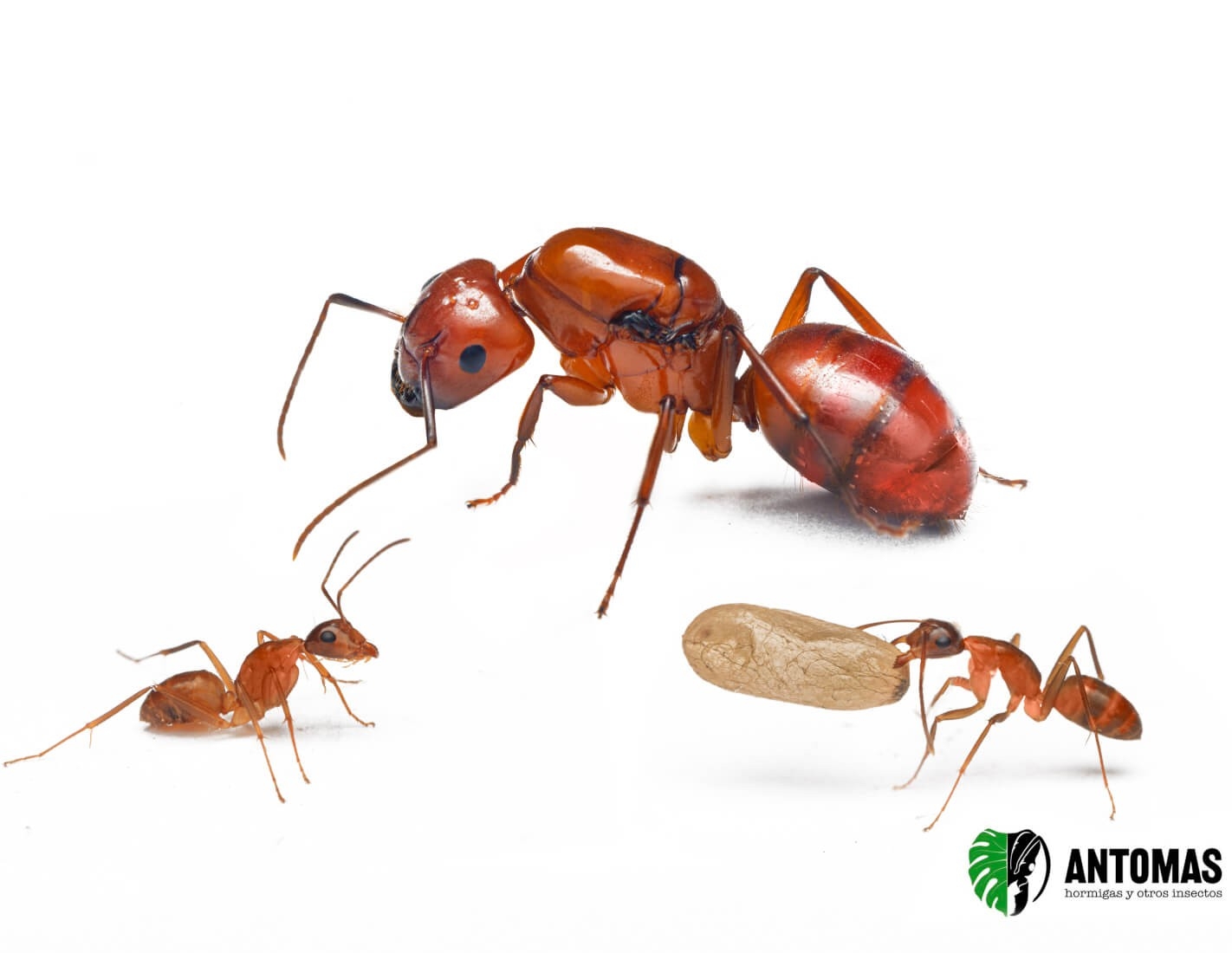
A large carpenter ant from eastern North America, a uniform, glossy orange chestnut with an amber gaster. Nocturnal, shy and polymorphic, and the natural host of the famous ‘zombie’ fungus Ophiocordyceps kimflemingiae. Colonies with a queen: queen with 3–7 workers and brood, monogynous and with claustral founding. QBIK ONE with medium galleries, then QBIK DUO with large galleries once the majors appear; nest at 23–27 °C, never above 28 °C, with a large humid area; sugar always available in a feeder and plenty of protein. Diapause of 10–12 weeks at 8–14 °C. It climbs glass: escape barrier needed. No sting.
Camponotus castaneus (Latreille, 1802) is a large, elegant carpenter ant from eastern North America, of an orange chestnut so uniform and glossy that it looks varnished. In English it is known as the chestnut carpenter ant, and at Antomas we sell it under its scientific name. It is shy, sets off to work as evening falls and, despite being a carpenter ant, prefers soil to wood.
It also holds a special place in the history of science: the ‘zombie’ fungus Ophiocordyceps kimflemingiae knows how to manipulate only two ants, this one and its twin C. americanus. As always, we keep apart what science says, what other keepers report and what we have learnt at Antomas.
Biology
From Formica castanea to Camponotus
The French naturalist Pierre André Latreille described it in 1802, in his Histoire naturelle des Fourmis, under the name Formica castanea: at the time, almost every ant was a Formica. The brackets around the author today, Camponotus castaneus (Latreille, 1802), mean exactly that: the species moved to another genus after it was described. The epithet holds no mystery: in Latin, castaneus means ‘the colour of a chestnut’.
Within the genus, its place has changed more than once. In the mid-20th century the myrmecologist William S. Creighton placed it in the subgenus Tanaemyrmex, the subgenus of our C. sylvaticus and C. barbaricus. The most recent revision of New World Camponotus (Mackay, 2019) moves it to the subgenus Camponotus in the strict sense, within the herculeanus complex and alongside its twin C. americanus, mainly because of its flattened clypeus. That said, molecular studies have shown that several classic Camponotus subgenera are not natural groups: the internal classification of the genus is still a work in progress.
From the Atlantic to the Great Plains
It is a species of the eastern United States. Its range runs from New York to Florida and, westwards, reaches Oklahoma, Kansas and Texas; to the north it reaches at least southern New England, since it appears in the field guide to the ants of that region. It lives in a wide variety of habitats: deciduous and mixed woodland, pine forests, oak savannas, prairies and clearings, scrub on sand and also disturbed habitats such as gardens, orchards, campsites and farmland. That versatility explains its broad distribution.
The climate across its range goes from the humid continental climate of the north-east, with cold winters and frequent frosts, to the humid subtropical climate of the south-east, with mild winters. Throughout, summers are hot and humid. We will bear this in mind when we talk about humidity and diapause.
The carpenter ant that does not depend on wood
It belongs to the group of carpenter ants, but C. castaneus does not particularly depend on wood. Its nests are often in the soil: under stones and objects, among roots, at the base of trees or in bare ground. It also occupies logs and stumps that are already rotten and the bark at the foot of pines and broadleaved trees. In Mississippi, nests were found in soil at the foot of an American beech.
Like all carpenter ants, it does not eat wood: it uses existing cavities or digs into soft, decayed material. And, unlike its neighbour C. pennsylvanicus, the large black carpenter ant, it is not a timber pest: if it enters a house, it is to look for food, not to nest. It does, however, often turn up in the bark-beetle traps hung on tree trunks and baited with α-pinene, a compound of pine scent: its workers patrol the trunks regularly.
The forest’s night shift
Its activity outside the nest is concentrated at dusk and during the night: in New England it is described as mainly nocturnal. Workers travel over the ground and climb the trunks, with regular trails to the plants where they find sugar. During the day a small colony may look almost inactive; as the light fades it starts sending out scouts, like a city whose working shift begins just as the rest of the forest switches off. It keeps the same hours as our C. sylvaticus, which is crepuscular and nocturnal.
It is also a cautious species, ‘very timid’ according to the literature, and less impulsive than other North American ants. When disturbed, many workers first choose to retreat into the nest, although the majors can defend the entrance with their mandibles and their formic acid.
The zombie ant of North American forests
In the forests of the south-eastern United States lives a parasitic fungus with a strategy straight out of a horror film: Ophiocordyceps kimflemingiae, one of the so-called ‘zombie-ant fungi’. Its spores land on workers foraging on the ground, germinate, pierce the cuticle, and the fungus begins to grow inside the ant. Over some two or three weeks it spreads through the body. In the end, the worker leaves the colony, climbs the vegetation, clamps its mandibles onto a twig and dies there, hanging in the ‘death grip’. A fungal stalk then grows from the back of its head and, from up high, releases a shower of spores onto the ground, right where its nestmates forage.
What is truly astonishing is how specific it is. In 2014 a team at Pennsylvania State University infected four ant species that live together in those forests in the laboratory: C. castaneus and C. americanus, its natural hosts, and two others the fungus does not parasitise in the wild, the carpenter ant C. pennsylvanicus and Formica dolosa. The fungus killed all four, but only manipulated the behaviour of C. castaneus and C. americanus. The researchers then grew it alongside living brains removed from the ants and found that it secreted different substances depending on the species of brain. The fungus, so to speak, ‘recognises’ its victim’s brain and brings out a different chemical repertoire for the two it knows how to control.
At the time it did not yet have a name of its own. In 2018 it was formally described as O. kimflemingiae, in honour of Kim Fleming, an amateur nature photographer who found the first dead ants in her woods and worked with the researchers. Since then, this fungus and its ants have become a model for understanding manipulation:
- The genes of the bite (2015). The genes the fungus switches on precisely during the death grip were studied using a strain isolated from a C. castaneus worker. In the laboratory, the biting ants died between 16 and 24 days after infection.
- A network inside the body (2017). Using 3D imaging and deep learning, it was shown that in manipulated ants the fungal cells form networks running through the whole body and surrounding the muscles, but without invading the brain.
- Twigs instead of leaves (2018). In tropical forests, zombie ants usually die biting leaves; in temperate ones, where leaves fall in autumn, they bite twigs. The study suggests this habit has evolved independently in response to climate.
- Locked mandibles (2019). The death grip is due to the mandible muscles becoming hypercontracted: the ant can no longer let go.
- A shared manual (2020). The fungus shares with a relative that parasitises another Camponotus several candidate genes for controlling its hosts.
Its twin shares the same fate: in 2025 the first confirmed record of the fungus on C. americanus in Tennessee was published. Nor is it its only lodger: a parasitic nematode, Rabbium paradoxus, has also been described in C. castaneus. Do not worry, though: the fungus is a forest parasite that needs leaf litter, humidity and spores raining down from above, and it has nothing to do with captive-bred colonies or with people.
Its dark-headed twin
C. castaneus has an almost identical relative, C. americanus, with which it shares a species complex, much of its range and even the zombie fungus. The two are easily confused, but there is a simple trick, the first one the identification keys give:
- C. castaneus: the head and the mesosoma, the ‘thorax’, are the same colour, with no dark patches on the back of the mesosoma, and very few hairs; the cheeks have almost no setae.
- C. americanus: the head is darker, with a lighter clypeus, and the back of the mesosoma has darkened areas.
In other words: if the whole ant looks carved from the same piece of chestnut wood, it is C. castaneus.
The same ant in three sizes
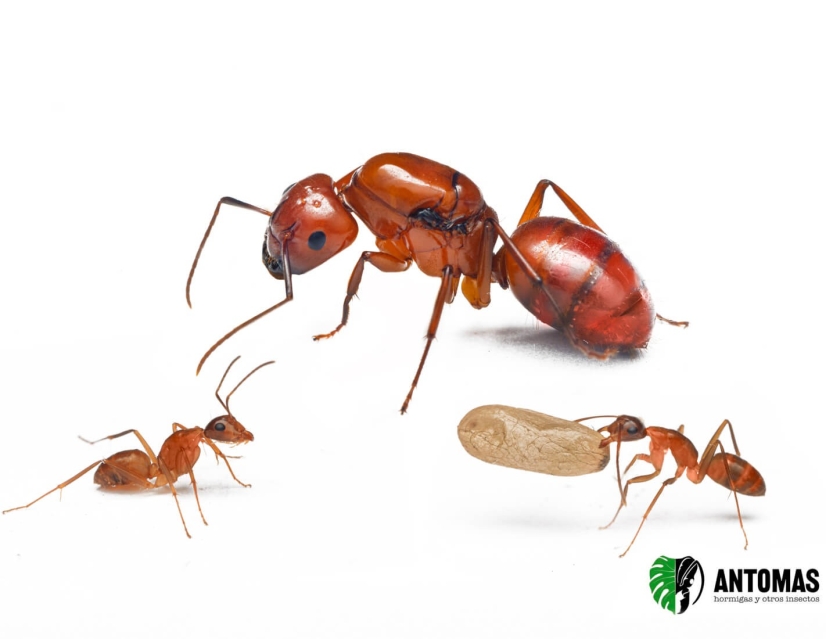
Colonies show a moderate, continuous polymorphism, with minor workers, intermediate forms and majors. There is no clear-cut boundary between workers and soldiers: the colony makes the same tool in different formats. As in other Camponotus, the small ones explore and care for the brood, while the large ones defend the nest, carry bulky food, cut up prey and store liquids in their crop.
The difference is most obvious in the head. A minor’s head is clearly longer than wide; a major’s is almost as wide as it is long, subquadrate, with much more powerful mandibles. The measurements confirm it: in museum majors, the head is 2.9–3.4 mm wide and 3.1–3.4 mm long.
Hundreds, not thousands
C. castaneus does not form gigantic colonies. The published census of five complete colonies collected in Florida gave an average of about 350 workers per colony; in the same study, the Florida carpenter ant, C. floridanus, reached 10,000. In captivity it is therefore a species with a moderate population, more manageable than other large Camponotus that can build up several thousand individuals.
Colonies are monogynous: a single queen, according to keepers, although there is still no genetic study. Always keep one queen per colony and do not combine queens bought separately: in a keeping journal published on a forum, one of the queens added to a colony ended up dead.
Princesses that spend the winter at home
Nuptial flights take place at night: winged queens and males come to lights from April to September, and the light traps used to sample nocturnal insects often attract them. In Mississippi, alates have been seen from early May to mid-June and again in September, and keepers report that they fly after dark on warm nights of around 21–24 °C. But the most curious thing is that the alates can spend the winter inside the nest with their sisters and fly out the following season. If one day your colony produces queens and males, do not be surprised to see them spend diapause at home.
After the flight, the mated queen pulls off her wings, seals herself into a small chamber and raises the first generation without going out to feed, using her fat reserves and her wing muscles: this is claustral founding. The first workers are nanitics, considerably smaller than those that follow. As soon as they start bringing in food, the queen steps up her egg-laying and the colony produces ever sturdier workers. Early growth is slow, as in many large Camponotus, and the polymorphism only becomes clearly visible after several generations.
A nocturnal herder
Adult workers live on sugary liquids: nectar, honeydew from aphids and other hemipterans, ripe fruit and other carbohydrate-rich substances. Insects they catch or find dead are carried back to the nest and are used mainly to feed the larvae. Amateur naturalists have seen them on peony flower buds, or standing motionless by the nectaries of black cherry, as if guarding their sugar supply. A well-fed colony is easy to recognise: many workers carry a swollen gaster full of liquid reserves, with the pale membranes showing between the segments.
Bacteria inside its cells
Like every Camponotus studied, it carries a symbiotic bacterium, Blochmannia, which lives in special cells of the midgut and passes from mother to daughters through the ovaries. The bacterium’s family tree mirrors that of its ants, and in the Florida carpenter ant it was shown to supply essential amino acids and recycle nitrogen, which is very useful for an ant that lives mostly on sugar.
Size and morphology
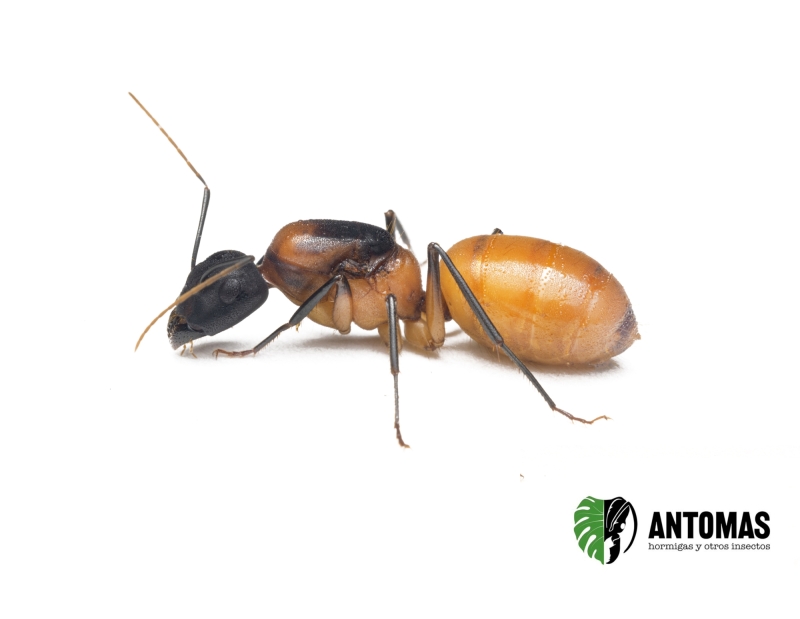
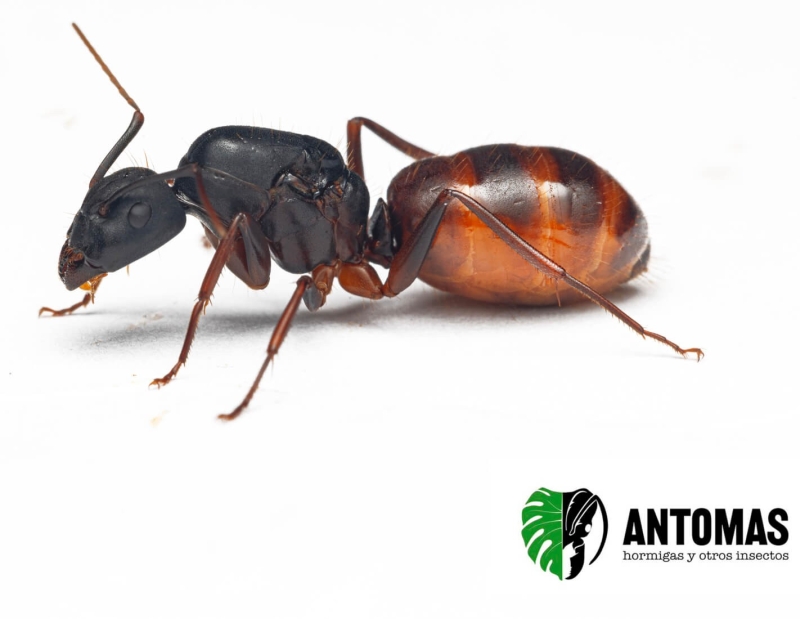
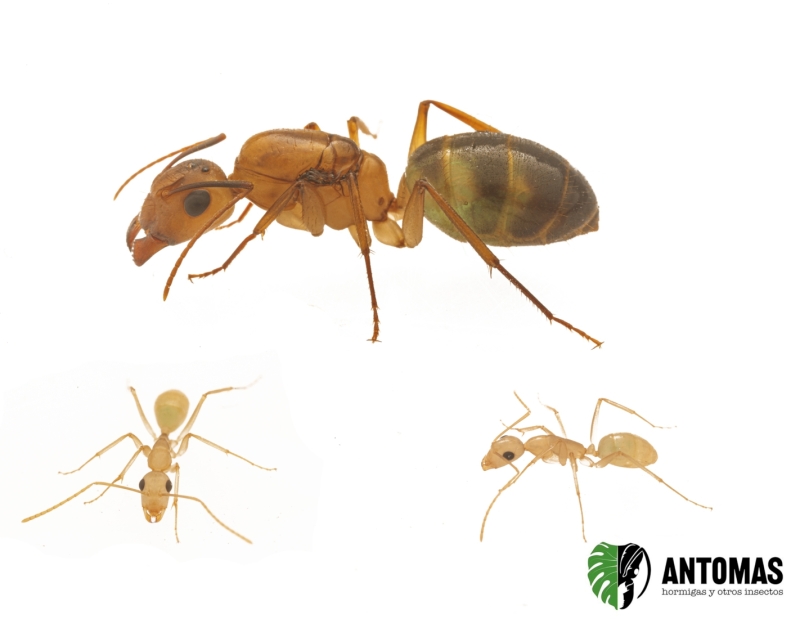
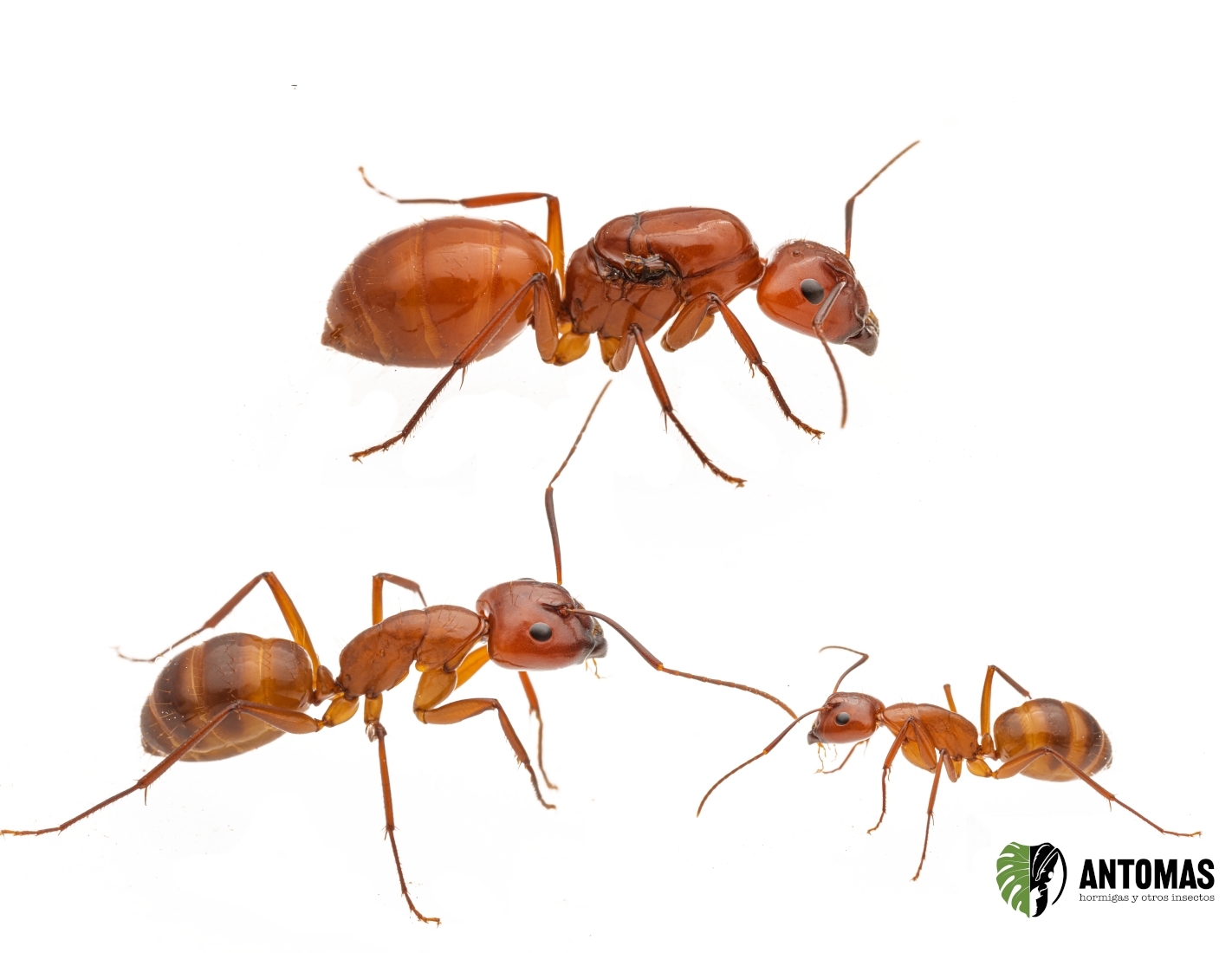
Camponotus castaneus is a large, elegant ant, easy to recognise by its uniform colouring: chestnut, reddish, orange or yellowish depending on the individual. Scientific descriptions speak of a uniform chestnut to yellowish brown, or an intense golden honey colour; in our colonies, orange chestnut with an amber gaster.
- Colour. Head and mesosoma the same shade, with no dark patches; the gaster may be slightly darker or more amber. As in other Camponotus, the teeth of the mandibles are darker.
- Surface. Smooth, glossy exoskeleton with very little hair. In direct light the colour looks especially intense.
- Head. Elongated in the minor; broad and almost square in the major, with powerful mandibles. The front edge of the clypeus is crenulate in the major and the queen, and the cheeks have almost no setae.
- Antennae and legs. Long and without erect hairs; the scapes are slightly flattened at the base.
- Male. Smaller, with the head longer than wide, large bulging eyes and reduced mandibles. Its colour recalls the queen’s but is lighter, often with dark bands running along the back of the thorax.
- No sting. Like all formicines, its gaster ends in an acidopore, an opening through which it releases formic acid in defence.
Approximate measurements
- Minor workers: 6.9–8.5 mm
- Major workers: 11–16 mm in our captive line; 10.9–12.1 mm in museum series
- Queen: 15.6–17.2 mm
- Male: 8.7–9.6 mm
The measurements for minors, queen and male are those of the Mississippi Entomological Museum at Mississippi State University. Majors measure 10.9–12.1 mm in museum series, but in our captive line they reach 11–16 mm: these are Antomas measurements taken in our own colonies. The 18–20 mm queens that circulate in shops and forums have no support in the published measurements.
Care in captivity
Difficulty: 3/5 – Advanced
At Antomas we place it at the advanced level, at the more accessible end. It has almost everything going for it: claustral founding, a moderate population, a generalist diet and a calm temperament. But it needs attention in four areas:
- Diapause. It needs a cool winter rest every year.
- Slow growth. The first year produces few workers, and the majors take a while to arrive.
- Humidity. It asks for more than most Camponotus, with a stable gradient.
- Its timetable. It is shy and works mainly at night: you have to learn how to watch it.
If you have already kept an Iberian Camponotus such as C. cruentatus, the routine will feel familiar, with two differences: here humidity matters more and the action starts at nightfall.
Recommended parameters
- Nest temperature: 23–27 °C during the active season, with one side slightly warmer so the colony can choose. Never above 28 °C.
- Humidity: a gradient with a large humid area for eggs and larvae, and a drier, ventilated area for the pupae.
- Foraging area: dry and at room temperature.
- Water: always available, in a test tube with water and cotton wool in the foraging area.
- Nest: Anthouse’s Alpha range, in PLA and acrylic, with medium galleries and, once the majors appear, large ones.
- Light: the nest area in darkness and the foraging area in the normal light of the room.
- Diapause: 10–12 weeks at 8–14 °C.
Temperature and humidity
Although it copes well with heat, you should not warm the whole formicarium. Place the heat source, a heat cable or mat with a thermostat, along one side, never under the whole nest, to create a gradient along which the colony can move its eggs, larvae and pupae as it needs. According to keepers, it does best at around 24–25 °C, and above about 29 °C it grows noticeably more slowly: hence our ceiling of 28 °C.
It is more demanding about humidity than other carpenter ants. Keepers agree that it prefers more humidity than most Camponotus, which makes sense for an ant of humid summers that nests in the soil. Eggs and larvae are usually kept in the dampest area, and cocoons are moved to drier chambers: the colony moves the children from room to room as needed. QBIKs in the Alpha range are on the dry side and get their humidity from the water tubes, so make sure the brood area always has its supply and never let it run out. If you see the colony crowded next to the water, it needs more humidity; if mould appears, there is too much.
Arrival and first weeks
At Antomas we sell C. castaneus as a queen with 3–7 workers and brood: the colony is already past founding, the most delicate stage, and has workers that go out for food. It arrives in a test tube and, while it is small, it can stay there, connected to a small foraging area:
- Rest on arrival: a couple of days somewhere quiet and dark, at 23–27 °C, checking that the tube still has water.
- Food from the start, but outside the tube: a drop of sugary liquid in a mini feeder and a small piece of insect two or three times a week, in the foraging area or by the entrance. Putting food inside the tube often brings dirt, mould and unnecessary stress.
- No knocks or vibrations: according to keepers, this is what most often makes a stressed queen eat her eggs.
- Into the nest once the tube becomes too small, at around 20 workers.
Recommended formicaria
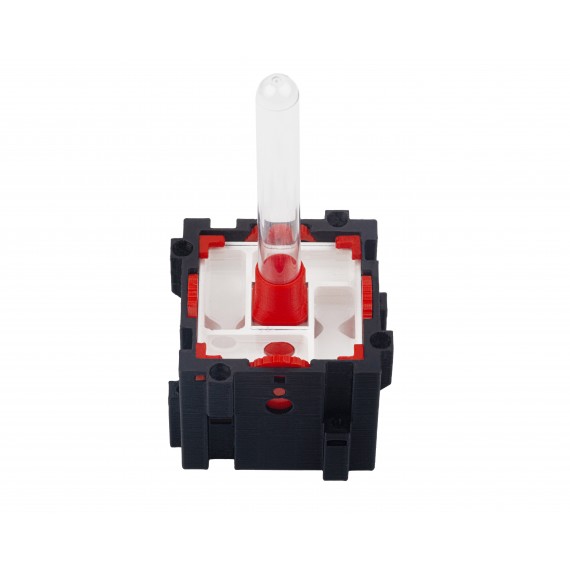
For C. castaneus we recommend the modular nests of Anthouse’s Alpha range, in PLA and acrylic. It needs neither cork nor wood, and these materials let you see the brood much better and control humidity. First, a QBIK ONE with medium galleries, perfect for a young colony:
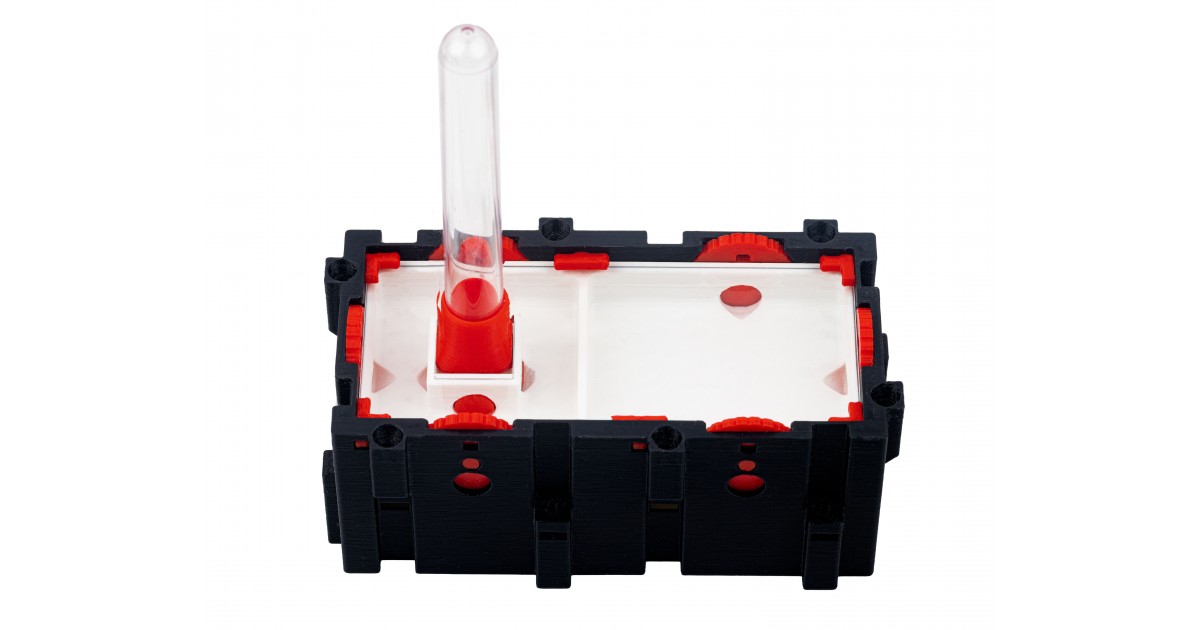
As the colony grows and the majors start to appear, with their broad heads, the next step is a QBIK DUO with large galleries, which comfortably house the queen, the brood and the biggest workers:
Expand gradually: according to keepers, if the colony cannot fill at least two thirds of the nest, it turns the rest into a rubbish dump. Set up a dry foraging area with sand or soil, a flat stone or two and a piece of bark to climb, always well away from the barrier.
Moving by tipping
At Antomas we always move colonies by tipping them, both from the tube to the QBIK ONE and when moving up to the QBIK DUO. This is how we do it:
- Everything ready beforehand: the new formicarium set up, with the barrier in place and the water connected.
- Over a tray, in case a worker climbs up your hands or the tools.
- Tip them in: open the tube or the old nest in the foraging area, next to the entrance of the new one, and empty it with a few gentle taps. Help any stragglers along with a brush.
- Darkness in the new nest: cover it with something opaque and the workers will start carrying in the brood and the queen.
- Calmly: no shaking or blowing. A very stressed colony releases formic acid, and in a closed container that acid ends up harming the ants themselves (see ‘Handling and safety’).
Feeding
Sugar, always. Carbohydrates are the workers’ main source of energy, and during the active season they should never be without a sugary liquid. Offer it in a feeder, traditional or home-made, where the drop stays spread out and accessible, and never on cotton wool: it goes mouldy and the liquid spoils in no time. Vary the sugars: at Antomas we recommend Anthouse Blue Sugar Nectar 4–5 times a week and another nectar, sugar water or diluted honey 1–2 times a week. You can also enrich the nectar with a little protein. Ripe fruit works as a supplement, removed before it ferments.
Protein, and plenty of it. How much they eat depends on the larvae: with plenty of brood, the colony will accept food several times a week. Our rule is clear: if you do maintenance daily and remove leftovers, it is better to overdo it than to fall short, because the colony senses it has resources to spare and raises more brood, faster. If you will not be able to clean often, adjust the amount.
- Change the prey every week. For a young colony, small prey, dead or cut up: flies, which keepers say are their favourite protein, and Thermobia domestica, just the right size to start with. As it grows, alternate crickets, dubia roaches, red runner roaches, moths and the odd chopped mealworm.
- Large prey once there are majors to cut it up. A small colony struggles to carry a whole roach: open it up and leave it by the entrance.
- At dusk. It is nocturnal: put the protein out late in the afternoon and remove the leftovers the next morning, or within 24 hours at most, to avoid mould and mites.
- Trustworthy insects, captive-bred and free of insecticides.
Water: besides the sugar, always a tube with water and cotton wool in the foraging area. In a species that likes humidity, letting it dehydrate is a serious mistake.
Growth and majors
With warmth and good food, development from egg to worker takes about 45–70 days, according to keepers, and longer the cooler the nest; the pupal stage alone can last about five weeks. The first year is slow, sometimes with fewer than ten workers before the first diapause, but after that the colony picks up pace and each generation brings bigger workers. There are no published data on when the first majors appear; according to keepers, they arrive when the colony reaches a few dozen workers, often in the second or third year. That is the time to move up to the QBIK DUO with large galleries.
If you would rather skip the slow start, we also offer the Chestnut Empire, an established colony of 60–80 workers with its queen, already in full expansion.
Diapause
In the wild, C. castaneus shuts down in winter: it stops foraging with the first cold spells and the colony spends those months inside the nest, which, underground, among stones or roots, buffers it against frost. In captivity it needs this too: according to keepers, skipping it weakens the colony. At Antomas we recommend:
- When: from mid-November or December to February or early March. The colony itself tells you: the queen stops laying, the larvae stop growing and foraging drops off.
- How long: about 10–12 weeks.
- At what temperature: 8–14 °C. An unheated room or a cool, dark cellar usually works; check it with a thermometer.
- Gradually: lower the temperature over 2–3 weeks, for example from 20 °C to 15 °C and then to the diapause temperature, and raise it the same way at the end. Sudden changes can kill the queen.
- During the rest: water always available and the nest humidity maintained; a little sugar if there are active workers and no protein.
- No rush: do not force activity by warming the colony if it has stopped raising brood of its own accord.
Behaviour in captivity
Discreet by day, active by night. Small colonies keep few workers in the foraging area, and you will see most of their activity late in the evening and at night. To enjoy their rush hour, watch them under dim light: many keepers use red light, which disturbs them less.
Each size, its trade. As the colony grows, clearer trails appear and the division of labour between minors and majors becomes noticeable. Majors tend to stay inside the nest and come out mainly for large food items or disturbances.
Watch without fear. At Antomas we believe ants are there to be enjoyed, observed and learnt from. Keep the nest dark and the foraging area lit, watch them calmly and step in only when needed: shy as it is, it gets used to your presence.
Escapes and barriers
Workers climb well on glass, plastic, silicone joints and any rough surface. To keep them in the foraging area:
- Escape barrier of mineral oil or talc around the top of the walls, thin, continuous and well applied. Renew it when it gathers dust.
- A well-fitting lid as a second line of defence, with fine mesh over the vents: nanitics fit through gaps that look harmless.
- No bridges: no branch or stone near the barrier.
- Check the connections after every expansion.
- Watch out at night: that is when they explore most, so check the barrier in the afternoon, before their shift begins.
Handling and safety
C. castaneus has no sting and poses no danger to people. Workers may bite if they get trapped or are handled directly, and majors have mandibles strong enough to give a noticeable nip. They also release formic acid, and that is the real risk, but for them: if they become too stressed during handling or transport and are shut in a small container, the acid builds up and can seriously harm the colony’s health. An absorbent substrate in the foraging area and good ventilation help. For moves and maintenance, use tubes, spare containers and long tweezers. And, as a North American species, it must never be released.
What not to do
- Combine queens or colonies: keep a single queen per colony.
- Heat the whole formicarium or go above 28 °C.
- Let the nest dry out or run out of water: it needs more humidity than most Camponotus.
- Put sugar on cotton wool or let the feeder dry out.
- Always give the same prey or leave leftovers for more than 24 hours.
- Skip diapause or change the temperature suddenly on the way in or out.
- Move a small colony into a huge nest.
- Keep medium galleries once there are majors.
- Neglect the barrier or the lid: they climb glass.
- Stress them in closed containers, where formic acid builds up.
Scientific sources
This care sheet is based on the scientific literature on Camponotus castaneus and its parasitic fungus, in particular the species page of the Mississippi Entomological Museum (Rasoamanana and MacGown, open access), W. P. Mackay’s revision (2019) and the field guide by Ellison et al. (2012), as well as on the experience of Antomas and other keepers. Main references:
- de Bekker, C., Quevillon, L. E., Smith, P. B., Fleming, K. R., Ghosh, D., Patterson, A. D. & Hughes, D. P. (2014). Species-specific ant brain manipulation by a specialized fungal parasite. BMC Evolutionary Biology 14: 166. doi:10.1186/s12862-014-0166-3
- de Bekker, C., Ohm, R. A., Loreto, R. G., Sebastian, A., Albert, I., Merrow, M., Brachmann, A. & Hughes, D. P. (2015). Gene expression during zombie ant biting behavior reflects the complexity underlying fungal parasitic behavioral manipulation. BMC Genomics 16: 620. doi:10.1186/s12864-015-1812-x
- Araújo, J. P. M., Evans, H. C., Kepler, R. & Hughes, D. P. (2018). Zombie-ant fungi across continents: 15 new species and new combinations within Ophiocordyceps. I. Myrmecophilous hirsutelloid species. Studies in Mycology 90: 119–160. doi:10.1016/j.simyco.2017.12.002
- Fredericksen, M. A., Zhang, Y., Hazen, M. L., Loreto, R. G., Mangold, C. A., Chen, D. Z. & Hughes, D. P. (2017). Three-dimensional visualization and a deep-learning model reveal complex fungal parasite networks in behaviorally manipulated ants. Proceedings of the National Academy of Sciences of the USA 114: 12590–12595. doi:10.1073/pnas.1711673114
- Loreto, R. G., Araújo, J. P. M., Kepler, R. M., Fleming, K. R., Moreau, C. S. & Hughes, D. P. (2018). Evidence for convergent evolution of host parasitic manipulation in response to environmental conditions. Evolution 72: 2144–2155. doi:10.1111/evo.13489
- Mangold, C. A., Ishler, M. J., Loreto, R. G., Hazen, M. L. & Hughes, D. P. (2019). Zombie ant death grip due to hypercontracted mandibular muscles. Journal of Experimental Biology 222: jeb200683. doi:10.1242/jeb.200683
- Will, I., Das, B., Trinh, T., Brachmann, A., Ohm, R. A. & de Bekker, C. (2020). Genetic underpinnings of host manipulation by Ophiocordyceps as revealed by comparative transcriptomics. G3: Genes, Genomes, Genetics 10: 2275–2296. doi:10.1534/g3.120.401290
- Coffman, K. R., Longmire, M. L., Chandler, J. G. & Grant, J. F. (2025). First confirmed record and ecologic observations of Ophiocordyceps kimflemingiae infecting Camponotus americanus in Tennessee. Journal of Entomological Science 60: 322–333. doi:10.18474/JES24-51
- King, J. R. (2010). Size–abundance relationships in Florida ant communities reveal how ants break the energetic equivalence rule. Ecological Entomology 35: 287–298. doi:10.1111/j.1365-2311.2010.01177.x
- Ward, P. S., Blaimer, B. B. & Fisher, B. L. (2016). A revised phylogenetic classification of the ant subfamily Formicinae (Hymenoptera: Formicidae), with resurrection of the genera Colobopsis and Dinomyrmex. Zootaxa 4072: 343–357. doi:10.11646/zootaxa.4072.3.4
- Sauer, C., Stackebrandt, E., Gadau, J., Hölldobler, B. & Gross, R. (2000). Systematic relationships and cospeciation of bacterial endosymbionts and their carpenter ant host species: proposal of the new taxon Candidatus Blochmannia gen. nov. International Journal of Systematic and Evolutionary Microbiology 50: 1877–1886. doi:10.1099/00207713-50-5-1877
- Feldhaar, H., Straka, J., Krischke, M., Berthold, K., Stoll, S., Mueller, M. J. & Gross, R. (2007). Nutritional upgrading for omnivorous carpenter ants by the endosymbiont Blochmannia. BMC Biology 5: 48. doi:10.1186/1741-7007-5-48
- Poinar, G. (2012). Nematode parasites and associates of ants: past and present. Psyche 2012: 192017. doi:10.1155/2012/192017