Difficulty: 2/5 – Beginner
A Camponotus from the deserts of south-western North America: pale, agile, polymorphic and nocturnal in the wild. One of the fastest-growing Camponotus when kept warm. Colonies with queen and brood, claustral founding. Dry nest (QBIK ONE or DUO), 25–30 °C in the nest and a slightly warmer spot in the foraging area, water always in a test tube, sugar in a feeder and plenty of varied protein. Short, mild diapause: 2–3 months at 12–16 °C. They climb and they are fast: escape barrier and lid from day one.
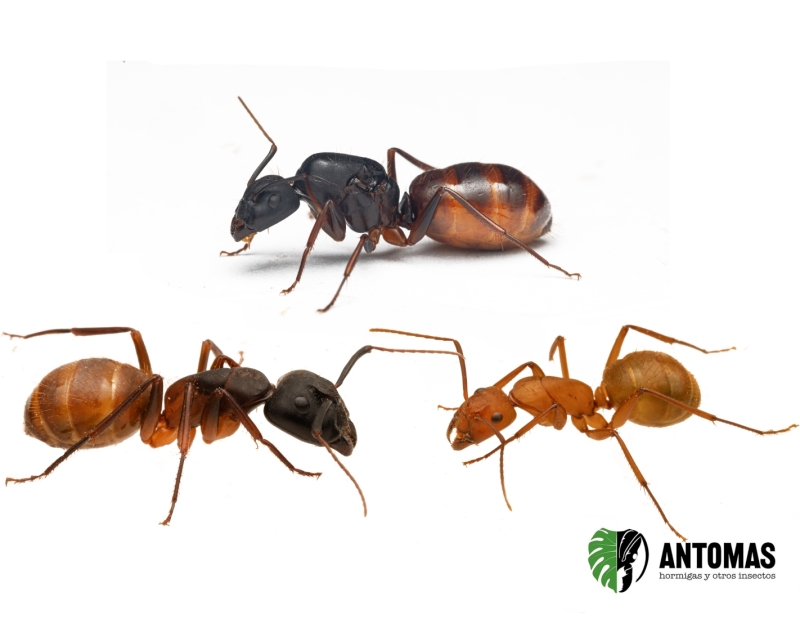
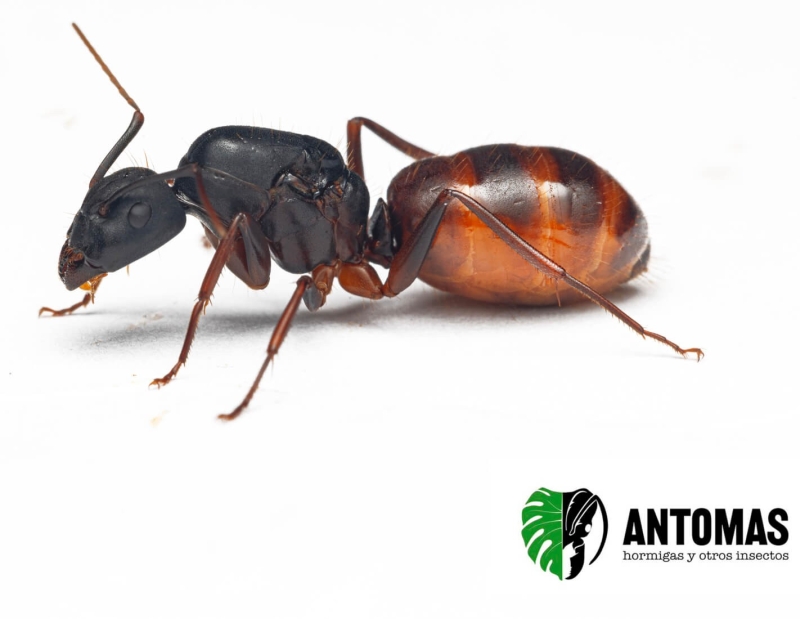
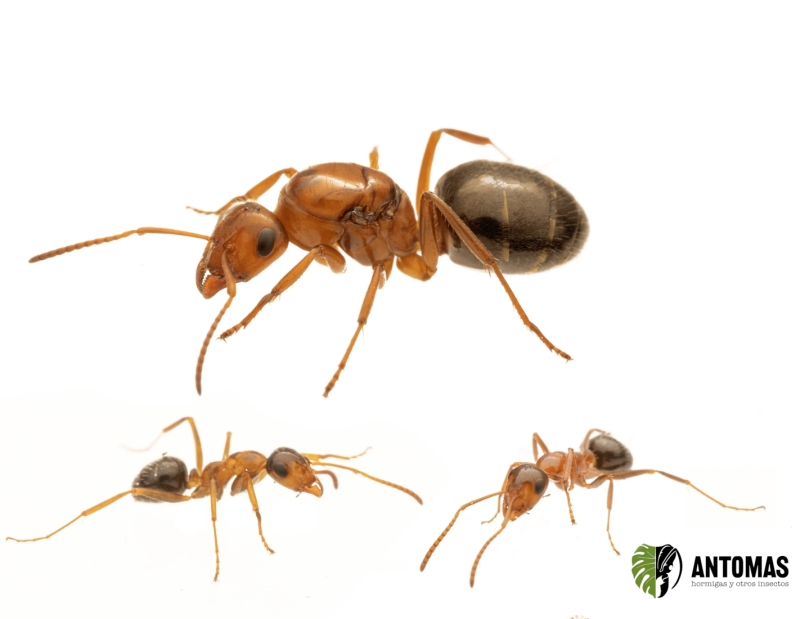
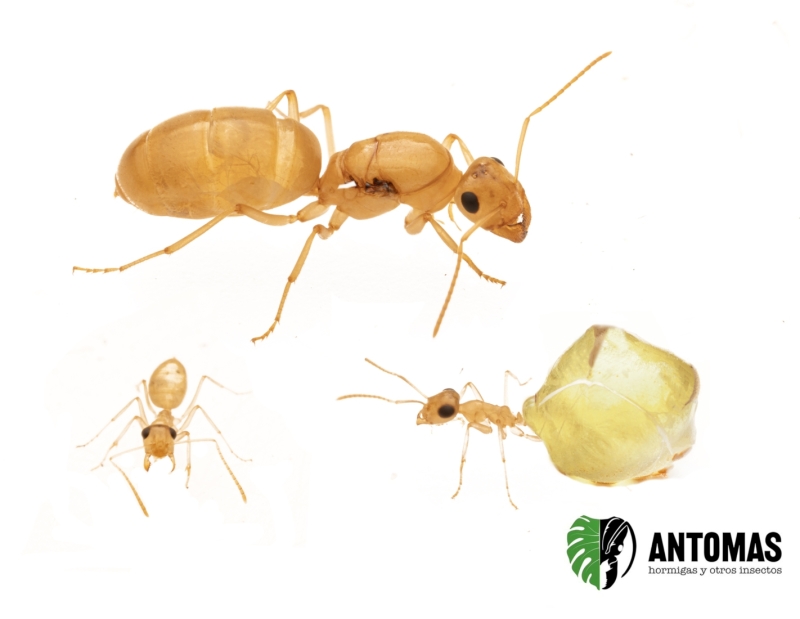
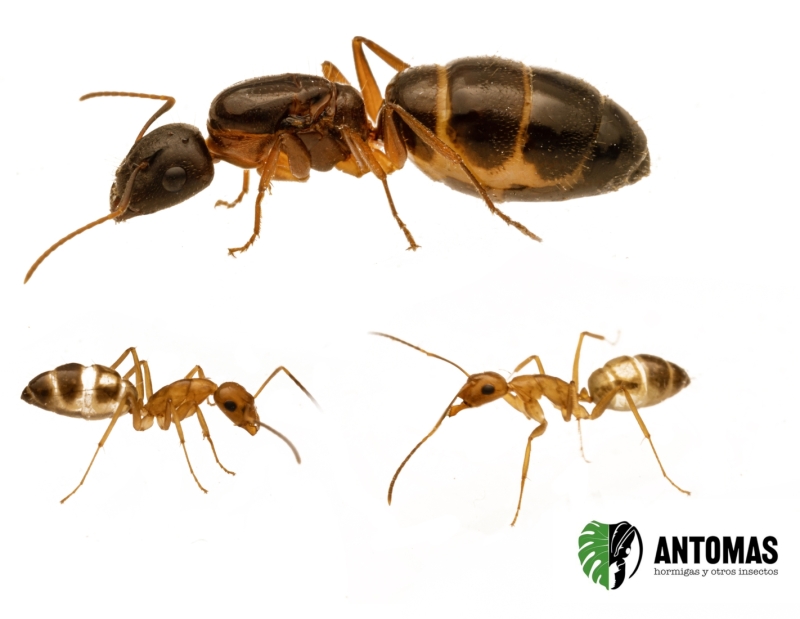
Camponotus fragilis Pergande, 1893 is a desert carpenter ant: a Camponotus in shades of yellow and orange, with a somewhat darker head and gaster, that lives in the dry, sandy soils of the south-western United States and north-western Mexico. By day it hides under stones; when the heat drops, it comes out to roam the desert. It belongs to the C. festinatus species complex, a group of relatives so alike that until 2006 nearly all of them were treated as a single species.
In the North American hobby it is one of the favourite Camponotus among keepers in California and Arizona: clean, curious, polymorphic and, above all, fast-growing for a Camponotus, as long as it is kept warm. In Europe it is rarely seen. In this care sheet we separate what is documented about C. fragilis and its complex, what keepers report and what we recommend at Antomas. The practical conclusion: with a dry nest, stable warmth and plenty of food, it is one of the best Camponotus to start with.
Biology
A species that went ‘missing’ for decades
It was described in 1893 by Theodore Pergande, an entomologist at the United States Department of Agriculture, from specimens collected on the Baja California peninsula in Mexico. But its name had little luck: for much of the 20th century it was considered a mere synonym of Camponotus festinatus (Buckley, 1866), the desert carpenter ant described by the naturalist Samuel B. Buckley. For most handbooks, C. fragilis simply did not exist.
Everything changed in 2006, when the myrmecologist Roy R. Snelling, of the Natural History Museum of Los Angeles County, thoroughly revised the so-called C. festinatus complex in the United States. Snelling explained that the group showed a ‘bewildering variety of forms’ across its range, and sorted it into six species: C. festinatus, C. vafer, two old names he rescued from oblivion (C. fragilis and C. pudorosus) and two new species (C. absquatulator, from California, Nevada and Baja California, and C. microps, from the Chiricahua Mountains of Arizona). To fix the name C. fragilis he designated a lectotype, a major worker from Pergande's original series that today serves as the reference for the species.
For this reason, studies earlier than 2006 on ‘C. festinatus’ in the south-western United States may refer to any of the species in the complex; when a piece of data comes from the complex and not specifically from C. fragilis, we say so. It is placed in the subgenus Tanaemyrmex, although the subgenera of Camponotus are awaiting revision, as the 2016 reclassification of the formicines acknowledged.
How do you tell it apart from its ‘twins’?
Separating the species of the festinatus complex is not a job for a mobile phone photo: they are very similar in size, shape and colour. In California, C. fragilis shares the ground with C. absquatulator: it lives at mid elevations on the margins of the low desert, while in the low desert of Imperial and Riverside counties it is replaced by its relative.
One of the characters in the key lies in the queen: the queen of C. fragilis has erect hairs along the entire margin of the head, and that of C. absquatulator does not. In workers you need to compare several castes from the same colony, looking at the pilosity and at the proportions of the head and eyes. North American forums are full of debates between fragilis, absquatulator and festinatus. The practical lesson: colour alone is not enough to identify it.
From the Sonoran Desert to the Mojave
C. fragilis is an ant of south-western North America. Its natural range covers southern California, Arizona and New Mexico (some sources also record it from Texas) and north-western Mexico, including the Baja California peninsula, where the original material came from, and several islands in the Gulf of California. In California it reaches north as far as the Mojave Desert and also occurs in the chaparral of San Diego County; in Arizona there are museum specimens from the deserts of the centre and south of the state and from the transition zones towards the Chihuahuan Desert.
It is an ant of desert and semi-desert scrub, with dry, sandy or stony soils, and not of the lowest and most extreme deserts but of their margins, at mid elevations.
Where does it nest? In the soil, almost always under a stone or another object that covers it, and also under dead wood. The stone acts as a roof, provides shade and holds some moisture, and the colony moves up or down its galleries in search of just the right temperature. A dry nest with spacious chambers and the water kept separate closely resembles what it chooses in the wild.
A climate of extremes: 40 °C by day, monsoon in summer
The climate of its range is hot desert, full of contrasts. As a guide, in the low and middle zones of the Sonoran Desert:
- April–June. Dry and increasingly hot; in May and June, afternoon relative humidity often drops below 15%.
- July–September. Highs of 38–41 °C and nights of 24–29 °C. The North American monsoon arrives, with afternoon storms and more humidity.
- October–November. It turns milder and dries out again.
- December–February. Highs of 18–20 °C and lows of 4–8 °C, with the odd frost and light rain; colder in the Mojave and at higher elevations.
Annual rainfall is around 200–300 mm. In summer the soil surface easily exceeds 60 °C, but a few decimetres down the temperature is far more stable. That is where the colony lives, under its stone.
For keeping, three conclusions: it likes warmth, it copes well with a dry nest as long as it has water to drink, and its winter is short and mild. And since it lives in our hemisphere, its seasons match ours (see ‘Short, mild diapause’).
Daughter of the desert night
In the wild, C. fragilis is considered a nocturnal species. Field observations in Arizona describe colonies that come out mainly at night, and its pale colouring fits that of many nocturnal desert ants. It makes sense: in summer, going out at midday onto ground at 60 °C would be suicide.
In captivity, many keepers see their colonies active during the day too: with no predators and a stable temperature, they have no reason to wait for nightfall, although they prefer dimly lit corners.
Nuptial flights after the monsoon storms
There is no published study on the nuptial flights of C. fragilis, but North American keepers have recorded them in detail. In one of the best-known keeping journals, the author caught alate queens in black-light traps on 24 July, on a hot night, at around ten o'clock, and on 3 August, at around eleven at night, after a storm. The next day he found an already dealate queen looking for a place to dig in next to a desert tree.
This is what you would expect from a monsoon ant: flights in high summer, at night and after storms, when the damp soil can be dug. These are hobbyist data, but consistent with its climate.
After the flight, the queen tears off her wings and seals herself in to found. Her founding is claustral: she does not go out to feed and raises her first workers solely on her body reserves. The same keepers report that not all queens start laying at the same time: some take a week and the odd one up to five before their first eggs.
The queen's protein larder
How can a queen spend weeks sealed in, without eating, and raise her first daughters? Part of the answer was discovered in the festinatus complex: in the 1990s, Diana E. Wheeler and her team at the University of Arizona studied, under the name C. festinatus, how queens prepare themselves:
- Before the flight, virgin queens build up proteins and fats in their fat body, and the protein is gradually used up during claustral founding.
- A large part of that reserve is made up of storage proteins called hexamerins. In virgin queens, one of them, Hex 2, accounts for close to 70% of the soluble protein in their fat body.
- These reserves begin to decline at the end of the claustral period, when the first workers emerge, and practically disappear about a month later.
The queen arrives at the flight with a genuine protein ‘larder’ and empties it to turn it into eggs and food for her first larvae. The team even sequenced Hex 2, a protein of 732 amino acids.
Workers have their own larder too: without larvae, they accumulate these proteins; when larvae appear, they devote them to the brood. The takeaway for the keeper: the queen founds with what she brings from home, but as soon as there are workers, the colony needs protein from outside (see ‘Feeding’).
One queen, one male… and sometimes several nests
How are its colonies organised? In 2005, Michael Goodisman and Daniel Hahn used genetic markers to study the C. festinatus complex and found a fairly classic system, with some interesting nuances:
- Laboratory colonies had a single queen. In the field, occasionally, several related queens reproduced within the same colony.
- Queens generally mate with a single male.
- Some colonies occupied several nests at once, spread across the ground.
- The different forms of the complex were genetically isolated, and colonies of the same form at different localities were very different from one another: gene flow between populations is limited.
This helps to explain why the group varies so much from place to place. At home, one colony, one queen: at Antomas we do not combine queens.
Minors, medias and majors
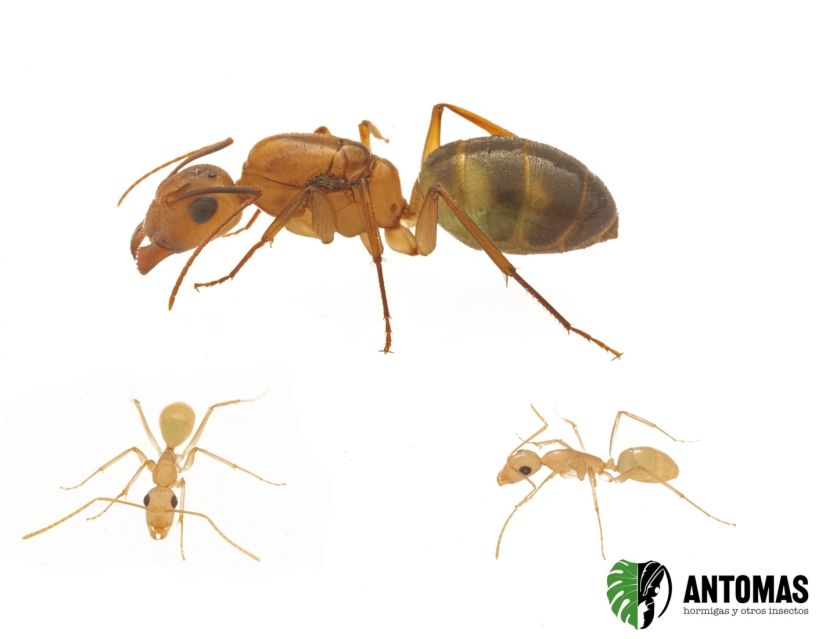
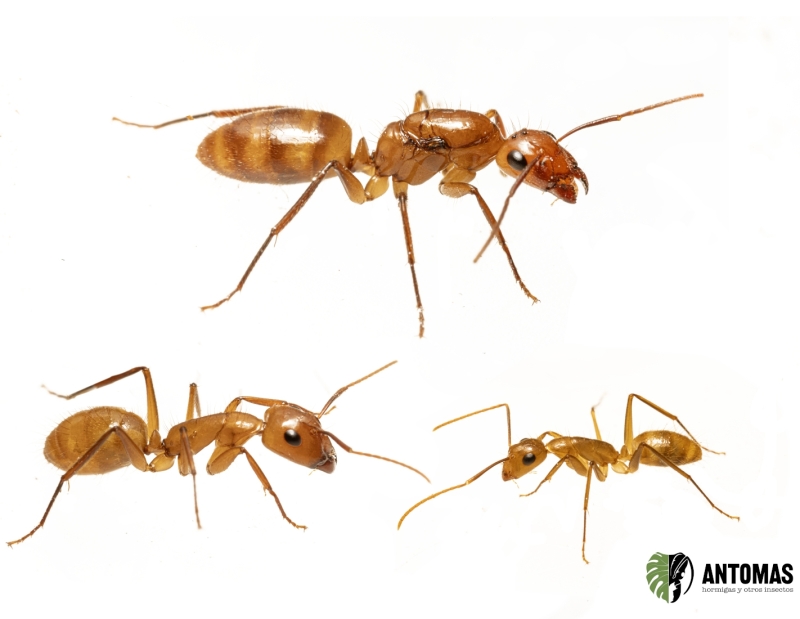
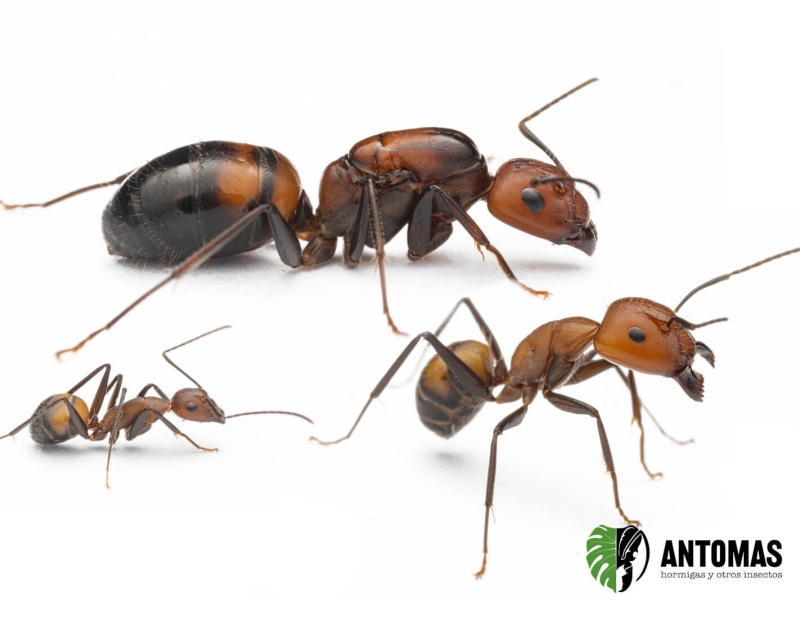
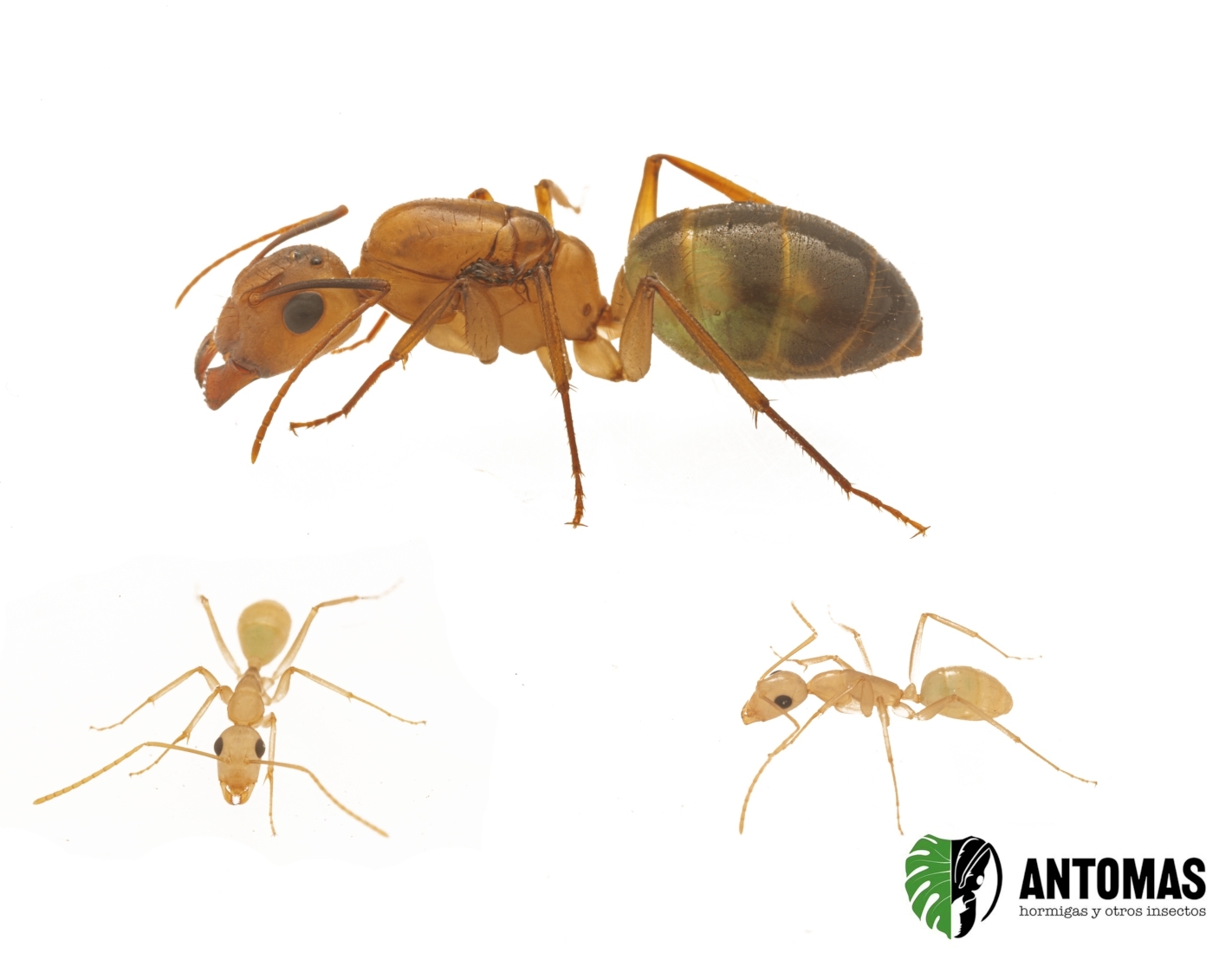
As a true Camponotus of the subgenus Tanaemyrmex, C. fragilis is polymorphic: in a mature colony, small, agile, narrow-headed minor workers live alongside media and major workers, with much larger heads and more powerful mandibles. The lectotype that fixes the name of the species is, precisely, a major.
And it comes early: in keeping journals, the first medias and small majors appear during the first year, with a few dozen workers. The minors explore; the majors come out mainly to dismember a large prey item or to defend the nest.
Gut bacteria: the laboratory versus the desert
C. fragilis has the honour of being one of the few North American Camponotus with a study devoted to its gut microbiota. In 2014, Hong He, Cong Wei and Diana Wheeler compared the bacteria of the crop, midgut and hindgut of laboratory-reared ants and of field-collected ants. The result was surprising:
- The laboratory ants had many more bacterial species in their gut: 12 and 11, depending on the method of analysis.
- The field ants had very few: 4 and between 1 and 3.
- Each section of the gut had its own dominant species.
The authors interpreted these bacteria as mainly commensals or mild pathogens. Our practical reading: hygiene matters, so remove leftovers and replace sugary liquids before they ferment.
Blochmannia and formic acid: a Camponotus's standard equipment
In addition, every Camponotus carries a permanent partner inside: the bacterium Blochmannia, which lives in cells of the midgut and in the queen's ovaries and passes from mother to daughters in the eggs. It produces almost all the essential amino acids and helps to recycle nitrogen; in C. floridanus, colonies without it and on a poor diet raised much less brood. According to a study published in Nature in 2020, the ant embryo integrates the bacterium into its own development.
Its weapon, like that of all formicines, is formic acid, which they spray from the acidopore at the tip of the gaster: they have no sting. In 2020 it was shown that formicines swallow their own venom while grooming, which keeps the crop highly acidic and filters out the microbes that come in with food. This was studied in C. floridanus and other formicines, not in C. fragilis, but it is a trait of the subfamily.
Mind you: having Blochmannia is no excuse to skimp on protein. Larvae need insects to grow.
Size and morphology
A medium-sized Camponotus, slender and long-legged, polymorphic, stingless and pale in colour.
- Colouring. Yellowish or orange, with a somewhat darker head and gaster. It is one of the palest Camponotus in the south-western United States, which is why in its home country it is informally known by its colour.
- Minor workers. Small, with a relatively narrow head and long legs: fast, nervous and great explorers.
- Media and major workers. Much larger, broader head, with strong mandibles. The lectotype of the species is a major.
- Queen. Robust, with the broad thorax typical of a claustral queen; according to Snelling's key, with erect hairs along the entire margin of the head, one of the traits that separate it from the queen of C. absquatulator. Keeping journals note that she is not a very large queen compared with the majors.
- Pilosity. The distribution of erect hairs is key to separating the species of the complex.
Approximate measurements
- Queen: no published measurements that we have been able to consult
- Minor and major workers: morphometric measurements in Snelling's redescription (2006); marked polymorphism, with majors having much broader heads than minors
- Male: no published measurements that we have been able to consult
We prefer not to give size figures without a scientific source: those circulating online almost always come from shops, with no known method or sample.
Care in captivity
Difficulty: 2/5 – Beginner
At Antomas we consider it a beginner species, and North American forums agree: keepers describe it as easy, clean and moderate to fast-growing, and one veteran counts it among the best species in the genus. It eats everything, makes do with a dry nest, its diapause is short and mild and its temperament is calm towards people.
Why not 1/5? Because of two details worth knowing:
- It needs real warmth. It is a desert ant. At the room temperature of a Spanish home in winter, a small colony stalls. Keepers agree: colonies that ‘don't grow’ usually take off as soon as they are given a thermostat-controlled heat source.
- They are fast climbers. The workers are agile, nervous and take advantage of any gap. You need to set up the escape barrier properly from day one (see ‘Escapes and barriers’).
And it is well worth it: rarely seen in Europe, warm-coloured, polymorphic from the first year and with growth that brings rewards early on.
Recommended parameters
- Nest temperature: 25–30 °C during the active season. This is the range in which keepers see their colonies grow well, and it matches the underground temperatures found in its range during the warm season.
- Hot spot: at one end of the foraging area or on one side of the nest it can reach around 32 °C, so that the colony can choose where to place the brood. Always with a thermostat and with cooler areas to retreat to.
- Humidity: a rather dry nest, with a slightly damp area at the start (see ‘Dry nest, water always’). The foraging area, dry.
- Water: always available, in a test tube with water and cotton wool in the foraging area.
- Light: simply leave them a dark area in the nest and the foraging area lit, with a normal day–night cycle.
- Diapause: short and mild, 2–3 months at 12–16 °C, in the depths of winter (see ‘Short, mild diapause’).
Avoid direct sunlight: in a closed container it heats the nest far beyond what they can tolerate, even though they are desert ants.
Dry nest, water always
This is the key to the set-up. C. fragilis lives in dry soils under stones and in captivity prefers a dry nest: that is why we recommend the Qbik Alpha range. But young colonies appreciate a damp area: when moving them into the nest, leave a water tube connected while the colony is small. After that, they regulate the humidity themselves with the water in the foraging area and the sugary liquids.
Dry does not mean without water: the tube in the foraging area must never be missing. What you must avoid is wetting the whole nest: with heat, excess humidity brings condensation, mould and mites.
Recommended formicaria
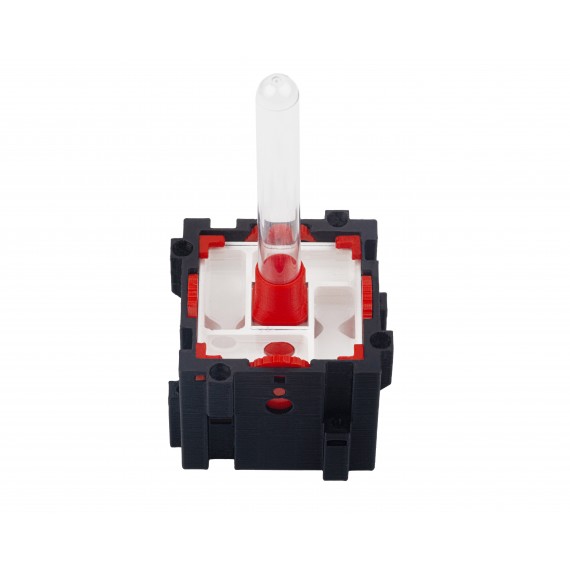
At Antomas we recommend the Qbik Alpha range by Anthouse: modular formicaria, on the dry side and suited to species from dry environments, that grow with the colony. For a colony like ours, with a queen and a few workers, the ideal starting point is a QBIK ONE:
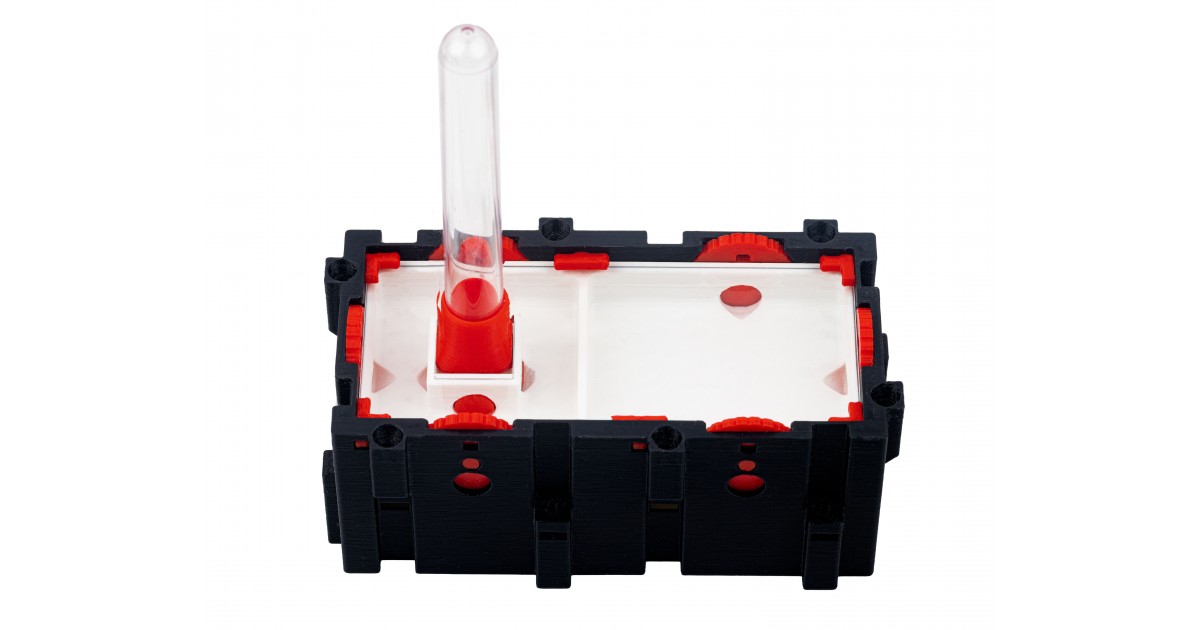
This species grows quickly when kept warm, so you will probably need to expand within the first year. For that, the QBIK DUO, and later the larger formats of the same range:
Expand when you see workers and brood crowded in the foraging area or the connections, not before: in an enormous nest, the spare chambers end up as rubbish dumps. Complete the set-up as follows:
- Escape barrier on the upper part of the walls of the foraging area and a well-fitting lid (see ‘Escapes and barriers’).
- Dry foraging area, with a little sand, a flat stone or two and a twig or piece of bark, with nothing that could act as a bridge to the barrier.
- Water always available, in a test tube with water and cotton wool.
- A feeder for sugary liquids, never on cotton wool (see ‘Feeding’).
- Thermostat-controlled heat on one side of the nest (heat cable or heat mat), away from the feeder, to create a gradient.
Founding and growth
At Antomas we sell colonies with a queen: a fertilised queen with 3–6 workers and brood, which has already come through the most delicate stage. Even so, it is worth knowing how it started:
- Claustral founding. The queen raises her first workers without going out to feed, on her body reserves (see ‘The queen's protein larder’).
- First workers. In keeping journals they emerge about 6–8 weeks after the queen is caught; the pupal stage lasts a little under a month. They are small, and size increases with each generation.
- Growth. In one of the most widely followed journals, the strongest colony went from its first worker, in September, to around 80 workers and its first small majors in June. In another, a colony of about 9 workers reached 70–100 in five months with a heated nest.
- Heat is what counts: colonies that stall usually take off as soon as they get stable warmth.
While it is still in the tube, check that the cotton wool is still damp and that there is water left, and offer a tiny drop of sugary liquid and a small piece of insect on a scrap of aluminium foil, removing the leftovers the next day. Never put the sugar on the cotton wool in the tube: it goes mouldy and spoils the water reservoir.
When should you move it into the nest? There is no need to wait: at Antomas we move them with just 3–6 workers into a nest suited to their size, such as the QBIK ONE, and sooner if the tube gets dirty or runs out of water.
Arrival and moving
When you receive your colony, let it rest in a quiet place at 26–28 °C and check that the tube has water. To move it into the formicarium, at Antomas we do it by tipping: we open the tube in the foraging area, next to the nest entrance, and gently tip out the queen, the workers and the brood, helping any stragglers with a paintbrush. Have the formicarium set up, with the barrier in place and the water tube connected, and work over a tray, because they are fast. With the nest dark and the heat on that side, they move in straight away. Use the same method for any move.
Feeding
Sugary liquids, always available. In the wild, desert Camponotus live largely on honeydew from aphids and scale insects and on plant nectar. Vary the sugars: at Antomas we recommend Blue Sugar nectar by Anthouse 4–5 times a week and another sugary liquid or nectar 1–2 times a week. You can also add a little protein to the nectar. Always offer them in a feeder and never on cotton wool, because cotton wool goes mouldy and spoils the liquid very quickly. Use a traditional or home-made feeder, where the drop stays ‘spread out’ and accessible, and replace it before it ferments; with the warmth this species needs, it ferments sooner.
Protein: the more, the better. It is the engine of their growth, and it is the Antomas philosophy: if you do daily maintenance and remove leftovers, it is better to overfeed, because the colony understands that it has more resources and grows faster and in greater numbers. If you will not be able to clean often, better not to overfeed: leftover food rots and brings mould and mites. Keepers of C. fragilis sum it up in one phrase: ‘fat ants are happy ants’.
Change the type of insect from one week to the next, so that they do not always eat the same thing. For small colonies, the firebrat, Thermobia domestica, is a perfect prey: small, soft and easy to dismember. Alternate with chopped crickets, small or chopped red runner roaches (Shelfordella), opened or chopped mealworms, flies and Drosophila. Keepers report that they love chopped mealworm and flies, and that some colonies turn their noses up at thawed cricket: if they do not like a prey item, try another or leave it next to the nest entrance. Buy insects from a reliable supplier: insects treated with insecticides can kill the colony.
Water: always, in the test tube with cotton wool in the foraging area. Even though their nest is dry, they must never be without drinking water, especially in the heat.
Short, mild diapause
In its range, winter is short and mild, with warm days and cool nights: neither the winter of a Central European Camponotus nor a tropical climate without seasons. That is why at Antomas we recommend a short, mild diapause:
- When and for how long: 2–3 months in the depths of winter, for example from mid-December to the end of February.
- At what temperature: 12–16 °C, as in an unheated room. Do not let it drop below about 10 °C.
- How: remove the heat and lower the temperature gradually, over one or two weeks, and raise it the same way at the end.
- During diapause: water always available, a little sugary liquid and little or no protein. Disturb the colony as little as possible.
- When it ends: put the heat and protein back as soon as you see activity. With spring, the queen resumes laying in earnest.
This is our own recommendation, based on the climate of its range: there is no study on the diapause of C. fragilis, and on forums opinions range from those who skip it altogether to those who cool it like a northern species.
A warning from the forums: what suits them worst is a halfway house. One keeper removed the heat from his colony in winter, without reaching a proper diapause, and the workers started eating the brood. Either heat and food, or a clear, cool and stable diapause.
Behaviour in captivity
Fast, curious and a little nervous. The workers move quickly, sometimes in jerks, explore the whole foraging area and sometimes drum their gaster against the floor, an alarm signal typical of Camponotus.
Calm towards people. Not very aggressive: they would rather flee than attack. If the nest is opened or knocked, they come out to defend it, bite and may spray formic acid.
Watch without fear. At Antomas we believe ants are there to be enjoyed, watched and learned from, not kept hidden away. Simply leave them their dark area in the nest and the foraging area lit, and watch them gently, intervening and stressing them as little as possible. They get used to your presence.
Warning signs:
- Brood that stalls or never reaches the pupal stage: almost always a lack of heat or protein.
- Workers eating the brood in the cold: neither heat nor diapause; choose one or the other.
- Condensation on the walls or mould: too much humidity or forgotten leftovers.
- Lots of workers and brood crowded outside the nest: time to expand.
Escapes and barriers
C. fragilis climbs well on glass and plastic, and its workers are fast: if they find a way out, they take it. One keeper even reports that his workers managed to get past a strip of PTFE. That is why at Antomas we recommend two lines of defence:
- An escape barrier on the upper part of the walls of the foraging area: a thin, continuous strip of paraffin oil or liquid Vaseline, or of PTFE (Fluon). Renew it when you see it collecting dust or debris.
- A well-fitting lid, as a second line, always in place.
- No gaps: check the connections, stoppers and tubes.
- Nothing that could act as a bridge: no twigs or stones leaning near the barrier.
- Take care when opening: open only as much as needed, work calmly and close up when you have finished. They are fast.
With the barrier, the lid and everything properly fitted, they cause no trouble.
Handling and safety
They cannot sting: they have no sting. If they feel attacked, they bite and may spray formic acid, which stings a little on sensitive skin or a small cut. Nothing to worry about if you work calmly. Handle them with entomological tools (a soft paintbrush or soft forceps), not with your hands, and work slowly so as not to lose or injure any worker, let alone the queen. Do not combine queens or different colonies, or keep them with other species. It is an exotic species: under no circumstances should it be released.
What not to do
- Keep it cold or at a low room temperature during the active season: without heat, it stalls.
- Heat without a thermostat or put the formicarium in the sun: heat must always be controlled and with cooler areas.
- Wet the whole nest: dry nest, with a damp area only at the start, and water always in a tube.
- Go halfway in winter: either heat and food, or a clear diapause of 2–3 months at 12–16 °C.
- Give it a cold, long diapause, as you would a species from northern Europe.
- Leave gaps, loose connections or the lid open: they climb and they are fast.
- Move it into a nest too large for its size.
- Put sugary liquids on cotton wool or let them ferment.
- Always give them the same insect or leave leftovers uncleaned.
- Combine queens or different colonies.
- Handle them with your hands.
Scientific sources
This care sheet has been compiled from the scientific literature on Camponotus fragilis, the C. festinatus complex and its genus, from distribution records and climate data for its range, and from the experience of Antomas and other keepers. Main references:
- Snelling, R. R. (2006). Taxonomy of the Camponotus festinatus complex in the United States of America (Hymenoptera: Formicidae). Myrmecologische Nachrichten 8: 83–97. PDF (no DOI)
- He, H., Wei, C. & Wheeler, D. E. (2014). The gut bacterial communities associated with lab-raised and field-collected ants of Camponotus fragilis (Formicidae: Formicinae). Current Microbiology 69: 292–302. doi:10.1007/s00284-014-0586-8
- Goodisman, M. A. D. & Hahn, D. A. (2005). Breeding system, colony structure, and genetic differentiation in the Camponotus festinatus species complex of carpenter ants. Evolution 59: 2185–2199. doi:10.1111/j.0014-3820.2005.tb00927.x
- Wheeler, D. E. & Buck, N. A. (1996). Depletion of reserves in ant queens during claustral colony founding. Insectes Sociaux 43: 297–302. doi:10.1007/BF01242930
- Martinez, T. & Wheeler, D. E. (1994). Storage proteins in adult ants (Camponotus festinatus): roles in colony founding by queens and in larval rearing by workers. Journal of Insect Physiology 40: 723–729. doi:10.1016/0022-1910(94)90100-7
- Martinez, T. & Wheeler, D. E. (1993). Identification of two storage hexamers in the ant, Camponotus festinatus: accumulation in adult queenless workers. Insect Biochemistry and Molecular Biology 23: 309–317. doi:10.1016/0965-1748(93)90013-I
- Martínez, T., Burmester, T., Veenstra, J. A. & Wheeler, D. E. (2000). Sequence and evolution of a hexamerin from the ant Camponotus festinatus. Insect Molecular Biology 9: 427–431. doi:10.1046/j.1365-2583.2000.00204.x
- Ward, P. S., Blaimer, B. B. & Fisher, B. L. (2016). A revised phylogenetic classification of the ant subfamily Formicinae (Hymenoptera: Formicidae), with resurrection of the genera Colobopsis and Dinomyrmex. Zootaxa 4072: 343–357. doi:10.11646/zootaxa.4072.3.4
- Feldhaar, H. et al. (2007). Nutritional upgrading for omnivorous carpenter ants by the endosymbiont Blochmannia. BMC Biology 5: 48. doi:10.1186/1741-7007-5-48
- Rafiqi, A. M., Rajakumar, A. & Abouheif, E. (2020). Origin and elaboration of a major evolutionary transition in individuality. Nature 585: 239–244. doi:10.1038/s41586-020-2653-6
- Tragust, S. et al. (2020). Formicine ants swallow their highly acidic poison for gut microbial selection and control. eLife 9: e60287. doi:10.7554/eLife.60287