Difficulty: 3/5 – Advanced
A harvester ant from south-western North America, famous in science because, in some populations, several unrelated queens found a colony together and live side by side for life. Founding queens with brood, alone or in groups of 2 or 3; the groups are kept just as they arrive, without adding or separating queens. Semi-claustral founding: the queen needs to eat, so she is raised in a tube with a mini-arena. Then a QBIK ONE with medium galleries, a dry granary and a humid area, 26–30 °C, varied seeds and plenty of protein, and a diapause of 3–4 months at 10–15 °C. Powerful sting: a mineral oil barrier and handling with tools.
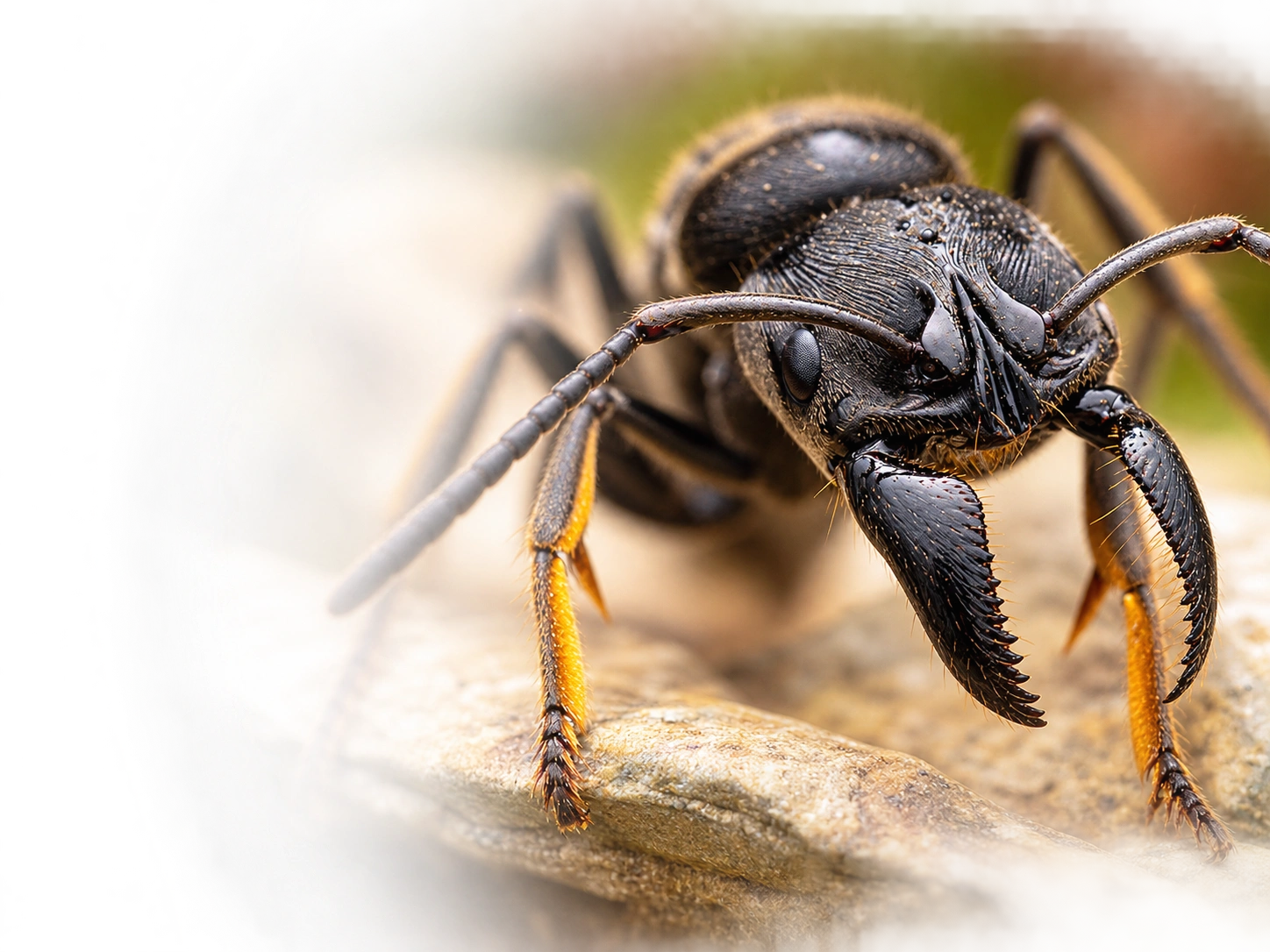
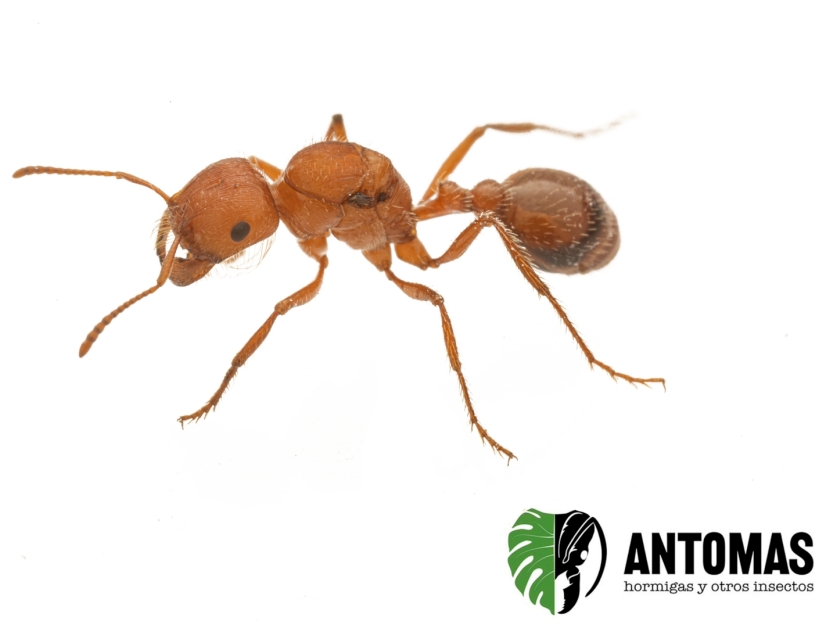
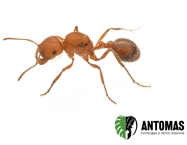
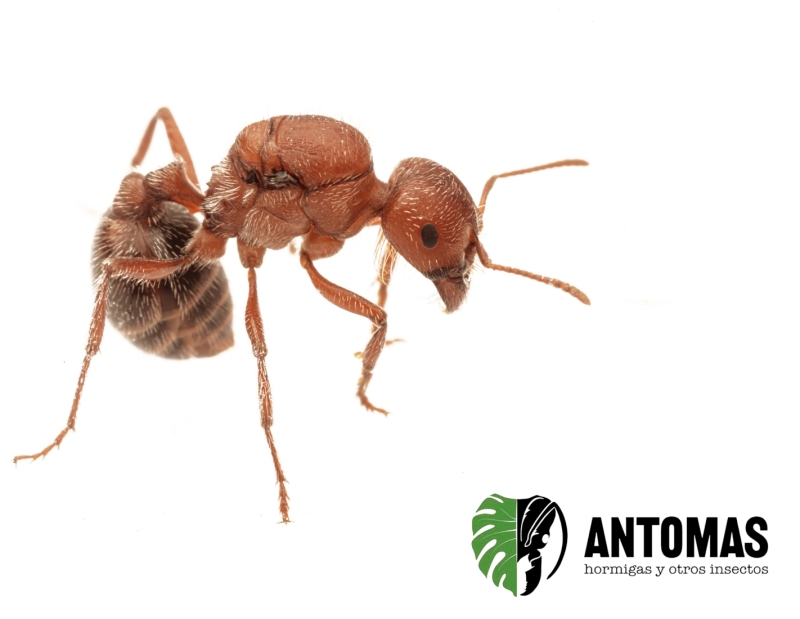
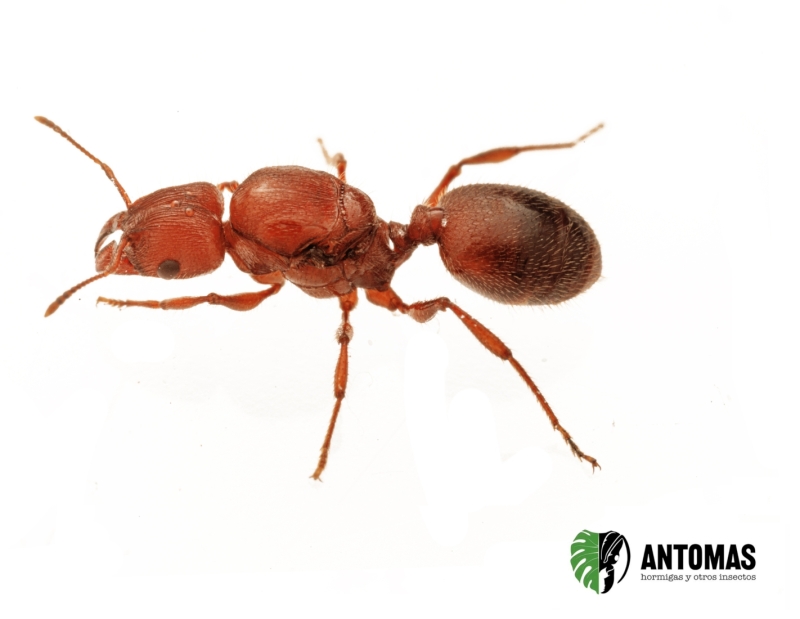
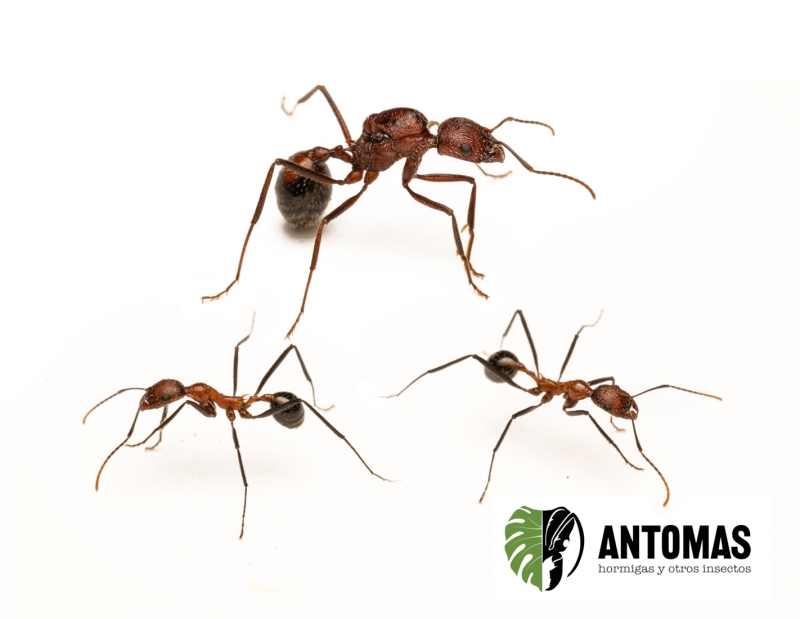
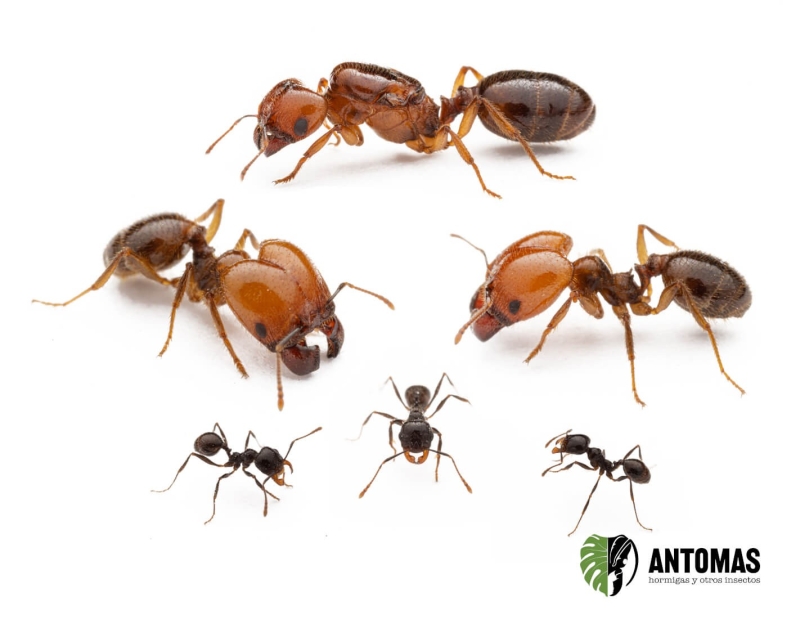
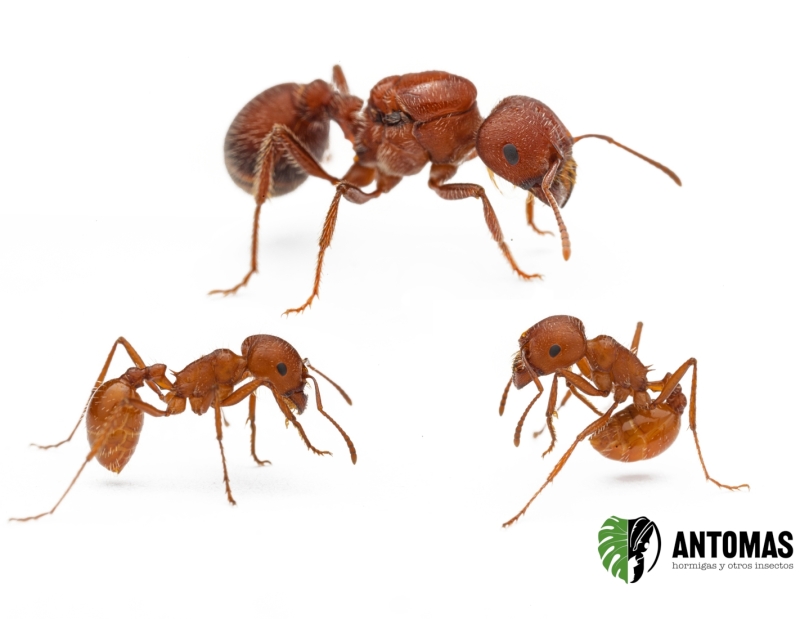
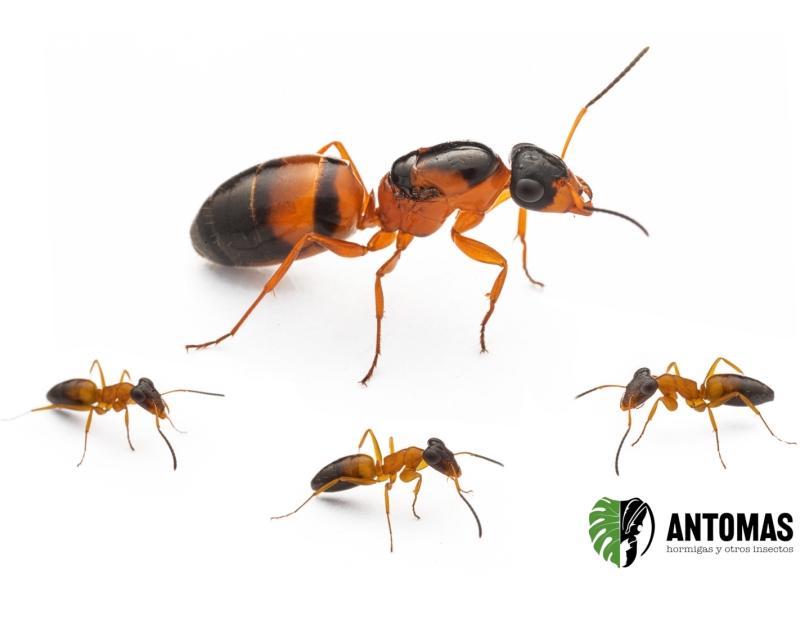
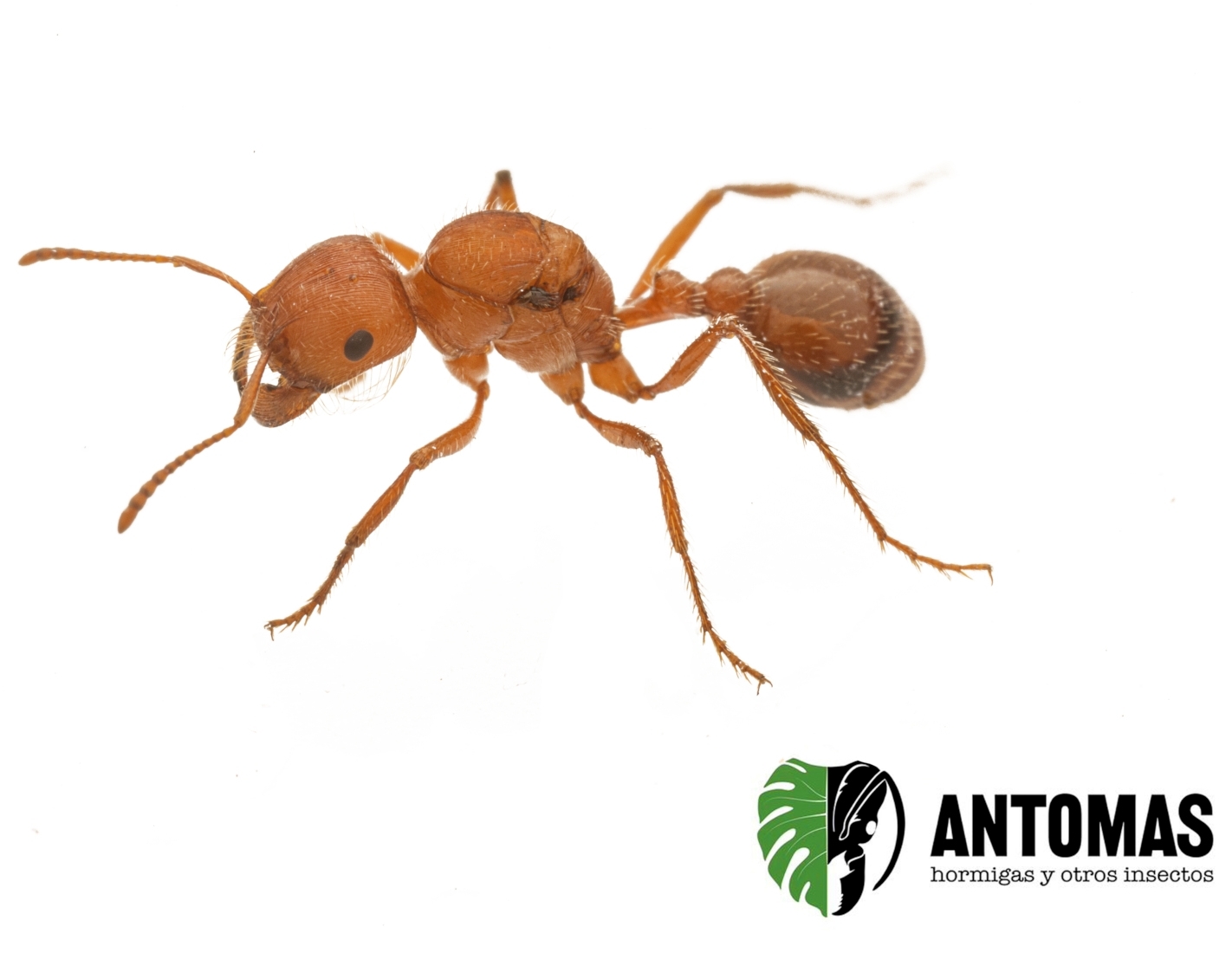
Pogonomyrmex californicus (Buckley, 1867) is a harvester ant from the south-western United States and north-western Mexico: a robust myrmicine, an intense rusty red, with a “beard” of long hairs under its head and a sting that commands respect. It lives in California, Arizona, Nevada, Utah, New Mexico and western Texas, and in Baja California, Sonora and Chihuahua. It occupies open, well-drained ground, such as creosote bush scrub (Larrea tridentata), desert plains, grasslands and chaparral, from the scorching low deserts to the mountains of southern California, where winters bring frost. It nests in the soil, often sandy, with chambers for the brood and for the seeds.
In the hobby it is just another harvester ant, but in the laboratory it is a star: Arizona State University uses it as a model species, and its complete genome was published in 2021. The reason is a social rarity. Across most of its range, each colony has a single queen, but in some populations of southern California and northern Baja California several queens that are not related found a colony together and live side by side for life. And there is more: it withstands over 51 °C, sows the desert, a great astronomer wrote about it and several Native peoples of California swallowed it alive to have visions.
Biology
Queens who make a pact for life
In almost all ants, when several queens found a colony together, something known as pleometrosis, the alliance is short-lived: when the first workers emerge, the queens fight or the workers eliminate them until only one remains. P. californicus breaks that rule in some populations. There, newly mated queens that are unrelated to one another team up underground, raise the first generation together and, once there are workers, carry on laying eggs together. This is primary polygyny: a colony with several queens from day one, and for good.
The myrmecologist Robert A. Johnson confirmed it in long-term experiments published in 2004: these associations are not reduced to a single queen when the workers emerge. Genetic studies later confirmed that the co-foundresses are not related and that this pleometrosis gives rise to adult colonies with several queens, and in 2024 an international team summed it up as a “lifelong” tolerance between unrelated queens. Founding groups range from 2 to more than 50 queens, and in the best-studied cooperative population there are on average about 4 queens per nest, both at founding and in mature colonies. How many years this cohabitation lasts has not been measured, because nobody knows how long a queen of this species lives either.
Two populations 50 km apart, two different societies
Most astonishing of all, this cooperative society is local. Across most of its range, the species founds colonies with a single queen and its colonies are monogynous. Pleometrosis appears only in some populations, and the contrast between neighbours can be stark: in one cooperative population, 35 of 47 founding nests had several queens; in another, only about 50 km away, just 1 of 17. The queens from each site also have a different temperament: those from solitary-founding populations are considerably more aggressive towards other queens and escalate conflicts sooner.
Why cooperate with strangers? A 2018 study found that, at a site dominated by multi-queen colonies, colonies reproduced less and had more neighbours, but with extra food they matched those at a site of single-queen colonies. Cooperation seems to be a response to harsh, saturated environments, where a lone queen has hardly any chance.
Together they survive: 26 out of 30 versus 3 out of 30
The figures are compelling. In 2021, a team from Arizona State University founded colonies in the laboratory, at 30 °C, with queens from a cooperative population: 30 with one queen, 30 with two and 30 with four. After 10 months, still alive were:
- 26 out of 30 four-queen colonies;
- 20 out of 30 two-queen colonies;
- and only 3 out of 30 single-queen colonies.
The multi-queen colonies also grew much faster: they took 70 days to reach 10 workers with four queens, 102 with two and 184 with one. And the group advantage lasted well beyond the founding stage.
So the more, the better? No. In 2022, another study with queens from the same population compared groups of 1, 3, 6 and 9 foundresses over 50 days. Groups of 3 and 6 were the best at turning eggs into workers, with 0.86 and 0.66 workers per foundress at 50 days, compared with 0.20 in groups of 9, where many queens spent their time idle. The first workers emerged around day 33–36 in all groups. The lone queens from that population did not raise a single worker: they lived for 15.8 days on average.
The foundress’s dilemma: the aggressive queen wins, the group loses
Cooperating does not mean living in harmony. In 2016, a study followed 384 newly mated queens in glass nests, alone and in groups. In the groups there was aggression, which caused 20 % of queen deaths, 46 out of 229, and the aggressive queen came out on top: she was the last survivor in 15 of the 27 nests with aggression. But groups without aggression survived better as a group. This is “the foundress’s dilemma”: within each nest, fighting pays off for the queen who fights; between nests, peaceful groups win. The authors interpret it as group selection in favour of cooperation.
The practical lesson, which we will repeat in the care section, is clear: never put queens together yourself or add queens to a colony. Cohabitation is built between queens that found the colony together from the start, and a foreign queen is an invitation to a fight.
Queens who share the work
Founding a colony means digging, going out to find food and caring for the brood. Who does what when there are several queens? In 2004, Sara Helms Cahan and Jennifer Fewell paired up queens from each type of population. Pairs of queens from solitary-founding populations split the work very unevenly: one dug or foraged and the other hardly did. Those from a cooperative population, by contrast, shared the tasks far more evenly. Where queens live together, evolution has favoured those who pull their weight equally, not a boss-and-subordinate arrangement. With a group of 2 or 3 queens at home, it is easy to see them tending the brood at the same time.
A supergene in the making and a complete genome
There is genetics behind these two societies. In 2024, an international team compared queens from a cooperative population and from a solitary-founding one and found a region of the genome of about 8 million base pairs, with 682 genes, in which recombination has almost disappeared. It comes in two versions, one common in cooperative queens and the other in solitary ones: everything points to a young supergene, a block of genes inherited as a whole, like those that control social organisation in the fire ant. It is not a perfect switch: 85 % of the cooperative queens carried two copies of the “cooperative” version, and 93 % of the solitary ones at least one of the “solitary” version. The authors believe many more genes are involved.
All this is possible because its complete genome has been assembled and annotated since 2021. Few ants kept at home can boast anything like it.
Queens who go out shopping
Many harvester ants of the genus, such as P. rugosus and P. maricopa, found their colonies claustrally: the queen shuts herself away and raises her first workers on her reserves, without going out. Not P. californicus: its founding is obligately semi-claustral. Johnson demonstrated it in 2002: its queens are small for the genus, have low fat and protein reserves and, to raise their first workers, have to go out and find food. In return, they raise a larger first generation. It even shows in the architecture: their founding nests are shallower and less enclosed than those of claustral species, but more branched, the nest of a queen who intends to go out.
Unlike other North American harvester ants, it does not wait for the monsoon rains to fly either. Its nuptial flights take place in early summer: according to Johnson, in late May and early June in Arizona, and in late June and early July in California. Johnson even suggested, at a conference, that these differences in timing, behaviour and physiology could be the beginning of a split into separate species; it remains an open hypothesis.
For a keeper, the consequence is direct: a queen of this species needs to eat. Shutting her away for weeks in a tube with no food, as is done with claustral species, is a death sentence. That is why, at Antomas, founding is done in a tube with a mini-arena (see “Founding: queens with brood, alone or in groups”). Some shops describe it as claustral or say it flies after the monsoon: both are mistakes.
It withstands 51.7 °C
Desert harvester ants work on some of the hottest ground on the planet. In 2004, Lighton and Turner measured the critical thermal maximum of P. californicus, the temperature at which an insect loses coordination, with an objective method based on its respiration: 51.7 °C, the same as P. rugosus, with which it shares territory. And its social life shows up here again: in a 2022 study, workers from multi-queen colonies tolerated more heat, and more uniformly, than those from single-queen colonies, which could allow them to forage for longer in the middle of the day. Resistance to desiccation, on the other hand, depends on the size of the worker: the large ones hold out longer.
There is no need to roast them at home: underground, the nest buffers the heat (see “Recommended parameters”).
A beard for carrying sand
Pogonomyrmex comes from the Greek pogon, “beard”, and myrmex, “ant”. The beard is the psammophore, a row of long, curved hairs under the head that works like a basket: with it, the workers carry sand and soil when digging and take it out of the nest. In P. californicus it is visible to the naked eye, and in a formicarium with a little sand in the foraging area it is one of the species’ most curious sights. The species name means “from California”; it was described in 1867 by the American naturalist Samuel B. Buckley.
Gardener of the desert
It lives mainly on seeds, but it does not collect just anything, or in just any way:
- It chooses so as not to fight. In the Chihuahuan Desert, Walter Whitford found in 1978 that it picked seed species that allowed it to avoid contact with other Pogonomyrmex.
- It counts the time. In a 1987 experiment with oats of three sizes, the colonies did not simply go for the biggest grains: they tended to obtain the maximum energy per unit of time, as optimal foraging theory predicts.
- It also hunts. It collects and hunts small arthropods, a key source of protein for the brood.
And, along the way, it sows. In the Colorado Desert, the Californian end of the Sonoran Desert, Dennis O’Dowd and Mark Hay studied its relationship with Datura discolor, a desert plant of the nightshade family, in 1980. The workers carry the seeds off for a nutritious appendage, make use of it in the nest and throw the intact seed onto the midden, an average of 2.3 m from the parent plant. That journey saves it: under the plant’s canopy, rodents took about 10 times more seeds. It is a textbook mutualism, although daturas are highly toxic and have no place in a formicarium.
War between neighbours
Its colonies do not get on with their neighbours. In the Mojave Desert, De Vita observed in 1979 that, after fights between colonies, the workers returned to the nest and stayed inside for a long time, and the colony collected fewer seeds: war does not just kill, it also paralyses. In another study, from 1986, its nests were more evenly spaced than chance would predict, the typical pattern of competition, and the data suggested that established colonies eliminate queens trying to found nearby.
It also has specialised enemies. The horned lizards (Phrynosoma) of south-western North America feed mainly on harvester ants, and in southern California the invasive Argentine ant displaces native ants and leaves the lizards without their main food. Against P. californicus, the Argentine ant uses chemistry: it sprays it with irritant compounds, the iridoids.
The ant that gave visions
Few ants have a cultural history like this one. Among several Indigenous peoples of south-central California, above all the Kitanemuk, the Kawaiisu, the Tübatulabal and the Interior Chumash, young people swallowed live red harvester ants, unchewed and in huge quantities, often more than 400, to fall into a prolonged state of unconsciousness. In that trance, guardian spirits, the “dream helpers”, appeared to them and could stay with them as allies for life. Further south, boys went through an initiation rite lying on an ant nest, covered in ants, to toughen them up. And the ants were used as a remedy for paralysis, rheumatism and other pains.
Which ant was it? In 2001, the anthropologist Kevin Groark confirmed it: a 1933 note by the ethnographer John P. Harrington identified it as Pogonomyrmex californicus, and the specimens Harrington had collected turned up in the Smithsonian’s collection. For Groark, it is the only well-documented case of the widespread use of an insect as a hallucinogen. Some Yokuts groups called it k’awk’aw, “crazy ants”. This is history, not a suggestion: its venom is highly active (see “Handling and safety”).
An astronomer among ants
In 1920, the journal PNAS published a report on some very rare workers of P. californicus, pterergates: workers with small wing stubs, halfway between worker and queen. It was signed, from the Mount Wilson Observatory, by Harlow Shapley, one of the great astronomers of the 20th century, the man who showed that the Sun is not at the centre of the Milky Way and who, that same year, took part in the “Great Debate” on the size of the universe. Shapley was passionate about ants, and in his spare time at the observatory he also measured how the speed of workers on their trails changes with temperature.
Size and morphology
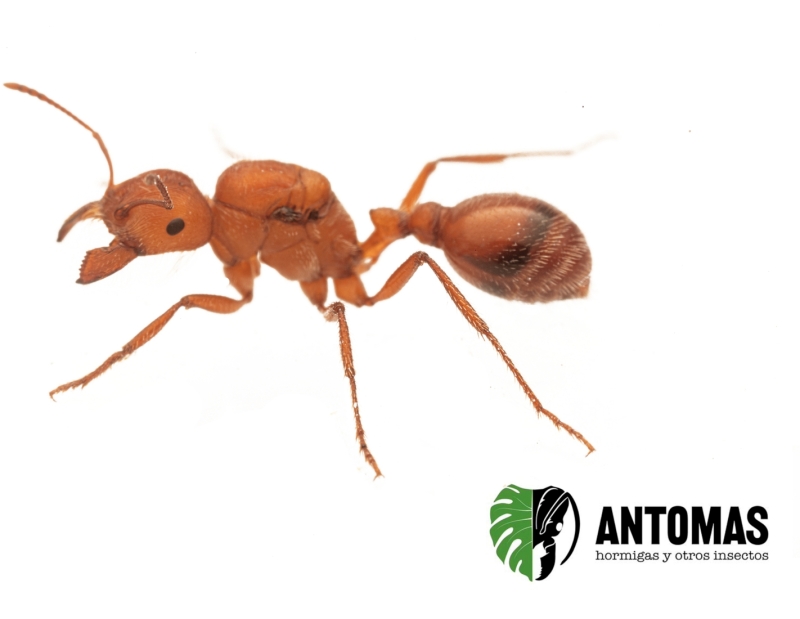
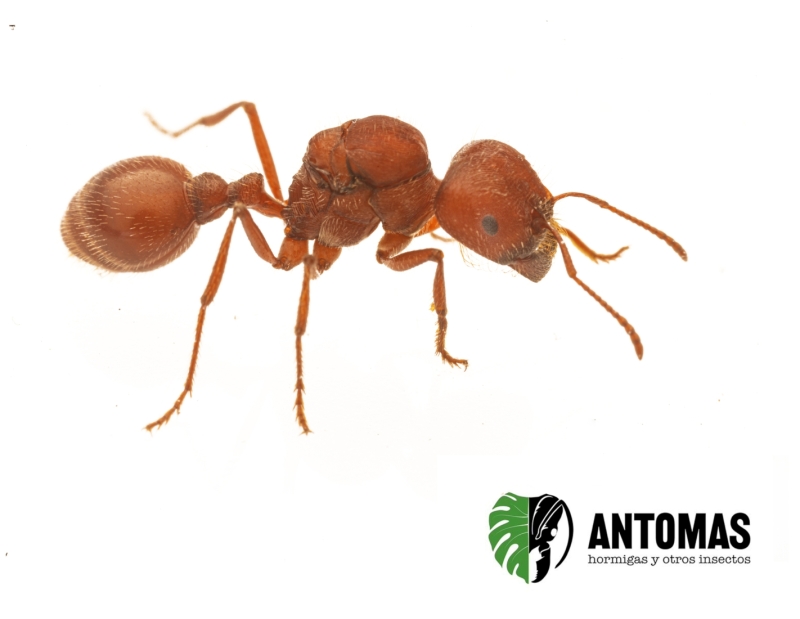
A robust myrmicine, with a single worker caste that varies somewhat in size, no soldiers and armed with a sting.
- Colour. From rusty red to orange-red. According to Cole’s 1968 revision of the genus, the colour changes gradually from one region to another: some populations are almost uniformly red and others, inland, have a darker gaster, even brown or black.
- Colour of our colonies. A uniform orange rusty red, with the gaster slightly darker towards the tip.
- Head. With well-marked longitudinal striations, strong mandibles and the psammophore clearly visible underneath.
- Workers. Monomorphic: there are no huge-headed soldiers, as in Messor, although some workers are somewhat larger than others.
- Queen. Small for her genus and with little fat, which is linked to her semi-claustral founding.
- Male. Winged; we have not found any description with measurements.
- Development. As in all myrmicines, the pupae are naked, without a cocoon. At 30 °C, the first workers emerge around day 33–36 after founding.
Approximate measurements
- Workers: mean head width, 1.63 mm
- Total length of workers: no published scientific measurements
- Queen and male: no published scientific measurements
The head width comes from a 2002 study. The lengths in millimetres given by some shops do not come from published measurements, so we prefer not to give them: this species has been studied in depth for its behaviour and genetics, but hardly at all for its measurements.
Care in captivity
Difficulty: 3/5 – Advanced
An established colony is hardy, easy to feed and very rewarding to watch. But getting there takes some experience:
- Semi-claustral founding. The queen needs to eat: you have to set her up with a tube and a mini-arena, feed her and clean carefully from day one.
- Heat and granary. It grows well at 26–30 °C and needs a nest with a humid area for the brood and a dry granary.
- Queens in groups. They are kept just as they arrive: putting queens together or adding queens can end in fights to the death.
- The sting. It is powerful, as in all Pogonomyrmex, and means working with tools and an escape barrier.
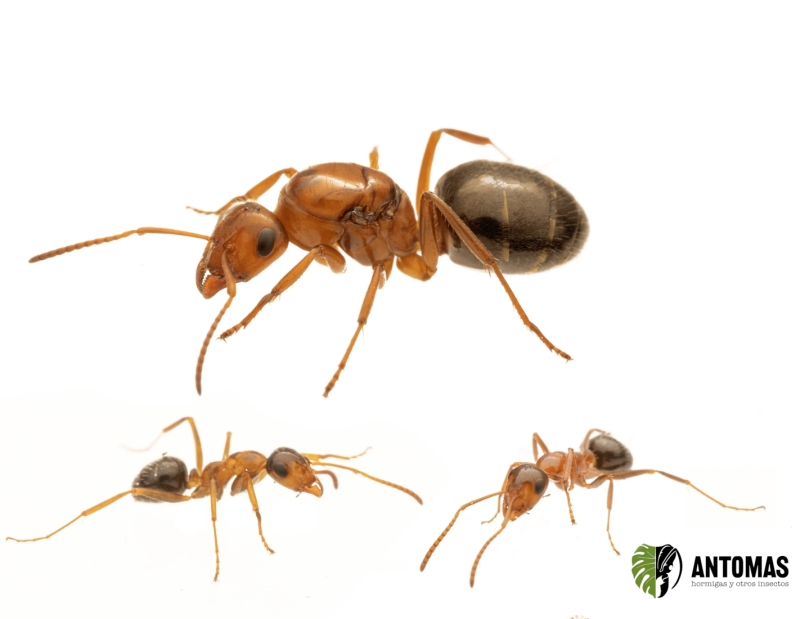
And it is well worth it. You will see the workers carrying sand with their beards, filling the granary and pouncing on an insect, and, with a group of queens, you will have one of the rarest societies in the ant world at home. If the genus appeals to you, at Antomas you will also find Pogonomyrmex badius, Pogonomyrmex bicolor and Pogonomyrmex rugosus hybrid.
Recommended parameters
- Nest temperature: 26–30 °C in the active season. Laboratories keep their colonies at a constant 30 °C, or at 35 °C by day and 26 °C by night, and keepers agree that below about 24 °C growth slows down a lot. If needed, gentle heat on one side of the nest, with a thermostat.
- Humidity: a humid area for the brood, without waterlogging, and a dry granary; the foraging area, dry. What matters is that the seeds do not get wet.
- Water: always available, in a test tube with water and cotton wool in the foraging area.
- Light: it is enough to leave them a dark area in the nest and a lit foraging area, with a normal day–night cycle.
- Diapause: about 3–4 months, roughly from December to February, at 10–15 °C (see “Diapause”).
Recommended formicaria
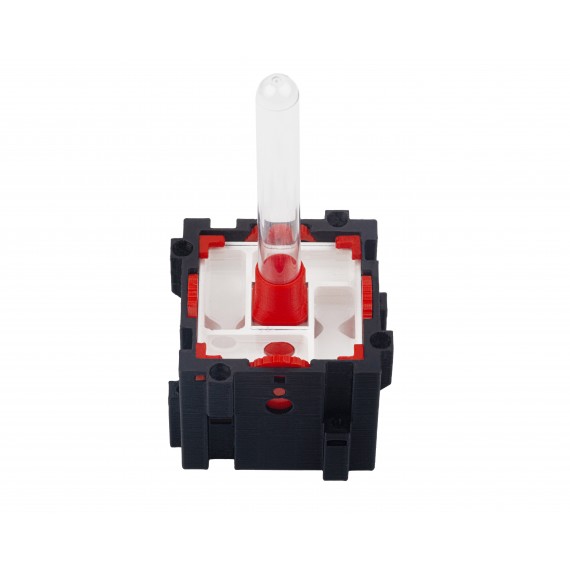
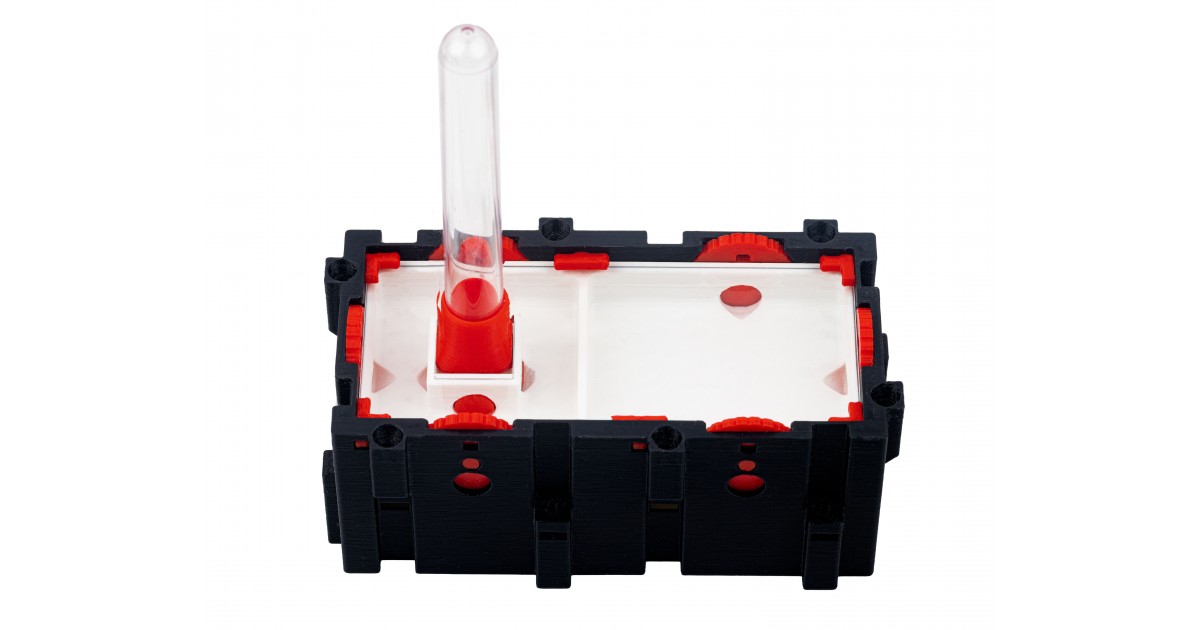
At Antomas we recommend the Qbik Alpha range by Anthouse, the same as for Messor: modular, rather dry formicaria that grow with the colony and in which it is easy to separate the humid brood area from the dry granary. To start with, a QBIK ONE with medium galleries:
When the colony grows, the next step is the QBIK DUO, followed by the larger formats in the same range:
Expand when you see lots of workers standing still in the foraging area, with no room inside; a nest that is too big for a small colony ends up with chambers turned into middens, mould and mites. Complete the set-up like this:
- Humid area and dry granary. Moisten only the part of the nest meant for the brood; the colony quickly learns to store the grain in the dry area.
- Sand in the foraging area. A thin layer of dry sand lets them use their psammophore and set up their midden.
- Water in a test tube with cotton wool, never open water: they can drown.
- A feeder for sugary liquids, never on cotton wool (see “Feeding”).
- A mineral oil barrier and a well-fitting lid (see “Escapes and barriers”).
Founding: queens with brood, alone or in groups
At Antomas we sell founding queens with brood: single queens or groups of 2 or 3 queens that have already started their colony, with eggs, larvae or pupae. As founding is semi-claustral, the key is that the queens can go out to eat. That is why we recommend a tube with a mini-arena:
- The tube is the brood chamber. Keep it as it arrives, with its water reservoir behind the cotton wool, in the dark and at 26–30 °C, preferably at the top of the range.
- The mini-arena is the pantry. Connect the mouth of the tube to a small foraging area, with a floor of fine, dry sand and a strip of mineral oil at the top of the walls. That is where you will put the food, so that the queens go out to find it, as they would in the wild.
- Food from day one. A few small, soft seeds (grass seed, sesame, chia or poppy) and, once or twice a week, a small prey item, such as a Thermobia or a small piece of cricket. As a reference, laboratories give each queen about 3 grass seeds every 3 days. Remove any leftover protein the next day, and any seeds that get wet or germinate.
- Seeds, away from the cotton wool: if they touch it, they germinate or go mouldy, and their roots drink the water in the tube.
- Keep disturbance to a minimum. Watch them gently, without moving the tube. A queen going out into the mini-arena is not a bad sign: it is exactly what she is supposed to do.
Groups of 2 or 3 queens, just as they arrive. This is the most important rule in this care sheet. The queens in a group already live and raise brood together, and that is how they should stay: do not separate them, do not add new queens and do not put together queens from different tubes. Even in cooperative populations, aggression caused 20 % of queen deaths in founding groups (see “The foundress’s dilemma”). If a queen in a group dies in the first few weeks, do not replace her: it is a natural risk of founding.
A single queen or a group? Across most of its range, the species founds colonies with a single queen, and a single queen with brood can raise her colony with food, warmth and peace and quiet. But in cooperative populations, groups survive and grow much better (see “Together they survive”). If you are looking for the most robust option, and want to see a society of several queens with your own eyes, choose a group.
When to move them to the nest? At about 10–15 workers, as keepers recommend, or sooner if the tube becomes too small, dirty or runs out of water, and always into a QBIK ONE with medium galleries.
Arrival and moving
When your queens arrive, let them rest in a quiet, dark place at 26–30 °C, check that the tube has water and connect it to its mini-arena as soon as possible, with a little food. To move them into the formicarium, at Antomas we do it by tipping: with the formicarium already set up, the humid area ready and the barrier in place, we open the tube in the foraging area, next to the nest entrance, and gently tip in the queens, the workers, the brood and the seeds, helping the stragglers with a brush. Work over a tray and with long tweezers, because they sting, and keep the nest dark: within a few hours they will have carried the brood to the humid area and started organising the granary. To move them into a QBIK DUO, use the same method.
Feeding
Seeds: the basis of their diet. Offer them a varied mix of small, clean seeds, untreated, unsalted and unroasted, and watch which ones your colony prefers. Laboratories feed them grass seed (Poa pratensis) and sesame in equal parts, and keepers also mention poppy, chia, dandelion, canary seed, millet, amaranth and, for large colonies, hulled sunflower seeds. For young colonies, small, soft seeds are best: large, oily ones are hard to crack and go mouldy sooner. No unidentified wild seeds, treated seeds or Datura seeds.
- Leave the seeds in the foraging area so that they carry them to the dry granary; never in the humid area or in contact with the cotton wool.
- Two or three times a week, remove germinated or mouldy seeds, and empty the midden from time to time.
- For a small colony, small amounts and often; for a large one, more, because it stores them.
Protein: the more, the better. Even though they are harvesters, animal protein is the engine of their growth: the queen needs it to lay and the larvae to grow. An American keeper put it with humour: if you want your colony to get out of control, give it protein. It is Antomas’s philosophy: if you do daily maintenance and remove leftovers, it is better to overfeed, because the colony understands that it has more resources and grows faster and in greater numbers. If you are not going to be able to clean often, it is better not to overfeed: leftover protein rots and brings mould and mites. Change the type of insect from one week to the next, so they do not always eat the same thing:
Buy insects from a reliable supplier, because insects treated with insecticides can kill the colony, and remove leftovers within 24 hours.
Sugars, as a supplement. They are not the basis of their diet, but many colonies take them eagerly. Offer them now and then, once or twice a month, as we do at Antomas with seed-harvesting ants, varying them: mostly Anthouse’s Blue Sugar nectar and, from time to time, another nectar or sugary liquid; you can also add a little protein to the nectar. Always in a feeder, where the drop stays “spread out” and accessible, and never on cotton wool, which goes mouldy and spoils the liquid straight away.
Water: always, in the test tube with cotton wool. Even though they eat dry seeds, they must never run out of water.
Diapause
No study has shown that it has an obligatory diapause, and laboratories keep it at 30 °C all year round. But its natural range includes mountains with frost and deserts with cold winter nights, and in the wild its activity drops sharply at that time of year. At Antomas we give it the diapause of a species from the south-western United States, as with the Myrmecocystus from that region: about 3–4 months, roughly from December to February, at 10–15 °C.
- Lower the temperature gradually, over one or two weeks, and raise it the same way at the end.
- No artificial heat: a cool room or an unheated storeroom usually does the job.
- Water always available and seeds in the granary; little or no protein.
- At the end, go back to heat and protein as soon as you see activity and brood.
What about a founding colony? If winter comes and your queens still have no workers, at Antomas we prefer to keep them active, with heat and food, until the first ones emerge, and to do the diapause the following winter: a semi-claustral queen without workers depends on what she eats.
Behaviour in captivity
Tidy. Within a few days you will see the home organised: the brood in the humid area, the granary in the dry one and the midden outside.
Growth. The start is slow: in the laboratory, at 30 °C, colonies took 70 to 184 days to reach 10 workers, depending on the number of queens. Then it speeds up: in another study, colonies of about 50 workers grew to about 770 on average in three and a half years.
Quick to alarm and territorial. They respond strongly to any disturbance, and the spread of alarm in this species has even been studied with automated video tracking: if you knock the formicarium, they will pour out to defend it. Do not put colonies together or connect formicaria to each other: in a formicarium they have nowhere to retreat.
Watch without fear. At Antomas we believe ants are there to be enjoyed, watched and learnt from, not kept hidden away. It is enough to leave them their dark area in the nest and a lit foraging area, and to watch them gently, intervening and stressing them as little as possible.
Warning signs: if a founding colony does not grow or loses brood, check the food in the mini-arena and the temperature; if there is mould or germinated seed in the granary, there is too much humidity; and if many workers die in a short time, check the water, the temperature and the leftovers.
Escapes and barriers
It has one advantage: it is a poor climber. As early as 1933, Harrington noted that it was unable to climb out of a bottle, and some care guides say it cannot climb clean glass or acrylic. But with a sting like this, it is not worth taking the risk:
- A strip of mineral oil at the top of the walls of the foraging area, including the mini-arena. Renew it when it collects dust or debris.
- A well-fitting lid, with no gaps at connections or plugs.
- Nothing that could act as a bridge to the barrier.
Handling and safety
They sting, and the sting is powerful, as in all Pogonomyrmex. The genus has some of the most toxic insect venoms known, according to tests on mice, although there is no specific figure for P. californicus. A 2024 study explained why it hurts so much and for so long: its venom contains peptides that activate the sodium channels of vertebrate sensory nerves. What is more, in the species of its group, the sting can stay embedded in the skin. In practice:
- Always handle them with tools, long tweezers and a soft brush, never with your hands.
- Open the formicarium only as much as necessary, work calmly and close it when you have finished.
- Not recommended for people who are allergic to insect stings.
It is an exotic species: it must never be released.
What not to do
- Put queens together, add queens to a colony or split up a group that arrives already formed.
- Shut a founding queen away with no access to food.
- Keep them below about 24 °C in the active season.
- Put seeds in the humid area or in contact with the cotton wool.
- Give them unidentified wild seeds, treated seeds or Datura seeds.
- Skimp on protein, always give them the same insect or leave leftovers.
- Put sugary liquids on cotton wool or offer open water.
- Put a founding colony without workers into diapause or change the temperature suddenly.
- Put colonies together or handle them with your hands.
Scientific sources
This care sheet is based on the scientific literature on Pogonomyrmex californicus and its genus, on the ethnography of California, and on the experience of Antomas and other keepers. Main references:
- Shapley, H. (1920). Preliminary report on pterergates in Pogonomyrmex californicus. Proceedings of the National Academy of Sciences 6: 687–690. doi:10.1073/pnas.6.12.687
- O'Dowd, D. J. & Hay, M. E. (1980). Mutualism between harvester ants and a desert ephemeral: seed escape from rodents. Ecology 61: 531–540. doi:10.2307/1937419
- Groark, K. P. (2001). Taxonomic identity of “hallucinogenic” harvester ant (Pogonomyrmex californicus) confirmed. Journal of Ethnobiology 21: 133–144. Full text at the Society of Ethnobiology
- Johnson, R. A. (2002). Semi-claustral colony founding in the seed-harvester ant Pogonomyrmex californicus: a comparative analysis of colony founding strategies. Oecologia 132: 60–67. doi:10.1007/s00442-002-0960-2
- Johnson, R. A. (2004). Colony founding by pleometrosis in the semiclaustral seed-harvester ant Pogonomyrmex californicus (Hymenoptera: Formicidae). Animal Behaviour 68: 1189–1200. doi:10.1016/j.anbehav.2003.11.021
- Helms Cahan, S. & Fewell, J. H. (2004). Division of labor and the evolution of task sharing in queen associations of the harvester ant Pogonomyrmex californicus. Behavioral Ecology and Sociobiology 56: 9–17. doi:10.1007/s00265-003-0746-5
- Lighton, J. R. B. & Turner, R. J. (2004). Thermolimit respirometry: an objective assessment of critical thermal maxima in two sympatric desert harvester ants, Pogonomyrmex rugosus and P. californicus. Journal of Experimental Biology 207: 1903–1913. doi:10.1242/jeb.00970
- Overson, R., Fewell, J. & Gadau, J. (2016). Distribution and origin of intraspecific social variation in the California harvester ant Pogonomyrmex californicus. Insectes Sociaux 63: 531–541. doi:10.1007/s00040-016-0497-8
- Shaffer, Z., Sasaki, T., Haney, B., Janssen, M., Pratt, S. C. & Fewell, J. H. (2016). The foundress's dilemma: group selection for cooperation among queens of the harvester ant, Pogonomyrmex californicus. Scientific Reports 6: 29828. doi:10.1038/srep29828
- Ostwald, M. M., Guo, X., Wong, T., Malaekeh, A., Harrison, J. F. & Fewell, J. H. (2021). Cooperation among unrelated ant queens provides persistent growth and survival benefits during colony ontogeny. Scientific Reports 11: 8332. doi:10.1038/s41598-021-87797-5
- Bohn, J. et al. (2021). Genome assembly and annotation of the California harvester ant Pogonomyrmex californicus. G3: Genes|Genomes|Genetics 11: jkaa019. doi:10.1093/g3journal/jkaa019
- Shaffer, Z., Dreyer, S., Clark, R. M., Pratt, S. C. & Fewell, J. H. (2022). Efficient allocation of labor maximizes brood development and explains why intermediate-sized groups perform best during colony-founding in the ant, Pogonomyrmex californicus. Frontiers in Ecology and Evolution 10: 768752. doi:10.3389/fevo.2022.768752
- Errbii, M., Ernst, U. R., Lajmi, A., Privman, E., Gadau, J. & Schrader, L. (2024). Evolutionary genomics of socially polymorphic populations of Pogonomyrmex californicus. BMC Biology 22: 109. doi:10.1186/s12915-024-01907-z
- Robinson, S. D. et al. (2024). Peptide toxins that target vertebrate voltage-gated sodium channels underly the painful stings of harvester ants. Journal of Biological Chemistry 300: 105577. doi:10.1016/j.jbc.2023.105577