This website uses its own and third-party cookies to improve our services and show you advertising related to your preferences by analyzing your browsing habits. To give your consent to its use, press the Accept button.
Functional cookies are strictly necessary to provide the services of the shop, as well as for its proper functioning, so it is not possible to refuse their use. They allow the user to browse through our website and use the different options or services that exist on it.
Cookie
Provider
Purpose
Expiry
PHP_SESSID
antomas.es
The PHPSESSID cookie is native to PHP and allows websites to store serialised status data. On the website it is used to establish a user session and to pass state data through a temporary cookie, which is commonly known as a session cookie. These Cookies will only remain on your computer until you close your browser.
Session
PrestaShop-#
antomas.es
This is a cookie used by Prestashop to store information and keep the user's session open. It stores information such as currency, language, customer ID, among other data necessary for the proper functioning of the shop.
These are cookies that collect information about the advertisements shown to users of the website. They can be anonymous, if they only collect information about the advertising spaces shown without identifying the user, or personalised, if they collect personal information about the user of the shop by a third party, for the personalisation of these advertising spaces.
Collect information about the user's browsing experience in the shop, usually anonymously, although sometimes they also allow the user to be uniquely and unequivocally identified in order to obtain reports on the user's interests in the products or services offered by the shop.
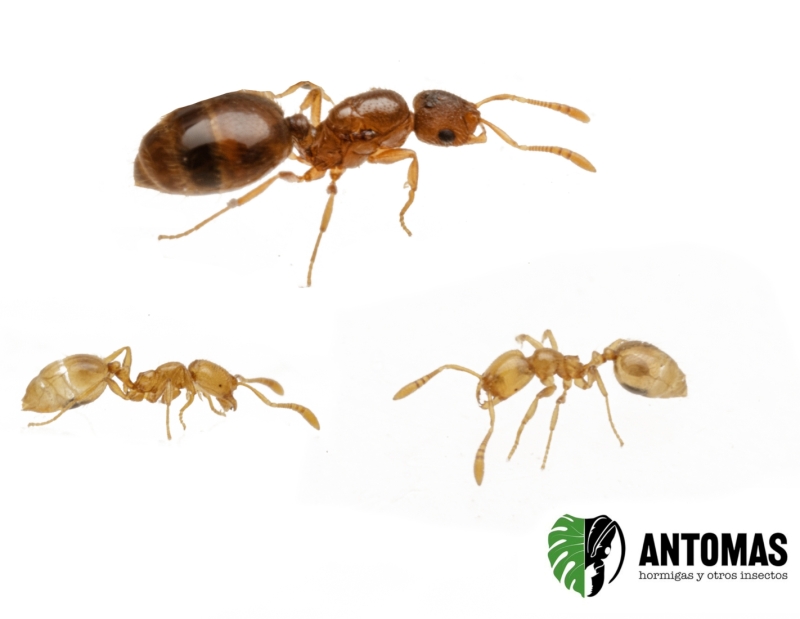
A usurper with sabre-shaped mandibles that lives like a queen in someone else’s home. Strongylognathus testaceus was first described as an army ant, but its art lies elsewhere: it settles beside the Tetramorium queen, lets her workers rear, feed and defend the colony, and claims the entire new generation of queens and males. Its yellow workers cannot even feed themselves, yet they kill the queens of other parasites that try to sneak in, and its chemical camouflage fools the whole colony. A European social parasite almost never seen in a formicarium. Mixed colonies with two S. testaceus queens and their host, T. immigrans. Shipping across Europe, live arrival guaranteed.
A permanent social parasite of Tetramorium, with yellow workers whose sabre-shaped mandibles cannot even feed them. Mixed colonies: two S. testaceus queens with their Tetramorium immigrans host queen and her workers, who do all the work. Qbik Wild One P 1C nest with localised humidity, 20–25 °C and the diet of a Tetramorium: sugar, plenty of small protein and some seeds. Diapause of 4–5 months at around 5–10 °C. Patience: the parasite’s workers may take up to about two years to appear. Mineral oil barrier, closely watched, because the workers are tiny.
Strongylognathus testaceus (Schenck, 1852) is one of the most curious ants in Europe: a permanent social parasite that cannot live without another species. Its workers, small and yellow, have sabre-shaped mandibles that are useless for digging, cutting up food or caring for the brood. That work is done by the workers of its host, a Tetramorium, in whose nest the parasite queen lives alongside the queen of the house. The host queen keeps laying, but only workers: the new queens and the males of the colony belong to the parasite.
At Antomas we sell it as what it is, a mixed colony: two S. testaceus queens, a Tetramorium immigrans host queen and a small group of her workers. In this care sheet we keep apart what is documented in the scientific literature, what keepers have seen and what we recommend at Antomas. And we warn you from the start about the virtue this species demands most: patience.
Biology
Described as an army ant
The German entomologist Schenck described it in 1852, in his work on the ants of Nassau, under a surprising name: Eciton testaceum. He placed it in Eciton, the genus of the American army ants, the ones that sweep through the rainforest in huge columns: a tiny European ant that lives hidden under stones, alongside the army ants. Its long, curved mandibles may have weighed in that decision, at a time when ant classification was taking its first steps. Shortly afterwards, the Austrian Gustav Mayr created the genus Strongylognathus for it and its relatives.
The name says almost everything: it comes from the Greek gnáthos, “jaw”, and strongýlos, “rounded”, for its narrow, almost cylindrical mandibles without a toothed edge. And testaceus means “the colour of roof tiles” in Latin, the yellowish-brown shade of its workers.
Sabre mandibles that are no good for work
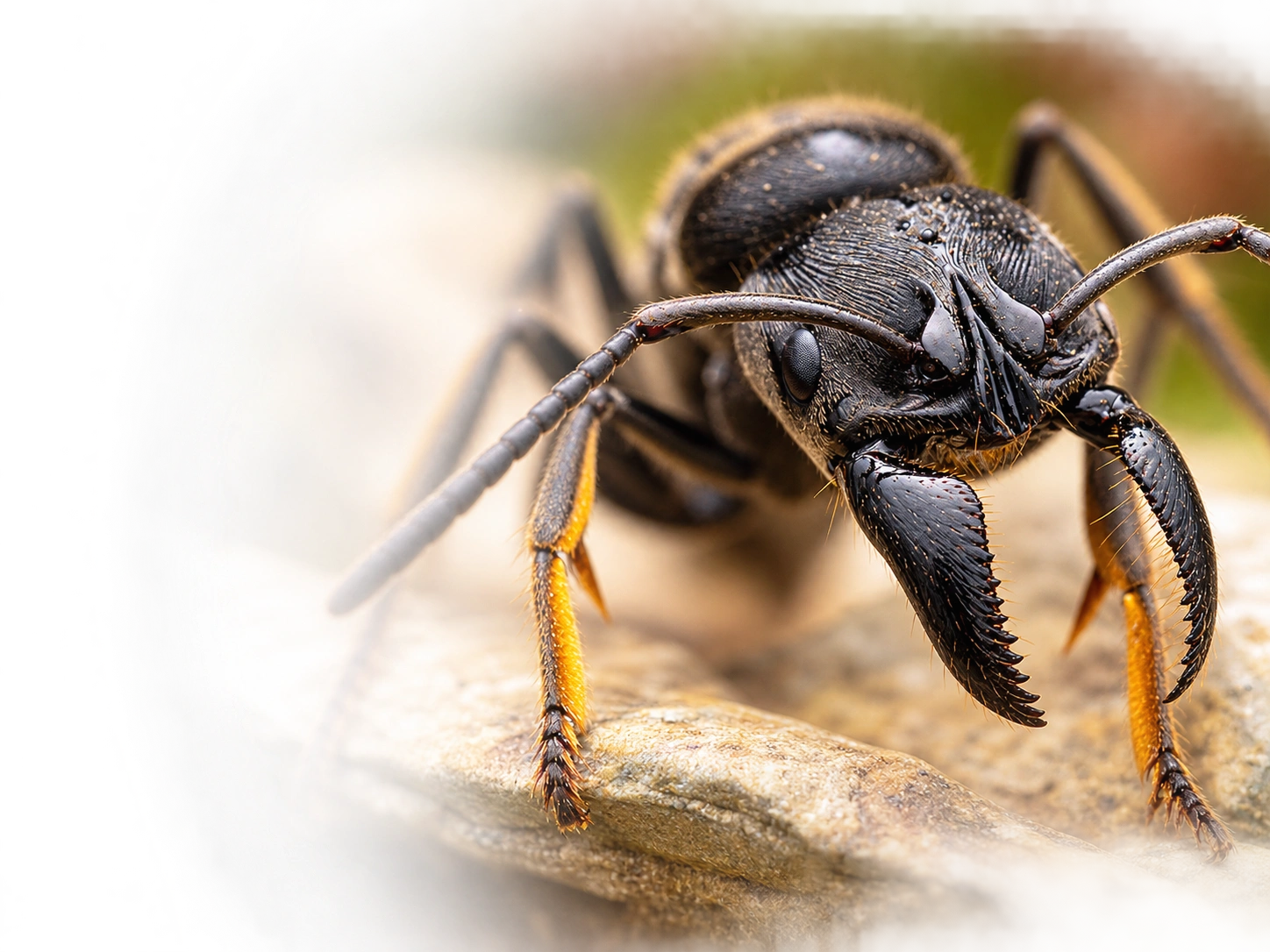
The roughly 25 species of Strongylognathus share narrow, curved, toothless mandibles, shaped like sabres. Those of an ordinary ant are an all-purpose tool: for cutting, digging, carrying brood and dismembering prey. Those of S. testaceus are for gripping and piercing. They are a weapon, not a tool.
The Czech keeper Pavel Amcha, who has kept the species and described it in Živa, the popular science magazine of the Czech Academy of Sciences, noticed that in his formicarium the parasite’s workers:
barely touched a freshly killed fruit fly with their antennae, or walked over it as if it were an obstacle;
ignored the cotton wool soaked in water and honey;
licked and palpated the eggs from time to time;
and spent a lot of time grooming themselves and each other.
They are unable to feed themselves: the host workers feed them. They hardly ever leave the nest, and defence is left to the Tetramorium. If one day you see a yellow worker in the foraging area, enjoy it: it is a rare privilege.
A slave-maker that forgot how to enslave
Many Strongylognathus are slave-makers: they raid Tetramorium nests, carry off their pupae and raise them as their own workers, just like the best-known slave-makers, those of the genus Polyergus, whose biology was reviewed by D’Ettorre and Heinze. The species of the S. huberi group can still carry out raids, although, according to Buschinger, the great specialist in social parasitism, raids have only really been observed in two or three species of the genus.
S. testaceus has gone further: it does not carry out organised raids, it lives permanently in its host’s nest and tolerates the host queen. Classic sources mention the occasional pillaging of pupae, but modern studies and keepers have not observed it. For Sanetra and Buschinger, who used genetic markers to study the relationships between the parasites of the tribe Tetramoriini, this inquilinism most probably arose from a form of slavery that gradually broke down: if the host queen does not die, the colony keeps producing workers and stealing them is no longer necessary. Their study also showed that social parasitism arose at least twice in the tribe.
At the end of that road lies Anergates atratulus, another parasite of Tetramorium that no longer even has workers. S. testaceus would be halfway there, with a small worker caste that is less and less useful: evolution in progress inside a formicarium.
Two queens, one throne: the parasite that “runs” the production of sexuals
In a parasitised nest, two queens live together in peace: the Tetramorium queen and the S. testaceus queen. The parasite does not kill the host: it needs her alive. The Tetramorium queen keeps laying, but her eggs produce only workers, and the queens and males reared in the colony belong to the parasite (Collingwood; Lapeva-Gjonova and Radchenko). The usurper takes over the sexuals “factory” and leaves the rightful queen with the job of producing the workforce.
How does it do it? A pheromonal inhibition is often mentioned, but nobody has yet identified the substance. What is known is that it pays off for the colony: as early as 1891, Erich Wasmann noticed that parasitised colonies did not produce alates of their own and had more workers than normal. What is not spent on sexuals is invested in workers, and mixed colonies can reach some 20,000 individuals (Collingwood).
In that crowd, the parasite’s workers make up around 1%, about 100 host workers for every S. testaceus worker, and at most 5%, according to Seifert. In a small colony, this means that for a long time you will see almost nothing but Tetramorium.
Chemical camouflage: smelling like the family
Ants recognise each other by smell, thanks to a layer of cuticular hydrocarbons that works as the colony’s chemical identity card. In 2014, Guillem, Drijfhout and Martin compared four parasite–host systems, and in that of S. testaceus the parasite’s chemical profiles could not be distinguished from those of its host, not even when it lived with different host species, and they even reproduced the small differences between colonies. Each S. testaceus smells like the particular family it lives with.
It is not a master key: a parasite queen that enters an unfamiliar adult nest is usually attacked, and the same happens to parasite workers that move to another nest (Kratochvíl, cited by Amcha). In captivity the rule is simple: colonies are never mixed.
Anthouse explains it in a short video: the basic biology of S. testaceus and the chemical submission of its host.
“La hormiga usurpadora”, a video by Anthouse (in Spanish): the basic biology and chemical submission of S. testaceus.
Useless at home, deadly with intruders
Not being able to feed themselves does not mean they are good for nothing. In the laboratory, Purkart, Wagner, Goffová, Selnekovič and Holecová introduced queens of Anergates atratulus (today also known as Tetramorium atratulum), the workerless parasite, into fragments of mixed colonies of T. caespitum and S. testaceus. The Tetramorium workers tolerated the intruders. The S. testaceus workers, on the other hand, attacked them with their sabre mandibles and killed them.
Amcha interprets it this way: Anergates would have a “calming” pheromone that works on the host but not on the parasite, and the S. testaceus workers would act as guards against a competitor for the same Tetramorium workers. It does not always happen: in his formicarium, an Anergates that arrived as a pupa lived alongside S. testaceus without hostility. But those “useless” workers turned executioners are one of the most surprising images in European myrmecology.
Wasmann versus Wheeler: a debate more than a century old
How does a mixed colony begin? As Donisthorpe recorded in 1927, Erich Wasmann argued that it was founded at the same time by two young queens, one of each species, after the nuptial flight, while William M. Wheeler believed that the Strongylognathus queen slipped into an already established Tetramorium colony. Donisthorpe sided with Wheeler, because parasite queens were found on their own.
A century later, captive breeding largely proves Wasmann right. Entering an adult nest usually ends badly (Kratochvíl). Amcha, by contrast, put a newly mated S. testaceus queen together with a newly mated Tetramorium queen, a few pupae and one worker, and there was no aggression at all. It has also been reported that Alfred Buschinger obtained associations of newly mated queens of both species that lived together from the start and reared workers. Both routes may exist in nature, but joint founding is the one that works best in a formicarium, and it is the one our colonies follow.
Two parasite queens in the same nest?
In nature, the typical pair is described: one queen of each species per nest (Collingwood; BWARS). In captivity, more has been seen. In 2018, Amcha collected more than a hundred S. testaceus alates from two Tetramorium nests, mated them in a jar with moss and obtained three mated queens: he put one with the host queen we have just described, and the other two with host workers. The parasite queens lived together with no visible rivalry and all of them laid: by the end of that summer there were already S. testaceus workers in all three formicaria.
This is the basis of our format of two S. testaceus queens alongside the host queen, which gives the colony a better chance of thriving with its usurper. Buschinger and Amcha both pointed out a precaution: a wingless queen is not always a mated queen. So the final proof that everything is going well is not seeing the queens, but seeing, in time, the first yellow workers emerge.
Tetramorium immigrans, the host of our colonies
The hosts of S. testaceus are ants of the Tetramorium caespitum complex, species so alike that for more than a century they were confused under a single name. In 2006, Schlick-Steiner and her team showed with genetic and morphological data that several cryptic species were hiding there, and in 2017 Wagner and colleagues delimited ten European species. The one that in 2006 was simply called “Tetramorium sp. E” got its old name back: Tetramorium immigrans.
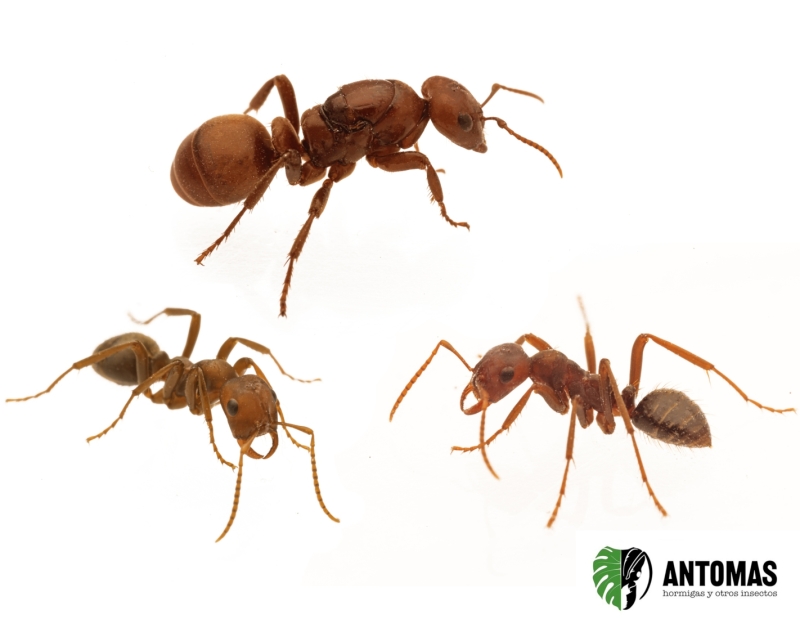
That 2017 revision also lists the parasites found with each species: S. testaceus appears with T. caespitum, T. alpestre and T. impurum, and the later records from Bulgaria and Poland are with T. caespitum or closely related forms. T. immigrans belongs to the same complex, shares much of its European range with the parasite and is a natural host of its relative Anergates atratulus. Antomas colonies are formed with T. immigrans, which acts as the host in captivity: its queen keeps laying workers and the colony works. What matters to the parasite is having Tetramorium workers to feed it and look after it.
T. immigrans is the largest species of the complex and one of the most heat-loving: at the sites studied by Wagner and colleagues, the mean air temperature from May to August was around 19.9 °C, compared with 16.1 °C at those of T. caespitum. It lives around the Mediterranean, in much of Europe, the Balkans, Anatolia and the Caucasus, probably its cradle, and has travelled with humans to the Americas. In France and parts of central Europe it is very urban, an ant of pavements, parks and roadsides; around the Mediterranean and in the Caucasus it also occupies dry grasslands, beaches, riverbanks and rocky outcrops.
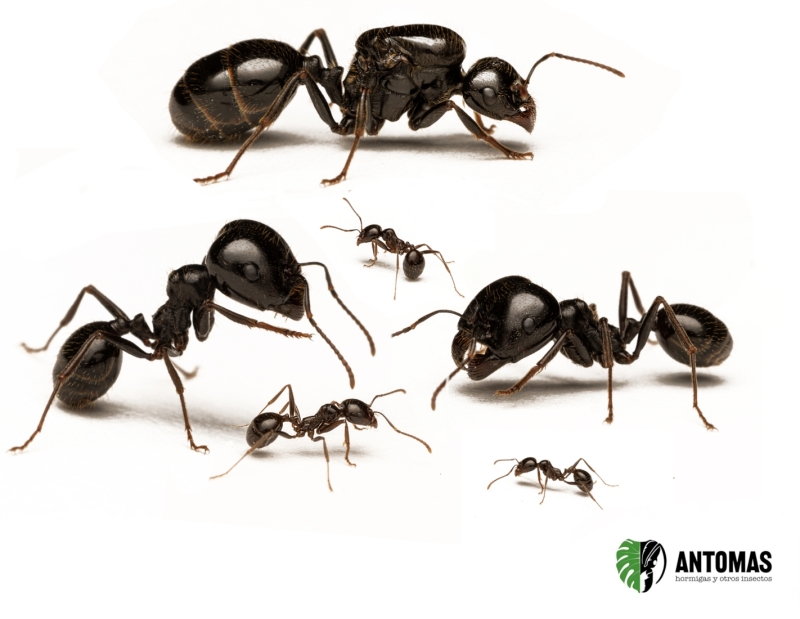
A curious detail: the specimen that fixes its name, the lectotype, comes from Valparaíso, in Chile, from an introduced population. And in 1748, the naturalist Pehr Kalm, a disciple of Linnaeus, described in Philadelphia a small ant, “black or dark red”, that could be T. immigrans (Moss and colleagues). Its relative Tetramorium caespitum, which we also have in our shop, is the parasite’s main host in nature.
The “pavement wars”
The ants of the complex are famous for their battles: two neighbouring colonies can clash on a pavement with thousands of workers that grip each other in pairs by the mandibles, push and drag each other… and hardly ever kill one another. In studies of these “pavement wars”, carried out mainly with T. immigrans in North America, staged battles lasted on average about 44 minutes (from 25 to 88) and there were few deaths, from a few dozen to around a hundred, among thousands of participants (Plowes; Schultz; reviewed by Moss and colleagues). They are ritual tournaments rather than wars of extermination.
The lesson for the keeper: Tetramorium are territorial, and two groups of workers from different nests treat each other as rivals. That is why colonies are never mixed.
From the Rhine valley to the Sierra Nevada
S. testaceus is the most common and widespread species of its genus. It lives in central and southern Europe, the south of eastern Europe, the Caucasus and Anatolia, and reaches as far as southern western Siberia and northern Kazakhstan (Lapeva-Gjonova and Radchenko). To the north it reaches Sweden, where it is very rare, and southern England, where it is listed as rare (BWARS). It lives wherever its hosts are abundant, in open, sunny places: dry grasslands, heathland, stony meadows and woodland clearings, from 100 m in the Rhine valley up to 2,000–2,100 m in the Sierra Nevada.
In Spain, Sanetra and Buschinger studied it in the Sierra Nevada and in the mountains of Cuenca and Teruel, between 1,200 and 2,100 m. In the Pyrenees, the work of Guillem and colleagues was based on mixed colonies with hosts close to T. impurum and, as has been reported, one with T. semilaeve, which does not even belong to the T. caespitum complex: an exceptional record, if confirmed.
Its rarity has a trick to it: among thousands of Tetramorium, a few yellow workers go unnoticed, and only a small proportion of nests are parasitised. In 2026, Rutkowski and Wendzonka added 15 new localities in Poland and proposed a field trick: look at the alates, because those of the parasite are much smaller than those of the host, which are usually missing from a parasitised nest. That is how Amcha recognised it.
Nuptial flights in high summer
S. testaceus alates fly in July and August (Collingwood); in southern England, from July to early August (BWARS), and German keepers see them from late June to late August. These dates may coincide with those of its hosts, whose sexuals appear on average in late June, and they fit Wasmann’s idea. In the mountains of the Iberian Peninsula, the calendar may be different.
In Tetramorium, the larvae that will become queens and males develop during the winter, and in another species of the complex it has been seen that the winged females might need cold (Poldi, cited by Moss and colleagues): a good reason to give them a proper diapause. There are no reliable data on the fecundity or longevity of S. testaceus; the lifespans of more than ten years that circulate on some websites have no published basis.
Size and morphology
A tiny myrmicine, with monomorphic workers, no soldiers and one unmistakable feature: the sabre mandibles.
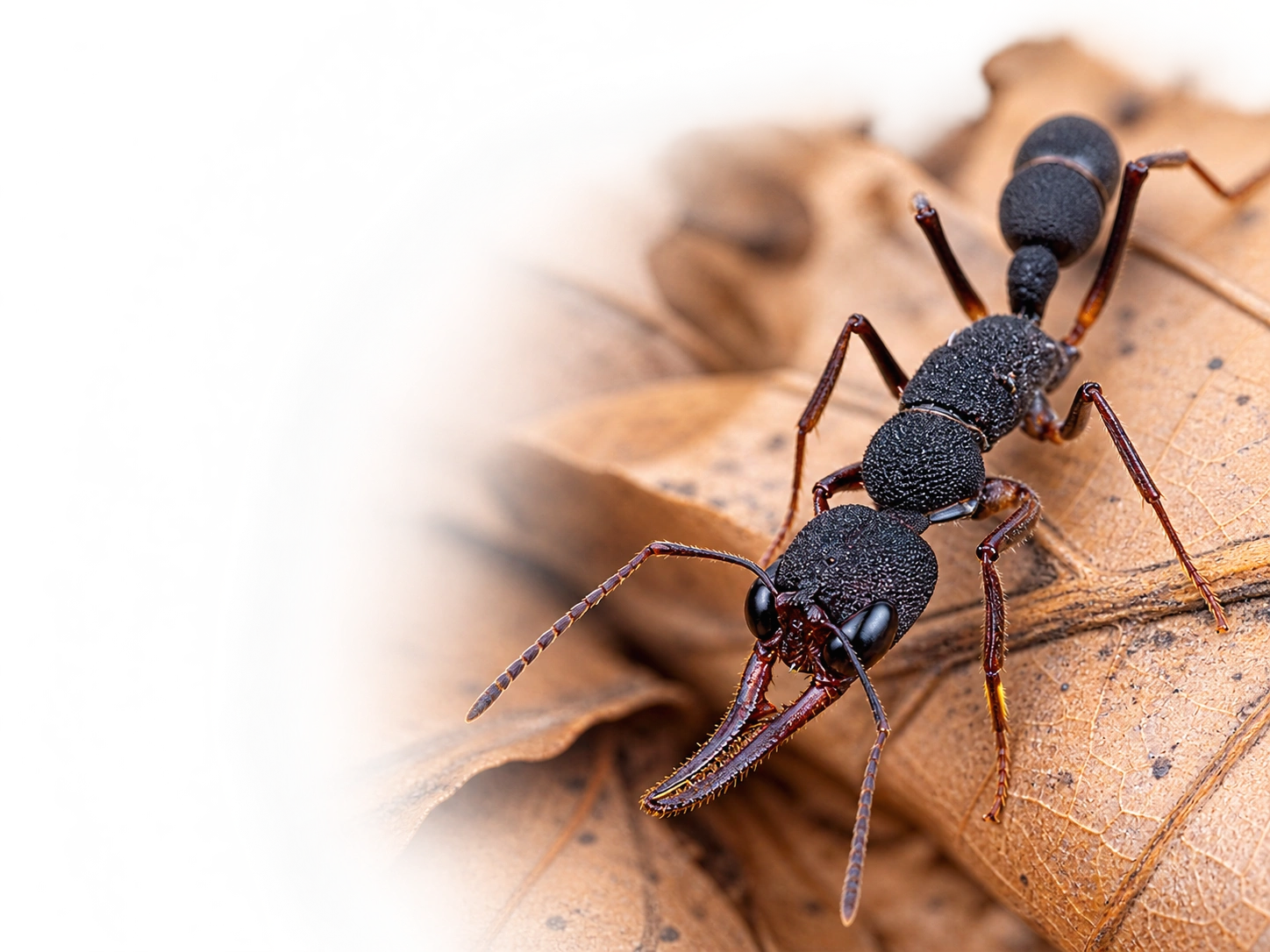
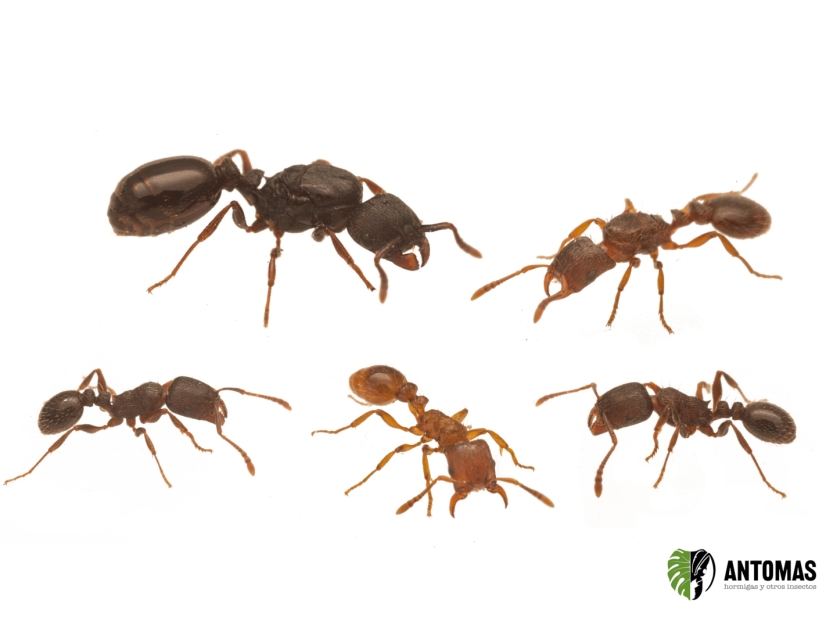
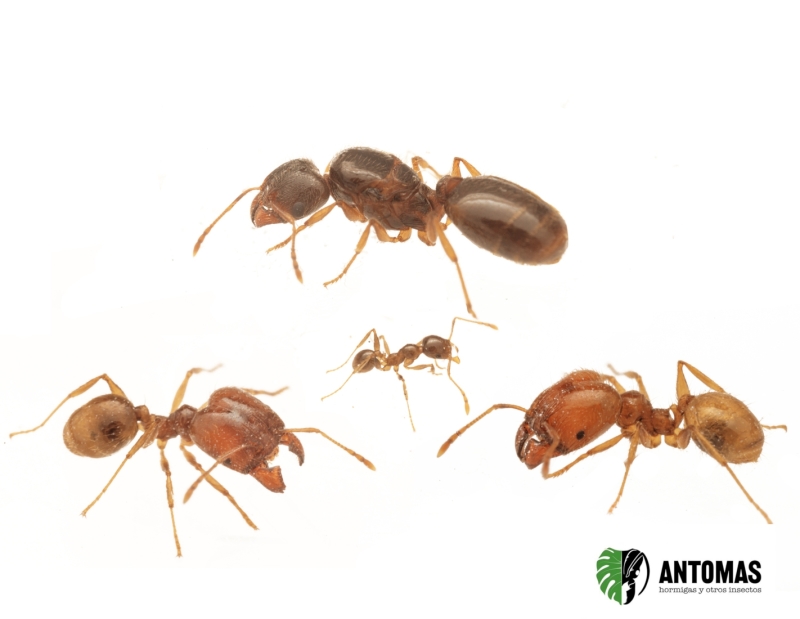
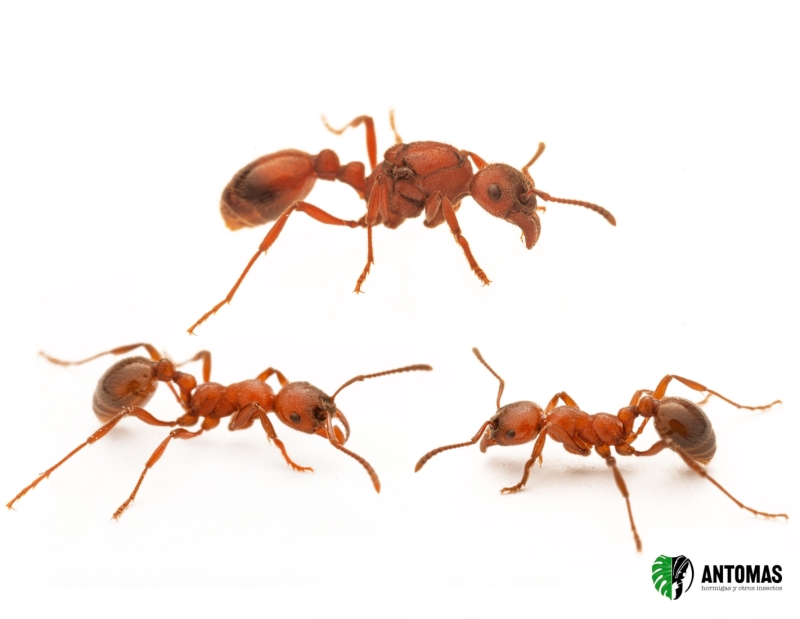
Worker. Yellowish brown, paler than its host. Rectangular head, with a deeply notched back and sharp, protruding posterior corners. Narrow, curved, toothless mandibles. At least the frons and cheeks bear longitudinal striae, more or less marked depending on the worker; in its relative S. karawajewi, the head is usually smooth (Collingwood; Lapeva-Gjonova and Radchenko).
Queen. Darker: brown, with paler legs and antennae, and only slightly larger than a Tetramorium worker. The very concave back of the head extends at the sides into small “horns” (Amcha).
Male. Dark brown, with paler appendages and a small head, its back notched at an acute angle (Collingwood).
Sting. Like any good myrmicine it has a sting apparatus, but at its size it is of no importance to the keeper: its real weapon is its mandibles.
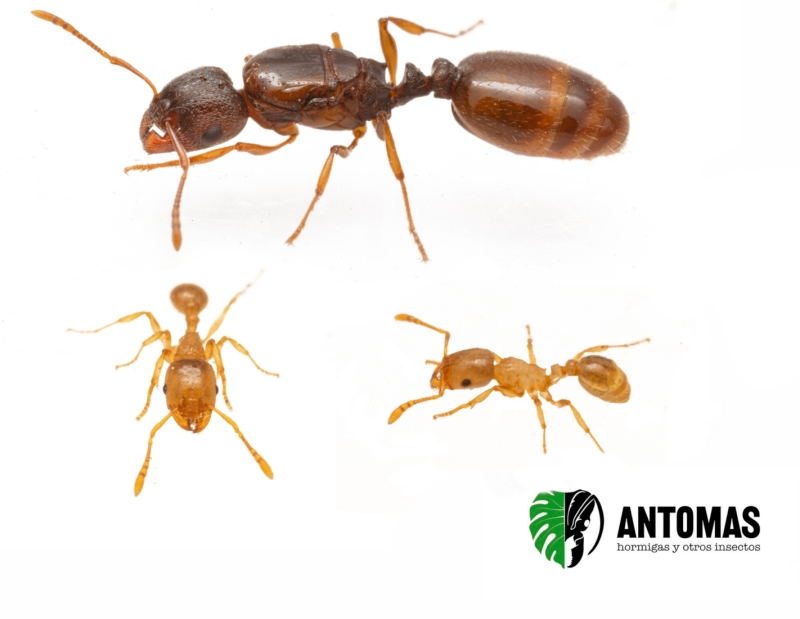
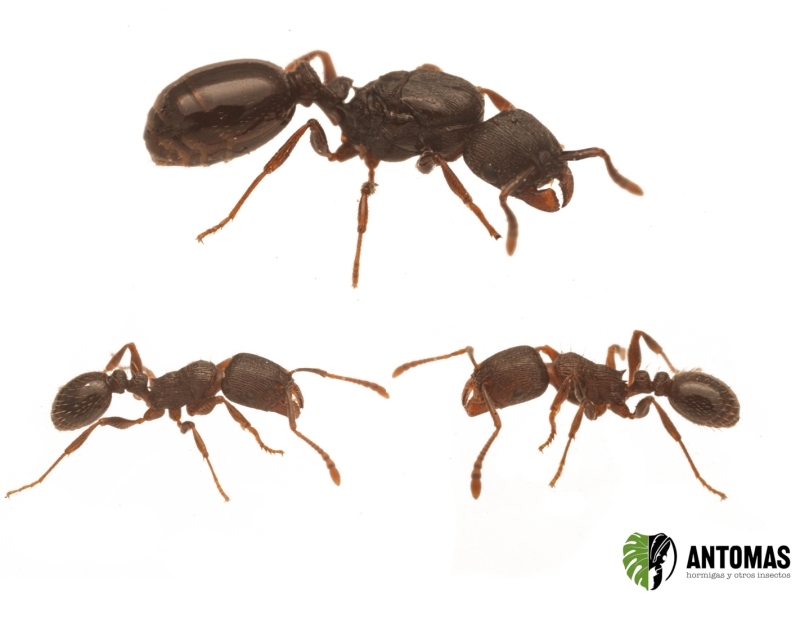
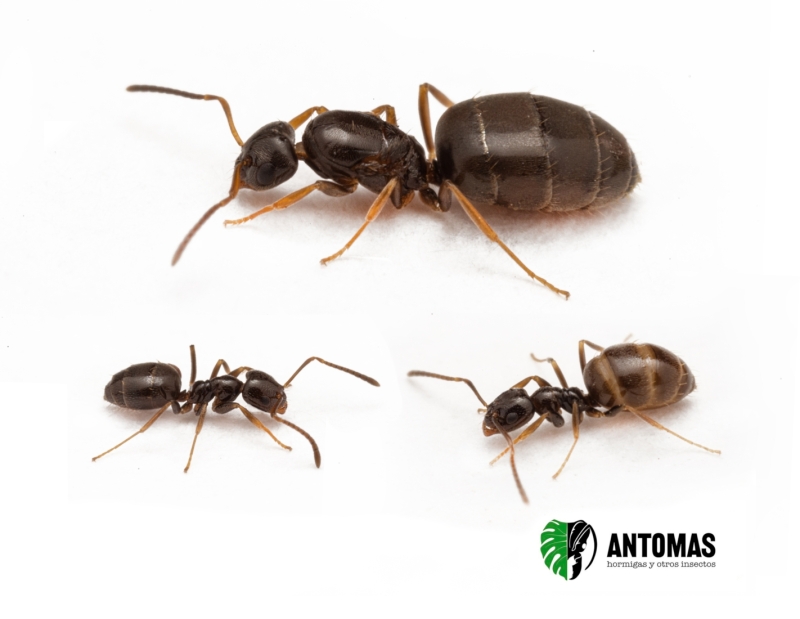
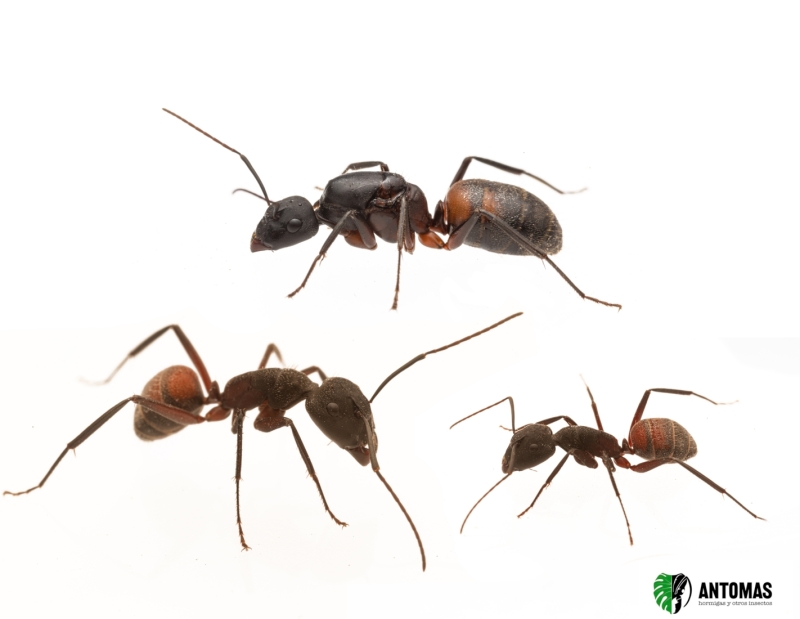
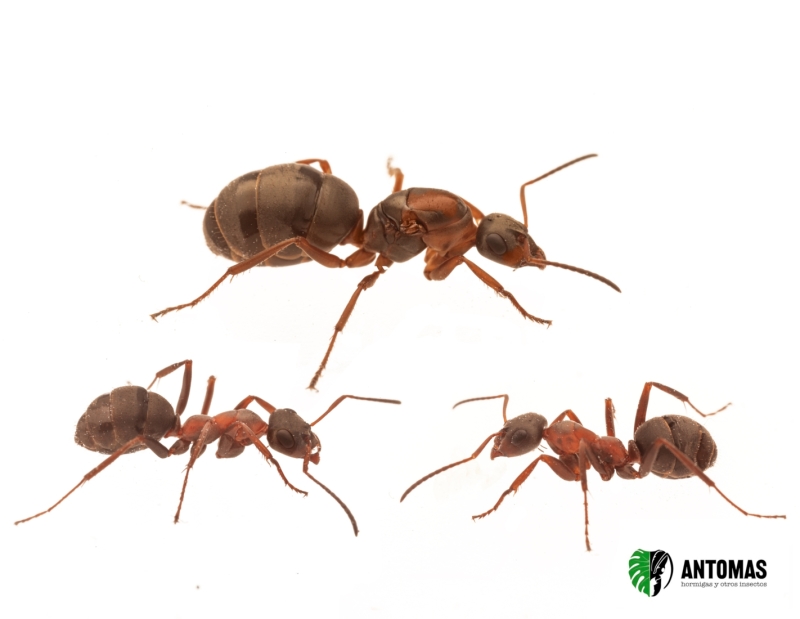
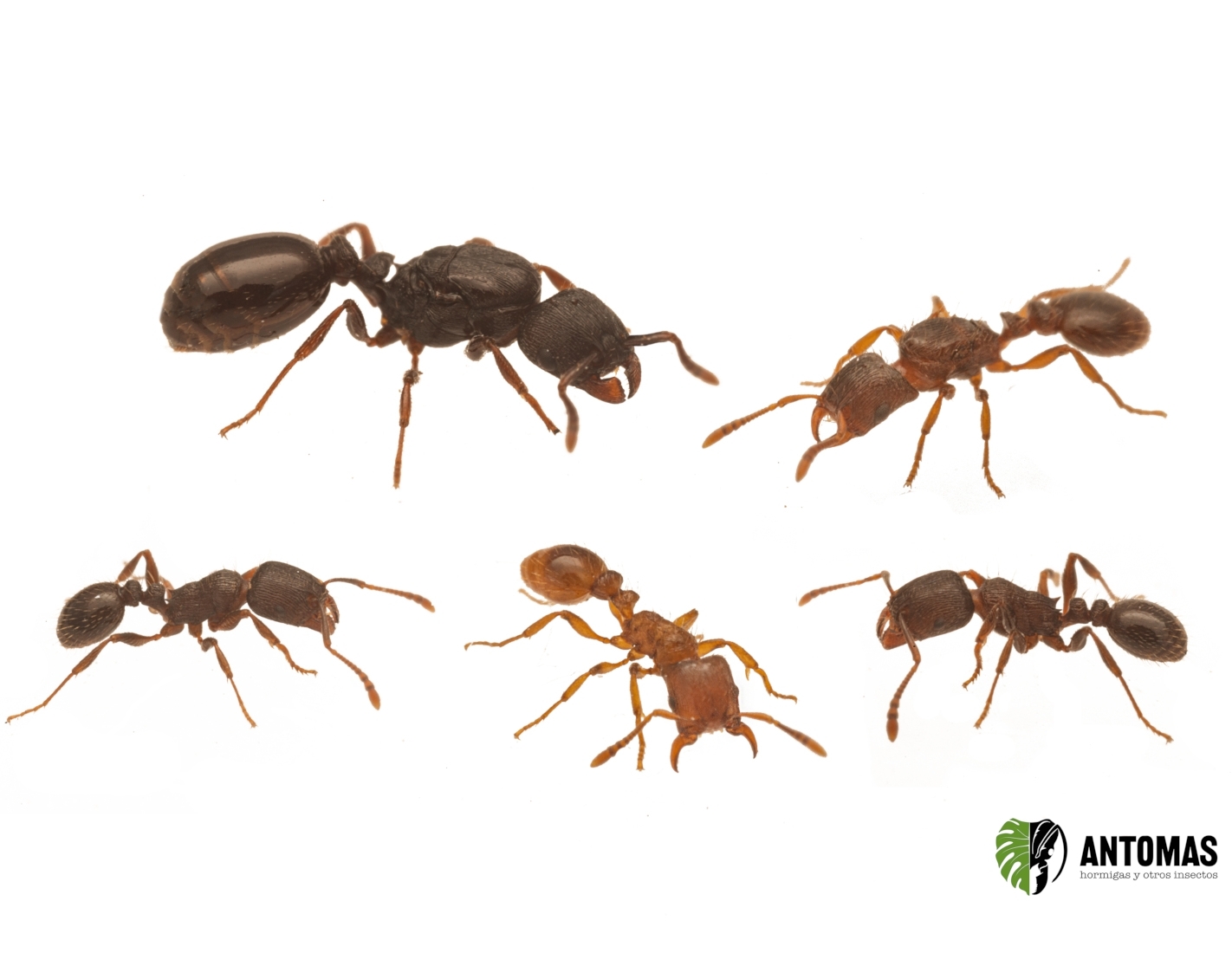
Colours of our colonies. Orange-yellow parasite workers, with their sabre mandibles clearly visible; dark brown T. immigrans workers, and a large, almost black host queen.
How to tell them apart in your formicarium? The T. immigrans queen is the largest and almost black; the S. testaceus queens are much smaller, brown and with their “horns”; and the parasite’s workers are the yellow ones, given away at once by their sabre mandibles under a magnifying glass.
Approximate measurements
S. testaceus workers: 2.0–3.6 mm
S. testaceus queen: 3.5–3.8 mm
S. testaceus male: 3.2–4 mm
T. immigrans workers: head size index of 713–943 µm (mean 834 µm, compared with 761 µm in T. caespitum), the largest in the complex
T. immigrans queen: no published measurements
The S. testaceus measurements are total lengths from Collingwood (1979); no detailed morphometric measurements have been published. The T. immigrans figure is from Wagner and colleagues (2017), an index combining head length and width. There are no published measurements of the host queen, and we prefer not to give figures without a basis.
Care in captivity
Difficulty: 3/5 – Advanced
A social parasite sounds like a species for experts, but at Antomas we consider it advanced, not extreme, because of the format: the colony arrives already formed, with its host queen, who keeps laying workers. The Tetramorium do all the work and the colony is self-sufficient. Looking after it is, in practice, looking after a Tetramorium, and in our experience they are hardy, rewarding ants.
So why is it not a 1/5 or a 2/5? For four reasons:
A small colony, more delicate when it comes to humidity, cleaning and food.
Tiny workers, which mean the escape barrier must be watched (see “Escapes and barriers”).
Patience: the parasite’s workers may take up to about two years to appear (see “Founding and growth: patience with the parasite”).
Everything depends on the host queen: the parasite’s workers care neither for the brood nor for their own queens.
And it is well worth it. It is a European social parasite that is almost never seen in a formicarium, with workers that seem to have stepped out of an evolution textbook. Watching the first yellow worker appear among the Tetramorium is a reward that only rare species can give.
Recommended parameters
Nest temperature: 20–25 °C during the active season.
Warm spot: optional, up to about 27 °C at one end, so the colony can choose.
Humidity: localised, with one part of the nest moist and another drier; the foraging area, dry.
Water: always available, in a test tube with water and cotton wool in the foraging area.
Light: simply leave them a dark area in the nest and a lit foraging area, with a normal day–night cycle.
Diapause: 4–5 months, from November to March, at around 5–10 °C (see “Diapause”).
Escape barrier: mineral oil, checked often.
Avoid direct sunlight, radiators and draughts: what they want is a mild, stable nest, with a slight gradient of temperature and humidity.
Nest and recommended formicarium
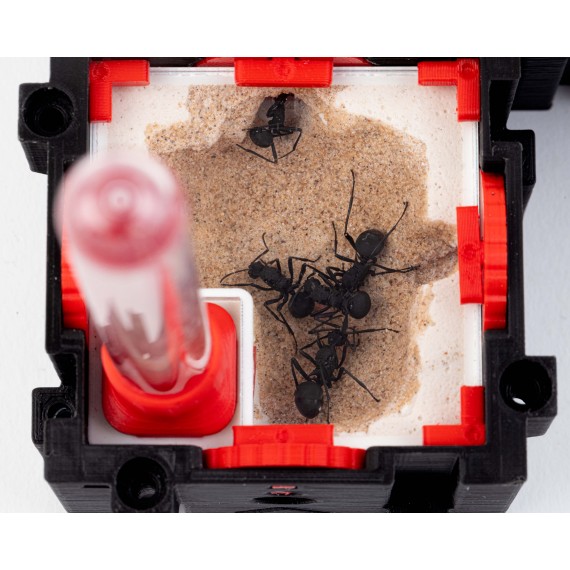
At Antomas we recommend starting with a Qbik Wild One P 1C from Anthouse: a compact plaster formicarium that holds humidity well and only needs to be moistened locally. It is what a small Tetramorium colony needs: small chambers, darkness for the brood and a moist area without waterlogging the rest.
Small, because the colony is small: in a large nest, a few workers cannot control the humidity or defend every chamber, and the spare ones end up as rubbish dumps. Tetramorium grow quickly once they get going, so expand later, with a larger model from the Qbik Wild range, when you see many workers in the foraging area with no room inside or brood piled up in every chamber. Complete the set-up with these details:
Localised humidity: moisten only part of the nest, so that there is always a drier area.
A dry foraging area, with a little fine sand or soil in one corner and a flat stone or two.
Water always available, in a test tube with water and cotton wool.
A small feeder for sugary liquids, never on cotton wool (see “Feeding”).
A mineral oil barrier and a tight-fitting lid (see “Escapes and barriers”).
Temperature and humidity
There is no published optimum for S. testaceus, nor is one needed: the parasite lives at its host’s pace. In nature, Tetramorium of the complex start foraging when the soil rises above about 10 °C, are most active between 20 and 25 °C and withdraw at around 36 °C (Schultz, cited by Moss and colleagues). Hence our 20–25 °C in the nest. If you use heating, keep it gentle, on one side and with a thermostat.
They nest in well-drained soils with a humidity gradient, and most of the nest lies 30–50 cm deep (Bruder and Gupta, cited by Moss and colleagues). The T. immigrans keepers quoted in that review report that colonies thrive with eggs and larvae in the moist area, and pupae and seeds in the dry one: exactly what a locally moistened plaster nest allows.
The dry area matters: seeds are stored in dry chambers, and on poorly drained soils T. caespitum colonies have been seen to come out of winter weakened (Elmes, cited by Moss and colleagues). So never soak the whole nest, which brings condensation, mould and mites, but do not let it dry out completely either: in such a small colony, the brood dehydrates quickly.
Feeding
The food is that of a Tetramorium. The parasite’s workers do not eat on their own: the hosts feed them, just as they feed the queens and the brood. Feed the T. immigrans colony well and it will take care of the rest.
Sugary liquids. Vary the sugars: at Antomas we recommend Anthouse’s Blue Sugar nectar 4–5 times a week and another sugary liquid or nectar 1–2 times a week. You can also add a little protein to the nectar. Always offer them in a feeder and never on cotton wool, because cotton wool goes mouldy and spoils the liquid very quickly. Use a small traditional or home-made feeder, where the drop stays “spread out” and accessible.
Protein: plenty, and small. It is the engine of growth, and it is the Antomas philosophy: if you do daily maintenance and remove leftovers, it is better to overfeed, because the colony understands that it has more resources and grows faster and in greater numbers. If you will not be able to clean often, it is better not to overfeed, because leftover food brings mould and mites. For such small workers, small prey:
Change the type of insect from one week to the next, so they do not always eat the same thing, and buy insects from a reliable supplier: insects treated with insecticides can kill the colony.
Seeds, as a supplement. In nature, Tetramorium of the complex collect seeds in late summer and autumn and chew them for the larvae in spring (Moss and colleagues). But in Amcha’s formicarium, a T. caespitum colony showed very little interest in them, whether whole, crushed or sprouted. Offer a few small seeds from time to time, especially in autumn, never as the basis of the diet, and remove them if they go mouldy.
Water: always, in the test tube with cotton wool in the foraging area.
Founding and growth: patience with the parasite
Your colony is a joint foundation like the one Wasmann argued for: a young host queen, her first workers and two parasite queens. This is how it usually grows:
First, the Tetramorium. The colony grows with host workers. T. immigrans keepers report a little over a month from egg to worker in warm conditions, and once the colony gets going, it grows quickly.
The parasite queens, next to the host queen. Amcha saw the S. testaceus queen stay by her side and touch her often with its antennae. It is the normal coexistence of a mixed colony.
The parasite’s workers, with patience. In Amcha’s formicaria, with newly founded colonies, they emerged the same summer. But in another young colony they did not appear until two years later, when the host colony had matured. If the colony is growing and the queens are alive, all is well.
The parasite’s sexuals, later on. There are no data on when a mixed colony produces alates in captivity; in nature, the parasite’s alates are in the nest from June to August.
The big risk is losing the host queen. Amcha lost one for unknown reasons, and without her the colony lives only as long as its workers, a few years at most. Everything you do for the T. immigrans queen, you do for the whole colony. If you notice anything odd, write to us.
And one golden rule: do not add workers, brood or queens from other nests. They would be attacked, and you could introduce mites or diseases.
Arrival and moving
When your colony arrives, let it rest in a quiet, dark place at 20–25 °C, and check that it has water. To move it into the formicarium, at Antomas we do it by tipping: we open the container in the foraging area, next to the nest entrance, and gently tip out the queens, workers and brood, helping the stragglers with a soft brush. Four tips:
Prepare everything beforehand: the formicarium set up, with the oil barrier and the water tube.
Work over a tray: they are so small that you lose sight of them in no time.
Count the queens: the parasite queens are barely larger than a host worker, so check that none is left in the container.
Take it calmly: after tipping, the workers carry the brood into the nest. Keep the nest dark so they settle in quickly.
If you ever need to move the colony to another formicarium, use the same method.
Diapause
S. testaceus lives in regions with a truly cold winter, and its hosts have a very marked annual cycle. At Antomas we recommend the diapause of a European Tetramorium: 4–5 months, from November to March, at around 5–10 °C.
Lower the temperature gradually, over one or two weeks, and raise it the same way at the end.
Do not go below about 5 °C: there is no need to get anywhere near freezing.
During diapause: water always, a dry area in the nest, little or no sugary liquid and no protein. Disturb the colony as little as possible.
At the end, go back to protein as soon as you see activity and brood.
Why? It gives the host queen a rest and keeps the colony’s natural rhythm. And since the larvae of the sexuals develop in winter and the winged females might need cold, without diapause the production of the parasite’s sexuals, the great prize of this species, could suffer. It has not been shown in S. testaceus, but it is its natural cycle.
Behaviour in captivity
The Tetramorium do everything. They forage, care for the brood, feed the queens and the parasite’s workers and defend the nest. Almost everything you will see in the foraging area is brown T. immigrans workers, fast, organised and very active in warm conditions.
This is what a mixed colony of S. testaceus and its Tetramorium looks like in captivity, in two short videos by Anthouse:
The parasitic army in captivity: “El ejército parásito”, part 1, by Anthouse (in Spanish).
And the sequel: “El ejército parásito”, part 2, by Anthouse (in Spanish).
Watch without fear. At Antomas we believe ants are there to be enjoyed, watched and learnt from, not kept hidden away. Simply leave them their dark area in the nest and a lit foraging area, and watch them gently, intervening and stressing them as little as possible. With a magnifying glass, looking for the parasite queens next to the host queen, or the first yellow worker among the brown ones, is part of the fun.
Warning signs:
Fewer and fewer host workers: this is the most worrying sign, far more than not seeing the parasite.
Brood that stalls or disappears outside diapause: protein is almost always lacking.
Condensation or mould: too much humidity or forgotten leftovers.
A host queen that stops laying in the middle of the season: check the temperature, food and humidity.
Many workers standing still in the foraging area, with no room inside: time to expand.
Escapes and barriers
This is the tricky part of the set-up: the workers are tiny, both the parasite’s and the host’s, and they squeeze through any gap. At Antomas we use a mineral oil barrier, but with these ants it must be watched more closely than with others:
A thin, continuous strip of mineral oil along the top of the foraging area walls. Renew it as soon as it gathers dust or debris: a dirty barrier is a bridge.
Check it often, especially in the first weeks, and make sure no worker manages to cross it.
A tight-fitting lid, as a second line of defence.
No gaps: check the connections, stoppers and tubes. Where a large ant cannot pass, a Tetramorium can.
Nothing that could act as a bridge near the barrier.
Take care when opening: open only as much as needed, work calmly and close up when you have finished.
Handling and safety
They are harmless to the keeper: both the parasite and the host have a sting, like any good myrmicine, but they are so small that they pose no problem at all. Handle them with entomological tools, such as a soft brush, and not with your hands: it is very easy to crush or lose them. Do not mix different colonies or separate the parasite queens from their colony. And although they are European species, do not release them or move them elsewhere: moving ants from one population to another can disrupt local populations.
What not to do
Separate the parasite queens from the colony or try to rear them on their own: without Tetramorium, they do not survive.
Add queens, workers or brood from other nests, or merge two colonies.
Lose patience if no parasite workers appear in the first year: they may take up to about two years.
Move the colony into a nest that is too large for its size.
Soak the whole nest, or let it dry out completely.
Put sugary liquids on cotton wool or let them run out.
Always give them the same insect, prey that is too large, or leave leftovers uncleaned.
Base the diet on seeds.
Skip the diapause, or start it abruptly.
Neglect the oil barrier: with such small workers, a dirty barrier or one with gaps means certain escapes.
Handle them with your hands or release them.
Scientific sources
This care sheet is based on the scientific literature on Strongylognathus testaceus, its genus and its hosts of the Tetramorium caespitum complex, and on the experience of Antomas and other keepers. In addition to the list, we have used works without a DOI: the revision of the complex by Wagner and colleagues (2017, Myrmecological News 25), Buschinger’s review of social parasitism (2009, Myrmecological News 12), Collingwood’s fauna (1979, Fauna Entomologica Scandinavica 8), the BWARS species account and Pavel Amcha’s articles in Živa (2019 and 2023). Main references:
Sanetra, M. & Buschinger, A. (2000). Phylogenetic relationships among social parasites and their hosts in the ant tribe Tetramoriini (Hymenoptera: Formicidae). European Journal of Entomology 97: 95–117. doi:10.14411/eje.2000.017
D'Ettorre, P. & Heinze, J. (2001). Sociobiology of slave-making ants. Acta Ethologica 3: 67–82. doi:10.1007/s102110100038
Schlick-Steiner, B. C., Steiner, F. M., Moder, K., Seifert, B., Sanetra, M., Dyreson, E., Stauffer, C. & Christian, E. (2006). A multidisciplinary approach reveals cryptic diversity in Western Palearctic Tetramorium ants (Hymenoptera: Formicidae). Molecular Phylogenetics and Evolution 40: 259–273. doi:10.1016/j.ympev.2006.03.005
Guillem, R. M., Drijfhout, F. & Martin, S. J. (2014). Chemical deception among ant social parasites. Current Zoology 60: 62–75. doi:10.1093/czoolo/60.1.62
Lapeva-Gjonova, A. & Radchenko, A. (2021). Ant genus Strongylognathus (Hymenoptera, Formicidae) in Bulgaria: a preliminary review. Biodiversity Data Journal 9: e65742. doi:10.3897/BDJ.9.e65742
Purkart, A., Wagner, H. C., Goffová, K., Selnekovič, D. & Holecová, M. (2022). Laboratory observations on Anergates atratulus (Schenck, 1852): mating behaviour, incorporation into host colonies, and competition with Strongylognathus testaceus (Schenck, 1852). Biologia 77: 125–135. doi:10.1007/s11756-021-00901-y
Moss, A. D., Swallow, J. G. & Greene, M. J. (2022). Always under foot: Tetramorium immigrans (Hymenoptera: Formicidae), a review. Myrmecological News 32: 75–92. doi:10.25849/myrmecol.news_032:075
Rutkowski, T. & Wendzonka, J. (2026). New data on the distribution of Tetramorium atratulum (Schenck, 1852) and Strongylognathus testaceus (Schenck, 1852) in Poland. Fragmenta Faunistica 69: 28–32. doi:10.3161/00159301ff2026.69.1.06