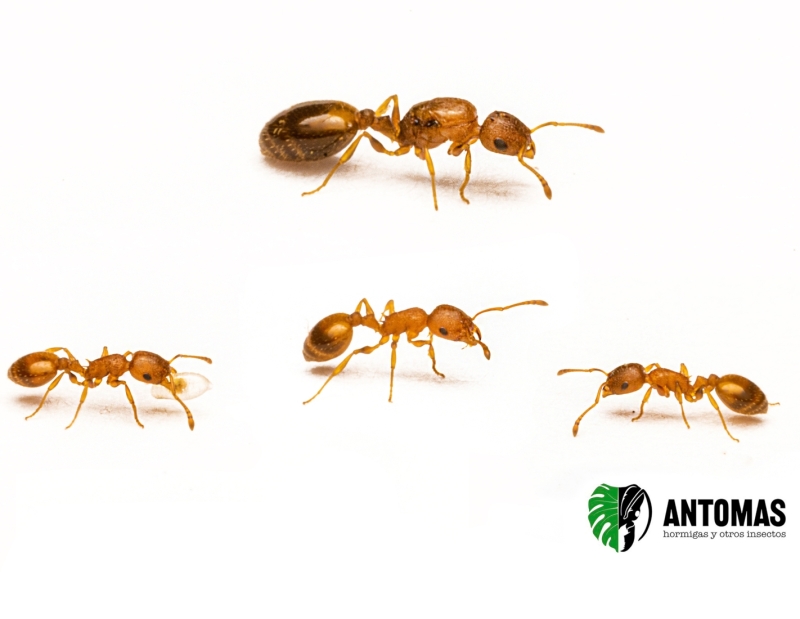
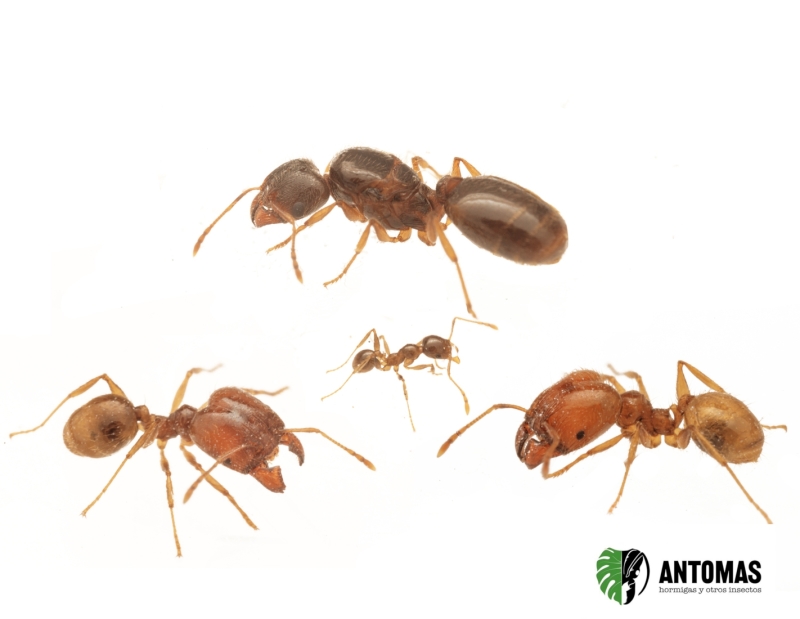
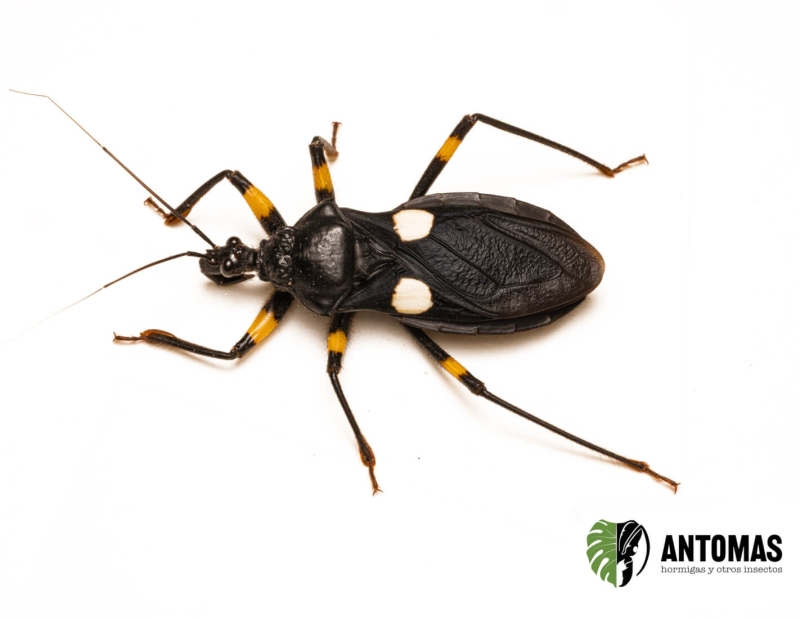
Difficulty: 3/5 – Advanced
The Iberian desert ant that rewrote the rules of inheritance: its workers are all hybrids of two genetic lineages, and its queens are born as clones of their mother, without a father. Colonies with several queens. Qbik Wild plaster nest with a little moisture, a dry foraging area with a hot spot of around 35 °C, substrate inside and outside the nest, plenty of protein and sugar always available. Diapause of 4–5 months, with the core period at 6–10 °C. Mineral oil barrier as a precaution.
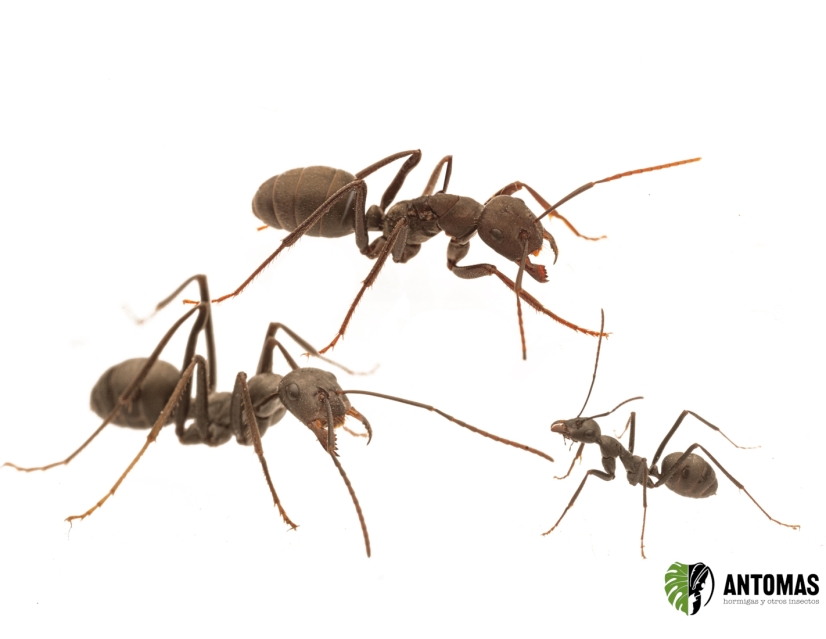
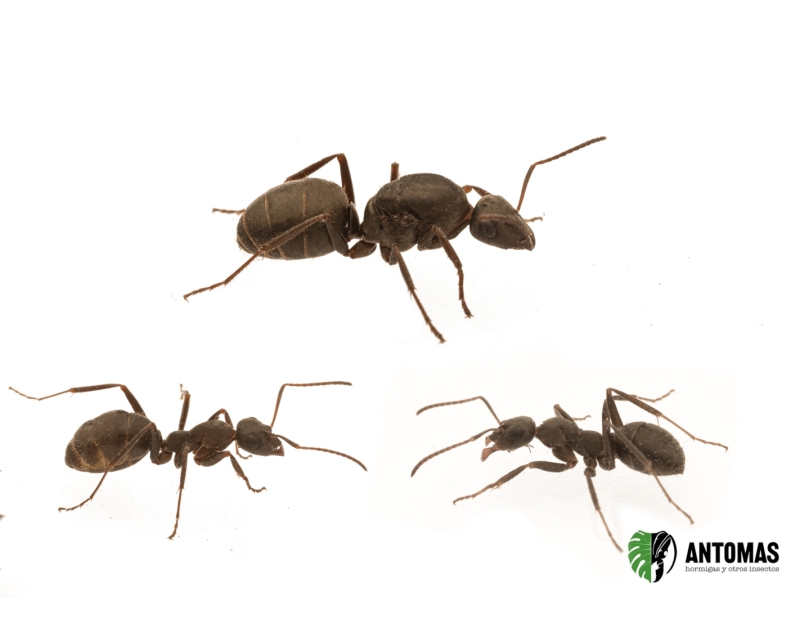
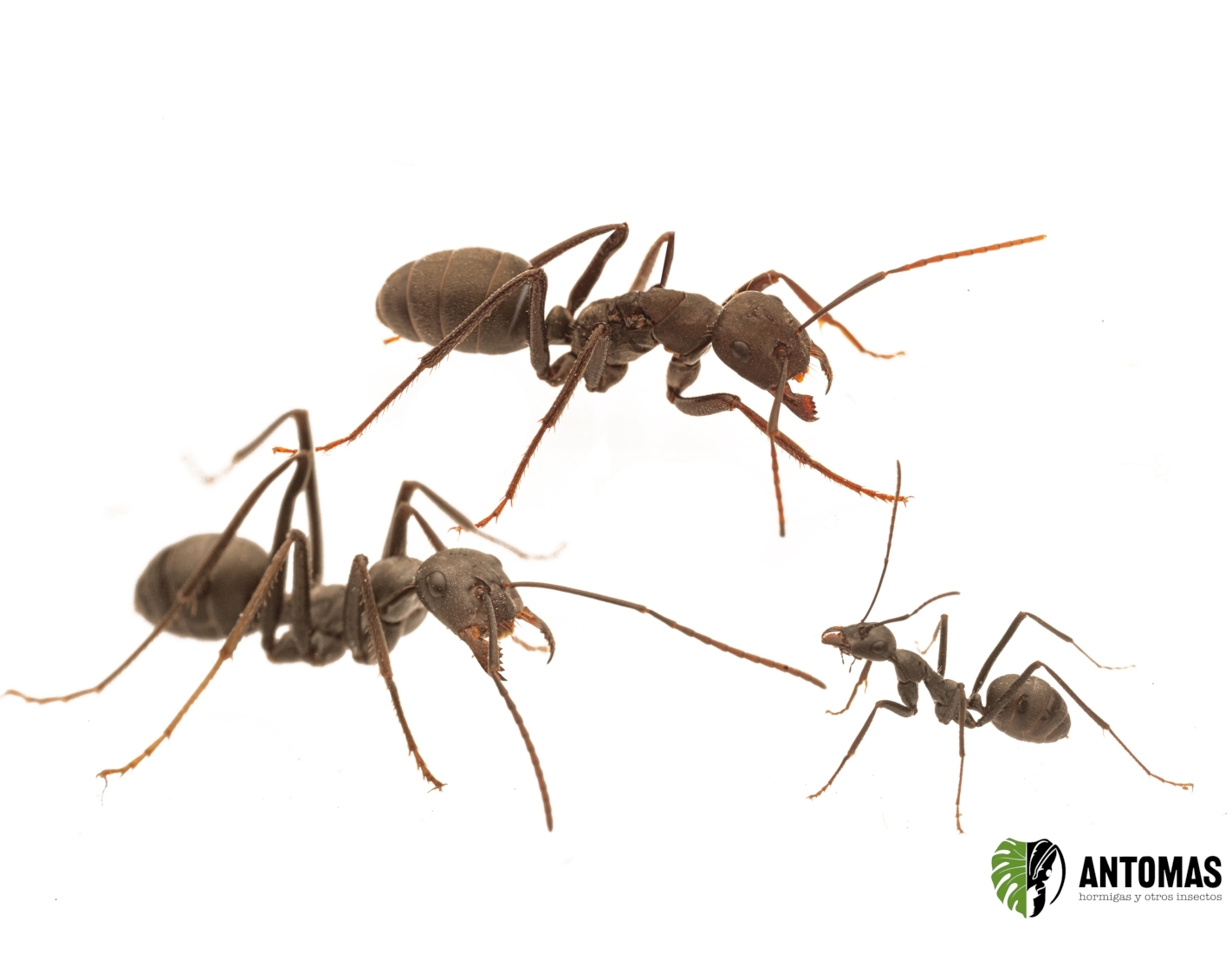
Cataglyphis hispanica (Emery, 1906) is a running ant from the south-west of the Iberian Peninsula: black and long-legged, it heads out to look for food in full sun when other ants hide from the heat. So far, just another Cataglyphis. But in 2012 a team from the Université Libre de Bruxelles and the Doñana Biological Station discovered that it hides one of the strangest reproductive systems in the animal kingdom: social hybridogenesis. Its workers are all hybrids of two distinct genetic lineages; its queens, by contrast, are genetic copies of their mother, born without a father.
It is also a species that can live with one or several queens per nest, and at Antomas we sell it with four. In this care sheet we explain what that means, how a C. hispanica colony works on the inside and how to keep one at home, keeping apart what has been documented in the species, what has been shown in its relatives in the genus, the practice of other keepers and Antomas’s own experience with Cataglyphis. If the genus interests you, we also recommend the care sheets for the Sahara Desert Ant, Cataglyphis bicolor, and the Saharan Silver Ant, Cataglyphis bombycina.
Biology
A desert ant with an Iberian passport
It was described by the Italian entomologist Carlo Emery in 1906, in his revision of the running ants of the Palaearctic, as a Spanish subspecies of what was then called Myrmecocystus viaticus. The name, hispanica, says it all: it is a species of the peninsula. Today it belongs to the altisquamis group of the genus Cataglyphis, together with relatives such as Cataglyphis velox, C. mauritanica and C. humeya.
The geneticists who have studied it describe it as typical of the most arid habitats in the south-west of the Iberian Peninsula. In 2014, Hugo Darras and his colleagues covered its whole range along a transect of around 400 km from north to south, with populations in western Andalusia, Extremadura and Castile and León. It lives in open, sunny terrain, on bare ground or with low scrub, where it nests underground. Its climate is dry inland Mediterranean: very hot, dry summers and cool winters, with frosts in the northern part of its range. That proper winter is the basis of its diapause.
The genus has a long history: according to a 2024 study, Cataglyphis arose in the open grasslands of the Near East some 18 million years ago and reached the Mediterranean basin around 9 million years ago. Today the Iberian Peninsula is one of its great centres of diversity.
A midday runner
Like all Cataglyphis, it is thermophilic: it forages by day, in the hottest hours, sometimes close to its thermal limit. It is the strategy of a subordinate ant. Dominant species, with huge colonies, control resources when temperatures are mild; Cataglyphis, with small colonies, make the most of the hours when the ground is scorching and there is hardly any competition. In the genus, heat tolerance has a molecular basis: in 1995, Gehring and Wehner showed that these ants produce heat shock proteins before going out, as an insurance against the heat.
Its workers forage alone, without pheromone trails. Above all, they are scavengers of dead arthropods scattered across the ground, and they only call on their nestmates for help when the prey is too large for one to carry. To find their way back to the nest they use the sun, polarised light and the landscape, and in their relative C. fortis it was shown in 2006 that they measure distance by counting steps: the famous “pedometer” of desert ants. What you will see in your formicarium is exactly that, on a smaller scale: workers leaving one by one, crossing the foraging area at full speed and returning in a straight line with their prey.
Two lineages that cannot live without each other
In 2012, Laurianne Leniaud, Hugo Darras, Raphaël Boulay and Serge Aron were studying the DNA of four populations from Huelva and Seville when they found something that did not fit. Within each population, queens and males fell into two very different genetic groups, which they called the His1 and His2 lineages. And in every colony, without exception, the queen and her male belonged to different lineages.
Two years later, the same group extended the study to 68 colonies from 14 populations across the species’ whole range. The result was even more surprising: the same two lineages are present in every population, from Andalusia to Castile and León. They are two genetic “families” that have been separated for a long time and yet need each other to produce workers. It is a kind of obligate mutualism within a single species.
Hybrid workers, clonal queens: social hybridogenesis
This is the heart of C. hispanica’s biology, and it is worth explaining slowly. In most ants, a mated queen lays fertilised eggs that develop into females, and food and environment decide whether they become workers or queens. In C. hispanica the queen uses two different modes of reproduction depending on what she wants to produce:
- Workers: by sexual reproduction. The queen mates with a male from the other lineage and uses his sperm to fertilise the eggs. All workers are hybrids between the two lineages. In the 2012 study, the 820 workers analysed from 58 colonies carried genes from the queen and from her male, and 94.6% were heterozygous at the five markers studied.
- New queens: by thelytokous parthenogenesis. Gynes hatch from unfertilised eggs and are clones of their mother. The 24 new queens from 7 colonies had exactly the same genotype as the mother queen, with a relatedness of 1.0.
- Males: by arrhenotokous parthenogenesis, as in all Hymenoptera: they hatch from unfertilised eggs, are haploid and carry only the queen’s genes.
The result is what biologists call social hybridogenesis: the colony’s “body”, the sterile workers, is hybrid, while the “germline”, the queens and males, is of pure lineage and passes on only maternal genes from generation to generation. Adding up the studies up to 2014, 1,228 workers, all hybrids, and 304 queens, all of pure lineage, had been analysed. Not a single exception.
What does the queen gain from this system? According to its discoverers, it combines the best of both worlds: she passes all her genes on to her daughter queens, like an asexual organism, and at the same time has a genetically diverse, highly heterozygous workforce, which tends to be more vigorous.
Indispensable males… with no descendants
From an evolutionary point of view, the C. hispanica male has a very raw deal. His genes only pass to the workers, which are sterile, so he never has grandchildren: the researchers themselves described him as an evolutionary dead end. And yet he cannot disappear: without males there are no workers, and without workers there is no colony. If one of the two lineages stopped producing males, the whole system would collapse.
What does not exist in this species is workers born by parthenogenesis: in its relative Cataglyphis cursor, which also produces fatherless queens, around 2.5% of workers come from unfertilised eggs; in C. hispanica, none. Orphaned workers do lay eggs, but no sexual has ever been found to come from them: the 199 sexuals analysed in 2012 were all of pure lineage.
Decided by its genes: born a worker or born a queen
In 2014, Darras, Kuhn and Aron went a step further with an elegant experiment. They set up 62 laboratory colonies, each with a single queen and 200 workers, fed on fly larvae and sugar water, and followed for two months what hatched in each. Colonies whose queens had mated with a male from the other lineage produced workers normally: 50 out of 52. Those whose queens had mated with a male from their own lineage did not produce a single worker: their fertilised eggs died en masse (only 17% were still alive, compared with 84% in the others), and the few that did develop became queens.
The conclusion is that in C. hispanica caste is genetically determined: a genome that is not hybrid has lost the ability to become a worker. This is extremely rare in ants, in which the environment almost always has the final say.
One queen or several? What science says about our four-queen colonies
Across most of its range, colonies have a single queen, mated only once. In the 2012 study, 34 of 38 excavated colonies had one queen, and in the other four the workers were compatible with a single mother; 28 of 30 queens had mated with a single male. In 2014, every colony in 12 of the 14 populations sampled had one queen.
But it is not always like that. In two populations, multi-queen colonies turned up, with two to six queens per nest, and in one population in Cáceres half the colonies were polygynous, with an average of 6.4 queens per nest. In other words, C. hispanica can be monogynous or polygynous depending on the population, and a colony with four queens, like the ones we sell, falls squarely within what has been observed in the wild.
The most interesting part is who those queens are. In the Cáceres population, relatedness between queens in the same nest was extremely high, 0.90: they are sisters, and almost clones, because they were all born by parthenogenesis from the same mother. According to the 2017 review by Boulay and his colleagues, polygyny in the altisquamis group arises from the adoption of related queens into established nests: daughters stay at home, or return to it, and cooperate with their mother and sisters. That explains why they live together without fighting.
There is one more detail. In that polygynous population, 15% of mated queens had mated with a male from their own lineage. Those queens do not produce workers, but they can remain in a multi-queen colony, where other queens supply the workforce, and produce queens and males. In a colony with several queens it is possible that not all of them lay worker eggs, and that is fine: the colony works as a team.
Colonies born on foot: founding by budding
Many ants found new colonies with a lone queen who seals herself in after the nuptial flight. Not C. hispanica. Its colonies multiply by budding: the young queen, already mated, leaves her natal nest accompanied by sister workers and settles with them in a new nest a short distance away, on foot. That is why, in a newly formed colony, the workers are not the daughters of their queen but of the queen of the mother nest, until her own first workers emerge.
It is a house move on a grand scale. The 2017 review by Boulay and his colleagues includes a photograph by Teresa Cerdá in which a few C. hispanica workers carry their nestmates on their backs to the new nest. In its relative C. cursor, which multiplies in the same way, it has even been seen that if the new nest does not thrive, the mother colony can reabsorb it.
Budding has a curious consequence: since the new queens are clones of their mother and do not move far away, colonies of the same lineage cluster in patches. The ones that travel are the males, which fly and make crossing between lineages possible. And it explains something practical: a C. hispanica queen is not built to found alone in a test tube, but to start with a group of workers. That is why at Antomas we always sell it as a colony.
A calendar with no brood in winter
In Cataglyphis no brood overwinters: the colony enters the cold season with adults only and the queen stops laying. When she resumes laying, in early spring, the first eggs are the ones that produce sexuals, queens and males; everything she lays later in the season becomes workers. That is why researchers excavated their colonies in April, before laying began, or in May, when there were already sexuals in the nest.
At home, this means two things. If you see no brood in winter, that is normal. And if winged gynes or males appear in spring, it is not a problem: it is the species’ cycle. In captivity they cannot found new colonies, because the males have no one to mate with.
An ancient system, 400 km across
Theory says that systems based on asexual reproduction are short-lived in evolution: they accumulate errors and end up disappearing. C. hispanica contradicts this. The same two lineages run across its whole range and remain highly differentiated in their nuclear DNA despite crossing in every generation to produce workers, which indicates that the system has been preserved for a long time.
There are clues as to how it manages this. In 2015, Darras and Aron found that mitochondrial DNA, which passes from mothers to daughters, does not separate the two lineages but groups by geographical area: at some point it has passed from one lineage to the other, a trace of occasional exchanges. And in polygynous populations, queens mated with their own lineage produce queens by sexual reproduction, not by cloning: this is the small back door of sex that could keep the system healthy in the long term.
In 2022 the complete genome of both lineages was published, with a surprising detail: one has its DNA arranged in 26 chromosomes and the other in 27. The authors propose it as a model species for studying both hybridogenesis and the adaptation of ants to extreme heat.
Relatives with the same trick
C. hispanica was the first, but not the only one. In 2013, Eyer and his colleagues found the same system in Cataglyphis velox and C. mauritanica, two species from the same altisquamis group whose colonies have several queens, almost all with the same genotype. In 2019 it was confirmed in most populations of C. velox, while its sister species C. humeya reproduces in the normal way. And in 2020, Kuhn and his colleagues studied 11 species of the genus and concluded that social hybridogenesis has appeared several times independently in Cataglyphis. Desert ants have become a natural laboratory for understanding why sex exists.
The precedent was Cataglyphis cursor, a species from southern France in which Pearcy and his colleagues showed in 2004 that queens use sex to make workers and parthenogenesis to make queens. C. hispanica takes that idea one step further, with two lineages obliged to work together.
Size and morphology
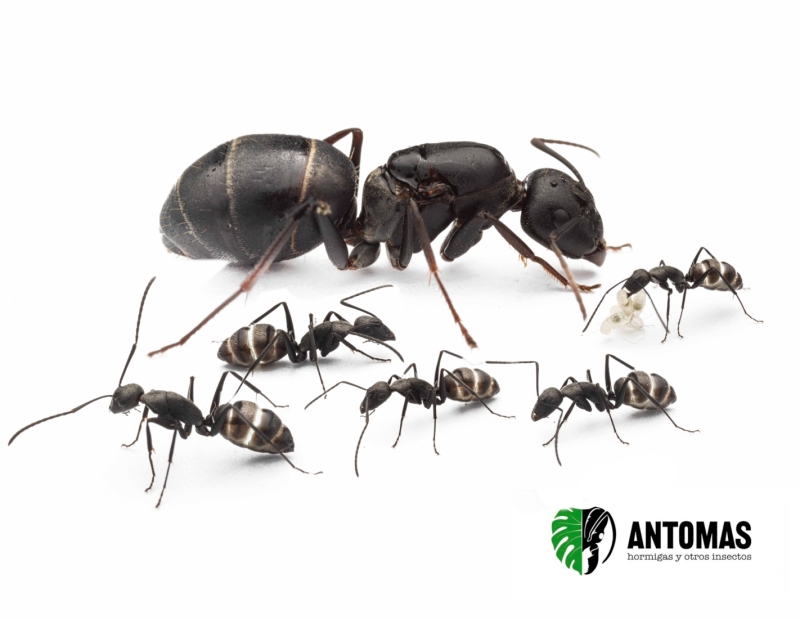
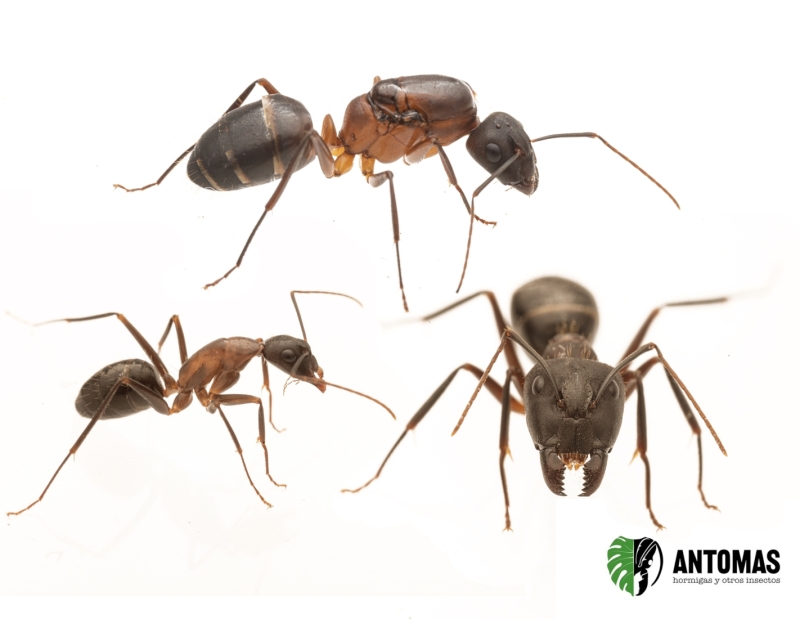
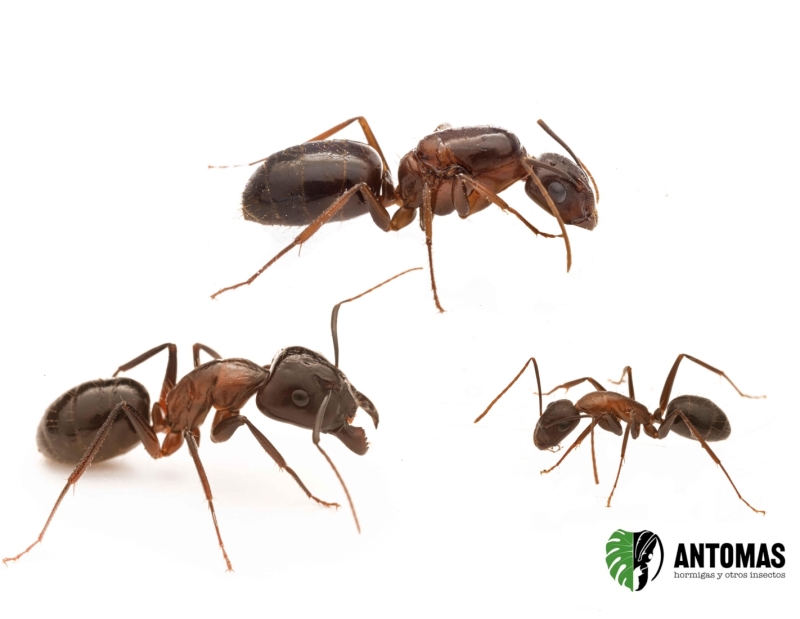
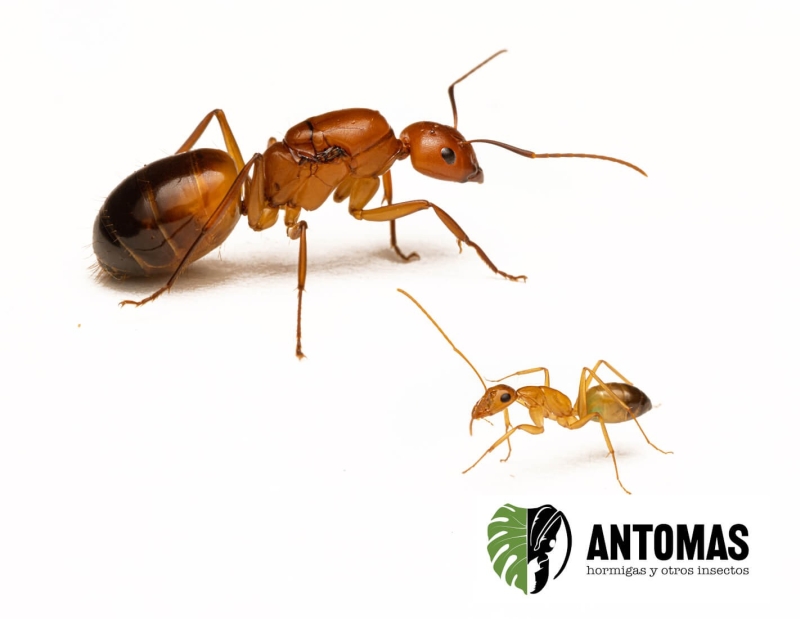
A slender, agile formicine, with long legs that lift the body off the hot ground, large eyes and three ocelli, as befits a visual navigator. It has no soldiers: its workers vary in size continuously, without separate castes.
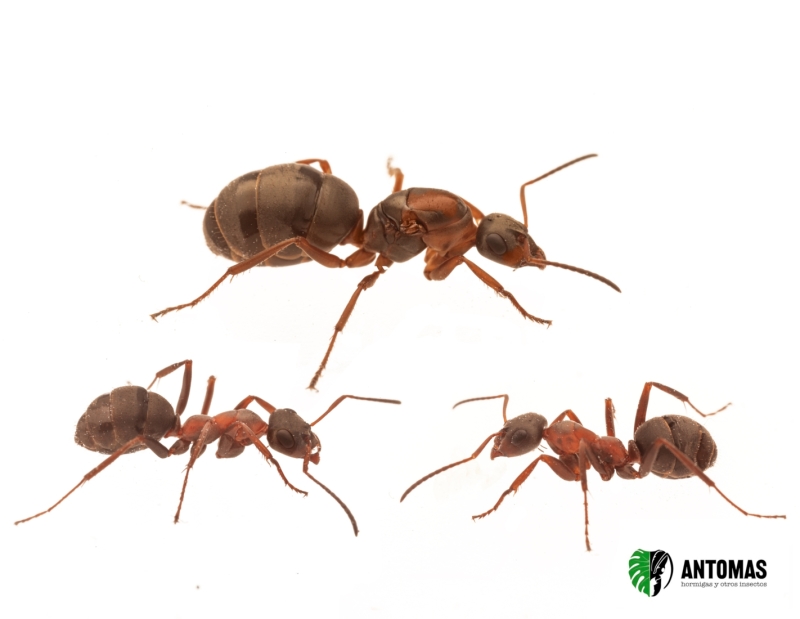
- Colouring of our colonies. Blackish-brown to black, matt workers, with long legs, reddish tibiae and tarsi, antennae that lighten towards the tip and reddish mandibles.
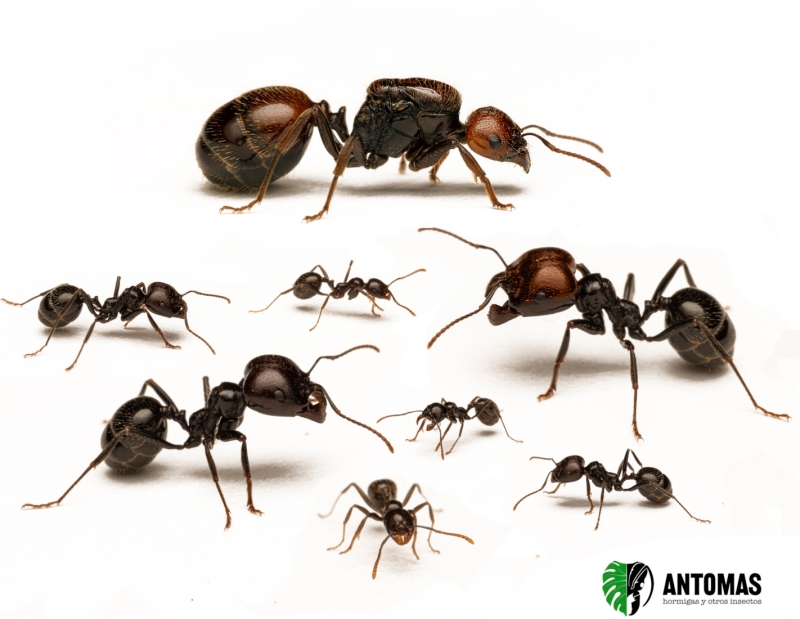
- Workers of several sizes. Small and large workers live side by side in the same colony. In the genus, the large ones usually go out to forage and the small ones stay with the brood.
- Queens. Larger and sturdier than the workers, with the broadened thorax typical of the caste. Genetically they are very different from their workers: the pure-lineage queens are highly homozygous, and the hybrid workers highly heterozygous.
- No sting. Like all formicines, it defends itself by biting and with formic acid.
Approximate measurements
We have found no published scientific measurements of the worker, queen or male of C. hispanica. The figures circulating in shops and keeping websites cite no source, and some do not fit what is known about the species, so we prefer not to give them. What we can say is that it is a medium-sized Cataglyphis, with workers of varied sizes and clearly larger queens.
Care in captivity
Difficulty: 3/5 – Advanced
Feeding it holds no secrets and, since it comes with several queens and workers, the colony gets off to a strong start. But it is not an ant for beginners: it needs well-planned heating, with a hot spot in the foraging area and a more temperate nest; it is extremely fast, so you need to work methodically when opening and cleaning; it appreciates space, because it patrols large areas; and it has a winter diapause that must be respected. In return, it is one of the most interesting species you can keep at home: a piece of the history of genetics running around your foraging area.
Temperature and humidity
- Nest: 24–28 °C during the active season, temperate and stable, with some moisture in one area; never wet or with condensation.
- Hot spot in the foraging area: around 35 °C, in just one part of the foraging area. Any heat source will do, a heat cable or heat mat underneath or a lamp above, always with a thermostat and with the temperature measured in the substrate. Never over the nest or over the whole set-up.
- Foraging area: dry.
- Water: always available, in a test tube with water and cotton wool.
- Light: the nest dark or covered; the foraging area with daylight and a clearly marked day–night cycle.
- Diapause: 4–5 months, with the core period from December to February at 6–10 °C (see “Diapause”).
This is an ant that lives on heat: with a well-made gradient, the workers gather in the hot zone and the colony is active all day. Without heat, it shuts down. As for humidity, a little is enough: one slightly moist corner of the nest, so the brood does not dry out, and the rest dry.
Recommended formicaria
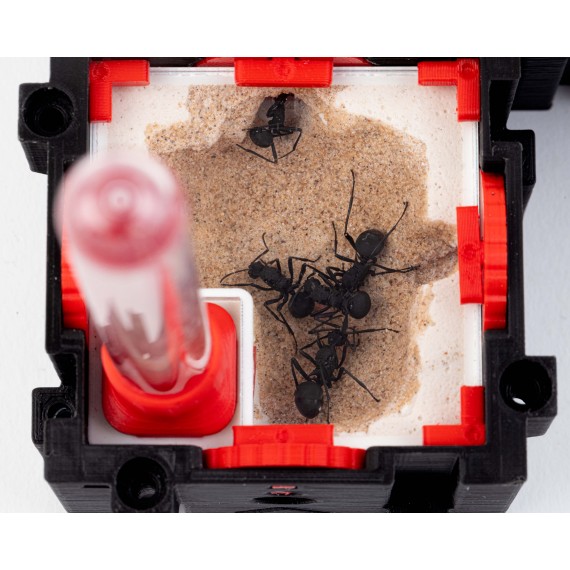
At Antomas we recommend a plaster nest from Anthouse’s Qbik Wild range, in its standard version: the plaster holds gentle moisture in the nest while the foraging area stays dry. To start with our colonies, the Qbik Wild One P 1C:
To grow, once the colony fills the nest, the Qbik Wild Duo P 2C:
- Substrate inside and outside the nest. Essential: in our experience with the genus, without substrate the larvae do not spin their cocoons properly. A thin layer of sand, or of sand and mineral soil, in the chambers and in the foraging area.
- A spacious foraging area. This is a runner that patrols a lot of ground: the more foraging space, the more natural behaviour you will see. Add a few flat stones or twigs as lookout points.
- Water, feeder and barrier: the water tube, a feeder for the sugar and a strip of mineral oil at the top of the walls.
Upgrade when the nest becomes too small for them, not before: in a nest that is too large, the spare chambers end up as rubbish dumps.
Growth of a multi-queen colony
At Antomas we sell C. hispanica as colonies with four queens and their workers, not as lone queens. This fits its biology: in the wild it does not found alone but by budding, with a group of workers, and its colonies can have several related queens. A few tips to get the most out of it:
- Keep the queens together. They arrive living together and are almost clonal sisters. Do not separate them or split them between formicaria: a queen without her group of workers is not built to make it on her own.
- Do not add queens or workers from other colonies, or merge different colonies. Polygyny in this species is based on relatedness; a foreign queen would be a problem.
- Do not worry if they do not all lay the same amount. As we have seen, in polygynous colonies a queen may not produce workers. What counts is that the colony grows.
- Growth rate. There are no scientific data on the species’ development time. What we do know is that the genus usually has small colonies, of a few hundred workers, and that a colony with several queens, heat and plenty of protein grows quickly in spring and summer.
Arrival and moving in. Prepare the formicarium in advance, with its substrate, its moisture and the barrier in place. At Antomas we install it by tipping out: we open the container in the foraging area, next to the nest entrance, and gently tip out the queens, workers and brood, helping the stragglers along with a brush. Work over a tray, with the heating switched off a few minutes beforehand, because they move more slowly when cool, and keep the nest dark so they occupy it straight away. Check that all four queens have gone in. If you ever change formicarium, use the same method.
Feeding
Protein: the more, the better. It scavenges dead arthropods, so the staple is small dead insects. At first, small prey, dead or cut up: Thermobia domestica, perfect for its size, flies, Drosophila or pieces of cricket and red runner roach. As the colony grows, increase the size of the prey and change its state: mealworms, whole crickets and roaches, half-dead or freshly killed. In the laboratory, researchers kept their colonies on fly larvae and sugar water.
At Antomas we recommend insects 4–5 times a week, or more. If you do daily maintenance and remove the leftovers, it is better to overfeed: the colony perceives that it has more resources and grows faster and in greater numbers. With four queens laying, protein demand in spring and summer is high. If you cannot clean often, better not, because leftover food brings mould and mites. Change the type of insect from one week to the next, so they do not always eat the same thing. A tip: place the prey in the warm zone, near the hot spot, which is where you will see the most foragers.
Sugar, always available. At Antomas we recommend a sugar feeder ad libitum. Vary the sugars: Blue Sugar nectar by Anthouse 4–5 times a week and another sugary liquid or nectar 1–2 times a week. You can also add a little protein to the nectar. Always in a feeder, never on cotton wool: cotton wool goes mouldy and the liquid spoils very quickly. Use a traditional or home-made feeder, where the drop sits “spread out” and easy to reach.
Water: the test tube with water and cotton wool, always full. And buy your insects from a reliable supplier: wild-caught ones can carry insecticides or parasites.
Diapause: the Iberian winter
Yes, it has a diapause, and it is best to respect it. It lives inland in south-western Iberia, with cool winters and frosts in part of its range, and in the genus the colony spends the winter without brood. At Antomas we recommend:
- Autumn (October–November): when the colony slows down its brood and comes out less, switch off the hot spot, gradually lower the temperature and shorten the hours of light.
- Core period (December–February): 6–10 °C, in a cool, stable place in the house, such as a garage or an unheated room, or in a wine fridge.
- Spring (March): gradually raise the temperature, lengthen the hours of light and switch the hot spot back on when the workers are moving freely.
- In total: around 4–5 months of rest and semi-rest.
- During diapause: no hot spot, no artificial light and no insects, but with sugar water available and the water tube. Nest humidity as always.
On coming out of diapause, the resumption of laying is the moment when the colony may rear sexuals. Offer protein as soon as you see activity, because spring is its great growth season.
Behaviour in captivity
Solitary foraging. You will not see columns or trails: each forager goes out alone, searches at full speed with abrupt stops to get its bearings and returns in a straight line with its prey. They only cooperate when the prey is large and close to the entrance. The ones you see outside are the colony’s veterans; seeing an old forager die now and then is a normal part of their cycle.
Watch without fear. At Antomas we believe ants are there to be enjoyed, observed and learnt from, not kept hidden away. C. hispanica has very good eyesight and soon gets used to light and to your presence. Just leave it the dark area in the nest and the lit foraging area, and observe it gently, intervening as little as possible. With several queens, it is worth looking into the nest from time to time: you will see how the workers tend to all of them.
Warning signs: few workers outside in warm conditions outside diapause (check the hot spot and the food); condensation or mould (too much moisture or leftovers); brood that stalls in the middle of the season (lack of protein or heat); and a queen isolated or attacked by the workers, which is unusual in an established colony but worth keeping an eye on.
Escapes and handling
Like other Cataglyphis, it can climb smooth surfaces, and it is so fast that at Antomas we recommend a mineral oil barrier as a precaution: a thin, continuous strip at the top of the foraging area walls, renewed when it collects dust; clean walls, with no dried sugar to give them grip; a well-fitting lid and gap-free connections; and nothing that could act as a bridge to the barrier.
The tricky moment is opening the formicarium: in the heat, a worker is out before you see it. Switch off the hot spot a few minutes beforehand, open only as much as needed and work calmly. It does not sting, because it has no sting, but it bites and can spray formic acid, which stings in a wound or near the eyes. Handle it with a soft brush or soft forceps, never with your hands, and always use a thermostat with the heat source. Although it is an Iberian species, a captive-bred colony must never be released into the wild.
What not to do
- Set it up without heating, or heat the whole set-up without leaving cooler areas.
- Heat without a thermostat or place the heat source over the nest.
- Wet the nest or the foraging area, or let condensation form.
- Set it up without substrate: the larvae do not spin their cocoons properly.
- Separate the queens, split them between formicaria or try to get one to found alone.
- Add queens or workers from other colonies or merge different colonies.
- Put the sugar on cotton wool, always give it the same insect or leave leftovers uncleaned.
- Skip diapause or cut it down to a few weeks.
- Panic if there is no brood in winter or if winged sexuals appear in spring.
- Open the formicarium in a hurry and with the heating on.
Scientific sources
This care sheet has been prepared from the scientific literature on Cataglyphis hispanica, the altisquamis group and the genus Cataglyphis, and from Antomas’s experience with the genus. Main references:
- Gehring, W. J. & Wehner, R. (1995). Heat shock protein synthesis and thermotolerance in Cataglyphis, an ant from the Sahara desert. PNAS 92: 2994–2998. doi:10.1073/pnas.92.7.2994
- Pearcy, M., Aron, S., Doums, C. & Keller, L. (2004). Conditional use of sex and parthenogenesis for worker and queen production in ants. Science 306: 1780–1783. doi:10.1126/science.1105453
- Wittlinger, M., Wehner, R. & Wolf, H. (2006). The ant odometer: stepping on stilts and stumps. Science 312: 1965–1967. doi:10.1126/science.1126912
- Leniaud, L., Darras, H., Boulay, R. & Aron, S. (2012). Social hybridogenesis in the clonal ant Cataglyphis hispanica. Current Biology 22: 1188–1193. doi:10.1016/j.cub.2012.04.060
- Eyer, P.-A., Leniaud, L., Darras, H. & Aron, S. (2013). Hybridogenesis through thelytokous parthenogenesis in two Cataglyphis desert ants. Molecular Ecology 22: 947–955. doi:10.1111/mec.12141
- Leniaud, L., Pearcy, M. & Aron, S. (2013). Sociogenetic organisation of two desert ants. Insectes Sociaux 60: 337–344. doi:10.1007/s00040-013-0298-2
- Darras, H., Leniaud, L. & Aron, S. (2014). Large-scale distribution of hybridogenetic lineages in a Spanish desert ant. Proceedings of the Royal Society B 281: 20132396. doi:10.1098/rspb.2013.2396
- Darras, H., Kuhn, A. & Aron, S. (2014). Genetic determination of female castes in a hybridogenetic desert ant. Journal of Evolutionary Biology 27: 2265–2271. doi:10.1111/jeb.12470
- Darras, H. & Aron, S. (2015). Introgression of mitochondrial DNA among lineages in a hybridogenetic ant. Biology Letters 11: 20140971. doi:10.1098/rsbl.2014.0971
- Boulay, R., Aron, S., Cerdá, X., Doums, C. et al. (2017). Social life in arid environments: the case study of Cataglyphis ants. Annual Review of Entomology 62: 305–321. doi:10.1146/annurev-ento-031616-034941
- Darras, H., Kuhn, A. & Aron, S. (2019). Evolution of hybridogenetic lineages in Cataglyphis ants. Molecular Ecology 28: 3073–3088. doi:10.1111/mec.15116
- Kuhn, A., Darras, H., Paknia, O. & Aron, S. (2020). Repeated evolution of queen parthenogenesis and social hybridogenesis in Cataglyphis desert ants. Molecular Ecology 29: 549–564. doi:10.1111/mec.15283
- Darras, H., De Souza Araujo, N., Baudry, L., Guiglielmoni, N. et al. (2022). Chromosome-level genome assembly and annotation of two lineages of the ant Cataglyphis hispanica: stepping stones towards genomic studies of hybridogenesis and thermal adaptation in desert ants. Peer Community Journal 2: e40. doi:10.24072/pcjournal.140
- Lecocq de Pletincx, N., Cerdà, X., Kiran, K., Karaman, C. et al. (2024). Ecological diversification preceded geographical expansion during the evolutionary radiation of Cataglyphis desert ants. iScience 27: 109852. doi:10.1016/j.isci.2024.109852