Difficulty: 3/5 – Advanced
The ant with which science began to work out how an insect finds its way: it reads the sun and polarised light, withstands up to 55.1 °C in the laboratory and runs at half a metre per second across the steppes of North Africa. Colonies with queen. Qbik Wild plaster nest with a little humidity, dry foraging area with a hot spot of about 35 °C, substrate inside and outside the nest, plenty of protein and sugar always available. Diapause of 4–6 months, with the core period at 14–18 °C. Mineral oil barrier as a precaution.
Cataglyphis bicolor (Fabricius, 1793) is one of the most famous ants in science, even though few people know it by name. It was the starting point, in the late 1960s, of one of the great adventures in behavioural biology: finding out how an ant that forages alone, without pheromone trails, can travel tens of metres from its nest and return home in a straight line. The polarised-light compass, systematic search and the neurons that “read” the sky were discovered, to a large extent, with its workers.
In our shop we call it the Sahara Desert Ant, but it is worth making one thing clear from the start: it is not a dune ant. It lives in the steppes, scrublands and oases of North Africa, between the Mediterranean coast and the gateway to the great desert. It is a relative of the Saharan Silver Ant, Cataglyphis bombycina, whose care sheet we recommend if you want to get to know the genus. Here we tell you what makes C. bicolor unique, keeping apart what has been documented in the species, what has been shown in its relatives, the practice of other keepers and the experience of Antomas.
Biology
Two colours and a name from 1793
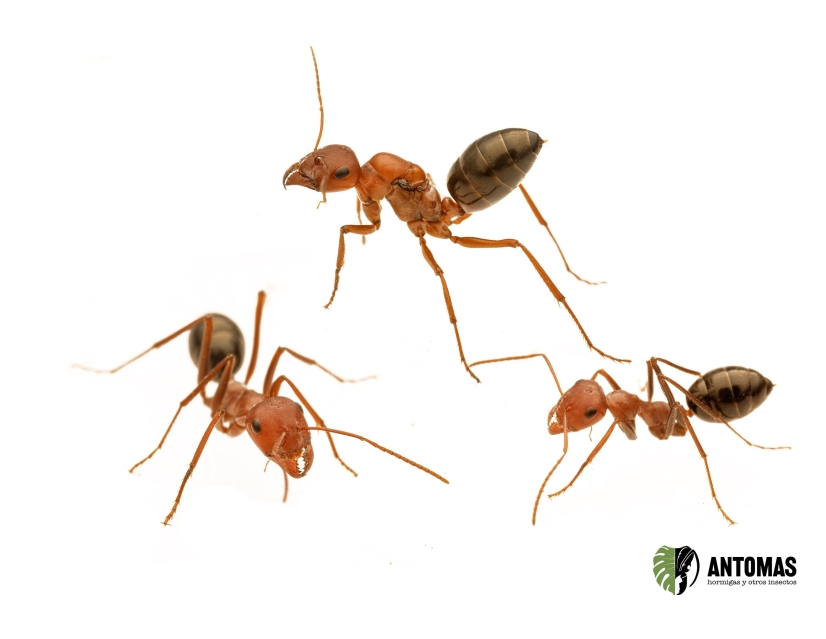
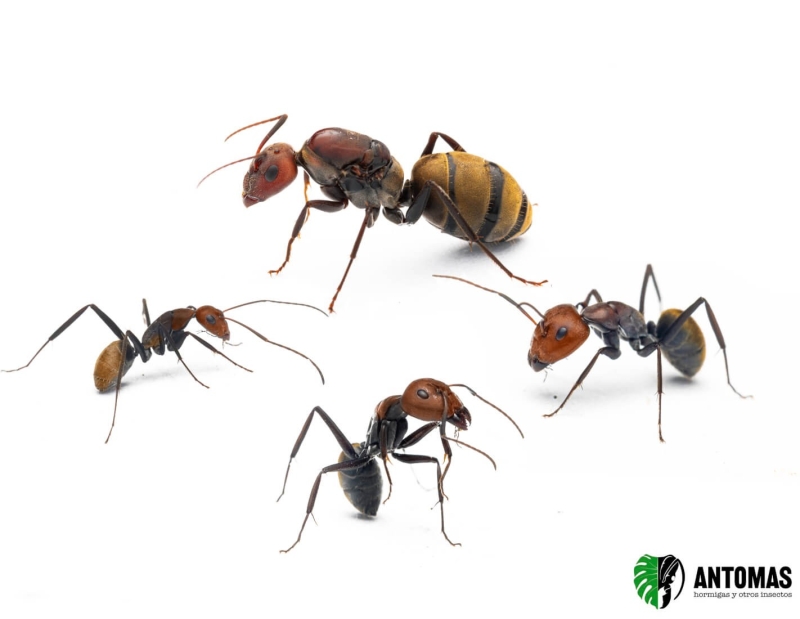
It was described by the Danish naturalist Johan Christian Fabricius in 1793 as Formica bicolor. The epithet, from Latin, means “two-coloured”, and it suits the ant perfectly: reddish head and thorax, black gaster. It gives its name to the bicolor group, a set of red-and-black species so alike that Donat Agosti’s classification (1990) relies mainly on the male genitalia, because worker characters overlap.
In 2005, Knaden and colleagues split the Tunisian “bicolor” into three species living in neighbouring areas: C. bicolor, C. viatica and C. savignyi. Mitochondrial DNA separates C. savignyi, but does not distinguish C. bicolor from C. viatica; microsatellites, on the other hand, show that where they meet they do not interbreed. That is why in this care sheet we sometimes talk about the group and not just the species: they are sisters with very similar biology.
Sahara in name only: steppes, scrubland and oases
Its natural range is North Africa, above all the Maghreb: Tunisia, Algeria and Morocco. Almost all of its published biology comes from Tunisia and the Algerian coast. Records from the Middle East, the Sahel or south-eastern Europe usually belong to other species of the group, which is absent, by contrast, from the Iberian Peninsula, home to other Cataglyphis such as Cataglyphis velox.
The most striking thing is where it does not live: according to Agosti, the bicolor group is absent from true deserts. C. bicolor is an ant of steppes and low scrubland, field edges, disturbed ground, coastal wetlands, islets off the Algerian coast and pre-Saharan oases: open, sunny landscapes with some vegetation, where it nests underground. The climate is Mediterranean or semi-arid, with hot, dry summers and winters that are mild on the coast and cool, with frosts, on the high inland steppes. There is a real winter, and in the cold months activity drops sharply or stops: this is the basis of its diapause.
Its great modern enemy is the plough. In an area of Tunisia studied by Knaden and Wehner, conversion to farmland cut its nests from 27 to 4.
Mistress of the irrigated scrub
In much of Tunisia it shares its territory with its sister species C. savignyi. How do two almost identical ants divide up the ground? Dietrich and Wehner studied this in 2003 using the vegetation around 113 nests, and the answer is a textbook case of asymmetric competition: where they live together, C. bicolor takes the patches of plants that need more water, such as irrigated areas, which are richer in food, and pushes C. savignyi out to the dry steppe. At baits and in the laboratory it dominates its sister, and its foragers make shorter trips. Where each lives alone, they use any microhabitat.
1969: the ant that taught science to navigate
In 1969, the zoologist Rüdiger Wehner and his colleague R. Menzel published a three-page article in Science: “Homing in the ant Cataglyphis bicolor”. It was the starting point for more than half a century of research by the group Wehner later led at the University of Zurich, which turned Cataglyphis into the great model for studying insect navigation.
They discovered that foragers steer by landmarks while they can see them and that, when landmarks fail, they fall back on the sun. And that not all workers are the same: excavators have poorer visual memory than foragers, foragers belong to the largest size class, and large and small workers responded differently to the striped patterns placed in front of them.
Later, C. fortis, from the Tunisian salt pans, took over, probably because its flat, almost landmark-free landscape is ideal for studying “blind” navigation. That is why the findings need to be kept apart. Path integration, adding up directions and distances to know at every moment where the nest lies, like a sailor’s dead reckoning, has been studied mainly in C. fortis. And the famous pedometer, the demonstration that they measure distance by counting steps, using workers fitted with “stilts”, was carried out in 2006 on C. fortis, its relative. What was indeed discovered with C. bicolor is covered in the next two sections.
A sky it can see and we cannot
To use the sun as a compass, you need to know where it is even when a cloud hides it. Cataglyphis solve this with polarised light: skylight vibrates in directions that form an orderly pattern around the sun, invisible to us, which gives away the sun’s position even when only a patch of blue sky is visible. In 1973, Duelli and Wehner studied with C. bicolor which colours of light the ant uses to read that pattern, and later work placed it in the ultraviolet.
The sensor sits in the upper part of the compound eyes, a strip of specialised facets looking at the sky, the dorsal rim area. In 2000, Thomas Labhart recorded POL neurons in the optic lobe of C. bicolor: they respond to the direction of polarisation and receive their ultraviolet input from that strip, a circuit dedicated to reading the sky. And there is more. In 1985, Fent and Wehner showed in Cataglyphis, with work on C. bicolor, that the three ocelli, the simple eyes on top of the head, also work as a polarised-light compass. At home, without an open sky, they rely mostly on what they see around them, but they carry all that equipment in their heads.
Getting lost methodically: systematic search
However accurate its compass, a worker returning from 20 or 30 metres away builds up small errors and does not always find the entrance, a hole a few millimetres wide, at the first attempt. It does not then wander at random. In 1981, Wehner and Srinivasan described in Cataglyphis, with work on C. bicolor, a systematic search: loops that go out and come back again and again to the point where the nest “should” be, getting wider each time. Overlaid, its paths form a bell curve, densest where the ant calculates the entrance to be. It is the most efficient strategy for finding something whose position is known within a margin of error.
More heat-tolerant than the silver ant
The Saharan Silver Ant is famous as the most heat-tolerant ant, but in the laboratory C. bicolor beats it. In 1995, Gehring and Wehner measured the critical thermal maximum (CTmax), the point at which the ant loses control of its movements, in the same study: 55.1 °C in C. bicolor and 53.6 °C in C. bombycina. Its workers forage with body temperatures above 50 °C. It is the same study as the heat shock proteins made in advance that we describe in the care sheet for the Saharan Silver Ant.
So why is it the silver ant that lives on the hottest dunes? Because physiology is only part of the story: C. bombycina compensates with its reflective hairs, its speed and a foraging timetable adjusted to the minute. C. bicolor has no silver mirrors, but it does have a wider thermal margin. It is a single study, with its own method, but the figure surprises anyone who knows its relative’s reputation.
Half a metre per second
In 2021, Tross, Wolf and Pfeffer filmed C. bicolor workers from a Tunisian coastal steppe at high speed to see whether size matters when running. It does:
- Small workers, with a mesosoma of 2.4–3.5 mm, reached 516 mm/s, about 80 body lengths per second.
- Large workers, with a mesosoma of 4–5 mm, reached 468 mm/s, about 49 body lengths per second.
- Above about 300 mm/s, stride frequency levels off at around 26 steps per second, and to go faster they lengthen their stride with aerial phases, with no leg touching the ground.
In the same study, C. albicans sped up by raising its frequency, to about 40 steps per second. C. bicolor wins not on frequency but on stride: it has long legs and makes good use of them.
Disposable foragers: six days out there
Foraging is the most dangerous job in the colony. In 1984, P. and R. Schmid-Hempel marked workers in southern Tunisia and followed their fate:
- Before going out, each worker spends about 4 weeks inside the nest.
- Once it starts foraging, the marked population falls by 16.4 % a day: after 4.2 days half have disappeared, and a forager’s life expectancy is only 6.1 days.
- The main culprits are spiders and robber flies, predatory flies.
In that short time they make an average of 3.7 trips a day. The colony works like a company with a rotating workforce: it produces foragers non-stop because it knows it will lose them, and the queen and the young workers are never exposed. At home there are no spiders or robber flies, but seeing old workers die from time to time is a normal part of their cycle.
Learning the trade
A novice forager does not go out knowing everything. In 2004, Wehner, Meier and Zollikofer followed C. bicolor workers from their very first trip: with experience, their trips lengthen to about 40 minutes on average, they travel up to about 28 m from the nest, they come back with prey on 70 % of trips and, above all, they become faithful to one direction. Back in 1984, Paul Schmid-Hempel had already seen that each forager has its own sector and its own search method, and keeps them trip after trip. These are workers with a style of their own.
A brain that grows when it goes out into the world
That learning can be seen in the brain. In 2006, Kühn-Bühlmann and Wehner made three-dimensional reconstructions of the mushroom bodies of C. bicolor workers, the centres of the insect brain associated with learning and memory. Their volume increases sharply when a worker starts foraging, above all in the collar, the region that receives visual input, and far more than age alone explains: what triggers it is the change of task. The increase is also proportionally greater in small workers, which suggests that a minimum brain size is needed to navigate. When a worker goes out for the first time and starts memorising landscapes, its brain reorganises itself to make room for them.
Scavenger and ant-eater
In the wild it eats mainly dead insects. Foragers cover the ground alone, find dead or weakened arthropods and return with one item per trip, often in the middle of the day, when the heat has killed other insects. The myrmecologist Henri Cagniant describes it as a diurnal predator that feeds mainly on dead insects, very often other ants such as Messor, Camponotus and other Cataglyphis, as well as caterpillars, larvae, beetles, small arachnids and sugary plant liquids. Analyses of food remains in Algeria confirm it:
- On islets and on the coast of north-eastern Algeria, Henine-Maouche and colleagues found that over 95 % of prey items were insects, and that ants were the preferred prey, at frequencies of 52 to 87 %.
- In a coastal wetland, Ouarab and Doumandji found that a single species, the harvester ant Messor barbarus, made up 87 % and 82.2 % of the prey of two nests, among 60 prey species measuring 1 to 30 mm.
But counting is not everything: by weight, those Messor contributed only 0.37 % of the biomass, while a single ground beetle, Ophonus, contributed 9.36 %. Lots of small prey and, now and then, a big one: a good lesson for keeping them.
One queen, many nests
A C. bicolor colony usually has a mother nest, with the queen, and several nearby satellite nests without a queen, containing workers and brood: this is polydomy. But it is still a monogynous colony, with a single queen. Dillier and Wehner, who followed the colonies of several Tunisian Cataglyphis for years, described a landscape in constant motion: nests about 9 m from their neighbour, a density about 100 times higher than that of C. fortis, at some 42 kg of ants per square kilometre, and nests that change all the time: a third disappear in under two weeks, and fewer than 5 % are still in the same place the following year.
According to Schmid-Hempel’s data, cited by Lenoir and colleagues, a colony has an average of about 2,600 workers. At home there is no need to imitate polydomy: a young colony lives perfectly well in a single nest.
Travelling queens
New colonies arise by independent founding after a nuptial flight, and genetics tell us that the queens fly far. Knaden and Wehner studied mitochondrial DNA, which passes only from mothers to daughters, in 25 colonies spread over 250 km of Tunisia: they found 16 lineages with no geographical structure at all, and identical lineages more than 180 km apart. Its neighbour C. mauritanica does the opposite: it reproduces by budding, and the researchers watched some 20 workers dig a new nest 30 m away and lead a queen there on foot.
Males and females from the same nest do not usually leave at the same time, which favours outcrossing with other colonies, and in the south of the range flights take place earlier. No month-by-month calendar has been published, nor is it known how many males a C. bicolor queen mates with; in its sisters C. savignyi and C. viatica, the average is 5–9.
Fatherless daughters: worker thelytoky
In most ants, orphaned workers that lay eggs produce only males. Not in C. bicolor. In 1990, Dartigues and Lenoir observed that queenless workers laid eggs from which females hatched, without fertilisation: this is thelytokous parthenogenesis, from the Greek for “giving birth to females”. Within the bicolor group it has also been confirmed in C. savignyi and C. viatica, while other species of the group seem to have lost it. It has not been shown, however, that the queen produces queens by parthenogenesis, as in other Cataglyphis, and a queenless colony is not viable in the long term.
A parasite at home: Cataglyphis hannae
In 1994, Donat Agosti described Cataglyphis hannae, a social parasite found in C. bicolor nests in an oasis in southern Tunisia, next to irrigated fields. It is an inquiline: no workers are known, only queens and males that live inside their host’s nest. In captivity, C. bicolor workers fed the C. hannae sexuals without any aggression, as if they were family. It has hardly been found again since.
Size and morphology
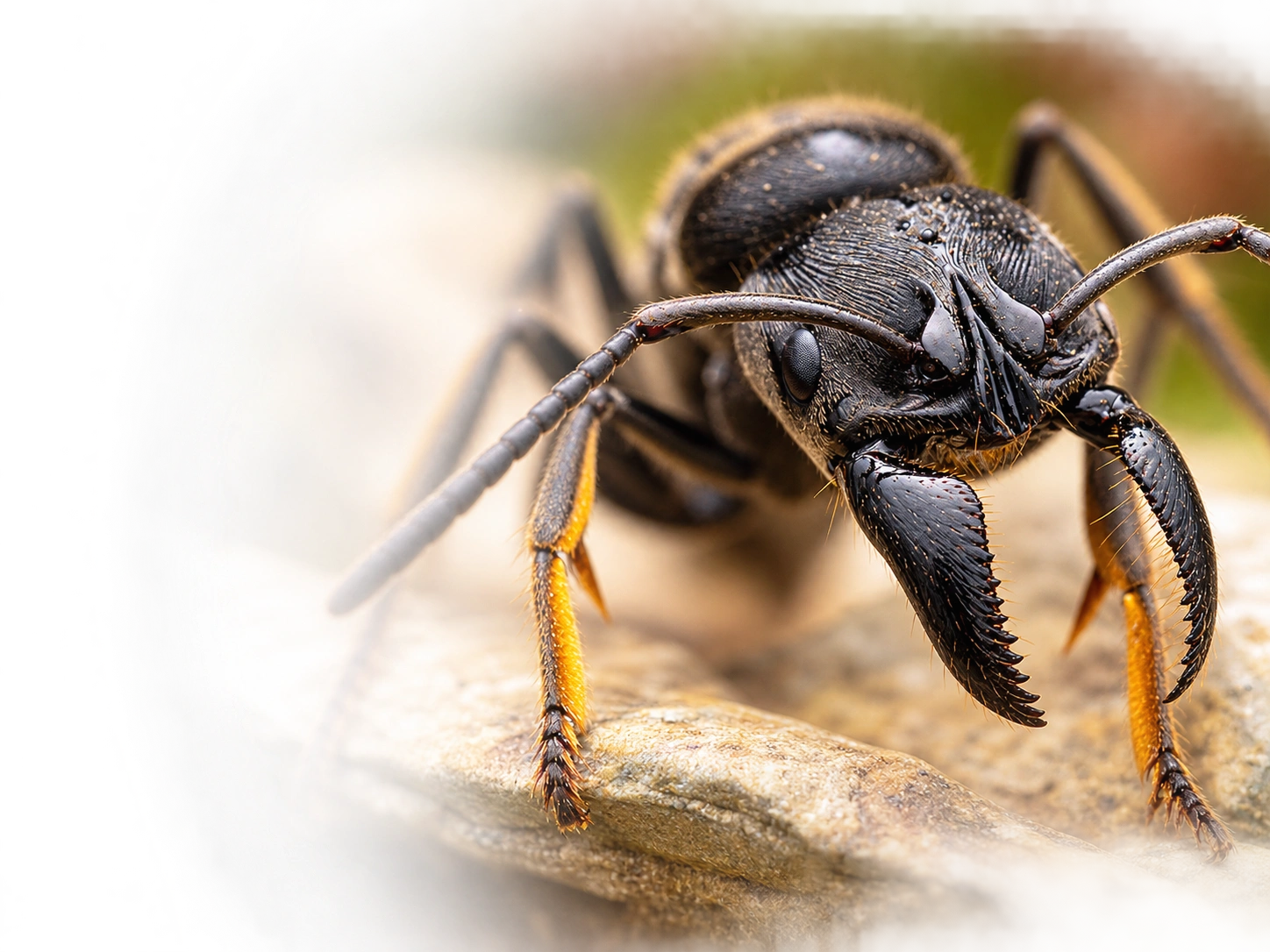
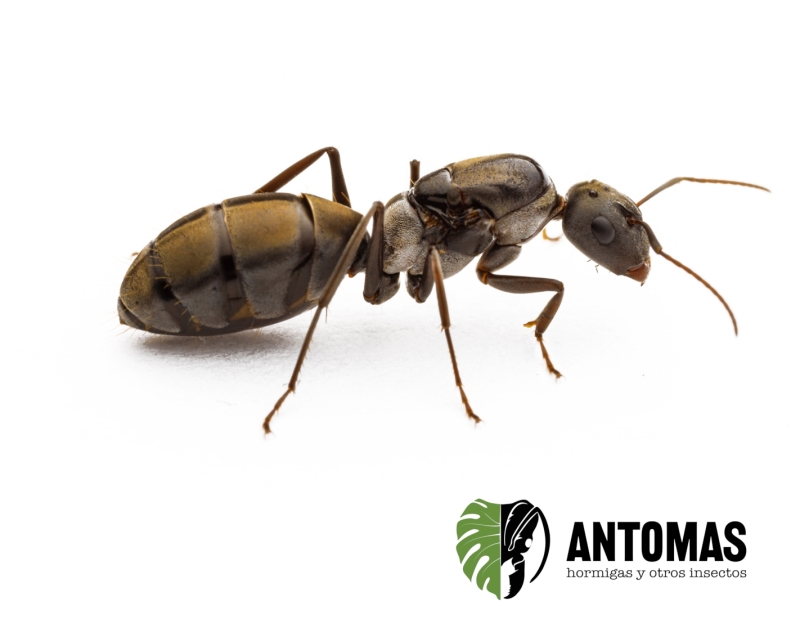
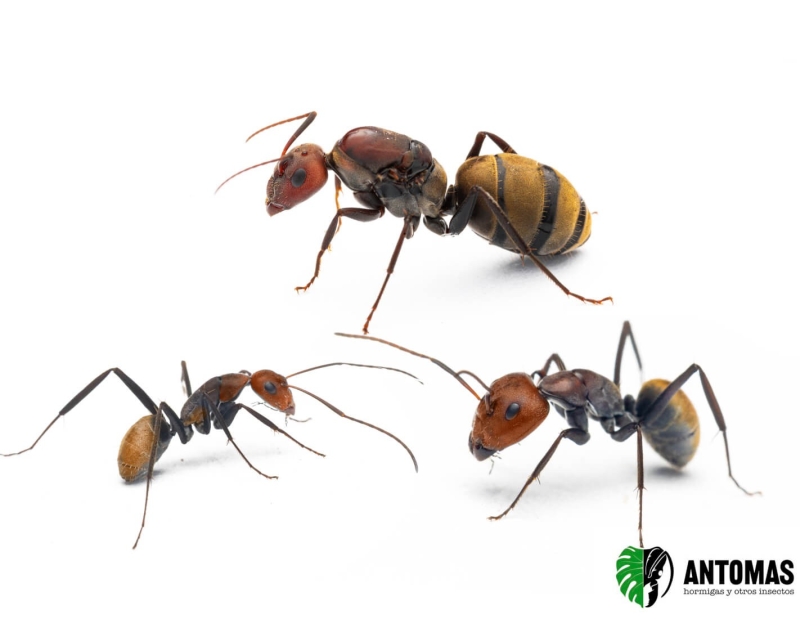
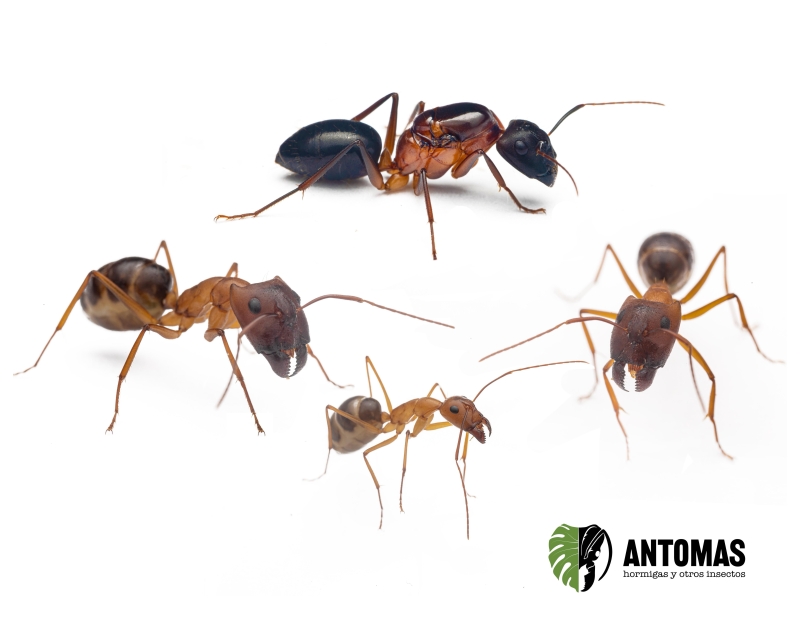
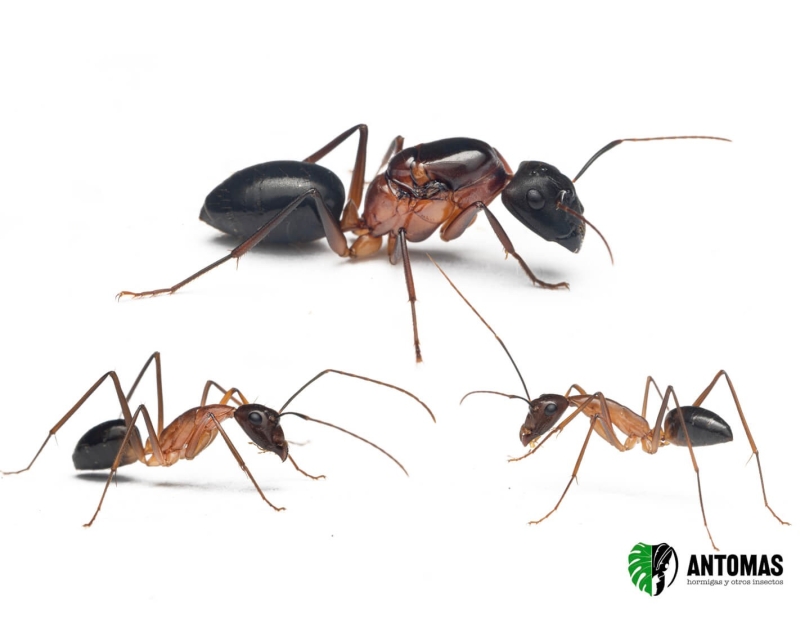
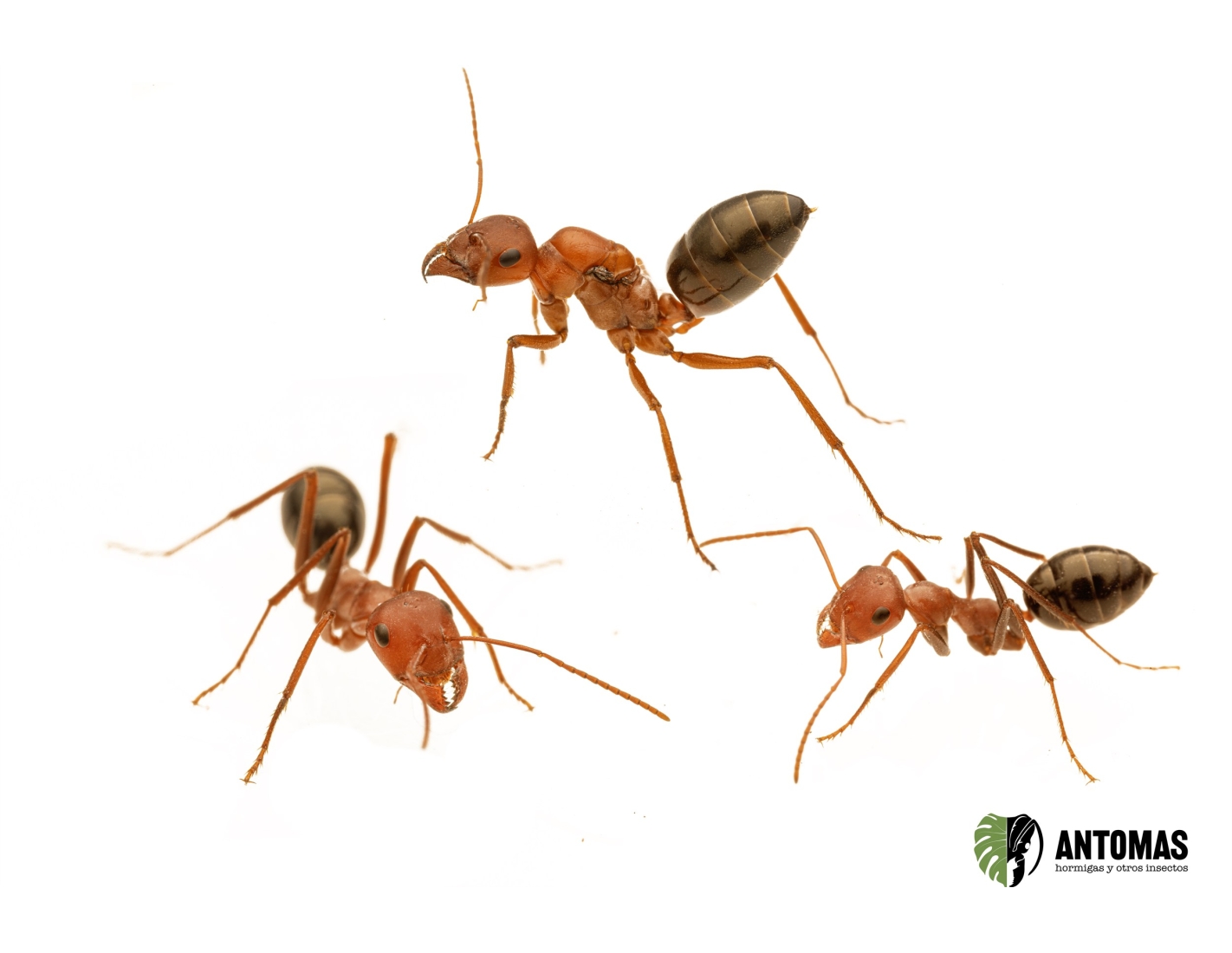
A slender formicine with long legs and a body held high off the ground, large eyes and three ocelli. Unlike the Saharan Silver Ant, it has no soldiers: its workers vary in size continuously, without separate castes.
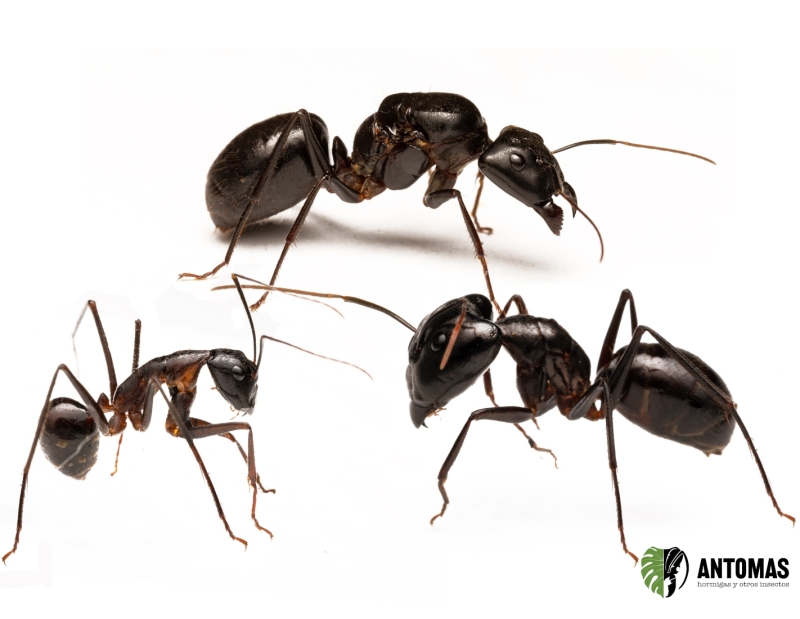
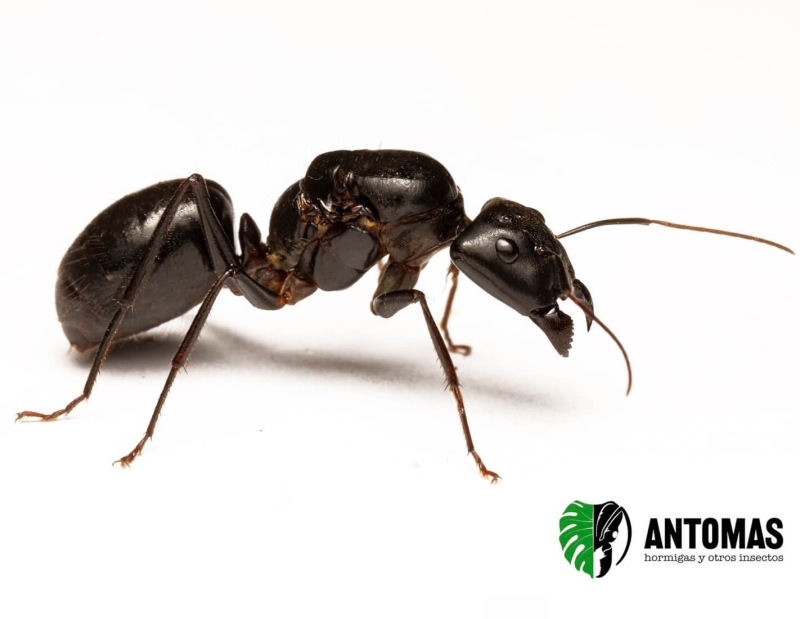
- Colouring of our colonies. Head and mesosoma (the thorax) reddish orange, long reddish legs and a blackish-brown gaster with pale bands.
- Workers of all sizes. The mesosoma ranges from about 2.4 mm in the smallest workers to almost 5 mm in the largest. The large ones go out to forage; the small ones mostly stay in the nest, looking after the brood.
- Head. Finely reticulate, with large compound eyes, as befits a visual navigator.
- Legs. Long; in the bicolor complex, the hind tibiae carry appressed pubescence, white to yellow.
- Petiole. Node-shaped, rounded on top.
- No sting. It defends itself by biting and with formic acid, which it releases through the acidopore at the tip of the gaster.
- Queen and male. We have not found any published measurements. Within the group, the male genitalia are the key to telling the species apart.
Approximate measurements
- Workers: mesosoma 2.39–4.96 mm (Tross and colleagues, 2021).
- Workers: head width 1.7 ± 0.4 mm on average (500 workers from Tunisia; Knaden and Wehner, 2006).
- Total length of workers: not published. Their speeds in body lengths per second give a length of about 6.5 mm for small workers and about 9.5 mm for large ones (our own calculation).
- Queen and male: no published measurements.
We prefer to be clear about it: there is no published scientific measurement of the C. bicolor queen, and the figures in circulation often mix up species of the group. That is why we only give worker measurements.
Care in captivity
Difficulty: 3/5 – Advanced
Feeding holds no secrets and its temperament is manageable, but it is not an ant for beginners: it needs well-planned heating, with a hot spot in the foraging area and a more temperate nest; it is extremely fast, so you have to work methodically when opening and cleaning; it appreciates space, because it patrols large areas; and it has a long diapause that you need to understand. Keepers do not agree: the species profile on the German forum Ameisenforum advises against it for beginners, while a keeper on the same forum, who published two years of keeping diary, described it as the easiest species he had ever had, as long as the temperature was right. Both are true.
And it is well worth it. It means watching, live, the ant with which the history of animal navigation was written: red-and-black workers that leave one by one, race across the hot sand, stop dead to get their bearings and return to the nest in a straight line with their prey.
Temperature and humidity
- Nest: 24–28 °C in the active season, temperate and stable, with a little humidity in one area; never wet or with condensation.
- Hot spot in the foraging area: about 35 °C, in just one part of the foraging area. Any heat source will do, a heating cable or mat underneath or a lamp above, always with a thermostat and with the temperature measured in the substrate. Never over the nest or over the whole set-up.
- Foraging area: dry.
- Water: always available, in a test tube with water and cotton wool.
- Light: the nest dark or covered; the foraging area with daylight and a clear day–night cycle.
- Diapause: 4–6 months, with the core period from December to February at 14–18 °C (see “Diapause”).
Keepers who have kept it used a gradient of 25 to 35 °C in the sand and agree: the workers gather at the hot spots. Without heat, the colony switches off. As for humidity, a little is enough: a German keeper noticed that his workers hardly used the damp area of the nest and preferred to drink at the feeder. At Antomas we prefer the nest to have it always to hand, without reaching the point of condensation or mould.
Recommended formicaria
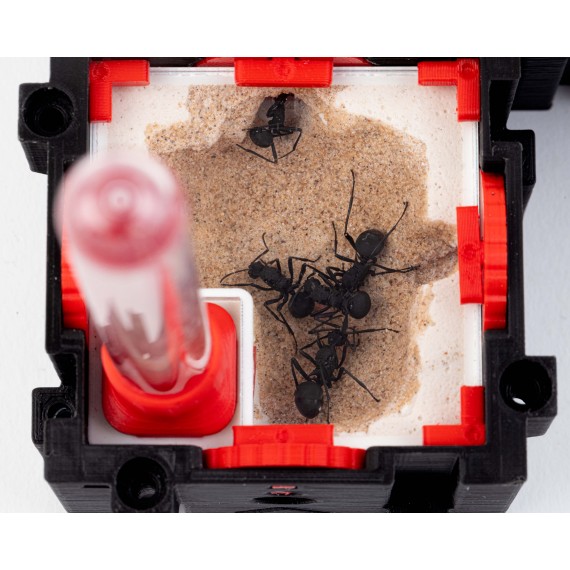
At Antomas we recommend a plaster nest from the Qbik Wild range by Anthouse, in its standard version: the plaster keeps gentle humidity in the nest while the foraging area stays dry. To start with our colonies, the Qbik Wild One P 1C:
To grow, once the colony fills the nest, the Qbik Wild Duo P 2C:
- Substrate inside and outside the nest. Essential: in our experience with the genus, without substrate the larvae do not spin their cocoons properly. A thin layer of sand, or sand and mineral soil, in the chambers and in the foraging area. It is a born digger: in one keeping diary, the colony moved by itself into a terrarium with soil and built little walls of sand.
- A large foraging area. The Ameisenforum profile asks for at least about 40 × 30 cm for a small colony, and preferably 80 × 40 cm, because they are “great walkers”. Add a few flat stones or twigs as lookout points.
- Water, feeder and barrier: the water tube, a feeder for sugar and a strip of mineral oil at the top of the walls.
Expand when the nest becomes too small for them, not before: in a nest that is too big, the spare chambers end up as rubbish tips.
Founding and growth
At Antomas we sell colonies with a queen, already with their workers: the best way to start with a Cataglyphis. In the wild it founds independently, but nobody has studied whether the queen is strictly claustral, raising her first workers without going out to feed, or semi-claustral, and shops and keepers contradict each other. What is clear is that the colony has a single queen: do not merge colonies or add queens.
Growth rate. There are no scientific data on development time. The best practical figure comes from the Ameisenforum keeper: at the end of winter he received a colony of about 50–60 workers with plenty of brood, and by autumn he had more than 400, with up to a hundred pupae at a time in summer. With warmth and plenty of protein it grows fast, and in the wild an adult colony has around 2,600 workers.
Arrival and moving. Prepare the formicarium beforehand, with its substrate, its humidity and the barrier in place. At Antomas we install colonies by tipping them in: we open the container in the foraging area, next to the nest entrance, and gently tip in the queen, the workers and the brood, helping the stragglers with a brush. Work over a tray, with the heat switched off a few minutes beforehand, because they move more slowly when cool, and leave the nest dark so that they occupy it straight away. If you ever change formicarium, use the same method. In the first few days there may be the odd loss: the German keeper lost a few workers after arrival, something his supplier had warned him was normal.
Feeding
Protein: the more, the better. It is a scavenger and an ant-eater, so the basis of its diet is small dead insects. At first, small prey, dead or cut up: Thermobia domestica, perfect for small colonies because of its size, flies, Drosophila or pieces of cricket and red runner roach. As the colony grows, increase the size and change the state of the prey: mealworms, whole crickets and roaches, half-dead or freshly killed. The Ameisenforum keeper watched his colony dismantle anything from flies to a 15 cm stick insect.
At Antomas we recommend insects 4–5 times a week, or more. If you do daily maintenance and remove leftovers, it is better to overfeed: the colony understands that it has more resources and grows faster and larger. If you cannot clean often, better not, because leftover food brings mould and mites. Change the type of insect from one week to the next, so that they do not always eat the same thing. A tip: put the prey in the warm zone, near the hot spot, which is where you will see most foragers.
Sugar, always available. Although it is mainly carnivorous, it takes sugary liquids. At Antomas we recommend a sugar feeder ad libitum. Vary the sugars: Anthouse’s Blue Sugar nectar 4–5 times a week and another sugary liquid or nectar 1–2 times a week. You can also add a little protein to the nectar, and one keeper found they accepted fruit, such as cherries. Always in a feeder, never on cotton wool: cotton wool goes mouldy and the liquid spoils very quickly. Use a traditional or home-made feeder in which the drop stays “spread out” and accessible.
Water: the test tube with water and cotton wool, always full. And buy insects from a reliable supplier: wild-caught ones may carry insecticides or parasites.
Diapause: a long pause
Yes, it has a diapause. There is a winter in its range, and the Ameisenforum keeper saw it in his colony: in October the brood decreased and only about 20 workers went out each day, compared with 60–70 in summer. Many guides speak of 1–2 months at 15–18 °C, but in our experience with the genus the natural diapause of these North African Cataglyphis is considerably longer, similar to that of our native species. At Antomas we recommend:
- Autumn (October–November): when the colony slows its brood and goes out less, lower the temperature gradually and shorten the hours of light.
- Core period (December–February): 14–18 °C. This is the safest range; there is no need to cool it further.
- Spring (March–April): raise the temperature gradually and lengthen the hours of light.
- In total: about 4–6 months of rest and semi-rest.
- During diapause: no hot spot, no artificial light and no insects, but with sugar water available as well as the water tube. Nest humidity as usual.
Skipping diapause in the first year. In our experience with the genus, diapause can be avoided without problems in the first year by keeping the colony above 30 °C with a long photoperiod, mainly with artificial light. This is useful if the colony arrives in autumn. From the second year on, respect its diapause.
Behaviour in captivity
Solitary foraging. You will not see columns or trails: it does not recruit nestmates. Each forager goes out alone, searches at full speed with sudden stops to get its bearings and returns in a straight line with its prey; they only cooperate when the prey is large and right by the entrance. The ones you see outside are the colony’s veterans.
Very sensitive to vibration. The Ameisenforum keeper reports that just touching the terrarium was enough to cause panic. Place it on a stable surface, away from slamming doors and vibrating appliances. They keep the nest clean and carry rubbish out: remove it yourself from the foraging area.
Watch them without fear. At Antomas we believe ants are there to be enjoyed, watched and learnt from, not kept hidden away. C. bicolor has excellent eyesight and soon gets used to light and to your presence. Simply leave it a dark area in the nest and a lit foraging area, and observe it gently, interfering as little as possible.
Warning signs: few workers outside in the warmth outside the diapause season (check the hot spot and the food); condensation or mould (too much humidity or leftovers); and brood that stalls in the middle of the season (not enough protein or heat).
Escapes and handling
According to other keepers, C. bicolor climbs smooth glass, but not upside down. Even so, it is so fast that at Antomas we recommend a mineral oil barrier as a precaution: a thin, continuous strip at the top of the foraging area walls, renewed when it collects dust; clean walls, with no dried sugar to give them a grip; a well-fitting lid and connections without gaps; and nothing that could act as a bridge to the barrier.
The tricky moment is opening the formicarium: in the warmth, a worker will be out before you see it. Switch off the hot spot a few minutes beforehand, open only as much as you need and work calmly. It does not sting, because it has no sting, but it bites, and quickly: the German keeper reports that they bit as soon as he put his hand in, although it “does not really hurt”. It can also spray formic acid, which stings in a cut or near the eyes. Handle it with a soft brush or soft forceps, never with your hands, and always use a thermostat with the heat source. It is an exotic species: it must never be released.
What not to do
- Set it up without heat, or heat the whole set-up without leaving cooler areas.
- Heat without a thermostat or put the heat source over the nest.
- Wet the nest or the foraging area, or let condensation form.
- Set it up without substrate: the larvae do not spin their cocoons properly.
- Give it a tiny foraging area.
- Put sugar on cotton wool, always give the same insect or leave leftovers uncleaned.
- Cut diapause down to a few weeks or keep it very cold.
- Worry about the odd loss of veteran foragers.
- Place it on a surface that vibrates, or open it in a hurry with the heat on.
- Merge colonies, add queens or keep it with other species.
Scientific sources
This care sheet is based on the scientific literature on Cataglyphis bicolor, its species group and the genus Cataglyphis, on published keeping diaries and on the experience of Antomas with the genus. Main references:
- Wehner, R. & Menzel, R. (1969). Homing in the ant Cataglyphis bicolor. Science 164: 192–194. doi:10.1126/science.164.3876.192
- Duelli, P. & Wehner, R. (1973). The spectral sensitivity of polarized light orientation in Cataglyphis bicolor (Formicidae, Hymenoptera). Journal of Comparative Physiology 86: 37–53. doi:10.1007/BF00694476
- Schmid-Hempel, P. & Schmid-Hempel, R. (1984). Life duration and turnover of foragers in the ant Cataglyphis bicolor (Hymenoptera, Formicidae). Insectes Sociaux 31: 345–360. doi:10.1007/BF02223652
- Dartigues, D. & Lenoir, A. (1990). La ponte des ouvrières chez Cataglyphis bicolor F. (Hymenoptera: Formicidae) : mise en évidence d’une parthénogénèse thélytoque. Annales de la Société Entomologique de France (N.S.) 26: 121–123. doi:10.1080/21686351.1990.12277816
- Agosti, D. (1994). A new inquiline ant (Hymenoptera: Formicidae) in Cataglyphis and its phylogenetic relationship. Journal of Natural History 28: 913–919. doi:10.1080/00222939400770481
- Gehring, W. J. & Wehner, R. (1995). Heat shock protein synthesis and thermotolerance in Cataglyphis, an ant from the Sahara desert. PNAS 92: 2994–2998. doi:10.1073/pnas.92.7.2994
- Labhart, T. (2000). Polarization-sensitive interneurons in the optic lobe of the desert ant Cataglyphis bicolor. Naturwissenschaften 87: 133–136. doi:10.1007/s001140050691
- Dietrich, B. & Wehner, R. (2003). Sympatry and allopatry in two desert ant sister species: how do Cataglyphis bicolor and C. savignyi coexist? Oecologia 136: 63–72. doi:10.1007/s00442-003-1245-0
- Wehner, R., Meier, C. & Zollikofer, C. (2004). The ontogeny of foraging behaviour in desert ants, Cataglyphis bicolor. Ecological Entomology 29: 240–250. doi:10.1111/j.0307-6946.2004.00591.x
- Knaden, M. & Wehner, R. (2006). Fundamental difference in life history traits of two species of Cataglyphis ants. Frontiers in Zoology 3: 21. doi:10.1186/1742-9994-3-21
- Kühn-Bühlmann, S. & Wehner, R. (2006). Age-dependent and task-related volume changes in the mushroom bodies of visually guided desert ants, Cataglyphis bicolor. Journal of Neurobiology 66: 511–521. doi:10.1002/neu.20235
- Henine-Maouche, A., Aissat, L. & Moulaï, R. (2019). Diet of Cataglyphis bicolor (Hymenoptera-Formicidae) in an insular condition in north-eastern Algeria. Zoology and Ecology 29: 120–130. doi:10.35513/21658005.2019.2.8
- Ouarab, S. & Doumandji, S. (2019). Relative biomass and size class of ant prey Cataglyphis bicolor (Fabricius, 1793) (Hymenoptera Formicidae) in the Reghaïa wetland reserve (Algeria). Biodiversity Journal 10: 101–108. doi:10.31396/Biodiv.Jour.2019.10.2.101.108
- Tross, J., Wolf, H. & Pfeffer, S. E. (2021). Allometry in desert ant locomotion (Cataglyphis albicans and Cataglyphis bicolor) – does body size matter? Journal of Experimental Biology 224: jeb242842. doi:10.1242/jeb.242842