Difficulty: 3/5 – Advanced
A tiny Asian hunter with long trap-jaws: it opens them to 180° and snaps them shut on springtails in thousandths of a second. Colonies with a queen. Small, humid nest (Qbik Wild One P 1C or test tube), 22–26 °C, no diapause. Live springtails are the staple of its diet, such as Sinella curviseta springtails: have a culture going before the colony arrives. They accept hardly any other food. They are minute: seal every gap and use PTFE (Fluon).
Strumigenys is one of the most diverse ant genera on the planet and, at the same time, one of the least often seen: more than 840 described species, and many more still to be described, living hidden in the leaf litter, in rotting wood and in forest soils all over the world. They are ants just a few millimetres long, slow, discreet and often coated in soil, that spend their lives lying in wait for even smaller animals: springtails, those jumping hexapods that abound in any damp soil.
Our MicroHunter belongs to the long-jawed Strumigenys, the genus’s true trap-jaws: it opens its mandibles to a straight angle, locks them like the spring of a mousetrap and fires them at the slightest touch of a springtail. Science has measured in this genus one of the highest accelerations known for a repeatable animal movement. In this care sheet we separate what is documented for the genus, what keepers report and what we have learnt at Antomas, because this is a species not yet identified and its particular biology has not been studied.
Biology
What does “sp.” mean?
“sp.” is the abbreviation of species, and it is used when the genus is known but not the exact species. In Strumigenys it is the most honest option: separating species requires a stereo microscope, mounted specimens and the keys of Bolton and of current revisers, which look at details such as the shape and number of teeth at the tip of the mandible, the pilosity of the head or the spongiform tissue of the waist. In South East Asia alone, a 2023 revision described 20 new species at once and rearranged the synonymies of several more, and a good share of the genus’s species still has no name.
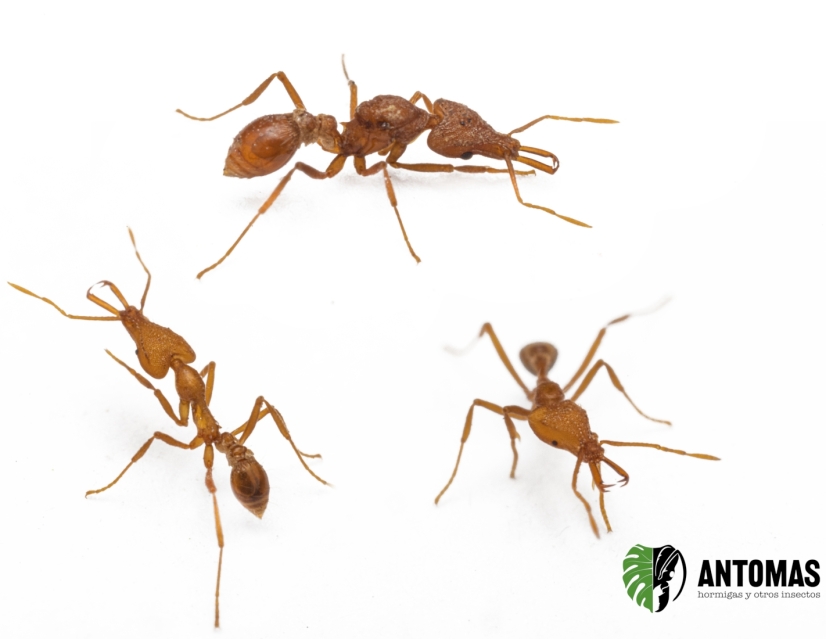
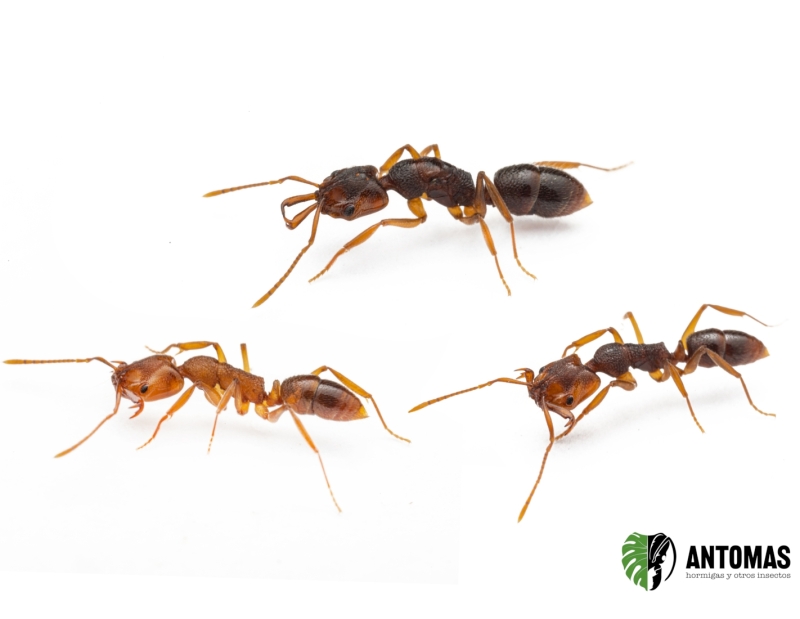
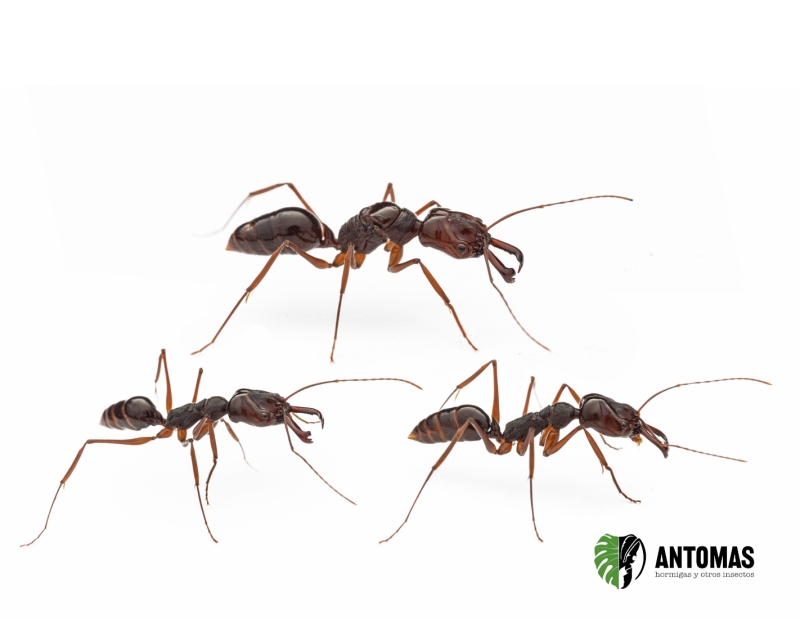
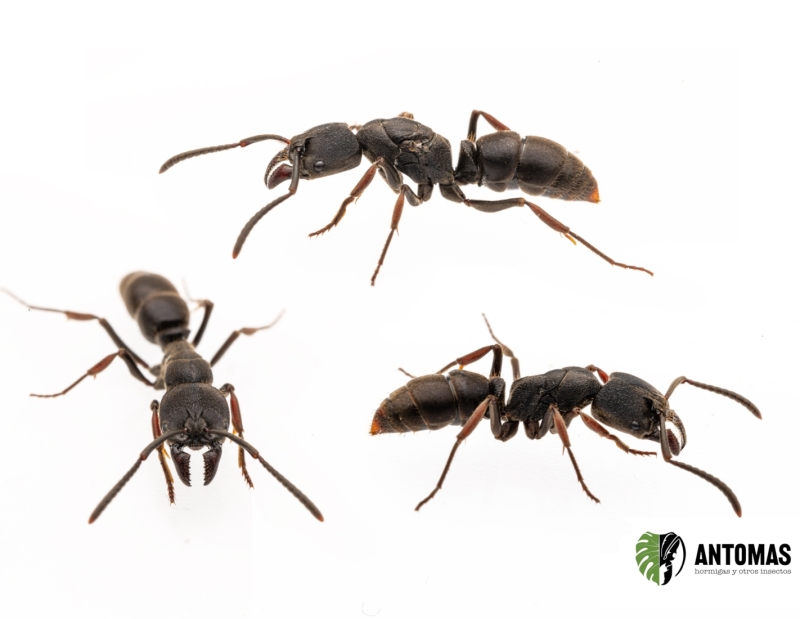
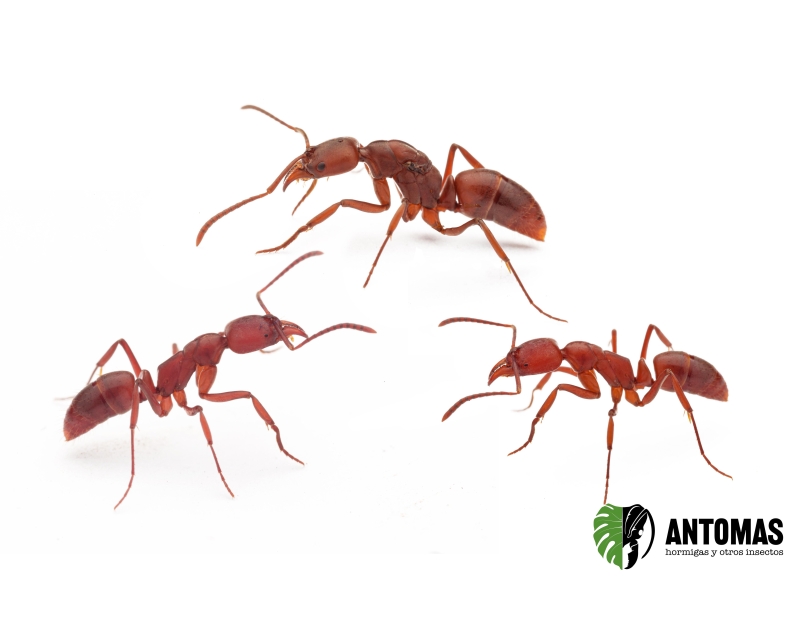
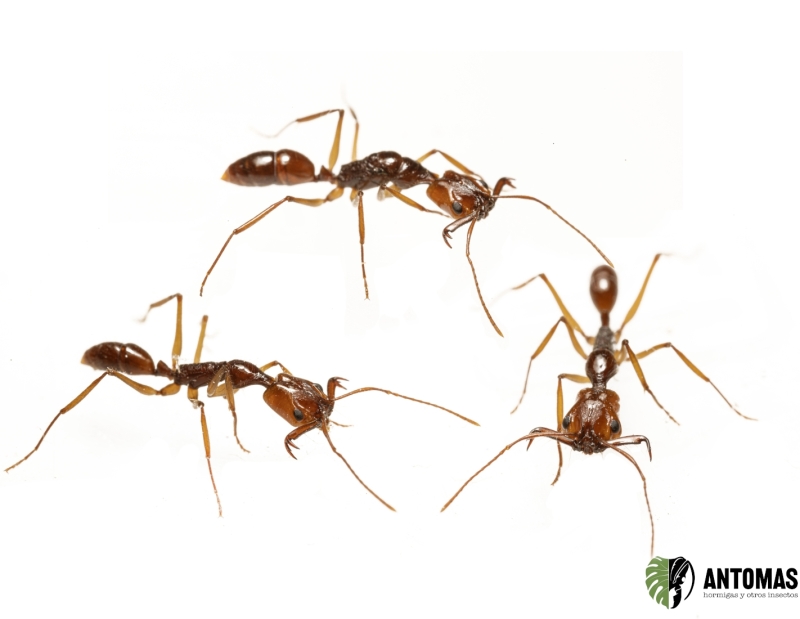
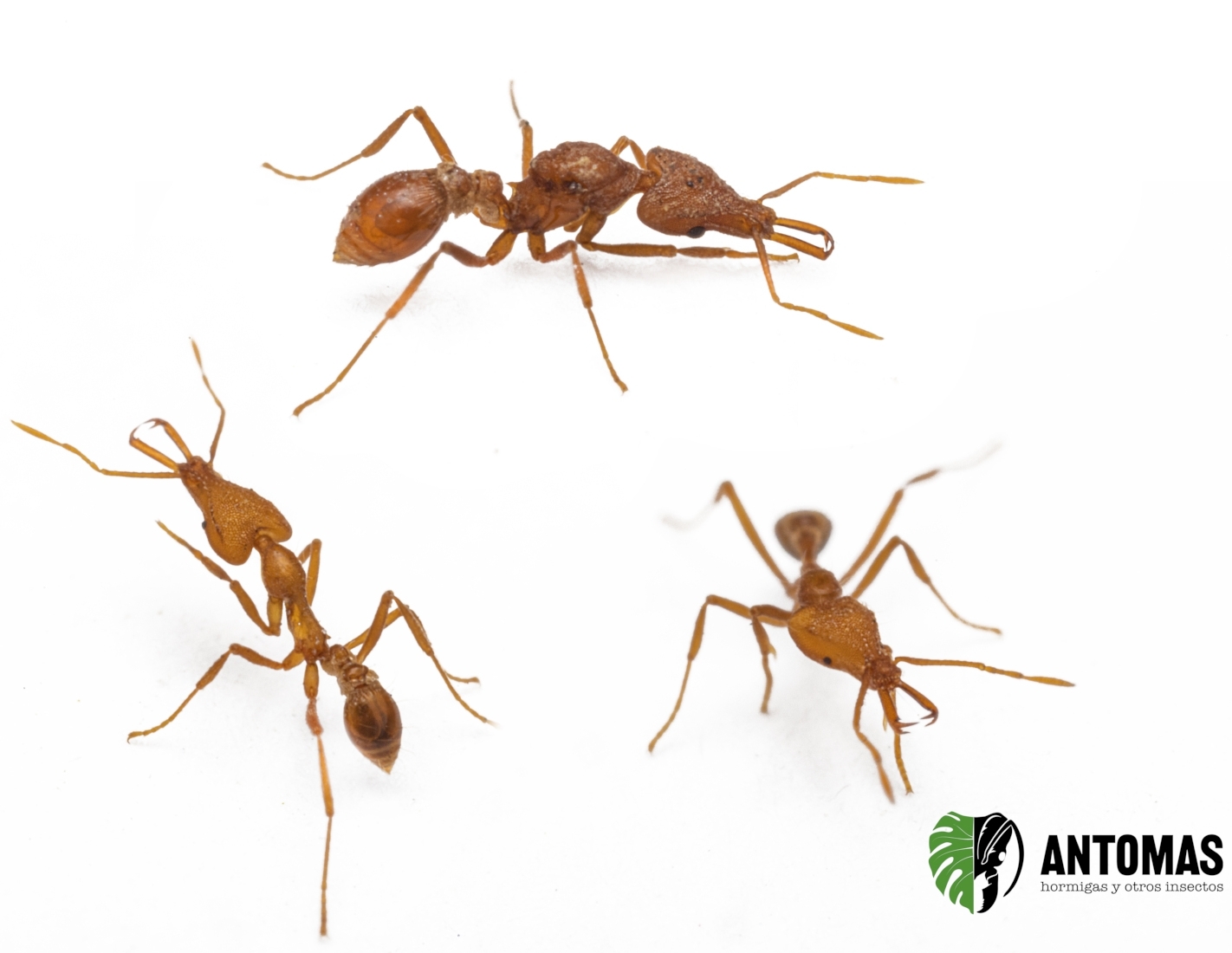
From the photos of our colonies we can, however, say something with reasonable confidence: their mandibles are long, linear and end in a fork of fine teeth. This is the shape of Strumigenys in the strict sense, the trap-jaw ones, and not that of the former Pyramica or Smithistruma, which have short, triangular mandibles. With its size, heart-shaped head and reddish colour it is reminiscent of the large long-jawed Asian Strumigenys of the S. feae complex, but without examining it under the microscope we are not going to claim so. That is why we sell it as Strumigenys sp.
A genus that swallowed seven others
For decades, the ants of this group were split into many genera: Strumigenys for the long-jawed ones and Pyramica, Smithistruma, Epitritus, Quadristruma and others for the short-jawed ones. Together they formed the tribe Dacetini, the “dacetines”, along with the large tree-dwelling Daceton of South America and other relatives. Morphological studies and, above all, the great molecular phylogeny of the myrmicines published by Ward and colleagues in 2015 showed that these divisions did not hold up: short and long forms appear mixed together in the evolutionary tree. Today they are all Strumigenys, and the old tribe Dacetini was absorbed into the tribe Attini, the same as the leafcutter ants.
The result is a gigantic and young genus: according to the study by Booher and colleagues in 2021, it began to diversify about 37 million years ago and today comprises more than 840 described species, spread across all the tropical and warm temperate regions of the world.
The fastest trap in the animal kingdom
The great show of the long-jawed Strumigenys is in the head. When hunting, they open their mandibles to an angle of about 180° and keep them locked in that position. The closing is not produced directly by the muscle, which is far too slow, but by a catapult mechanism: the large muscles close the mandibles against a latch and store elastic energy, like someone drawing a crossbow. When the latch is released, all that energy is unleashed at once.
Wulfila Gronenberg filmed the strike of a Strumigenys in 1996 with high-speed cameras: it lasts less than 2.5 milliseconds, and it is triggered within about 5 milliseconds of something touching some long, fine trigger hairs that project from the labrum, the “lid” of the mouth. Such a short reaction time requires fast trigger muscles, very fast-conducting nerves and few synapses along the way. And the most curious thing: the mechanism is different from that of other trap-jaw ants, such as Odontomachus, even though it achieves the same result. It is an example of convergent evolution.
In 2021, Booher and a large international team published in PLoS Biology the most comprehensive study of this trap. They measured the mandibles of hundreds of species and reconstructed their evolutionary history, and their conclusions are spectacular:
- Within the genus itself, the trap-jaw has evolved independently between 7 and 10 times.
- Compared with their relatives that merely grip, the trap-jaw species have multiplied the acceleration of the mandible by a factor of between one million and ten million (6–7 orders of magnitude), and have cut the duration of the strike between a thousand and ten thousand times.
- According to the authors, it is the highest acceleration recorded for an animal movement that can be repeated, again and again, without breaking anything.
- The power of the strike far exceeds what any muscle can deliver on its own: that is the advantage of storing energy and releasing it all at once.
To put it in perspective, in Odontomachus, much larger ants, jaw closures of 35 to 64 metres per second have been measured, so powerful that they use them to jump. Strumigenys are tiny and do not jump with their mandibles, but the physical principle is the same.
A small adjustment that changed everything
How does a trap like this come about? Booher’s study found that it all began with a minimal change: a slight variation in the alignment of the mouthparts, between some processes at the base of the mandibles and the labrum, created a latch where there had been none before. From there, the whole head was reorganised. The fibres of the mandibular muscles shifted from an arrangement built for speed to one built for force, because what mattered now was drawing the catapult, and the length of the mandibles and the angle at which they lock diversified enormously.
This is what biologists call a functional innovation: a small change that opens the door to an explosion of forms. Most of the diversity of heads and mandibles in the genus appeared after the trap was born. And there are unexpected twists: in some regions, long-jawed species shortened their mandibles again without losing the latch, and today there are short-jawed Strumigenys that also fire like a trap.
Springtail hunters
Springtails are the prey par excellence of Strumigenys. Booher’s study sums it up in one sentence: they are leaf-litter predators that feed mainly on springtails. As early as 1953, Edward O. Wilson had observed this in the dacetines of North America, and in 1959, with William L. Brown, he drew up the first great evolutionary history of the group around that specialisation.
It is not an easy choice. Springtails are abundant and nutritious, but they have their own escape system: the furcula, a kind of spring folded under the abdomen that, when released, launches them into the air in a fraction of a second. To catch something that escapes on a spring you have to be faster still, and this arms race between two springs helps to explain why the trap has evolved so many times in the genus.
The short-jawed species, by contrast, hunt in a different way. The Japanese researcher Keiichi Masuko, who studied the dacetines of East Asia for decades, described in them a stealthy, almost slow-motion approach and a tenacious grip: they hold the prey in their mandibles and paralyse it with the sting. Some have specialised in even rarer prey: in 2009 he documented one species that hunts gamasid mites and another with a prey specialisation unknown until then. The Frenchman Alain Dejean, in 1986, compared the hunting of several species of the genus and found a fundamental difference between the long-jawed and the short-jawed ones.
How a MicroHunter stalks
Long-jawed Strumigenys do not chase their prey. They walk slowly, with their mandibles open and locked, their antennae probing the ground and the trigger hairs out in front. When they detect a springtail, they move closer centimetre by centimetre, often with long pauses, until the prey sits between the open mandibles and touches the trigger hairs. Then, the strike. Springtails are usually pierced or held by the teeth at the tip, and the ant finishes it off with the sting, which paralyses the prey before it can use its furcula.
Dejean studied this sequence with Folsomia candida, one of the springtails most widely cultured in laboratories, and described it step by step: detection, approach, strike, sting and transport of the prey to the nest. You will see the same in your formicarium: it is one of the most interesting hunts you can watch in an ant colony, although it takes patience and, if possible, a magnifying glass.
Spongiform tissue: the mystery of the waist
If you look closely at the waist of a Strumigenys, the petiole and postpetiole, you will see whitish or yellowish masses, like dry foam. They are clearly visible in our photos. This is the spongiform tissue, a honeycomb-like cuticular structure found almost exclusively in the ants of this group, which for a long time was a mystery.
In 2023, a team from Taiwan, the United States and Belgium studied it from the inside with microscopy and found that it conceals a new exocrine gland: clusters of secretory cells located beneath the pillars of those cuticular extensions. What is not yet known is what it produces or what it is for. The authors suggest that the honeycomb texture might store the secretion and help to disperse it.
Masters of camouflage
Strumigenys are cryptic ants. Many species have their head and body covered in spatulate hairs or scale-shaped ones, which hold particles of soil and leaf-litter debris, and a granulated surface to which dirt sticks. On the forest floor, a motionless worker looks like just another grain of soil. And when disturbed, they usually keep still, with their legs tucked in, until the danger has passed.
Small travellers of the world
Their size and hidden life have another curious consequence: some Strumigenys travel with people. Several species have spread around the world with the trade in plants and soil, and today they turn up in gardens, greenhouses and islands far from their origin. The revisions of the dacetines of south-eastern North America, for example, record species introduced from Africa and Asia that go unnoticed for years in the leaf litter. It is a good reminder of why an exotic species must never be released.
From the floor of Asian forests
East and South East Asia are among the regions with the most Strumigenys species in the world. They live in the leaf litter and rotting wood of tropical and subtropical forests, both primary and secondary, and some also in plantations and disturbed areas. Long-jawed species similar to ours have been found mainly on the floor of lowland and mid-montane forests, in an environment that is always humid, shady and of stable temperature.
The climate of their range is warm and humid, with abundant rainfall and, depending on the area, a somewhat cooler and drier season. But at ground level and under the leaf litter, conditions change far less than in the air: humidity hardly ever drops and the temperature stays mild. That is exactly what you need to reproduce in the formicarium.
Small, discreet colonies
Strumigenys colonies are small compared with what we are used to in other ants: in most of the species studied, from a few dozen to a few hundred workers. They nest in existing cavities, such as cracks in rotting wood, hollows under stones or plant debris and small chambers in the soil, and they do not build large nests. Some species have a single queen per colony and others several; there are no published data on our line, and at Antomas we do not combine queens.
Size and morphology
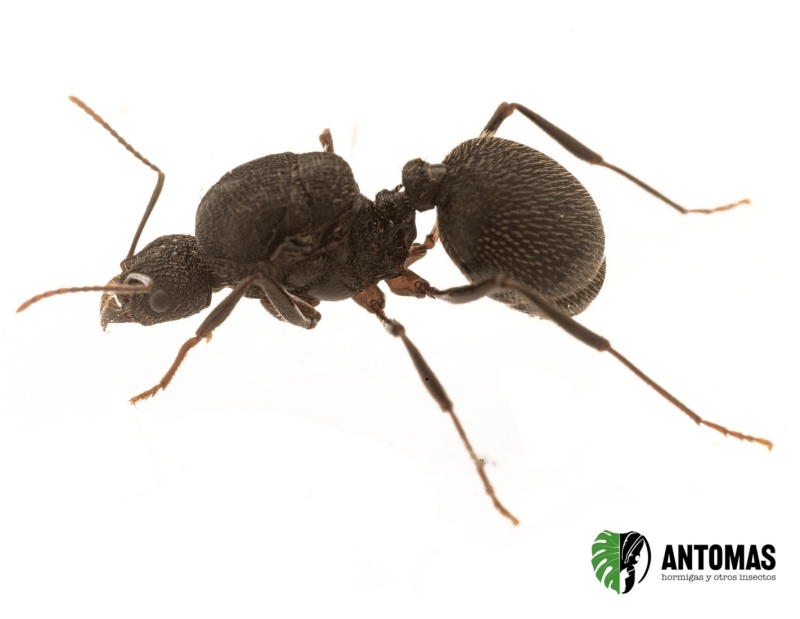
A tiny ant with long trap-jaws, a large heart-shaped head and a waist with spongiform tissue. What we describe of our line comes from our photos and our colonies; what is common to the genus, from the literature.
- Mandibles. Long, straight and narrow, almost parallel when closed, and ending in a fork of fine teeth at the tip. When hunting they open to a straight angle and stay locked. These are the typical mandibles of trap-jaw Strumigenys.
- Trigger hairs. Two long, fine hairs that arise from the labrum, between the mandibles, and that fire the strike when they touch the prey. They cannot be seen with the naked eye; with a good magnifier, they can.
- Head. Large, heart-shaped or triangular: broad at the back, with two marked lobes, and narrow towards the front. Densely granulated and punctate surface.
- Eyes. Small, located on the sides of the head. They are tactile and chemical hunters, not visual ones.
- Antennae. Long and slender, with the last segments elongated, always probing the ground in front of the mandibles.
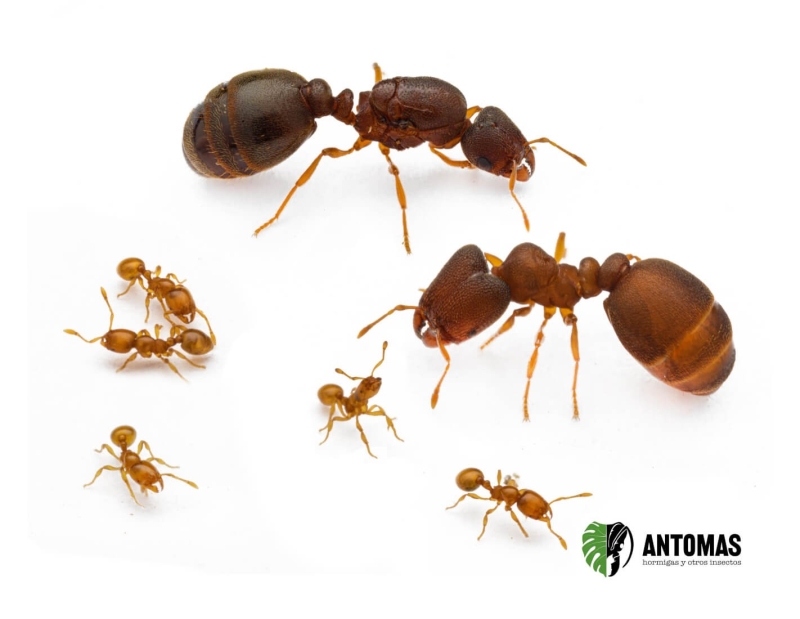
- Mesosoma (thorax). In workers, narrow and elongated; in the queen, much bulkier, with the scars of the wings she shed after the nuptial flight.
- Waist. Two segments, petiole and postpetiole, with masses of whitish spongiform tissue (see “Spongiform tissue: the mystery of the waist”).
- Gaster. Oval, shiny and somewhat darker than the rest of the body, with fine striations at the base. It ends in a sting, which they use to paralyse their prey.
- Colouration of our colonies. Reddish orange or ferruginous, with a reddish-brown gaster and paler legs and antennae.
Approximate measurements
- Workers and queen: ants just a few millimetres long; no measurements of this line have been published
- Queen: clearly larger than the workers, mainly because of the mesosoma and gaster
- Differences between workers: no polymorphism; all workers have the same shape
- Male: no published description or measurements for this line
As the species has not been identified, we cannot give you scientific measurements, and we are not going to make them up. Suffice it to say that they are among the smallest ants we sell and that, to enjoy the details of their head and their hunting, a hand lens or a small digital microscope makes all the difference.
Keeping in captivity
Difficulty: 3/5 – Advanced
It is not a hard ant to keep alive once you understand its two needs: high humidity and live springtails. What makes it an advanced species is everything surrounding those two things:
- Food. The “a chopped-up cricket and a water dispenser” plan will not do. They need tiny live prey, above all springtails, and that means keeping your own culture or buying them regularly.
- Humidity. They live on the floor of humid forests. A nest that dries out is a serious mistake, one that can wipe out the brood in a few days.
- Size. They are minute: they escape through gaps other ants would not even notice, and they get lost in a large nest. You have to work with small, well-sealed set-ups.
- Pace. Colonies are small and grow slowly. This is not a species for seeing hundreds of workers within a few months.
So why is it worth it? Because it is one of the most fascinating ants you can watch: a hunter with the fastest trap in the animal kingdom, in a small colony that fits in the palm of your hand. For anyone who has already kept simpler species, it is a wonderful leap into the world of specialist ants.
Recommended parameters
- Nest temperature: 22–26 °C, stable. Avoid heat peaks: at ground level in its forest, the temperature changes little.
- Foraging area: at a mild room temperature, with no direct heat.
- Humidity: high and constant in the nest, with one part always damp. The foraging area should also be somewhat damp, with a little moistened substrate where the springtails can live.
- Water: always available, in a test tube with water and cotton wool or in the reservoir of the plaster nest. No puddles or large drops: such small ants can get trapped in a drop of water.
- Light: a dark area in the nest and a foraging area in normal light, with a day–night cycle.
- Diapause: they do not need one (see “No diapause”).
Recommended formicarium: small and made of plaster
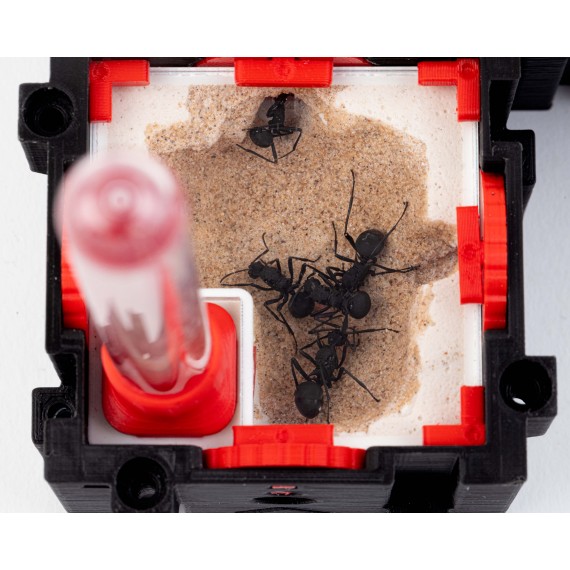
For an ant this small and this fond of humidity, at Antomas we recommend the smallest formicarium in Anthouse’s Qbik Wild range, the Qbik Wild One P 1C. It is made of plaster, holds humidity well and is just the right size for a colony of a few dozen workers:
Another option, especially at the start, is to keep them in a test tube with its water reservoir behind the cotton wool, connected to a small foraging area. This works very well with colonies of this size, and lets you see the brood and the queen easily. Complete the set-up with these details:
- A small foraging area, with a thin layer of moistened substrate (soil without fertilisers, coconut fibre or a little very clean leaf litter) where the springtails can live and the ants can hunt them as on the forest floor.
- Water always available, in the nest reservoir or in a tube with cotton wool.
- A tight-fitting lid and, if there is ventilation, a very fine mesh: otherwise the workers and the springtails would escape through it.
- A PTFE (Fluon) barrier on the upper part of the walls (see “Escapes and barriers”).
- No large nests: in an oversized nest, the colony scatters, humidity is hard to control and debris builds up in the empty chambers. Expand only when the chambers are full.
Humidity: the mistake they do not forgive
Strumigenys live under the leaf litter, where humidity hardly ever drops. You have to reproduce this in the formicarium: the plaster of the nest must always be damp, with a wetter area where the colony can take refuge and a slightly drier one, so they can choose. Letting them dehydrate is a serious mistake: such a small colony loses water very quickly, and the brood is the first to suffer.
High humidity does not mean waterlogging. Free water is dangerous for ants of this size, and excess humidity without ventilation brings mould. Here the springtails lend you a hand: as well as being the food, they feed on fungi and debris, and a small population living in the foraging area helps to keep it clean. Check the nest every few days and add water to the reservoir before the plaster starts to turn lighter.
Feeding: springtails, springtails and more springtails
Live springtails are the staple of their diet. They are the prey their trap evolved for, and what they eat in the wild. At Antomas we recommend Sinella curviseta springtails, easy to culture at home and of the right size. Ideally, have the culture up and running before the colony arrives, so you never run out of prey.
- How many: add springtails to the foraging area several times a week, in quantity. A small population living in the substrate is best: the workers go out hunting whenever they like, just as in the forest.
- The more food, the better: that is the Antomas philosophy. If you carry out maintenance often and remove leftovers, it is better to overfeed, because the colony understands it has more resources and grows faster and in greater numbers. With live springtails it is easy: those that are not eaten stay alive and do not rot.
- Cleaning: remove any prey remains that build up in the nest or the foraging area, especially if you see mould.
What about other foods? Here we have to be honest: Strumigenys are specialists, and they accept very little else. The usual prey of other ants, such as crickets or mealworms, are huge for them and they do not recognise them as food. What can work, as a supplement and to vary the protein, is very small, soft-bodied live prey:
- Newly hatched nymphs of Thermobia domestica, which are very small at hatching and move across the ground like a springtail. Larger ones are no longer any use to them.
- Other cultured springtails, such as Folsomia candida, which is used in laboratory studies of their hunting, to alternate with S. curviseta.
If a new food does not interest them, remove it and go back to springtails.
Sugar? They hardly need it. They are specialised hunters and, as far as we know, live on their prey in the wild; many keepers never offer them sugar and their colonies do well. If you want to try, now and then put a tiny drop of diluted honey on something non-absorbent, such as a small piece of aluminium foil, and remove it the next day. Never on cotton wool: it goes mouldy straight away. Do not worry if they ignore it.
The colony you receive and its growth
At Antomas we sell colonies with a queen, with a group of workers and brood, already established in their tube. It is the best way to start with a species like this: the most delicate phase, that of the lone queen raising her first workers, is already behind it, and the colony arrives ready to hunt. When you receive it:
- Let it rest for a day in a quiet, dark, mild place at 22–26 °C, and check that the tube has water.
- Offer springtails straight away, near the tube entrance or in a small foraging area connected to it.
- Do not move it into a large nest. If the tube is clean and has water, it can stay there for weeks or months.
Growth is slow. Strumigenys colonies are small by nature, and a queen of this size does not lay at the pace of a Messor. With stable humidity, a mild temperature and plenty of springtails, the brood develops without pause, but do not expect a colony of hundreds of workers in the first year. The sign that all is well is always seeing brood at every stage: eggs, larvae and pupae.
Moving house. When it is time to move them into the Qbik Wild One P 1C, at Antomas we do it by tipping them out: we open the tube inside the foraging area, next to the entrance of the already moistened nest, and gently tip out the queen, workers and brood, helping the stragglers with a very fine paintbrush. Work over a light-coloured tray, because a worker this size is easily lost, and keep the nest area dark so that they move in straight away.
No diapause
These are ants from warm, humid Asian forests, and they do not need diapause: keep them at 22–26 °C all year round. If your home cools down a little in winter and the temperature drops to about 20–22 °C for a few weeks, that is fine: many areas of their range have a somewhat cooler season, and it is normal for the queen to lay a little less. What you must not do is cool them like a European ant, or let the nest dry out at any time.
Behaviour in captivity
Slow and methodical. Do not expect foraging trails or frantic activity. You will see individual workers slowly patrolling the foraging area with their mandibles open, stopping, probing and suddenly firing at a springtail.
Watch without fear. At Antomas we believe ants are there to be enjoyed, watched and learnt from, not kept hidden away. Just leave them their dark area in the nest and a lit foraging area, and observe them gently, intervening and stressing them as little as possible. With this species, a hand lens or a digital microscope turns every hunt into a spectacle.
They freeze. If you disturb them, they will normally stop and stay motionless, sometimes with their legs tucked in. They are not dead: it is their way of defending themselves on the forest floor. Within a few minutes they start moving again.
Warning signs:
- Workers motionless for a long time, curled up, or brood drying out: not enough humidity.
- Mould in the nest or foraging area: forgotten leftovers or too much humidity without ventilation.
- Brood that does not develop or disappears: not enough springtails.
- Workers outside the set-up: there is a gap.
Escapes and barriers
Their size is the big problem: a Strumigenys gets through gaps you cannot even see. The priority is a well-sealed set-up:
- Check all connections, stoppers and tubes, and make sure the lid fits with no play.
- Ventilation with a very fine mesh, which does not let the springtails through either.
- A PTFE (Fluon) barrier on the upper part of the foraging area walls, as a second line of defence.
- Nothing that can act as a bridge to the barrier or the lid.
- Take care when opening: open only as much as needed, work calmly over a light-coloured tray and close up when you have finished.
Handling and safety
They have a sting, but they are so small that they pose no risk to people: they use it to paralyse springtails. Their bite cannot be felt either. Care works the other way round: it is they who need protecting. Always handle them with very fine entomological tools, such as a soft paintbrush, never with your hands, and work slowly so as not to crush or lose a single worker, let alone the queen. Do not combine different colonies or keep them with other species. This is an exotic species: under no circumstances must it be released.
What not to do
- Buy the colony without first having a springtail culture or a reliable source of them.
- Expect them to eat crickets, mealworms or ant food: they are specialists.
- Let the nest dry out: it is the most serious mistake with this species.
- Waterlog the nest or leave large drops of water: they can get trapped.
- Move them into a large nest too soon.
- Put sugary liquids on cotton wool.
- Leave gaps, loose connections or coarse-mesh ventilation.
- Give them a cold diapause as with European species.
- Handle them with your hands.
- Combine different colonies or release them.
Scientific sources
This care sheet has been compiled from the scientific literature on the genus Strumigenys and the former dacetines, from observation of our colonies and from the experience of Antomas and other keepers. As the species has not been identified, the biological data are for the genus. Main references:
- Booher, D. B., Gibson, J. C., Liu, C., Longino, J. T., Fisher, B. L., Janda, M., Narula, N., Toulkeridou, E., Mikheyev, A. S., Suarez, A. V. & Economo, E. P. (2021). Functional innovation promotes diversification of form in the evolution of an ultrafast trap-jaw mechanism in ants. PLoS Biology 19: e3001031. doi:10.1371/journal.pbio.3001031
- Gronenberg, W. (1996). The trap-jaw mechanism in the dacetine ants Daceton armigerum and Strumigenys sp. Journal of Experimental Biology 199: 2021–2033. doi:10.1242/jeb.199.9.2021
- Patek, S. N., Baio, J. E., Fisher, B. L. & Suarez, A. V. (2006). Multifunctionality and mechanical origins: ballistic jaw propulsion in trap-jaw ants. Proceedings of the National Academy of Sciences 103: 12787–12792. doi:10.1073/pnas.0604290103
- Wilson, E. O. (1953). The ecology of some North American dacetine ants. Annals of the Entomological Society of America 46: 479–495. doi:10.1093/aesa/46.4.479
- Brown, W. L. & Wilson, E. O. (1959). The evolution of the dacetine ants. The Quarterly Review of Biology 34: 278–294. doi:10.1086/402828
- Dejean, A. (1986). Étude du comportement de prédation dans le genre Strumigenys (Formicidae, Myrmicinae). Insectes Sociaux 33: 388–405. doi:10.1007/BF02223947
- Masuko, K. (2009). Studies on the predatory biology of Oriental dacetine ants (Hymenoptera: Formicidae) II. Novel prey specialization in Pyramica benten. Journal of Natural History 43: 825–841. doi:10.1080/00222930802610543
- Masuko, K. (2009). Studies on the predatory biology of Oriental dacetine ants (Hymenoptera: Formicidae). III. Predation on gamasid mites by Pyramica mazu with a supplementary note on P. hexamerus. Journal of the Kansas Entomological Society 82: 109–113. doi:10.2317/jkes806.17.1
- Masuko, K. (2021). Dacetine ants. In Encyclopedia of Social Insects, pp. 323–325. Springer. doi:10.1007/978-3-030-28102-1_34
- Bolton, B. (1999). Ant genera of the tribe Dacetonini (Hymenoptera: Formicidae). Journal of Natural History 33: 1639–1689. doi:10.1080/002229399299798
- Ward, P. S., Brady, S. G., Fisher, B. L. & Schultz, T. R. (2015). The evolution of myrmicine ants: phylogeny and biogeography of a hyperdiverse ant clade (Hymenoptera: Formicidae). Systematic Entomology 40: 61–81. doi:10.1111/syen.12090
- Wang, C., Chung, F.-Y., Lin, C.-C., Gibson, J. C., McGuire, S., Suarez, A. V. & Billen, J. (2023). The spongiform tissue in Strumigenys ants contains exocrine glands. Arthropod Structure & Development 73: 101246. doi:10.1016/j.asd.2023.101246
- Tang, K. L. & Guénard, B. (2023). Further additions to the knowledge of Strumigenys (Formicidae: Myrmicinae) within South East Asia, with the descriptions of 20 new species. European Journal of Taxonomy 907: 1–144. doi:10.5852/ejt.2023.907.2327
- Deyrup, M. & Cover, S. (2009). Dacetine ants in southeastern North America (Hymenoptera: Formicidae). Southeastern Naturalist 8: 191–212. doi:10.1656/058.008.0201