This website uses its own and third-party cookies to improve our services and show you advertising related to your preferences by analyzing your browsing habits. To give your consent to its use, press the Accept button.
Functional cookies are strictly necessary to provide the services of the shop, as well as for its proper functioning, so it is not possible to refuse their use. They allow the user to browse through our website and use the different options or services that exist on it.
Cookie
Provider
Purpose
Expiry
PHP_SESSID
antomas.es
The PHPSESSID cookie is native to PHP and allows websites to store serialised status data. On the website it is used to establish a user session and to pass state data through a temporary cookie, which is commonly known as a session cookie. These Cookies will only remain on your computer until you close your browser.
Session
PrestaShop-#
antomas.es
This is a cookie used by Prestashop to store information and keep the user's session open. It stores information such as currency, language, customer ID, among other data necessary for the proper functioning of the shop.
These are cookies that collect information about the advertisements shown to users of the website. They can be anonymous, if they only collect information about the advertising spaces shown without identifying the user, or personalised, if they collect personal information about the user of the shop by a third party, for the personalisation of these advertising spaces.
Collect information about the user's browsing experience in the shop, usually anonymously, although sometimes they also allow the user to be uniquely and unequivocally identified in order to obtain reports on the user's interests in the products or services offered by the shop.
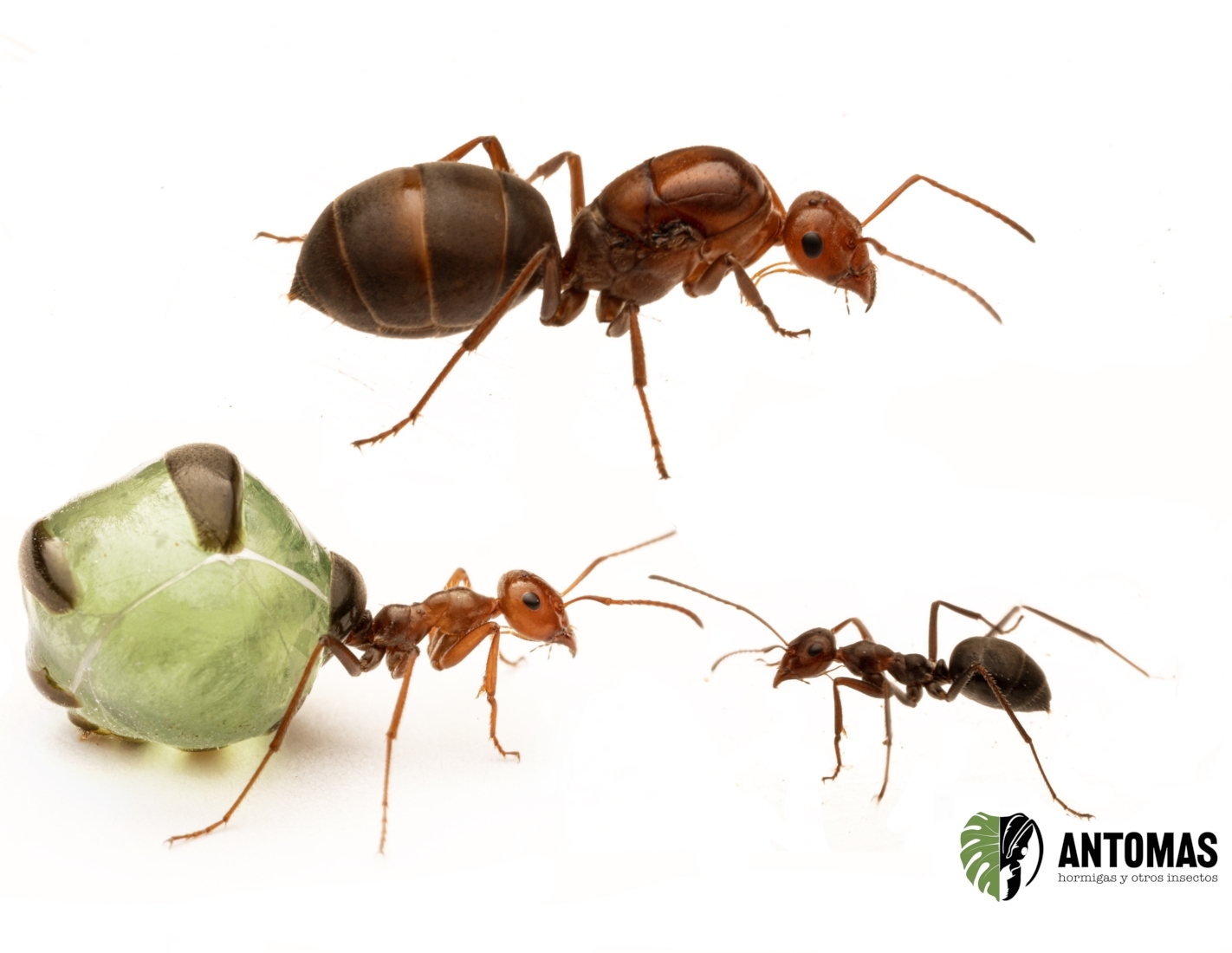
Midday warriors of the Chihuahuan Desert. Myrmecocystus mimicus settles its wars not with blood but with tournaments: hundreds of workers parade on stretched legs, inflate their gasters and size each other up for days, until the stronger colony raids the weaker one and carries off its brood, its future slaves and even its repletes, living larders filled with nectar. Two-toned, with a reddish head and thorax, and a relentless termite hunter, this is the honeypot ant that Bert Hölldobler made legendary. Colonies with a queen. Shipping across Europe, live arrival guaranteed.
The warrior honeypot ant of the desert: diurnal, two-toned (reddish head and thorax, dark gaster), a termite hunter and the star of Bert Hölldobler’s famous ritualised tournaments, which sometimes end in raids and slavery. Colonies with a queen. A Qbik Wild nest with headroom for the repletes, ordinary room temperature (successful keepers use 24–31 °C), sugar by the dropper until the first repletes appear and freely after that, tiny prey almost every day and a diapause of about 4 months, from November to February, at 15–18 °C. Mineral oil is enough as a barrier.
Myrmecocystus mimicus Wheeler, 1908 is a honeypot ant from the arid regions of the south-western United States and northern Mexico. Like all Myrmecocystus, it stores nectar in replete workers, living larders that hang from the nest ceiling with their gasters swollen like grapes. But it owes its place of honour in the myrmecology textbooks to the way it settles its conflicts: tournaments in which hundreds of workers size each other up with postures and parades, almost without touching, and which sometimes end with the weaker nest being raided.
It was made famous by the German myrmecologist Bert Hölldobler, who studied it for years in the Chihuahuan Desert, near Portal (Arizona) and Rodeo (New Mexico), and who in 1976 published “Tournaments and slavery in a desert ant” in Science. In this care sheet we separate what is documented in those studies from what we have learnt by keeping it at Antomas.
Biology
Bloodless tournaments: the parade on stilts
Two neighbouring colonies find a feast of termites at the same time. In many ants, that would end in battle. In M. mimicus it starts a tournament: the scouts recruit a small army, often of two hundred workers or more, and within minutes hundreds of ants from both colonies meet face to face. But they do not go for each other’s throats. They show off:
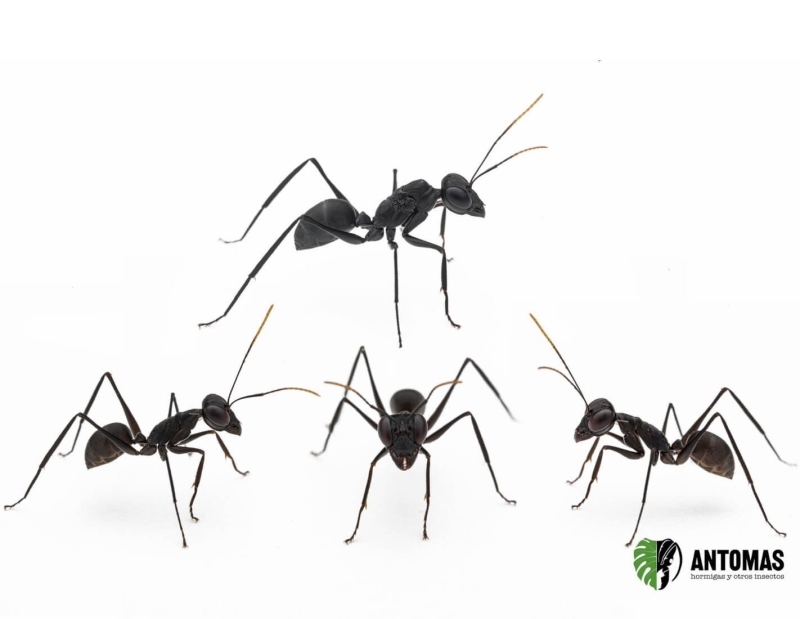
They walk on stretched legs, as if on tiptoe or on stilts: this is the tournament posture that the authors call “stilt legs”.
They raise their head and gaster and stand side-on to their rival, to look bigger.
They drum on each other with their antennae and push each other with kicks.
Some inflate their gaster, and workers have been seen climbing onto a small stone to gain height.
Each encounter lasts one to three seconds at first and up to about thirty once the tournament settles down. There are feints and the odd bite, but hardly ever a real fight: if a large worker faces a small one, the small one gives way. Only workers from another colony of the same species trigger this display; between nestmates, the greeting lasts a second or two.
A tournament can last several days. It stops at night and, at around half past five in the morning, each colony sends its contingent back to the same spot, even before it starts foraging. There are even “guards”: groups of one to six workers that, on their stretched legs and often on top of a small stone, occupy the same spot every day until dusk. Neighbours also establish a dominance order which, over time, is sometimes reversed.
Sizing up the rival without fighting: the census of the big workers
Why all this theatre? Hölldobler measured the participants: tournament workers are larger than foragers, with an average head width of 1.43 mm against about 1.0 mm. Each colony sends its most imposing members to the front.
In 1983, Charles Lumsden and Hölldobler himself proposed that the tournament is a system of communication between colonies, a kind of census. Mature colonies produce larger workers, so the proportion of giants in the tournament, and how often each worker runs into rivals, reveal the size of the other colony. It is like two armies parading before deciding whether a fight is worth it: the parade lets them assess the rival without paying the price of a battle.
Borders that move with the food
Most territorial ants defend a fixed area. Not M. mimicus: it has spatiotemporal territories. Each colony defends only the place where it is foraging at that moment, and the tournament is staged wherever the food is. Very often that place is the rival nest’s own entrance: the stronger colony plants its army at the neighbour’s door and keeps it busy while its foragers make the most of the spoils. In the study areas, nests were more evenly spaced than chance would predict, 10–45 m from their nearest neighbour, with overlapping foraging areas: the typical pattern of intense competition.
Termite hunter
Honeypot ants are known for living on nectar, and M. mimicus does collect it from desert plants such as Eriogonum or spiny hackberry (Celtis pallida), as well as honeydew from aphids and other hemipterans. But its star prey is something else. In 27 hours of watching three nests, Hölldobler recorded what foragers carried home:
928 loads were termites, more than half of the 1,747 recorded;
167 were other insects and only 20 were seeds;
632 workers came back with nothing visible, probably with liquid in the crop.
Termites turn up in unpredictable patches, under dry cow pats or in tunnels in the soil, and to exploit them the ants must arrive quickly and in numbers. The scout that finds them lays a trail home with the contents of its gut and, in the nest, jerks in front of its nestmates and releases poison gland secretion. This draws columns of 20–50 workers, sometimes 100–300, which travel up to 48 m. Scouts also navigate by sight: every 50–70 cm they stop, turn round and “look” back.
What matters at home: M. mimicus is not a sweet-tooth that lives on sugar, but a hunter that needs plenty of protein to raise brood (see “Protein: termites and miniature prey”).
When the tournament ends in a raid
When one colony is much stronger than the other, the parade is short and the weaker colony is raided. Hölldobler recorded 34 raids, about 8 % of tournaments, and saw what happened inside:
the resident queen was killed in three cases and driven out in two more;
the raiders carried larvae, pupae, newly emerged workers and even repletes back to their own nest: up to 293 larvae, 318 pupae and 117 live repletes in a single raid.
That brood completes its development in the winning colony and works for it: this is slavery within the same species, and M. mimicus was the first known case in ants. Intact repletes are also absorbed, so the winner gains both future workers and its rival’s larders. All the raided colonies were young, and the raider was at least ten times larger. Those further away, at 16–26 m, resisted in another way: they blocked their entrance with pebbles and twigs.
Surprise raids on newborn colonies
A 2011 study by Hölldobler, Barbara Grillenberger and Jürgen Gadau, with data from ten field seasons, showed that not every raid begins with a tournament: mature colonies actively search for incipient colonies and simply plunder them.
They documented 17 complete raids without a tournament, with a haul of up to 137 larvae, 152 pupae and 23 repletes.
Many repletes were not carried off: they were emptied on the spot, and up to 409 workers left the plundered nest with full crops.
Of twenty artificial incipient nests of 100–200 workers, nine were found and raided in just 18 days, one of them 16 m from the mature colony.
Scouts inspect the entrance, return home laying a trail with the tip of the gaster and come back at the head of a swarm. For a young queen, the neighbourhood is extremely dangerous: she almost never manages to settle within about 3 m of a mature colony, and between 3 and 15 m she runs a high risk of being raided.
Enslaved by its sister: the case of M. depilis
At Portal and Rodeo, M. mimicus shares the ground with its sister species, M. depilis, so similar that the small workers of the two can sometimes only be told apart with genetic markers. The relationship is one-sided: M. depilis raids colonies of M. mimicus, not the other way round. In 2003, genetic analyses by Daniel Kronauer, Jürgen Gadau and Bert Hölldobler found M. mimicus workers labouring in M. depilis nests: on top of slavery within each species, there is slavery between species.
The sisters have different styles. M. depilis tournaments are shorter, from half an hour to two hours, and turn into fights sooner, and the species is strictly monogynous: of 397 incipient colonies and 27 two-year-old ones, every single one had just one queen. Curiously, tournaments between the two species have never been seen.
And a practical detail: a blackish gaster with a smoky head and thorax is exactly what characterises M. depilis. M. mimicus is sometimes credited with a “practically black” gaster, but its gaster is darker than the front of the body, not black (see “Size and morphology”).
Founding in a group… only to end up with one queen
After the nuptial flight, which in this genus usually follows heavy summer rain, the queen sheds her wings, digs a chamber and seals herself in. Founding is claustral: she rears her first workers without going out to feed, living on her fat reserves and on the muscles of wings she no longer needs.
In M. mimicus, she often does not do it alone. In 1982, Steven Bartz and Bert Hölldobler found at Portal that, just after the flight, most founding nests had one queen, but that when they were opened later most had 2 to 4 queens, and some as many as nine. This is pleometrosis, founding in a group, and these nests cluster in patches away from mature colonies. Even the queens’ movements during founding have been studied.
Why do they cooperate? Because competition starts very early. In the laboratory, nests with several queens raised considerably more workers, and neighbouring incipient colonies stole each other’s brood until it was all gathered in a single chamber; the workers often abandoned their own mother along the way. Whoever has more workers first wins.
The alliance is temporary: once the first workers emerge, it is they who eliminate queens until, almost always, only one is left. Not always: in 2011, genetics showed that 4 of 14 mature colonies were polygynous, with 2–4 lines of unrelated mothers. This is facultative polygyny, possible but in the minority. Its sister M. depilis, by contrast, never accepts group founding.
And at home? At Antomas we rear and sell M. mimicus as a monogynous species, with one queen per colony, and we recommend always founding separately (see “One colony, one queen”). If you are looking for a honeypot ant in which several queens live together stably, that is another species in our range: Myrmecocystus mendax, which we sell as colonies with 2 or 3 queens.
Living larders the size of a pea
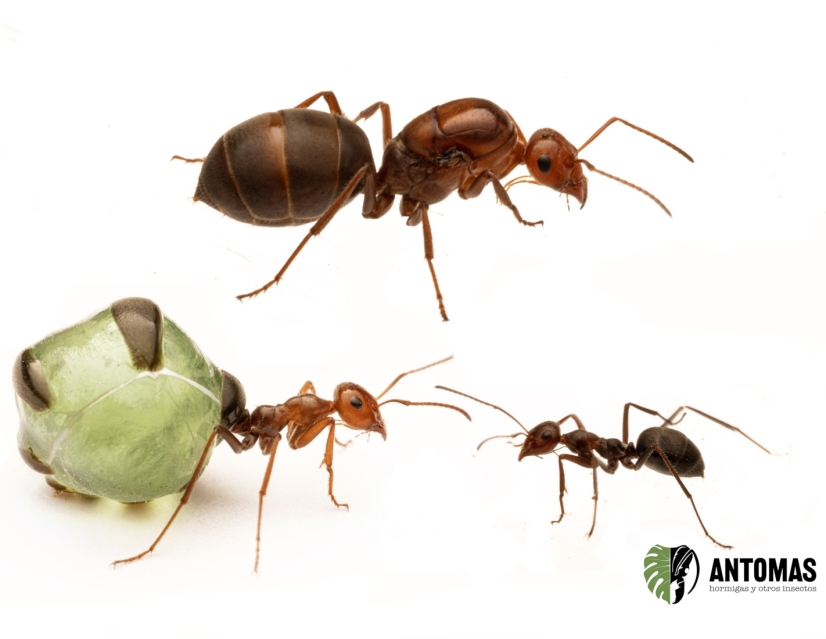
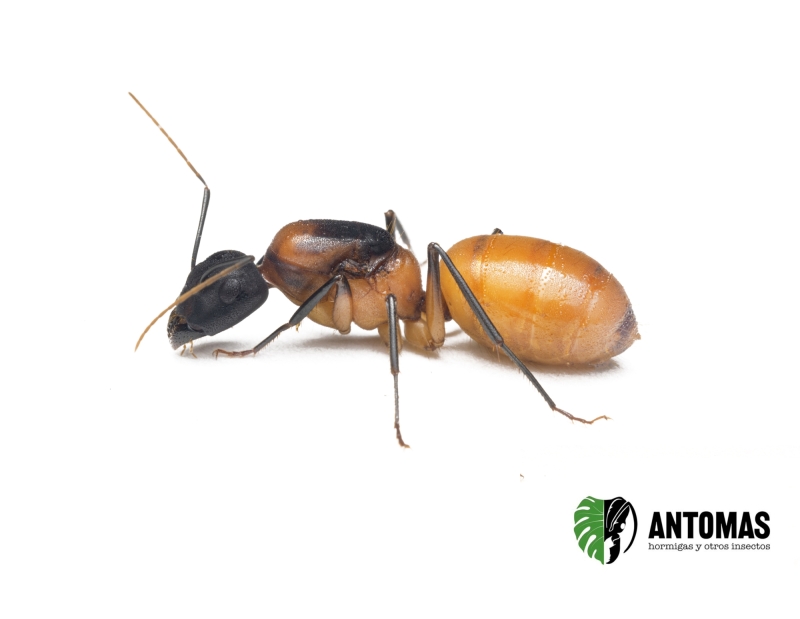
Repletes are ordinary workers with a special destiny. They are usually the largest in the colony, and their nestmates fill them with nectar until the social crop, the part of the gut where ants keep the food they share, takes up almost the whole gaster. The plates of the abdomen are left like islands on a taut, translucent membrane, and the replete hangs motionless from the ceiling; when another worker taps its antennae, it hands the food back mouth to mouth. Depending on the species, they reach the size of a pea or a cherry.
They are made, not born. If the repletes are removed, the next largest workers replace them. They usually form in the two weeks after emergence, although mature workers can also become repletes.
Their honey has a recipe. Those of M. mimicus and M. mexicanus analysed in Arizona contained 47–49 % fructose, 42–44 % glucose and 7–8 % maltose.
Not all of them store sugar. The genus has clear repletes, almost pure water, and milky repletes, with proteins and fats.
They empty and refill. An emptied replete does not die: it goes limp and can be filled again.
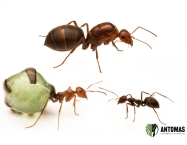
In our product photo you will see a replete with a translucent green gaster. A replete’s colour depends on what it stores: the entomologist John Conway gave M. mexicanus colonies sugar water dyed blue or red and obtained blue and red repletes.
M. mimicus repletes hanging from the nest ceiling: this is what a living larder looks like inside (Anthouse video).
In captivity, the first repletes do not come from the first generation of workers, which are small, but arrive later, when large workers start to emerge (see “Sugar: from the dropper to the open bar”).
Midday ant
In the desert, honeypot ants work in shifts. At Portal and Rodeo, M. mexicanus and M. navajo, pale and large-eyed, come out at night; M. mimicus and M. depilis, darker, are strictly diurnal. Our species forages most intensely in the middle of the day, with mass departures of over a hundred workers.
Roy Snelling grouped these dark, day-active honeypot ants in Endiodioctes, Greek for “midday hunter”, as opposed to the pale, nocturnal species of the M. mexicanus group. These subgenera are no longer formally used, because DNA suggests that day or night activity has evolved more than once in the genus, but they capture two ways of life. According to a 1978 study by Kay and Whitford:
Diurnal species, such as M. mimicus, are immobilised by cold at around 11–12 °C, but forage with air temperatures of 13–46 °C and the ground at up to 60 °C.
Nocturnal species, such as M. mexicanus, keep moving at almost 0 °C and work at 2–30 °C.
That is why the diapause of M. mimicus has to be milder than that of the nocturnal honeypot ants (see “Diapause: four months of mild winter”).
Stones in the doorway and lizards lying in wait
Working in full sun has its risks. The horned lizard Phrynosoma modestum eats 0.5–1 % of the foragers of the M. mimicus and M. depilis colonies it watches every day. And the small ant Dorymyrmex bicolor practises one of the strangest forms of competition known: it drops pebbles into the entrance of neighbouring honeypot ants, up to 200 in five minutes, forcing them to stop foraging. In the desert, defending the door is a matter of survival.
From south-western Kansas to California
According to Snelling’s revision, M. mimicus ranges from south-western Kansas to the Big Bend in Texas and north-central Mexico, and westwards to California and Baja California. Records are concentrated in Arizona, Texas, New Mexico and California, with fewer in Nevada; in Mexico, mainly in Chihuahua, but also in Sonora, Baja California, Durango, Nuevo León, San Luis Potosí, Coahuila and Zacatecas. It has sometimes been reported from Colorado, but that state appears neither in Snelling’s revision nor in the records we have checked.
It lives in deserts, dry grasslands and mesquite-acacia savannas, open and very sunny ground. Its underground nests give the queen, the brood and the repletes far more stable conditions than at the surface, with low, vaulted chambers and rough ceilings.
A 1908 name that mixed three species
William Morton Wheeler described it in 1908 as a form of M. melliger, but according to specialists that material also contained specimens now assigned to M. depilis and M. romainei. That is why old “mimicus” data should be read with care, and in this care sheet we rely mainly on Hölldobler’s studies and on modern genetics.
DNA has put things in order: M. mimicus and M. depilis are sister species, and the genus, with 29 described species, is a close relative of Lasius, the genus of the black garden ant. According to the 2021 phylogeny by Tobias van Elst and colleagues, it diversified about 14 million years ago, as the North American deserts were forming. The honeypot ants of other continents, such as Australia’s Camponotus inflatus, reached the same solution on their own: this is convergent evolution.
Size and morphology
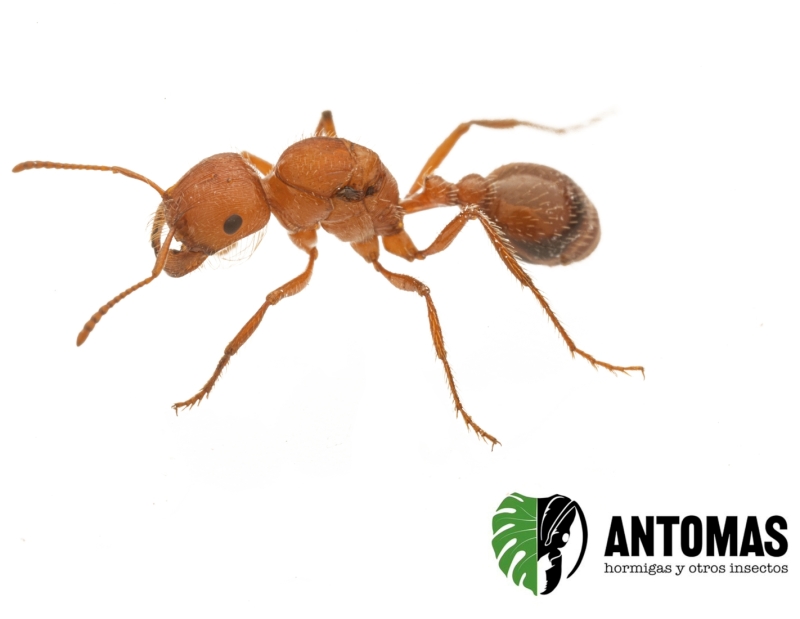
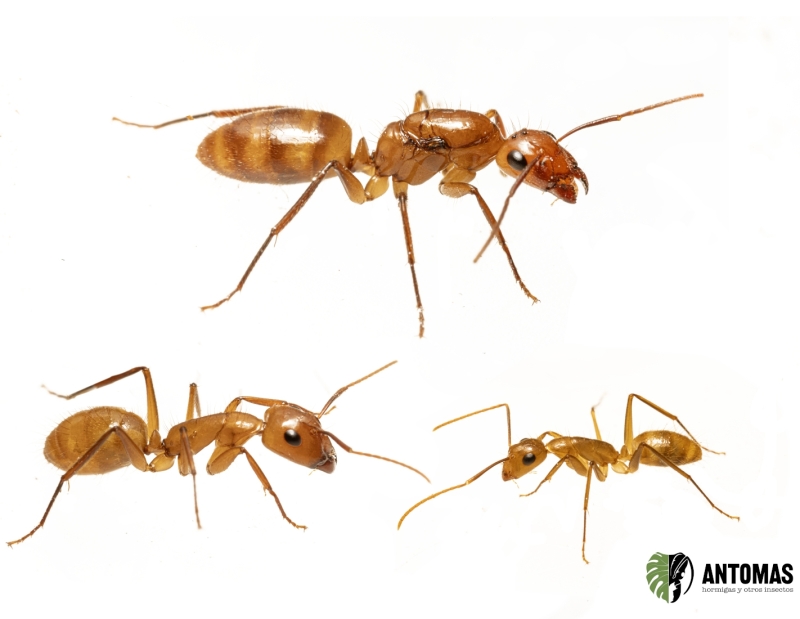
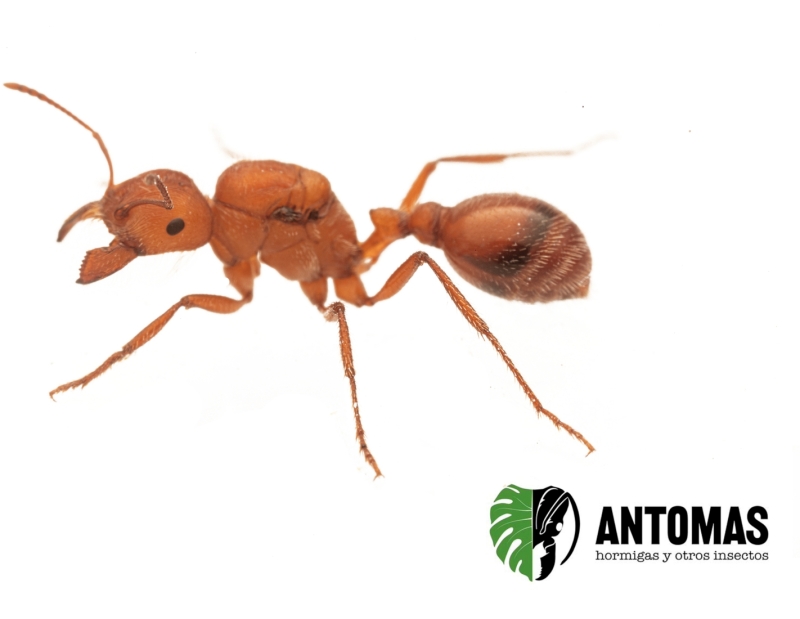
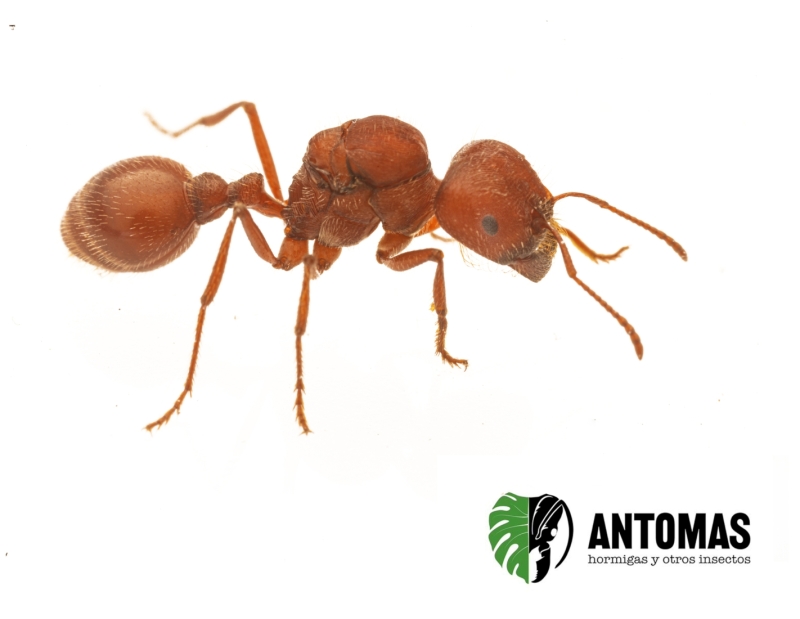
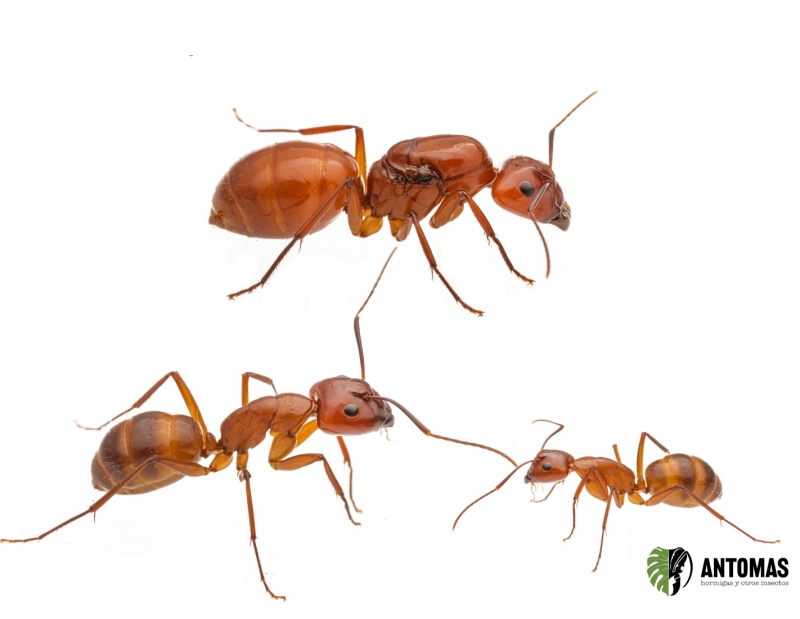
A medium-sized to large honeypot ant, polymorphic, agile, long-legged and stingless, with striking two-tone colouring.
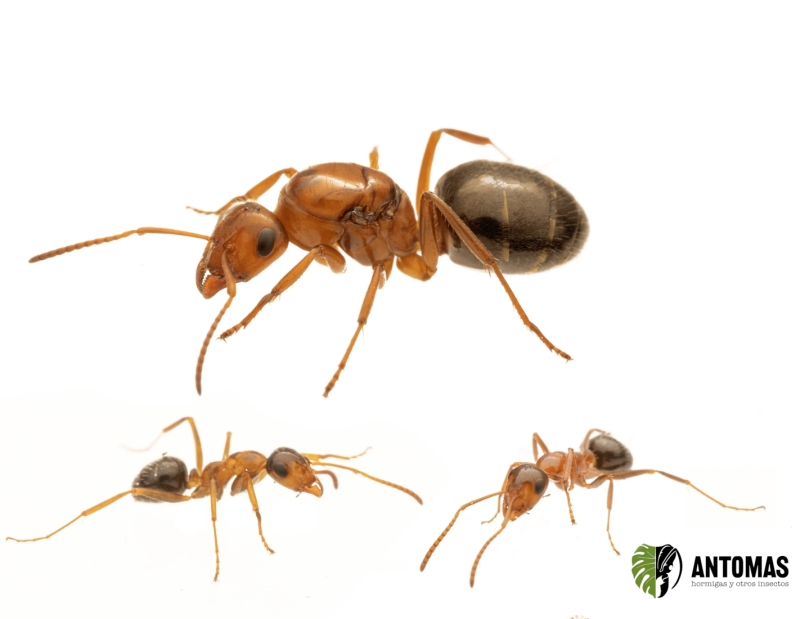
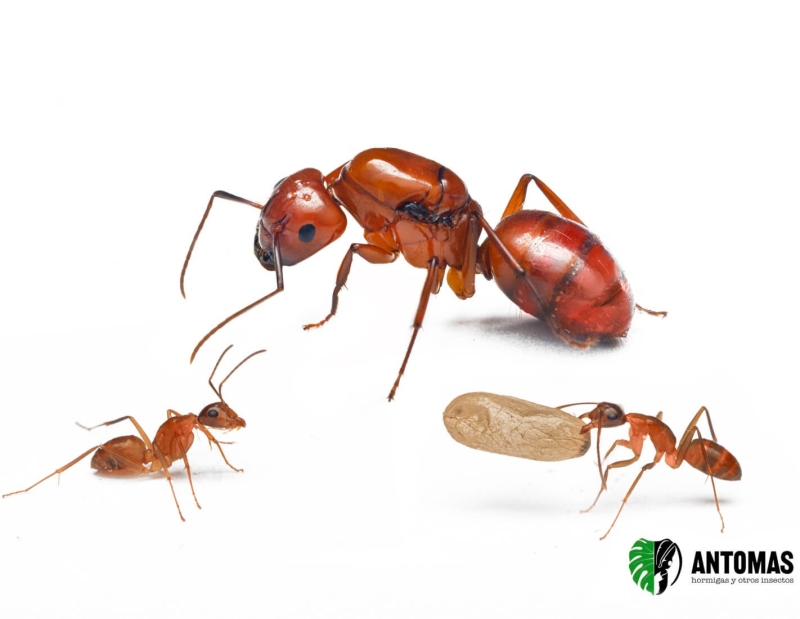
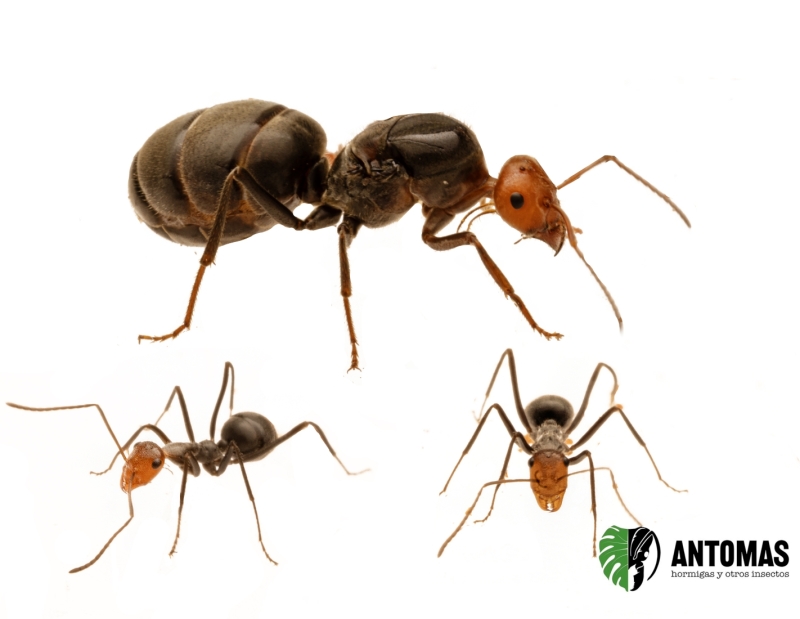
Colour of our colonies. Workers with a reddish head and thorax and a dark gaster. The queen has a reddish-brown head and mesosoma (the thorax) and a dark brown, banded gaster.
Colour according to science. Wheeler described the typical form with the head, thorax, antennae and legs a uniform reddish brown, and Snelling with a smooth, shiny frons and occiput. The gaster is darker, but not black: a blackish gaster with a smoky front half is the hallmark of M. depilis.
Hairs. Short. In small workers, the hairs on the pronotum are all the same length; in M. depilis, they vary greatly in length.
Gradual polymorphism. No soldiers, but a continuous range of sizes. The large workers star in the tournaments and become repletes; the small ones look after the brood.
Legs. Long and fast. The “stilt legs”, however, are not a body feature but a posture: that of workers walking on tiptoe in tournaments.
Repletes. A large worker with an enormously distended gaster; in our photo, translucent green.
Defence. Like all formicines, it has no sting: it bites and releases formic acid through the acidopore, at the tip of the gaster.
Approximate measurements
Forager workers: average head width of about 1.0 mm (Hölldobler, 1981)
Tournament workers: average head width of 1.43 mm (Hölldobler, 1981)
Total length of workers: about 4–10 mm, as a guide only (no published source)
Queen: no published measurement we have been able to access
Repletes: gaster the size of a pea or a cherry
The reference measurements are in Snelling’s 1976 revision of the genus, which we have not been able to access. The figure of 8–10 mm sometimes given for the queen has no source and seems small: Wheeler measured 12 mm in the female of M. melliger, from the same group. We have removed it until we can check it.
Care in captivity
Difficulty: 4/5 – Advanced
At Antomas we consider M. mimicus a species for experienced keepers. Not because it is aggressive or an escape artist, which it is not, but because honeypot ants require you to understand their rhythm:
A slow, fragile start. In our experience, the colony is not established until it passes a hundred workers, and that can take about two years.
Sugar that must be rationed. At first by the dropper, so that the queen does not turn into a replete; later, freely.
Delicate repletes, which a fall or a knock can burst.
A tailored diapause: about four months and mild, because cold immobilises it sooner than the nocturnal honeypot ants.
Is it worth it? Absolutely. It is one of the ants with the richest history in myrmecology, it is active in broad daylight, it hunts in groups and, over time, it fills its nest with living larders. Seeing the first replete hanging from the ceiling is one of the great moments of this hobby.
Recommended parameters
Temperature: at Antomas we keep them practically at ordinary room temperature. Keepers who succeed with the genus use 24–31 °C, with a warm spot on one side, and point to about 29 °C as ideal; as a diurnal species, M. mimicus appreciates that warm area next to the brood.
Repletes, away from the heat: in a stable, mild area at the opposite end from the heat source.
Humidity: a mostly dry nest, with a damp spot near the brood and no condensation.
Foraging area: dry and well ventilated.
Water: always, in a test tube with water and cotton wool in the foraging area.
Nest: horizontal chambers with headroom for the repletes to hang and rough surfaces.
Light: a dark area in the nest and a lit foraging area.
Diapause: about 4 months, from November to February, at 15–18 °C.
One colony, one queen
In the wild, M. mimicus queens often found in groups, but the workers later eliminate the surplus ones. At Antomas we treat it as what it is in the vast majority of its colonies: a monogynous species. Our colonies have a single queen, and the guidelines are clear:
Always found separately. If you have young queens, each one in its own tube: an association that works in the field can end in a massacre in a test tube.
Do not combine queens or colonies, or connect two occupied nests: the raids and brood theft that Hölldobler studied are exactly what would happen.
A young colony: the first months
We sell M. mimicus as a young colony, in the “Queen and 5/15 workers with brood” option: a queen with five to fifteen workers and brood, in a test tube (when available, also queens with brood). What to expect:
On arrival, leave the tube somewhere quiet, at room temperature and out of direct sun, and check the water reservoir. There is no need to move it into the nest on day one.
The first workers are small and do not become repletes. Repletes arrive with the second or third generation.
Growth comes in spurts, with bursts and pauses, and keepers agree that this is the stage at which most colonies are lost.
The aim of the first months is a well-fed colony that grows, not getting repletes as soon as possible.
The sweet death: when the queen turns into a replete
This is the most treacherous mistake with honeypot ants. In a small colony with no repletes, surplus nectar has nowhere to go, and the workers fill up whoever can store it: the queen. Her gaster swells like a replete’s, she becomes clumsy and lays far fewer eggs or stops laying altogether. The colony stalls, and the queen may even die. This is the “sweet death”. There are no scientific studies on it: it is rearing experience, ours and other keepers’, and this video shows it very well.
Honeypot queens swollen with nectar during founding: the risk the dropper avoids (Anthouse video).
The solution: until there are repletes, sugar is given by the dropper. One or two tiny drops that the colony will finish quickly, on a small piece of aluminium foil or in a small feeder, removing the leftovers. That way everyone eats, but there is no surplus to end up in the queen’s body. When you see the first repletes hanging, they will take over that role.
Recommended formicaria
Honeypot ants need chambers with headroom, so that the repletes can hang, and rough surfaces. Vertical formicaria are best kept for large colonies: they give a young one too much space and make food and humidity harder to control.
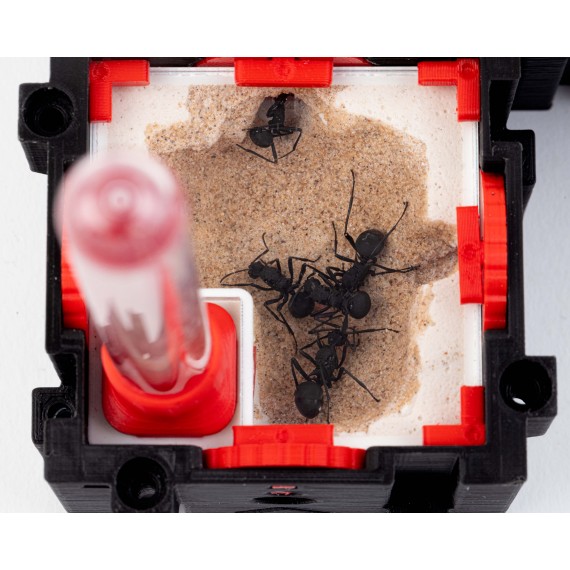
To start with, the Qbik Wild One P 1C, a module of about 6.8 × 6.8 cm and 5 cm high with a central humidity point, designed for small colonies of large ants. It has headroom for the first repletes to hang and a well-proportioned area for the queen and brood, and keeps the colony compact and easy to watch.
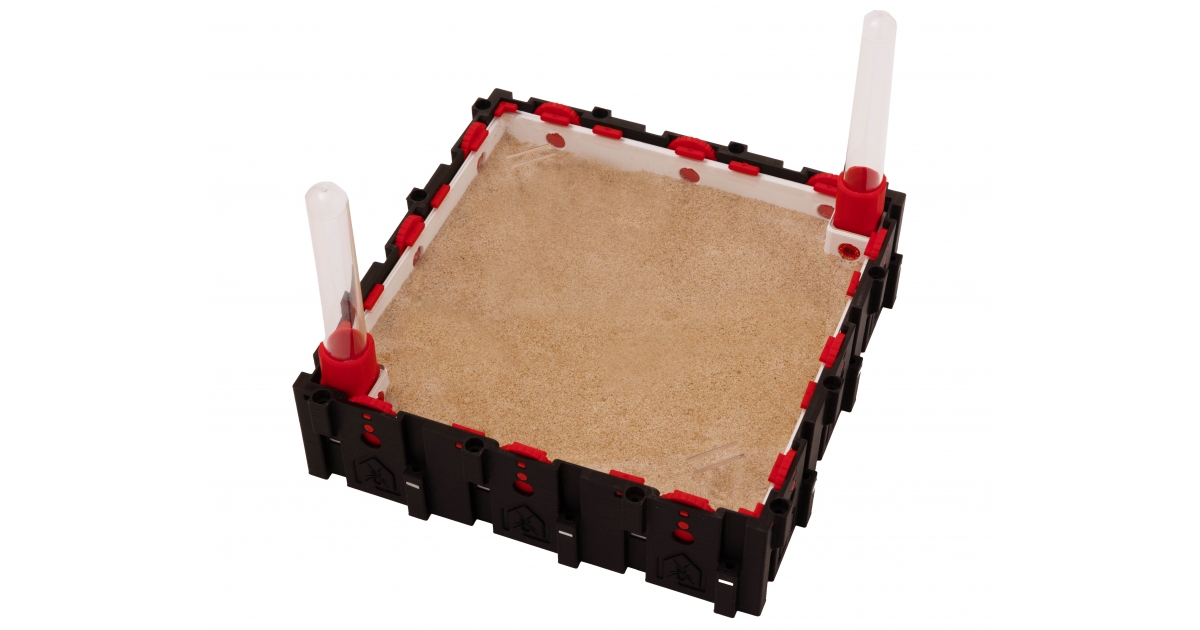
For mature colonies, the Qbik Wild NoNa Diáfano, with no pre-designed chambers: the workers dig their own network in the substrate and create low chambers with rough ceilings on several levels, as in their natural nests. Use a compact substrate that will not collapse on the repletes, and moisten it at one point only. It is for large colonies only.
We also recommend the hybrids. The Qbik Wild Duo P 2C Híbrido combines a lower reservoir that humidifies the nest by evaporation, without the water touching the chambers, with a side drinking tube. For honeypot ants it is ideal: stable humidity without condensation for the repletes, and water always to hand. If you use heat, put it on one side, never under the reservoir.
Qbik nests are modular: as the colony grows, new modules are attached. Complete the set-up with a dry foraging area, the water tube, a feeder for the sugar and the mineral oil barrier.
Humidity: a dry nest with a damp corner
Although it comes from the desert, M. mimicus does not live in a parched nest: underground, its chambers have far more stable humidity and temperature than the surface. In captivity:
a gradient, with a damp spot near the brood and the rest drier;
replete chambers that are stable and free of condensation: on a wet ceiling, repletes lose their grip and fall;
drinking water always available.
If you see droplets on the ceiling or mould, stop moistening for a few days and clear away the leftovers.
Sugar: from the dropper to the open bar
Until the first repletes, by the dropper, several times a week (see “The sweet death: when the queen turns into a replete”).
From the moment the first repletes appear, ad libitum. From then on, sugar must never run out: filling the repletes is their job, and with too little sugar they do not form.
Vary the sugars: at Antomas we recommend Anthouse’s Blue Sugar nectar 4–5 times a week and another sugary liquid or nectar 1–2 times a week; you can also add some protein to the nectar. Always offer them in a feeder, never on cotton wool, which goes mouldy and spoils the liquid very quickly: a traditional or home-made feeder is best, where the drop stays “spread out” and accessible. And nectar is no substitute for the water tube, which must always be full.
Protein: termites and miniature prey
With 928 loads of termites out of 1,747, M. mimicus makes it clear that it does not live on nectar alone. The Antomas routine:
At first, exaggeratedly small prey:Drosophila, firebrats (Thermobia), captive-bred termites and micro crickets, ideally every day.
As the colony grows, larger prey, such as flies, crickets or small cockroaches, in larger amounts but more spaced out, not daily.
Change the insect every week.
If you do daily maintenance and remove leftovers, it is better to overfeed: the colony understands that it has resources and grows faster. If you will not be able to clean often, better not, because leftovers bring mould and mites. As it is diurnal, put the protein in during the morning or at midday and remove leftovers in the afternoon.
How honeypot ant larvae feed: M. placodops larvae eating protein at Antomas (Antomas channel).
Moving by tipping
At Antomas, honeypot ants are moved by tipping: the tube or old nest is opened in the foraging area of the new one, next to the entrance, and the colony is gently tipped out. With repletes, take care:
Move early, before there are many repletes: a tube with 5–15 workers tips out without any problem.
Tip from a low height onto a soft surface, such as sand.
Repletes, no tweezers: their gaster bursts easily. Guide them with a soft brush, without pressing, or let the workers drag them.
Prepare everything beforehand and keep the new nest dark so that they move in straight away.
Diapause: four months of mild winter
At Antomas we give M. mimicus a diapause of about 4 months, from November to February, somewhat shorter than that of our native species. And here it matters that it is diurnal: dark honeypot ants become immobile at around 11–12 °C, while pale, nocturnal ones stay active at almost 0 °C. That is why we recommend a mild diapause, at about 15–18 °C: cool enough to slow down egg-laying, but well away from the threshold at which it is paralysed. It is a guide figure, consistent with its physiology; nocturnal honeypot ants can have a much colder diapause.
Lower and raise the temperature gradually, over one or two weeks.
Water always, and a sugar feeder that never runs dry.
Very little or no protein if there are no developing larvae.
If only larvae that have stopped growing remain, the colony is at rest; if there are still new eggs and pupae, it is not yet.
Behaviour in captivity
Diurnal and very lively. Fast and active in light and warmth, this is a species to watch by day: a developed colony forms recruitment trails to a prey item within minutes.
Echoes of the tournaments. In our experience, large workers sometimes adopt display postures, with stretched legs and raised gaster, when faced with something strange. Never pit two colonies against each other: in captivity, a tournament can end in a raid.
Watch without fear. At Antomas we believe ants are there to be enjoyed, watched and learnt from, not kept hidden away. Just leave them a dark area in the nest and a lit foraging area, and watch them gently, intervening as little as possible. They get used to your presence.
Warning signs: a queen with a swollen gaster (too much sugar), fallen repletes (condensation or knocks), stalled brood outside diapause (lack of protein) and mould (too much humidity or leftovers).
Escapes and barriers
M. mimicus is not much of an escape artist: a band of mineral oil on the upper part of the foraging area walls is enough. Renew it when it gathers dust, keep the lid well fitted and leave nothing that could act as a bridge.
Handling and safety
It cannot sting, because it has no sting. If trapped, it bites and may release formic acid, which smarts on sensitive skin, nothing more. Handle it with a soft brush or soft tweezers, never with your hands; the greater risk is to them, especially to the repletes. It is an exotic species: it must never be released.
What not to do
Give sugar freely to a colony without repletes, or leave a colony that already has them without sugar.
Put the sugar on cotton wool.
Skimp on protein or always give the same insect.
Combine queens or colonies.
Pull repletes off with tweezers or tip them from a height.
Put heat under the nest or next to the repletes, or soak the whole nest.
Give it a cold diapause, as for nocturnal honeypot ants: at around 12 °C it becomes immobile.
Move a small colony into a huge nest.
Scientific sources
This care sheet is based on the scientific literature on Myrmecocystus mimicus and its genus, and on the experience of Antomas and other keepers. Main references:
Hölldobler, B. (1981). Foraging and spatiotemporal territories in the honey ant Myrmecocystus mimicus Wheeler (Hymenoptera: Formicidae). Behavioral Ecology and Sociobiology 9: 301–314. doi:10.1007/BF00299887
Lumsden, C. J. & Hölldobler, B. (1983). Ritualized combat and intercolony communication in ants. Journal of Theoretical Biology 100: 81–98. doi:10.1016/0022-5193(83)90093-0
Bartz, S. H. & Hölldobler, B. (1982). Colony founding in Myrmecocystus mimicus Wheeler (Hymenoptera: Formicidae) and the evolution of foundress associations. Behavioral Ecology and Sociobiology 10: 137–147. doi:10.1007/BF00300174
Kronauer, D. J. C., Gadau, J. & Hölldobler, B. (2003). Genetic evidence for intra- and interspecific slavery in honey ants (genus Myrmecocystus). Proceedings of the Royal Society B 270: 805–810. doi:10.1098/rspb.2002.2288
Hölldobler, B., Grillenberger, B. & Gadau, J. (2011). Queen number and raiding behavior in the ant genus Myrmecocystus (Hymenoptera: Formicidae). Myrmecological News 15: 53–61. No DOI; open access
Kronauer, D. J. C., Hölldobler, B. & Gadau, J. (2004). Phylogenetics of the New World honey ants (genus Myrmecocystus) estimated from mitochondrial DNA sequences. Molecular Phylogenetics and Evolution 32: 416–421. doi:10.1016/j.ympev.2004.03.011
Schooley, R. L. & Bestelmeyer, B. T. (2000). Movements during colony founding by queens of the honey ant (Myrmecocystus mimicus Wheeler). The American Midland Naturalist 144: 439–444. doi:10.1674/0003-0031(2000)144[0439:MDCFBQ]2.0.CO;2
Kay, C. A. R. & Whitford, W. G. (1978). Critical thermal limits of desert honey ants: possible ecological implications. Physiological Zoology 51: 206–213. doi:10.1086/physzool.51.2.30157867
Möglich, M. H. J. & Alpert, G. D. (1979). Stone dropping by Conomyrma bicolor (Hymenoptera: Formicidae): a new technique of interference competition. Behavioral Ecology and Sociobiology 6: 105–113. doi:10.1007/BF00292556
Conway, J. R. (1986). The biology of honey ants. The American Biology Teacher 48: 335–343. doi:10.2307/4448321
van Elst, T., Eriksson, T. H., Gadau, J., Johnson, R. A., Rabeling, C., Taylor, J. E. & Borowiec, M. L. (2021). Comprehensive phylogeny of Myrmecocystus honey ants highlights cryptic diversity and infers evolution during aridification of the American Southwest. Molecular Phylogenetics and Evolution 155: 107036. doi:10.1016/j.ympev.2020.107036
Dificultad
Experienced
1 Reviews
Tomás has been incredibly kind and helpful. When the queen of my honeypot ant colony sadly died shortly after arrival, he was very understanding and arranged a replacement colony, which has now arrived. Great communication and excellent customer care—he really stood behind his service. Thank you, Tomás! Highly recommended.
Shipment into Switzerland.


Shipment into Switzerland.