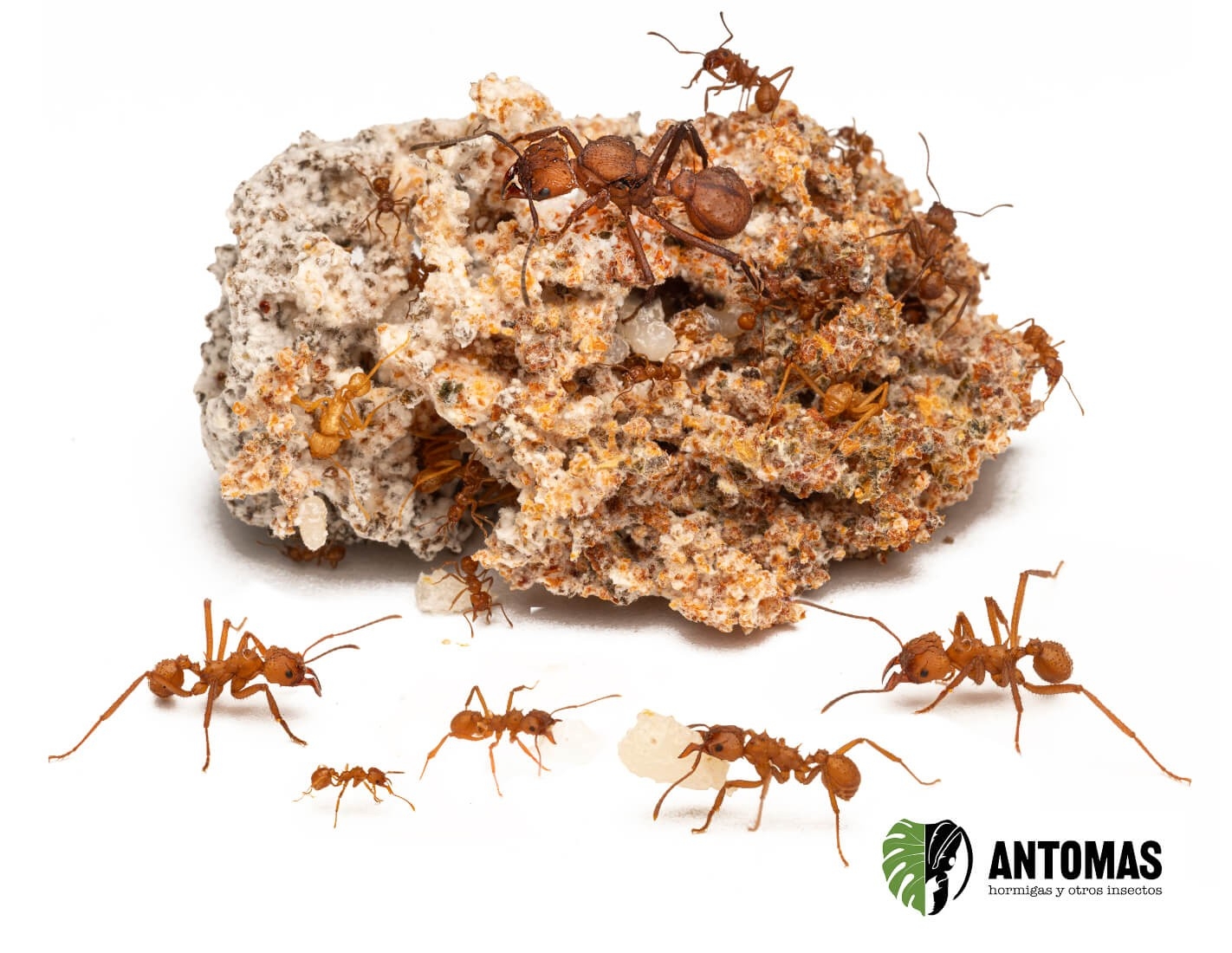
Difficulty: 3/5 – Advanced
A Neotropical leafcutter ant that does not eat leaves: it uses them to grow a fungus, which it protects with bacteria that produce antifungal compounds. Once established, it is fairly easy to keep, as long as you understand that you are looking after a living fungus. Colonies with queen, already founded. Anthouse Fungarium Kit, fungus at 24–28 °C (ideally 24–26 °C) and 80–90% humidity without puddles, good ventilation, a separate waste area, and fresh leaves, flowers and fruit free of pesticides. No diapause. It climbs: use a mineral oil barrier.
Acromyrmex octospinosus (Reich, 1793) is a Neotropical leafcutter ant found from Mexico and Central America to much of northern South America and several Caribbean islands. It lives in rainforests, secondary forests, open areas and farmland, and has been studied in detail in places such as Panama and Trinidad. It is one of the most studied leafcutter ants in the world: much of what we know about these ants’ protective bacteria, their defensive chemistry and the mating of their queens has been researched in this species.
Its common name says almost everything, but with an important nuance: it does not eat the leaves it cuts. It uses them to grow a fungus on which the whole colony lives. This is farming, complete with fertiliser, pests, antibiotics and even waste management, and in this care sheet you will see just how sophisticated it is. As always, we keep apart what is documented by science, what other keepers report and what we have learnt keeping it at Antomas.
Biology
One species, six names: the 2025 revision
Reich described it in 1793, from specimens from French Guiana, as Formica octospinosa, “the eight-spined ant”. More than two centuries later, its taxonomy has changed significantly.
During the 20th century, several very similar species and subspecies were described. In 2025, Daniela Mera-Rodríguez, Hermógenes Fernández-Marín and Christian Rabeling published a revision in Systematic Entomology that combined morphology, population genetics, phylogeny and biogeography, with samples from across its range and DNA fragments spread throughout the genome. Their conclusion: the old “A. octospinosus complex” was far more fragmented than the genetic data justified, and in fact contains only two species: A. octospinosus, widespread and highly variable, and its social parasite, A. insinuator (see “The squatter that looks like its landlord”).
As a result, five names become synonyms of A. octospinosus:
- Acromyrmex echinatior (Forel), the leafcutter of Panama, star of dozens of studies;
- Acromyrmex volcanus Wheeler;
- and the subspecies A. octospinosus cubanus, A. o. ekchuah and A. o. inti, all three described by Wheeler.
That is why many shops’ older care sheets still talk about subspecies. And that is why this revision also matters for interpreting its biology: behaviours and social structures published under the name A. echinatior are now part of the known variability of A. octospinosus. We include them in this care sheet, and we always tell you which populations they come from.
An open debate. The synonymy is not unanimous. In 2026, a team with almost 25 years of fieldwork in Panama published a population genomics analysis that still treats A. echinatior and A. octospinosus as separate species: according to their data, the two are completely distinct there. It is a preprint, a study not yet peer-reviewed, but it shows that the last word has not been said. At Antomas we follow the 2025 revision, which is the published one.
Almost seven million years of history. The same revision reconstructed its past: A. octospinosus arose in the late Miocene, some 6.9 million years ago, in the Neotropical rainforest, and its parasite A. insinuator split from it about 3.4 million years ago. And in 2025 its genome was also published, assembled at chromosome scale: 19 chromosomes, about 320 million base pairs and 12,123 annotated genes. It is a new tool for studying the evolution of all fungus-farming ants.
They don’t eat leaves: they farm a fungus
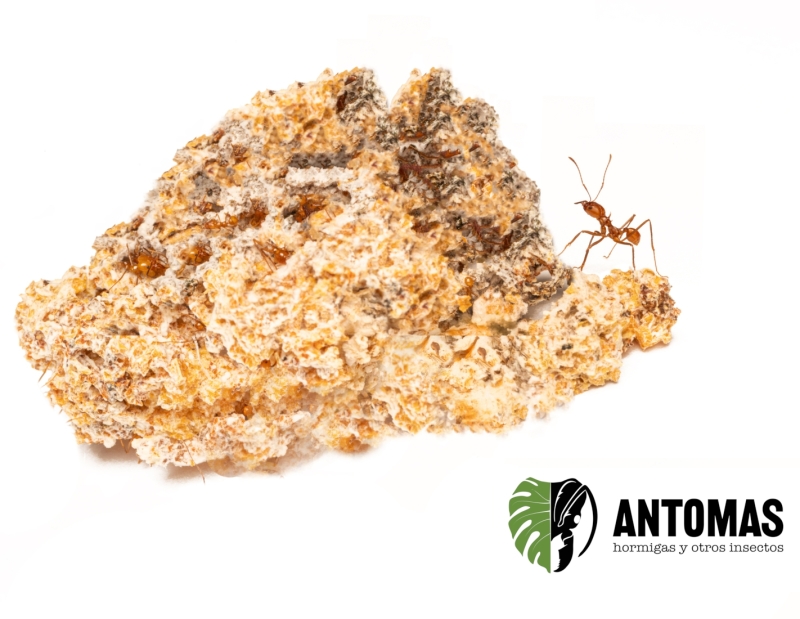
The colony does not feed directly on the leaves it cuts. The workers collect leaves, flowers, petals, tender stems and other plant tissue to use as a growing substrate for a symbiotic fungus, traditionally identified as Leucoagaricus gongylophorus (in some works, Leucocoprinus gongylophorus). The fungus grows on this plant substrate and produces small nutrient-rich swellings at the tips of its filaments, which are the colony’s food.
The plant material goes through very elaborate processing. The workers cut, lick, scrape, pierce, chew and gradually break it down before adding it to the garden. The smallest workers then prepare the finest particles and place them exactly where the fungus is growing.
During this process the ants also feed directly. As they cut and handle plant tissue they can ingest some of the sap and fluids released by the leaves, while the fungus is an essential source of nutrients for the colony and, above all, for the development of the larvae. And they make the most of it: the labial glands of A. octospinosus workers produce enzymes that can digest chitin, the material that makes up fungal cell walls.
The result is a spongy-looking garden, full of galleries, where the queen, the brood and many of the workers live. Looking after it is, in essence, the whole art of keeping this species.

The amazing leafcutter ants, in a video by Anthouse (in Spanish).
The fungus must survive, in a video by Anthouse (in Spanish).
Thousands of workers of every size
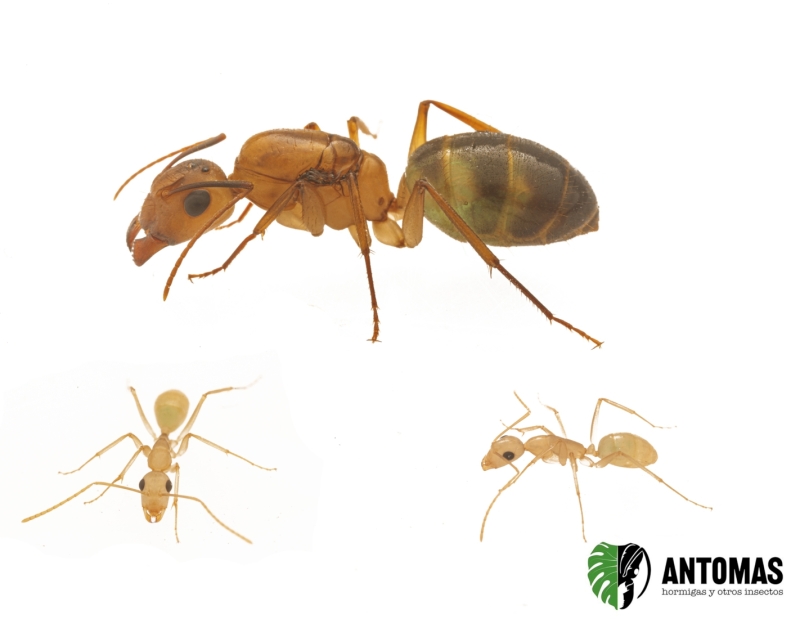
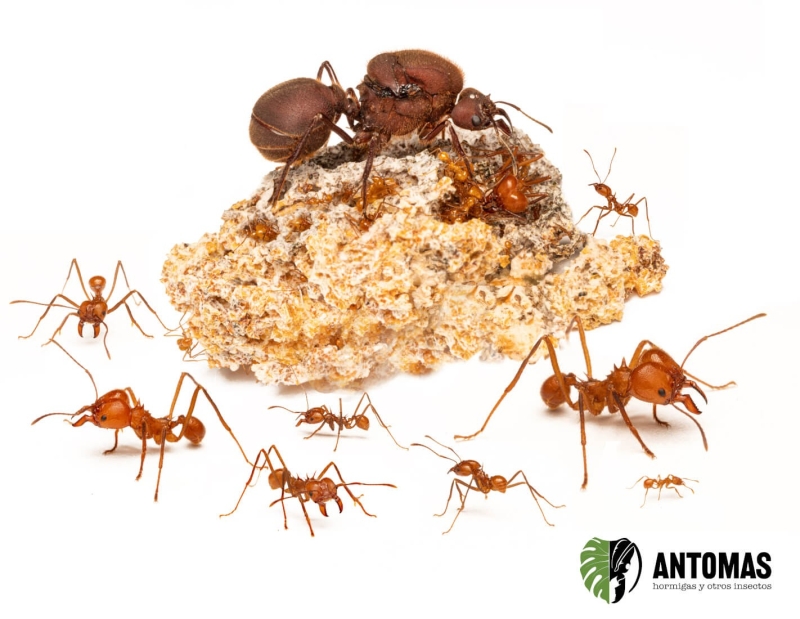
The division of labour is very marked. Large workers are more often involved in cutting, carrying, defence and the initial handling of leaves; medium-sized workers process material and carry out other tasks inside the nest; and the minors, the smallest, can slip into the three-dimensional structure of the garden and are especially important in caring for the fungus, the eggs and the larvae.
A laboratory study of A. octospinosus put numbers on it. Using a head width of 2 mm as the boundary, minor workers devoted themselves mainly to the brood and the garden, and majors to handling freshly cut fragments. But the division is flexible: when there were no leaves to process, the differences in tasks between sizes faded. Foragers also adjust the weight of the load they choose to the slope of the trail. This is what makes the species so entertaining to watch: the work adapts to what the colony needs at any given moment.
There is, however, no clearly separate soldier caste as in many Atta species. In Acromyrmex we find mainly a continuum of worker sizes and specialisations.
How many are there? Colonies can reach several thousand individuals. The reference field study is T. Lewis’s, published in 1975, in citrus, cacao and rubber plantations in Trinidad: the largest nest contained around 14,000 individuals, and a medium-to-large colony produced some 200–300 sexuals, queens and males, a year. This figure should not be taken as an absolute maximum for the species, but it shows that mature colonies can far exceed ten thousand individuals. Lewis also found that nests reach their maximum size, with up to 17 entrance holes, about three years after founding.
There is an older, and curious, count. In 1937 the great myrmecologist William M. Wheeler devoted a chapter of his book on mosaics (ants with female and male features in the same body) and other anomalies to a single A. octospinosus colony from Trinidad: among more than 8,000 normal individuals he found 163 anomalous ones. Keepers report colonies of up to about 20,000 ants. And they are long-lived colonies: Neal Weber, one of the pioneers of leafcutter research, published in 1977 an account of an A. octospinosus colony he had kept for ten years in the laboratory.
Precision farming
Keeping A. octospinosus means keeping much more than an ant colony. The survival of the society depends on a whole agricultural micro-ecosystem made up of the ants, their cultivated fungus and various associated microorganisms.
The garden can be attacked by specialised fungi such as Escovopsis, a highly specialised parasitic fungus which, as far as is known, lives only in the gardens of fungus-farming ants and feeds on their crop. In Panama it has been found in about a quarter of the gardens studied. To fight it, the ants clean their crop constantly: they remove damaged fragments, groom one another, clean particles before adding them and use antimicrobial secretions.
The parasite’s chemical weapon. Escovopsis weberi can destroy the cultivated fungus without even touching it, and in 2018 a German team analysed why. They found several substances: two of them, emodin and cycloarthropsone, strongly inhibited the growth of the ants’ fungus, and emodin also attacked the ants’ protective bacteria, which we discuss below.
A less fearsome parasite than it seemed. The most recent reviews temper its reputation: in complete colonies, with a queen and workers, Escovopsis turns out to be of low virulence and behaves more like an opportunist. In experiments with leafcutter colonies, these fungi did little damage to colonies with a queen, more to queenless colonies and much more to gardens without ants. The lesson for the keeper is clear: what protects the garden is a complete, active colony, with enough workers to look after it. A garden with no ants, or very few, is left defenceless.
The garden, therefore, is not a passive mass that simply receives leaves: it is a crop subjected to selection, cleaning, pruning, fertilisation, microbial control and constant waste removal.
Ants with their own pharmacy
If you look closely at some A. octospinosus workers, you may see a kind of whitish powder on the front of the thorax. It is not mould or dirt: it is a layer of bacteria that the ants grow on their own bodies.
They are actinobacteria of the genus Pseudonocardia, relatives of the bacteria from which medicine has obtained many of its antibiotics. In 1999 Cameron Currie and his colleagues showed in Nature that fungus-farming ants use antibiotic-producing bacteria to keep Escovopsis in check. In 2006 it emerged that they do not carry them by chance: the bacteria live in cuticular crypts, fed by special glands, which only fungus-farming ants have. It is the sign of a very ancient alliance between ants, fungus, parasite and bacteria.
A well-stocked pharmacy. From A. octospinosus colonies researchers have isolated a Pseudonocardia that produces an unusual antifungal, similar to nystatin, and bacteria of the genus Streptomyces that make candicidin, an antifungal that was once used in medicine. A single Streptomyces from this ant can produce several antifungals at once. According to the authors, the ants combine two strategies: they inherit their Pseudonocardia from generation to generation and also “recruit” useful bacteria from the environment.
A job of their own. Not all workers carry the same amount of bacteria. In A. octospinosus, those with a dense layer of Pseudonocardia prefer the bottom of the nest, never go out to the feeding area or the waste area, spend more time grooming the fungus and are groomed more by their nestmates. In other words, there are workers specialised in the garden’s “pharmacy”. Large workers are not born with the coating: they acquire it inside the colony after emerging from the pupa, and maintaining it has a cost: a worker carrying bacteria breathes 10–20% more and eats more fungus. Each colony also grows a single bacterial strain, identical in all its workers.
They protect the ants too. In seven Acromyrmex species, the Pseudonocardia layer helped the workers themselves resist Metarhizium, an insect-killing fungus.
A built-in disinfectant. As well as their bacteria, the ants have a metapleural gland on each side at the rear of the thorax, which secretes an antimicrobial cocktail. For years only two components were known in this species: indoleacetic acid and myrmicacin. In 2000, 20 new compounds were identified in A. octospinosus: short- and long-chain acids, alcohols, lactones and keto acids. And here lies one of its big differences from Atta: A. octospinosus does not produce phenylacetic acid, the great antimicrobial of the metapleural secretion of Atta.
Producing this disinfectant is costly. In experiments with major workers of leafcutter ants, sealing the gland clearly lowered their respiration; and, without the gland, a Metarhizium infection killed them within a few days, whereas with the gland working it was almost harmless. Leafcutter ants also adjust the amount of secretion to how dangerous the attacking fungus is, as if it were an external immune system.
The key to Acromyrmex. Bacteria and chemistry coexist in all leafcutter ants, but with very different weight. Atta, with colonies of millions of workers, have largely abandoned their dependence on bacteria and rely mainly on the phenylacetic acid from their glands. In Acromyrmex, by contrast, the visible bacterial layer remains a key part of their defence. So if you see workers “dusted” with white, don’t be alarmed: it is the colony’s pharmacy at work.
They taste before they farm: toxic plants, pesticides and learning
Leafcutter ants have an extraordinary ability to select which material is worth adding to their crop. This does not mean they are resistant to pesticides.
In fact, various plant extracts have proved toxic to A. octospinosus. In Guadeloupe, where it is a pest (see “The fourmi-manioc: the leafcutter that conquered Guadeloupe”), extracts of plants from traditional Caribbean medicine were tested on major workers. Those of Mammea americana, the mamey apple, and Nicotiana tabacum, tobacco, were toxic on contact and when ingested, and those of Nerium oleander, oleander, when ingested and with a delayed effect. Oleander is a very common ornamental shrub in Spain and the rest of southern Europe: never use it to feed them.
The colony does, however, have several behavioural filters. Foragers inspect material before collecting it; then other workers lick, cut, scrape and chew it before adding it to the garden. Ants can also learn to reject certain substances after a bad experience. In an experiment with A. octospinosus, workers learnt in just two days to avoid fungus substrate treated with shearinine L, one of the compounds produced by Escovopsis, even though that substance does not inhibit the fungus’s growth on a laboratory plate.
In captivity this produces a situation that can be misleading: with certain contaminated plants, affected workers may appear before any obvious damage to the garden is visible. It makes sense: the ants are the first to handle, test and physically process the plant before adding it to the fungus. This does not mean the fungus is immune to the product; it simply means the workers may receive the first exposure.
In Antomas’s experience, this is exactly what can happen: you start to see deaths or abnormal behaviour among the workers while the garden still looks apparently normal. That is why you must never use plants from anywhere where you do not know what treatments have been applied. Washing a leaf does not necessarily solve the problem either: many modern insecticides, acaricides and fungicides are systemic, meaning they enter the plant and remain inside its tissues.
And a practical point: since they learn from bad experiences, it is only logical that a colony may reject for a while a plant that disagreed with it. Don’t worry if a new leaf is not a success at first; try another one and try again later.
Pheromones, colony odour and vibrations
Organising thousands of workers around a single crop requires a very complex communication system.
When a forager finds a suitable plant source, it can chemically reinforce the route back to the nest with trail pheromones; the one used by A. octospinosus was identified as early as 1982. Other workers detect the signal and gradually increase the traffic towards the resource. However, the colony does not depend solely on a simple chemical road.
You are what you eat. Recognition of nestmates also depends on the environment. Experiments with A. octospinosus showed that colonies fed on different plants could gradually change their colony odour and increase aggressive interactions between them. Diet is therefore part of the colony’s “chemical signature”.
Mouth-to-mouth food. There is also exchange of liquid food through trophallaxis. In a study of A. octospinosus and its relative A. subterraneus, more than 62% of the foragers returning with liquid food later shared it with another worker. Interestingly, the authors concluded that trophallaxis serves to distribute food but does not seem to be key to spreading the colony odour. Information and nutrients flow constantly throughout the society.
Vibrations. Acromyrmex also has a stridulatory organ, which produces vibrations by rubbing structures of the postpetiole and the gaster together. These signals should not be imagined simply as an audible sound like a cricket’s: for the ants, the vibration transmitted through the substrate is especially important. In leafcutter ants, vibrational signals are known in the context of communication, alarm and foraging, although the exact function of each pattern has been studied far better in some Atta than in A. octospinosus. That is why we do not assign each stridulation a fixed meaning that has not been demonstrated. What matters is that these ants’ communication is not limited to smell and touch: it also has a vibrational dimension.
Combat queens: princesses who become warriors
One of the most interesting curiosities of these ants are what we at Antomas informally call “combat queens”.
In 2012, Volker Nehring, Jacobus J. Boomsma and Patrizia d’Ettorre published a study in Current Biology on leafcutter ants of the genus Acromyrmex from Panama, where populations of A. octospinosus and the former A. echinatior live side by side. They discovered that some young virgin queens that lose their wings without mating neither die nor get eaten: they stay in their mother colony and, instead of behaving as inactive reproductives for the rest of their lives, switch roles and start working like workers.
According to the study, these wingless virgin females:
- care for the brood;
- work on nest maintenance and construction;
- and defend the colony against intruders, with a much stronger defensive response to the odour of other colonies.
And they come cheap: they live largely on the reserves of their flight muscles, which they no longer need. That is where our informal name of combat queens comes from. It is not a phenomenon unique to these ants: a commentary published the same year pointed out that it had already been observed in two other Acromyrmex species and in an American Messor.
They should not be confused with mated queens. A large, wingless female moving around a mature colony may simply be a virgin queen that missed her chance to reproduce and is helping to run her mother colony.
One queen, up to ten fathers
The species’ reproductive structure is also more varied than was once thought.
Highly polyandrous queens. A. octospinosus queens mate with several males during the nuptial flight. In Panama it was estimated that each queen mates with at least 4–10 males, so that many of the workers in a colony are half-sisters, with an average relatedness of just 0.33, compared with 0.75 for full sisters. It was one of the first cases in ants in which multiple mating pushes relatedness so clearly below 0.5. And with a surprise: A. octospinosus mates with more males than Atta colombica, which lives in the same area and has far larger colonies. Why so many fathers? One of the most widely discussed explanations is genetic diversity: a colony with many fathers has more varied workers, which could help it against parasites and diseases.
Sometimes more than one queen. Since the 2025 revision it is no longer correct to describe A. octospinosus throughout its range as strictly monogynous, that is, with a single queen. The Panamanian populations formerly called A. echinatior include facultatively polygynous colonies: some have one queen and others several. There, queens mate with about 2.5 males on average, and 12 of the 13 studied had mated with several. In those populations, several unrelated queens may even found a colony together, whereas in classic A. octospinosus populations colonies are founded by a single queen.
This does not mean we can freely mix queens from different colonies. If an Antomas colony arrives with several reproductives, it can be kept that way. But natural polygyny does not mean automatic acceptance of a foreign queen added later.
The squatter that looks like its landlord
Few ants have a “made-to-measure” parasite. A. octospinosus does: Acromyrmex insinuator, an ant described in 1998 in Panama that lives as an inquiline inside its colonies. It does not kill the colony’s queen: it lives alongside her and exploits the work of her workers.
It is a very “young” parasite, and it shows. It looks very much like its host, although it is somewhat smaller, and it is its closest relative, as predicted by the so-called Emery’s rule, according to which social parasites tend to be closely related to their hosts. It has lost the large worker caste but keeps small workers, and they are not just for show: they help to curb the host queen’s reproduction and favour the rearing of the parasite’s queens and males by the colony. Its queens, moreover, have reverted to mating with a single male, whereas those of its host mate with many.
The 2025 revision estimated that it split from A. octospinosus about 3.4 million years ago, in the same area as its host and with no geographical barriers in between. The 2026 preprint adds a detail: in Panama, A. insinuator mainly parasitises colonies of the former A. echinatior and, less often, those of A. octospinosus in the classic sense. It is one of the reasons why these ants have become a model for studying how social parasitism evolves.
Founding a colony: a life-or-death gamble
At La Selva, in Costa Rica, on 17 March 1993, in the middle of the dry season, many winged A. octospinosus, mostly queens, appeared at six in the morning, which suggests a nuptial flight before dawn. In the plantations of Trinidad, the mounds of new nests appeared throughout the year, but mostly 4–10 months after the main flights.
The founding of A. octospinosus is semi-claustral: in the early stages the queen leaves her shelter to collect small plant fragments to feed her first garden. She starts the colony with a small piece of fungus that she carries from her mother colony in her infrabuccal pocket, a cavity in the mouth. That little crop becomes the basis of the entire future garden.
During founding, the queen also carries out very elaborate hygienic behaviour. In Panama she was observed hanging her small garden from rootlets, away from the floor of the chamber, and, before touching the fungus, rubbing her front leg on her metapleural gland, passing it through her mouth and then licking the crop’s substrate. In other words, she disinfects her hands before working. A later study found that hanging gardens become infected less often than those touching the floor, although this did not change the survival of the foundations over the eight weeks of the experiment.
The first workers can take several months to appear: in the field, the first 3–7 workers were seen about 2.7 months after founding. And it is a very risky stage: newly founded nests died or were abandoned at a rate of around 50% per month. That is why a queen’s success should never be judged only by how quickly she produces workers: the priority at this stage is to keep the small garden stable and healthy. And that is why, at Antomas, we sell colonies that are already founded and have put the most delicate stage behind them.
The fourmi-manioc: the leafcutter that conquered Guadeloupe
In the Caribbean, A. octospinosus has been recorded on islands such as Cuba, Trinidad and Tobago and Carriacou, in the Grenadines. But in some of the French Antilles it is a newcomer, and a well-known one: the fourmi-manioc, the “cassava ant”. Its history in Guadeloupe is well documented:
- 1954: first detection, at Morne-à-l’Eau, on the island of Grande-Terre.
- Around 1975: it occupies almost all of Grande-Terre.
- From 1982: it spreads to Basse-Terre, the archipelago’s other main island, and defoliates crops, gardens and forests. Its advance slows in the rainforest above about 700 m altitude.
- Around 2002: it reaches Saint Barthélemy, probably with bois d’Inde plants (Pimenta racemosa) brought from Guadeloupe.
- 18 December 2019: workers are seen at Grand-Bourg, on Marie-Galante, cutting mainly a small herb, Oxalis barrelieri. It is the third island in the Lesser Antilles where it has been recorded since 1954.
Genetic analyses suggest that the Guadeloupe invasion probably came from Trinidad and Tobago or north-eastern South America. Today it is listed in the IUCN invasive species database, which records its damage to agriculture and forests in Guadeloupe, where it is considered one of the most important pests. That is precisely why the plant extracts mentioned above were tested against it, in search of alternatives to synthetic insecticides.
A leafcutter to be reckoned with at home too. In the plantations of Trinidad, Lewis counted up to 153 nests per hectare in an undisturbed young cacao plantation, and between 3 and 36 in established crops. In newly planted cacao the ants defoliated and destroyed between 6 and 17% of the plants. And in mature cacao plantations their foragers preferred flowers to leaves: they collected about 3,000 flowers per hectare per day.
All this has a clear message for the keeper: it is an exotic species that, in a tropical climate, can become a serious pest. It must never be released.
Acromyrmex versus Atta: cousins, not twins
In the hobby, people talk about “leafcutter ants” as if they were all the same, but there are two major genera, Acromyrmex and Atta, and they are less alike than they seem. At Antomas we also offer Atta mexicana, the Giant Leafcutter Ant, so here are the main differences:
- Colony size. A. octospinosus: from thousands to somewhat over 10,000 individuals in the wild. Atta: millions.
- Castes. Acromyrmex: a continuum of sizes, without soldiers. Atta: extreme polymorphism, with huge soldiers.
- Spines. In general, Acromyrmex has four pairs of spines on the thorax and a gaster with small tubercles; Atta has three pairs and a smooth gaster.
- Founding. Acromyrmex: semi-claustral, the queen goes out to look for leaves. Atta: claustral, the queen rears her first workers without leaving.
- Garden defence. Acromyrmex: a visible bacterial layer on the workers and a metapleural secretion without phenylacetic acid. Atta: much less dependence on bacteria and plenty of phenylacetic acid.
- Mating. The A. octospinosus queen mates with more males than that of Atta colombica, its neighbour in Panama.
- Temperature. In our experience, A. octospinosus tolerates quite a lot of heat: in summer, at our premises, large colonies withstood 33–34 °C without any problem, and they also cope well with lower temperatures. In Atta, on the other hand, we have seen that above 30 °C sustained over time, queens can become infertile.
- In captivity. Keepers agree that Acromyrmex is easier: smaller colonies, less space, fewer leaves and more resilience. That said, it appreciates long routes to the foraging area.
Size and morphology
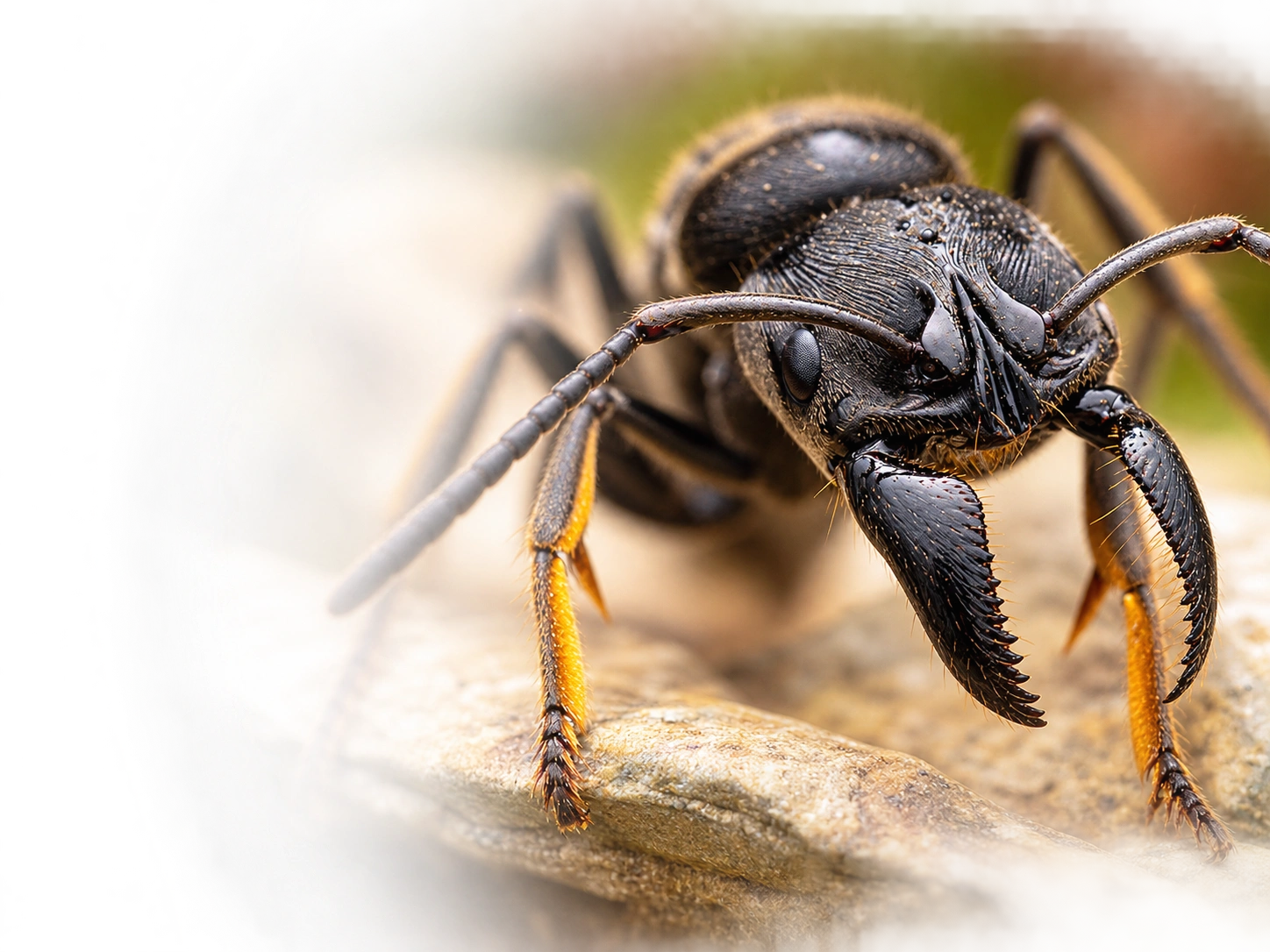
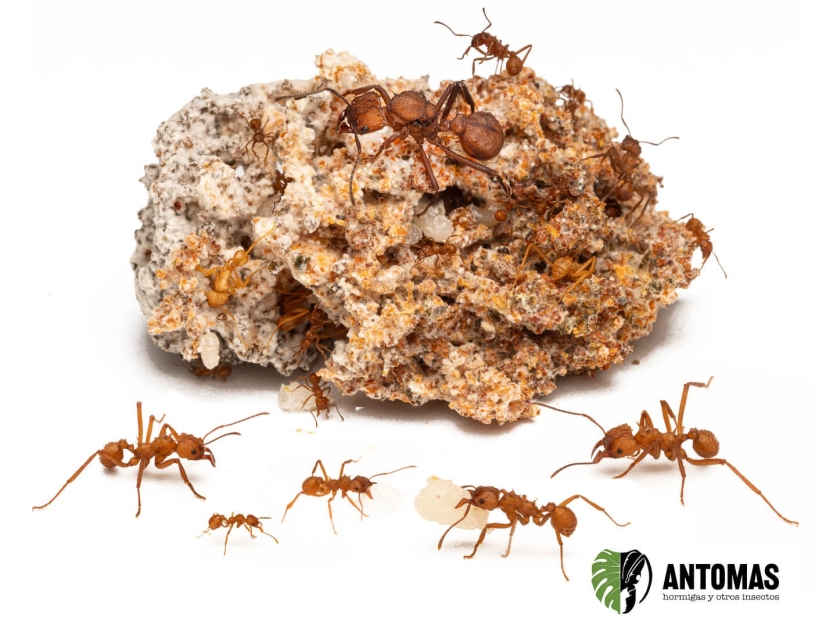
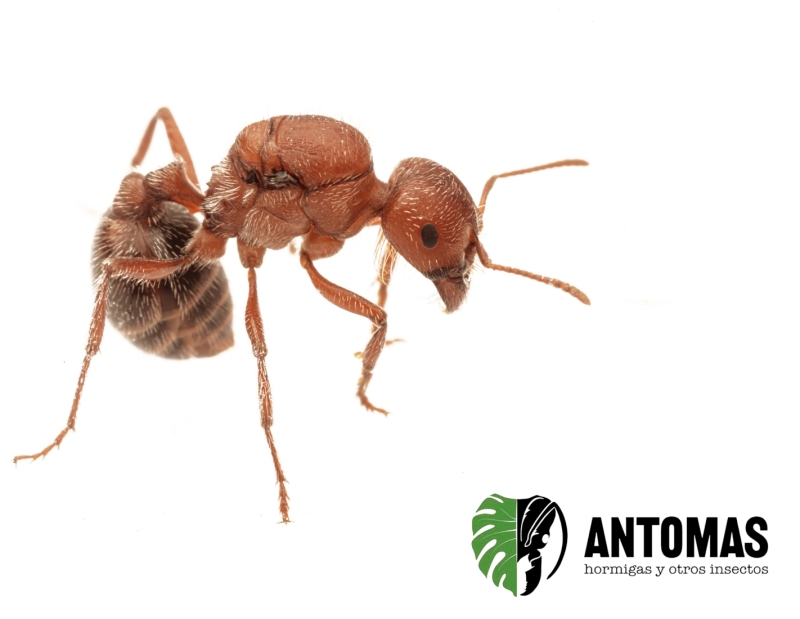
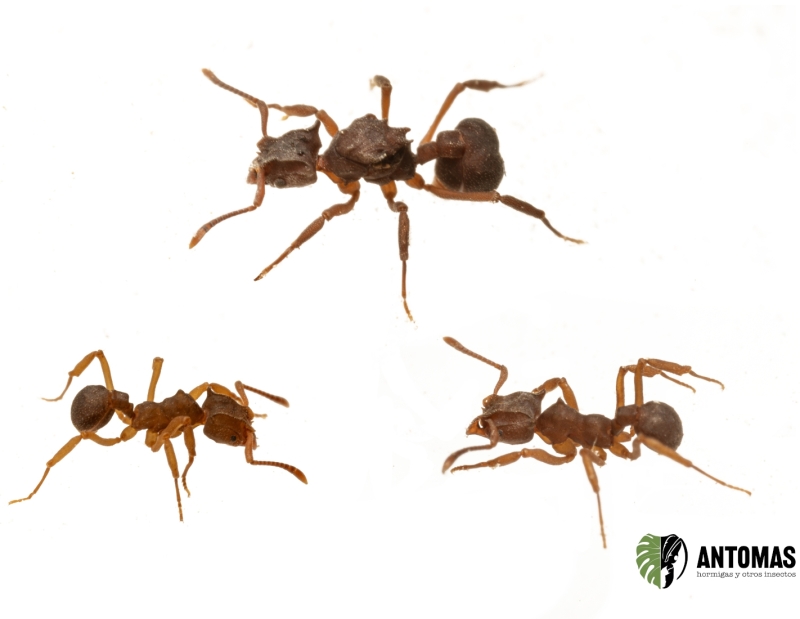
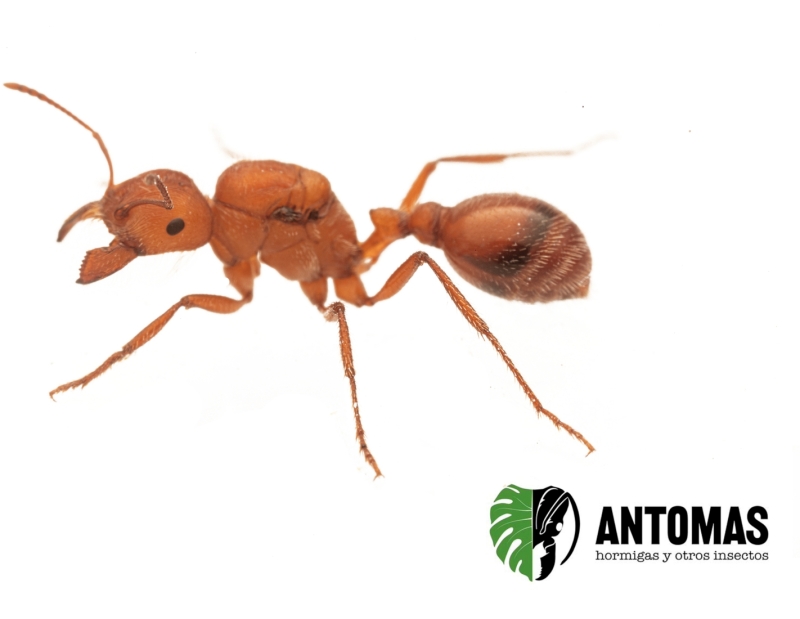
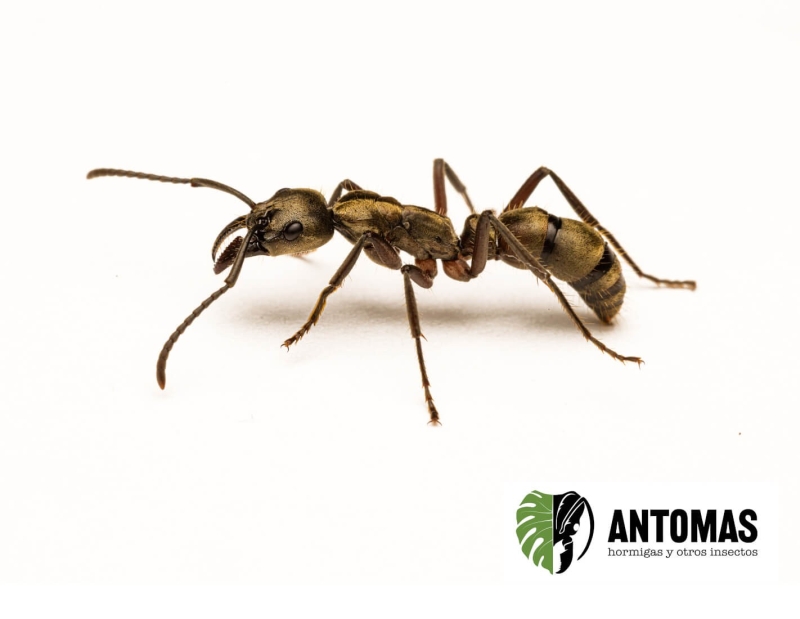
Acromyrmex octospinosus shows clear worker polymorphism, with workers of many sizes, although less extreme than in Atta: there are minima, minor, media and major workers, but no soldiers. The 2025 taxonomic revision has also shown that the species displays enormous morphological variability across its range.
- Colour. From reddish brown to orange, dark reddish or yellowish-brown tones, in workers of all sizes.
- Sculpture. The body has very marked sculpturing, with a rough appearance.
- Spines. Its most obvious feature is the numerous spines on the mesosoma, the thorax, which give it the name octospinosus, “eight-spined”. They vary between populations: in Costa Rica, for example, the central pronotal spines are missing, reduced at most to low tubercles, and the propodeal spines are conical.
- Gaster. With small tubercles, one of the features that separate it from Atta.
- Mandibles. Those of the major workers are especially well developed for cutting plant tissue.
- Minors. Their size allows them to work their way deep into the three-dimensional framework of the garden.
- Whitish coating. Some workers carry a white powder on the front of the thorax: these are their protective bacteria, not mould (see “Ants with their own pharmacy”).
- No giant soldiers, unlike many Atta.
- Naked pupae, without a cocoon.
- Queen. Much larger and sturdier than the workers, with the bulky thorax typical of winged queens. She sheds her wings after the nuptial flight.
Approximate measurements
- Minor workers: head width up to about 2 mm; the smallest are just a few millimetres long.
- Major workers: head width over 2 mm, up to about 3.2 mm in Costa Rica; length about 7–9 mm (approximate).
- Queen: about 10–13 mm (approximate).
Science does not measure these ants from head to tip of the gaster but by head width, which is a more reliable measurement. We have not found scientific measurements of total length, so the lengths are approximate, and there is considerable geographical variation. Be wary of care sheets that mention queens of 17–20 mm or colonies of “millions”: those are figures for Atta, not Acromyrmex.
Care in captivity
Difficulty: 3/5 – Advanced
At Antomas we rate Acromyrmex octospinosus as 3/5 – Advanced. Once the colony is established and has a stable garden, it is in fact fairly easy to keep. It does not need extremely complex daily care or impossible parameters, and European keepers agree that it is considerably easier than Atta.
The difficulty lies mainly in understanding that you are keeping a living fungus. A stable colony, with the right temperature, safe plants, enough ventilation and a separate waste area, can grow with very little intervention. These are the key points:
- Humidity without puddles: the fungus needs moisture, but not free water.
- Ventilation: never a hermetically sealed fungus chamber.
- Safe plants: pesticide-free and never of unknown origin.
- A separate waste area, away from the fungus.
- Stability, in temperature and in handling.
And it is well worth it. Few ants let you see anything like this at home: highways of workers carrying pieces of leaf and petals, a garden that grows day by day, workers of every size sharing out the work and a society that has practised farming for millions of years.
Recommended parameters
- Fungus temperature: 24–28 °C, stable, which is also the range on which European keepers agree; the ideal, in our experience, is 24–26 °C. It is a species that tolerates considerably more heat: in summer, at our premises, large colonies withstood 33–34 °C without any problem, and they also cope well with lower temperatures. This is an important difference from Atta, whose queens, in our experience, can become infertile above 30 °C sustained over time. Even so, stability matters more than heat, high temperatures increase evaporation and condensation, and small colonies are more delicate: do not expose them to those extremes.
- Foraging area: at room temperature, between 21 and 28 °C.
- Humidity: 80–90% in the fungus chamber, 40–70% in the foraging area and 30–40% in the waste area. But no free water in the fungus chamber (see “Humidity: the fungus needs moisture, not water”).
- Ventilation: essential; never seal the fungus chamber hermetically.
- Water: optional. They get plenty of water from the fungus itself and from fresh leaves, so a drinker is not necessary, although you can put one, or a test tube with water and cotton wool, in the foraging area. You can also mist the leaves with water before giving them.
- Light: a normal day–night cycle. You can watch the fungus and the colony without any problem; just avoid direct sunlight, which heats up the formicarium and triggers condensation.
- Diapause: not needed (see “Diapause: not needed”).
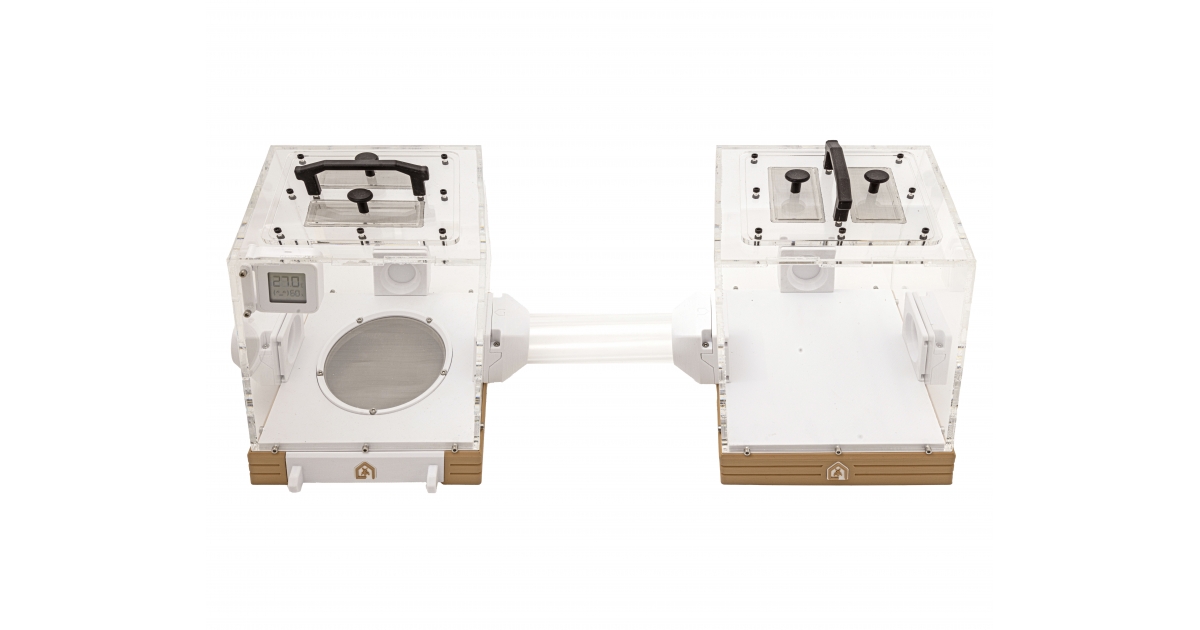
- Set-up: fungus garden → foraging area → waste area, with the Anthouse Fungarium Kit.
If you need extra heat, do not apply intense heat directly to the fungus container. A warm, stable room is better or, if necessary, a gentle heat source with a thermostat on one side.
Humidity: the fungus needs moisture, not water
This is one of the most important points in the whole care sheet. The fungus needs high humidity to grow properly, but a moist garden is not the same as a wet garden.
The fungus mass itself contains a great deal of water. As the colony breathes and the garden gives off moisture, the air in the container can become saturated. If the walls or the lid are slightly cooler, the vapour condenses again. With enough condensation, droplets start to fall to the bottom and can end up forming puddles inside the fungus container.
That accumulated water is dangerous. In Antomas’s experience, a garden that stays wet or partly flooded can deteriorate and die. And in the wild they avoid waterlogging too: in the plantations of Trinidad, nests were concentrated on the dry edges of drainage ditches during the dry season and moved to drier ground in the rainy season. Founding queens themselves hang their first garden from rootlets, away from the damp floor of the chamber.
So you need to watch not only the air humidity but, above all, the presence of free liquid water. If a puddle starts to form, act:
- Drain the accumulated water physically, or remove it carefully if the container’s design allows.
- Increase ventilation.
- Find the cause of the condensation: too airtight a closure, a very large temperature difference, too much external hydration or simply a fungus mass that already produces more moisture than the container can get rid of.
A chamber that is completely fogged up for a while is not necessarily a problem. What is worrying is condensation that drips continuously and ends up collecting as liquid water.
Ventilation
Ventilation is essential. The garden and thousands of ants produce CO₂, heat and water vapour. In leafcutter ants, nest architecture is closely linked to gas exchange and the internal climate: in another species of the genus, A. ambiguus, it has been shown that currents of dry air even organise how the workers build.
A. octospinosus builds relatively shallow nests: in Costa Rica they have been described at ground level, at the base of dead trees and under leaf litter, a far cry from the gigantic deep systems of some Atta. It is an architecture that makes gas exchange with the outside much easier.
That is why, at Antomas, we never recommend keeping the fungus in a hermetically sealed container. Ventilation should be enough to prevent CO₂ build-up and excessive condensation, but without quickly drying out the surface of the garden. That balance is achieved much better with a set-up designed specifically for leafcutter ants than by improvising with a completely closed container.
Single-chamber or multi-chamber?
In its architecture, A. octospinosus is much closer to a leafcutter with one or a few chambers than to a large multi-chamber Atta colony. The colony starts with a single chamber, that of the founding queen, and German keepers describe adult nests as soil nests with several chambers, but much smaller than those of Atta. In the plantations of Trinidad, mature nests had up to 17 entrance holes.
We would not claim, therefore, that every population of the species necessarily has a single chamber. Since the 2025 revision we know that A. octospinosus includes very different populations, and the genus can develop more chambers as the colony grows.
And above all, in captivity there is no problem with using several fungus containers. A colony can perfectly well maintain two, three or more connected containers if it needs extra space. The ants will decide how much fungus to keep in each and can move material from one module to another. In short:
- In the wild: usually a shallow nest, with one or a few main gardens.
- In captivity: several connected fungus containers work perfectly and make it easier for large colonies to expand.
Recommended formicarium: Anthouse Fungarium Kit
For Acromyrmex octospinosus, the system we recommend at Antomas is the Anthouse Fungarium Kit for leafcutter ants. It is specially designed for keeping leafcutter ants and lets you organise the colony’s functional areas in a modular way, with modules measuring 19.5 × 19.5 × 26 cm.
Ideally, you should separate:
fungus garden → foraging area → waste area
and add new fungus containers as the colony grows. It is the same idea that European keepers recommend: at least three containers, one for the fungus, one for food and water and one for waste, with which a colony can last one or two years before it needs more space for the fungus. This separation makes maintenance much easier.
- Waste area away from the fungus. The ants themselves tend to gather plant debris, fragments of dead fungus, corpses and other waste in specific places. If they spontaneously choose a module as their waste area, it is better to respect that layout than to keep forcing them to reorganise.
- Long routes. Acromyrmex travel long distances to their cutting sites, and keepers find that they do better with a good length of tubing between the fungus and the foraging area. And watching them parade with their leaves is one of the great spectacles of this species.
- Minor-proof mesh and connections. The smallest workers are tiny: check that no ventilation mesh or connection leaves gaps they could squeeze through.
- Mineral oil barrier on the upper part of the walls of the foraging area, because they climb smooth surfaces (see “Escapes and barriers”).
- Water, optional: a drinker in the foraging area if you like; they get plenty of water from the fungus itself.
Arrival, set-up and first weeks
At Antomas we sell A. octospinosus as colonies with queen, already founded, with workers and brood. They always arrive with their fungus: the queen, her workers, the brood and the garden travel together in a plastic tub. We often also include a test tube with backup fungus, in case the main garden is damaged in transit. The colonies have put the riskiest stage of their lives behind them, but they are still young, and the first weeks at home are important.
Very important: the ants in the backup tube must be removed. Any workers that come inside the backup fungus tube must never be mixed with those in the queen’s tub. Before using that fungus, carefully remove them all with a soft brush or soft tweezers, and use only the fungus.
- On arrival, let the colony rest in a quiet place at 24–26 °C and check the tub: the garden should be in good condition, with no puddles or excessive condensation.
- Prepare the Fungarium beforehand: assembled, with the foraging area and waste area ready, the oil barrier applied and the lids and connections properly fitted.
- Set-up by tipping. At Antomas we transfer the colony by tipping it in: we open the tub over the fungus module and move the garden in blocks as intact as possible, with the queen, workers and brood inside. Breaking it up unnecessarily destroys part of its microstructure. Stragglers can be picked up with a soft brush. Work over a tray and take your time.
- The backup fungus, without ants. If the main garden arrives in good condition, the colony will not need it. If it arrives damaged, place the backup fungus, with every ant from the tube removed, next to the main garden so that the colony’s workers can incorporate it.
- The first leaves. As soon as the colony has settled in, offer a small amount of tender, safe material, such as young bramble or rose leaves and the odd petal, and see what they accept.
- Patience. It is normal for them to spend the first few days reorganising the garden. Don’t take it apart to see how it is doing.
- To expand, connect new fungus modules as the colony grows: the ants themselves will move the material.
Small colonies are the most fragile: with few workers, any setback weighs more heavily. So it pays to be especially careful with humidity and with where your plants come from during the first few months.
Feeding: leaves, flowers and no pesticides
Feeding should be based on fresh, varied plant material that is completely free of chemical treatments. Remember that you are not feeding the ants directly but their fungus: the leaves are the garden’s fertiliser. Different plants can be used depending on availability and on what the colony accepts.
Which plants to use. In captivity, A. octospinosus colonies have been kept on plants from genera such as:
- Rosa (roses);
- Vitis (grapevine);
- Prunus (cherries, plums and other stone fruit trees);
- Acer (maples);
as well as other ornamental plants and shrubs. European keepers single out the rose family as the favourites and also mention bramble, raspberry, elder, lime, oak, willow and false acacia. In captivity, bramble and many petals and flowers work very well, as long as they come from safe plants.
Flowers too. We would not restrict the diet to green leaves. In mature cacao plantations in Trinidad, foragers preferred flowers to leaves and collected about 3,000 flowers per hectare per day. Flowers, petals and tender shoots can be an excellent part of the diet.
Fruit and vegetables. In our experience, they also readily accept supermarket fruit such as apple, banana and orange, and vegetables such as lettuce, cauliflower and broccoli. Other keepers also mention grapes. With supermarket fruit and vegetables, be careful: many are treated after harvest, especially citrus fruit, with waxes and fungicides on the skin. Organic or untreated produce is best, washed well, and remove anything they do not cut before it ferments or goes mouldy.
Winter food. When fresh leaves are scarce, there are alternatives: dried rose petals, which are sold ready to use (food grade, never decorative or scented ones); the fruit and vegetables we have just mentioned; and rolled oats, especially useful when there is a lot of humidity in the set-up.
Variety. It is highly recommended. Do not offer a single plant for months, even if the colony accepts it very well: it is better to alternate different resources and let the ants themselves choose.
How much leaf. They should never run short. If you do daily maintenance and remove leaves that dry out or spoil, at Antomas we prefer too much to too little: a colony with abundant resources grows more. If you will not be able to clean often, adjust the amount to what they cut in one or two days, because forgotten leaves rot and bring mould. And be ready to give more when the colony is rearing queens and males: in Lewis’s laboratory nests, leaf intake tripled when sexuals were present. For small colonies, a practical trick is to offer sprigs in a small jar of water, which stay fresh longer; cover the mouth of the jar with cotton wool or aluminium foil so that no worker drowns.
Plants to avoid:
- Any treated plant, sprayed with insecticides, acaricides, fungicides or herbicides; commercial florist’s flowers; newly bought ornamental plants; leaves collected next to treated crops or roads, and any material of unknown origin.
- Oleander (Nerium oleander) and tobacco (Nicotiana tabacum): proven toxic to this species.
- Sumac (Rhus): toxic to the fungus, according to keepers.
- Citrus leaves, with caution: mandarin leaves contain substances that deter A. octospinosus. The fruit is another matter: in our experience, they eat orange readily, as long as it is untreated.
A colony may reject a dangerous plant, but we must not use its ability to select as proof of safety.
Nectar, only now and then. Unlike other ants, leafcutter ants do not need insects or a sugar routine: their food is the fungus. As a supplement, and only occasionally, roughly once a fortnight, you can offer them a little nectar or sugar water, which the workers drink. It is not necessary. If you do, give a small amount, in a drinker and never on cotton wool, and remove the leftovers before they ferment. The basis must always be fresh plant material.
Water: optional. They get plenty of water from the fungus itself and from fresh leaves; if you like, put a drinker in the foraging area and mist the leaves. What must never be lacking is moisture in the garden: letting the fungus dry out is a serious mistake.
Fungus garden care
The fungus should be touched as little as possible. It is not a good idea to keep taking the garden apart to check what it looks like inside: a healthy colony takes care of reorganising it, cleaning damaged areas and moving material to where it is growing.
- If you have to move it, do so in blocks as intact as possible: breaking it up unnecessarily destroys part of its microstructure.
- Let the workers reach the whole garden. Do not put mesh or dividers inside the fungus container that block the large workers. One keeper described how, with an Atta colony, the top of the garden sank and by the next day had completely collapsed because of a divider; once it was removed, the fungus recovered.
- Don’t mix fungi. We would avoid routinely mixing fungus from different colonies. Cultivars can be incompatible: in two Acromyrmex that live in the same area, the former A. octospinosus and A. echinatior, partial incompatibility has been shown between the ants and the fungi of other colonies. In addition, each garden carries its own microbial community. A small top-up of fungus from a compatible colony can be useful in specific situations, but it should not become routine.
If the garden collapses. A fungus that shrinks, darkens or is left without workers, patches of differently coloured mould or water collecting at the bottom are warning signs. Check the basics first: puddles, ventilation, temperature and where the latest plants came from. Since Escovopsis is of low virulence in complete colonies, when a garden collapses in captivity it is better to look for a husbandry error before blaming the parasite.
Waste area
The waste area deserves its own container. Leafcutter ants produce a great deal of waste: discarded plant material, fragments of old garden, corpses and contaminated particles. The workers in charge of the waste area have a different behavioural repertoire from the garden workers, and the separation is also social: workers covered in protective bacteria never go there.
Keeping waste away from the crop reduces the risk of opportunistic microorganisms and makes cleaning much easier. Keepers also recommend a dry waste area, at 30–40% humidity, which slows down moulds and mites.
Waste also carries information. In another species of the genus, A. lobicornis, a field experiment showed that the ants use the waste dump as a source of information: when a perfectly good food was placed in it, its acceptance on the foraging trails fell by 55% the next day, and only returned to normal weeks later. One more reason never to mix food and waste.
When you empty the waste area, there is no need to sterilise it completely every time. Just remove most of the material and keep the container working.
Diapause: not needed
Acromyrmex octospinosus does not need a cold diapause. Most of its range lies in tropical or subtropical regions, where the annual temperature variation is relatively limited. Its natural seasonality depends much more on rain, humidity, plant availability and reproduction than on a cold winter like that of European species. European keepers agree: no winter rest.
In captivity we would not deliberately cool the garden in winter: we would keep it at roughly the same temperature range all year round. The colony may temporarily change its growth or reduce the amount of material it collects, but this should not be confused with a diapause.
Behaviour in captivity
An established colony is extraordinarily active. When it finds a suitable resource, it can quickly form a route of workers moving non-stop between the plant and the nest. The chemical trail is reinforced as traffic increases, so a small route can turn into a real highway within minutes.
Plenty to watch. Large workers cutting leaves with their mandibles, columns carrying pieces of leaf or petals, minors working inside the garden, the coming and going to the waste area, workers “dusted” white by their bacteria… It is one of the most rewarding species to watch.
Watch without fear. At Antomas we believe ants are there to be enjoyed, watched and learnt from, not kept hidden away. Just watch them gently, intervening and stressing them as little as possible and without taking the garden apart. They get used to your presence.
Warning signs:
- Dead workers or workers moving strangely with no apparent damage to the garden: suspect a contaminated plant (see “They taste before they farm”). Remove that plant at once.
- Droplets falling continuously or water at the bottom of the fungus container: too much humidity or too little ventilation.
- A garden that shrinks or is left without workers: check temperature, humidity and plants.
- Leaves left uncut for days: they may not like the plant or it may have disagreed with them; try another.
- Lots of workers and little room for the fungus: time to add another module.
Escapes and barriers
A. octospinosus climbs smooth surfaces, and its recruitment ability calls for close attention to connections and lids. A small opening that a single worker manages to get through can then be used by many more, and the chemical trail will do the rest. In our experience, mineral oil works quite well as an escape barrier:
- A band of mineral oil on the upper part of the walls of the foraging area, thin and continuous. Renew it when you see it collecting dust or debris.
- Well-fitting lids on all modules.
- Secure connections between modules and tubes; check them often, especially as the colony grows.
- Fine ventilation mesh, through which not even the smallest workers can pass.
- Nothing that can act as a bridge: no twigs or leaves resting near the barrier.
- Take care when opening to add leaves or empty the waste area: open only as much as necessary, work calmly and close up when you have finished.
Handling and safety
Large workers can bite hard, but we do not consider A. octospinosus a dangerous species for the keeper in the same sense as a large Myrmecia or a Pogonomyrmex maricopa. The main risk is to the colony itself and its crop. A household insecticide, an aggressive air freshener, a contaminated plant, a flooded chamber or a prolonged temperature failure can do far more harm than small everyday feeding mistakes.
Handle them with entomological tools, such as a soft brush or soft tweezers, never with your hands, and work slowly so as not to damage the garden or the queen. Do not combine different colonies. It is an exotic species that has become a pest in tropical climates (see “The fourmi-manioc: the leafcutter that conquered Guadeloupe”): it must never be released.
Once these principles are understood, a well-established colony is surprisingly easy to keep.
What not to do
- Use plants of unknown origin, from a florist, freshly bought from a garden centre or collected next to treated crops or roads.
- Give them oleander, tobacco or other toxic plants, or trust the colony to “know” how to reject a dangerous plant.
- Let puddles form in the fungus container, or wet the garden directly.
- Seal the fungus chamber hermetically, or heat it with an intense heat source pressed against the container.
- Take apart or break up the garden to see what it looks like inside.
- Put mesh or dividers inside the fungus chamber that block the workers.
- Routinely mix fungus from different colonies, combine colonies or add foreign queens.
- Put the waste area next to the fungus, or leave leaves rotting in the foraging area.
- Give treated fruit or vegetables without washing them, or make nectar a routine: a little once a fortnight is enough, and it is not even necessary.
- Mix the ants that come in the backup fungus tube with the colony.
- Use insecticides, air fresheners or sprays near the formicarium.
- Give them a cold diapause.
- Neglect the barriers: leave gaps, loose connections or mesh through which the smallest workers can pass, or fail to renew the oil.
- Handle them with your hands, or release them.
Scientific sources
This care sheet is based on the scientific literature on Acromyrmex octospinosus and leafcutter ants, and on the experience of Antomas and other keepers. Main references:
- Mera-Rodríguez, D., Fernández-Marín, H. & Rabeling, C. (2025). Phylogenomic approach to integrative taxonomy resolves a century-old taxonomic puzzle and the evolutionary history of the Acromyrmex octospinosus species complex. Systematic Entomology 50: 469–494. doi:10.1111/syen.12665
- Agavekar, G. et al. (2025). A haplotype-resolved chromosome-scale genome assembly and annotation for the leafcutter ant, Acromyrmex octospinosus. Genome Biology and Evolution 17: evaf047. doi:10.1093/gbe/evaf047
- Lewis, T. (1975). Colony size, density and distribution of the leaf-cutting ant, Acromyrmex octospinosus (Reich) in cultivated fields. Transactions of the Royal Entomological Society of London 127: 51–64. doi:10.1111/j.1365-2311.1975.tb00552.x
- Muscedere, M. L., Berglund, J. L. & Traniello, J. F. A. (2011). Polymorphism and division of labor during foraging cycles in the leaf-cutting ant Acromyrmex octospinosus (Formicidae; Attini). Journal of Insect Behavior 24: 94–105. doi:10.1007/s10905-010-9239-3
- Currie, C. R., Poulsen, M., Mendenhall, J., Boomsma, J. J. & Billen, J. (2006). Coevolved crypts and exocrine glands support mutualistic bacteria in fungus-growing ants. Science 311: 81–83. doi:10.1126/science.1119744
- Barke, J. et al. (2010). A mixed community of actinomycetes produce multiple antibiotics for the fungus farming ant Acromyrmex octospinosus. BMC Biology 8: 109. doi:10.1186/1741-7007-8-109
- Fladerer, J.-P. & Bucar, F. (2022). Behavioral specialization of workers of the leafcutter ant Acromyrmex octospinosus (Hymenoptera: Formicidae) with an external bacterial layer. Journal of Insect Behavior 35: 127–135. doi:10.1007/s10905-022-09806-3
- Ortius-Lechner, D., Maile, R., Morgan, E. D. & Boomsma, J. J. (2000). Metapleural gland secretion of the leaf-cutter ant Acromyrmex octospinosus: new compounds and their functional significance. Journal of Chemical Ecology 26: 1667–1683. doi:10.1023/A:1005543030518
- Dhodary, B., Schilg, M., Wirth, R. & Spiteller, D. (2018). Secondary metabolites from Escovopsis weberi and their role in attacking the garden fungus of leaf-cutting ants. Chemistry – A European Journal 24: 4445–4452. doi:10.1002/chem.201706071
- Boulogne, I. et al. (2012). Acromyrmex octospinosus (Hymenoptera: Formicidae) management. Part 1: Effects of TRAMIL's insecticidal plant extracts. Pest Management Science 68: 313–320. doi:10.1002/ps.2267
- Nehring, V., Boomsma, J. J. & d'Ettorre, P. (2012). Wingless virgin queens assume helper roles in Acromyrmex leaf-cutting ants. Current Biology 22: R671–R673. doi:10.1016/j.cub.2012.06.038
- Boomsma, J. J., Fjerdingstad, E. J. & Frydenberg, J. (1999). Multiple paternity, relatedness and genetic diversity in Acromyrmex leaf-cutter ants. Proceedings of the Royal Society B 266: 249–254. doi:10.1098/rspb.1999.0629
- Fernández-Marín, H., Zimmerman, J. K. & Wcislo, W. T. (2003). Nest-founding in Acromyrmex octospinosus (Hymenoptera, Formicidae, Attini): demography and putative prophylactic behaviors. Insectes Sociaux 50: 304–308. doi:10.1007/s00040-003-0687-z
- Mikheyev, A. S. (2008). History, genetics and pathology of a leaf-cutting ant introduction: a case study of the Guadeloupe invasion. Biological Invasions 10: 467–473. doi:10.1007/s10530-007-9144-7