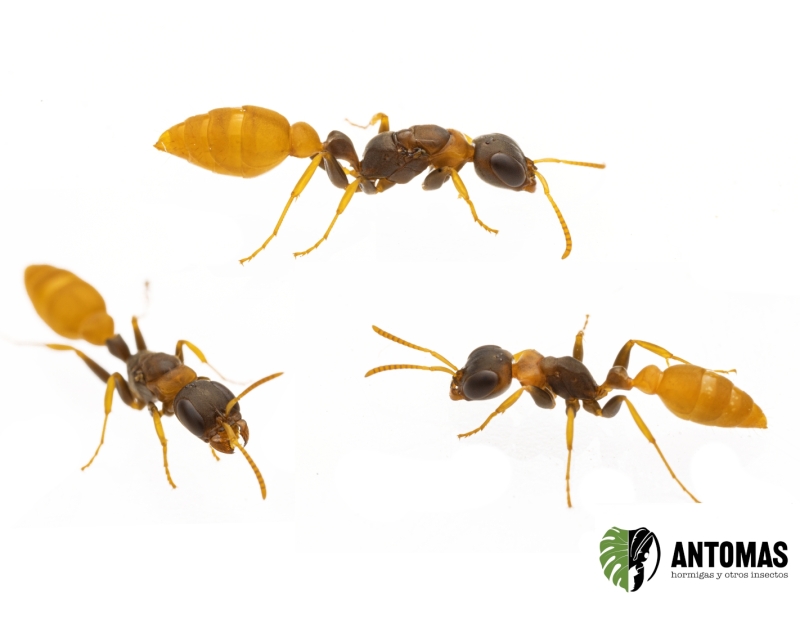
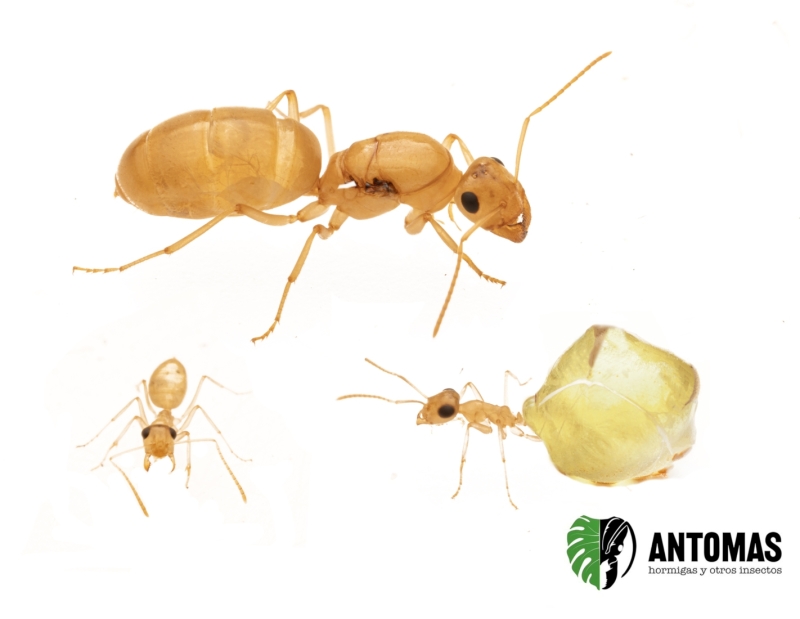
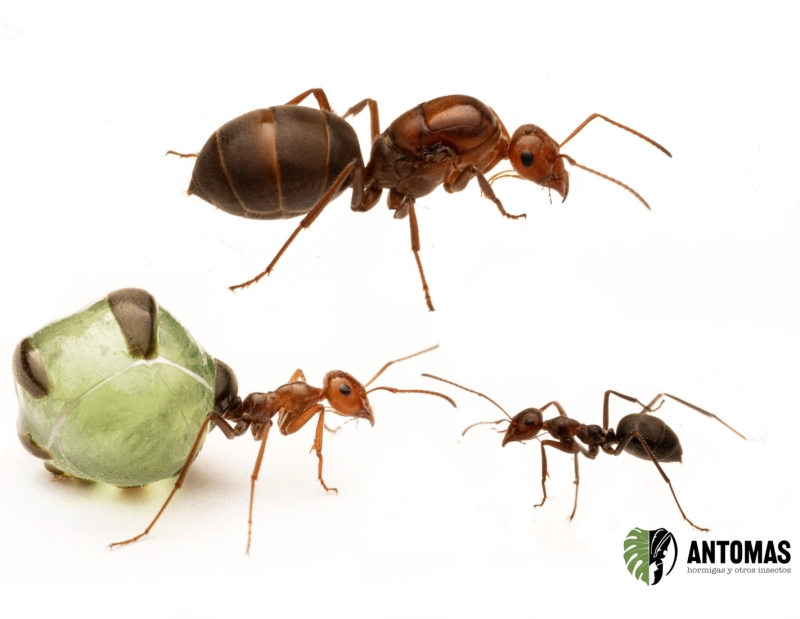
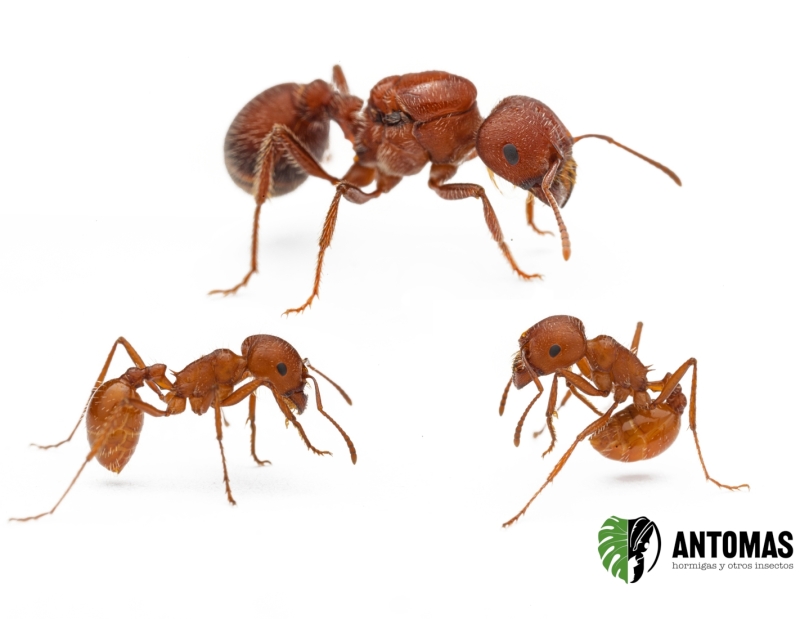
Difficulty: 3/5 – Advanced
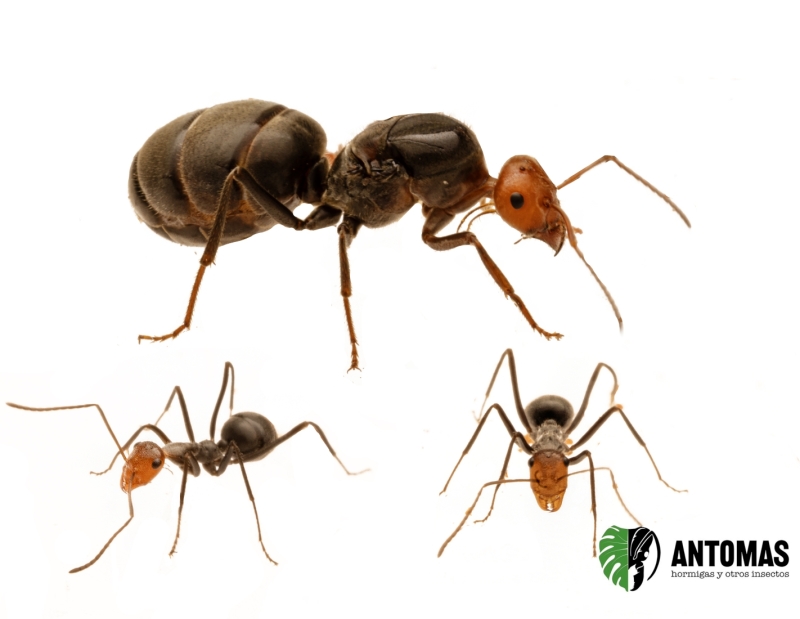
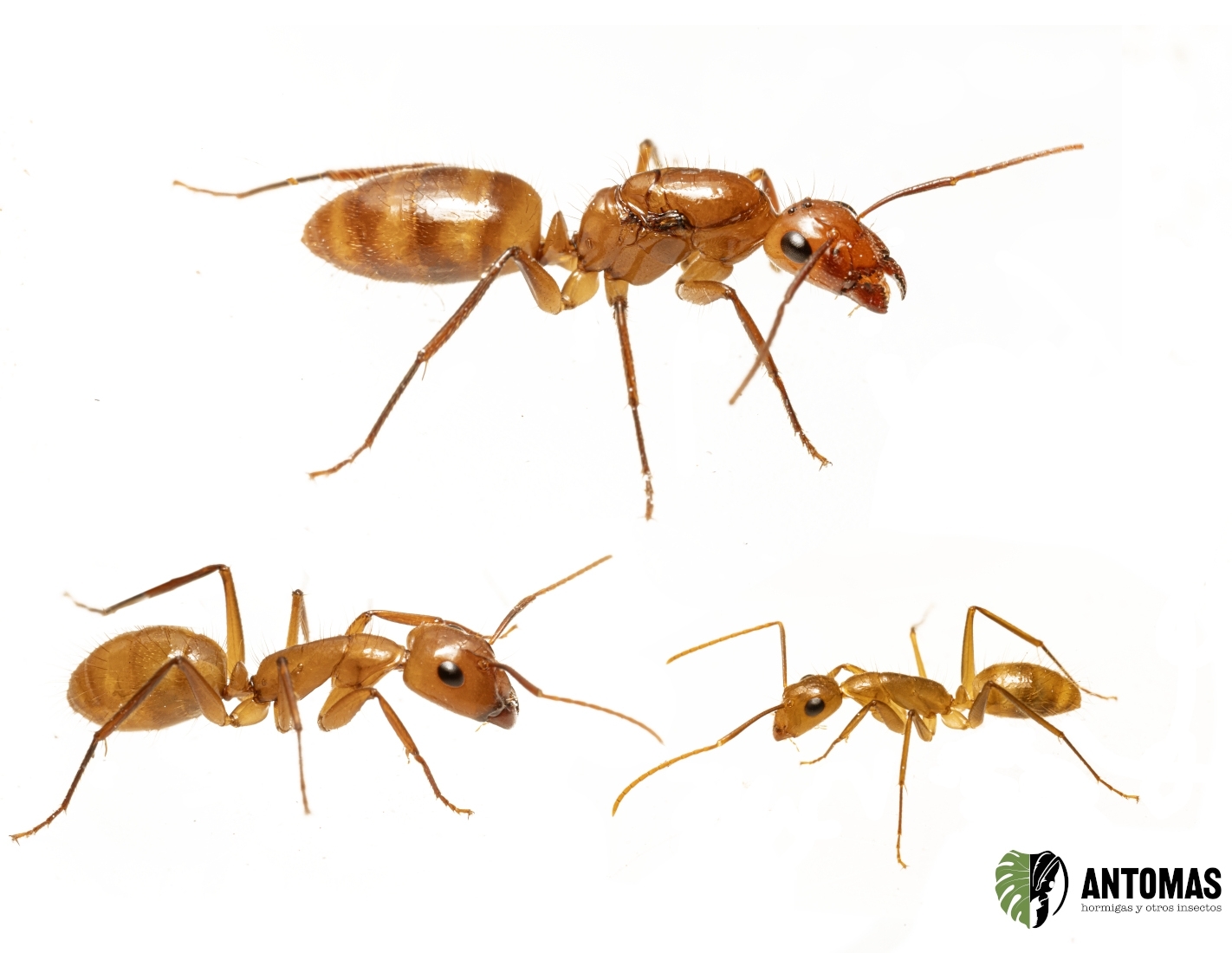
A Neotropical Camponotus of the subgenus Tanaemyrmex that lives inside the hollow stems of Cecropia, the great ant-tree of the Amazon. Polymorphic, calm and shy, and the type host of the “zombie ant” fungus Ophiocordyceps camponoti-balzani. Colonies with queen, monogynous. Qbik Wild Duo P 2C (plaster) with moderate humidity and one drier side, 24–28 °C all year round, sugar always available in a feeder and plenty of protein. No diapause: at most, a gentle rest at 22–24 °C. An excellent climber: PTFE escape barrier. No sting.
Camponotus balzani Emery, 1894 is a carpenter ant from the rainforests of South America with a habit that is unusual in its genus: instead of excavating wood or nesting in the soil, it settles inside a living tree. Its favourite home is the hollow stems of Cecropia, the yarumo, guarumo or embaúba, one of the most famous trees in tropical ecology thanks to its alliance with ants. There it shares the neighbourhood, and sometimes competes, with the aggressive Azteca ants, the classic owners of these trees.
It is a very little-known species in the hobby. It has no common name, there are no published rearing journals, and almost everything known about it comes from field studies on Cecropia ants and from a mycological discovery that made it famous in 2011: a “zombie” fungus described precisely from its workers. In this care sheet we always separate what is documented for C. balzani, what is known about its genus and about Cecropia ants, and what we at Antomas recommend for keeping it.
Biology
A dedication to a travelling naturalist
It was described by the Italian myrmecologist Carlo Emery in 1894 from material from Bolivia, its type locality. The epithet honours Luigi Balzan, the Italian naturalist who travelled through Bolivia and Paraguay at the end of the 19th century and whose insect collections Emery studied. Since then, its place within the enormous genus Camponotus has changed several times:
- In 1896, Emery himself placed it in the C. maculatus group, that of our well-known African C. maculatus.
- In 1914, Auguste Forel moved it to the subgenus Myrmothrix, and Emery kept it there in 1920.
- Today Myrmothrix is treated as a synonym of Tanaemyrmex, and the current combination is Camponotus (Tanaemyrmex) balzani.
It has no synonyms or subspecies. That said, Tanaemyrmex is a subgenus of convenience rather than a natural group: the 2016 reclassification of the formicines showed that many of the classic subgenera of Camponotus need a thorough revision.
From the Amazon to the Atlantic Forest
C. balzani is an ant of the tropical lowlands of South America. There are records from Bolivia, Brazil, Colombia, Ecuador, Peru, Venezuela, French Guiana, Paraguay and northern Argentina, from almost the equator down to about 24° south. It has been studied in the central Amazon, in south-eastern Peru and in the Atlantic forests of south-eastern Brazil, three of the most ant-rich ecosystems on the planet.
The climate across most of its range is equatorial: averages of 26–29 °C all year round, minimums that rarely drop below about 23 °C, maximums of 31–34 °C and relative humidity of 75–86 %. There are no thermal seasons, only a rainy season and a somewhat drier one, and the day lasts almost 12 hours all year. Only at the southern end of its distribution, in the inland Atlantic forests, are the winters somewhat cooler. We will bear this in mind when discussing temperature and diapause.
Living inside a tree
Cecropia are very fast-growing pioneer trees, the first to colonise gaps in the rainforest. Their stems are hollow and divided into chambers, the internodes, which seem purpose-built to house ants. On the labels of C. balzani specimens in scientific collections the same note appears again and again: “nest in Cecropia”. It is one of the few Camponotus that habitually nest inside these trees.
The colony occupies several interconnected internodes of the stem, like a vertical block of flats. It is a very particular nest: narrow and elongated, with smooth walls, protected from rain and predators, and with a humid but never waterlogged atmosphere, because water does not get into the stem. Some collection labels also place it in other substrates, such as the base of a dead palm trunk, so it does not depend one hundred per cent on Cecropia. But the hollow stem is its hallmark, and the best clue for setting up a good formicarium for it (see “Nest: a hollow stem at home”).
The calm alternative to Azteca
Most Cecropia belong to Azteca ants, the tree’s specialised partners: they defend it fiercely against herbivores and climbing vines in exchange for a home and food. C. balzani is a different kind of tenant. In a study in the central Amazon on Cecropia purpurascens, 64 % of the 50 trees examined were occupied by four ant species, and the two most frequent were Azteca alfari, in 16 trees, and C. balzani, in 14. The trees of each species did not differ in height or internode volume: C. balzani does not settle for leftovers, but occupies trees of the same kind as those of its great competitor.
The difference lies in temperament. In the paper describing its closest relative, C. reburrus, it is noted that both species behave the same way inside the stems: when disturbed, they flee rather than attack. Nothing like Azteca, which pour out en masse to bite any intruder. That is why specialists in Cecropia ants regard it as a “recent and secondary” associate of the tree: it uses it as a home, but does not have the defence pact with it that Azteca have.
Queens that seek out forest gaps
How does a C. balzani queen choose her tree? In the 1990s, Douglas Yu and Diane Davidson planted saplings of several Cecropia species in south-eastern Peru, on riverbanks and in small forest gaps, and recorded which founding queens colonised them. The results for C. balzani were very clear:
- Its queens turned up disproportionately in forest gaps, where they also fared better.
- They were generalists: they accepted almost every Cecropia species, and were only scarce in the one with very small internodes, where they do not fit.
This preference fits what is known about Cecropia ants in general: the light regime, gap or understorey, influences which ants occupy the tree and how well they do. To get in, the founding queens of Cecropia ants use the prostoma, a small, thin, fibre-free area of the internode wall that works like a prefabricated door: the queen chews through it, shuts herself inside and seals the hole from within. From then on, the foundation is the classic one of a Camponotus.
A tree that provides food
Cecropia do not only provide a home: they also provide food. At the base of each leaf they have pads of hairs, the trichilia, from which tiny, white, nutritious Müllerian bodies sprout continuously. A study published in Science in 1971 discovered that their cells store glycogen, the reserve sugar typical of animals, something exceptional in a plant: the tree literally manufactures “animal” food for its ants. Besides glycogen, they contain lipids and proteins.
In the internodes where C. balzani and C. reburrus live, Müllerian bodies and coccids have been found: small hemipterans that suck the tree’s sap from inside the stem and excrete honeydew. It is very likely that, like other Cecropia ants, C. balzani makes use of that honeydew, although coccid tending has only been described directly in its relative. For keeping, the message is simple: plenty of sugar and varied protein (see “Feeding”).
The ant that gives its name to a zombie fungus
In 2011, a team of mycologists and biologists led by Harry Evans and David Hughes published a discovery that went round the world. The famous “zombie ant” fungus, Ophiocordyceps unilateralis, was not a single species but a complex of species, each specialised on a different host ant. In the Atlantic forests of Minas Gerais, Brazil, they described four new species, and one of them was named after its victim: Ophiocordyceps camponoti-balzani, described from workers of C. balzani, which is its type host.
The life cycle of these fungi is straight out of a horror film. A spore lands on a foraging worker, penetrates its cuticle and the fungus grows inside its body. At the end of the infection, the ant abandons its normal behaviour, climbs to an exposed spot on the vegetation, clamps on with its mandibles and dies there, fixed in the so-called “death grip”. The fungus then sprouts from the corpse and, from up high, rains its spores down onto the trails of its nestmates. In the case of O. camponoti-balzani, the fungus covers the leg and antennal joints with pads of chocolate-brown mycelium, and its fertile part matures to a dark brown that is almost black.
What is known about the manipulation? The most detailed studies were carried out in Thailand on another Camponotus, C. leonardi, and the results are astonishing:
- An exact place. Infected ants died biting the underside of leaves, mostly on a vein, about 25 cm above the ground, a very specific height and microclimate, the best for the fungus to grow and release its spores. Corpses that the researchers moved higher or lower gave the fungus poorer results.
- An exact time. The bites happened in synchrony, around solar noon.
- Locked mandibles. The fungus damages the mandible muscles, which remain contracted: the ant can no longer let go.
It is the same type of fungus that parasitises our C. castaneus in the forests of North America. And for peace of mind: these fungi depend on leaf litter, humidity and spores falling from above in the forest. They do not affect captive colonies or people.
A faithful partner of intact rainforest
Near Manaus, in the central Amazon, lies one of the longest-running ecological experiments in the world: the Biological Dynamics of Forest Fragments Project, where for decades researchers have studied what happens to the rainforest when it is broken up into islands of forest. In 2012, an analysis was published there of the networks of alliances between ants and plants with domatia, cavities that plants offer to ants. C. balzani appeared in continuous forest, associated with a single plant species, and was absent from the fragments. The alliance network as a whole proved fairly resilient to fragmentation, but some species, such as this one, were only found in intact rainforest.
Workers of every size
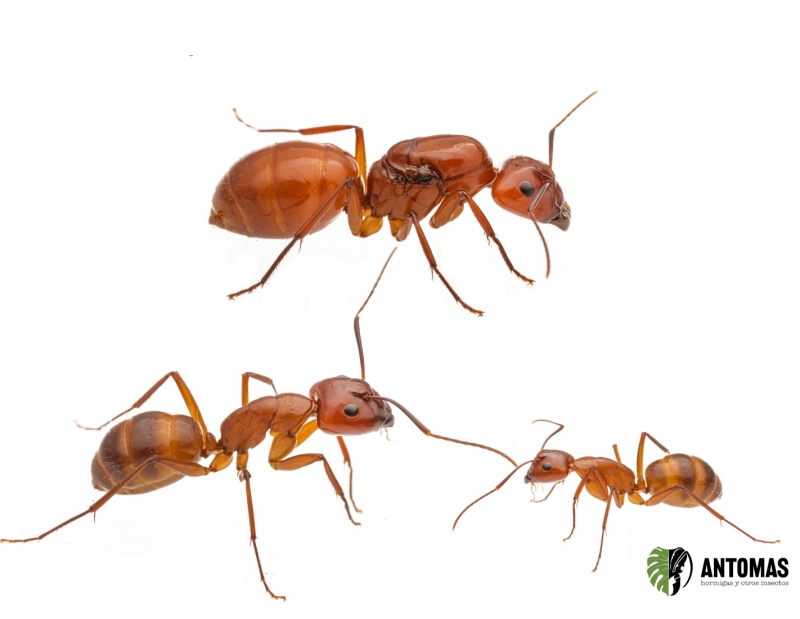
C. balzani is polymorphic: it has minor workers and well-developed major workers, with a larger head that narrows towards the front. That is precisely what separates it from its closest relative, C. reburrus, described from Ecuador in 2012, which, as far as is known, has no majors, something very rare in a Camponotus. DNA barcodes place the two species together, and both live in Cecropia. C. reburrus is smaller in all its castes, has few erect hairs on the sides of the head and yellow bands on the gaster; C. balzani has many erect hairs and a uniform light brown gaster.
In the wild, colonies have a single queen, as is usual in Camponotus of its type, and colony foundation is claustral: the queen shuts herself into the internode and rears her first workers without leaving, using her body reserves. The size of mature colonies has not been studied. At home you will see the division of labour typical of the genus: minors forage and majors stay more in the nest.
Formic acid: weapon and disinfectant
Like all formicines, C. balzani has no sting. Its chemical defence is formic acid, which it sprays through the acidopore, a nozzle at the tip of the gaster. And it does not use it only as a weapon: in 2020 it was shown that formicines swallow their own venom while grooming, which keeps the crop, the “social stomach” where they store the food they share, highly acidic and holds back the microbes that come in with it.
Size and morphology
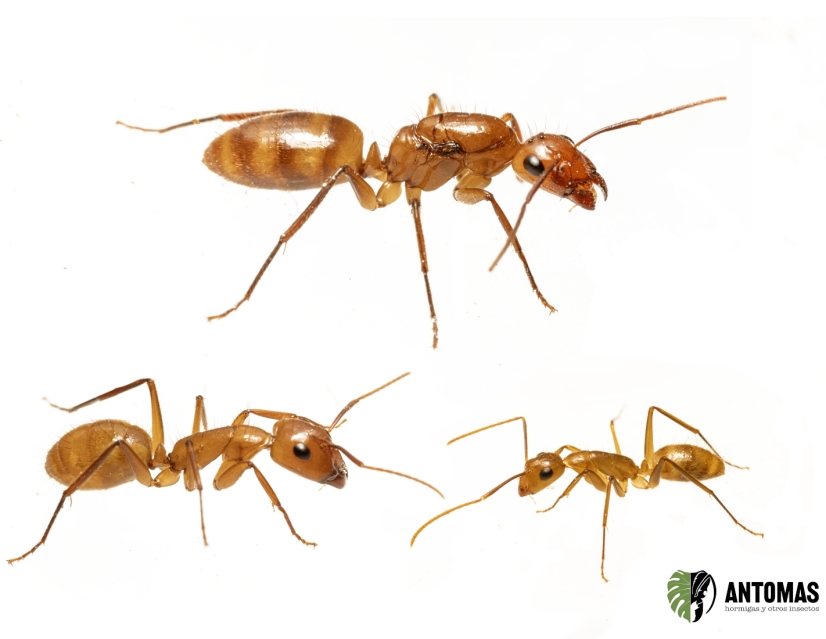
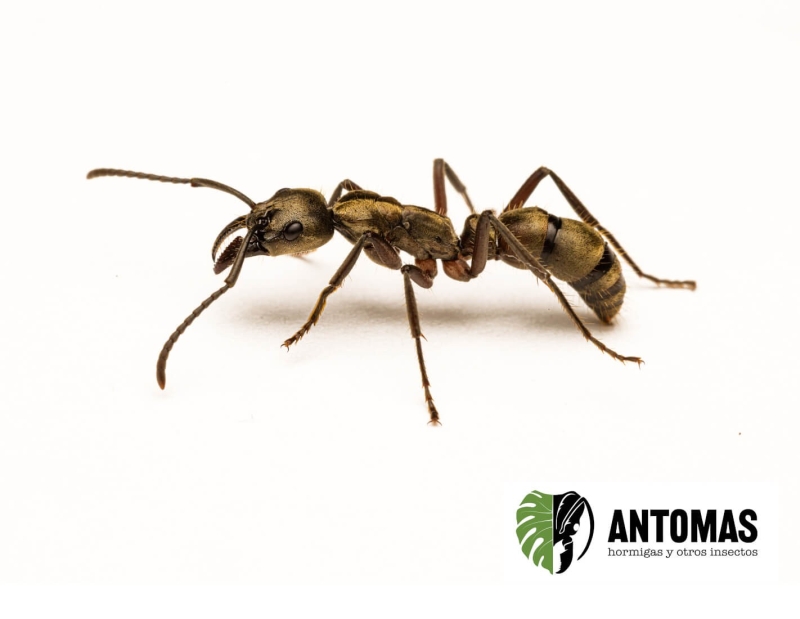
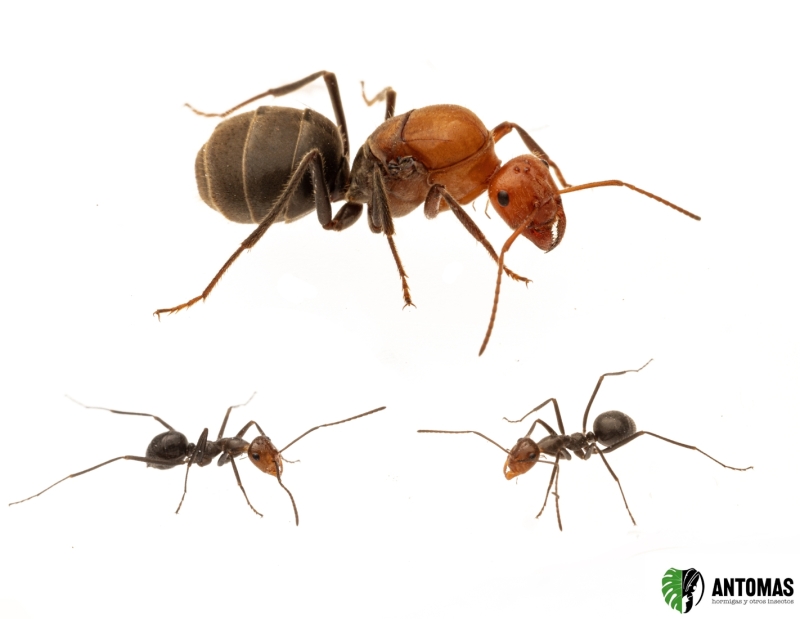
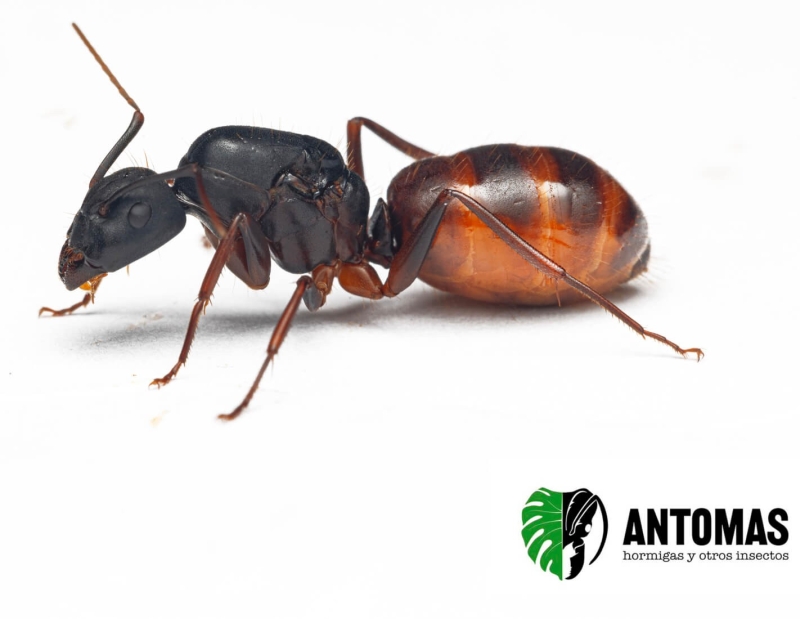
A medium to large Camponotus, polymorphic and stingless. Little has been published on its morphology: the most detailed account is the comparison with C. reburrus by Mackay and Barriga (2012).
- Colouration. Medium to light brown. Minors have a uniform light brown gaster; in majors and queens, the gaster bands, if present, are only pale brown, never yellow as in C. reburrus.
- Pilosity. Minors have many erect hairs on the sides of the head, a good character for separating it from C. reburrus, which has very few.
- Minor workers. On average slightly larger than those of C. reburrus, although the size ranges of the two species overlap a great deal.
- Major workers. Well developed, with a large head whose sides narrow towards the front, and a carina on the clypeus, the plate above the mandibles.
- Queen. Much larger than that of C. reburrus, over 1 cm in total length, with a brown gaster bearing pale markings at most.
- Male. Pale medium brown and over 5 mm long.
- Gaster. Ends in the acidopore, through which it sprays formic acid.
C. balzani is an ant with a vertical lifestyle: it spends its existence climbing up and down stems and trunks. You will notice this straight away in the formicarium, where it climbs the walls with complete ease (see “Escapes and barriers”).
Approximate measurements
- Queen: over 10 mm total length
- Male: over 5 mm total length
- Minor and major workers: no published measurements that we have been able to consult; majors are clearly larger than minors
The measurements for the queen and male come from Mackay and Barriga (2012), who compare them with those of C. reburrus, whose queen is under 7 mm and whose male is around 4.7 mm. We give no figures for the workers: we have not found any published measurements.
Keeping in captivity
Difficulty: 3/5 – Advanced
At Antomas we rate it as Advanced. It is not a delicate species: it eats everything, it is calm and it does not need extreme conditions. But it has its peculiarities:
- It is truly tropical. It comes from a climate without winter, with 24–28 °C all year round, and does not tolerate prolonged cold. At home it needs steady warmth during our winter too.
- It has a very particular nest. In the wild it lives in narrow, elongated chambers inside a stem, with moderate humidity: neither the dry nest of open-woodland Camponotus nor a soaking-wet nest.
- It is very little known. There are no published rearing journals, and almost everything we know comes from its biology in the wild and from experience with other tropical Camponotus.
- It is an excellent climber. It is an arboreal ant: the escape barrier is essential from day one.
And it is well worth it. It is an ant of the Amazonian Cecropia, with workers of every size, a calm temperament and a fungus named after it. What is more, we sell it as colonies with queen, already up and running, with workers and brood: you skip the most delicate phase, the foundation.
Recommended parameters
- Nest temperature: 24–28 °C all year round. This is the temperature of its rainforest, where monthly averages range from 26 to 29 °C and minimums barely drop below 23 °C.
- Foraging area: can be somewhat warmer at one end, up to 30–32 °C, so that the colony can choose. Never strong heat inside the nest.
- Humidity: moderate, with a gradient: one part of the nest humid and another drier. The foraging area, dry.
- Water: always available, in a test tube with water and cotton wool in the foraging area.
- Light: the nest area dark and the foraging area lit, with a normal day–night cycle.
- Diapause: no (see “No diapause: a climate without winter”).
Nest: a hollow stem at home
In the wild, C. balzani lives in the internodes of Cecropia: elongated chambers with smooth walls and a humid, stable atmosphere but no free water. The ideal formicarium for it tries to reproduce those three things: snug chambers, moderate humidity and stability. As it comes from a rainforest with air humidity of 75–86 %, a nest that holds some moisture is advisable; and, as there is never standing water inside the stem, that nest should not be wet throughout.
That is why at Antomas we recommend the Qbik Wild range by Anthouse, made of plaster, which holds moisture well. For a colony like ours, already with workers, the Qbik Wild Duo P 2C, with two chambers: moisten only one of them and leave the other drier, and the colony will choose where to put the brood.
Expand when the nest becomes too small for them: the sign is seeing lots of workers sitting idle in the foraging area, with no room inside. Do not jump the gun: in a nest that is too large, the spare chambers end up as rubbish dumps. Complete the setup as follows:
- PTFE escape barrier (Fluon) on the upper part of the foraging area walls and a well-fitting lid (see “Escapes and barriers”).
- Dry foraging area, with some substrate, a twig or piece of bark to climb on and, if you want a nice touch, a piece of hollow cane or cork with galleries: a stem-dwelling ant loves exploring them. Nothing that could act as a bridge to the barrier.
- Water always available, in a test tube with water and cotton wool.
- A feeder for sugary liquids, never on cotton wool (see “Feeding”).
- Gentle heat on one side of the nest (heat cable or mat), away from the feeder and always with a thermostat, so that a gradient forms.
Keep an eye on humidity in the first few weeks: if you see condensation on the glass or mould, moisten less; if the colony always crowds next to the humid area and the plaster looks dry, add a little more water. After a few days of observation you will find the right balance.
Arrival and moving in
When you receive your colony, let it rest for a few hours in a quiet, dark place at 24–26 °C, and check that it has water. When it is time to move it into the formicarium, at Antomas we do it by tipping: we open the container inside the foraging area, next to the nest entrance, and gently tip out the queen, the workers and the brood, helping any stragglers with a soft brush. Three tips:
- Get everything ready beforehand: the formicarium assembled, the PTFE barrier applied and dry, the water tube in place and the nest chamber moistened.
- Work over a tray, because they climb straight up the container, the tools and your hands.
- Take it calmly: after tipping, the workers gather the brood and carry it into the nest. Keep the nest area dark and within a few hours they will have settled in.
If you ever need to move them to another formicarium, use the same method.
Foundation and growth
At Antomas we sell C. balzani as colonies with queen, already established, with workers and brood. In other words, the most fragile phase, the foundation, is already over. Even so, it is worth knowing how a colony begins: foundation is claustral. After the nuptial flight, the mated queen sheds her wings, looks for a closed cavity, in the wild a Cecropia internode, seals herself in and rears her first workers without going out to feed, using up the reserves of her body and flight muscles. The first workers are small, and size increases with each generation.
How fast does it grow? Nobody has measured it in this species. In tropical Camponotus, development from egg to worker usually takes about 6–10 weeks depending on temperature, and majors appear once the colony has reached a sufficient size.
There are two keys to good growth: steady warmth, without dropping below the 24–28 °C range, and plenty of protein. In a rainforest ant, cold does not kill outright, but it slows down brood rearing: that is why a warm, stable nest is better than one at room temperature in winter.
Feeding
Sugary liquids, always available. In the wild it lives surrounded by sugar: honeydew from hemipterans, nectar and the glycogen of Müllerian bodies. Vary the sugars: at Antomas we recommend Blue Sugar nectar by Anthouse 4–5 times a week and another sugary liquid or nectar 1–2 times a week. You can also add a little protein to the nectar. Always offer them in a feeder and never on cotton wool, because cotton wool goes mouldy and spoils the liquid very quickly. Use a traditional or home-made feeder, where the drop stays “spread out” and accessible, and replace it before it ferments: with the warmth this species needs, it ferments sooner.
Protein: the more, the better. It is the engine of its growth, and it is the Antomas philosophy: if you carry out daily maintenance and remove leftovers, it is better to overfeed, because the colony understands that it has more resources and grows faster and in greater numbers. If you will not be able to clean often, it is better not to overfeed: leftover food rots and brings mould and mites, especially in a warm, somewhat humid nest like theirs. Change the type of insect from one week to the next, so that they do not always eat the same thing:
The Müllerian bodies of Cecropia are rich in glycogen, lipids and proteins. To imitate that input from time to time, at Antomas we suggest offering a pinch of hard-boiled egg yolk or another nutritious paste, in small quantities and removing the leftovers the next day. It is a supplement, not a substitute for insects.
A trick for a shy ant: if you notice they hardly come out during the day, put the protein in late in the afternoon and remove the leftovers in the morning. Many Camponotus become livelier as the light fades.
Water: always, in the test tube with cotton wool in the foraging area. With the warmth it needs, it evaporates faster: check it often.
No diapause: a climate without winter
C. balzani does not undergo diapause. Across almost its entire range there is no cold season: in the Amazon, monthly averages barely change throughout the year and the only season is the rainy one. Your colony needs warmth, food and water all year round, during our winter too.
- Warmth all year round: 24–28 °C in the nest. In winter, with a heat source on a thermostat.
- A gentle, optional rest: if you like, during our winter you can keep the nest slightly cooler, at 22–24 °C, for one or two months. It is the closest thing to the somewhat cooler winter at the southern end of its distribution, and it is not necessary at all.
- Never below 20 °C for prolonged periods: activity drops and brood rearing stops.
- During that rest, if you do it, keep offering water, sugar and some protein.
Behaviour in captivity
Shy and calm. This is its most characteristic trait. In the wild, when the stem is disturbed, its workers flee rather than attack, and the same happens in the formicarium: when something startles them, they retreat into the nest and take the brood with them. It is not an ant that comes out to bite en masse, like the Azteca with which it shares its tree.
More active in low light. Like many Camponotus, you will probably see more movement at dusk and at night, and less at midday. It does not mean that anything is wrong with the colony.
Watch without fear. At Antomas we believe ants are there to be enjoyed, observed and learned from, not kept hidden away. Just leave them their dark area in the nest and a lit foraging area, and observe them gently, intervening and stressing them as little as possible. Over time they get used to your presence, even a species as cautious as this one.
Warning signs:
- Brood that stalls or disappears: almost always a lack of warmth or a lack of protein.
- Colony huddled together and almost motionless: check the temperature; it is probably below 22 °C.
- Condensation on the walls or mould: too much humidity or forgotten leftovers.
- Workers always crowded next to the water tube: the nest is too dry.
- Lots of workers sitting idle in the foraging area, with no room inside: time to expand.
Escapes and barriers
C. balzani is an arboreal ant, and it climbs glass and plastic without any difficulty. From day one:
- PTFE barrier (Fluon) on the upper part of the foraging area walls, thin and continuous. It is the safest option for species that climb well. Renew it when you see it wearing off or gathering dust.
- Paraffin oil as reinforcement, if you prefer, in a thin strip above the PTFE.
- A well-fitting lid, as a second line of defence.
- No gaps: check the connections, stoppers and tubes.
- Nothing that could act as a bridge: no twigs or bark leaning near the barrier.
- Take care when opening: open only as much as necessary, work calmly and close up when you have finished.
With the barrier properly applied and everything well fitted, it causes no problems.
Handling and safety
It does not sting: it has no sting. It is a shy ant that prefers to flee, but if it feels cornered it can bite, the majors more strongly, and spray formic acid, which stings on sensitive skin or in a small cut. Handle it with entomological tools (a soft brush or soft forceps), never with your hands. Do not combine different queens or colonies, or keep them with other species. It is an exotic species: under no circumstances should it be released.
What not to do
- Give it a cold diapause like European ants, or keep it below 20 °C for weeks: it is a rainforest ant.
- Wet the whole nest: moderate humidity with a gradient, never waterlogged.
- Let the water tube dry out.
- Forget the escape barrier or leave gaps and badly fitting lids: it is an excellent climber.
- Move it into a nest that is too large for its size.
- Put sugary liquids on cotton wool or let them ferment.
- Always give them the same insect or leave leftovers uncleaned.
- Combine different queens or colonies.
- Handle it with your hands.
Scientific sources
This care sheet has been compiled from the scientific literature on Camponotus balzani, Cecropia ants and its genus, from distribution records and climate data for its range, and from Antomas’s experience with other tropical Camponotus. Main references:
- Mackay, W. P. & Barriga, P. A. (2012). A new species of Neotropical carpenter ant in the genus Camponotus (Hymenoptera: Formicidae), apparently without major workers. Psyche: A Journal of Entomology 2012: 382938. doi:10.1155/2012/382938
- Evans, H. C., Elliot, S. L. & Hughes, D. P. (2011). Hidden diversity behind the zombie-ant fungus Ophiocordyceps unilateralis: four new species described from carpenter ants in Minas Gerais, Brazil. PLoS ONE 6: e17024. doi:10.1371/journal.pone.0017024
- Yu, D. W. & Davidson, D. W. (1997). Experimental studies of species-specificity in Cecropia–ant relationships. Ecological Monographs 67: 273–294. doi:10.1890/0012-9615(1997)067[0273:ESOSSI]2.0.CO;2
- Davidson, D. W. & Fisher, B. L. (1991). Symbiosis of ants with Cecropia as a function of light regime. In: Huxley, C. R. & Cutler, D. F. (eds.), Ant–Plant Interactions. Oxford University Press, pp. 289–309. doi:10.1093/oso/9780198546399.003.0020
- Passmore, H. A., Bruna, E. M., Heredia, S. M. & Vasconcelos, H. L. (2012). Resilient networks of ant-plant mutualists in Amazonian forest fragments. PLoS ONE 7: e40803. doi:10.1371/journal.pone.0040803
- Rickson, F. R. (1971). Glycogen plastids in Müllerian body cells of Cecropia peltata — a higher green plant. Science 173: 344–347. doi:10.1126/science.173.3994.344
- Andersen, S. B. et al. (2009). The life of a dead ant: the expression of an adaptive extended phenotype. The American Naturalist 174: 424–433. doi:10.1086/603640
- Hughes, D. P. et al. (2011). Behavioral mechanisms and morphological symptoms of zombie ants dying from fungal infection. BMC Ecology 11: 13. doi:10.1186/1472-6785-11-13
- Ward, P. S., Blaimer, B. B. & Fisher, B. L. (2016). A revised phylogenetic classification of the ant subfamily Formicinae (Hymenoptera: Formicidae), with resurrection of the genera Colobopsis and Dinomyrmex. Zootaxa 4072: 343–357. doi:10.11646/zootaxa.4072.3.4
- Tragust, S. et al. (2020). Formicine ants swallow their highly acidic poison for gut microbial selection and control. eLife 9: e60287. doi:10.7554/eLife.60287