Difficulty: 3/5 – Advanced
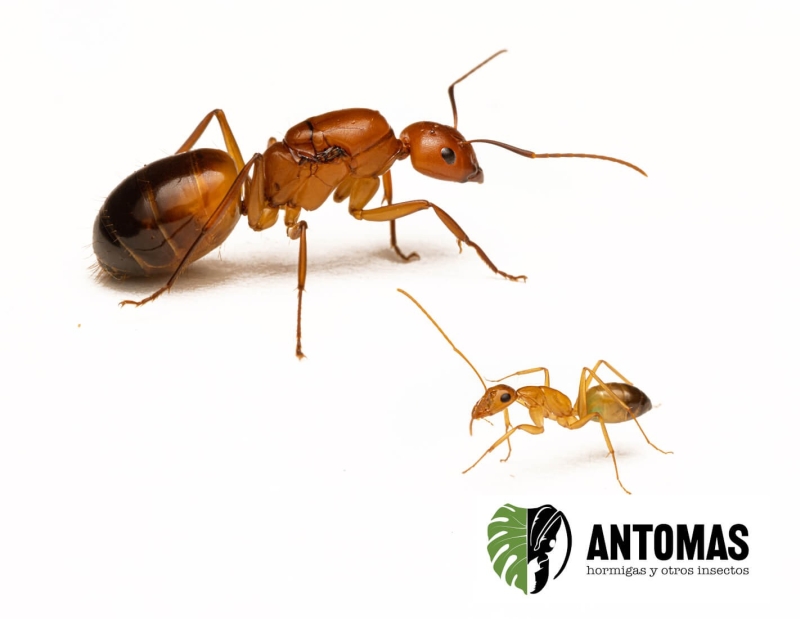
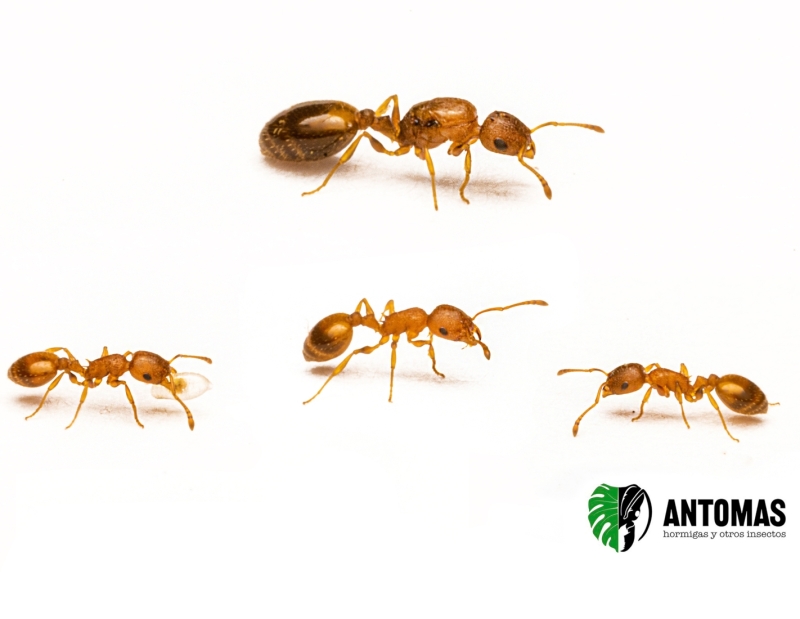
A small tree-dwelling ant whose soldiers have a flat-cut head, which they use to plug the nest entrance. It arrives as a queen with 15/30 workers and brood, ready to move into a small formicarium: a plaster Qbik Wild One P 1C, with dry twigs in the foraging area. Colonies have a single queen, stay small and grow slowly. It likes 22–27 °C, moderate humidity, nectar always available and small insects. Winter rest (diapause): about four months at 8–12 °C. Its workers measure barely 3–5 mm: use a barrier of mineral oil or talc and a lid with fine mesh, with no gaps.
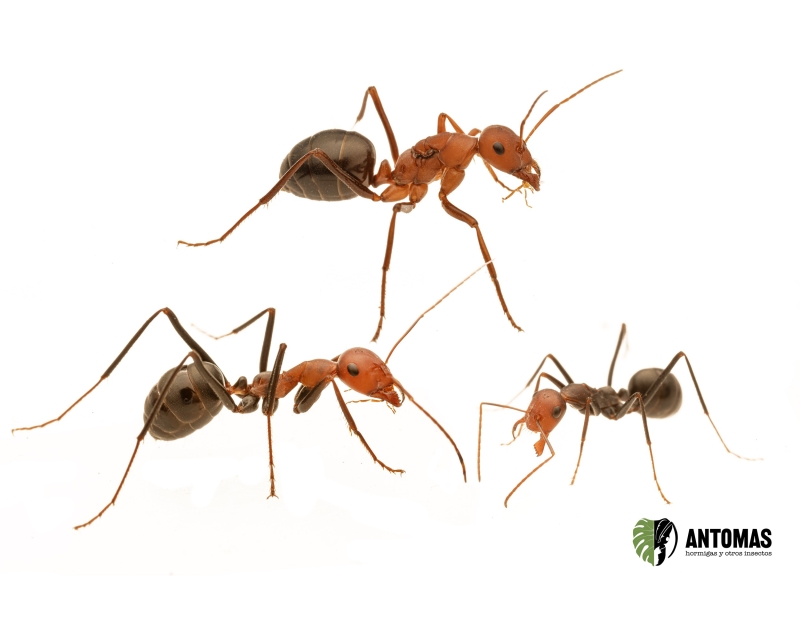
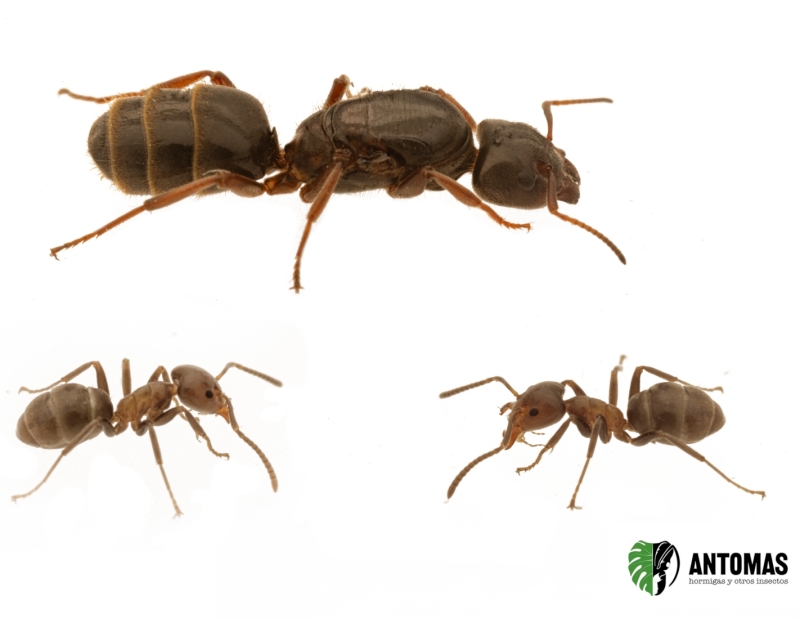
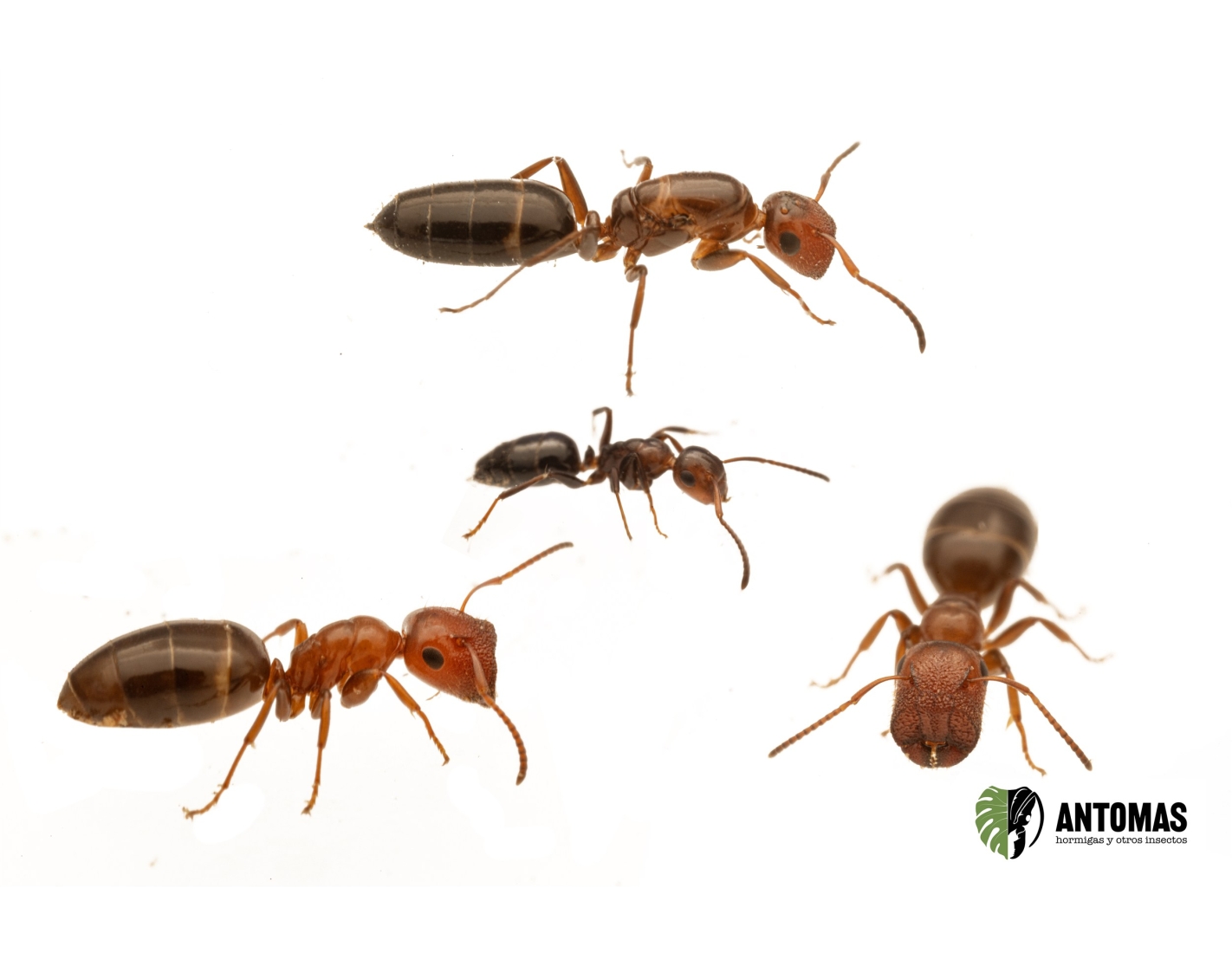
Colobopsis truncata (Spinola, 1808) is one of those ants that almost nobody sees, even though it may live just a few metres away: it spends its life in the crowns and trunks of oaks, holm oaks, chestnuts and other broadleaved trees, inside dry twigs, galls and galleries abandoned by beetles. Its small workers, reddish with a black abdomen, roam the bark in search of honeydew and tiny prey. Its soldiers, on the other hand, hardly ever go out: their job is to stay at the door.
Those soldiers are the reason this species has fascinated myrmecologists for two centuries. Their head ends in a flat, rough disc that fits into the nest entrance like a cork in a bottle. It is a textbook example of phragmosis, defending a home by sealing it with one’s own body. Because its biology has been little studied, in each section we state whether a fact comes from the scientific literature, from the experience of other keepers or from what we recommend at Antomas.
Biology
The “truncated” one: a name that describes a head
It was described in 1808 by the Italian entomologist Maximilian Spinola under the name Formica truncata. The Latin adjective truncata means “truncated”, “cut off abruptly”, and there is no better way to describe the head of its soldiers: seen from the side, it looks as if someone had sawn off the front.
The genus name, Colobopsis, was coined by Gustav Mayr in 1861 and follows the same idea: it is usually explained from the Greek kolobós, “docked” or “mutilated”, and ópsis, “appearance”. C. truncata is also the type species of the genus: the one that serves as the reference for defining what a Colobopsis is. In Germany it is known as the “Stöpselkopfameise”, something like “the plug-headed ant”.
From subgenus to genus: a change made in 2016
For more than a century, almost all authors treated it as a subgenus of the carpenter ants, which is why it still appears in books and shops as Camponotus truncatus. In 2016, Philip Ward, Bonnie Blaimer and Brian Fisher published a new DNA-based classification of the subfamily Formicinae and showed that Colobopsis does not sit within Camponotus, but is a separate lineage, related yet long since split off. They restored it to the rank of genus, and in 2021 Ward and Boudinot finished sorting out which species go on each side.
Today the genus contains almost a hundred species spread across southern North America, South and Southeast Asia, Oceania and a few in Europe. Among its tropical relatives are the famous “exploding ants” of Southeast Asia, such as Colobopsis explodens, whose workers burst their abdomen to smear the enemy with a sticky secretion. Rest assured: C. truncata does nothing of the kind.
A twin discovered in 2021
Until recently it was thought that Europe had only one Colobopsis. In 2021, a team led by Enrico Schifani showed, by combining genetics, morphology, behaviour and distribution, that the southern populations were in fact another species: Colobopsis imitans, which often mimics the acrobat ant Crematogaster scutellaris and lives in the Maghreb, Sicily and the south of the Iberian Peninsula, as well as the eastern Mediterranean.
The two are so alike that they can only be separated by measurements under the microscope. According to Wagner and Csősz (2025), C. imitans replaces C. truncata across much of southern Europe, and they have only been found together at a few sites. That is why old records from the south of the peninsula should be treated with caution: some may belong to the twin.
From Andalusia to southern Poland
C. truncata lives in central and southern Europe and in western Asia. To the north it reaches southern Poland and, in Germany, up to about 50° of latitude; populations in more northerly cities, such as Berlin, are attributed to transported plants. In the Iberian Peninsula, Fede García gathered some seventy records in 2020 from mainland Spain, from Álava, Huesca and Catalonia to Madrid, Castile, Valencia and Andalusia, as well as Portugal, Andorra and the Balearic Islands, and contributed the first Galician record, from an oak wood with chestnuts in Ourense.
Its climate. García links its Iberian distribution to the Mediterranean region, although in France and central Europe it ventures into cooler, wetter areas. It has been found from almost sea level up to about 1,350 m in altitude. It is, therefore, an ant of warm summers and of winters ranging from mild to downright cold: that is why we propose a cooler diapause than for the southern carpenter ants (see “Diapause”).
A home inside a twig
It is strictly arboreal and lives in broadleaved trees, both in warm deciduous woodland and in isolated trees, parks and gardens. It builds nothing from scratch: it occupies cavities that already exist and enlarges them.
- Oak galls, those woody balls made by tiny gall wasps (cynipids) which, once abandoned, make perfect homes. As early as 1983, Espadaler and Nieves listed it among the ants that inhabit old Quercus galls in the peninsula.
- Galleries of wood-boring insects, such as those of beetles that drill into wood, both in dead branches and in the wood of living trees.
- Dry twigs and hollow stems, such as those of brambles, where the queen often founds her colony.
In 2019, a team from the University of Parma studied how it remodels the galls of Andricus quercustozae: C. truncata excavates only the lower half and organises it into a few small chambers arranged radially, leaving the upper part untouched. And in 2022 they found that its entrances are larger and more centred than those of its neighbour Temnothorax italicus, probably so that a soldier can plug them properly.
Phragmosis: the door is a soldier
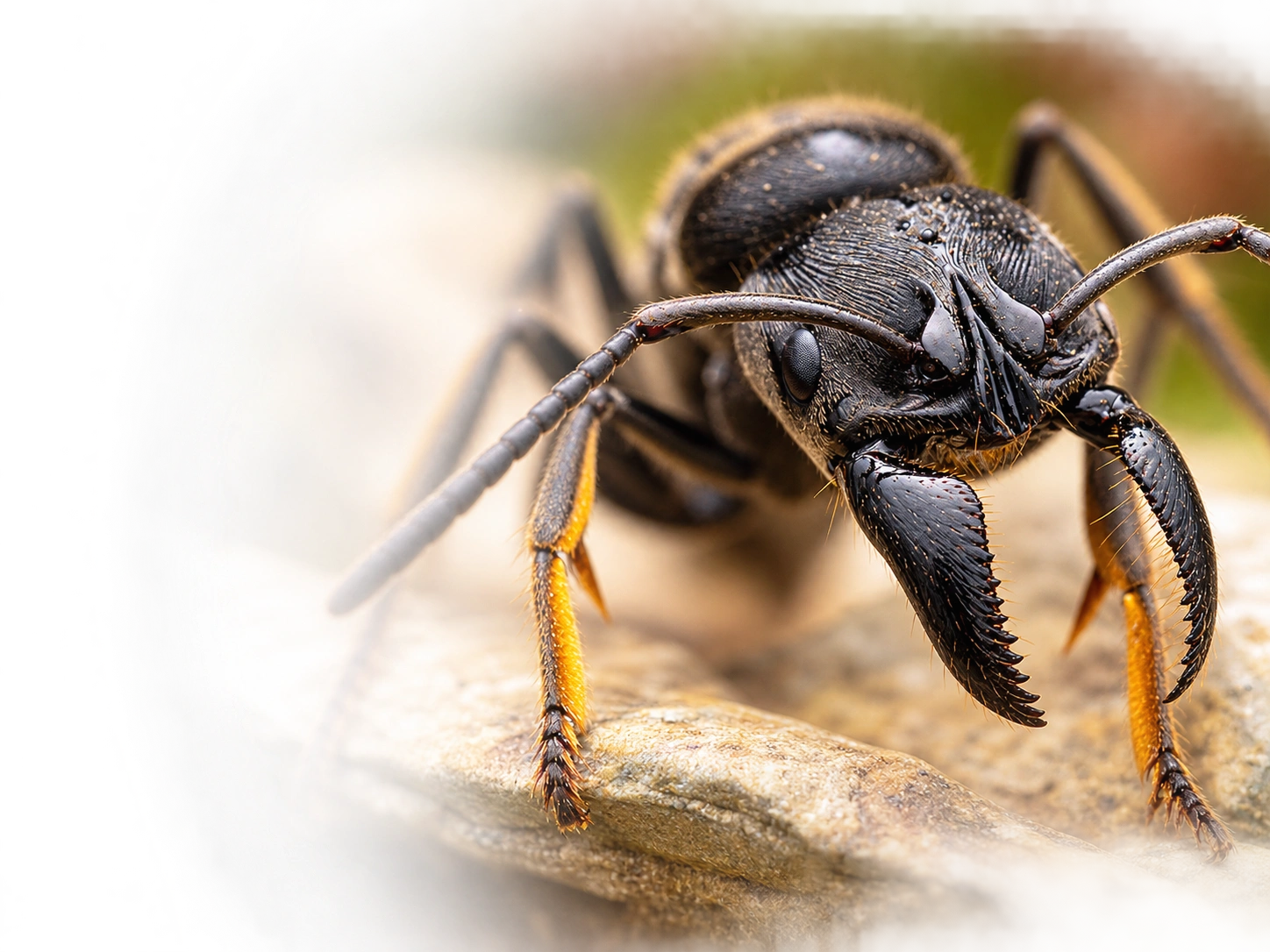
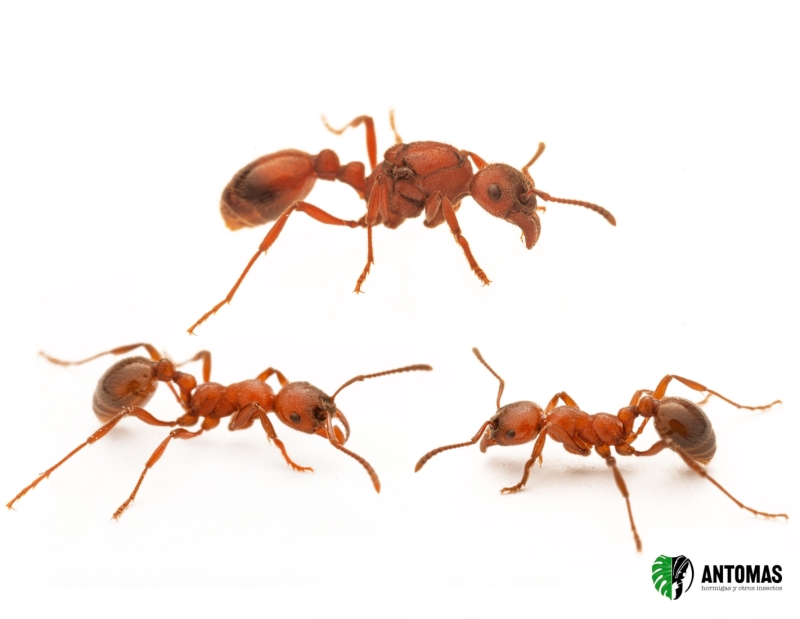
Here lies the great peculiarity of the species. The colony has two very different kinds of workers: the minors, nimble and with a normal head, and the majors or soldiers, with a transformed head. Seen from the front, a soldier’s head is a flat, almost circular disc with a marked rim, covered in coarse sculpture, like sandpaper, which includes the mandibles.
The nests have few openings, small and round, which widen just behind. A soldier takes up position in the passage with its head facing outwards and fits it into the hole: from outside, all you see is a rough circle the same colour as the bark. When a nestmate arrives, the doorkeeper steps back and lets it through; an intruder, by contrast, finds a closed door it cannot get round.
The queen also has a truncated head, though less so, and when founding it is she herself who plugs the entrance to her first chamber; later the soldiers take over. García (2020) adds a fine detail: the soldiers have very thick front femora and strongly curved claws, with large pads. This could be a gripping kit so that they cannot be yanked out of the doorway, although it has not yet been tested.
In a Japanese relative, C. nipponica, Eisuke Hasegawa saw in 1993 that colonies start producing soldiers very early and that, without them, young colonies survive less well. A well-guarded door is a matter of life and death for such a small society.
Storage soldiers? There is another intriguing hypothesis. In some American and Asian Colobopsis, soldiers have been seen to have a more distended abdomen and larger fat reserves, and to store liquid food for the colony: Edward O. Wilson described it in 1974 in C. fraxinicola, and Hasegawa in C. nipponica. Something similar has been suggested for C. truncata, because its soldiers have a proportionally larger gaster, but it remains unproven. Meanwhile, it is a good reason to watch the soldiers of your colony when they receive food.
A mimic of another ant
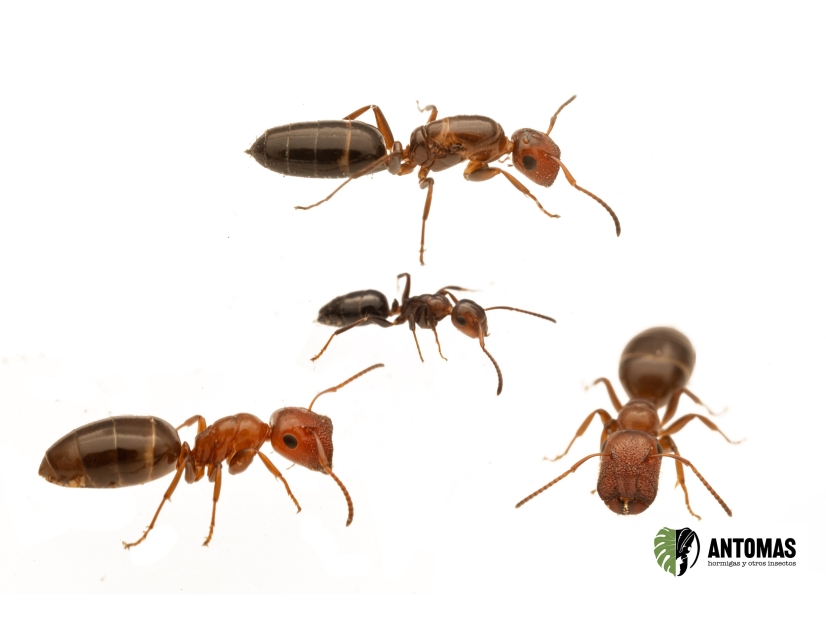
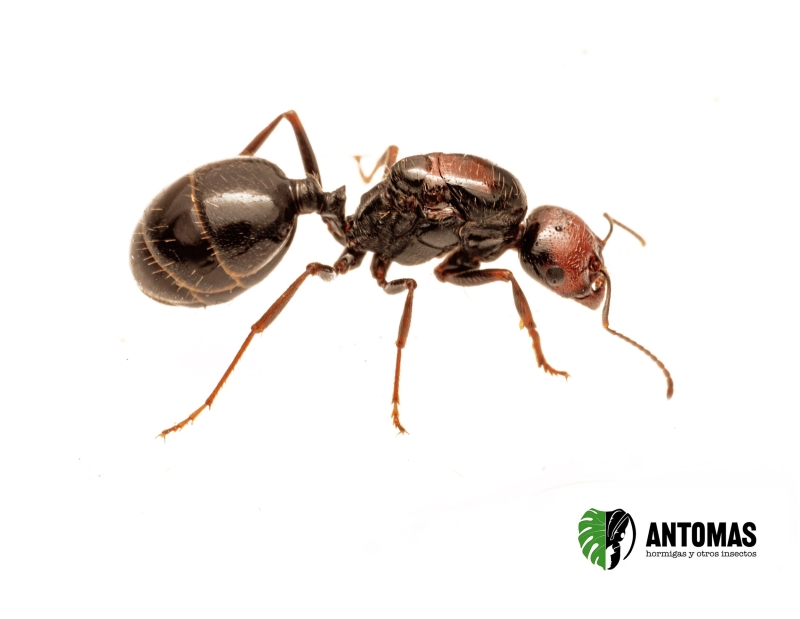
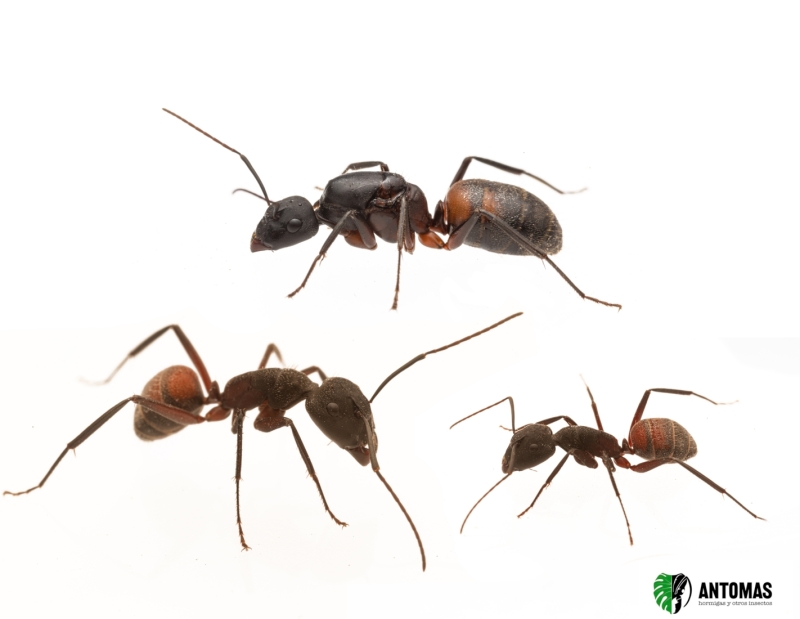
The minor workers have a reddish to dark brown head and thorax and a black gaster with two small pale spots on the front of the second segment. García explains that these are neither hairs nor pigment: they are two translucent “windows” in the cuticle through which the fat bodies, white or yellowish in colour, can be seen.
That pattern is strikingly similar to that of Dolichoderus quadripunctatus, another tree-dwelling ant, of similar size, with four white dots on the abdomen. Wagner and Csősz (2025) regard it as its model throughout its range: in Vienna, at least 36% of the trees with C. truncata also had D. quadripunctatus, and in Italy 40%. This is Batesian mimicry, in which a harmless species resembles another that predators avoid. In a preliminary observation, an Italian wall lizard ate a C. truncata without any trouble, but spat out the Dolichoderus and would not try again.
Discreet and not much of a fighter
It is not a dominant ant. Authors describe it as shy and not very aggressive: when disturbed, its workers rush to hide in the nearest crack and keep still. It shares trees with far more belligerent species, such as the acrobat ant, and survives through discretion and closed doors. According to the German literature, it only shows aggression towards foreign colonies of its own species.
Its diet in the wild is poorly known: the minor workers collect honeydew from aphids and other sap-sucking insects and hunt or scavenge tiny arthropods on the bark. The Parma group observed that, unlike Temnothorax italicus, it does not mix insect remains into the nest walls, and interprets this as a sign of a somewhat less carnivorous diet. Like all formicines, it has no sting: its chemical weapon is formic acid, which they also swallow while grooming to disinfect the crop, as was shown in 2020 in other species of the subfamily.
One colony spread over several homes
It is a monogynous species: a single queen per colony. But that colony does not have to live in a single nest. Since Forel, in the early 20th century, it has been known to be polydomous: one tree can hold several nests of the same colony, in different twigs or galls, between which workers and brood move. This fits what the Parma group saw: of the galls it occupied in the field, almost all had workers but no queen.
These are small colonies: they rarely exceed about 500 workers, and soldiers are 20 to 30 times less numerous than minors. They grow slowly.
Founding. After the nuptial flight, the queen sheds her wings and looks for a ready-made cavity: a twig, a hollow stem, a gall or a beetle gallery. She seals herself in, plugs the entrance with her head and raises her first daughters alone on her reserves, without going out to feed: it is a claustral foundation.
Nuptial flights on summer nights
In the peninsula, the flights take place in summer. With 27 observations gathered between 2007 and 2018 by hobbyists on the La Marabunta forum, García (2020) places the peak between late June and early August, with occasional flights up to the first week of September, mostly in the first hours of the night. In central Europe they are recorded from June to early August. The males are small, 4–5 mm, and yellowish brown.
Huge eggs and pupae without cocoons
Two oddities you will be able to see with your own eyes. The first: its eggs are gigantic for the size of the ant, very elongated, 1.2–1.4 mm, longer than the queen’s head. The second: almost all formicines, including Camponotus, spin a silk cocoon before metamorphosis, but Colobopsis larvae do not. Their pupae are naked, white, with the legs and antennae folded in plain view, and in them you can follow how the eyes darken as emergence approaches.
Another peculiarity, this one invisible: as in Camponotus, the metapleural gland is missing, which in many other ants secretes antibiotics. In 1984 Hölldobler and Engel-Siegel proposed that life in the trees, with fewer microbes than the soil, may have made that gland unnecessary.
How long does a queen live?
Nobody has measured the lifespan of a C. truncata queen. What is known is that ant queens are among the longest-lived insects and that in related species, such as Camponotus, queens of more than twenty years have been documented in captivity. With a colony that grows slowly, you can count on a companion for many years.
Size and morphology
A small, dimorphic ant: there are two well-separated worker castes, not a gradation of sizes as in the carpenter ants. Here we bring together what the scientific descriptions say, above all García’s (2020) study of Iberian material.
- Colour. Head and thorax red to dark brown; minors are more often dark and soldiers more reddish. The gaster is always black and glossy, with two small pale spots on the second segment.
- Hair. Very short, sparse pubescence, with a few erect setae on the margins of the abdominal segments.
- Minor workers. Normal head, slightly longer than wide, relatively large eyes and mandibles with five teeth.
- Soldiers (major workers). Head as wide as long, truncated at the front into a flat disc with a marked rim and coarse sculpture; mandibles with only three or four blunt teeth; shorter antennae, smaller eyes, very thick front femora and a robust thorax.
- Queen. Similar to a soldier in colour and head shape, but with a smaller truncated surface, well-developed ocelli, larger eyes, an elongated thorax with wing scars and longer antennae.
- Male. Small, 4–5 mm, yellowish brown, with a short antennal scape and the rest of the antenna pear-shaped.
- Pupae. Naked, without a cocoon.
How to recognise it
- The soldiers and the queen are unmistakable in Europe: no other ant has a flat-cut head, except its twin C. imitans.
- Compared with C. imitans: they can only be separated by measurements under the microscope and a statistical analysis. In the south, C. imitans usually has a red head and a dark abdomen, mimicking Crematogaster scutellaris, although it also has a form very similar to C. truncata.
- Compared with Dolichoderus quadripunctatus: its model has four white dots on the abdomen, not two, and belongs to another subfamily; under a lens it can be told apart by the shape of the thorax and the waist.
- Compared with Camponotus lateralis: similar in colour and, in its smallest workers, in size, but with a very differently shaped thorax.
- Compared with C. fallax: the darkest specimens of C. truncata may resemble it to the naked eye, but C. fallax is a larger, black carpenter ant, with no truncate-headed soldiers.
Measurements
The sizes given in the scientific descriptions are as follows:
- Minor workers: 3 to 4.8 mm according to Forel (1874); usually under 3.5 mm according to Giannetti and colleagues (2019). In Iberian material, head 0.70–0.91 mm wide and thorax 1.1–1.5 mm long (García 2020).
- Soldiers: 4 to 6 mm according to Forel; 5.2–6 mm according to Giannetti and colleagues. Head 1.03–1.23 mm wide and thorax 1.4–1.7 mm (García 2020).
- Queen: head about 1.05 mm wide and thorax about 2.15 mm long (García 2020, two specimens). We have not found her total length in any scientific source, and we do not copy the figures given by shops.
- Male: 4–5 mm.
- Egg: 1.2–1.4 mm; mature larvae 2.5–3.2 mm.
García observed some overlap in size between castes across colonies, although within a single colony the two kinds of workers separate clearly, and he suggests that young colonies may have smaller soldiers.
Care in captivity
Difficulty: 3/5 – Advanced
It is not a hard ant to keep alive, but it is hard to raise well and to enjoy without scares. We rate it as advanced because of its own biology:
- It is arboreal. It is built to live in dry wood and twigs, not in soil: it needs a small nest, with compact chambers and moderate humidity.
- Small, slow colonies. You will never have a formicarium full to bursting: a few hundred workers at most, and unhurried growth. It demands patience.
- Tiny workers. At 3–4 mm, a minor can slip through gaps that would never let a carpenter ant through. The barrier, the lid and the connections must be perfect.
- Shy. A small colony is slow to come out and feed if there are vibrations or sudden movements around it.
- A long, cool diapause, essential every winter.
- Little husbandry information: there are few keepers with long experience and plenty of contradictory data.
In return, it offers something few ants have: watching a soldier close the nest door with its head.
Temperature, humidity and light
- Nest: from spring to autumn, 22–27 °C, with one slightly warmer end that does not exceed 28 °C. Keepers recommend 21–28 °C for the nest.
- Foraging area: at room temperature; keepers put it between 18 and 30 °C.
- Humidity: moderate. In the wild it lives in dry wood and galls, not in wet soil. Moisten the plaster only slightly and leave a somewhat damper area to which the colony can carry the brood if needed. Specialist shops speak of 50–60% in the nest and less in the foraging area.
- Water: a full test tube, plugged with cotton wool, always in the hunting area.
- Light: darkness in the chambers, brightness in the hunting area and the natural rhythm of days and nights.
- Diapause: about 4 months at 8–12 °C, from mid-November to mid-March.
If you want to add heat, fit a thermostat-controlled heating mat or cable along one side of the nest, never under the whole of it, so that there is a gradient. Avoid direct sunlight and radiators. Droplets on the walls or mould mean there is too much water; brood huddled in the damp area means there is too little.
Recommended formicaria
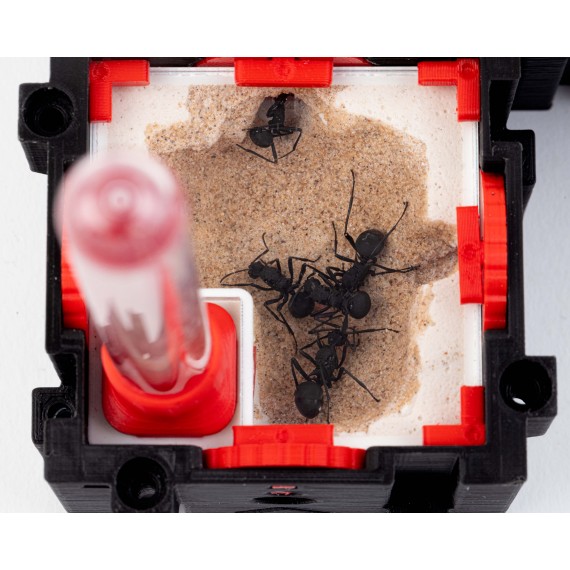
At Antomas we recommend a small formicarium: the Qbik Wild One P 1C from Anthouse. It is made of plaster, a material that holds gentle moisture, and its size suits a colony that will never be huge. Its compact chambers are reminiscent of the galleries in a twig, and a colony of 15–30 workers feels safe in it from day one:
Has the colony grown and no longer fits? Then move on to its big brother with a double chamber, which will be enough for most colonies of this species for their whole lives:
Expand only when the colony asks for it, never in advance: in an oversized nest, the empty chambers fill up with waste and a shy species feels exposed. The rest of the set-up:
- An anti-escape band at the top of the foraging area, made of mineral oil or talc, and a lid with fine-mesh ventilation.
- Dry twigs, pieces of bark or an empty oak gall in the foraging area, away from the barrier. They love exploring them and, if the colony grows, it may take one over as a secondary nest, just as it does in the tree with its polydomy. Make sure they are clean, dry and free of fungi.
- Water in a tube, with its cotton wool plug, and a separate feeder for the nectar.
- Heat along one side of the nest, with a thermostat and away from the feeder.
The first weeks with your colony
We send you a queen with 15/30 workers and brood (eggs, larvae or pupae) in a tube with its water reserve. There is no need to wait for it to grow in the tube: with that number of workers, you can move it straight into the formicarium.
- Prepare the set-up beforehand: formicarium moderately moistened, barrier applied, water tube and feeder in the foraging area.
- Move the colony by tipping it out within the first few days (see the next section).
- Give it a few days to settle. For the first days they will barely come out: that is their nature. Leave nectar and a small prey item, and remove whatever they do not eat. You can watch the colony as much as you like; just avoid knocks, vibrations and sudden changes.
- Look for the door. Once the colony has settled, look closely: you may well see a soldier stationed at the chamber entrance, with its head facing outwards.
What if you find a queen on her own? Her foundation is claustral: in the wild she seals herself into a twig or a hollow stem and raises her first workers alone. In captivity she founds in a test tube with water, in the dark and at 24–26 °C, with little handling and fearless watching. Keepers agree that it is slow and takes a great deal of patience, which is why we sell colonies that are already up and running.
Moving house by tipping out
At Antomas we move colonies into the formicarium by tipping them out: we do not wait for them to decide to move on their own.
- Have the formicarium ready: barrier applied, water connected and chambers in half-light.
- Do it over a white tray: against a pale background you will immediately spot any escaped worker, however small.
- Unplug the tube inside the foraging area, next to the nest entrance, and carefully let its whole contents drop out: queen, workers and brood.
- Any that stay inside, ease them out with a fine brush. The soldiers are usually the last to come out.
- Close the lid properly and let them get on with it: within a short while they will have carried the brood into the chamber.
The later move to the Qbik Wild Duo P 2C is done the same way.
Feeding
Nectar always available. In the trees it lives largely on the honeydew of aphids and scale insects, so sugar must never run out. Serve it in a small feeder, never on cotton wool: cotton wool soaked in nectar ferments and grows mould within days. Choose a feeder with an easily reachable drop, because its workers are tiny. Alternate flavours: Blue Sugar, Anthouse’s nectar, on most days (4–5 a week), and another nectar or sugar water on the remaining 1–2. A little protein can be added to the nectar.
Small, varied insects. Larvae grow on protein. Our rule is a generous one: if you clean up the leftovers every day, you can, and should, give more than they need, because a colony that senses plenty lays more eggs. If you cannot check the foraging area often, scale back the portions, because rotting leftovers attract mites and fungi. What matters in this species is the size of the prey: small pieces that a few 3–4 mm workers can handle.
With 15–30 workers, protein two or three times a week is enough; with more than a hundred, every other day or daily. Buy insects from a trusted supplier, because any that have touched insecticides can wipe out the colony. And keep the water tube in the foraging area topped up.
Growth: slow and steady
Colonies of C. truncata grow slowly and stay at a few hundred workers at most. Do not expect a spectacular leap from one year to the next: normally the colony adds workers little by little each active season, faster if it has steady warmth, frequent protein and a properly done diapause. In the wild, soldiers appear early and number a few for every twenty or thirty minors; in your colony they will appear at that rate. Expand when you see workers standing idle in the foraging area because there is no room left inside.
Diapause: a cool winter
C. truncata needs its winter rest, the diapause. It lives from the Mediterranean to central Europe, where winters are truly cold, and in the wild it spends the winter inside twigs and galls exposed to the open air.
Keepers’ data do not agree: one German shop proposes October to March at 5–8 °C, and other sources speak of about 10 °C. At Antomas we recommend about 4 months at 8–12 °C, from mid-November to mid-March: cold enough for a species with cool winters, without pushing it to extremes.
- A gentle way in. In November, switch off the nest heating and let the temperature drop little by little over 2–3 weeks.
- Four quiet months between 8 and 12 °C: an unheated room, a garage that does not freeze, a cool pantry or a wine cooler. If your home does not get that cold, a corner at 12–14 °C is better than nothing.
- The water tube stays in place all winter, and the nest must not dry out completely.
- Minimal food: a little nectar in the feeder in case a worker wants it, and no insects. It is to be expected that the brood stops developing.
- An equally gentle way out. From early March, raise the temperature little by little over 2–3 weeks. When activity and eggs reappear, go back to offering insects.
No warmth before its time: waking the colony in the middle of January does not bring the season forward and drains the queen’s strength.
Behaviour and observation
Watch it as much as you want. An ant colony is for enjoying and learning from, not for hiding in a cupboard: that is how we see it at Antomas. With the chambers dark and the hunting area lit, you can watch it every day. All this species asks for is calm around it: no knocks on the table or vibrations, and moving the nest only as much as necessary.
Things worth watching:
- The doorkeeper. Look at the chamber entrance or the narrow passages: you will see a soldier with its head wedged in, acting as a door, and how it steps back to let a nestmate through.
- The naked pupae, white and without a cocoon, in which you can see the eyes darken before emergence.
- The huge eggs, elongated like tiny grains of rice.
- The spots on the gaster, which in side lighting look like two little windows.
- Trophallaxis, when two workers pass food mouth to mouth, and whether the soldiers receive or hand out more food than the minors.
- The twigs in the foraging area: check whether they explore the cavities or whether the colony ends up moving part of its brood into one.
Warning signs:
- The brood does not progress in the middle of the active season: almost always a lack of warmth or protein.
- Droplets on the walls, mould or mites: too much water or forgotten food.
- Brood piled up by the damp area: the nest has become too dry.
- Workers that never come out to feed after several weeks: check for vibrations, direct light on the chambers or a foraging area that is too large and empty.
Keeping them in
Here lies half the difficulty of this species. Its workers measure 3–4 mm, climb plastic and glass like all formicines, and are built to slip through tiny holes in wood. A gap that would not let a carpenter ant through is a motorway for them.
- Mineral oil or talc along the top edge of the foraging area, in a continuous band with no breaks. Replace the oil when it picks up dust and the talc when it cakes.
- A tight-fitting lid, with the ventilation covered by fine mesh, in case one gets past the barrier.
- Check connections, stoppers and tubes: leave no slack anywhere, especially in the cotton wool plugs and the tube joints.
- Nothing that could serve as a bridge: the enrichment twigs always away from the barrier and not touching the lid.
- Open up calmly and over a pale surface, so you can spot any escape at once.
Does it bite? Safety and handling
No risk whatsoever. It has no sting and is too small for its bite to be felt: at most, a slight tickle. It may release a tiny droplet of formic acid, with no consequences for people.
For their sake, move them with a fine brush, never with your fingers. Do not mix colonies or put new queens into a colony. And although it is a native species, a colony raised at home must never be set free in the wild.
What not to do
- Put it in a large formicarium “so that it grows”: it is a species with small colonies.
- Flood the nest: it comes from dry branches, not wet soil.
- Serve the nectar on cotton wool or allow the feeder to run dry.
- Give it large, whole prey its workers cannot open, or let leftovers pile up.
- Always offer the same insect.
- Skip the diapause, cool it below freezing or wake it in January.
- Go suddenly from warm to cold, or from cold to warm.
- Neglect the barrier, the lid mesh or the connections: with 3 mm workers, any gap is a way out.
- Release the colony into the wild.
Scientific sources
For this care sheet we started from the scientific literature on Colobopsis truncata, its twin C. imitans and its genus, from distribution records and the climate of its range, and from what other keepers report and we apply at Antomas. The Iberian data, measurements, flights and development come mainly from García (2020), Arquivos Entomolóxicos 22: 401–416; we have also relied on Seifert (2018), The Ants of Central and North Europe. Main references:
- Ward, P. S., Blaimer, B. B. & Fisher, B. L. (2016). A revised phylogenetic classification of the ant subfamily Formicinae (Hymenoptera: Formicidae), with resurrection of the genera Colobopsis and Dinomyrmex. Zootaxa 4072: 343–357. doi:10.11646/zootaxa.4072.3.4
- Ward, P. S. & Boudinot, B. E. (2021). Grappling with homoplasy: taxonomic refinements and reassignments in the ant genera Camponotus and Colobopsis (Hymenoptera: Formicidae). Arthropod Systematics & Phylogeny 79: 37–56. doi:10.3897/asp.79.e66978
- Schifani, E., Giannetti, D., Csősz, S., Castellucci, F., Luchetti, A., Castracani, C., Spotti, F. A., Mori, A. & Grasso, D. A. (2022). Is mimicry a diversification-driver in ants? Biogeography, ecology, ethology, genetics and morphology define a second West-Palaearctic Colobopsis species (Hymenoptera: Formicidae). Zoological Journal of the Linnean Society 194: 1424–1450. doi:10.1093/zoolinnean/zlab035
- Wagner, H. C. & Csősz, S. (2025). The «chameleon ant» Colobopsis imitans adapts its mimetic appearance to local model species across the Mediterranean Basin (Hymenoptera: Formicidae). Ecology and Evolution 15: e72674. doi:10.1002/ece3.72674
- Giannetti, D., Castracani, C., Spotti, F. A., Mori, A. & Grasso, D. A. (2019). Gall-colonizing ants and their role as plant defenders: from «bad job» to «useful service». Insects 10: 392. doi:10.3390/insects10110392
- Giannetti, D., Schifani, E., Castracani, C., Spotti, F. A., Mori, A. & Grasso, D. A. (2022). Different nest entrance architecture by Colobopsis and Temnothorax ants colonizing oak galls. Insectes Sociaux 69: 383–388. doi:10.1007/s00040-022-00884-2
- Hasegawa, E. (1993). Nest defense and early production of the major workers in the dimorphic ant Colobopsis nipponicus (Wheeler) (Hymenoptera: Formicidae). Behavioral Ecology and Sociobiology 33: 73–77. doi:10.1007/BF00171658
- Wilson, E. O. (1974). The soldier of the ant Camponotus (Colobopsis) fraxinicola as a trophic caste. Psyche 81: 182–188. doi:10.1155/1974/17428
- Hölldobler, B. & Engel-Siegel, H. (1984). On the metapleural gland of ants. Psyche 91: 201–224. doi:10.1155/1984/70141
- Laciny, A. et al. (2018). Colobopsis explodens sp. n., model species for studies on «exploding ants» (Hymenoptera, Formicidae), with biological notes and first illustrations of males of the Colobopsis cylindrica group. ZooKeys 751: 1–40. doi:10.3897/zookeys.751.22661
- Tragust, S. et al. (2020). Formicine ants swallow their highly acidic poison for gut microbial selection and control. eLife 9: e60287. doi:10.7554/eLife.60287
- Haskins, C. P. & Haskins, E. F. (1992). Note on extraordinary longevity in a queen of the formicine ant genus Camponotus. Psyche 99: 31–33. doi:10.1155/1992/53614