Difficulty: 5/5 – Expert
One of the giants of the gulosa group, from temperate southern Australia: workers up to about 25 mm and black antennal scapes. For Tomás, it is «a bit legendary level». Founding queens with brood, semi-claustral: a starter tube or module with fine sand, kept dark and moist at first; then a QBIK DUO with large galleries and, for large colonies, a Qbik Wild NoNa Diáfano. 22–26 °C, and mature larvae never above about 28 °C for long. Sugar every day, protein according to the larvae and dead prey at first. Diapause of 3–4 months at 10–15 °C, without brood: the queen may go months without laying. Very painful sting: not suitable for people with allergies or for homes with small children or pets nearby.
Myrmecia nigriscapa Roger, 1861 is a bull ant from southern Australia and one of the giants of its genus: workers up to about 25 mm, long toothed mandibles, huge eyes and a sting that deserves to be taken seriously. It belongs to the gulosa group, the large red bull ants. Tomás sums it up in a few words: it is «a bit legendary level».
Large and spectacular, yet elusive: the myrmecologist Brian Heterick described it as surprisingly shy. Its yearly cycle is one of the most marked in the genus, with broodless winters and a queen that only lays in the good season, and hardly anyone has kept it: we have found only one published breeding journal. Here we separate what is documented for the species, what is known about the genus and what we apply at Antomas. If you are looking for a real challenge and have patience to spare, this is your ant.
Biology
Black scapes: the name Roger gave it
It was described by the German entomologist Julius Roger in 1861, and the name says almost everything: nigriscapa means «black-scaped». The scape is the first segment of the antenna, the long «handle» that leaves the head before the elbow, and on an ant with a reddish head, scapes darker than the head stand out at a glance: they are still one of the characters used to identify it. Some English-language records call it the black-scaped bull ant.
The queen and the male were described by John Clark in 1925, and in 1951 he returned to the species in his work on the Formicidae of Australia, the source of the measurements repeated in compilations. The revision by Ogata and Taylor (1991) places it in the gulosa group.
A giant of the gulosa group
The gulosa group holds the giants of the genus, known in Australia as inch ants. It takes its name from M. gulosa, the large red bull ant of the east, and in south-western Western Australia alone it includes 16 species (Heterick 2009). In the key, the group is recognised by an extra tooth on the underside of the mandible, near the tip.
Genetics supports it: Hasegawa and Crozier (2006) recovered it as a natural lineage, one of the four lines of the genus with an occipital carina, a ridge at the back of the head. Mera-Rodríguez and colleagues (2023), using genome-wide markers from 66 of the 93 species, dated the stem lineage of the genus to about 58 million years ago. It is an ancient lineage that today lives only in Australia, with one species in New Caledonia (Ward and Brady 2003).
Heterick's shy giant
If any group of Myrmecia has a reputation for a bad temper, it is this one. Brian Heterick describes its relatives M. desertorum and M. vindex pouring out of the mound as soon as they are disturbed. By contrast, when he disturbed a nest of M. nigriscapa, the workers flatly refused to confront him, and he concluded that, unlike the more aggressive bull ants, this one seems shy.
It is a single observation of a single nest, and shy does not mean harmless: it keeps the mandibles, the eyesight and the sting, and a founding queen is a determined hunter (see «A patient queen: what a breeding journal tells us»). But if your colony takes after its species, it will rather hide than defend itself, and that works in the keeper's favour.
From the Darling Range to Wilsons Promontory
Its range is split in two. The core lies in the south-east: Victoria and South Australia account for the vast majority of the more than 2,600 records in the Atlas of Living Australia, down to Wilsons Promontory, the southernmost point of the mainland. In south-western Western Australia there is an isolated population, from the hills of the Darling Range to the coastal plain. Almost 3,000 km separate one end from the other. The odd records from other states are so few that they should be checked: almost nine out of ten records are naturalists' photos, and red bull ants are easily confused.
Its climate is temperate to Mediterranean: warm, dry summers, with average highs of 27–30 °C, and cool, wet winters, with highs of 12–17 °C, lows of 4–8 °C and daily means of about 10–12 °C in July. It is not a tropical ant: it needs a real winter, and its seasons run opposite to ours.
Five bull ants in the same scrub: Barnett's study
Almost everything known about its life in the wild comes from the PhD thesis of J. M. Barnett (Monash University, 1974), which followed five neighbouring Myrmecia species in an area of mallee, low eucalypt scrub, in inland Victoria. With the same climate and the same soil, M. nigriscapa proved the most original:
- A more complex nest. Each species had a nest with its own outward look, but only its nest showed an internal structure more complex than that of its neighbours.
- An ant that moves house. It was one of the two species that relocated their nest; the other was M. forceps.
- A timetable at the mercy of the thermometer (see «Neither day nor night: whenever the temperature is right»).
- A blank winter (see «A winter without brood»).
We have only been able to read the abstract, so we know neither the depth nor the chambers of the nest. But it is clear that it organises its home with care and that moving is part of its repertoire.
Neither day nor night: whenever the temperature is right
In Barnett's study, four of the five species foraged mainly at night, and M. pyriformis only at night. M. nigriscapa broke the mould: it went out hunting whenever the temperature was favourable, whatever the hour. Calling it nocturnal, as some commercial care sheets do, is a mistake: it is a thermal-window hunter, which makes sense in a climate where activity is limited by cold rather than by light.
In all five species, the number of foragers also tracked the amount of brood: more larvae, more hunters outside. You will see it at home too (see «Feeding»).
A winter without brood
This is the most important fact for keeping it. While its neighbours had eggs all year round, M. nigriscapa had no brood in winter and stopped all activity. The queen only laid from mid-July to early December: from the end of the austral winter to the start of summer.
Naturalists tell the same story: the Atlas of Living Australia has between 360 and 470 records a month from October to December and barely about 40 in June and in July, although fewer people go out into the field in winter too. A M. nigriscapa queen comes with a very marked built-in clock: she lays in batches in the good season and spends the cold without brood (see «Diapause: the cold that wakes the queen»).
A hunter's eyes
Two large, convex eyes take up much of the sides of its head. Myrmecia hunt alone and by sight, without pheromone trails: each worker spots the prey, approaches and seizes it with the mandibles before using the sting.
Greiner and colleagues (2007) showed that eye structure in Myrmecia changes with the time of day each species goes out, and Narendra and colleagues (2011) that workers, queens and males have eyes adapted to their own timetable. In M. croslandi, workers even perform «learning walks» around the nest to memorise the landscape before setting off (Jayatilaka and colleagues, 2018). The eyes of M. nigriscapa have not been measured yet.
At home they will follow you with their eyes and turn their heads towards the tweezers. It is not aggression, it is their way of reading the world, and the reason why founding is done in the dark (see «Watch without fear, but with care»).
Larvae that feed on the prey
Bull ants raise their young the old-fashioned way: the larvae feed by themselves, straight from the pieces of insect left beside them, instead of being fed mouth to mouth. In its relative M. gulosa, many workers also lay trophic eggs, soft and sterile, that serve as food for the larvae and the queen (Dietemann and colleagues, 2002).
To spin the cocoon, the larvae need particles around them, and, according to compilations on the genus, the workers cover them with soil. In a bare chamber, many fail (see «Substrate for spinning: a must»).
And the queen is, in Tomás's words, «a bit useless» with the brood: she sometimes neglects it, and if newly hatched larvae have no food, she may eat them. That is why food must never be missing when the eggs hatch (see «Founding: the queen with brood»).
A double-edged venom
The best-studied venom in the genus belongs to a relative from the same group, M. gulosa. Robinson and colleagues (2018) showed that almost all its peptides come from a single gene family, the aculeatoxins: one incapacitates insects, the hunting venom, and others activate the pain neurons of mammals, the defensive one.
Eagles and colleagues (2022) found in it a toxin that mimics vertebrate EGF hormones and, in mice, causes long-lasting pain hypersensitivity. The venom of M. nigriscapa has not been analysed, but it shares group, size and sting with M. gulosa (see «Handling and safety»).
What we still don't know
There are no censuses of its colonies: the figure of «up to 1,000 workers» given by some shops has no study behind it. Its nuptial flights are unknown too, as is whether a colony can have several queens; at Antomas we treat it as a single-queen species, with the semi-claustral founding of the genus. For a keeper, that has its charm: every colony that grows adds something not yet written.
Size and morphology
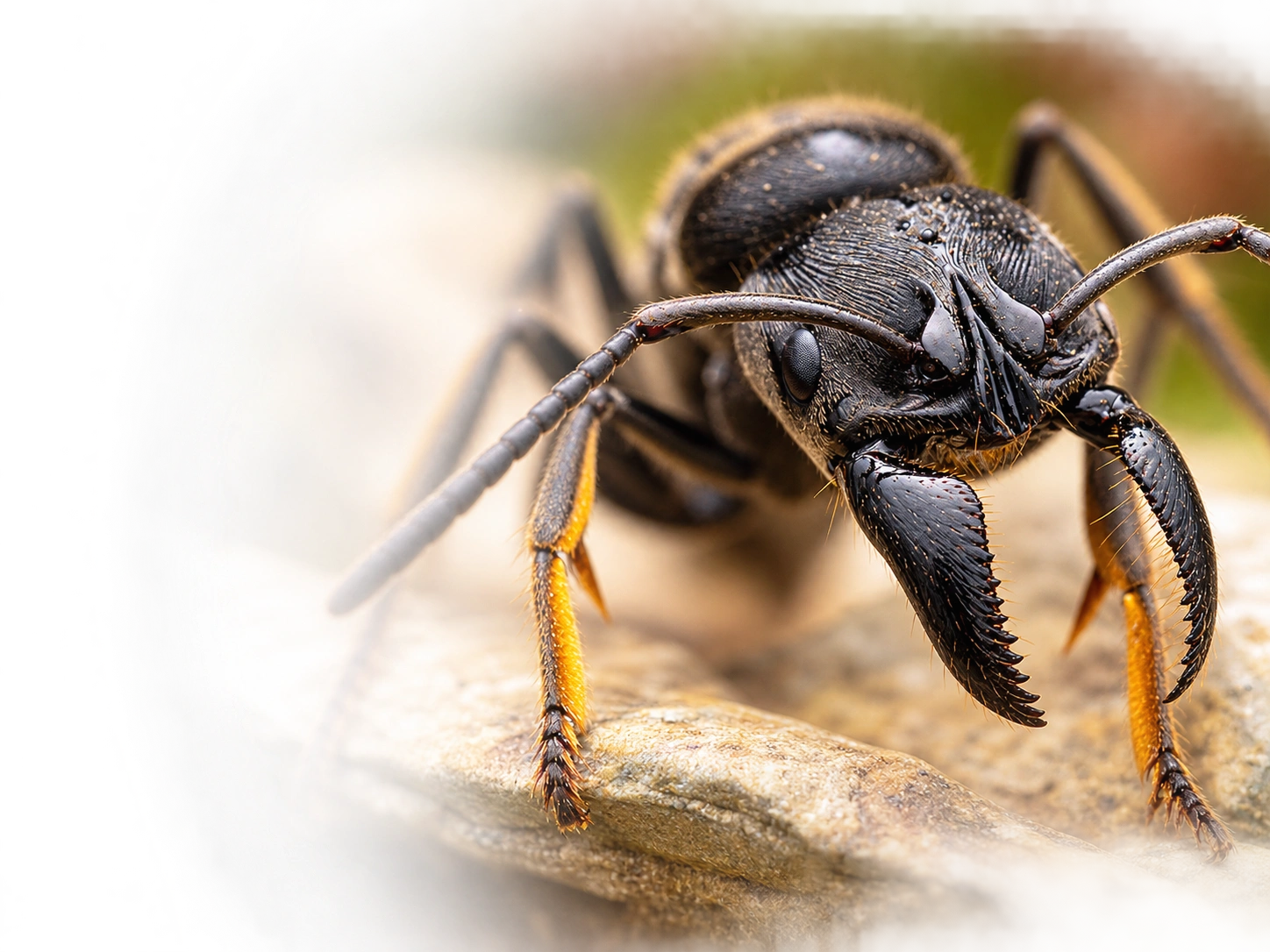
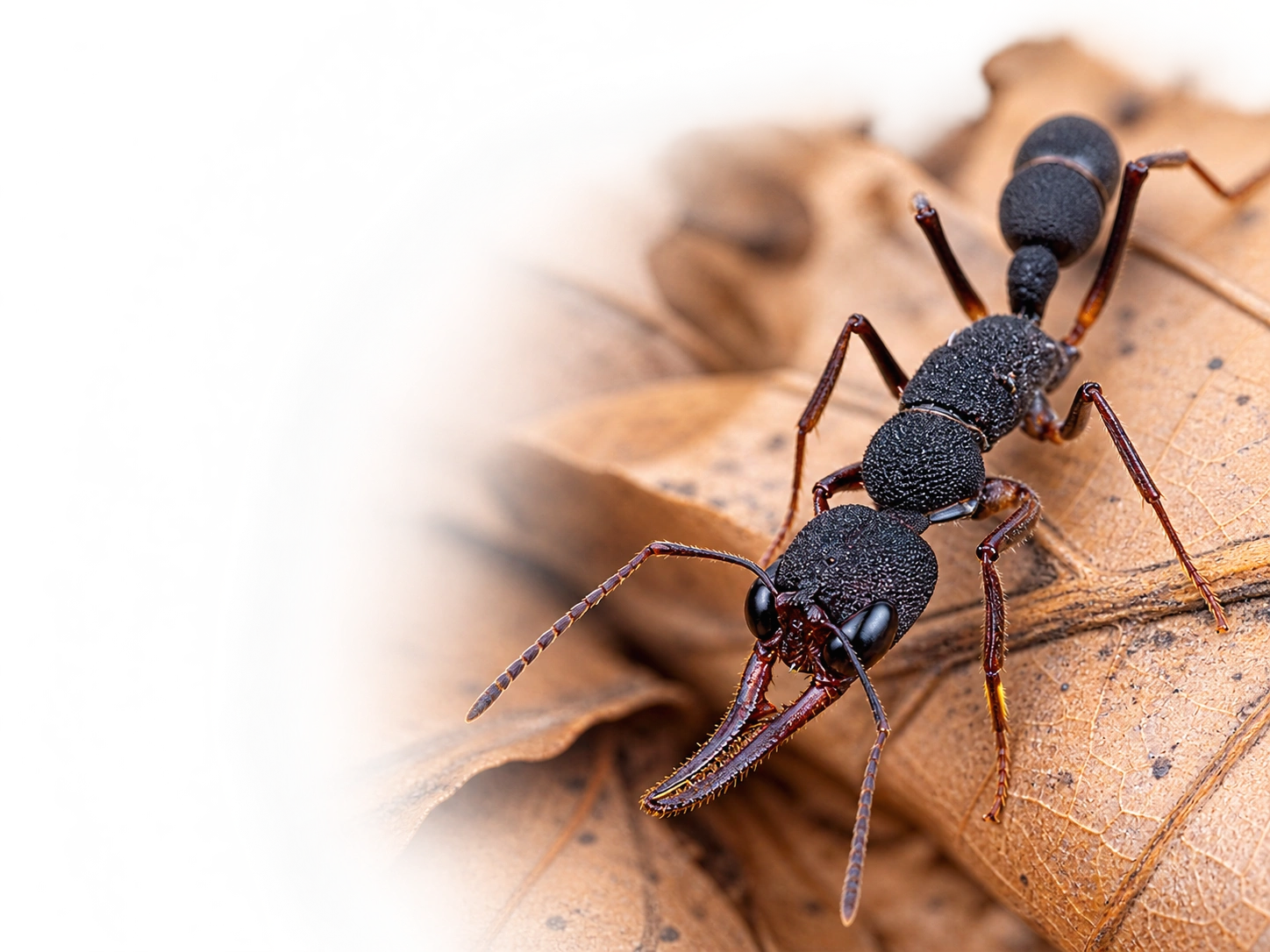
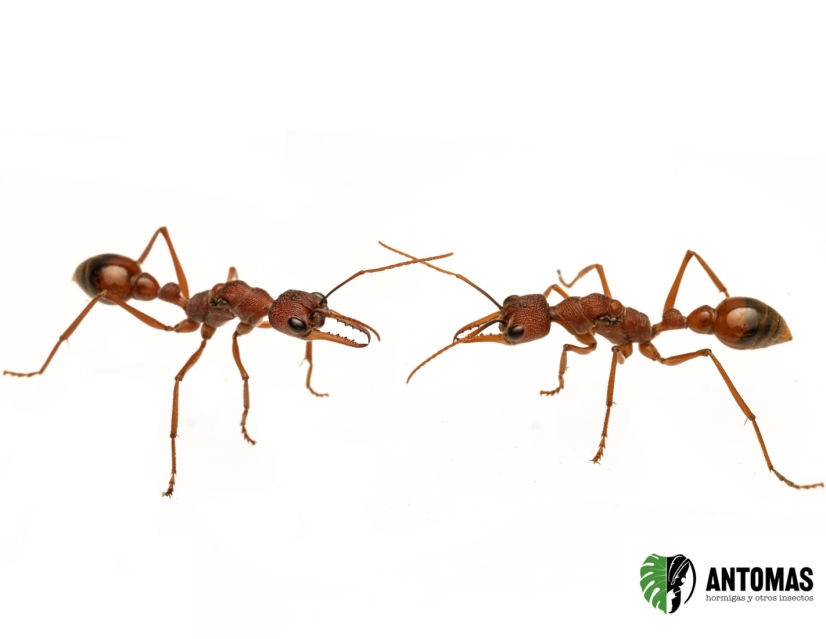
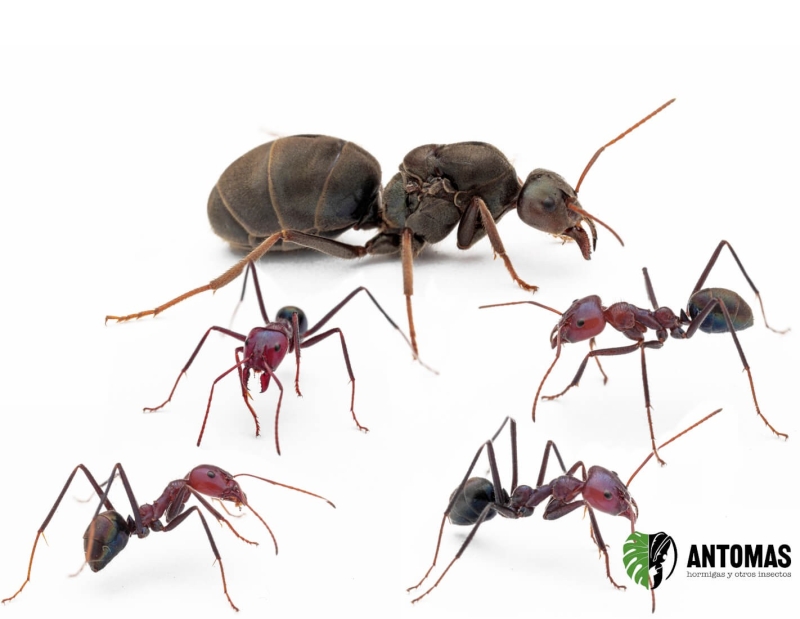
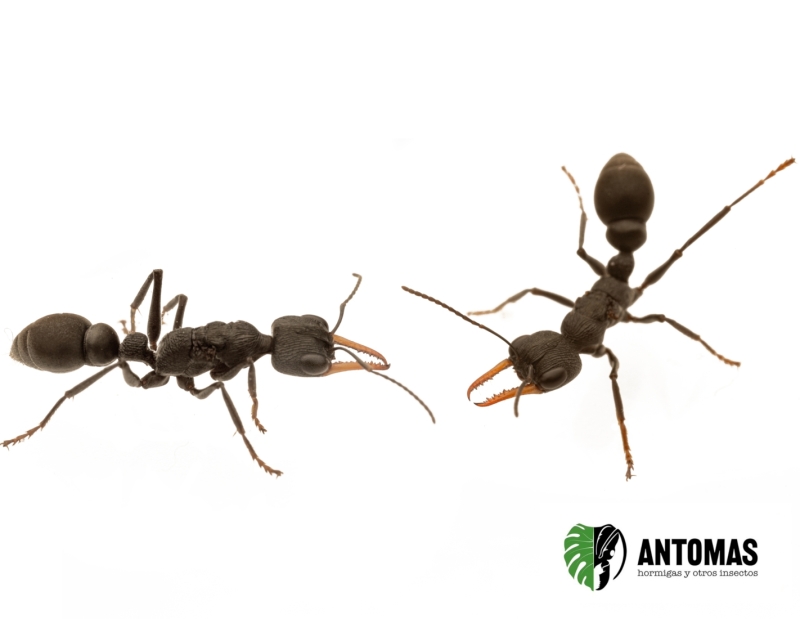
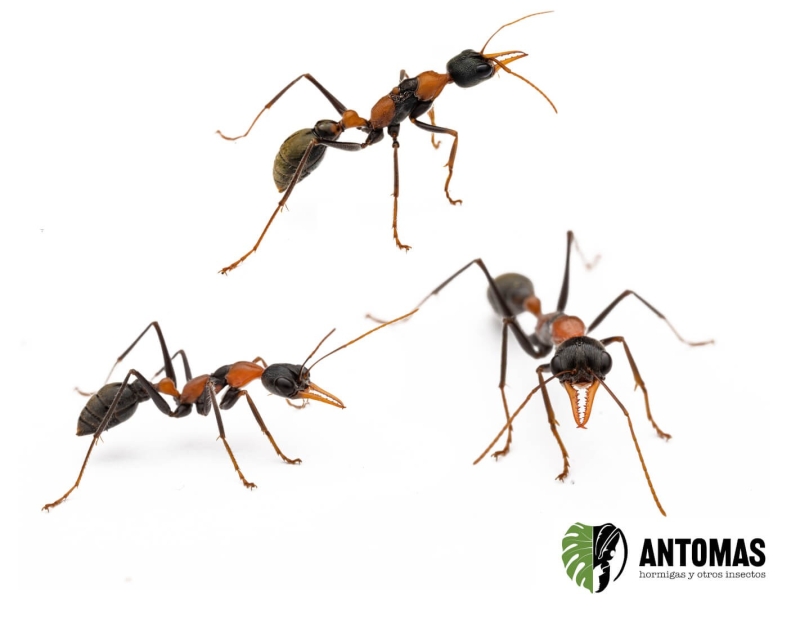
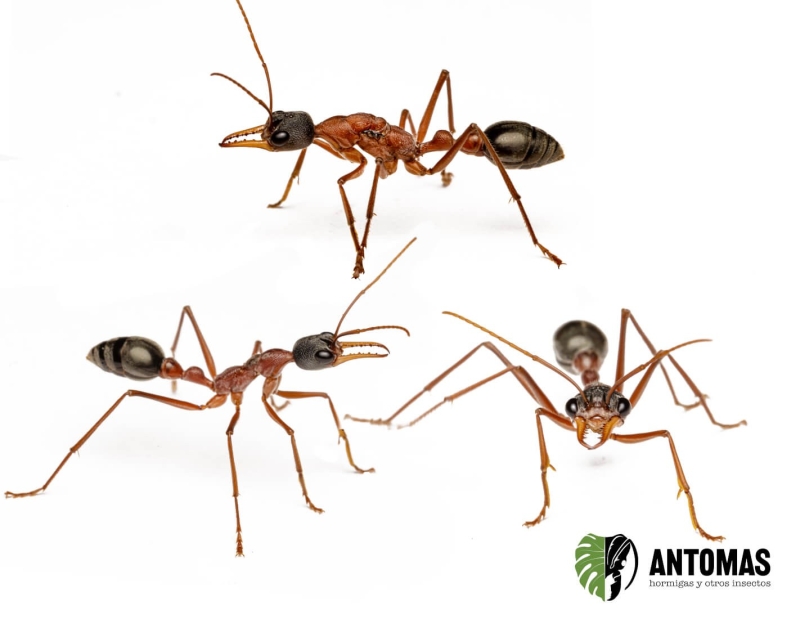
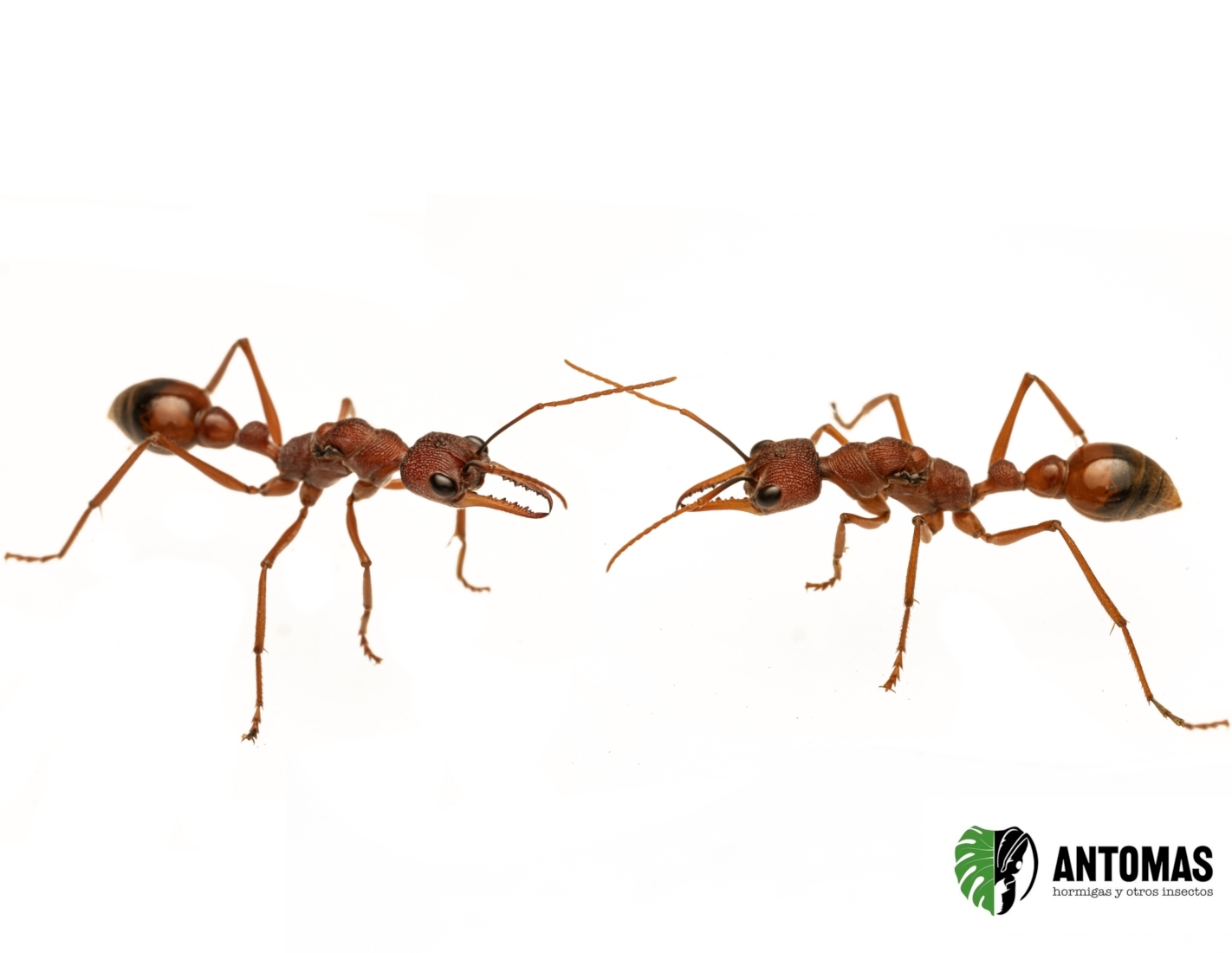
A large, slender Myrmecia, with long legs and long toothed mandibles. There are no soldiers: workers vary continuously in size, and the queen looks like a large worker with a bulkier thorax.
- Colour according to the literature. Head, mesosoma (the thorax) and node red; legs yellowish red; mandibles and clypeus clearly paler than the head.
- Scapes. Darker than the head: the feature behind its name.
- Gaster. Reddish-brown base and yellowish tip. Its south-western «twin», M. analis, also has a yellow tip, but a black base (Heterick 2009).
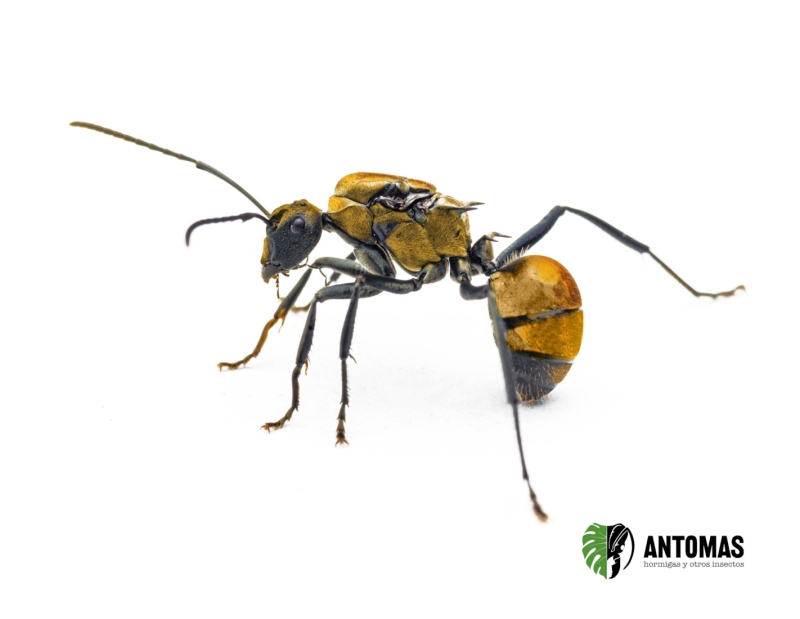
- Colour of our colonies. Reddish-brown head and mesosoma, long legs and orange mandibles, and a dark gaster with a paler tip.
- Mandibles. Long, with many teeth and, as in the whole group, an extra tooth underneath near the tip.
- Head and eyes. Large, convex eyes, ocelli in workers too, and an occipital carina.
- Sting. Functional.
- Brood. Larvae spin cocoons; in a healthy colony you will not see naked pupae.
In our colonies, the base of the gaster looks dark. To recognise the species, the reliable clue is the combination of dark scapes, pale mandibles and a yellowish gaster tip.
Approximate measurements
- Workers: 17–25 mm
- Queen: 23–26 mm
- Male: 16–20 mm
These are the measurements given in compilations, based on Clark (1951); we have not been able to consult the original. They put it in the league of M. gulosa and M. pyriformis. A queen of about 25 mm needs to turn round with a large larva in her mandibles: large galleries from day one.
Care in captivity
Difficulty: 5/5 – Expert
We put it at the top of the scale because it forgives few mistakes and its timescales are long:
- A slow, delicate founding. The queen is semi-claustral and a poor carer of her brood; losing the odd cocoon is normal.
- A temperature ceiling. Mature larvae must never stay above about 28 °C: the European summer is a real risk.
- Humidity with a method and substrate in the nest so the larvae can spin.
- A clock of its own. After the first batch, the queen may go months without laying until after a cool diapause.
- Eyesight, stress and sting. Founding in the dark and serious handling.
To get into the genus, in our experience M. pavida and M. nigriceps are more forgiving, and M. nigrocincta is easier, though smaller; at the opposite end in size is the tiny M. cf. exigua. If you have already kept a Myrmecia, M. nigriscapa is the shy giant that few people own. And once there are workers, everything runs more smoothly: the tricky part is getting there.
Recommended parameters
- Nest temperature: 22–26 °C in the active season, with a gradient.
- Mature larvae: never above about 28 °C for long (see «The 28 °C ceiling»).
- Humidity: as a gradient, without percentages: moist for young brood, dry and ventilated for cocoons.
- Substrate: always inside the nest, with plant fibre.
- Water: always available, in a test tube with water and cotton wool in the foraging area.
- Light: total darkness during founding; afterwards, a dark nest and a foraging area with a normal day–night cycle.
- Diapause: 3–4 months at 10–15 °C, without brood.
The 28 °C ceiling
This is the most important rule for the genus. In Antomas's experience with several Myrmecia, when mature larvae spend days above about 28 °C, they fail to spin: they start the cocoon and do not finish it, unravel it and start again until they are exhausted, or pupate naked and die. In a M. nigrocincta journal on Formiculture, the larvae pupated without cocoons and almost all the brood was lost. The mechanism has not been demonstrated; the result keeps repeating. Therefore:
- Nest at 22–26 °C; heat only on one side, with a thermostat and no more than 27 °C.
- Never heat under the brood chamber, nor to try to speed up the colony.
- In summer, the coolest corner of the house, away from the sun, with no heaters and, if necessary, air conditioning.
Heat also holds the queen back: in a M. pavida journal on Ameisenforum, the queen stopped laying for seven weeks with the foraging area at 33–35 °C and started again at 28–29 °C by day and 25–26 °C at night.
Humidity: start moist and let it dry
Tomás has a simple method that avoids almost every problem:
- Moist at first. A fairly moist starter tube or module, which suits the eggs and small larvae.
- Then let it dry. While the larvae grow, no more water is added.
- Cocoons in the dry. By the time they spin, the humidity has dropped just enough. A wet cocoon suffocates.
Connecting a separate dry module works worse than it seems, because queens do not always move the cocoons on their own. And if you add water, go easy: if it reaches the brood, it kills it. With workers, the rule is the same: one slightly moist area and another dry and ventilated, and they take each thing where it belongs.
Substrate for spinning: a must
Larvae need grains and fibres around them to spin the cocoon. That is why there must always be substrate inside the nest:
- In the starter tube or module: a thin layer of fine sand with some plant fibre.
- In the formicarium: small heaps of soil, fine and slightly coarser sand, a pinch of clay, plant fibre and dry leaf litter, without filling the chambers.
- Sized for a giant: its larvae use more material; top it up if they run out.
In a M. pyriformis journal, six of seven larvae died in a nest without substrate, and the author blamed precisely the lack of material.
Recommended formicaria
The set-up grows in three steps, always with large galleries.
1. Founding: starter tube or module with fine sand. Small, moist at first and connected to a small foraging area. A 25 mm queen in a huge nest gets stressed and neglects the brood.
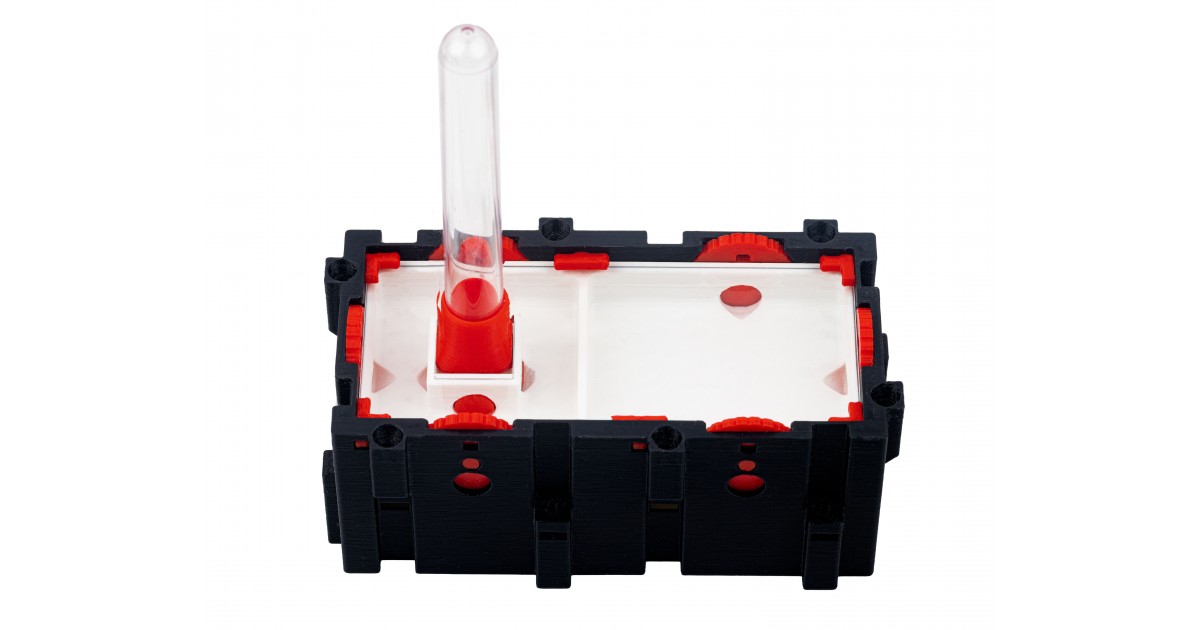
2. First workers: QBIK DUO with large galleries. From Anthouse's Alpha range: modular and rather dry, with the starter tube connected as the moist area at first and small heaps of substrate inside.
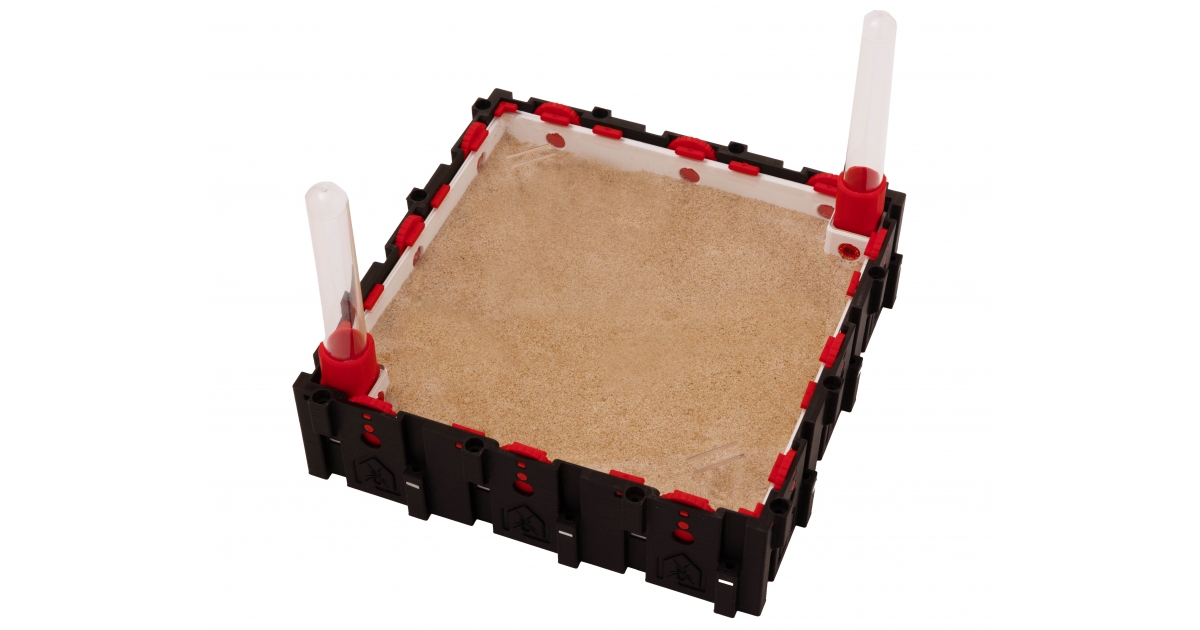
3. Large colony: Qbik Wild NoNa Diáfano. Made of plaster, which holds moisture, and with no pre-designed chambers: it is filled with substrate and the colony digs the nest to its own measure. Ideal for the species that builds the most complex nest in its community (see «Five bull ants in the same scrub: Barnett's study»).
Do not rush the expansions: a small colony in a large nest loses control of humidity and cleanliness. Complete the set-up with:
- A spacious foraging area, with sand, flat stones and bark.
- A wide barrier and a secure lid (see «Escapes and barriers»).
- A water tube with cotton wool and a feeder for sugar, never cotton wool.
- A thermometer next to the nest: with this species it is not optional.
Founding: the queen with brood
At Antomas we sell founding queens with brood, which arrive with eggs, larvae or cocoons. Founding is semi-claustral: unlike a Camponotus, the queen goes out to drink, take sugar and hunt for her larvae. The keys:
- Total darkness. Cover the tube and its small foraging area with opaque card or aluminium foil, in a quiet place, free of vibrations and away from people or animals passing by.
- A brief daily check. Water, sugar and food in place, and leftovers out, without opening or moving the tube.
- Dead or freshly killed prey. Myrmecia queens are keen hunters and detect vibrations, but live prey that fights back can injure them, and an injured queen is a lost founding.
- Hatching, the critical moment. Once the first larvae appear, protein every day: if there is none, the queen may eat them. In a M. dispar journal, about 12 hours without prey were enough to lose a larva.
- Normal losses. One or two cocoons in ten, roughly; if it is many more, check humidity and temperature.
In other Myrmecia, keepers report 6–10 weeks from egg to worker, but for M. nigriscapa the only figure is about three and a half months. With the first workers, everything runs more smoothly: they hunt, tend the brood and look after the cocoons.
A patient queen: what a breeding journal tells us
The only published breeding journal we have found is that of a German keeper on Ameisenforum (2025–2026). It is a single queen, but it shows exactly what to expect:
- A hungry queen. On the first day she accepted a cricket and the next day laid her first egg; she took protein from the tweezers and licked syrup for half an hour at a time.
- Three and a half months to the first worker. First egg in early October and first worker in mid-January, about 14–15 weeks; a few days later, four workers and one pupa.
- And then, nothing. Some six months without laying. An Australian keeper told him this is normal for the species and advised a diapause at 10–15 °C.
- Cold as an alarm clock. After about two months in the cellar, without brood and still accepting protein, by early August there was brood again and, weeks later, a good pile of larvae.
It matches what Barnett saw in the wild. Some Australian sellers speak of laying cycles up to a year apart, with no study to back it up. The lesson: if your queen stops laying after the first batch, she is neither ill nor infertile. She is waiting for her winter.
Arrival and moving by tipping
When she arrives, leave her somewhere dark and quiet at 22–25 °C, check that the tube has water and do not change her tube. To move her into the formicarium, at Antomas we do it by tipping:
- Prepare everything first: the QBIK DUO with its substrate, the barrier and the water.
- Work inside a large box or tray with its own barrier.
- Tip out gently the queen, workers and brood next to the nest entrance, and help stragglers with long tweezers or a thick brush, never with your fingers.
- Leave the nest dark and do not disturb them for a couple of days.
To move them later into a NoNa, the method is the same.
Feeding
Sugar every day, with variety. Adult workers run on sugar: nectar and honeydew in the wild. Most days, sugar or honey water, alternated with Anthouse Blue Sugar Nectar, to which a little protein can be added; one day a week, a tiny piece of ripe fruit. Always in a feeder, never on cotton wool, which goes mouldy and spoils the liquid: a traditional or home-made feeder with the drop spread out and accessible, replaced before it ferments.
Protein according to the larvae. With larvae they hunt eagerly; without them, prey hardly interests them. The amount grows with the larvae, and the prey size with the colony:
- Founding: small prey, dead or freshly killed, daily while there are larvae: Drosophila, firebrats, Thermobia domestica, just the right size for a queen and her first larvae, or a small cricket opened up.
- Young colony: crickets, flies, red runner roaches, Shelfordella lateralis, and chopped mealworms.
- Large colony: prey for 2 cm workers, such as adult crickets, large flies or nymphs of dubia roaches, Blaptica dubia, and, now and then, some live prey to watch them hunt.
Change the insect every week and feed generously, which is the Antomas philosophy: with daily maintenance and leftovers removed, it is better to overfeed, because the colony senses it has more resources and grows faster and in greater numbers. If you cannot clean often, do not overdo it: leftovers bring mould and mites. Use insects from a reliable supplier, free of insecticides, and leave the prey in the foraging area, near the entrance: it will reach the larvae, which feed straight from it.
Diapause: the cold that wakes the queen
At Antomas we recommend a diapause of 3–4 months at 10–15 °C, based on three facts: in the wild it spends winter without brood and the queen only lays in spring and early summer (Barnett 1974); in its range, the daily mean in July is around 10–12 °C; and in the breeding journal, the queen laid again after about two months at 10–15 °C.
The most important warning in this care sheet: after her first batch, your queen may go months without laying. Do not force her with heat or give her up for lost: she needs her winter.
- When. Let the current batch finish and start the diapause when the colony has no larvae or cocoons left. The convenient option is to match it with our winter, and over time the colony falls into step with the European calendar; but if the queen has been idle for weeks despite warmth and food, it can be done then, somewhere stable at 10–15 °C, such as a cellar or a wine cooler.
- How. Lower the temperature gradually, over one or two weeks, and keep it there for 3–4 months. Water always, a little sugar if there are active workers, protein only if they accept it, and minimal checks.
- Afterwards. Raise it just as slowly to 22–26 °C. The queen should lay within a few weeks, and with the larvae comes daily feeding again.
If winter arrives with half-grown larvae, wait until they spin and emerge before cooling: in the wild, this species never winters with brood.
Watch without fear, but with care
Once the colony is established, apply the Antomas rule: ants are there to be enjoyed, watched and learnt from, not kept hidden away. Simply give them their dark area in the nest and a lit foraging area, and watch them gently, stressing them as little as possible. What to expect:
- Activity driven by temperature: no fixed timetable; they come out when the thermometer allows.
- More hunting with larvae: without them, the colony seems uninterested in prey.
- Cautious rather than aggressive: they will rather retreat, although a cornered worker or a queen with larvae will defend herself.
Warning signs:
- Unfinished cocoons or naked pupae: heat or lack of substrate.
- Mouldy cocoons, or cocoons carried out into the foraging area: too much humidity.
- Larvae disappearing during founding: hunger or stress in the queen.
- Workers pacing the edge of the foraging area non-stop: check the barrier.
Escapes and barriers
A loose 2 cm worker, with a sting, does not go unnoticed. They are fast and long-legged, and several Myrmecia climb smooth surfaces, so treat it as a climber from day one:
- A wide barrier of paraffin oil or PTFE at the top of the foraging area, renewed often: some species in the genus jump several centimetres, and PTFE loses effectiveness in high humidity.
- A secure lid and well-fitted connections.
- Nothing that can act as a bridge, including remains of large prey leaning against the wall.
- Take care at feeding time: that is when many escapes happen. Have the food ready, open only as much as needed and close straight away.
Handling and safety
Its sting hurts a lot, far more than a bee or wasp sting, and since the sting does not stay embedded, they can sting several times. In Australia, Myrmecia caused almost nine in ten ant-sting anaphylaxis cases where the species was identified (Brown and colleagues, 2011). No alarmism, but respect:
- Never by hand: long tweezers and calm, without working over the entrance.
- We do not recommend it for people allergic to insect stings, or for homes with small children or pets near the set-up.
- Do not mix queens or colonies, and never release it: it is an exotic species.
What not to do
- Keeping mature larvae above about 28 °C for days, or using heat to speed up the colony.
- Using a nest without substrate.
- Wetting the cocoons, or still watering the tube while the larvae grow.
- Leaving the queen without protein when the eggs hatch, or giving her large live prey.
- Founding in the light or in a busy spot.
- Writing off a queen that stops laying as infertile, or skipping the diapause.
- Cooling half-grown larvae.
- Moving to a large nest too early, or using small galleries.
- Putting sugar on cotton wool, or always giving the same insect.
- Skimping on the barrier, or opening the foraging area without the food ready.
- Handling it by hand, or keeping it within reach of children or pets.
Scientific sources
This care sheet is based on the literature on Myrmecia nigriscapa, the gulosa group and the genus, on distribution records and the climate of its range, and on the experience of Antomas and other keepers. Main references:
- Barnett, J. M. (1974). Ecology and general biology of five sympatric species of Myrmecia (Hymenoptera: Formicidae). PhD thesis, Monash University. doi:10.26180/7658450.v1
- Heterick, B. E. (2009). A guide to the ants of South-western Australia. Records of the Western Australian Museum, Supplement 76: 7–206. doi:10.18195/issn.0313-122x.76.2009.007-206
- Ogata, K. & Taylor, R. W. (1991). Ants of the genus Myrmecia Fabricius: a preliminary review and key to the named species (Hymenoptera: Formicidae: Myrmeciinae). Journal of Natural History 25: 1623–1673. doi:10.1080/00222939100771021
- Ogata, K. (1991). Ants of the genus Myrmecia Fabricius: a review of the species groups and their phylogenetic relationships (Hymenoptera: Formicidae: Myrmeciinae). Systematic Entomology 16: 353–381. doi:10.1111/j.1365-3113.1991.tb00694.x
- Hasegawa, E. & Crozier, R. H. (2006). Phylogenetic relationships among species groups of the ant genus Myrmecia. Molecular Phylogenetics and Evolution 38: 575–582. doi:10.1016/j.ympev.2005.09.021
- Mera-Rodríguez, D., Jourdan, H., Ward, P. S., Shattuck, S., Cover, S. P., Wilson, E. O. & Rabeling, C. (2023). Biogeography and evolution of social parasitism in Australian Myrmecia bulldog ants revealed by phylogenomics. Molecular Phylogenetics and Evolution 186: 107825. doi:10.1016/j.ympev.2023.107825
- Ward, P. S. & Brady, S. G. (2003). Phylogeny and biogeography of the ant subfamily Myrmeciinae (Hymenoptera: Formicidae). Invertebrate Systematics 17: 361–386. doi:10.1071/IS02046
- Greiner, B., Narendra, A., Reid, S. F., Dacke, M., Ribi, W. A. & Zeil, J. (2007). Eye structure correlates with distinct foraging-bout timing in primitive ants. Current Biology 17: R879–R880. doi:10.1016/j.cub.2007.08.015
- Narendra, A., Reid, S. F., Greiner, B., Peters, R. A., Hemmi, J. M., Ribi, W. A. & Zeil, J. (2011). Caste-specific visual adaptations to distinct daily activity schedules in Australian Myrmecia ants. Proceedings of the Royal Society B 278: 1141–1149. doi:10.1098/rspb.2010.1378
- Jayatilaka, P., Murray, T., Narendra, A. & Zeil, J. (2018). The choreography of learning walks in the Australian jack jumper ant Myrmecia croslandi. Journal of Experimental Biology 221: jeb185306. doi:10.1242/jeb.185306
- Dietemann, V., Hölldobler, B. & Peeters, C. (2002). Caste specialization and differentiation in reproductive potential in the phylogenetically primitive ant Myrmecia gulosa. Insectes Sociaux 49: 289–298. doi:10.1007/s00040-002-8316-9
- Robinson, S. D. et al. (2018). A comprehensive portrait of the venom of the giant red bull ant, Myrmecia gulosa, reveals a hyperdiverse hymenopteran toxin gene family. Science Advances 4: eaau4640. doi:10.1126/sciadv.aau4640
- Eagles, D. A. et al. (2022). A peptide toxin in ant venom mimics vertebrate EGF-like hormones to cause long-lasting hypersensitivity in mammals. Proceedings of the National Academy of Sciences 119: e2112630119. doi:10.1073/pnas.2112630119
- Brown, S. G. A., van Eeden, P., Wiese, M. D., Mullins, R. J., Solley, G. O., Puy, R., Taylor, R. W. & Heddle, R. J. (2011). Causes of ant sting anaphylaxis in Australia: the Australian Ant Venom Allergy Study. Medical Journal of Australia 195: 69–73. doi:10.5694/j.1326-5377.2011.tb03209.x