Difficulty: 4/5 – Advanced
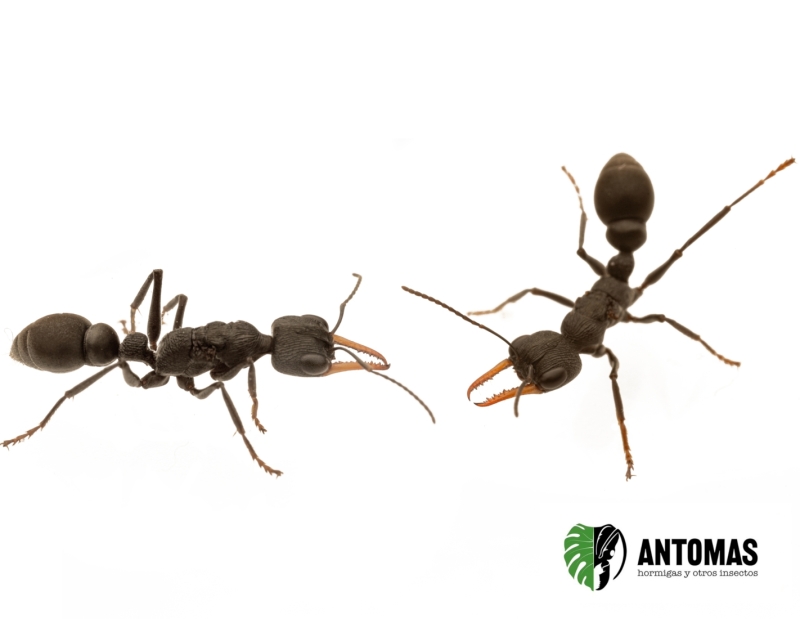
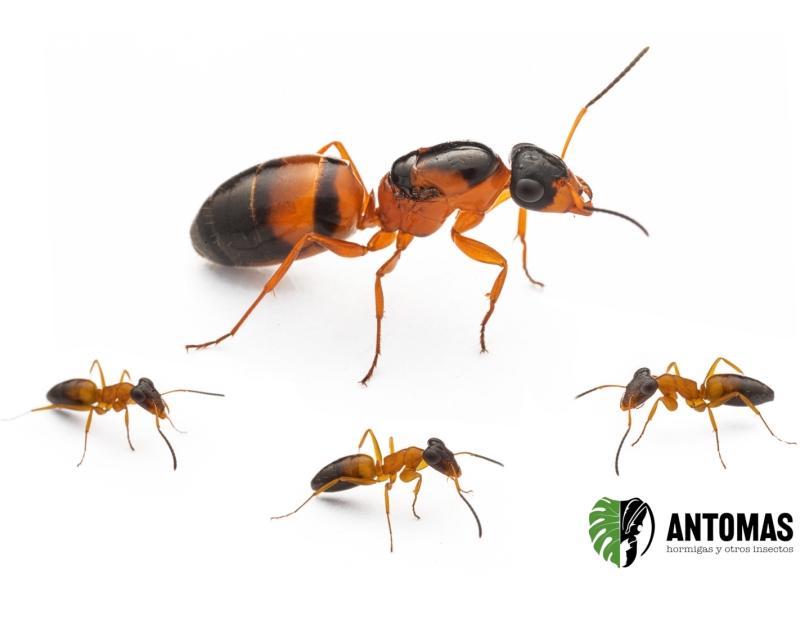
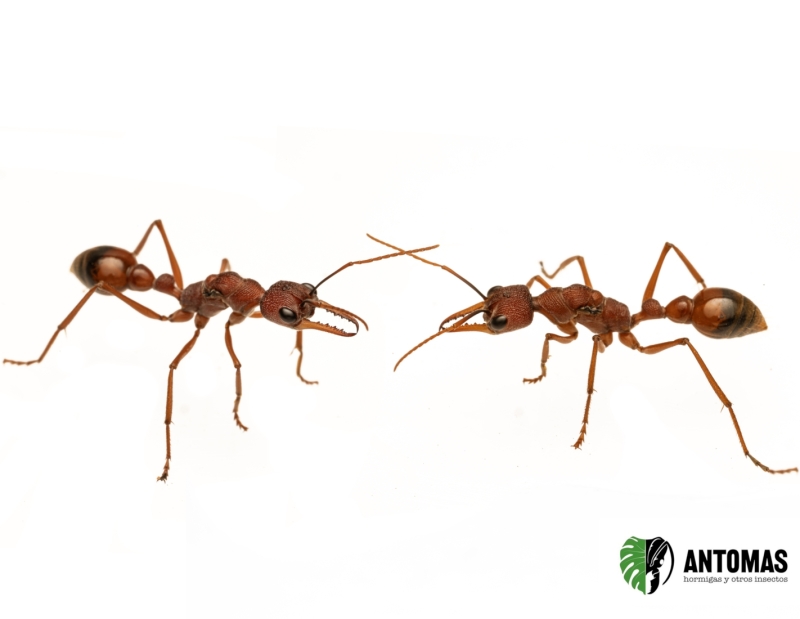
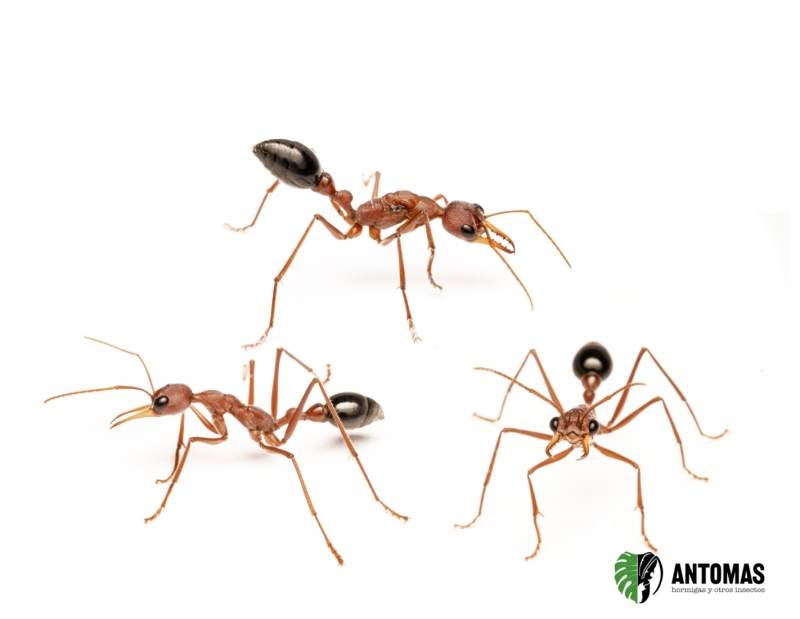
The jumper ant of eastern Australia: a slender, medium-sized bulldog ant with yellow mandibles and a red thorax girdled by a black band, which really does jump, from 7.5 to 10 cm. At Antomas we find it simpler than M. nigriscapa, but sensitive: it takes a practised hand. Founding queens with brood, with semi-claustral founding: a moist starter tube that is left to dry out, fibrous substrate, total darkness and dead prey at first. Nest at 22–26 °C, larvae never above about 28 °C, sugars daily and protein according to the larvae. Optional winter rest of about 3 months. It jumps and climbs: a wide PTFE barrier and a mesh lid. Very painful sting: not suitable for people with allergies or for homes with small children or pets.
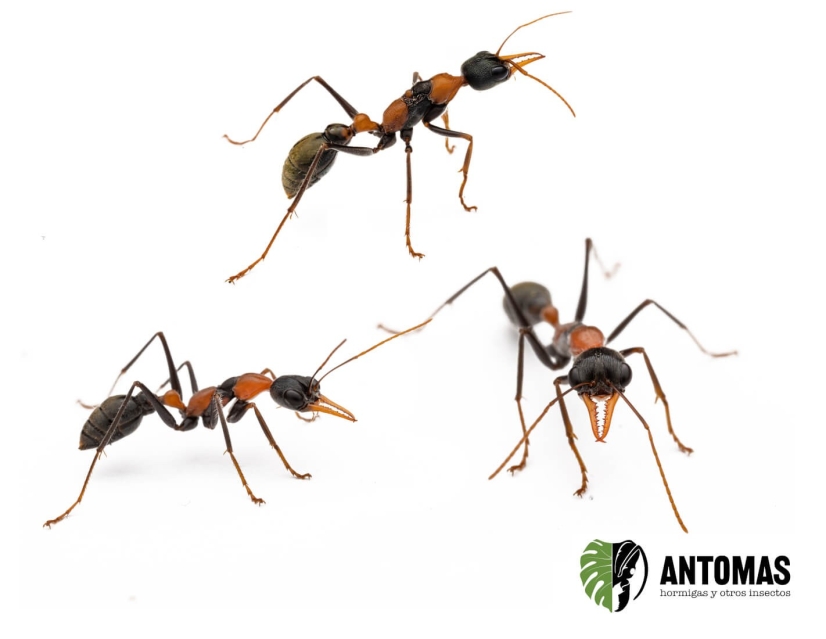
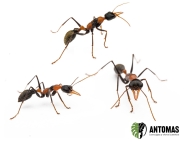
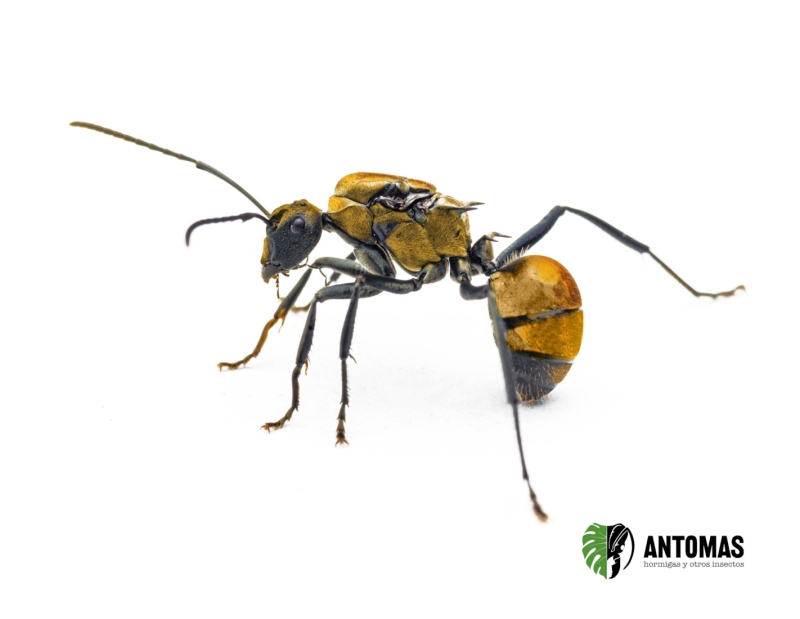
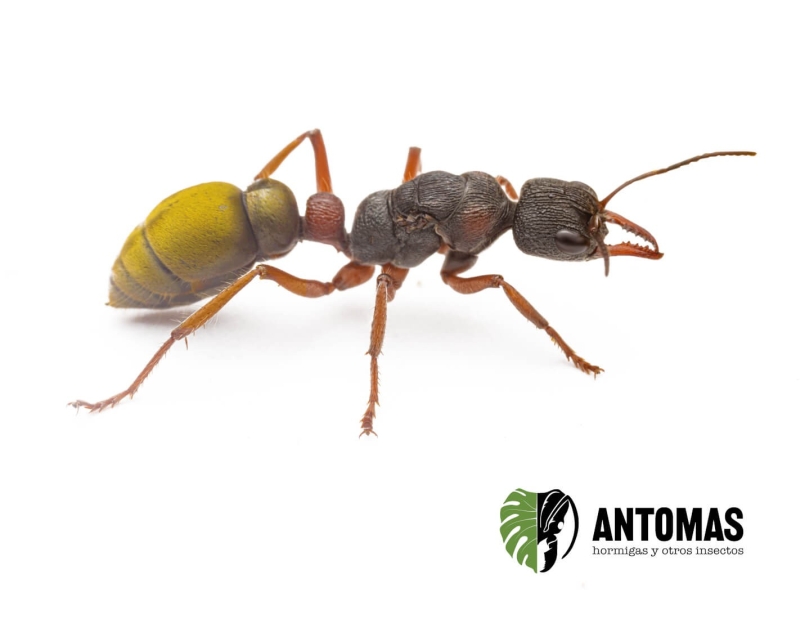
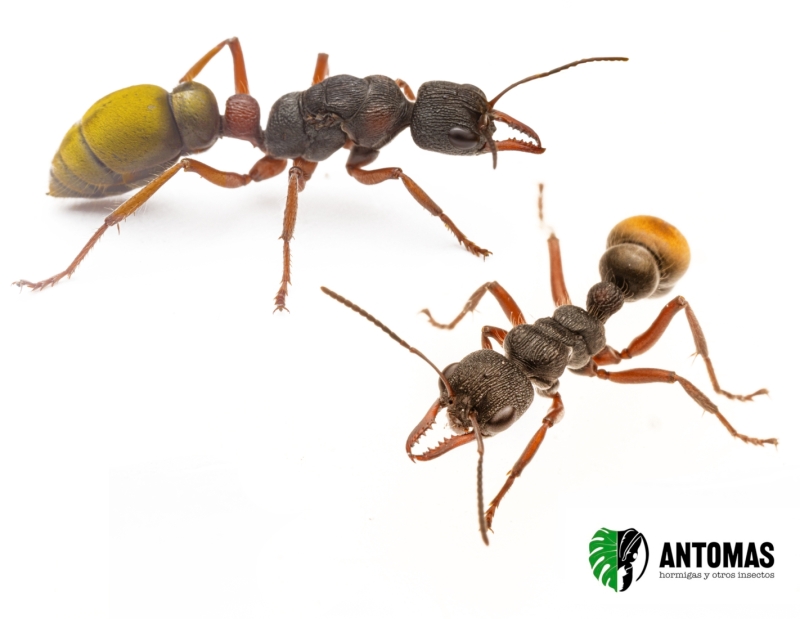
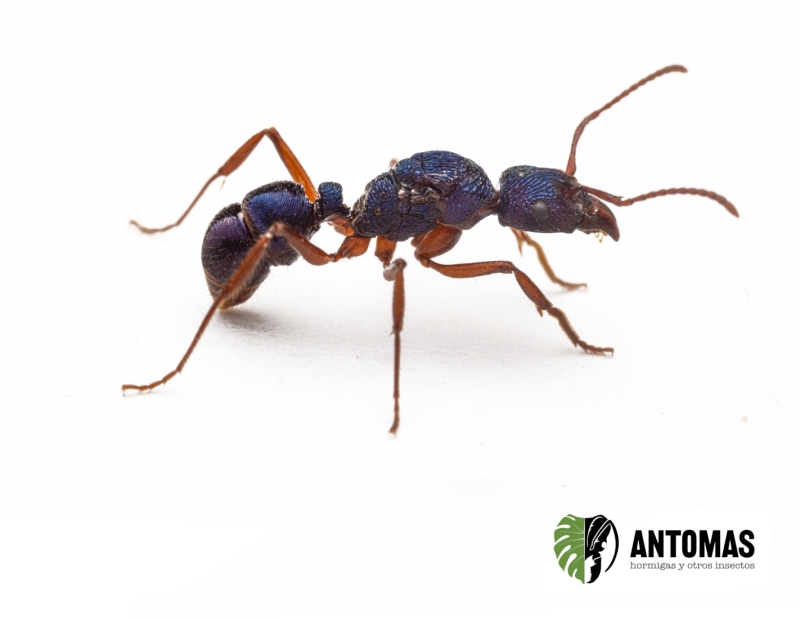
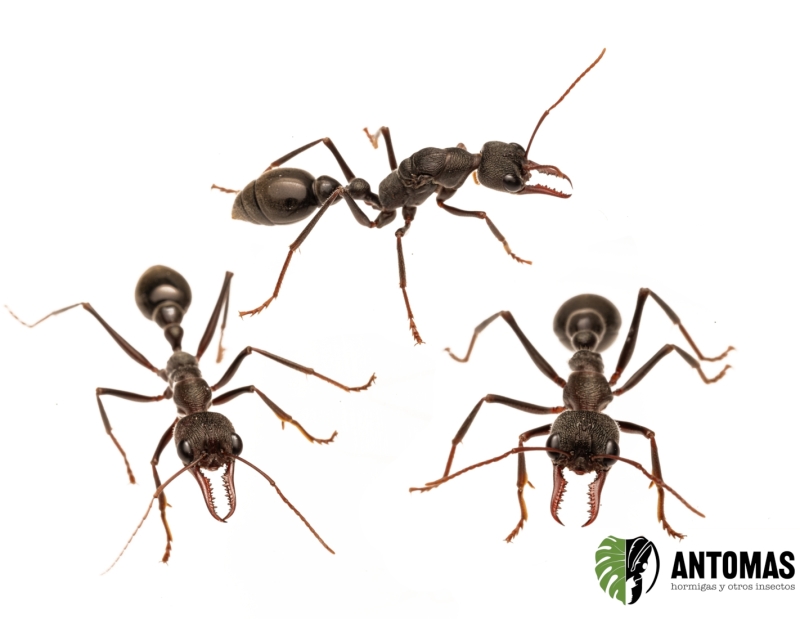
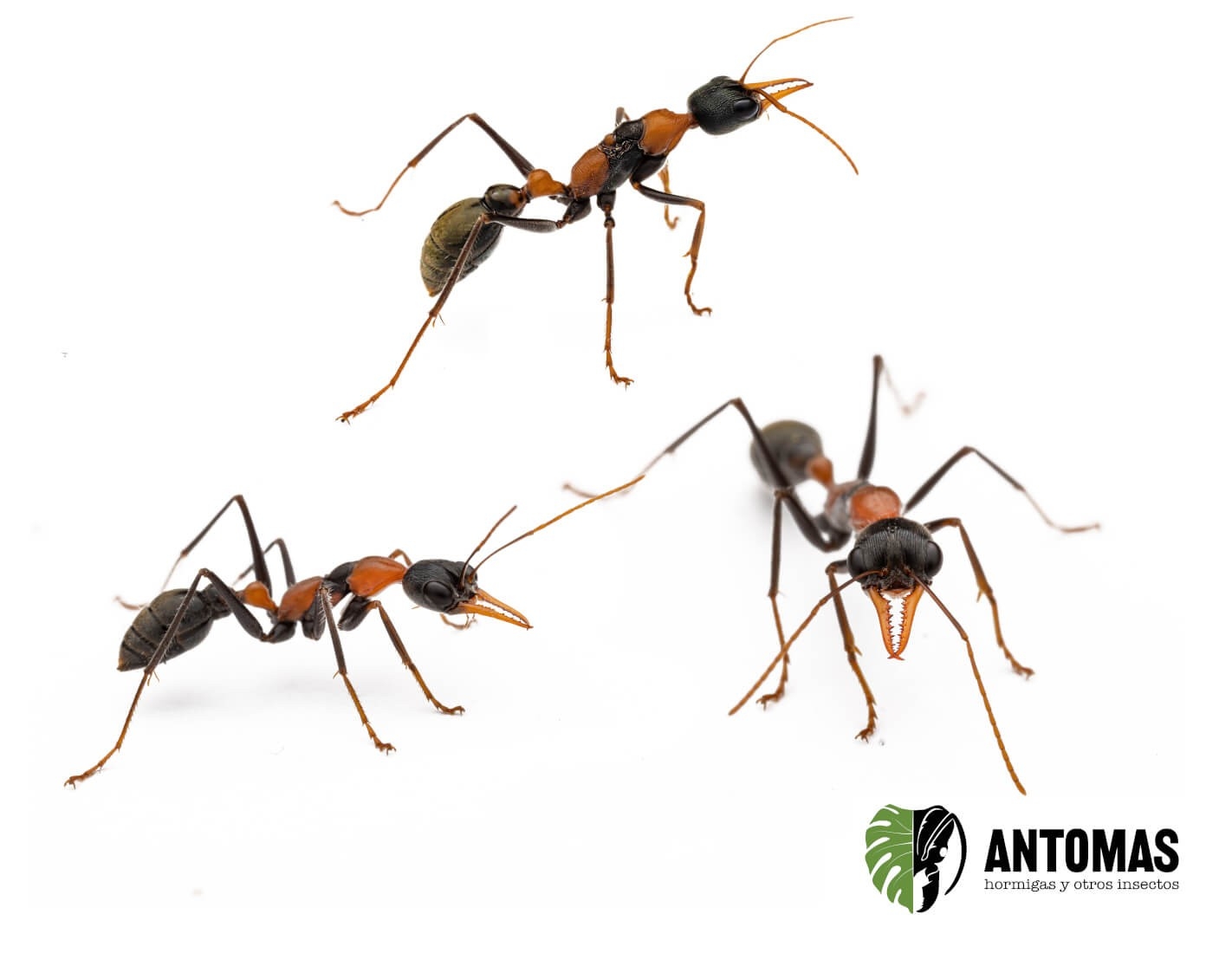
Myrmecia nigrocincta Smith, 1858 is a bulldog ant from eastern Australia: the one Australians call the jumper ant and, in our shop, the Jumper Ant. It is a medium-sized Myrmecia, around 11–15 mm long, slim-bodied and long-legged, with a black head and gaster, a red thorax crossed by a black band and yellow mandibles that stand out against the dark head. And it has a talent that very few ants share: it jumps. It pushes off with its middle and hind legs together, takes off in about 20 milliseconds and lands 7.5–10 cm away.
It is diurnal, hunts by sight and lives in colonies of a few hundred workers with a single queen, who, what is more, cannot fly. Here we separate what is documented about the species, what is known about the genus and what we apply at Antomas, where we sum it up like this: “simpler than nigriscapa, but smaller too”, and “quite sensitive: it takes a practised hand”. If you have already kept semi-claustral ants and want a Myrmecia with character, one that works by day and lets itself be seen, this is your bulldog ant.
Biology
“Girdled in black”: a worker with no locality in the British Museum
Frederick Smith described it in 1858, in the British Museum’s catalogue of ants, from the worker caste. The label said nothing more than “Australia” and a number, “56/43”, probably a museum register number. The specimen is still held at the Natural History Museum in London, under the code CASENT0902805, and its photograph appears in the phylogeny of the genus by Mera-Rodríguez and colleagues (2023). The other castes and the larva came later: the queen was described by Julius Roger in 1861, the male by Gustav Mayr in 1876 and the larva by George and Jeanette Wheeler in 1971.
The name comes from the Latin niger, “black”, and cinctus, “girdled” or “encircled by a belt”. Smith did not explain why he chose it, but one look is enough: the mesonotum, the central part of the thorax, is black and sits wedged between the pronotum and the propodeum, which are red. It is as if the ant wore a black belt around its middle, hence its scientific name.
A lineage of just three species
There are some 93 species of Myrmecia, all Australian except one from New Caledonia, and taxonomists divide them into groups of related species. M. nigrocincta gives its name to one of the smallest, the nigrocincta group, which Kazuo Ogata defined in 1991. According to the key by Ogata and Taylor and the compilations on the genus, it is made up of three species, all from eastern Australia: M. nigrocincta itself, M. flammicollis and M. petiolata, the latter two from north Queensland.
Ogata separated it on the basis of a combination of details that can only be seen under magnification:
- A genal groove, a small furrow between the clypeus and the eye, which within the genus is found only in this group.
- An occipital carina, a fine ridge at the back of the head.
- Mandibles with the teeth in a single row, without the extra lower tooth of the large bulldog ants of the gulosa group.
- Long scapes and legs and a medium-sized, slender body.
Genetics proved him right. Hasegawa and Crozier (2006), using two nuclear genes, recovered the group as a natural branch, and the phylogenomic study by Mera-Rodríguez and colleagues (2023), based on hundreds of regions of the genome, showed that it is one of the few classic groups to remain intact: five of the nine did not survive the analysis. And a surprising detail: although it jumps, M. nigrocincta is not closely related to the jack jumpers of the pilosula group, Australia’s best-known jumping bulldog ants, which sit on a different branch of the tree.
From tropical Queensland to southern Victoria
This is an ant of eastern Australia. The Atlas of Living Australia holds almost 3,700 records: around 2,160 in New South Wales, around 1,500 in Queensland and only a handful in Victoria, South Australia and the Australian Capital Territory. None in Western Australia or the Northern Territory. Its range stretches from 16° south, in the wet tropics of north Queensland, to 38° south, in southern Victoria, but the bulk of the records lie in the coastal and subcoastal strip of south-east Queensland and New South Wales, with its humid subtropical and temperate climate.
For years, some care sheets, ours included, placed it in the west of the country and in tropical climates. That is a mistake, probably arising from confusion with M. ludlowi, the jumper ant of Western Australia, which belongs to the pilosula group. It lives in eucalypt woodland and sclerophyll forest, along rainforest edges and also in the bushland surrounding coastal cities: naturalists photograph it in parks on the urban fringe and even on university campuses, and the vision studies we cite below were carried out with workers collected on one of them.
A calendar the other way round
Across most of its range the climate is mild: summers with average highs of 25–30 °C and coastal winters with daily means of 12–17 °C and no frost, except in the inland mountains, where it does freeze. Naturalists’ records paint a clear picture of its year. Activity peaks in September, at the start of the austral spring, and stays high into summer; in June, July and August, the austral winter, only one in ten observations is made, and the lull is more marked in the south than in the tropical north, where there is hardly any winter. And it is strictly diurnal: in a sample of time-stamped observations, all fall between eight in the morning and six in the evening, and none is nocturnal.
For keeping it in Europe, the clue is in the heading: its seasons run the other way round from ours. Its winter is our summer, and for the first few months a colony may be out of step with our calendar (see “Winter rest and the austral clock”).
A bulldog ant that really jumps
Many care sheets say so, and in this case it is true and has been measured. Aibekova and colleagues (2023) filmed its jumps with high-speed cameras and scanned its anatomy:
- Take-off in about 20 milliseconds, at a speed of 0.44 m/s.
- Middle and hind legs together: the middle legs leave the ground a split second before the hind legs.
- A jumper’s legs: the hind leg measures 122% of body length, compared with 83% in Nothomyrmecia macrops, its closest relative outside the genus, which does not jump.
- An athlete’s muscles: the trochanter depressors, which extend the leg during the jump, are 4.5 times larger in the middle legs and 6.5 times larger in the hind legs than in Nothomyrmecia.
The jump covers 7.5–10 cm, according to the classic work by John Clark (1951), and the ant uses it to launch itself at prey or at an intruder. It is a rarity: forward jumping with the legs has evolved in only four, very distantly related ant genera, Myrmecia, Harpegnathos, Odontomachus and the South American Gigantiops destructor. And within Myrmecia jumping is more widespread than was once thought: in a recent Macquarie University thesis, of eight species from four groups, five jumped.
Some 2,500 facets per eye
It is a diurnal, visual hunter. Each worker sets out alone, works its way over low vegetation and tree trunks, spots its prey by sight, seizes it with its mandibles and finishes it off with its sting, without recruiting nestmates. Its eyes have been studied directly. Palavalli-Nettimi and colleagues (2019) used electroretinography to measure the resolving power and contrast sensitivity of four diurnal ants, M. nigrocincta among them, and Ogawa and colleagues (2023) later compiled its data:
- Around 2,480 facets in each compound eye.
- Facets 20.5 µm in diameter.
- Acuity of 0.52 cycles per degree, its ability to make out fine detail, with peak contrast sensitivity for large, blurry objects.
In other words: it cannot read the small print, but it is very good at picking up large shapes and changes in light, such as a passing silhouette. You will notice this at home: in Antomas’s experience, they get stressed just by you walking past the set-up. It is not bad temper, it is simply how it sees the world, and the reason why founding is done in the dark (see “Eyesight, stress and observation”).
The thorax that became a model
When a team of morphologists set out to describe, muscle by muscle, the thorax of an ant from an ancient lineage, they chose M. nigrocincta. Liu and colleagues (2019) scanned it using X-ray microtomography and reconstructed the skeleton and musculature of the worker’s mesosoma in 3D, as a reference for studying how that part of the body was transformed over the course of ant evolution. It is a modest honour, but it makes sense: Myrmecia retain many traits regarded as ancestral among ants, and the present-day genus is, according to the 2023 phylogeny, around 29 million years old.
A queen that cannot fly
The queen of M. nigrocincta is brachypterous: she has short wings that are no use for flying, as William Morton Wheeler noted in 1933 and Clark in 1951. That is why there is no nuptial flight of queens as in most ants. In all likelihood they mate near their home nest, with winged males that can fly, and the queen then walks away to found her own colony. Records of winged males are concentrated in late winter and the austral spring, from August to October, and one naturalist photographed some twenty of them flying at midday in September.
Founding is semi-claustral, as in almost the entire genus: the queen does not live on her reserves alone, but goes out to drink, take sugars and hunt for her first larvae, something already described by Caryl and Edna Haskins (1950) in their classic studies of bulldog ants. Myrmecia queens are determined hunters: they sense vibrations and pounce on anything that moves. In captivity, that has its risks (see “Founding: the queen with brood”).
570 workers underground
No censuses of its colonies have been published. The only scientifically based field record is a 2007 excavation in northern New South Wales: one queen, 570 workers, 75 cocoons, larvae and eggs (C. Peeters, unpublished data reported on AntWiki). Some compilations, without a clear primary source, speak of colonies of 400 to 1,200 individuals, with a single queen.
The nest is in the ground, often in sandy soil, next to a tussock, a shrub or the base of a tree. According to Australian naturalists, it is sometimes topped with a small mound camouflaged with twigs, leaves and gravel.
Larvae with a healthy appetite
Bulldog ants raise their young the old-fashioned way: the larvae are not fed mouth to mouth, but feed directly on the pieces of insect that the workers leave beside them. A mature M. nigrocincta larva measures almost a centimetre, about 9.7 mm according to the description by Wheeler and Wheeler (1971), and eats accordingly: one Australian keeper reported that, with the colony in full spring swing, the larvae polished off a whole cricket, exoskeleton included, in 6–8 hours.
To spin its cocoon, each larva needs particles around it to anchor the silk, which is why the nest substrate is so important in captivity (see “Fibrous substrate: the raw material for cocoons”). And the queen, as we say at Antomas, is “a bit useless” with the brood: her care is primitive, she sometimes neglects or mistreats it, and if the first larvae hatch with no food to hand she may eat them.
A venom with its own signature
Like all Myrmecia, it has a functional sting, and its venom has a personality of its own. Street and colleagues (1994) analysed six venoms from the genus, including this one, and found in each of them four to six proteins capable of triggering allergies. The major Australian study of ant sting anaphylaxis (Brown and colleagues, 2011) turned up another curious finding: of the people allergic to M. nigrocincta, a third reacted only to its venom and not to that of other bulldog ants, so the treatment used for allergy to jack jumpers is of no use to them. The cases were concentrated on the north coast of New South Wales and in south-east Queensland, the heart of its range.
That is no reason to be afraid of it, but it is a reason to treat it with respect: always handle it with tools, never with your hands (see “Handling and safety”).
What we still don’t know
For one of the commonest bulldog ants in eastern Australia, many questions remain open: its chromosome number (the karyotype was published in 1977, but we have not been able to consult it), how long a queen lives and what its nest looks like inside. Every colony that grows in a formicarium adds something that has not yet been written down.
Size and morphology
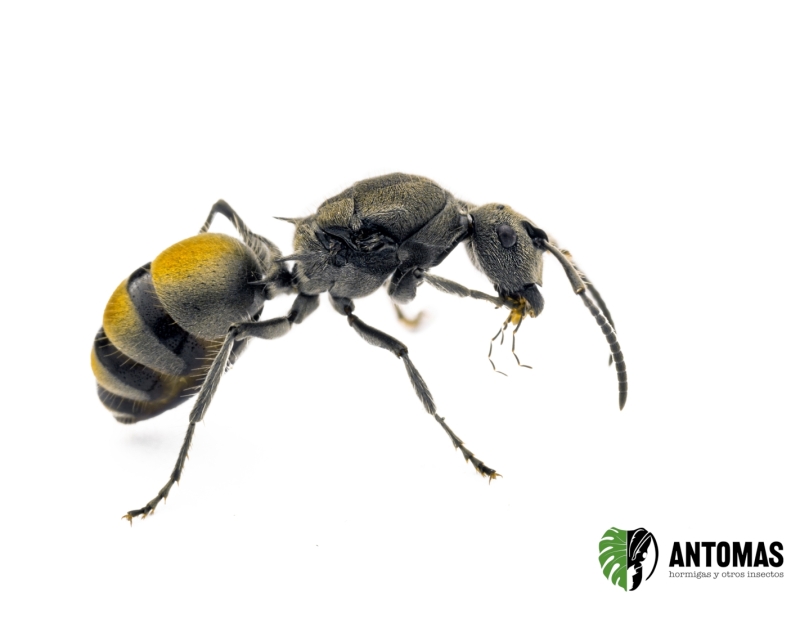
A medium-sized, slender Myrmecia, with long legs and scapes, long toothed mandibles and a functional sting. There are no soldiers: the workers vary somewhat in size, but they all share the same shape, and the queen looks like a large worker with a bulkier thorax and short wings that are no use for flying.
- Colouration. Head, gaster and legs black or dark brown; pronotum, propodeum, petiole and postpetiole red or yellowish red, and between them the black mesonotum, the “girdle” of the name.
- Mandibles. Pale yellow, in sharp contrast with the dark head. This is the feature that separates it from its closest relative, M. flammicollis, which has blackish mandibles. They bear four or five large teeth, in addition to the apical one, in a single row.
- Head. With fine longitudinal striations, large eyes, an occipital carina and the genal groove characteristic of its group.
- Thorax. With fine transverse striations; the nodes of the petiole and postpetiole smooth and shiny.
- Legs. Long and slender, with spurs on the middle and hind tibiae.
- Gaster. Shiny, with a silky grey pubescence and a few long, pale hairs at the tip, where the sting is.
- Brood. The larvae spin cocoons; a naked pupa is a sign that something has gone wrong (see “Heat: the 28 °C limit”).
In one Australian keeping diary, newly emerged workers were a bright orange and darkened within a few days. Some compilations mention dark mandibles depending on the area, but the identification key is clear: in M. nigrocincta, they are yellow.
Approximate sizes
- Workers: about 11–15 mm (10.6 mm for the type specimen; 12.25 mm on average in a laboratory study)
- Queen: about 17–19 mm
- Male: about 16–17 mm
- Mature larva: about 9.7 mm
The type specimen measures “5 lines” in Smith’s description (1858), about 10.6 mm, and Aibekova and colleagues (2023) measured an average of 12.25 mm. The other figures are those given in the compilations, based on Clark (1951), whose original we have not been able to consult; the larval figure comes from Wheeler and Wheeler (1971).
Care in captivity
Difficulty: 4/5 – Advanced
It is not the easiest bulldog ant, but nor is it the most demanding. We compare it with M. nigriscapa, the giant we rated 5/5: nigrocincta is “simpler”, diapause is not as decisive and, being smaller, it develops faster than the large species. Even so, we rate it 4/5 – Advanced because:
- It forgives few mistakes. It is a sensitive species, and without a daily check it is very hard to bring it through.
- Delicate founding. The queen is semi-claustral and a poor carer of brood; the first workers are the turning point.
- Demanding cocoons. The larvae need substrate to spin, humidity that drops at its own pace and no excessive heat.
- Eyesight and stress. Any nearby movement unsettles it, especially during founding.
- It jumps, climbs and stings. It needs a set-up with no gaps and handling with tools.
If you are looking for your first bulldog ant and want to play it safe, we advise waiting until M. pavida or M. nigriceps are available, as they are more forgiving. If you already have experience with semi-claustral ants, M. nigrocincta is a bulldog ant that is easy to watch: active by day, quick and with that unforgettable jump.
Recommended parameters
- Nest temperature: 22–26 °C during the active season, with one side slightly warmer but no higher than 27 °C.
- Mature larvae: never above about 28 °C for any sustained period.
- Foraging area: room temperature; once the colony is established, one end away from the nest can reach 28–30 °C by day, with a drop of a few degrees at night, as in its native climate.
- Humidity: in a gradient; moist for the eggs and small larvae, dry and well ventilated for the cocoons. The foraging area, drier.
- Substrate: always inside the nest, with plant fibre.
- Water: always available, in a test tube with water and cotton wool in the foraging area.
- Light: total darkness during founding; afterwards, a dark nest and a foraging area with daylight, 12–14 hours during the active season.
- Winter rest: optional, about 3 months at 15–18 °C.
Heat: the 28 °C limit
This is the heat guideline that we apply to the whole genus: when mature larvae spend days above about 28 °C, they die or have trouble spinning, and the European summer is when we see the most problems. It is a practical keeping guideline, not a mechanism proven in the laboratory.
In M. nigrocincta there is a curious twist: in one Australian keeping diary, two larvae pupated without a cocoon even though they had substrate, and one of those naked pupae went on to become a worker. If you see one, do not give it up for lost: leave it in a dry, clean part of the nest and check the temperature and the substrate. In practice:
- Work within the 22–26 °C range and do not try to speed the colony up with more heat.
- If you use heating, keep it gentle, on one side only and with a thermostat, never under the brood chamber.
- In summer, the coolest corner of the house, away from the sun and from appliances that give off heat; with air conditioning if need be.
- A thermometer next to the nest is not optional with this species.
Humidity in two stages
The eggs and small larvae of Myrmecia appreciate humidity; the cocoons cope with it badly. A soaked cocoon suffocates, and the workers end up carrying it out of the chamber. Our guideline solves this with a method that needs no gadgets:
- A moist start. The queen begins in a well-hydrated starter tube or module.
- Gradual drying. While the larvae grow, no more water is added: the reserve gradually runs down on its own.
- Spinning in the dry. When the larvae look for a place to spin, the humidity has already dropped to just the right level.
Be careful: drying out is not the same as parching. The species lives in a humid coastal strip, and in another keeping diary the larvae were dying because the nest was losing water too quickly; the workers carried the brood to wet sand as soon as they found it. If the tube runs out of water too early, top it up with a dropper, well away from the brood, because excess water that reaches the larvae will also kill them. Connecting a dry module alongside seems logical, but it depends on the queen moving the cocoons, and she does not always do so. With workers, the arrangement becomes simpler: one slightly moist area, another dry and well ventilated, and they put everything in its proper place.
Fibrous substrate: the raw material for cocoons
A Myrmecia larva does not spin its cocoon in a vacuum: it needs grains and fibres around it to anchor the silk. That is why we insist on a good substrate mix inside the nest. What we suggest at Antomas:
- In the founding tube: a thin layer of sand and sieved soil with a little shredded plant fibre.
- In the formicarium: small heaps of sieved soil, fine and medium-grain sand, a pinch of clay and coco coir or crushed dry leaf litter, spread around the chambers without filling them. It should not be dust: the queen and the workers must be able to pick it up in their mandibles.
- Topping up: when you see the chambers bare of material, add a little more. The workers carry it and pile it up next to the larvae that are about to spin.
Recommended formicarium
With this species, always use Anthouse Qbik Wild formicaria, made of plaster, which hold moisture and spread it: never one from the Alpha range, because it needs a nest that keeps the moisture in. The set-up grows with the colony, and at every step the same idea applies: moisture where the small brood is and dryness where the larvae spin.
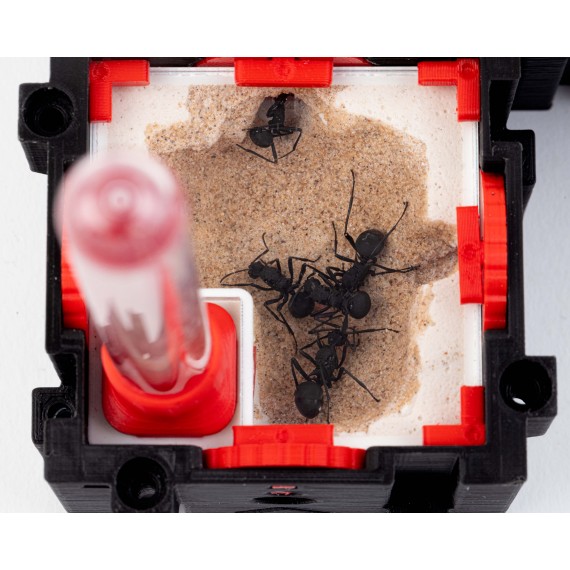
1. Founding: Qbik Wild One P 1C. Small, easy to keep dark and moist at first, connected to a mini foraging area where food can be left without opening the queen’s chamber. If you prefer to start even smaller, the Qbik Wild Fundación also works.
2. Expansions: Qbik Wild Duo P 2C Híbrido. In Antomas’s experience, the hybrids work very well for expanding, even once the colony is large.
3. Large colony: Qbik Wild NoNa with large galleries. For large colonies, the Qbik Wild NoNa models with several large galleries; neither the Diáfano nor those with very convoluted galleries.
Do not jump ahead: in a nest that is too big, a small colony cannot control the humidity and the empty corners end up as rubbish tips. Complete the set-up with:
- A large, tall foraging area, with sand, flat stones and a branch or piece of bark: in the wild it hunts over low vegetation and tree trunks, and it likes to have something to climb. Keep the branches well away from the barrier.
- A tight-fitting mesh lid and a wide barrier (see “Escapes: an ant that jumps and climbs”).
- A water tube with cotton wool and a feeder for sugars, never cotton wool.
- A thermometer next to the nest.
Founding: the queen with brood
At Antomas we sell founding queens with brood: they arrive with eggs, larvae or cocoons already under way. Founding is semi-claustral, so the queen needs water, sugar and prey from day one. What makes the difference:
- Total darkness. Cover the tube and its mini foraging area with opaque card or aluminium foil and place them somewhere quiet, free of vibrations and away from people or animals passing by. At this stage, any visual stimulus overwhelms her.
- A brief daily check. Water, sugar, food and leftovers, looking from the outside and without moving the tube.
- Dead or freshly killed prey. Myrmecia queens detect vibrations and pounce on anything that moves, but live prey that fights back can injure them. With this species in particular, we prefer to offer it dead at first.
- Hatching, the critical moment. When the first larvae hatch, food every day: if there is none, the queen may eat them.
- Small batches of eggs. During founding, the queen lays in short batches, two to five eggs according to one keeping diary, and it is normal to have weeks with no laying between one batch and the next.
- Normal losses. In Myrmecia it is normal to lose the odd cocoon, one or two in every ten. If many are lost, check the humidity and the temperature.
How long does it take? Going by the dates in an Australian keeping diary, with a large colony in full spring swing, about 12 weeks from egg to worker, five or six of them as a cocoon; with a lone queen, the first batch can take several months. Once the first workers arrive, hunting and tending the brood, everything runs much more smoothly.
Arrival and moving by tipping
When it arrives, leave it somewhere dark and quiet at 22–26 °C, check that the tube has water and do not transfer it to another tube. When the time comes to move it into the formicarium, at Antomas we do it by tipping, and with a species that jumps it pays to prepare carefully:
- Everything ready beforehand: the Qbik Wild with its substrate, the water tube connected, the barrier in place and the nest area in darkness.
- Inside a large box or tray with its own barrier, in case a worker jumps out.
- Gentle tipping of the queen, workers and brood next to the nest entrance, helping any stragglers along with long tweezers or a thick paintbrush, never with your fingers.
- Calm afterwards: cover it and leave the colony undisturbed for a couple of days.
For later expansions, the method is the same. Some shops advise waiting until there are 10–15 workers before moving to a larger nest; at Antomas we prefer to watch the colony: when the tube becomes too small, dirty or runs out of water, the time has come.
Feeding
Sugars every day, with variety. Adult workers live on sugars, and our rule is not to give them the same thing every time. At Antomas we recommend Anthouse Blue Sugar Nectar 4–5 days a week and sugar water or honey water on the other days; on one of those days, add a very small piece of ripe fruit, such as banana, apple or grape, and remove it before it ferments. A little protein can be added to the nectar. Liquid sugars should always go in a feeder, never on cotton wool, which goes mouldy and spoils the liquid in no time: a traditional or home-made feeder where the drop sits spread out and within easy reach.
Protein according to the larvae. Without larvae, the colony shows little interest in prey; with larvae, it asks for it daily, and the amount and size of prey grow with them. The basis should always be real insects: “no substitutes as the main protein source”, as one keeper experienced with Myrmecia puts it.
- Founding: small prey, dead or freshly killed. Firebrats, Thermobia domestica, are just the right size for a queen and her first larvae; also suitable are Drosophila and newly hatched crickets, which in one keeping diary the queen left directly on the brood.
- Young colony: small crickets, flies, nymphs of red runner roaches, Shelfordella lateralis, and mealworms cut in half: left whole, they harden and the ants leave them.
- Large colony: medium crickets, large flies and dubia roach nymphs, and every now and then a small live prey item so you can watch them jump on it.
Change the insect every week and feed generously: that is the Antomas philosophy. With daily maintenance and leftovers removed, it is better to overfeed, because the colony understands that it has resources to spare and grows faster and larger. If you will not be able to clean often, do not overdo it: leftovers bring mould and mites. Use insects from a reliable supplier, free of insecticides, and leave them in the foraging area, close to the nest entrance.
Winter rest and the austral clock
Our experience is clear: in M. nigrocincta diapause is not as vital as in other Myrmecia, although you can give it a rest of about 3 months. This fits its climate: mild, frost-free coastal winters, and only one in ten of the year’s observations falls in June–August, with the drop most marked in the south of its range. At Antomas we suggest a rest of about 3 months at 15–18 °C during our winter:
- Lower the temperature gradually, over one or two weeks, and raise it the same way at the end.
- Do not take it below about 12 °C: this is a cool winter, not the cold of a European species’ diapause.
- During the rest, water at all times, a little sugar and protein only if they accept it or if there are larvae still growing.
- With the warmth, laying resumes and, with the larvae, so does daily feeding.
The first summer can be confusing. For the first few months the colony may follow the southern hemisphere’s clock, where winter runs from June to August. Between June and September the queen may slow down her laying or the colony may eat less, even though it is warm. Do not cool it down in summer or assume it is ill: keep offering food, make sure the nest does not go above 27 °C and let it gradually fall into step with our calendar.
Eyesight, stress and observation
In our experience, it is a species that gets stressed “just by you walking past”, and that makes sense: it sees very well and reacts even to a shadow. That is why founding is done in the dark. Once the colony is established, however, the Antomas rule applies: ants are there to be enjoyed, observed and learned from, not kept hidden away. Simply keep the nest dark and the foraging area lit, and observe them gently, stressing them as little as possible: over time they get used to your presence, and watching them hunt by day is one of the great pleasures of this species. Learn to read them and check the colony every day.
Warning signs:
- Naked pupae or unfinished cocoons: heat or lack of substrate.
- Mouldy cocoons or cocoons carried out to the foraging area: too much humidity.
- Larvae that shrivel or disappear: lack of water or food.
- Dead workers after a move or a scare: stress; give them calm and space.
- Workers endlessly patrolling the edge of the foraging area: check the barrier.
Escapes: an ant that jumps and climbs
A worker that jumps 7.5–10 cm and that, according to one Australian keeper, climbs smooth surfaces far better than M. forficata calls for a set-up designed with it in mind. One keeper even saw some Myrmecia race across an oil barrier, carried by the momentum of an attack. What we recommend:
- A tight-fitting metal mesh lid, with no gaps.
- A wide PTFE barrier on the upper part of the foraging area walls, renewed often: it loses effectiveness with humidity and dust. Oil only as back-up.
- Walls with margin to spare, so that a jump cannot reach the rim, and nothing that can act as a bridge: no branches or debris resting near the barrier.
- Secure connections and plugs: a cotton wool plug that pops out when you connect a tube means a mass escape.
- Take care at feeding time: that is when most escapes happen. Have the food ready, open only as much as needed and close straight away; better still, use a tube or a hatch for feeding without opening the lid.
Handling and safety
Its sting hurts considerably more than a bee or wasp sting, and since the sting does not stay lodged in the skin, it can sting several times. One Australian keeper said it hurt for days. No alarmism, but with respect:
- Never with your hands: long tweezers, slow movements and no working directly above the nest entrance.
- We do not recommend it for people allergic to hymenopteran stings, or for homes with small children or pets.
- Do not combine queens or colonies, and never release it: it is an exotic species.
What not to do
- Keep mature larvae above about 28 °C for days, or use heat to speed up the colony.
- House it in a nest without substrate.
- Wet the cocoons or keep adding water to the tube while the larvae are growing.
- Let the nest dry out completely with larvae inside.
- Leave the queen without protein when the eggs hatch, or give her live prey during founding.
- Found the colony in the light or in a busy area.
- Cool it down during our summer because the queen slows her laying.
- Move it into a large nest too early.
- Put sugar on cotton wool or always give the same insect.
- Rely on an oil barrier without a lid, or open the foraging area without the food ready.
- Handle it with your hands or keep it in a home with small children or pets.
Scientific sources
This care sheet is based on the literature on Myrmecia nigrocincta, its species group and the genus, on distribution records and the climate of its range, and on the experience of Antomas and other keepers. Main references:
- Ogata, K. (1991). Ants of the genus Myrmecia Fabricius: a review of the species groups and their phylogenetic relationships (Hymenoptera: Formicidae: Myrmeciinae). Systematic Entomology 16: 353–381. doi:10.1111/j.1365-3113.1991.tb00694.x
- Ogata, K. & Taylor, R. W. (1991). Ants of the genus Myrmecia Fabricius: a preliminary review and key to the named species (Hymenoptera: Formicidae: Myrmeciinae). Journal of Natural History 25: 1623–1673. doi:10.1080/00222939100771021
- Hasegawa, E. & Crozier, R. H. (2006). Phylogenetic relationships among species groups of the ant genus Myrmecia. Molecular Phylogenetics and Evolution 38: 575–582. doi:10.1016/j.ympev.2005.09.021
- Mera-Rodríguez, D., Jourdan, H., Ward, P. S., Shattuck, S., Cover, S. P., Wilson, E. O. & Rabeling, C. (2023). Biogeography and evolution of social parasitism in Australian Myrmecia bulldog ants revealed by phylogenomics. Molecular Phylogenetics and Evolution 186: 107825. doi:10.1016/j.ympev.2023.107825
- Aibekova, L., Keller, R. A., Katzke, J., Allman, D. M., Hita-Garcia, F., Labonte, D., Narendra, A. & Economo, E. P. (2023). Parallel and divergent morphological adaptations underlying the evolution of jumping ability in ants. Integrative Organismal Biology 5: obad026. doi:10.1093/iob/obad026
- Palavalli-Nettimi, R., Ogawa, Y., Ryan, L. A., Hart, N. S. & Narendra, A. (2019). Miniaturisation reduces contrast sensitivity and spatial resolving power in ants. Journal of Experimental Biology 222: jeb203018. doi:10.1242/jeb.203018
- Ogawa, Y., Jones, L., Ryan, L. A., Robson, S. K. A., Hart, N. S. & Narendra, A. (2023). Physiological properties of the visual system in the Green Weaver ant, Oecophylla smaragdina. Journal of Comparative Physiology A 209: 489–498. doi:10.1007/s00359-023-01629-7
- Liu, S.-P., Richter, A., Stoessel, A. & Beutel, R. G. (2019). The mesosomal anatomy of Myrmecia nigrocincta workers and evolutionary transformations in Formicidae (Hymenoptera). Arthropod Systematics & Phylogeny 77: 1–19. doi:10.26049/ASP77-1-2019-01
- Haskins, C. P. & Haskins, E. F. (1950). Notes on the biology and social behavior of the archaic ponerine ants of the genera Myrmecia and Promyrmecia. Annals of the Entomological Society of America 43: 461–491. doi:10.1093/aesa/43.4.461
- Imai, H. T., Crozier, R. H. & Taylor, R. W. (1977). Karyotype evolution in Australian ants. Chromosoma 59: 341–393. doi:10.1007/BF00327974
- Street, M. D., Donovan, G. R., Baldo, B. A. & Sutherland, S. (1994). Immediate allergic reactions to Myrmecia ant stings: immunochemical analysis of Myrmecia venoms. Clinical & Experimental Allergy 24: 590–597. doi:10.1111/j.1365-2222.1994.tb00957.x
- Brown, S. G. A., van Eeden, P., Wiese, M. D., Mullins, R. J., Solley, G. O., Puy, R., Taylor, R. W. & Heddle, R. J. (2011). Causes of ant sting anaphylaxis in Australia: the Australian Ant Venom Allergy Study. Medical Journal of Australia 195: 69–73. doi:10.5694/j.1326-5377.2011.tb03209.x