Difficulty: 3/5 – Advanced
One of the largest Pheidole in the world, with giant-headed soldiers and an ocellus on the forehead. Humid nest, 24–28 °C and no hibernation: a barely studied species that does well at home.
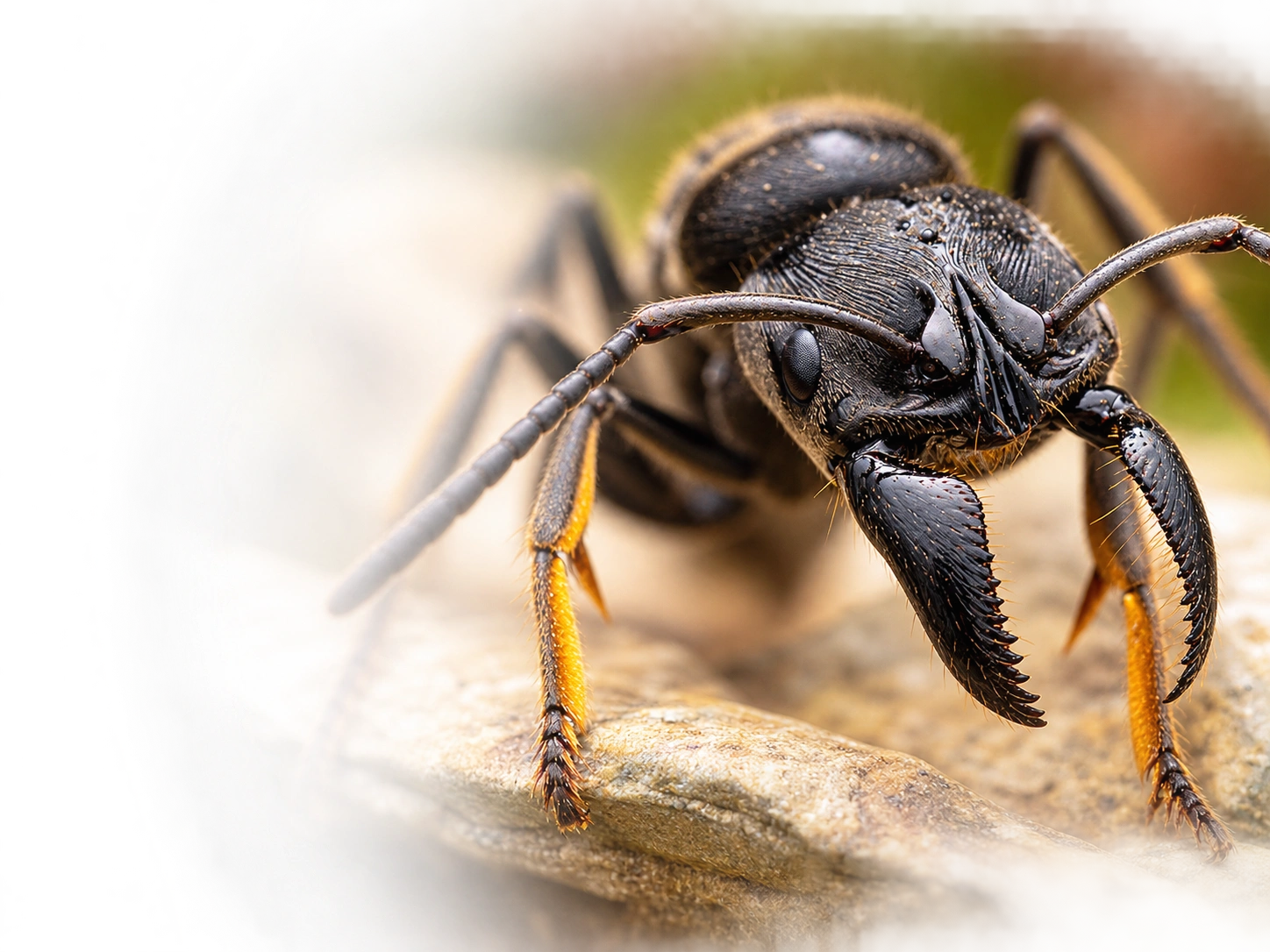
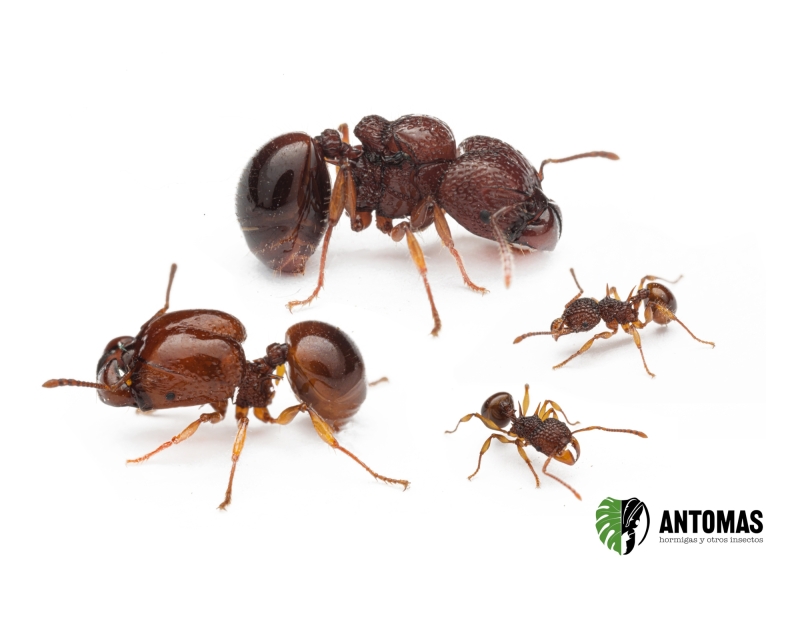
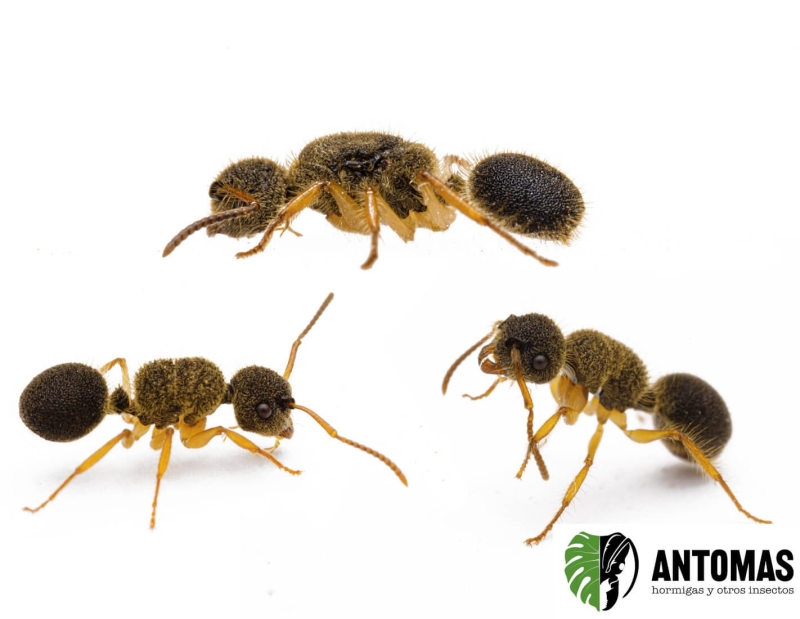
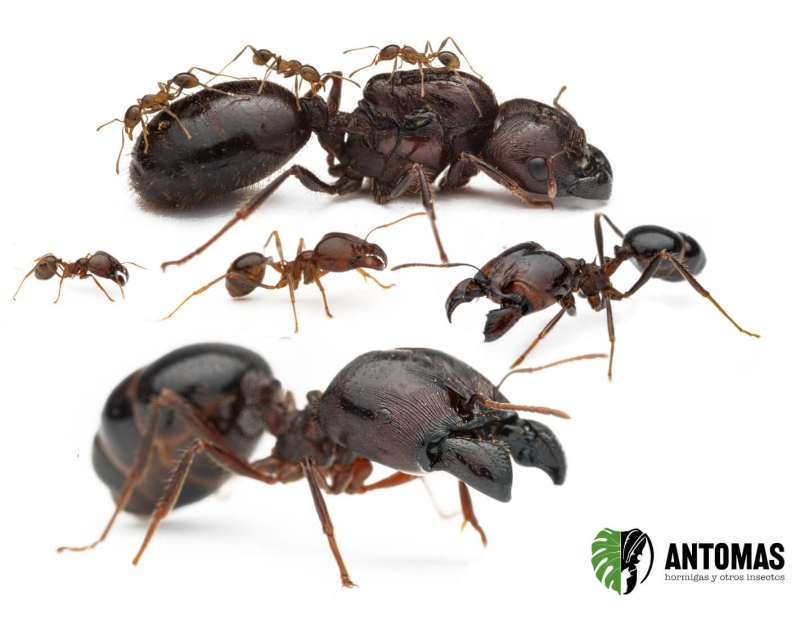
Pheidole ocellata Zhou, 2001 is one of the largest Pheidole known and, at the same time, one of the least studied. Its soldiers, with a head about 3 mm wide and a clearly visible ocellus high on the forehead, look like a different species next to the slender, long-legged minor workers. It was described in 2001 from a handful of specimens from southern China, and science has still published nothing about its life in the wild. For the keeper, that makes it special: much of what is observed in captivity will be new information.
Biology
ocellata or dugasi? A small taxonomic mystery
This is a little-studied species, and its identity has a nuance we prefer to share. In 2008 the Japanese myrmecologist Katsuyuki Eguchi revised the Pheidole of northern Vietnam and assigned to Pheidole dugasi Forel, 1911 material he had earlier identified provisionally as "? ocellata". In addition, the P. dugasi specimens he examined include some from Shiwandashan (Guangxi), the very reserve the type of P. ocellata comes from; the soldier measurements of the two almost match, and Eguchi describes a median ocellus "often present" in the soldier of P. dugasi, which is precisely the trait that gives ocellata its name.
Eguchi did not formally merge the two species, and P. ocellata is still listed as a valid species in the catalogues; its status was confirmed in Guénard and Dunn's checklist of the ants of China (2012). But everything suggests they are very close relatives. For this reason, this care sheet uses the biology of its relative P. dugasi, the only one of the two that has been observed in the field, as a reference, and says so each time. The Antomas line comes from Vietnam, precisely the country where Eguchi studied this group.
Distribution and habitat
P. ocellata in the strict sense is only reliably known from its type locality: the Shiwandashan (Shi Wan Da Shan) Nature Reserve in southern Guangxi, where Zhou collected the type specimens on 24 May 1996. It is a range of subtropical forest on the border with Vietnam.
Its relative P. dugasi has been recorded in Vietnam (from the north to Cat Tien National Park in the south), southern China (Guangxi and Hainan) and Thailand, at roughly 160–700 m above sea level. It nests underground, in wooded gardens and forest edges, in a tropical or subtropical monsoon climate: warm and humid almost all year, with no real winter.
A soldier with a "third eye"
The name says it all: ocellata means "with ocelli". Zhou set it apart from all known Chinese Pheidole by a detail of the soldier: on top of the head it has one clearly visible median ocellus and two vestigial lateral ocelli.
This is a rare trait. Ocelli are three simple eyes located between the compound eyes, and they are best developed in queens and males, the castes that fly, where they help to hold a course and to navigate in dim light. In Pheidole workers they are normally absent. There are exceptions in other ants: in Australian Myrmecia the size of the workers' ocelli depends on how they move and when they are active, and in the desert ant Melophorus bagoti it has been shown that workers use their ocelli as a celestial compass.
Can the P. ocellata soldier see anything with its ocellus? Nobody has studied it. It may be functional or simply an unused remnant; for now it is an open question and one of the most striking curiosities of the species.
Mosaic soldiers: queen traits in a worker
Myrmecologists describe ant soldiers as "mosaic" castes that combine parts of the worker body plan with others typical of the queen. Pheidole is the textbook example: during the last larval stage, future major workers develop rudimentary wing discs, wing buds that never become wings, and these discs help to set the proportion between the soldier's huge head and its body. Their growth also responds to social signals from the colony itself. An ocellus on a soldier's head fits this idea of "queen" traits reappearing in a worker very well, although it has not been investigated in P. ocellata.
A giant among Pheidole
The genus is famous for its big-headed soldiers, but those of P. ocellata are among the largest: the holotype is about 10 mm in total length, with a head of 3.37 × 3.03 mm (length × width), while the head of the minor workers barely exceeds 1 mm. In hobbyist compilations it appears as the Pheidole with the largest known head area, ahead of P. sinica, although that comparison does not come from a scientific study. In P. dugasi, the soldier's head is about three times as wide as that of the minor worker.
Pantry soldiers
In P. dugasi, Eguchi observed that soldiers act as "repletes": they fill their crop with liquid food and keep it as a reserve for the colony. It is a less familiar role for a soldier than defence or cutting up prey. This has been published for P. dugasi; it has not been confirmed in P. ocellata.
Seed harvesters in dung
In Cat Tien National Park, in southern Vietnam, masses of P. dugasi workers were seen collecting seeds from mammal dung. It is a form of opportunistic seed harvesting: the colony takes advantage of seeds already separated from the fruit and probably disperses them along the way (the latter is a reasonable ecological interpretation, not a measurement). Many Pheidole collect seeds, and their soldiers crack them with their mandibles. That is why it makes sense to offer seeds in captivity as a supplement to insects.
How many soldiers a colony makes
In Pheidole, whether a larva becomes a soldier or a minor worker is not written in its genes: it depends on juvenile hormone during a sensitive period of the last larval stage, and therefore on how the colony feeds it. Adult soldiers slow down the production of new soldiers, so the proportion regulates itself, and colonies that detect competitors of their own species produce more soldiers. The system is so flexible that, in Pheidole species without supersoldiers, simply applying a juvenile hormone analogue to the larvae produces individuals that look like supersoldiers: the potential was there, dormant.
These experiments were carried out with other species of the genus, not with P. ocellata, but they explain something you will see at home: the proportion of soldiers changes with feeding and with colony size.
A hyperdiverse genus
Pheidole is one of the most species-rich animal genera, with more than 1,100 species described worldwide, nearly all with the same pattern of minor workers and soldiers. Phylogenetic studies indicate that the genus originated in the Americas and that, after reaching the Old World, it diversified repeatedly, reproducing similar ecological patterns on different continents.
Social organisation and founding: what is known and what is not
Here we have to be honest: nothing has been published on the founding, number of queens, colony size or nuptial flights of P. ocellata, nor of P. dugasi. The queen has not even been described: Zhou described the species from soldiers and minor workers only, and in P. dugasi the male genitalia have been studied. What is general for the genus, unverified for this species, is claustral founding: the queen seals herself in alone and raises her first workers on her reserves; the first ones are small minors and soldiers come later. In Antomas' experience, P. ocellata is a mainly monogynous species: a single queen per colony. This fits with what is said about its large Asian relatives, such as P. sinica and P. spathifera, which keepers and shops list as monogynous, with colonies of several thousand workers.
Size and morphology
P. ocellata has the two worker castes typical of the genus, with no intermediate sizes:
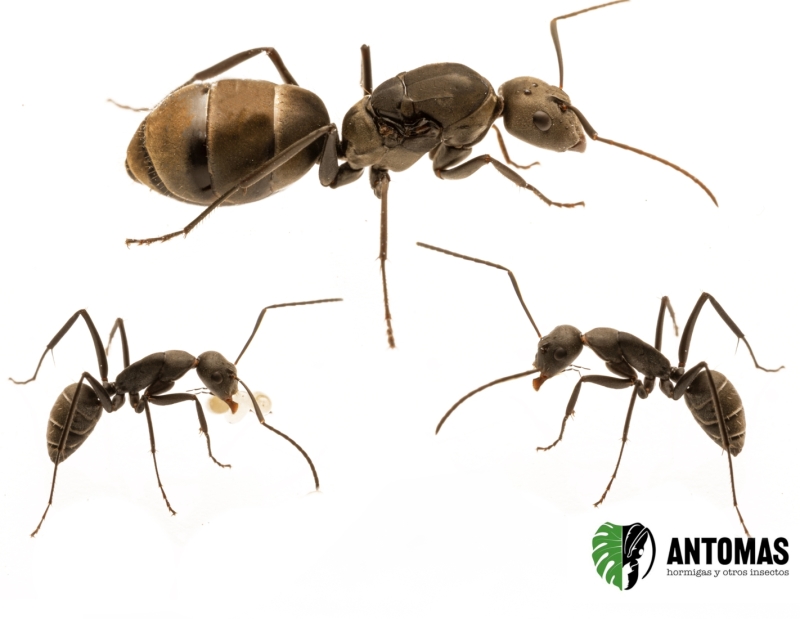
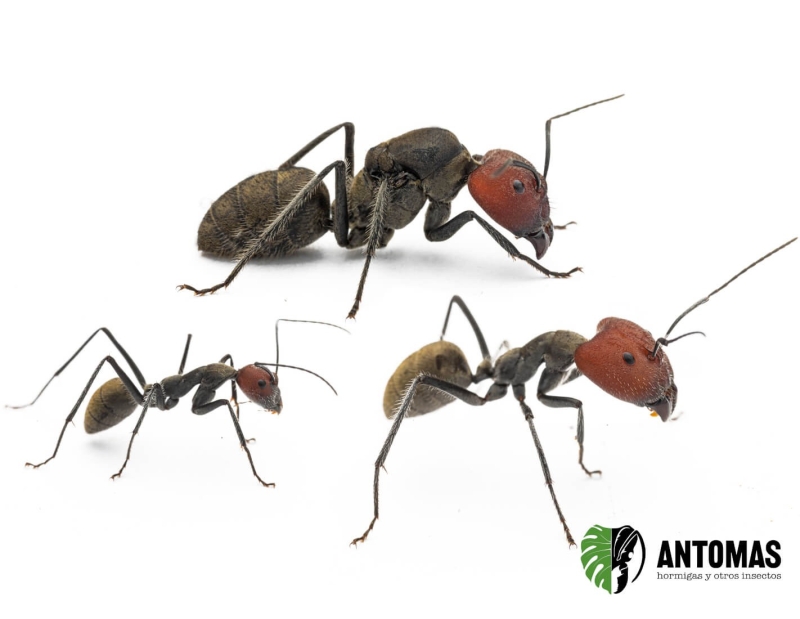
- Soldier (major worker). Huge head, slightly longer than wide (cephalic index 89), with straight sides and a strongly concave posterior margin; short antennal scapes (scape index 51, i.e. half the head width); propodeal spines; one visible median ocellus and two vestigial lateral ocelli on the vertex.
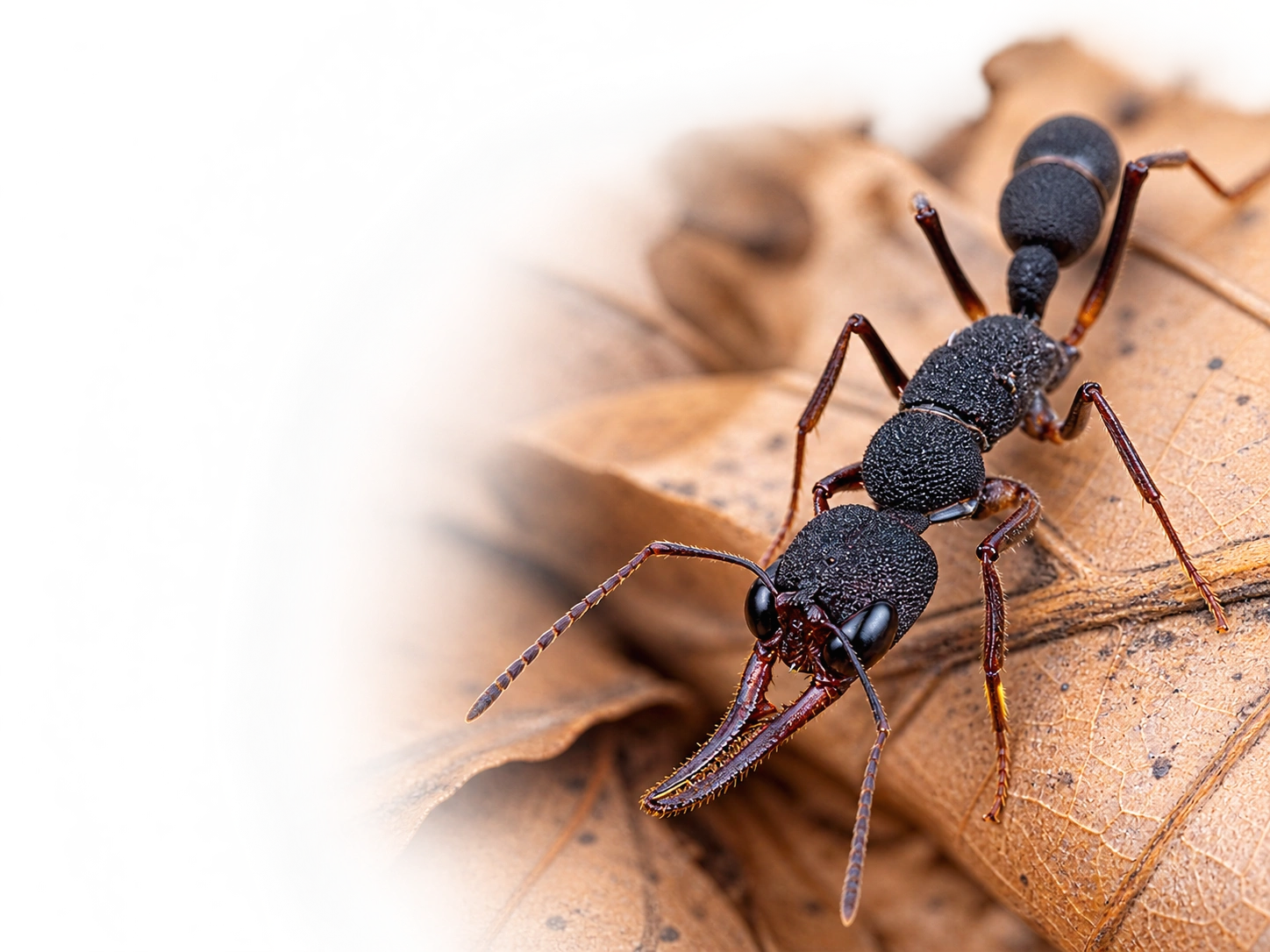
- Minor worker. Slender, long-legged, with very long scapes (scape index 138–139) that extend well beyond the posterior margin of the head. Ocelli are not recorded.
- Antennae. 3-segmented club, the character that separates it from P. sinica, which it resembles in shape.
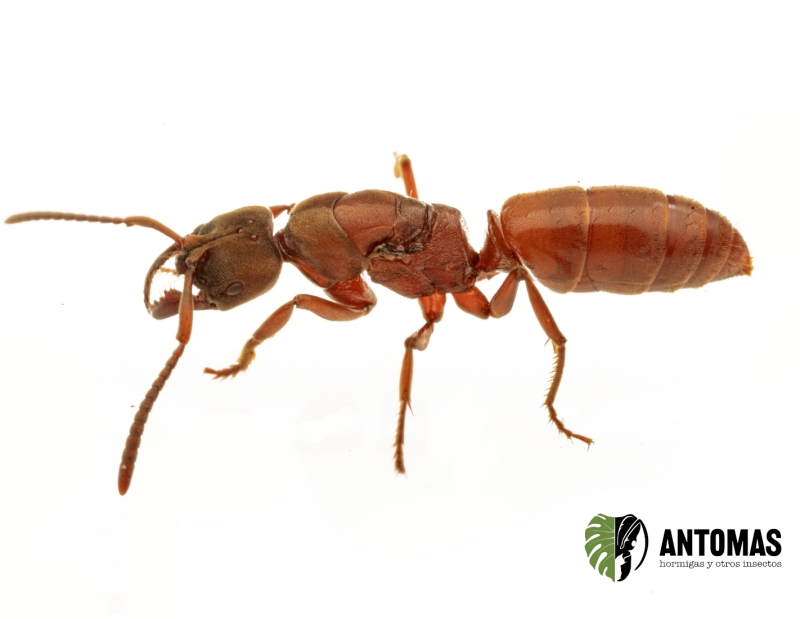
Colouration. According to the original description, orange-red body with a darker head; mandibles, clypeal margin, scapes and gaster dark reddish brown, and funiculi and legs lighter. The text does not make clear whether it refers only to the soldier or to both castes. In the Antomas line the ants are blackish brown, which roughly matches this description.
Approximate measurements
- Soldier: 9.8–10.4 mm (head 3.26–3.51 mm long and 2.95–3.13 mm wide)
- Minor worker: 4.7–4.9 mm (head 1.16–1.19 mm long and 0.97–1.00 mm wide)
- Queen: 9–11 mm, based on Antomas' experience with its queens (no published measurements: the queen has no scientific description)
- For comparison, P. dugasi: soldier head 3.38–3.60 × 3.15–3.40 mm; minor head 0.97–1.19 mm long
The soldier and minor worker measurements are from Zhou's (2001) type series, with specimens from Guangxi. These are few specimens, so the real range is probably somewhat wider.
Care in captivity
Difficulty: 3/5 – Advanced
It is not a difficult species day to day: it tolerates a wide range of temperatures, eats everything and, according to our customers' reviews, grows steadily at room temperature and soon reaches a good number of workers. Its rating is due to three things: it needs a well-managed humid nest, neither waterlogged nor mouldy; its minor workers are agile explorers and require a careful escape barrier; and there is almost no keeping literature, so it pays to watch the colony and adjust.
And it is well worth it. Few ants offer such a spectacular contrast between castes: slender, fast minor workers that recruit in seconds and giant-headed soldiers that cut up prey and crack seeds. It is also a species that almost nobody has kept and documented: every colony adds something new.
Recommended parameters
- Temperature: 24–28 °C. It tolerates temperatures somewhat below and above this range quite well.
- Nest: humid. We recommend keeping one part always moist and another somewhat drier, so the colony can choose where to place the brood.
- Foraging area: drier than the nest.
- Humidity as a guide: keepers of similar Asian Pheidole (P. sinica, P. spathifera) use 60–80 % in the nest and 40–60 % in the foraging area; there are no measurements for P. ocellata.
- Hibernation: it does not hibernate. It can be kept active all year round at 24–28 °C.
- Light: nest dark or covered; the foraging area can be lit.
Recommended formicaria
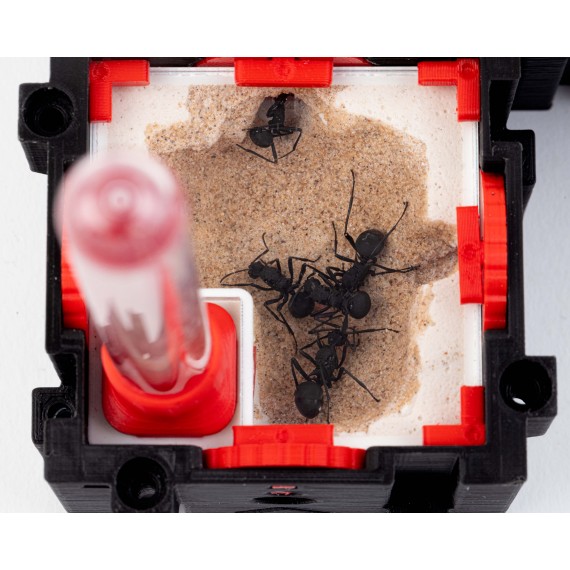
At Antomas we recommend the Qbik Wild range by Anthouse. Choose the model according to the size of the colony you buy: the Qbik Wild One or the Qbik Wild Duo; for larger colonies, the Duo.
Plan the expansion in good time: among Pheidole keepers it is common for the colony to outgrow its set-up sooner than expected.
Founding and first weeks
At Antomas we sell single queens. Whether you start with a queen or with a colony, leave it dark and undisturbed for the first few days, and avoid opening or lighting the nest often: in Pheidole there are cases of queens eating their eggs after an inspection. In our experience the species is mainly monogynous, and in its Asian relatives, if several queens are kept together, they end up fighting until only one remains. For this reason, never combine queens or colonies of different origin.
Feeding
The basis is a varied diet of sugars, protein and, as a supplement, seeds.
Sugars. Anthouse Blue Sugar Nectar 4–5 times a week, and another nectar or sugary liquid 1–2 times a week, so they do not always get the same thing. Protein can also be added to the nectar.
Protein. Insects, changing the type from one week to the next: crickets, small cockroaches, flies, Drosophila, chopped mealworms and other feeder insects. Minor workers find the prey and recruit the others, and soldiers cut up the large pieces. With its Asian relatives, keepers agree that the colony grows fast with regular protein and sugar. Remove leftovers within 24–48 h: in a humid nest they soon go mouldy.
Seeds. As a supplement, small seeds: sesame, millet or amaranth, the ones keepers use with P. spathifera. This fits with what has been observed in P. dugasi, which collects seeds in the wild, but it is not the basis of the diet: care guides that call for lots of seeds are based on seed-harvesting Pheidole from the North American deserts.
Water: clean water always available.
Behaviour in captivity
Minor workers go out to forage and recruit very quickly with pheromone trails; soldiers turn up when there is large prey or a threat and otherwise usually stay in the nest. It is aggressive towards other ants: do not keep it in mixed set-ups or next to other colonies. Keepers describe P. sinica, its relative most similar in shape, as very aggressive with raiding traits.
Escapes and barriers
Minor workers are slender, fast and exploratory. Among Pheidole keepers, the most recommended barrier is PTFE (Fluon), applied in a thin layer and, to make it last, on the underside of a lip. As an alternative, mineral oil (paraffin oil) works and is much easier to find. Also check lids, stoppers and connections: any gap is an exit.
Handling and safety
It is not a dangerous species, but the soldiers have large mandibles and can give a noticeable pinch. Use tweezers and work slowly. This is an exotic species: it must never be released.
What not to do
- Let the nest dry out or, on the contrary, become waterlogged.
- Hibernate it or leave it in the cold during winter.
- Always feed the same insect or the same sugar.
- Leave prey remains for more than 48 h in the humid nest.
- Open or light the nest often, especially in the first few days.
- Combine queens or colonies of different origin, or keep it with other species.
- Rely on an old or poorly applied barrier.
- Wait until the colony is cramped before expanding the formicarium.
Scientific sources
This care sheet was compiled from the scientific literature on the species and its relative P. dugasi, from the general biology of the genus Pheidole, and from the experience of Antomas and European keepers. Main references:
- Zhou, S. (2001). Ants of Guangxi [in Chinese]. Guangxi Normal University Press, Guilin. Original description of Pheidole ocellata: pp. 134 and 236.
- Eguchi, K. (2008). A revision of Northern Vietnamese species of the ant genus Pheidole (Insecta: Hymenoptera: Formicidae: Myrmicinae). Zootaxa 1902: 1–118. doi:10.11646/zootaxa.1902.1.1
- Narendra, A., Ramirez-Esquivel, F. & Ribi, W.A. (2016). Compound eye and ocellar structure for walking and flying modes of locomotion in the Australian ant, Camponotus consobrinus. Scientific Reports 6: 22331. doi:10.1038/srep22331
- Narendra, A. & Ribi, W.A. (2017). Ocellar structure is driven by the mode of locomotion and activity time in Myrmecia ants. Journal of Experimental Biology 220: 4383–4390. doi:10.1242/jeb.159392
- Schwarz, S., Wystrach, A. & Cheng, K. (2011). A new navigational mechanism mediated by ant ocelli. Biology Letters 7: 856–858. doi:10.1098/rsbl.2011.0489
- Molet, M., Wheeler, D.E. & Peeters, C. (2012). Evolution of novel mosaic castes in ants: modularity, phenotypic plasticity, and colonial buffering. The American Naturalist 180: 328–341. doi:10.1086/667368
- Rajakumar, R., Koch, S., Couture, M. et al. (2018). Social regulation of a rudimentary organ generates complex worker-caste systems in ants. Nature 562: 574–577. doi:10.1038/s41586-018-0613-1
- Rajakumar, R., San Mauro, D., Dijkstra, M.B. et al. (2012). Ancestral developmental potential facilitates parallel evolution in ants. Science 335: 79–82. doi:10.1126/science.1211451
- Wheeler, D.E. & Nijhout, H.F. (1981). Soldier determination in ants: new role for juvenile hormone. Science 213: 361–363. doi:10.1126/science.213.4505.361
- Passera, L., Roncin, E., Kaufmann, B. & Keller, L. (1996). Increased soldier production in ant colonies exposed to intraspecific competition. Nature 379: 630–631. doi:10.1038/379630a0
- Economo, E.P., Klimov, P., Sarnat, E.M. et al. (2015). Global phylogenetic structure of the hyperdiverse ant genus Pheidole reveals the repeated evolution of macroecological patterns. Proceedings of the Royal Society B 282: 20141416. doi:10.1098/rspb.2014.1416
- Moreau, C.S. (2008). Unraveling the evolutionary history of the hyperdiverse ant genus Pheidole (Hymenoptera: Formicidae). Molecular Phylogenetics and Evolution 48: 224–239. doi:10.1016/j.ympev.2008.02.020
- Wilson, E.O. (2003). Pheidole in the New World: A Dominant, Hyperdiverse Ant Genus. Harvard University Press.