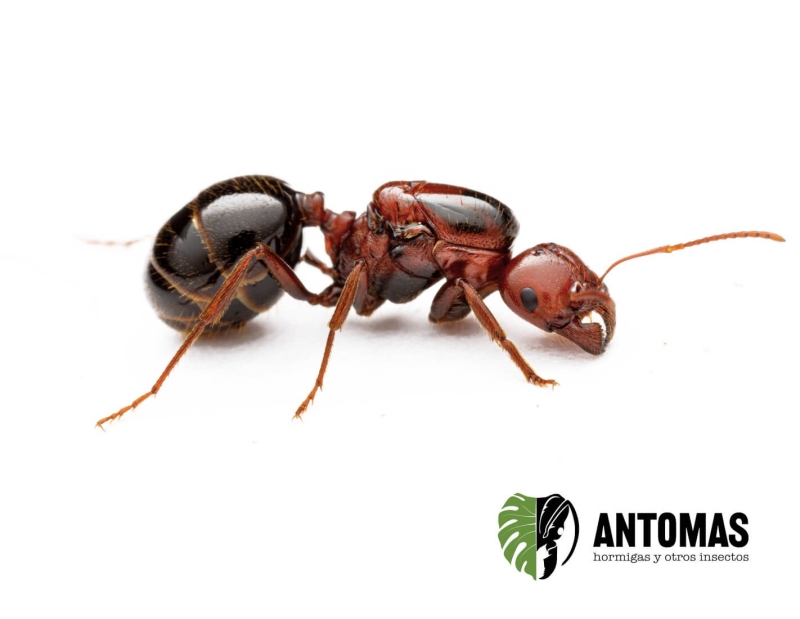
Difficulty: 4/5 – Advanced (because of its tiny size and the risk of escapes, not its temperament)
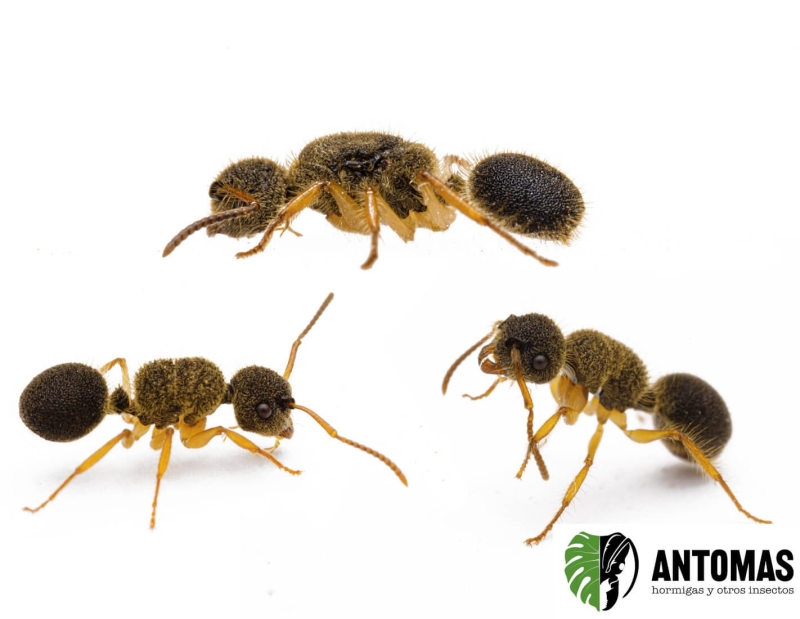
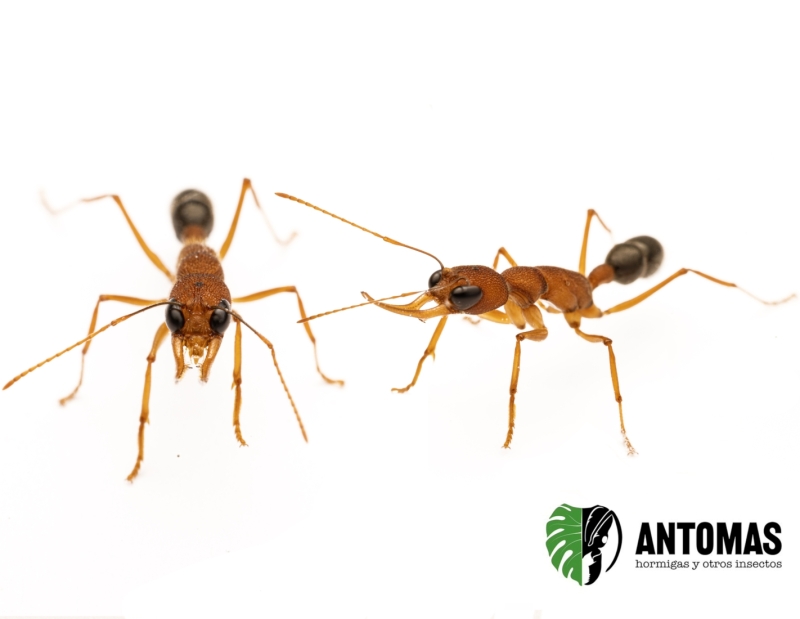
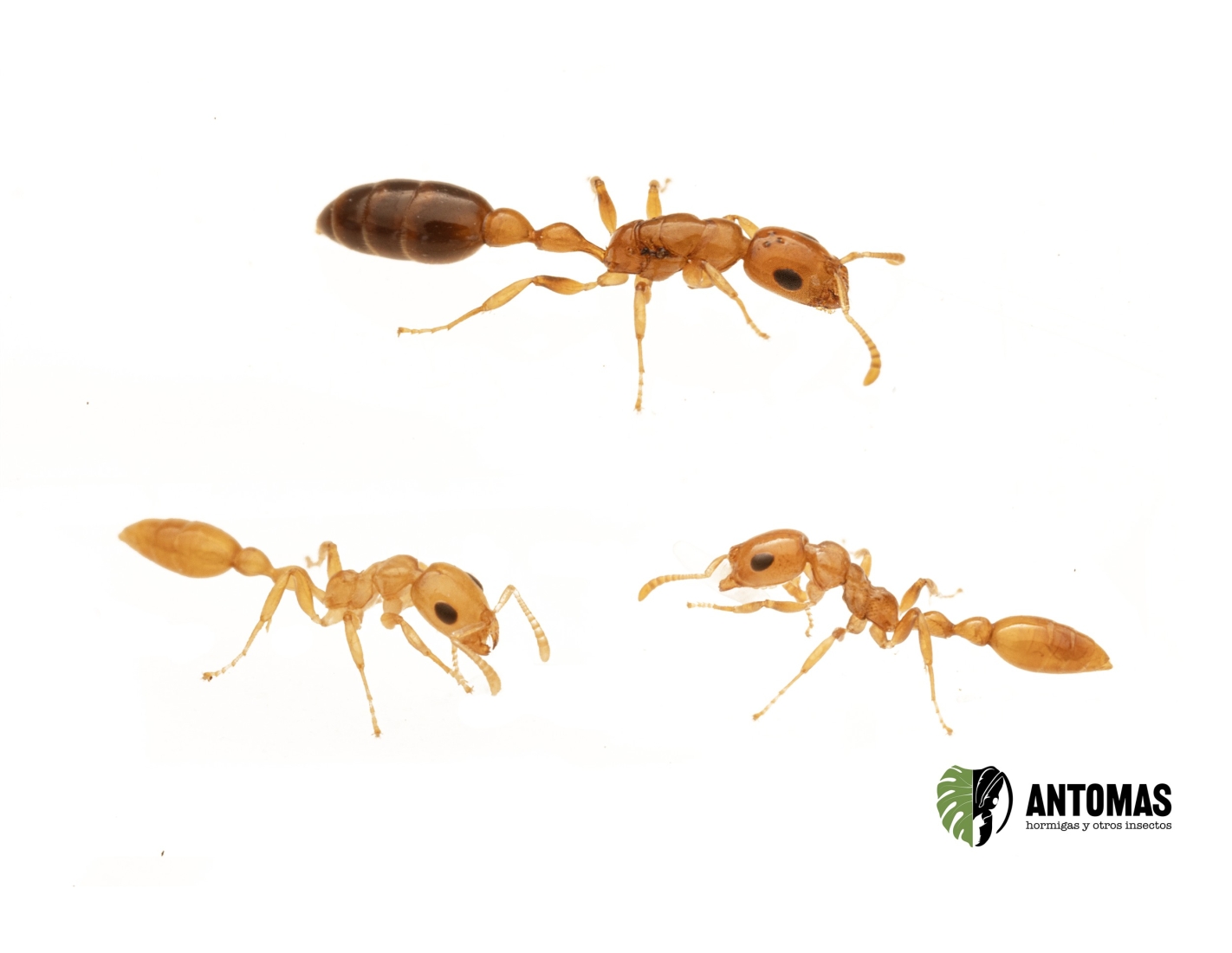
A miniature Tetraponera from Southeast Asia: workers orange-yellow from head to toe, huge eyes and a queen with a dark gaster. It lives inside hollow twigs and is the tiny, peaceful version of our red-and-black Tetraponera rufonigra. In short: QBIK ONE from the Qbik Alpha range (or a wooden nest, keeping an eye out for chewing), 24–28 °C all year round, fine ventilation mesh and a thin barrier, sugary liquids always available with Blue Sugar Nectar as the staple, and tiny prey: fruit flies, termites or firebrats. They can sting, but being so small you will barely notice it.
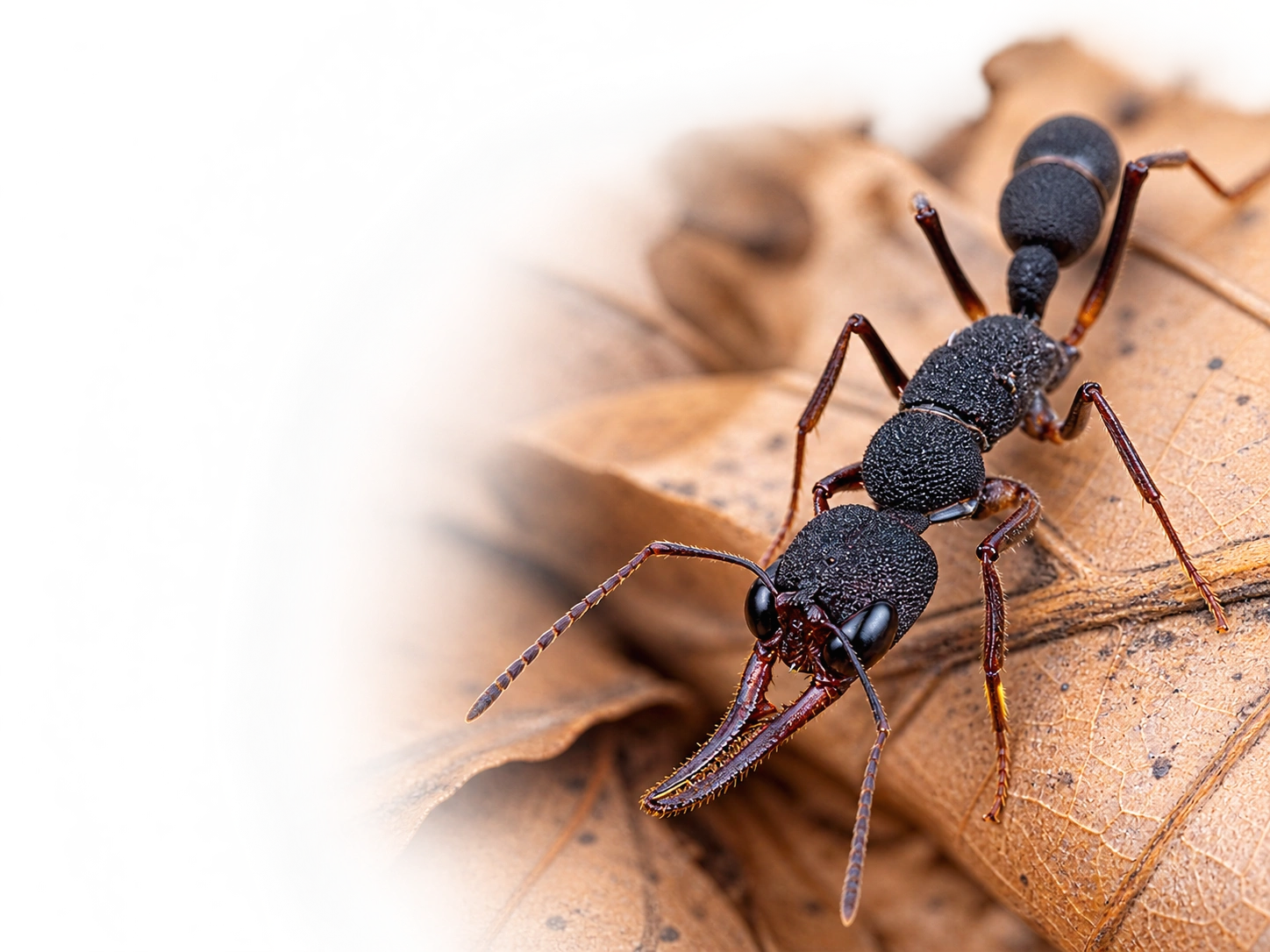
Tetraponera cf. modesta is an arboreal ant of the subfamily Pseudomyrmecinae, the same as our Tetraponera rufonigra, the Bi-coloured Arboreal Ant. It shares with it the long, narrow body, the two-segmented waist, the oversized eyes and the habit of living inside wood. But everything else is different: it is several times smaller, its workers wear a uniform orange-yellow and its world is one of slender twigs, not the trunks of avenue trees.
Until recently we sold it as "Tetraponera sp. 'Yellow'". On checking its identity against the specialist literature, everything points to Tetraponera modesta (Smith, 1860), a species with an enormous range and an almost undocumented biology. In this care sheet we explain why the name carries a "cf." in front, what is known about the species and the genus, and how we keep it at Antomas. Whenever a fact comes from another Tetraponera or from our own experience, we say so.
Biology
A name with "cf.": what it means and why we use it
"cf." is short for the Latin confer, "compare". In taxonomy it is placed before the species name when a specimen matches that species but has not been confirmed by the examination the group requires: micrometer measurements, a count of the mandibular teeth or comparison with the type material. Tetraponera cf. modesta therefore means "a Tetraponera that, compared with T. modesta, matches it". It is an honest way of giving the most likely name without claiming more than we know.
Why modesta? For several reasons that all fit together:
- Colour. In the worker key of Philip S. Ward's revision (2001), updated in 2025 by Yodprasit and colleagues, T. modesta is the species with a body that is "predominantly yellow or orange-brown", the gaster sometimes partly or entirely dark brown. Our workers are completely yellow and the queen has a dark gaster: both variants fit that definition.
- Size and shape. Small workers with a short head and very large eyes, almost hairless, without ocelli and with a slender, pedunculate petiole. These are the features of the allaborans group, to which T. modesta belongs.
- Geography. Among the Tetraponera recorded in its part of Southeast Asia, T. modesta is the only yellow one. The others are black, brown or, like T. rufonigra, red and black.
What is still needed to drop the "cf." is to look at several workers under the microscope: count the three mandibular teeth typical of the group, measure the head width and check the shape of the petiole and the pilosity. Ward himself warns that within the modesta complex not every specimen is easy to assign, so we prefer to be cautious. The name may change if a specialist examines it, and we will tell you here.
Golden workers, dark-gastered queen
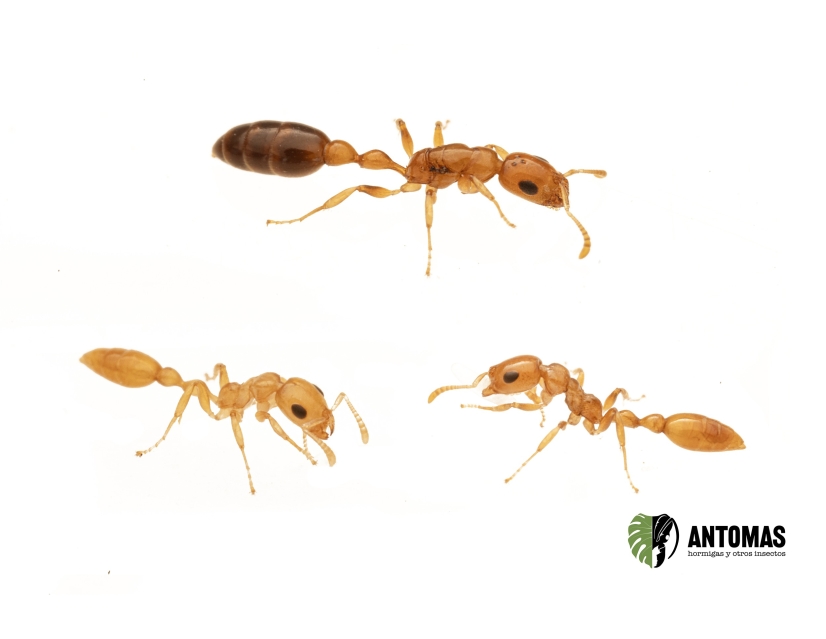
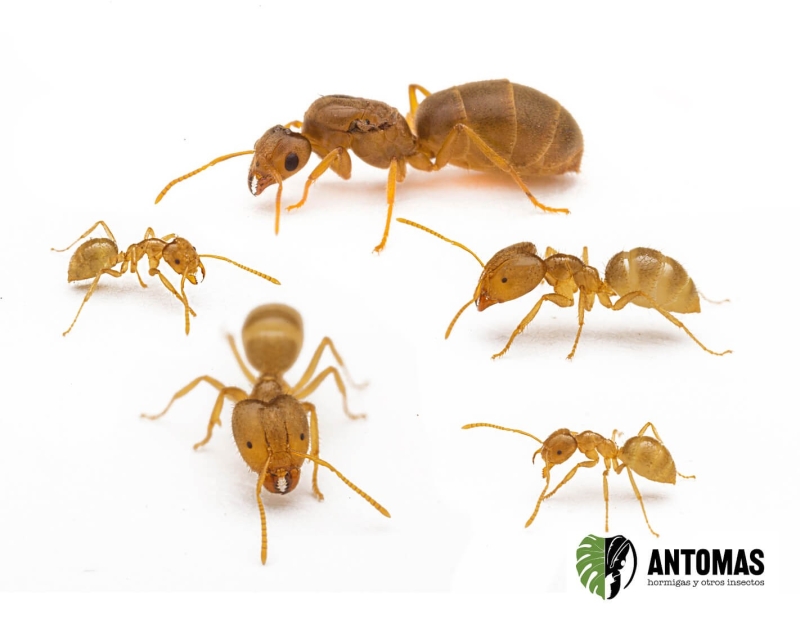
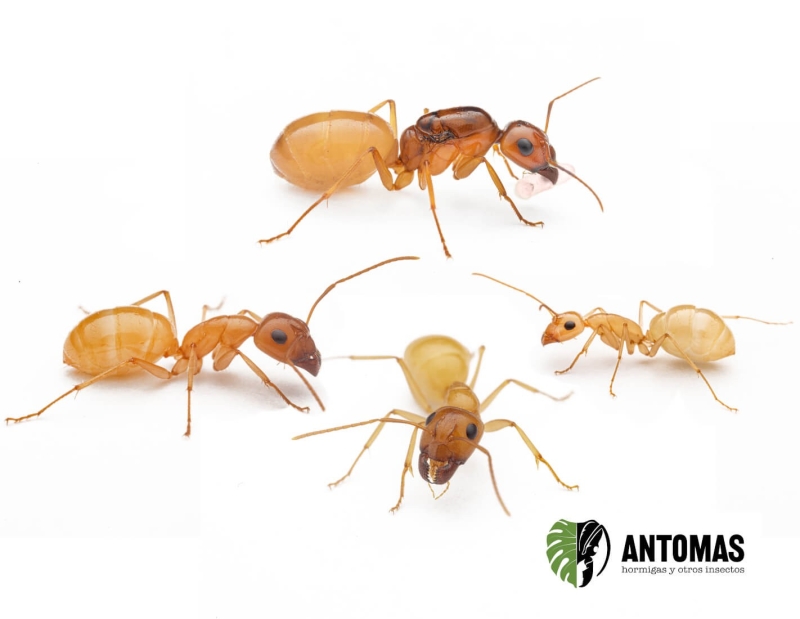
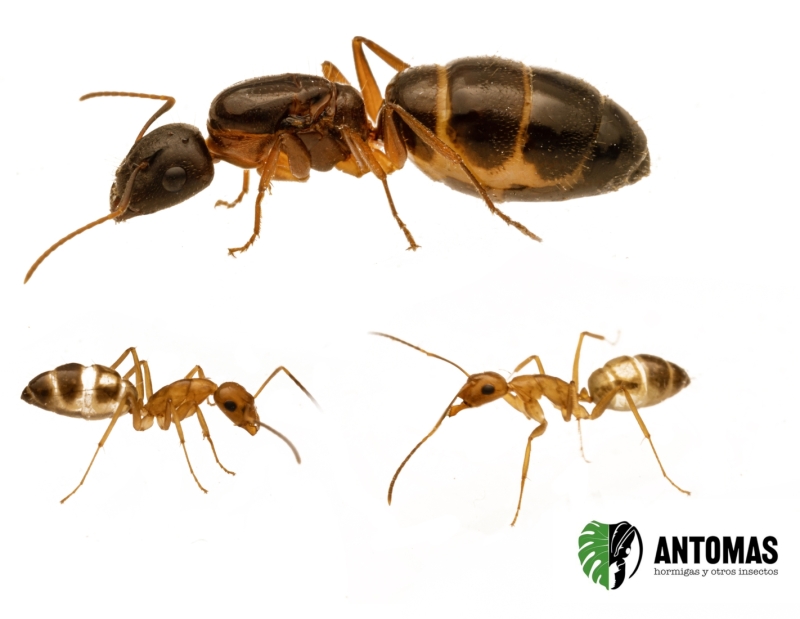
The first thing that strikes you in a colony is the contrast between castes. The workers are a uniform orange-yellow: head, thorax, waist and gaster in the same warm tone, with slightly paler legs and antennae. Against that colour the eyes stand out, black and huge, taking up a good part of the sides of the head.
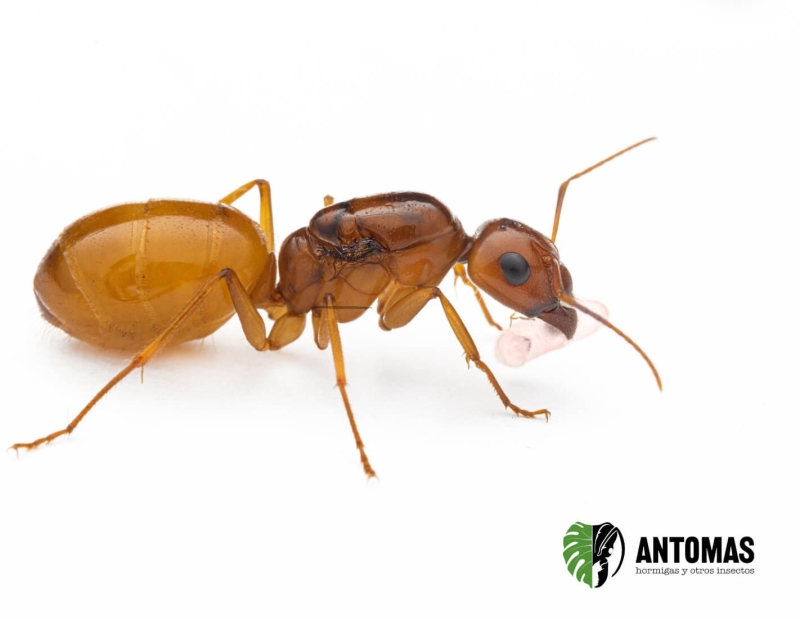
The queen repeats the yellow at the front, but her gaster is dark chestnut and glossy, large and elongated, as befits a female that lays eggs non-stop. She keeps on the back of her thorax the scars of the wings she shed after the nuptial flight and, between the eyes, three clearly visible ocelli. She is easy to find in the nest even when the colony is small: she is the only "two-tone ant" in the group.
Ward's key already notes this variation in the species' gaster ("sometimes dark brown"). Whether that shade depends on caste, age or population has not been studied: we have found no published account of the T. modesta queen.
Three ants that look like one
Ward divided the Tetraponera of Asia and Australia into four species groups. The allaborans group brings together small to medium-sized ants with two very specific features: a slender mandible with only three teeth on the masticatory margin, and dense pubescence on the underside of the thorax, the mesosternum. Within it, Ward described the modesta complex, three very similar forms to which he gave provisional names:
- T. modesta: the smallest and palest, with a yellow or orange-brown body.
- T. extenuata: somewhat larger, with the head, thorax and most of the gaster black; only the postpetiole and parts of the legs are pale.
- T. crassiuscula: brownish, with a shorter, higher petiole.
Are they three species or a single one in different colours? Ward leaned towards the former for an elegant reason: at some localities in Malaysia, such as Pasoh, all three live side by side and do not intergrade. If they were mere colour variants, you would expect intermediate forms everywhere. Even so, he acknowledges that some collections show colour contrasts halfway between them that are not easy to classify. It is one of those puzzles genetics has yet to solve.
A home inside a twig
The Tetraponera of Southeast Asia are arboreal. They nest inside live and dead branches, and field surveys report that many colonies turn up in, or emerge from, freshly fallen branches. In T. modesta, the colonies in Singapore were found exactly like that: in hollows and cavities of fallen branches and twigs, in primary or mature secondary forest. Workers have also been collected by beating the foliage, that is, shaking leaves over a beating tray: they go out to forage among the vegetation.
It is not fussy about the tree. In Sri Lanka, where it was first recorded in 2020, the colony turned up in a rubber plantation, a habitat heavily modified by people. Yodprasit and colleagues describe the genus's "twig" species as occupants of dead twigs, branches, cavities opened by other insects or domatia (hollows offered by some living plants). In other words, they make use of whatever space they find, without being tied to any particular plant.
This miniature life explains almost everything it needs at home: narrow galleries, little empty space and a stable environment. A hollow twig is only a few millimetres across, and a young colony feels safer in chambers that fit its size.
Not all Tetraponera live the same way
The genus includes "unspecialised" twig-nesting species, such as T. modesta, and others that have entered into very close partnerships with plants and insects. The best-studied case is a bamboo-dwelling Tetraponera from Malaysia, now assigned to T. binghami. Alfred Buschinger, Rudolf W. Klein and Ulrich Maschwitz described the structure of its colonies in 1994:
- A single queen per colony, but spread over many nests at once: internodes of several bamboo culms connected to one another.
- Thousands of workers: in one of the colonies they counted 6953.
- Livestock farming inside the culm: the ant raises mealybugs inside the bamboo that provide its honeydew, almost its only food.
None of this has been observed in T. modesta, and it would be a mistake to simply transfer it. The closest reference to our species comes from another small twig-nesting Tetraponera from southern Thailand, T. sirindhornae, described in 2025: one of its colonies occupied a dry branch about 3 cm thick and 1.5 m long, with one queen, about 100 workers, males and pupae. It belongs to a different species group, so the figure is only a guide, but it gives an idea of the scale: modest colonies, as the name suggests.
From eastern India to New Guinea
For such a small and little-studied ant, its range is astonishing. T. modesta is one of the Tetraponera with the largest known distribution:
- To the west, from eastern India and Sri Lanka.
- To the north, as far as southern China, including Taiwan.
- In the centre, Indochina and Thailand, where it appears in the updated checklist of the country's ants.
- To the south and east, Malaysia, Singapore and Indonesia, as far as Papua New Guinea.
It is very likely present in many more places than the maps show: an ant a few millimetres long that lives inside twigs goes unnoticed, and only turns up when a myrmecologist beats the foliage or breaks open a fallen branch. The first Sri Lankan record, in 2020, proves it: a well-sampled island that, even so, had never recorded it.
In older literature it sometimes appears under another name, Sima fulva or Tetraponera fulva: the type material examined includes specimens of Sima fulva, which indicates that this name is now a synonym of T. modesta. The original name under which Frederick Smith described it in 1860 was Pseudomyrma modesta, and since then it has passed through Sima to reach Tetraponera, the genus in which Ward's revision places it.
Giant eyes on a tiny head
In the literature, Pseudomyrmecinae are known as "the big-eyed arboreal ants", and in T. modesta the nickname is an understatement: relative to its short, broad head, the eyes look enormous. It is not decoration. An ant that roams leaves and branches in broad daylight, where smell loses effectiveness in the wind and chemical trails are washed away by rain, needs good eyesight.
There are no studies on vision in this species, but the same pattern repeats throughout the group: fast workers, alert to any movement, foraging on their own in the vegetation. At home you notice it straight away: as soon as something moves near the formicarium, the workers in the outworld stop, turn their heads and speed off again. It is one of the great pleasures of watching them.
A wingless wasp: a miniature sting
All Pseudomyrmecinae retain a functional sting, inherited from their wasp ancestors. In T. modesta it sits at the tip of a small, oval, pointed gaster. Its venom has not been analysed and there is no medical data on its sting.
In Antomas's experience, they can sting, but being so small it is no big deal: nothing like its cousin T. rufonigra, which is several times larger. With normal handling, using tweezers and never picking them up with your fingers, you will usually feel nothing. We go into more detail under "Handling and safety".
Bacteria that recycle nitrogen
One of the most striking curiosities of the genus lies inside the gut. In 2002, Steven van Borm and colleagues discovered that Tetraponera have, between the midgut and the hindgut, a pouch full of bacteria related to those living in the root nodules of legumes, famous for fixing nitrogen from the air.
The authors' hypothesis is that these bacteria help the ant reuse the nitrogen in its own waste, a very valuable resource for species that feed mainly on sugary liquids, which are poor in protein. It was described in Tetraponera that live almost exclusively on mealybug honeydew, like the bamboo species, and has not been tested in T. modesta. But it is a trait of the genus, and it is tempting to think it also helps our little sweet-toothed ants.
Larvae with a pocket, naked pupae and messages through the wood
Pseudomyrmecine larvae have a structure found in no other ant subfamily: the trophothylax, a kind of pocket on the underside, just behind the head. The workers compact the solid remains of food in their mouths, form them into a pellet and place it in that pocket. The larva eats it bit by bit, like a child keeping a snack in an apron pocket.
In other ants, these pellets from the mouth cavity are thrown away; here they are food for the brood. The trophothylax is considered a trait of the whole subfamily and has been described mainly in Pseudomyrmex, the American cousins, so in T. modesta it is a reasonable inference, not an observation. Another peculiarity of the subfamily: the larvae do not spin cocoons, so the pupae are naked and you can clearly see the future worker taking shape.
And one last oddity of life in wood: messages by vibration. Ants barely detect sound carried through the air, but they are very sensitive to vibrations in the ground or in wood. Many produce those vibrations with a stridulatory organ: a finely ridged surface at the base of the gaster over which they rub the preceding segment, like a fingernail over a comb.
A study by Golden and Hill (2016) reviewed the presence of this organ in ants and found it to be more common in genera that live in trees, where branches and leaves conduct vibrations well. Pseudomyrmecinae have it. For a species that lives inside a twig, being able to alert the whole colony with a tremor through the wood makes perfect sense, although nobody has yet studied it in T. modesta.
Distant relatives of the bulldog ants
With their wasp-like look, Pseudomyrmecinae seem like a lineage apart, and in a way they are. The genetic and morphological analysis by Ward and Downie (2005) places them as the sister group of the Myrmeciinae, the subfamily of the large Australian Myrmecia, and dates the common origin of both to the Cretaceous, in the age of the dinosaurs.
Since then, the subfamily has split into two large genera that look like twins: Tetraponera in the Old World and Pseudomyrmex in the Americas. Both are slender, big-eyed and tree-dwelling. And in both, species living in plants with hollows prepared for them have arisen several times independently. T. modesta is not one of those specialists: it is a twig generalist, probably similar to how the first Tetraponera lived.
The little sister of Tetraponera rufonigra
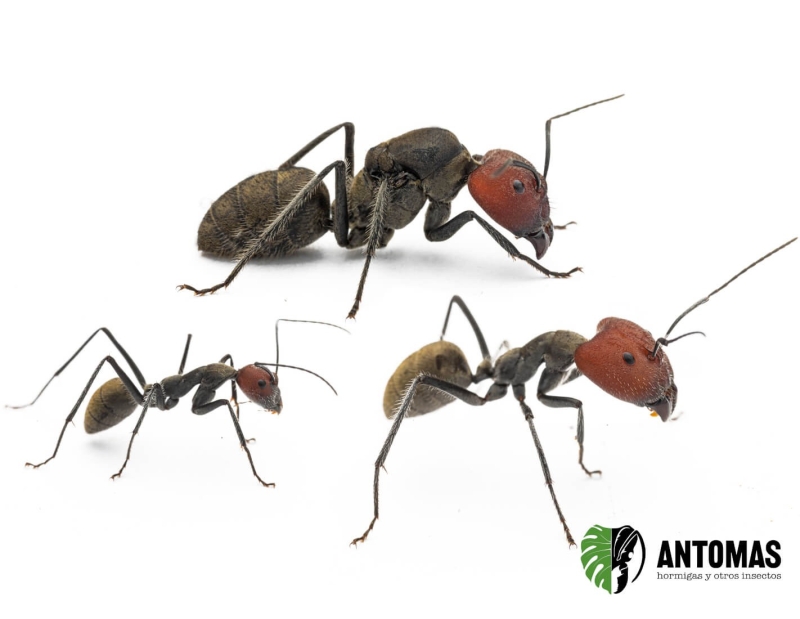
At Antomas we have two Tetraponera, and comparing them helps you understand both. Our T. rufonigra belongs to the rufonigra group, that of the large species with ocelli in the workers too. T. modesta belongs to the allaborans group, that of the small ones. The differences are obvious:
- Size: the T. rufonigra worker is over a centimetre long; the T. modesta worker has a head just over half a millimetre wide.
- Colour: orange-red and black in the former; entirely orange-yellow in the workers of the latter.
- Ocelli in the worker: three well-marked ones in T. rufonigra; none visible in T. modesta.
- Nest: branches and beetle galleries in large trees, often in towns, versus thin fallen twigs in the forest.
- Temperament: the former is very aggressive towards mammals and its sting hurts; the latter can sting too, but in our experience, because of its size, it is no big deal.
What they share is their way of life: arboreal, visual, fast, sweet-toothed and armed with a sting. Anyone already keeping T. rufonigra will immediately recognise the habits of this little one.
What is still unknown
Almost everything published on T. modesta consists of identification keys, head measurements and lists of localities. So that you can tell what has been confirmed from what is assumed, these are the main gaps:
- Reproduction: there is no data on nuptial flights, on how many queens a colony has, or on whether founding is claustral or semi-claustral. The other Tetraponera studied are monogynous, but that guarantees nothing.
- Colony: no data on mature size, longevity or whether the colony is spread over several twigs.
- Natural diet: it is not known what it hunts or whether it visits nectar or honeydew, although its fondness for sugar in captivity suggests it does.
- Development: no published egg-to-worker times.
- Queen and male: the queen has not been described at species level, and all that is known of the male is which group it belongs to.
If you keep a log of your colony, with dates of egg-laying, worker emergence and temperatures, you will be gathering information that no publication currently contains.
Size and morphology
A slender-bodied pseudomyrmecine with a sting and monomorphic workers: all of the same type, with no soldiers or distinct size classes. These are its main features, according to the diagnosis of the genus and of the allaborans group and what we see in our colonies:
- Worker colour: orange-yellow all over; legs and antennae slightly paler.
- Queen colour: orange-yellow front half and a dark chestnut, glossy gaster.
- Head: short and relatively broad in the worker, with very large black eyes; in the queen, slightly longer than broad and with three ocelli.
- Antennae: short and thick, with 12 segments and no distinct club.
- Mandibles: slender, with three teeth on the masticatory margin, the key feature of the allaborans group (not yet counted under the microscope in our colonies).
- Thorax: long and slim, with a flexible suture between pronotum and mesonotum and no propodeal spines.
- Two-segmented waist: a slender petiole, with a long anterior peduncle and a low, rounded node, and a globular postpetiole.
- Pilosity: almost hairless and shiny; according to the key, only one or two pairs of long hairs on the pronotum and none on the mesonotum.
- Gaster: small, oval and pointed in the worker, with the sting at the tip.
- Pupae: naked, without cocoons, as in the whole subfamily.
Approximate measurements
Tetraponera taxonomists do not publish body length but measurements of the head and the hind tibia, which are more reliable. For T. modesta, the key by Yodprasit and colleagues (2025), based on Ward (2001), gives:
- Worker: head width 0.51–0.64 mm, excluding the eyes
- Worker: hind tibia under 0.58 mm
- Worker: petiole index (height over length) 0.45–0.59, i.e. a long, low petiole
- Queen and male: no published measurements at species level
- Total length: not published for any caste
As a guide, the small workers of T. sirindhornae, with a head width of 0.68–0.75 mm, measure 4.2–5.0 mm. By proportion, a T. modesta worker would be around 3.5–4.5 mm and the queen somewhat larger; this is our own estimate, not a published measurement, and we will refine it by measuring our colonies. If you are wondering whether it is small: yes, very. That is why the whole setup revolves around its size.
For comparison, the head of the T. rufonigra worker is 1.62–2.07 mm wide, about three times as much.
Keeping in captivity
Difficulty: 4/5 – Advanced
It is not a difficult ant to feed, nor does it have a difficult temperament. We rate it as advanced because almost all the difficulty comes from its size:
- Escapes. A worker with a half-millimetre head slips through gaps, joints and mesh that easily hold almost any other ant on the market.
- Space to scale. A young colony gets lost in a nest with large chambers; it needs small galleries, like those of a twig.
- Tiny prey. A whole cricket is no good: you need fruit flies, termites, small firebrats or very small pieces to hand.
- Little information. There are no published keeping journals for this species, so you have to observe and adjust with good judgement.
In return, it is a beautiful and very unusual species: few European shops have a Tetraponera, and even fewer one of this colour. Watching its golden workers patrol with those huge eyes, crowd around the feeder or dismantle a fruit fly is a show in miniature. If you already have experience with small species or with T. rufonigra, it is the natural next step to round off your collection.
Recommended parameters
- Temperature: 24–28 °C in the nest, all year round.
- Gradient: a slightly warmer area, 27–28 °C, at one end of the nest, so the colony can choose where to keep the brood. Avoid sustained temperatures above about 30–32 °C: such a small nest overheats and dries out very quickly.
- Night-time drop: a few degrees lower at night suits it; in the branches, the temperature follows that of the air in the shade.
- Humidity: moderate. In nature, the hollow twig is dry inside, but the forest air is very humid. At home: the nest's water humidity system, one area slightly damper than another, and nothing soaked.
- Water: always available, in a test tube with cotton wool in the outworld.
- Light: nest in semi-darkness and outworld lit, with its day-night rhythm.
- Diapause: no (see below).
Our colonies come from Southeast Asia, and these values match the species' climate: summers averaging 28–30 °C with high humidity and, in the mainland part of its range, somewhat cooler but never cold winters.
Recommended formicaria
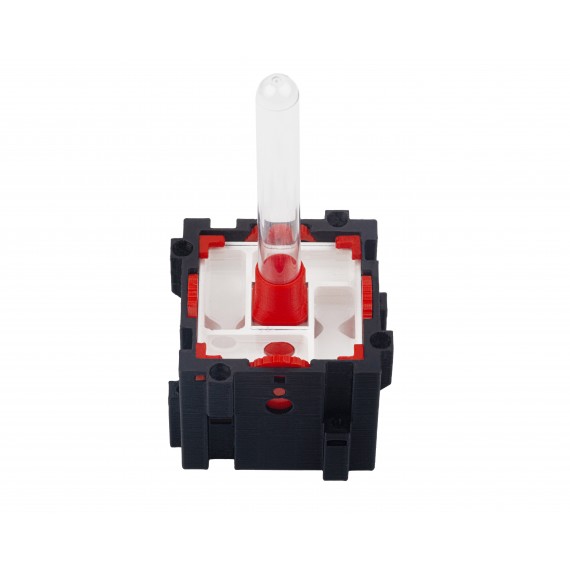
In nature, T. modesta lives inside hollow twigs: narrow galleries, little free space and walls close by. At Antomas we recreate that feeling with the smallest formicarium in Anthouse's Qbik Alpha range, the QBIK ONE, which also lets you see the whole colony:
Choose the smallest galleries you have available: with a colony of a few dozen workers, the snugger the better. In large chambers the workers scatter, the brood is left unprotected and unused corners collect debris and mould. When the colony fills the nest and you see workers with nowhere to go, expand with another module from the same range.
What about a wooden nest? As they live in wood, wooden nests can also work well with this species, and at Antomas we see them as a good alternative. But watch out for chewing: its cousin T. rufonigra gnaws soft materials, and such a tiny worker does not need much to get through. Check the walls and joints from time to time and, if you see sawdust or new holes, move them to a Qbik. What we do not recommend is keeping them in a natural branch: you cannot see anything that goes on inside, and wood collected outdoors can bring in mites or other lodgers.
Complete the setup with these details:
- A small, closed outworld, with a tight-fitting lid and very fine ventilation mesh, suited to their size (see "Escapes and barriers").
- A thin barrier around the rim of the outworld, as explained below.
- A water tube fixed in the outworld.
- A feeder for sugary liquids, small and with a spread-out drop, so they do not get stuck.
- Thermometers and probes, on the outside. In T. rufonigra, workers have been seen getting inside a digital thermometer, and a worker this size gets through any slot.
Arrival of the colony and moving by tipping out
We ship young colonies with their queen, workers and brood, with the founding stage already behind them. When it arrives, leave the tube for a few hours in a quiet place at 24–28 °C, check that it has water and offer a micro-drop of nectar at the entrance.
There is no data on how this species founds colonies, but there is a recurring experience among keepers of pseudomyrmecines: they do not do well in a test tube for long, so it is best to move them into their nest soon. At Antomas we do it by tipping them out:
- Prepare the setup beforehand: nest humidified, outworld closed, barrier in place, water and feeder.
- Work over a light-coloured tray with a barrier around the edge: on a white surface you will immediately spot any yellow worker that escapes.
- Tip the contents of the tube out next to the nest entrance, inside the outworld, with a few gentle taps. If there is cotton wool, remove it with tweezers and shake it over the outworld, because workers often stay inside.
- Help the stragglers with a fine, damp paintbrush; at this size, a brush is better than tweezers.
- Close the lid as soon as you finish and leave the colony in peace for a few hours. Usually, before long they will have carried the queen and the brood into the nest.
To move them into a larger nest, use the same method.
Feeding
Sugary liquids, ad libitum. They have a sweet tooth, and a growing colony should have sugar within reach at all times. At Antomas we always give them Anthouse Blue Sugar Nectar as the main liquid, but it is worth varying:
- Blue Sugar 4–5 times a week.
- Another sugary liquid or nectar 1–2 times a week, so they do not always get the same thing.
- Protein in the nectar: from time to time you can add it to the liquid, a convenient way of giving protein to a small colony.
- Always in a feeder, never on cotton wool: cotton wool soaked in sugar goes mouldy and the liquid spoils quickly. Use a traditional or homemade feeder in which the drop stays spread out and accessible.
- Small, fresh drops: with such tiny workers, a large, thick drop can trap them. Better a small amount, renewed often.
Protein: very small insects. Their mouthparts and size set the rules. The best prey are:
- Fruit flies (Drosophila), preferably flightless ones.
- Termites, soft and just the right size.
- Firebrats (Thermobia domestica), the smallest ones, or cut into pieces.
Change the type of prey from one week to the next so the diet is varied. Always use insects bred as feeders, never ones collected where insecticides are used. A tip from Tetraponera keepers against mites: scald dead prey for a few seconds in boiling water, because freezing does not kill their eggs.
The more they eat, the more they grow. With daily removal of leftovers, at Antomas we prefer to overdo it rather than fall short: the colony senses there are plenty of resources and raises more brood, faster. If you cannot remove leftovers every day, it is better not to overfeed, because forgotten protein rots and attracts mould and mites, and in such a small nest that really shows.
Winter: no diapause
T. modesta is tropical and subtropical, and in its range no month has cold averages. It does not undergo diapause: keep it at 24–28 °C in winter too. In mainland Southeast Asia the winter is somewhat cooler, so a gentle drop of a couple of degrees at home, to about 22–24 °C, will do no harm; the colony will simply slow down a little. What you must not do is cool it down like a European species.
Behaviour in captivity
Fast and alert. Like true pseudomyrmecines, they move at a good pace and react to nearby movement: they stop, "look" and carry on. In nature they forage among the foliage, so do not be surprised to see them running over the walls and lid of the outworld.
Sweet-toothed. You will most likely see several workers gathered around the feeder, their gasters getting fuller and fuller. As for protein, what they make best use of is small, soft prey that suits their mandibles.
Discreet. A colony of this size makes no fuss and does not fill the outworld with workers. To enjoy it, a hand lens or a phone camera with zoom is well worth having.
Watch without fear. At Antomas we believe ants are there to be enjoyed, observed and learned from, not kept hidden away. Just leave them a dark area in the nest and light in the outworld, watch gently and disturb them as little as possible during maintenance.
If something goes wrong: if the colony is not growing, it is usually cold or too little protein; if you see mould, there are too many leftovers or too much moisture; if workers wander restlessly along the rim, check that they are not short of water or sugar and that the nest has not become too small for them.
Escapes and barriers
With this species, escapes are the critical point. Because of their size, the barrier must be thin and the mesh fine:
- Very fine ventilation mesh. The standard mesh of many terrariums lets through a worker with a half-millimetre head. Use the finest you can find or cover the ventilation with a very tightly woven fabric.
- A thin barrier of mineral oil around the top rim of the outworld: a thin, continuous film with no gaps, better than a thick layer in which such a small worker could get trapped. Renew it as soon as it gets dirty.
- A tight-fitting lid and joints with no play: check the corners, tube connections and stoppers.
- No bridges: nothing touching or crossing the barrier.
- Care when opening: a worker may be on the inside of the lid. Check it before putting it down on the table.
Handling and safety
They have a sting and can sting, but, being so small, in Antomas's experience it is no big deal: far less painful than a bee or wasp sting. Even so, it is best to work methodically:
- Use fine tweezers and a paintbrush for food and stray workers; never your fingers.
- Get everything ready before opening (food, clean feeder, tweezers) and close up as soon as you finish.
- Work over a light-coloured surface, where escaping workers can be seen.
- If one stings you, wash the area with soap and water.
As with any stinging species, as a precaution we do not recommend it for households with small children or pets, or for people allergic to hymenopteran stings (bees, wasps and ants). It is an exotic species: never release it.
What not to do
- Put a small colony in a nest with large chambers.
- Use standard ventilation mesh or leave joints unchecked.
- Apply a thick layer of oil in which they get trapped, or trust a lid that does not fit properly.
- Use a wooden nest without checking from time to time whether they are chewing it.
- Serve sugar on cotton wool or in large, thick drops.
- Let them run out of sugar or water.
- Give them prey that is too large or hard, or always the same one.
- Leave protein leftovers for more than a day.
- Cool them in winter like a European species.
- Put devices or cables in the outworld.
Scientific sources
The biology of Tetraponera modesta is almost unstudied: what is known comes mainly from identification keys and species lists. This care sheet is completed with studies on other Tetraponera and on the subfamily Pseudomyrmecinae, and with Antomas's own experience. Main references:
- Ward, P. S. (1990). The ant subfamily Pseudomyrmecinae: generic revision and relationship to other formicids. Systematic Entomology 15: 449–489. doi:10.1111/j.1365-3113.1990.tb00077.x
- Ward, P. S. (2001). Taxonomy, phylogeny and biogeography of the ant genus Tetraponera (Hymenoptera: Formicidae) in the Oriental and Australian regions. Invertebrate Taxonomy 15: 589–665. doi:10.1071/IT01001
- Ward, P. S. and Downie, D. A. (2005). The ant subfamily Pseudomyrmecinae: phylogeny and evolution of big-eyed arboreal ants. Systematic Entomology 30: 310–335. doi:10.1111/j.1365-3113.2004.00281.x
- Yodprasit, K., Tasen, W., Jeenthong, T., Buddhakala, N. and Jaitrong, W. (2025). A new species of the ant genus Tetraponera Smith, 1852 (Hymenoptera: Formicidae: Pseudomyrmecinae) from Thailand. Tropical Natural History, suppl. 8: 287–296. doi:10.58837/tnh.25.8.266419
- Khachonpisitsak, S., Yamane, S., Sriwichai, P. and Jaitrong, W. (2020). An updated checklist of the ants of Thailand (Hymenoptera, Formicidae). ZooKeys 998: 1–182. doi:10.3897/zookeys.998.54902
- Dias, R. K. S., Udayakantha, W. S., Thotagamuwa, A. and Akbar, S. A. (2020). Tetraponera modesta, a new pseudomyrmecine ant record (Hymenoptera: Formicidae) for Sri Lanka. Ukrainska Entomofaunistyka 11(2): 1–3.
- Hamer, M. T., Lee, J. H. C., Tse, C. Y. L., Silva, T. S. R. and Guénard, B. (2022). Remarkable diversity in a little red dot: a comprehensive checklist of known ant species in Singapore… Asian Myrmecology 15: e015006.
- Buschinger, A., Klein, R. W. and Maschwitz, U. (1994). Colony structure of a bamboo-dwelling Tetraponera sp. from Malaysia. Insectes Sociaux 41: 29–41. doi:10.1007/BF01240571
- van Borm, S., Buschinger, A., Boomsma, J. J. and Billen, J. (2002). Tetraponera ants have gut symbionts related to nitrogen-fixing root-nodule bacteria. Proceedings of the Royal Society of London B 269: 2023–2027. doi:10.1098/rspb.2002.2101
- Golden, T. M. J. and Hill, P. S. M. (2016). The evolution of stridulatory communication in ants, revisited. Insectes Sociaux 63: 309–319. doi:10.1007/s00040-016-0470-6
- Xu, Z.-H. and Chai, Z.-Q. (2004). Systematic study on the ant genus Tetraponera of China. Acta Zootaxonomica Sinica 29: 63–76.
- Wheeler, W. M. (1915). On the presence and absence of cocoons among ants… Annals of the Entomological Society of America 8: 323–342. archive.org