Difficulty: 4/5 – Advanced
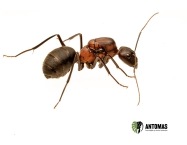
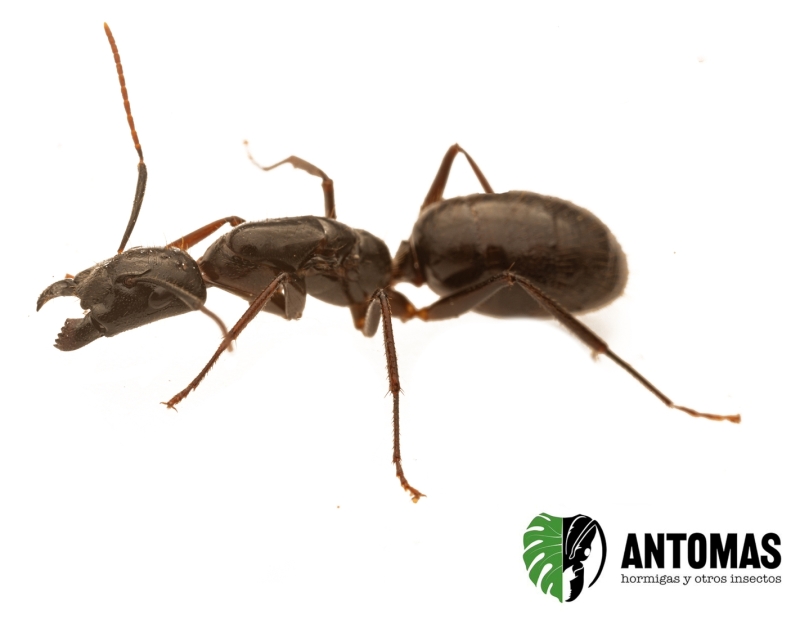
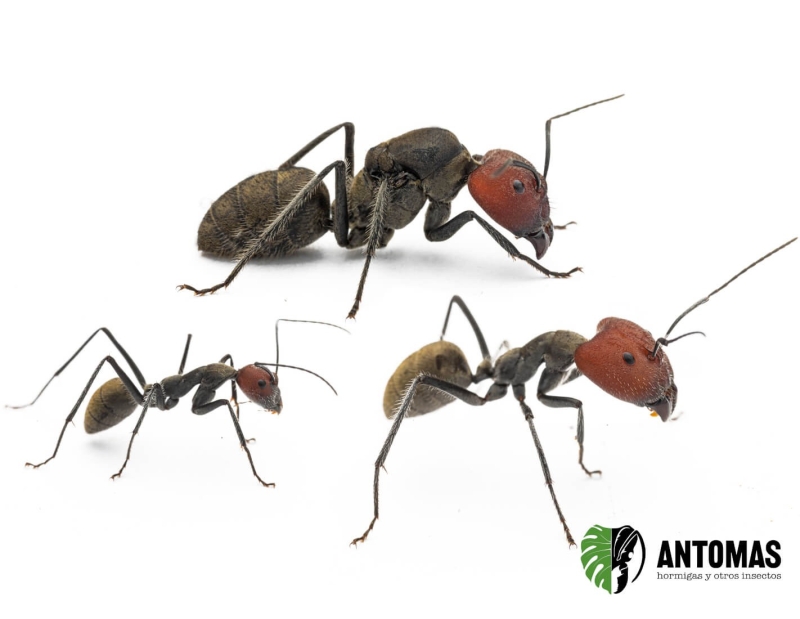
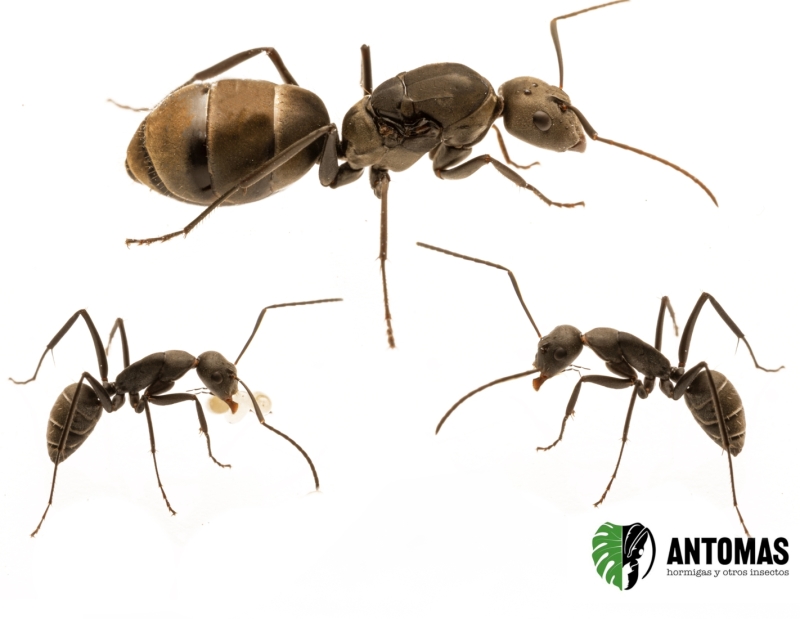
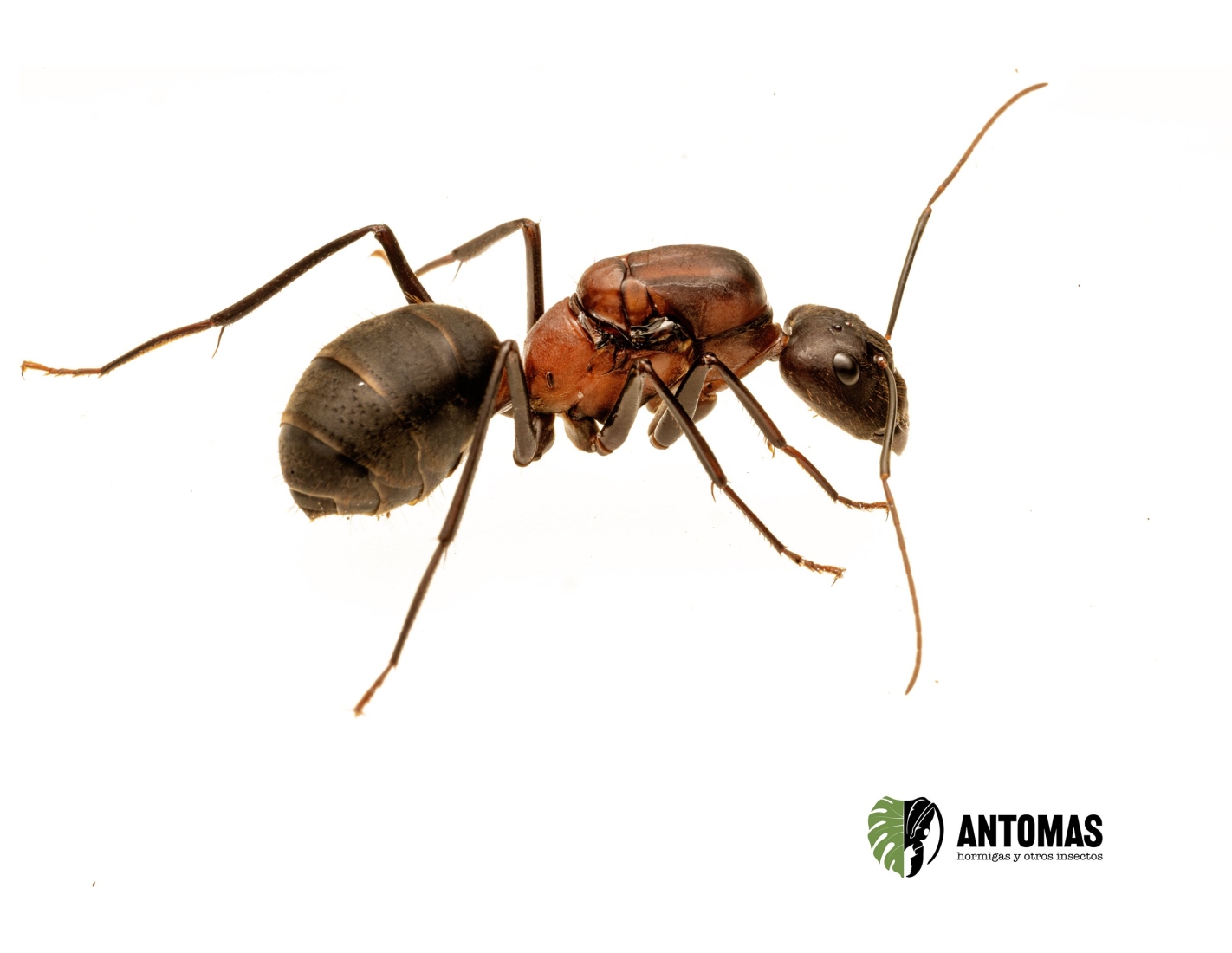
One of the great Camponotus of South and South-East Asia: slender and long-legged, with minor workers whose elongated head ends in a “neck”. C. angusticollis sanguinolentus is its blood-red subspecies: a dull rusty red, with a blackish-brown gaster. Queen with workers and brood. Nocturnal and calm, but it bites hard when defending the nest. Nest at 22–26 °C in the active season, with one side slightly warmer, a humidity gradient that never dries out completely, a Qbik Wild to start with and a Qbik Alpha with large galleries as it grows. Nectar in a feeder, plenty of varied protein, moving by tipping and a mineral-oil barrier. Cold hibernation: 2–3 months at about 15 °C.
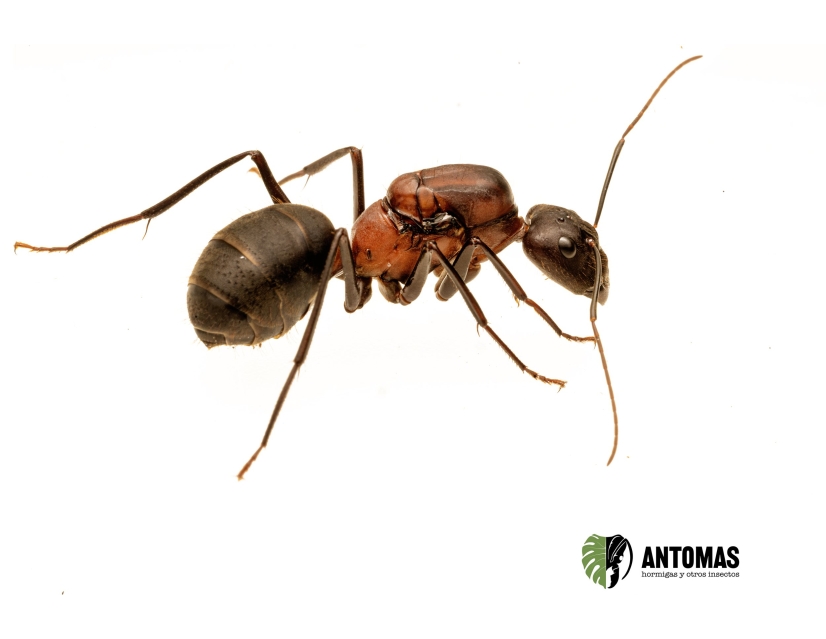
Camponotus angusticollis (Jerdon, 1851) is one of the great carpenter ants of South and South-East Asia: a slender, long-legged Camponotus, with broad-headed major workers and minor workers whose head narrows behind into a real neck, the feature that gives the species its name. The one we keep at Antomas is the subspecies C. angusticollis sanguinolentus Forel, 1895, the red form: where the typical form is a dull black, this one wears a rusty blood red.
It is a very little-studied ant. In the scientific literature, there is little more than its description for the subspecies, and a handful of field records for the species. Keeping experience is another matter: practically everything sold as C. angusticollis is sanguinolentus, so what shops and keepers report refers to this subspecies. Throughout this care sheet, we always say where each fact comes from: from sanguinolentus, from C. angusticollis in the broad sense, from its relatives, from other keepers or from Antomas’s own experience.
Biology
“Blood red”: the subspecies sanguinolentus
The Swiss myrmecologist Auguste Forel described it in 1895 as a variety, Camponotus angusticollis var. sanguinolentus, from workers collected in Assam, in north-east India. His description begins with the most obvious feature: a colour that is “blood red, rusty and dull”. The name needs no further explanation: sanguinolentus is a Latin adjective derived from sanguis, “blood”, which translates as “bloodstained” or “blood-red”.
Forel considered it identical to the typical form except for its colour, a more abundant and longer yellowish pubescence and somewhat more numerous hairs. In 1903, the British naturalist Charles Bingham summed up the relationship between the two: in Assam and Burma, the black form “is replaced” by the variety sanguinolentus. Today, the world catalogue of ants, AntCat, keeps it as a valid subspecies, the only one recognised within the species besides the typical form. And in 2023, Dhadwal and Bharti added a difference in shape in their key to the Camponotus of India: in sanguinolentus, the worker’s head is clearly longer than broad, with parallel sides; in the typical form, it is as long as broad, with the sides converging towards the front.
“Narrow neck”: the name of the species
The species was described by the British naturalist Thomas C. Jerdon in 1851, under the name Formica angusticollis, in his catalogue of the ants of southern India. Angusticollis combines the Latin angustus, “narrow”, and collum, “neck”, and Jerdon explained it in his description: the worker’s head is elongated and ends behind in a narrow neck. This is what makes its minor workers unmistakable, with the back of the head stretched into a kind of collar. The major workers, which Jerdon called “warriors”, have instead a very large head with a notch at the back.
Jerdon also left one of the few field observations that exist: he found it only in the forests of Malabar, on the south-west coast of India, “and always singly”. Today it is placed in the subgenus Tanaemyrmex, although the subgenera of Camponotus are considered provisional: the revision of the formicines by Ward, Blaimer and Fisher (2016) acknowledges that many are artificial groupings awaiting a revision of the genus.
Mistaken for the giant ant of Borneo
For much of the 19th century, this ant lived in the shadow of another. Frederick Smith, in 1858, and Gustav Mayr, in 1863 and 1872, treated it as a synonym of Camponotus gigas, the huge giant ant of the forests of Malaysia and Borneo, and in the early 20th century it was still placed in the subgenus Dinomyrmex, that of gigas. Forel treated it as a species in its own right in 1892 and brought together several names that had been described separately: Formica impetuosa, Camponotus prismaticus and Formica ardens, which turned out to be its queen.
The confusion makes sense: both are large, long-legged carpenter ants from the same region. Today they are further apart than they seemed: in 2016, Ward and his colleagues removed Dinomyrmex from Camponotus and raised it to a genus of its own. Even so, Dinomyrmex gigas is the best-studied large Indo-Malayan carpenter ant, and it gives an idea of how these giants live: in Borneo, Pfeiffer and Linsenmair (2000) found that its colonies go out to forage at dusk and that most of what they carry back to the nest is honeydew.
From the eastern Himalayas to Borneo
C. angusticollis in the broad sense lives in India, Sri Lanka, Nepal, Bangladesh, Myanmar, Thailand, Malaysia and Indonesia, including Borneo. Bingham recorded it from western and central India, from Assam and from the plateaux of Burma, at about 900 m above sea level. The subspecies sanguinolentus is known from Assam, its type locality, and from Burma, and regional lists also record it from Borneo, Malaysia and Indonesia. Observations by naturalists, identified from photographs, also place it in the foothills of the eastern Himalayas; they are useful clues, although they are no substitute for specimens examined by a specialist.
The home range of sanguinolentus is the monsoon belt at the foot of the eastern Himalayas: Assam, where it was described, northern Burma and Yunnan, in south-western China. There the summer is warm and very humid, with averages of 25–28 °C and a relative humidity of 75–85 %, and the winter, from December to February, is cool and dry, with averages of 14–19 °C and nights of 8–13 °C, but no significant frosts. The records from Borneo, with its equatorial climate, belong to the range of the species in the broad sense and are not the reference climate for keeping it. Under the canopy, the soil and the dead wood buffer the extremes even further. It is this cool, dry winter that you need to reproduce at home with a cold hibernation (see “Winter: cold hibernation”).
An aphid herder, from the ground to the trees
The few field studies place it at two levels. In the Western Ghats, the mountain range of south-western India, Sabu and his colleagues (2008) found it in the forest leaf litter, both in deciduous forest at about 300 m and in evergreen forest at about 800 m. And in cashew plantations in southern India, Vanitha and her colleagues (2017) saw it foraging on trunks and leaves, tending aphids and feeding on their honeydew. Note that both records refer to C. angusticollis in the broad sense, not to the subspecies.
That honeydew is much more than a treat. All Camponotus carry a bacterium, Blochmannia, which lives in special cells of their gut and makes essential amino acids that the ant cannot produce itself. According to Wernegreen and colleagues (2009), the ancestors of these ants acquired it precisely by tending sap-sucking insects such as aphids and scale insects. It is an alliance millions of years old, and you will see it at work as soon as you give them a feeder.
Fungi that take control
In 2021, Baiswar and Firake published the first Indian record of Pandora formicae infecting C. angusticollis in rice fields. This fungus was known mainly from the red wood ants of European forests, of the genus Formica, and it has a macabre strategy: the infected worker climbs the vegetation, clamps its jaws onto a blade of grass or a twig and dies there, clinging on, in a position from which the fungus spreads its spores more effectively (Małagocka and colleagues, 2017).
It is not the only fungus that “steers” carpenter ants in Asia. In the forests of Thailand, workers of Camponotus leonardi infected by the famous “zombie” fungus Ophiocordyceps bite the main vein of a leaf, all of them around midday, and die there, hanging (Hughes and colleagues, 2011). It has not been recorded in C. angusticollis, but it shows how much these large forest ants are a sought-after prize.
A great unknown of the night
What is not known about this ant is almost as much as what is known. There is no study of where it nests, how many workers its colonies have, when the queens fly or how long the brood takes to develop, and the male has not even been described. The figures that circulate on all this, such as colonies of hundreds or thousands of workers or queens that live for decades, come from shops, not from studies.
What shops and keepers do agree on is that it is a night ant: the workers go out to forage when it gets dark. No studies confirm this in the wild, but it fits with what other large carpenter ants of the region do, such as D. gigas. At home, it means the show begins at dusk (see “Behaviour and observation”).
Size and morphology
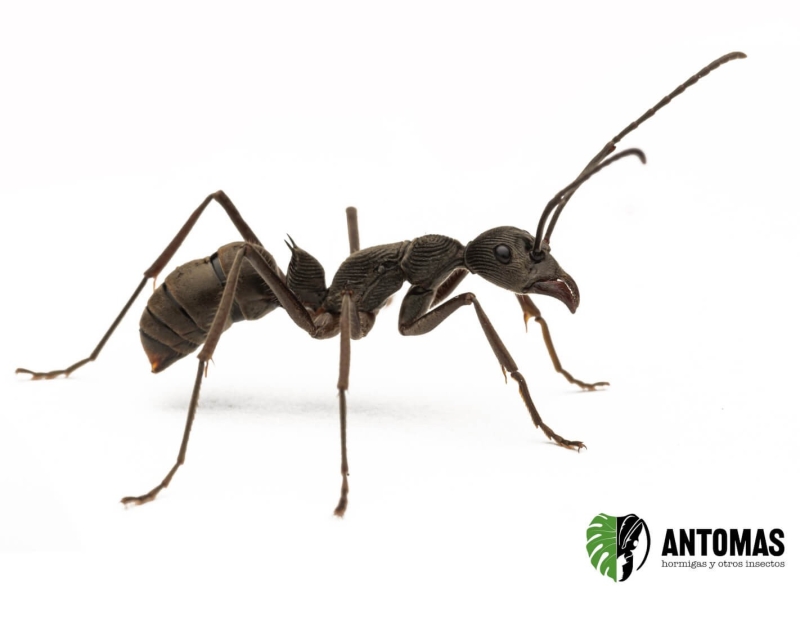
A large, slender and strongly polymorphic Camponotus, long-legged and without a sting, with minor and major workers that can be told apart at a glance.
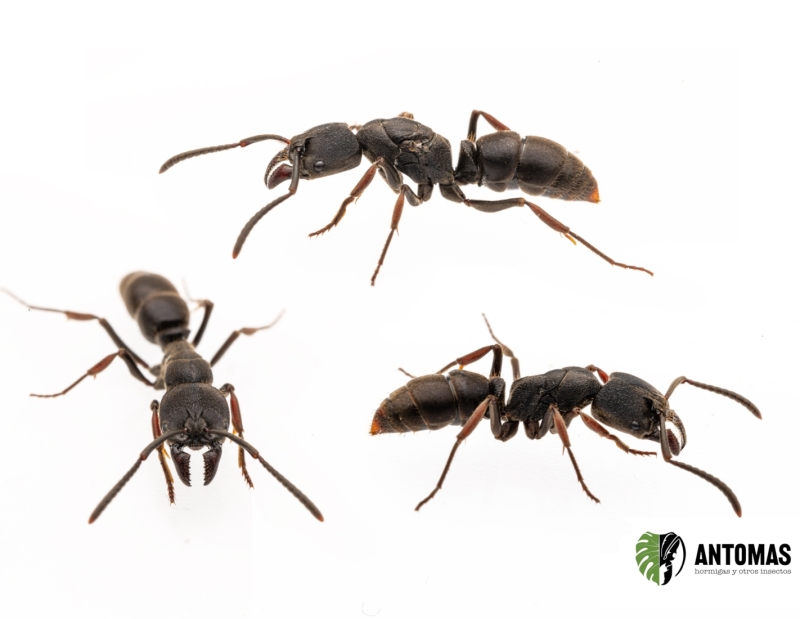
- Colouring of sanguinolentus. According to Forel (1895), blood red, rusty and dull, with the gaster, the legs (except the tarsi and joints) and the antennal scapes blackish brown, and the petiole, the front of the head and the mandibles more or less brownish. According to Bingham (1903), its colour ranges from a light yellowish red to a deep maroon red, and some major workers have a black head and legs.
- The typical form, by contrast, is black and opaque, with the antennae and legs brown to reddish (Jerdon, 1851; Bingham, 1903).
- Minor worker. An elongated head that narrows behind into a neck or collar, and a pronotum also narrowed at the front: the “narrow neck” of the name.
- Major worker. A very large, subtriangular head notched at the back, with strong six-toothed mandibles, a long, narrow thorax and a massive gaster.
- Head shape. In sanguinolentus, clearly longer than broad, with parallel sides; in the typical form, as long as broad, with the sides converging towards the front (Dhadwal and Bharti, 2023).
- Legs. Long, with prismatic, grooved tibiae and a row of oblique spines along the inner edge (Forel, 1892).
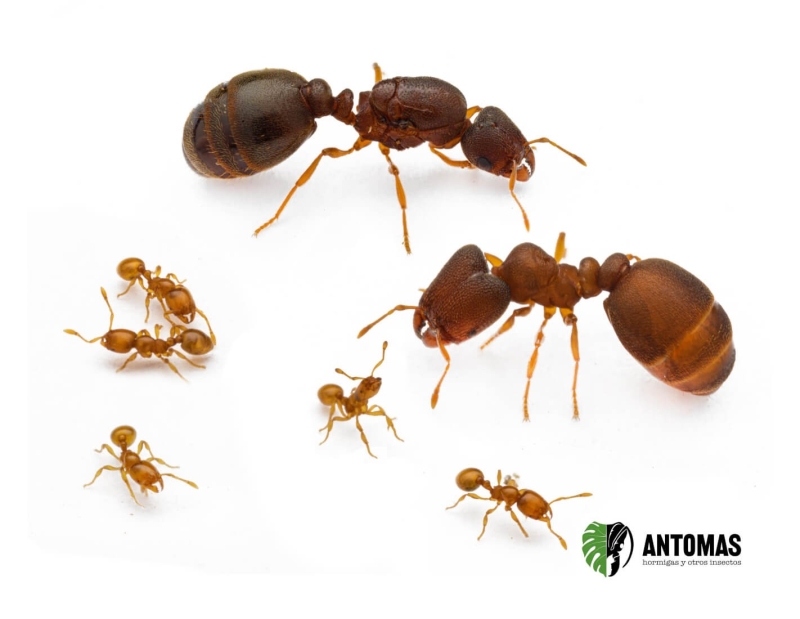
- Queen. Similar to a major worker, with a strongly humped thorax, where the flight muscles were, and a massive gaster. Forel singled out the smoky tint of her wings, brownish above all along the veins, as very characteristic.
- Gaster. It ends in the acidopore, the nozzle through which formicine ants spray formic acid. There is no sting.
- Male. Not yet described.
Approximate sizes
- Major-media worker of sanguinolentus: 15 mm (Forel, 1895, in the original description)
- Major workers of the species: 17–21 mm (Bingham, 1903)
- Minor workers of the species: 12–15 mm (Bingham, 1903); 13–14 mm (Forel, 1892)
- Queen of the species: about 20 mm (Forel, 1892)
- Male: no published measurements
These measurements are more than a century old, taken from few specimens, and, apart from the first one, they refer to the species in the broad sense, mostly to the typical form. We have not found any modern measurements. The larger figures given by many shops, with queens of 23–30 mm and major workers of up to 25 mm, do not come from published measurements, so we prefer not to give them.
Care in captivity
Difficulty: 4/5 – Advanced
It eats everything, has no sting and is calm from day to day. Even so, at Antomas we rate it as advanced, for five reasons:
- Temperature and annual cycle. Nest at 22–26 °C in the active season, with a thermostat, and a cold hibernation of 2–3 months at about 15 °C, never below 10 °C: you need to get both phases right.
- Humidity. It is an ant of humid forests: the nest must never dry out completely, but too much water brings mould. You have to find the right balance.
- Patience. Most shops and keepers describe it as slow- to moderate-growing, and the major workers take a while to arrive.
- Nocturnal habits. During the day it shows itself little, and you have to learn to watch it at dusk.
- Little published experience. There are few published keeping journals, and practically all of them are of sanguinolentus, which is the form on sale: you will need to observe and adjust.
And it is well worth it. It is one of the great Camponotus of Asia, slender, long-legged and, in this subspecies, of a very striking blood red, and it is rarely seen in Europe. If you have not yet kept a tropical Camponotus, start with Camponotus nicobarensis, also from Asia, much easier and fast-growing, or with the African giant Camponotus maculatus.
Recommended parameters
- Nest temperature: 22–26 °C in the active season, from spring to autumn, with one side slightly warmer and always with a thermostat, so that the colony can choose. It does not need more heat.
- Why: it is an ant of cool temperatures, not of constant heat: in summer the air in its range is around 25–28 °C, but the forest soil, where it nests, stays cooler and more stable.
- Foraging area: at room temperature, with no added heat.
- At night it can drop a few degrees without any problem, as in the wild.
- Humidity: humidity systems full at first and, later, a gradient with a humid zone that never dries out; a dry, ventilated foraging area (see “Humidity: never completely dry”).
- Water: always available, in a test tube with water and cotton wool in the foraging area.
- Light: a dark nest and a lit foraging area, with a normal day–night cycle and no direct sunlight.
- Winter: hibernation of 2–3 months at about 15 °C, never below 10 °C (see “Winter: cold hibernation”).
Humidity: never completely dry
In much of its range more than 2,500 mm of rain falls each year, and in the rainy season the relative humidity is around 75–85 %. At home you do not need to recreate a rainforest, but you do need to stop the colony from drying out, which in a species from humid forests is a serious mistake:
- At first, the formicarium’s humidity systems should be well filled with water: the queen and the small brood need it.
- Once the colony has grown, at Antomas we recommend a gradient: one part of the nest always humid, where they usually keep the smallest brood, and the rest drier, where the cocoons gather. The colony chooses.
- Never soaked: condensation on the walls, mould or mites mean there is too much water or that leftovers have been forgotten.
Recommended formicaria
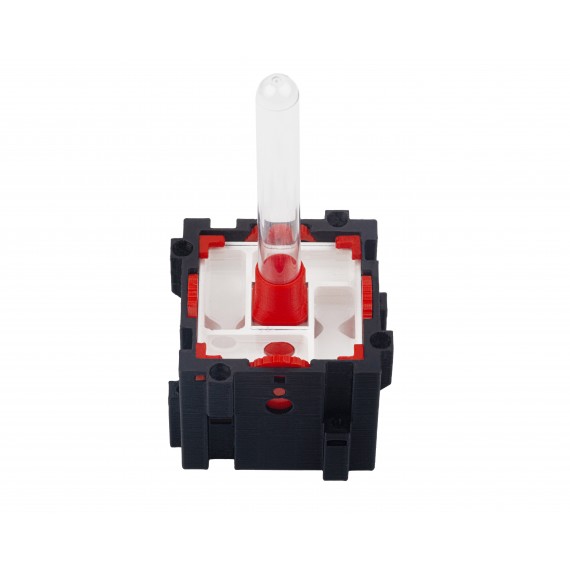
To start with, at Antomas we recommend a formicarium from the Anthouse Qbik Wild range, made of plaster, which holds humidity well. For a colony like the ones we sell, with its queen and her first workers, the Qbik Wild One P 1C:
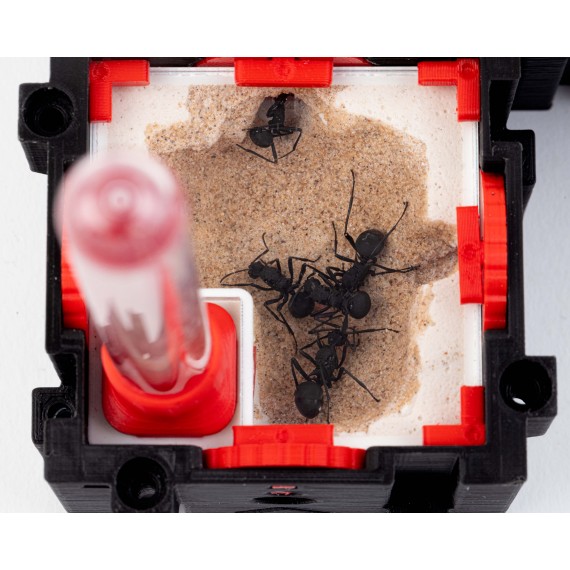
As the colony grows, the natural next step is the Qbik Alpha range, modular and lighter, which expands with the colony. With this ant, always with large galleries: the major workers and the queen are long and need room to move around and to carry the brood. First, a QBIK ONE with large galleries:
To keep expanding, the QBIK DUO, also with large galleries. The nest should always be in proportion to the colony: in one that is too big, the spare chambers become rubbish tips, with mould and mites, and it is one of the mistakes shops warn about most with this species. Expand when you see many workers standing idle in the foraging area because there is no room inside. Complete the set-up like this:
- A large foraging area, with some substrate and a piece of bark or a branch to climb, with nothing reaching up to the barrier: with those long legs, they cover a lot of ground.
- Water in a test tube with cotton wool and a feeder for sugar, never on cotton wool.
- Heat on one side of the nest, with a thermostat, away from the feeder.
- A mineral-oil barrier and a well-fitting lid (see “Escapes and barriers”).
Arrival and moving by tipping
At Antomas we sell it as a queen with workers and brood: a small colony, with a single queen, that has already passed the founding stage. When you receive it:
- First days. Keep it for a few days as it arrives, in a dark place free of vibrations, at 22–24 °C. Watch it often to check that it has water and that the queen and the brood are well tended.
- Gentle feeding. Offer a drop of nectar on a small piece of aluminium foil and a small, opened prey item. Remove anything left over the next day.
- Watch it often, carefully. Check every day how the queen, the brood and the water are doing, but without opening the container or moving it more than necessary. One keeper lost several queens of this species which, stressed in a nest that did not suit them, ate their eggs or let them rot.
With the workers it arrives with, it can already go into its first formicarium. At Antomas we do it by tipping:
- Set up the formicarium beforehand, with the humidity loaded, the barrier in place and the water ready.
- Work over a tray, with a soft brush or soft tweezers, never with your hands.
- Open the tube or container it arrives in, in the foraging area, next to the nest entrance, and gently tip out the queen, the workers and the brood, helping the stragglers along with the brush.
- Close the lid and leave the nest dark. Within a few hours they will have carried the brood inside.
To move it later into a larger module, use the same method.
Growth and major workers
There are no scientific data on this ant’s development, and what shops and keepers say does not agree: between about 4 and about 12 weeks from egg to worker, depending on the source and the temperature. Most describe it as slow- to moderate-growing. The only keeping journal we have found describes a colony that went from 16 to about 24 workers in three months, still without a single major worker.
The major workers, with their large heads, arrive once the colony has gained strength, and the sooner the more protein it receives in the active season. One colony, one queen: at Antomas we do not combine queens or colonies.
Feeding
Sugar in a feeder, always available. In the wild, much of its energy comes from aphid honeydew. At Antomas we recommend variety: Anthouse Blue Sugar Nectar 4–5 times a week and another nectar or sugary liquid 1–2 times a week. You can also add a little protein to the nectar. Always offer it in a feeder, where the drop stays spread out and within reach, and never on cotton wool, which goes mouldy and spoils the liquid straight away.
Protein: the more, the better. It is the engine of growth, and one keeper describes this ant as very voracious. In Antomas’s experience, if you do frequent maintenance and remove leftovers, it is better to give too much than too little: the colony understands that it has resources and grows faster and in greater numbers. If you will not be able to clean often, it is better not to overfeed. Change the type of insect from one week to the next, so that they do not always eat the same thing:
At dusk and opened. As it is nocturnal, put the protein in at nightfall and remove the leftovers the next morning. While the colony is small, offer the prey opened or cut up. Buy the insects from a reliable supplier: insects treated with insecticides can kill the colony.
Water: always, in the test tube with cotton wool in the foraging area, separate from the sugar.
Winter: cold hibernation
It is an ant of cool climates and needs to hibernate. In its range, the winter, from December to February, is cool and dry, with nights of 8–13 °C. At Antomas we recommend a hibernation of 2–3 months at about 15 °C, roughly from December to February, never below 10 °C: it is part of its annual cycle and the colony needs it to stay healthy.
- Going in gradually: in autumn, when activity and laying slow down, lower the temperature by a few degrees each week down to about 15 °C.
- During hibernation: water always available and a little nectar; protein, little or none. Check it often to make sure the queen is well and that no mould appears.
- Coming out gradually: at the end of winter, raise the temperature gradually up to 22–26 °C and offer protein again once it becomes active.
- No warmth all year round: do not keep it warm in winter; it needs its cold rest.
Behaviour and observation
An ant of the dusk. During the day you will see a calm colony and little movement in the foraging area; as evening falls the foragers come out, long-legged and quick, to roam the sand. If you want to see them hard at work, watch them at nightfall.
Calm, but with character. Shops and keepers describe it as calm with whoever looks after it, but it bites hard when defending the nest.
Observe without fear. At Antomas we believe ants are there to be enjoyed, watched and learnt from, not kept hidden away. It is enough to keep the nest dark and the foraging area lit, and to watch them gently, intervening and stressing them as little as possible. They get used to your presence.
Warning signs:
- The colony does not grow in the middle of the season: almost always a lack of protein or the wrong temperature.
- Larvae that do not develop or a queen that stops laying: check that the nest is at 22–26 °C in the active season and that the colony has had its hibernation.
- Workers crowded into the humid zone and the rest of the nest empty: it may be too dry.
- Condensation, mould or mites: too much humidity or forgotten leftovers.
- Many workers standing idle in the foraging area: time to expand.
Escapes and barriers
Like almost all Camponotus, it climbs well, and with those long legs an escape does not go unnoticed. At Antomas we use mineral oil with them:
- A thin, continuous band of mineral oil along the top of the walls of the foraging area. Renew it when it collects dust or debris.
- A well-fitting lid, as a second line of defence.
- No gaps in connections, stoppers or tubes.
- Nothing that can act as a bridge to the barrier: no branches or bark leaning nearby.
Handling and safety
It does not sting: it has no sting. But it bites, and a major worker of this size makes itself felt; it can also spray formic acid, which stings on sensitive skin or in a small cut. Nothing serious if you work calmly:
- Always use tools: a soft brush, soft tweezers and, for transfers, tubes and adaptors. Never your hands.
- Open the formicarium only as much as needed, work slowly over a tray and close it when you finish.
- Do not combine different queens or colonies, or keep it with other species.
- With young children at home, let them enjoy it by watching, with the formicarium closed, but never handling it.
It is an exotic species: it must never be released into the wild.
What not to do
- Keep it warm all year round, without hibernation.
- Overheat it: 22–26 °C with one side slightly warmer is enough; heating, always with a thermostat.
- Let the nest dry out completely, or soak it all.
- Put a small colony into a huge formicarium, or use small galleries once the major workers arrive.
- Open or move a newly arrived colony all the time: watch it often, but without opening the container more than necessary.
- Put the sugar on cotton wool or let it run out.
- Always give it the same insect or leave leftovers for more than a day.
- Combine queens or colonies.
- Handle it with your hands or neglect the barrier.
Scientific sources
This care sheet is based on the scientific literature on Camponotus angusticollis and its subspecies sanguinolentus, which is very scarce, on the AntCat and AntWiki catalogues, on climate data from its range and on the experience of Antomas and other keepers. Main references:
- Jerdon, T. C. (1851). A catalogue of the species of ants found in Southern India. Madras Journal of Literature and Science 17: 103–127. doi:10.5281/zenodo.6297922
- Forel, A. (1892). Les Formicides de l’Empire des Indes et de Ceylan. Part I. Journal of the Bombay Natural History Society 7: 219–245. Text on the Internet Archive (open access)
- Forel, A. (1895). Les Formicides de l’Empire des Indes et de Ceylan. Part V. Adjonction aux Camponotinae. Journal of the Bombay Natural History Society 9: 453–472. doi:10.5281/zenodo.14352
- Bingham, C. T. (1903). The Fauna of British India, including Ceylon and Burma. Hymenoptera, Vol. II. Ants and Cuckoo-wasps. Taylor and Francis, London. Text on the Internet Archive (open access)
- Pfeiffer, M. & Linsenmair, K. E. (2000). Contributions to the life history of the Malaysian giant ant Camponotus gigas (Hymenoptera, Formicidae). Insectes Sociaux 47: 123–132. doi:10.1007/PL00001690
- Sabu, T. K., Vineesh, P. J. & Vinod, K. V. (2008). Diversity of forest litter-inhabiting ants along elevations in the Wayanad region of the Western Ghats. Journal of Insect Science 8: 69. doi:10.1673/031.008.6901
- Wernegreen, J. J., Kauppinen, S. N., Brady, S. G. & Ward, P. S. (2009). One nutritional symbiosis begat another: phylogenetic evidence that the ant tribe Camponotini acquired Blochmannia by tending sap-feeding insects. BMC Evolutionary Biology 9: 292. doi:10.1186/1471-2148-9-292
- Hughes, D. P., Andersen, S. B., Hywel-Jones, N. L., Himaman, W., Billen, J. & Boomsma, J. J. (2011). Behavioral mechanisms and morphological symptoms of zombie ants dying from fungal infection. BMC Ecology 11: 13. doi:10.1186/1472-6785-11-13
- Bharti, H., Guénard, B., Bharti, M. & Economo, E. P. (2016). An updated checklist of the ants of India with their specific distributions in Indian states (Hymenoptera, Formicidae). ZooKeys 551: 1–83. doi:10.3897/zookeys.551.6767
- Ward, P. S., Blaimer, B. B. & Fisher, B. L. (2016). A revised phylogenetic classification of the ant subfamily Formicinae (Hymenoptera: Formicidae), with resurrection of the genera Colobopsis and Dinomyrmex. Zootaxa 4072: 343–357. doi:10.11646/zootaxa.4072.3.4
- Małagocka, J., Jensen, A. B. & Eilenberg, J. (2017). Pandora formicae, a specialist ant pathogenic fungus: new insights into biology and taxonomy. Journal of Invertebrate Pathology 143: 108–114. doi:10.1016/j.jip.2016.12.007
- Vanitha, K., Bhat, P. S., Raviprasad, T. N. & Srikumar, K. K. (2017). Species composition of ants in cashew plantations and their interrelationships with cashew. Proceedings of the National Academy of Sciences, India, Section B: Biological Sciences 87: 399–409. doi:10.1007/s40011-015-0600-3
- Baiswar, P. & Firake, D. M. (2021). First record of Pandora formicae on ant, Camponotus angusticollis and Batkoa amrascae on white leaf hopper, Cofana spectra in rice agroecosystem of India. Journal of Eco-friendly Agriculture 16: 27–31. doi:10.5958/2582-2683.2021.00005.8
- Dhadwal, T. & Bharti, H. (2023). Two new species of the genus Camponotus Mayr, 1861 (Hymenoptera: Formicidae) with five new records from India. European Journal of Taxonomy 901: 1–51. doi:10.5852/ejt.2023.901.2317