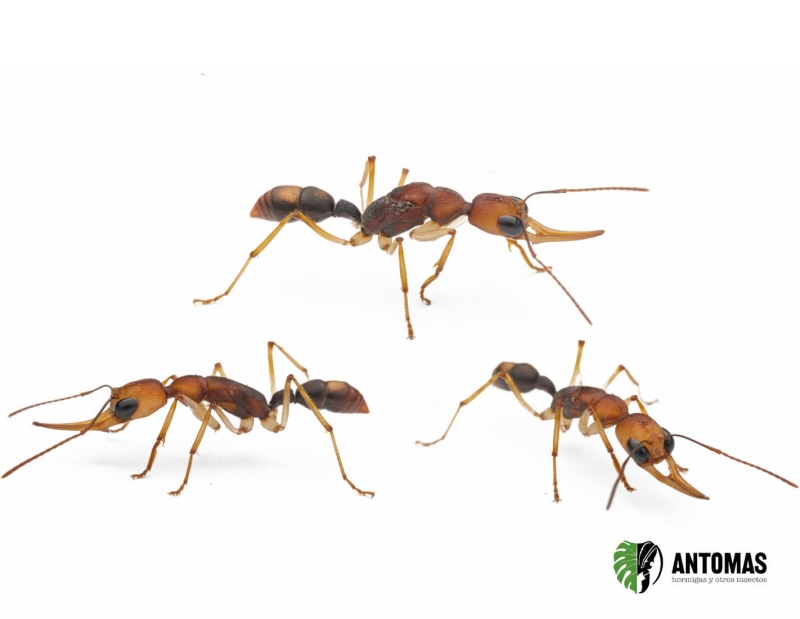
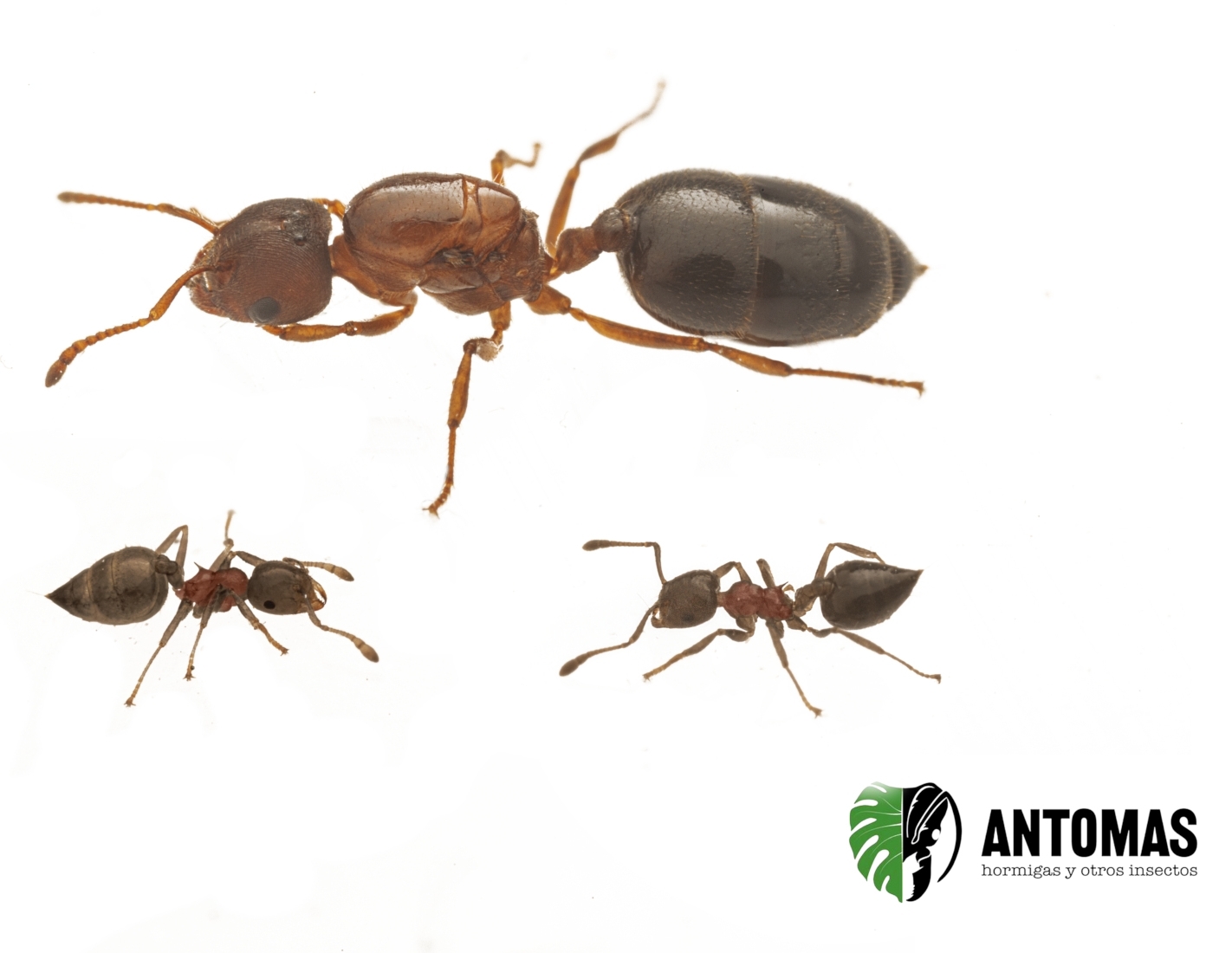
Difficulty: 2/5 – Beginner
An acrobat ant from tropical Asia, tree-dwelling and a builder of carton nests that hang from branches like small wasp nests. It raises its heart-shaped gaster at the slightest threat and defends the colony with phenol-based chemistry. Colonies with a queen, workers and brood, fast-growing. 24–28 °C all year round, no diapause, a dry, well-ventilated Qbik nest from the Alpha range, sugar always in a feeder and plenty of varied protein. Key point: everything tightly closed and a barrier of paraffin oil or petroleum jelly, because they climb and cling like few others.
Crematogaster rogenhoferi Mayr, 1879 is one of the most characteristic tree-dwelling ants of monsoon Asia. It ranges from India and Sri Lanka to southern China, Taiwan, Indochina, Borneo and the Philippines, and wherever it lives it does not go unnoticed: its colonies build globular carton nests on branches, made of folded leaves and a dark, hard paste, which can exceed 40 cm in length and house tens of thousands of ants. Like all Crematogaster, it is an acrobat ant: when something disturbs it, it lifts its heart-shaped gaster above its body, ready to smear its venom.
It has no established common name, and we are not going to invent one. What it does have, which is rare for a terrarium ant, is a small scientific library of its own: the antifungal chemistry of its nest, its venom, its role as a predator of pests, its vibrational “conversation” with the caterpillars of a butterfly and even how its colonies are “farmed” in Vietnam. We tell you all of it, separating what is documented from what keepers report, and then how to keep it at home: it is rewarding, grows fast and is very easy to feed, with just one point that demands attention: escapes.
Biology
An ant that gives its name to its group
The Austrian Gustav Mayr, one of the founding fathers of myrmecology, described it in 1879 in his work on the ants of Asia, from workers. The name almost certainly honours his Viennese colleague Alois Rogenhofer, an entomologist at the Natural History Museum in Vienna. Catalogues also list three subspecies described in the late 19th and early 20th centuries, costulata (Myanmar), lutea (Indonesia) and fictrix (Borneo), which have never been revised with modern methods.
In 2012, the entomologist Bonnie Blaimer reorganised the genus Crematogaster, with hundreds of species spread across the world, into just two subgenera, and proposed a series of regional species groups. One of them, covering South-East Asia, New Guinea and Australia, bears its name: the C. rogenhoferi group, which for now brings together C. rogenhoferi, C. flava, C. ochracea and C. laeviceps. They are recognised by a strongly broadened petiole, often with a sharp edge, a postpetiole split into two lobes by a central groove and a pronotum with angular margins. Our species is the one that gives the family its name.
From Sri Lanka to Taiwan: monsoon Asia
Its range is enormous. Published records and catalogues place it in India (including the Andaman Islands), Sri Lanka, Myanmar, Thailand, Laos, Vietnam, southern China (Yunnan, Hainan and Macau), Taiwan, Singapore, Sumatra, Borneo and the Philippines. As early as 1903, the British naturalist Charles Bingham recorded it from Sikkim, in the Himalayas, to southern India, Ceylon, Assam and Burma.
It is a tree species, and it does not need virgin rainforest: it has been found in degraded forests and gardens in Singapore, in rubber plantations in southern China and in home gardens in Sri Lanka, among mango, coconut and cinnamon trees. All it needs is trees to hang its home from.
Carton architects: nests hanging from branches
Many Crematogaster know how to make carton, a paste of chewed plant fibres that they use to plug gaps or divide the nest. A few go further and build complete, free-standing nests around branches. C. rogenhoferi is one of them, and its nests are among the best studied in the genus.
In a home garden in Sri Lanka, the zoologists R. K. S. Dias and K. G. I. Udeshika found nests hanging from the forks of 19 tree species, from mango and avocado to teak and mahogany, and distinguished three stages of construction:
- Initial nest. 5–9 cm long, made of green leaves folded over and covered with a hard black paste and a clay-like material. Only workers lived in it, between 115 and 375.
- Intermediate nest. 6–11 cm long and up to 15 cm wide, well coated on the outside. Inside, the leaves, by now brown, were folded like an accordion. It housed more than 2,000 workers and several queens.
- Mature nest. An elongated globe 36–45 cm long and 20–24 cm wide, with folded leaves forming the inner chambers. It contained every stage, from egg to adult: between 13,385 and 18,134 individuals per nest.
Further east, in Tarutao National Park in southern Thailand, Suparoek Watanasit and Sopark Jantarit studied fifteen nests built from leaf debris and twigs on branches, between 2.5 and 4.7 m above the ground. They found none in the dominant tree of the area, which produces an insect-repellent oil. The average population exceeded 29,000 ants per nest, with around 15,600 workers, and the largest nests held more than 67,000 individuals.
In captivity, keepers report that they chew wood and mix it with saliva, and that they can build with whatever is to hand: mud, dry grass and even the cotton wool from the tubes. The result, according to one of them, is slow to make but “incredibly hard”.
A nest that is also a pharmacy
A warm, humid carton nest full of ants is a paradise for fungi. How does C. rogenhoferi prevent it? A Chinese team investigated this in 2024. From the material of its nests they isolated two compounds and tested them against Beauveria bassiana, a fungus that parasitises and kills insects, and against a pathogenic bacterium. Both slowed the growth of the fungus, by contact as well as by fumigation: their vapour alone was enough. Against the bacterium, however, they did nothing.
The most interesting part is their origin. The first, a phenol, was found in the head and abdomen of the workers: they make it themselves. The second, lupenone, was not present in the ants: it is a typical plant compound, which reaches the nest with the plant tissue it is built from. In the authors’ words, the species makes use of its own chemical defences and, probably, also of those that plants evolved to protect themselves.
Even so, the carton has its lodgers. In 2026 a genus and species of fungus new to science was described, Exsiccatiomyces formicarium, isolated from the wall of a C. rogenhoferi nest in Yunnan. Back in 2018, an Indian study had already seen fungal hyphae among the nest materials: its home is a whole little ecosystem.
The heart-shaped gaster and a phenol venom
Crematogaster are called acrobat ants because of the way they defend themselves: they raise the gaster, which seen from above is heart-shaped, and carry it over the thorax and even over the head, pointing it at the threat. Their sting does not pierce: its tip is spatula-shaped and is used to smear the venom on by contact. In the Mediterranean acrobat ant, C. scutellaris, it has been shown that this venom repels other ants and that the posture is both a warning and a weapon.
What is in the venom of C. rogenhoferi? In 2025 its Dufour’s gland, the main source of defensive chemistry in the genus, was analysed by chromatography. Each worker carried about 83 µg of substances, and more than 80 % of them were two long-chain phenols, from the same chemical family as the defensive secretions of other Asian Crematogaster. Young queens, by contrast, had four times less and a different mixture, of alkanes and esters, without those phenols. It makes sense: the one who goes out to fight is the worker, not the future queen. And a lovely detail: the only compound shared by the two castes is the same antifungal phenol that the workers put into the nest.
A reputation for biting
In its homeland it has a reputation as a nuisance. In that Sri Lankan garden, the workers came into the house while foraging and bit anyone who came near to pick flowers or fruit, causing a painful itch and the odd allergic reaction: just what you would expect from a colony of tens of thousands of ants defending its tree. At home, with a starting colony, a bite from a 4 mm worker is no more than a pinch (see “Handling and safety”).
Scale-insect herders… and scale-insect hunters
Like so many acrobat ants, C. rogenhoferi lives largely on honeydew, the sugary liquid excreted by aphids and scale insects. In Singapore, workers were collected on trees “visiting” soft scales of the family Coccidae, a relationship of tending and milking that biologists call trophobiosis.
Yet the same species is, in the rubber plantations of southern China, one of the main predators of another scale insect, Parasaissetia nigra, a crop pest, and effectively keeps its populations in check. So much so that a Chinese team has studied the genes behind its sense of smell, with 37 olfactory receptors identified, in order to make better use of it as a biological control agent. In Vietnam, a 2025 study also describes it as a natural enemy of several pests, with a “very rich” natural diet, mainly of insect larvae. Tending some scale insects and eating others is not a contradiction: it is what opportunistic predators do.
A butterfly that speaks its language
In Taiwan, C. rogenhoferi has a very special guest: the caterpillar of the butterfly Spindasis lohita, a lycaenid that lives with ants. In 2019, a Taiwanese team recorded the vibrations produced by both. The ant produces one type of call; the caterpillar, three, and the pupa, one more. The caterpillar’s calls closely resembled those of the ant and, when the researchers played one of them back next to the workers, the ants responded by touching it with their antennae, gathering together and standing guard. It was the first evidence of vibrational communication between these two families: the butterfly “imitates the voice” of its host to win its protection.
Many queens, tens of thousands of workers
C. rogenhoferi colonies are polygynous: they can have more than one queen. In Thailand, nests had an average of 1.5 queens; in northern Vietnam, 1.8; and in Sri Lanka, intermediate nests housed several dealate queens. In Sri Lanka they also observed something revealing: small nests, built by workers alone, were later occupied by queens that began laying in them. Everything points to colonies that spread across several nests in the same tree or in neighbouring trees.
Mature colonies rear hundreds or thousands of winged females and males: in Thailand, in March, there was an average of more than 1,700 alates per nest. In northern Vietnam, at field temperatures, full development is slow: about 26 days as an egg, 28 as a larva and 21 as a pupa, that is, about 11 weeks from egg to worker. At a constant 24–28 °C it can be expected to go somewhat faster.
Ant eggs on the table
In Vietnam, where it is called kiến ngạt, the brood of this ant is eaten: “ant eggs”, which are actually eggs, larvae and pupae, are in demand at market. So much so that the country’s forestry science journal published a study in 2025 on how to farm it under the forest canopy without wiping it out. The technique that worked best was to open the nest at the foot of the tree, harvest the brood and leave around 5 % of the envelope with eggs, hang it back in the tree and leave food beside it: the colony rebuilt itself. The best trees turned out to be two local species, with 2–4 nests per tree. Few ants in the world are “farmed” like this.
Monsoons and no real winter
Its huge range spans two types of climate. In the tropical lowlands, from Sri Lanka and southern India to the Malay Peninsula, it is hot all year round, with averages of 26–29 °C, abundant rain and high humidity. In the north of its range, in northern Vietnam, southern China and Taiwan, the climate is subtropical: warm, rainy summers and a cool, drier winter, with averages of about 14–18 °C in the coldest month, but no frost in the lowlands. Nowhere in its range is there a winter that forces it to stop completely. That is why at Antomas we keep it active all year round (see “Diapause”).
Size and morphology
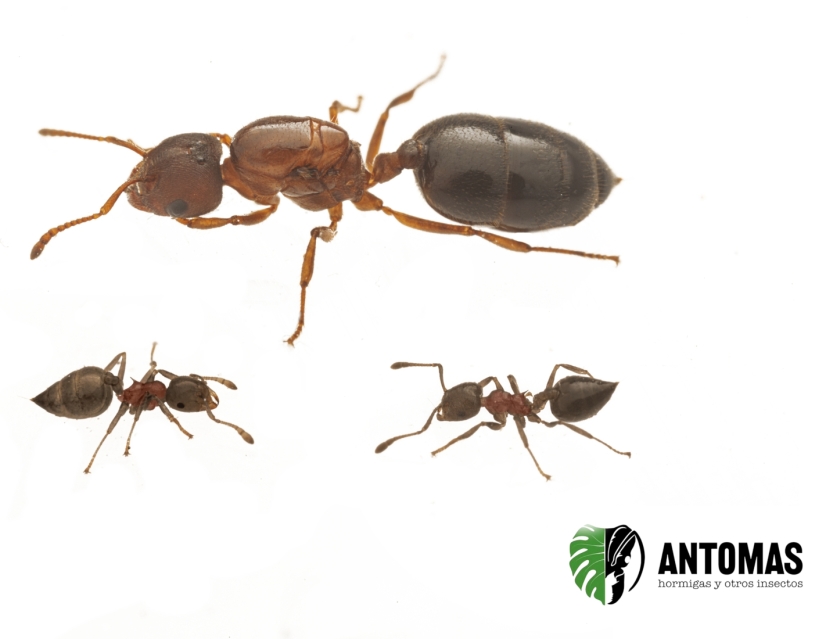
A small to medium-sized acrobat ant, reddish brown, with long spines on the thorax and the typical heart-shaped gaster.
- Colouring. Reddish brown, with the rear half of the gaster darker brown, and the antennae, legs and edges of the gaster segments yellowish. Pale hairs, sparse and very short.
- Head. Almost square seen from the front, with fine longitudinal wrinkles and a somewhat matt appearance. 11-segmented antennae, with a three-segmented club. In many workers the ocelli, the three simple “little eyes” on the forehead, can be made out.
- Thorax. Broad pronotum with angular margins; thorax with longitudinal wrinkles and, at the rear, on the propodeum, two long, slender spines, spreading outwards and curving downwards.
- Waist. Petiole flat and broadened at the front, with angular sides; postpetiole with three rounded tubercles and a central groove dividing it into two lobes. These are the features of the C. rogenhoferi group.
- Gaster. Heart-shaped and somewhat elongated, with the first segment matt and the following ones shiny. Attached to the postpetiole by its upper surface, as in all Crematogaster: that is why they can raise it above the body.
- Sting. Spatulate: it smears the venom instead of driving it in.
- Queen and male. We have not found any published descriptions or measurements. The queen is clearly larger than the workers, with the robust thorax of winged queens.
Approximate measurements
- Worker: 3.5–4.5 mm total length (Bingham, 1903)
- Queen: no published measurements
- Male: no published measurements
The figures for the queen circulating in shops do not come from any study, so we do not give them. Workers from the same colony show some size variation, without forming soldiers.
Care in captivity
Difficulty: 2/5 – Beginner
C. rogenhoferi is a good species for making the leap to tropical ants. It eats everything, takes sugar and protein without any trouble, needs no diapause and is happy at the temperature of a warm home. What you need to bear in mind comes down to three points:
- They climb and cling very well. Keepers agree that they are very agile and that one or two usually escape when you open up. With a well-fitting lid and a good barrier, it is not a problem.
- They prefer it dry. Excess humidity brings mould and, according to one breeding log, mass escape attempts.
- They grow fast. Well fed, they need extensions sooner than you would expect.
And it is worth it: few species offer so much for so little.
Recommended parameters
- Temperature: 24–28 °C all year round. If the room is cool, a gentle heat source on one side of the nest, with a thermostat, so that they can choose.
- Humidity: a fairly dry nest, with a small, slightly damp area while the colony is small. The foraging area, dry.
- Water: always available, in a test tube with water and cotton wool.
- Ventilation: good, always: it prevents condensation and mould.
- Light: simply leave them the dark area in the nest and the foraging area in the light, with a normal day–night cycle.
- Diapause: none.
Recommended formicaria
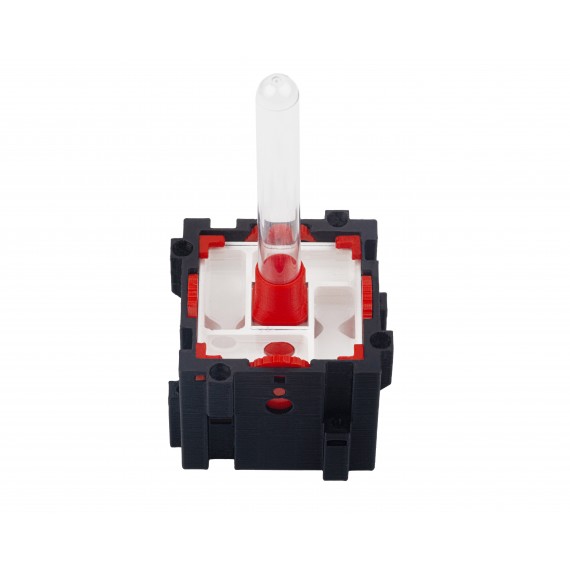
For a tree-dwelling species that likes it dry and well ventilated, at Antomas we recommend the Qbik Alpha range by Anthouse: modular, dry formicaria that grow with the colony. To start with, a QBIK ONE with small galleries, where a colony of a few dozen workers feels safe and where you can keep a close eye on the queen and the brood.
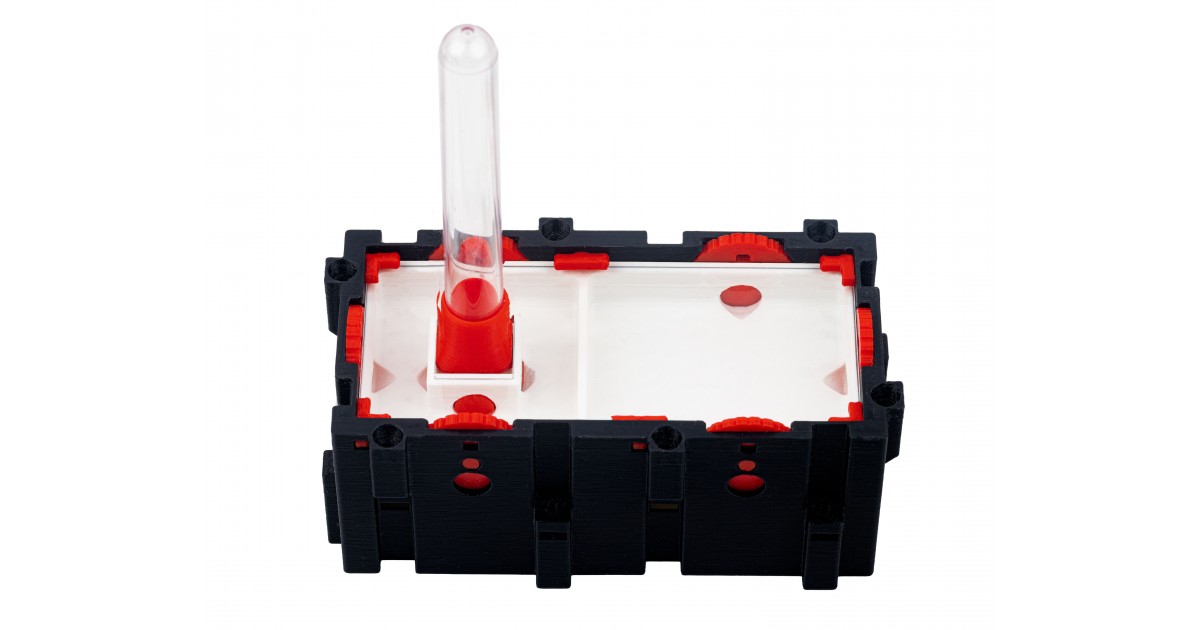
When the colony grows, which with this species does not take long, move on to the QBIK DUO and then to the larger modules of the same range.
Complete the set-up with an enclosed foraging area, with a well-fitting lid or very fine mesh, a water tube, a feeder for the sugar and a few dry twigs for them to explore and climb. If you want to watch them build, you can offer them a little fine sawdust or untreated softwood shavings in the foraging area: keepers report that they make carton out of whatever they find, albeit slowly. Without that material, they live perfectly well in the nest.
Dry and ventilated, with the water kept separate
This is the key to the set-up. In its habitat, the nest hangs from a branch, in the open air. In captivity, the breeding logs agree: in one, with the hygrometer constantly at 90 %, the workers tried to escape en masse, and the problem disappeared once the terrarium was dried out; on another forum, a veteran keeper advises keeping them fairly dry because the nests go mouldy. At Antomas we recommend some humidity in one part of the nest while the colony is small and, once it grows, a dry, well-ventilated nest. But the water tube must never be missing: they drink a lot.
Arrival and moving in
At Antomas we sell colonies with a queen, workers and brood. When yours arrives, let it rest for a few hours somewhere warm, at 24–28 °C, and check that it has water. To move it into the formicarium, we do it by tipping: open the tube inside the foraging area, next to the nest entrance, and tip the colony out (queen, workers and brood) with a few gentle taps, helping any stragglers along with a brush. Three tips:
- Prepare everything beforehand, with the barrier already in place, so that the lid is open for as short a time as possible.
- Work over a large tray: if a worker climbs up your tools, it will not end up on the table.
- Check the cotton wool in the tube: they may pull it out to build with. If they are picking it apart, replace it before the water spills.
Afterwards, check on the colony often during the first few days: make sure the queen is inside, the brood is gathered together and the workers are drinking and eating. If you ever need to move them to a new formicarium, the same method is used.
Feeding
Sugar, always available. In the wild they live largely on the honeydew of scale insects. Vary the sugars: at Antomas we recommend Blue Sugar nectar by Anthouse 4–5 times a week and another sugary liquid or nectar 1–2 times a week; you can also add a little protein to the nectar. Always offer it in a feeder and never on cotton wool, which goes mouldy and spoils the liquid straight away: a traditional or home-made feeder, where the drop stays “spread out” and accessible. Also avoid large puddles of honey: one keeper warns that workers can get stuck and drown.
Protein: the more, the better. It is the engine of their growth, and keepers agree that they prefer it to sugar and empty insects completely. If you do daily maintenance and remove leftovers, it is better to overfeed: the colony understands that it has more resources and grows faster and in greater numbers. If you will not be able to clean often, it is better not to overfeed, because leftover food rots and brings mould and mites. Change the insect from one week to the next, so they do not always eat the same thing:
With a small colony, offer small prey, chopped or freshly killed. When the colony is large, they surround and dismember prey far bigger than themselves, with dozens of gasters held high: quite a spectacle. Buy your insects from a reliable supplier: insects treated with insecticides can kill the colony.
Colony growth
Your colony arrives already up and running, with a queen, workers and brood, so you skip the most delicate phase, the founding, and start with the fun part: watching it grow. And it grows fast. In a breeding log published on a German forum, a colony went from about 26 workers in mid-September to about 150 at the end of December: six times as many in three and a half months, although it slowed down in the cold months despite the heating cable. With constant warmth and plenty of protein, you can expect a pace like this or better.
Extend when you see lots of workers sitting idle in the corners of the foraging area, but do not jump the gun: in a huge nest, the spare corners end up as rubbish dumps. Over the years, a large colony may produce alates, males and queens, which will try to fly off: in captivity they do not mate, and a good lid stops them escaping.
Diapause
It does not undergo diapause: there is no winter in its range that forces it to stop (see “Monsoons and no real winter”). At Antomas we keep it active all year round, at 24–28 °C. If your home gets cold in winter, heat one side of the nest: in the cold, the colony stays alive but grows much more slowly.
Behaviour in captivity
They are fast and organised: as soon as a scout finds food, the trail fills with workers (like other Crematogaster, they mark trails with a gland in their hind legs). When you open the lid you will see gasters held high, and if they have material, they may plug gaps with carton.
Watch without fear. At Antomas we believe ants are there to be enjoyed, observed and learned from, not kept hidden away. Simply leave them their dark area in the nest and the foraging area in the light, and observe them often and gently. Checking on them frequently is the best way to spot any problem in time: workers crowding on the lid (too much humidity or too little ventilation), mould (forgotten leftovers), brood that stalls (lack of protein) or the cotton wool in the tube picked apart (replace it).
Escapes and barriers
This is the only delicate point with this species: C. rogenhoferi climbs very well and clings tightly, and its small workers can squeeze through tiny gaps.
- A well-fitting lid or very fine mesh on the foraging area, and connections, stoppers and tubes firmly fitted.
- A barrier of paraffin oil or petroleum jelly on the upper part of the foraging area walls. On the forums, oil worked even with large colonies; one keeper had good results with talc mixed with alcohol. PTFE (Fluon), on the other hand, only half works with this species and is ruined by condensation.
- Take care when opening up. That is when most escapes happen: open only as much as you need and close it again when you have finished.
- No bridges: make sure no twig, tube or pair of tweezers touches the barrier or the lid.
- Dry and ventilated: excess humidity triggers escape attempts.
Handling and safety
Their sting is spatulate and does not pierce the skin; what you may feel is the odd bite, which in a home colony is no more than a pinch. Always handle them with entomological tools, a soft brush or soft tweezers, and not with your hands, and work slowly so as not to lose or harm any worker, let alone the queen. It is an exotic species: it must never be released into the wild.
What not to do
- Leave gaps or loose lids, or rely on PTFE alone.
- Flood the nest or keep the terrarium laden with humidity.
- Put the sugar on cotton wool or in large puddles of honey.
- Skimp on protein, always give them the same insect or leave leftovers uncleaned.
- Put them into diapause or let them spend the winter at cold room temperature.
- Leave them for days without checking: check on the colony often, and carefully.
- Handle them with your hands.
Scientific sources
This care sheet has been compiled from the scientific literature on Crematogaster rogenhoferi and its genus, from climate data for its range and from the experience of Antomas and other keepers. Main references:
- Dias, R. K. S. & Udeshika, K. G. I. (2019). Effects of a gel bait on the suppression of noxious Crematogaster rogenhoferi Mayr, 1879 (Formicidae: Myrmicinae) in Sri Lanka. Caucasian Entomological Bulletin 15: 317–322. doi:10.23885/181433262019152-317322
- Watanasit, S. & Jantarit, S. (2006). The ant nest of Crematogaster rogenhoferi Mayr, 1879 (Hymenoptera: Formicidae) at Tarutao National Park, Satun Province, Southern Thailand. Songklanakarin Journal of Science and Technology 28: 723–730.
- Bai, W., Chen, B., Chen, H., Nie, L., Liang, M., Xu, Y., Lu, Y. & Wang, L. (2024). Antimicrobial activity of compounds isolated from the nest material of Crematogaster rogenhoferi (Mayr) (Hymenoptera: Formicidae). Insects 15: 1019. doi:10.3390/insects15121019
- Kularathnage, N. D., Senanayake, I. C., Thiyagaraja, V., Wang, Z.-Y., Zhao, Q., Gu, Z.-J., Hyde, K. D. & Jayawardena, R. S. (2026). Exsiccatiomyces formicarium gen. et sp. nov. from the wall of Crematogaster rogenhoferi carton nest. Phytotaxa 766: 101–121. doi:10.11646/phytotaxa.766.2.1
- Bai, W., Xu, W., Lu, Y., Xu, Y. & Wang, L. (2025). Chemical analysis of Dufour’s gland of workers and gynes of Crematogaster rogenhoferi Mayr (Hymenoptera: Formicidae). The Journal of Basic and Applied Zoology 86: 83. doi:10.1186/s41936-025-00506-w
- Zhou, X., Guo, J., Zhang, M., Bai, C., Wang, Z. & Li, Z. (2021). Antennal transcriptome analysis and candidate olfactory genes in Crematogaster rogenhoferi. Bulletin of Entomological Research 111: 464–475. doi:10.1017/S0007485321000134
- Lin, Y.-H., Liao, Y.-C., Yang, C.-C. S., Billen, J., Yang, M.-M. & Hsu, Y.-F. (2019). Vibrational communication between a myrmecophilous butterfly Spindasis lohita (Lepidoptera: Lycaenidae) and its host ant Crematogaster rogenhoferi (Hymenoptera: Formicidae). Scientific Reports 9: 18548. doi:10.1038/s41598-019-54966-6
- Hoàng, Q. B., Chu, V. H., Vũ, V. L., Phạm, T. T. T. & Nguyễn, M. C. (2025). Biological and ecological characteristics of Crematogaster rogenhoferi in Lao Cai province, Vietnam. Vietnam Journal of Forest Science. doi:10.70169/vjfs.1100
- Trần, Q. K., Vũ, V. L. & Phạm, T. T. T. (2025). Harvesting and farming techniques for Crematogaster rogenhoferi under the forest canopy in Lao Cai province. Vietnam Journal of Forest Science. doi:10.70169/vjfs.1143
- Wang, W. Y., Soh, E. J. Y., Yong, G. W. J., Wong, M. K. L., Guénard, B., Economo, E. P. & Yamane, S. (2022). Remarkable diversity in a little red dot: a comprehensive checklist of known ant species in Singapore (Hymenoptera: Formicidae) with notes on ecology and taxonomy. Asian Myrmecology 15: e015006. doi:10.20362/am.015006
- Blaimer, B. B. (2012). A subgeneric revision of Crematogaster and discussion of regional species-groups (Hymenoptera: Formicidae). Zootaxa 3482: 47–67. doi:10.11646/zootaxa.3482.1.3
- Marlier, J.-F., Quinet, Y. & de Biseau, J.-C. (2004). Defensive behaviour and biological activities of the abdominal secretion in the ant Crematogaster scutellaris (Hymenoptera: Myrmicinae). Behavioural Processes 67: 427–440. doi:10.1016/j.beproc.2004.07.003
- Leuthold, R. H. (1968). A tibial gland scent-trail and trail-laying behavior in the ant Crematogaster ashmeadi Mayr. Psyche 75: 233–248. doi:10.1155/1968/73761
- Bingham, C. T. (1903). The Fauna of British India, including Ceylon and Burma. Hymenoptera, Vol. II: Ants and Cuckoo-wasps. London: Taylor & Francis.