This website uses its own and third-party cookies to improve our services and show you advertising related to your preferences by analyzing your browsing habits. To give your consent to its use, press the Accept button.
Cookie preferences
| Cookie | Provider | Purpose | Expiry |
|---|---|---|---|
| PHP_SESSID | antomas.es | The PHPSESSID cookie is native to PHP and allows websites to store serialised status data. On the website it is used to establish a user session and to pass state data through a temporary cookie, which is commonly known as a session cookie. These Cookies will only remain on your computer until you close your browser. | Session |
| PrestaShop-# | antomas.es | This is a cookie used by Prestashop to store information and keep the user's session open. It stores information such as currency, language, customer ID, among other data necessary for the proper functioning of the shop. | 480 hours |
| rc::a | It is used to read and filter bot requests. | Persistent | |
| rc::c | It is used to read and filter bot requests. | Persistent |
| Cookie | Provider | Purpose | Expiry |
|---|---|---|---|
| _ga | Registers a unique ID that is used to generate statistical data on how the visitor uses the website. | 2 years | |
| _gat | Used by Google Analytics to throttle request rate | 1 day | |
| _gat_gtag_UA_# | Used to throttle request rate. | 1 minute | |
| _gd# | This is a Google Analytics Session cookie used to generate statistical data on how you use the website which is removed when you quit your browser. | Session | |
| _gid | Registers a unique ID that is used to generate statistical data on how the visitor uses the website. | 1 day |
Gigantiops destructor – Ninja Ant
Biology
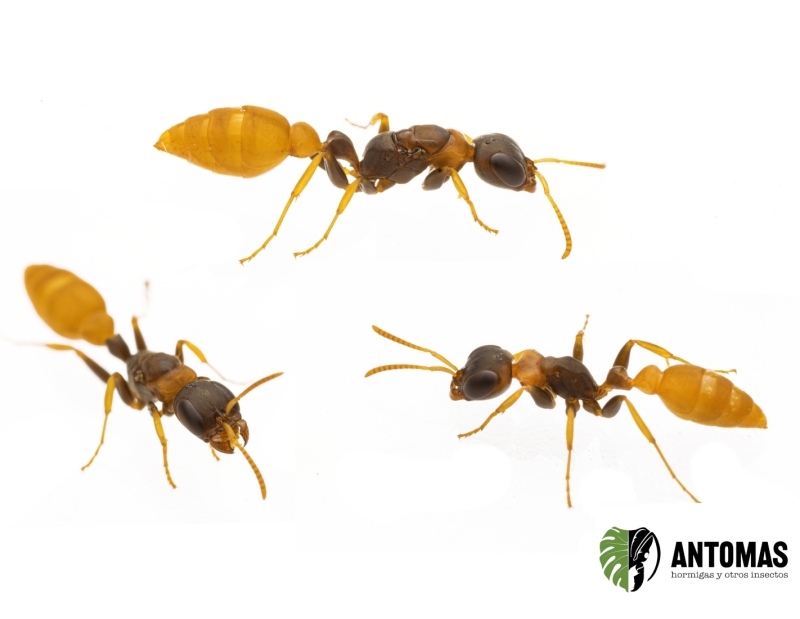
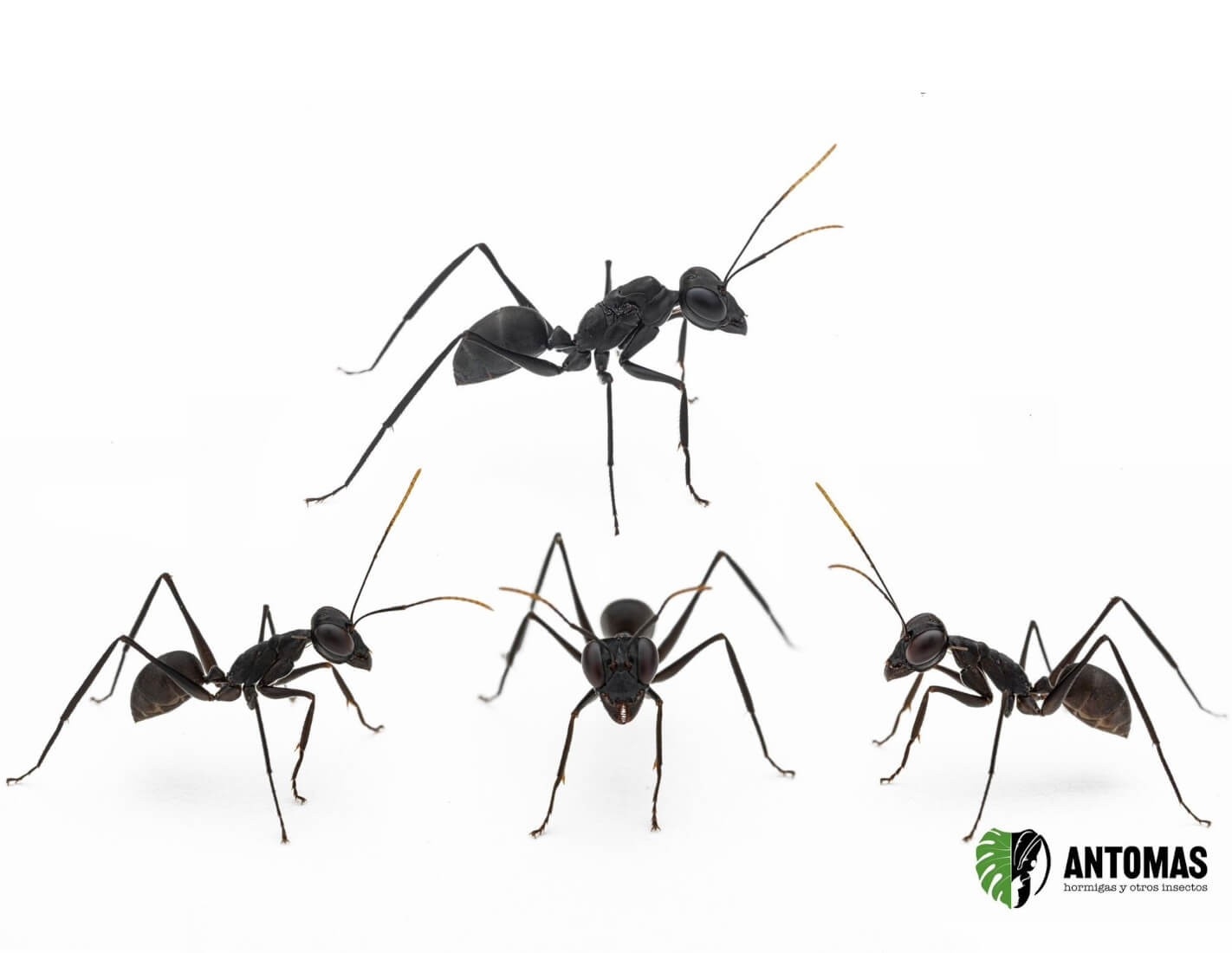
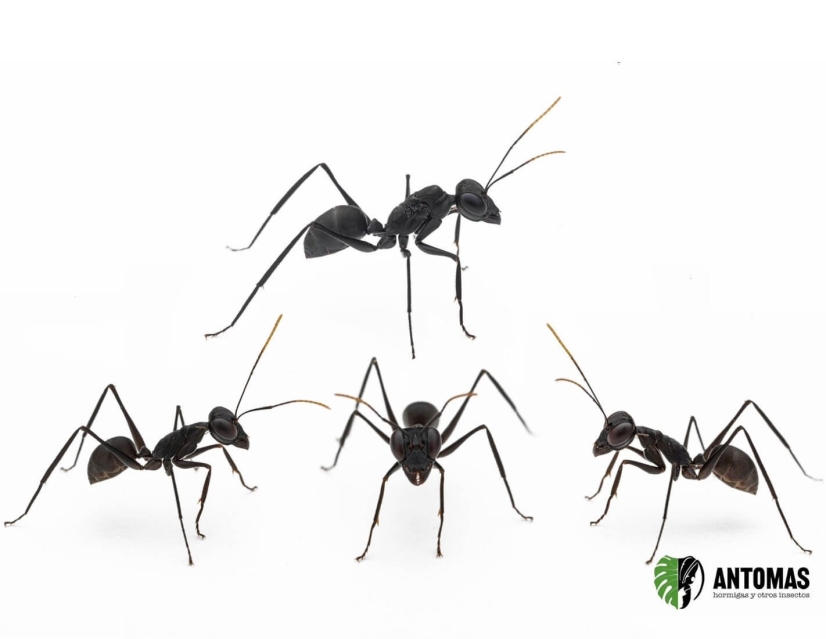
Gigantiops destructor is one of the most unusual and fascinating ants of South America. It is immediately recognisable by its enormous eyes, long legs and extremely agile movements.
This species inhabits tropical forests, where workers forage individually on vegetation and on the ground, relying heavily on vision to locate prey and navigate their surroundings.
Unlike many ants that depend primarily on chemical trails, Gigantiops destructor has exceptionally developed eyesight and can orient itself using visual landmarks.
Its movements are fast, precise and often include sudden jumps, which has earned it a reputation as an extremely agile ant.
Workers are active hunters and opportunistic foragers. They capture small arthropods and also consume sugary liquids such as nectar and honeydew.
Colonies are relatively small compared with many other tropical ants, which makes each worker especially important to the functioning of the colony.
The combination of excellent vision, jumping ability and active hunting behaviour makes Gigantiops destructor one of the most interesting species to observe in captivity.
An ant dominated by vision
The enormous eyes of Gigantiops destructor are not simply an aesthetic peculiarity.
They are the centre of its way of interacting with the environment.
Workers can detect movement at considerable distances and visually track both prey and potential threats.
Their vision is also fundamental for navigation. Instead of relying exclusively on pheromone trails, they can memorise visual landmarks and use them to return to the nest.
This ability allows each worker to develop relatively independent foraging routes.
Speed is the second defining characteristic of the species.
When startled, a worker can accelerate suddenly and change direction almost instantly, making capture surprisingly difficult.
In addition, Gigantiops destructor can jump between surfaces, using its long legs to overcome small gaps or escape from danger.
This combination of sight, speed and jumping ability explains why the name “Ninja Ant” fits the species so well.
Foraging and hunting
Unlike many ants, workers usually forage individually.
Each worker explores its own area and relies mainly on vision to locate food.
When it detects small prey, it approaches rapidly and attempts to capture it without recruiting large numbers of nestmates.
This individual hunting strategy is closely linked to its excellent eyesight and high mobility.
Workers can hunt small arthropods on the ground, leaf litter, trunks and vegetation.
They also exploit sugary resources such as nectar and honeydew, which provide the carbohydrates needed to sustain their intense activity.
Their foraging behaviour is therefore very different from that of species that organise large recruitment trails.
Each Gigantiops worker behaves almost like an independent hunter that memorises its surroundings and repeatedly patrols familiar areas.
Colonies and nesting
Colonies of Gigantiops destructor are relatively small compared with those of many other tropical ants.
This way of feeding the larvae is especially interesting because it shows that, despite the highly individualistic hunting behaviour of the workers, the captured food ultimately becomes a resource for the colony.
Social organisation and colony size
Colonies of Gigantiops destructor can contain several hundred workers.
Their social organisation is unusual and does not always follow the simple pattern of one queen permanently monopolising reproduction.
In this species, reproductive dynamics can be more complex, and workers retain important reproductive capabilities.
This makes Gigantiops particularly interesting from the point of view of the evolution of social organisation in ants.
Despite living together and cooperating in brood care, the workers retain a remarkable degree of behavioural independence outside the nest.
This contrast between cooperation inside the colony and individualism during foraging is one of the most distinctive characteristics of the species.
Nesting
In nature, Gigantiops destructor usually nests in cavities and sheltered spaces associated with the forest floor, dead wood, roots or plant structures.
Nests have been found in:
- hollow branches;
- dead wood;
- spaces beneath bark;
- cavities in the ground;
- abandoned galleries of other insects.
One of the most interesting characteristics of Gigantiops destructor is its tendency towards polydomy.
A single colony can occupy several physically separated nests that remain socially connected.
Workers move between these nests, transporting food, brood and other resources.
This organisation allows the colony to exploit a larger territory and adapt to changes in the availability of suitable nesting cavities.
In captivity, this behaviour can be reproduced especially well with modular systems that allow several nesting chambers to be connected to the same foraging area.
Colony size and reproduction
Colonies are not usually enormous, but they can reach several hundred workers.
The reproductive biology of Gigantiops destructor is especially interesting because colonies may show greater complexity than the classic model of a single permanently reproductive queen.
The two colonies maintain their own social organisation and brood, but share part of the nesting structure and immediate surroundings.
This association is particularly striking because Paraponera clavata is a much larger and more powerful ant.
Gigantiops destructor, however, avoids direct confrontation thanks to its extraordinary visual abilities, speed and jumping capacity.
The relationship does not imply that both species form a single colony. Each retains its own queen, workers and brood.
What they share is the nesting space and, potentially, some of the advantages associated with occupying the same area.
This natural coexistence is one of the most unusual examples of association between different ant species in the Neotropics.
Size and morphology
Gigantiops destructor is a slender ant with very long legs and an unmistakable appearance.
Its most striking feature is the enormous size of its compound eyes, which occupy a large part of the head.
The workers have a light and elongated body adapted for rapid movement and jumping.
Recommended parameters
- Temperature: 24–28 °C.
- Warm area: 27–29 °C.
- Humidity: moderate to high, but with good ventilation.
- Foraging area: spacious, well lit during the day and preferably with vertical structures.
It is important to avoid stagnant, excessively humid environments.
The nest should retain moisture without remaining waterlogged, and the foraging area should have good air circulation.
Lighting
Lighting is especially important for this species because vision plays a fundamental role in its behaviour.
A clear day/night cycle should be provided.
During the day, the foraging area can be well lit, while the interior of the nest should remain darker and sheltered.
A planted or structurally complex setup provides visual references that workers can use for orientation.
Branches, roots, bark and plants also allow them to make better use of their extraordinary ability to move and jump in three dimensions.
Once the first workers appear, the colony can progressively receive slightly larger prey.
Even so, it is advisable to continue offering small insects that encourage active hunting.
Recommended ant nests
For very small colonies, a compact nest connected to a foraging area with sufficient vertical structure can work well.
As the colony grows, modular systems are especially useful because they make it possible to expand the available nesting space without excessively disturbing the ants.
Because of the species’ tendency towards polydomy, connecting several nesting modules to the same foraging area can reproduce part of its natural organisation.
The nest should provide humid areas but should not remain completely saturated.
Good ventilation is essential, especially in tropical setups with substrate, plants and high environmental humidity.
Foraging area
The foraging area is one of the most important parts of a Gigantiops destructor setup.
They should be used to create real routes through the enclosure, allowing the workers to move at different heights and jump between nearby surfaces.
It is also advisable to leave some open areas where the ants can detect and pursue prey visually.
The objective is not to fill every centimetre of the terrarium, but to create a varied three-dimensional environment with clear visual references.
In a bioactive setup, springtails help control small organic remains and fungal growth, although they do not replace normal cleaning and maintenance.
Feeding
Protein
Gigantiops destructor is an active predator and should receive live or freshly killed insects regularly.
Suitable prey includes:
- Drosophila;
- small flies;
- small crickets;
- small cockroaches;
- termites;
- other appropriately sized feeder insects.
For queens in the founding stage and very small colonies, Drosophila and springtails are particularly useful because their small size makes them easy to capture.
The brood can therefore contain eggs, larvae and pupae at different times of the year depending on the condition of the colony, temperature and food availability.
FEEDING
The diet of Gigantiops destructor should combine carbohydrates and animal protein.
Carbohydrates
Workers readily accept sugary liquids.
We recommend offering:
- specific ant nectar;
- sugar water;
- diluted honey;
- other safe carbohydrate solutions.
These foods provide the energy needed for the intense activity of the workers.
Protein
Protein is essential for larval development.
They explore alone, hunt alone and usually return to the nest without recruiting companions.
This does not mean that the colony lacks social organisation, but rather that foraging is based much more on the individual abilities of each worker.
In a well-designed enclosure, it is possible to observe how individual workers establish habitual routes and repeatedly use the same visual landmarks.
They can also stop on elevated points to observe their surroundings before continuing.
This behaviour makes branches, leaves and other raised structures especially valuable in captivity.
ESCAPE PREVENTION AND HANDLING
The combination of speed, climbing ability and jumping makes Gigantiops destructor a species that requires very good escape prevention.
The enclosure must close securely and any ventilation openings must be protected with mesh fine enough to prevent workers from passing through.
An effective anti-escape barrier should also be maintained around the upper perimeter of the foraging area whenever the design allows it.
Maintenance should be carried out calmly and with all necessary tools prepared beforehand, since an escaping worker can move extremely quickly.
It is preferable to keep part of the substrate clearly moist and other areas simply fresh, allowing the ants to choose.
WHY KEEP GIGANTIOPS DESTRUCTOR?
It is not the ideal species for someone looking for a conventional ant colony.
But it is extraordinary for anyone who wants to observe:
- visual orientation;
- individual hunting;
- jumps;
- complex movement;
- interaction with vegetation;
- polydomy;
- an unusual relationship with the environment;
- and one of the most spectacular visual systems known in ants.
In a well-designed tropical terrarium, Gigantiops destructor stops being simply a colony of ants and becomes one of the most interesting animals that can be kept in a naturalised formicarium.
Its enormous eyes, intelligence, speed and jumping ability make every worker a small predator that seems to observe the keeper almost as much as the keeper observes it.
That is precisely what makes the Ninja Ant such a special species.
- Dificultad
- Advanced