Difficulty: 3/5 – Advanced
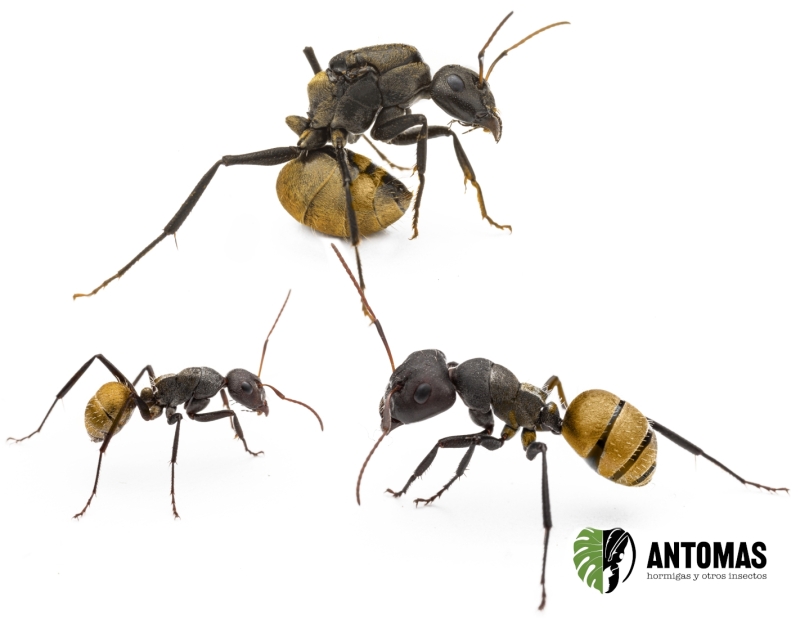
An African acrobat ant from dry lands, black and large for its genus, which raises its heart-shaped gaster and smears its enemies with a contact poison. Colonies with queen. A single queen per colony, exceptionally fast growth and truly massive colonies. 24–28 °C all year round, no diapause, a dry, well-ventilated Alpha nest (a little humidity only at the start), sugar always available and all the protein they can eat.
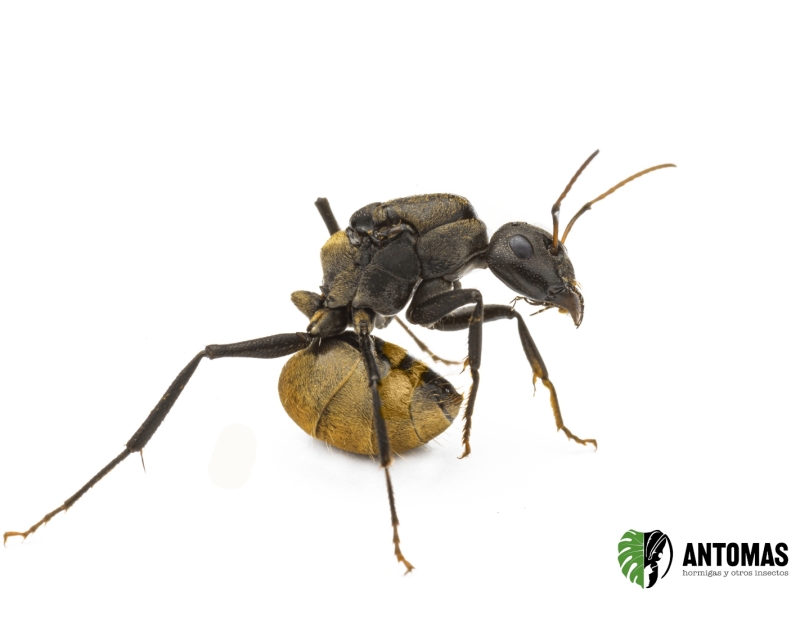
Crematogaster senegalensis Roger, 1863 is an African acrobat ant: a myrmicine with a double waist and a heart-shaped gaster which, when it feels threatened, raises it above its head and points it at its enemy, like someone drawing a weapon. It was described from specimens from Senegal more than a century and a half ago and lives in the dry lands of Africa, from the Sahel and the savannahs of West Africa to Sudan and Angola, and crosses the Red Sea to the mountains of Arabia.
At Antomas, in Spanish, we sell it as the “hormiga acróbata gigante”, the giant acrobat ant, and not on a whim: they are fairly large Crematogaster compared with those of our own countryside and, above all, they form truly massive colonies that grow at a speed that surprises even experienced keepers. They also have one of the most ingenious defences in the ant world: they neither inject venom nor spray acid, but smear their rivals with a contact poison. It is a little-studied species, which science has not yet finished sorting out, and it is almost undocumented in the hobby. Here we tell you what is known about it and its relatives, and what we have learned from keeping it.
Biology
Why “giant”? A large acrobat in huge colonies
Let us start with the name, because it is worth being clear: “giant acrobat ant” is our Spanish trade name, not a scientific name. We have not found any common name for the species in any language. “Acrobat”, on the other hand, is the popular name for the whole genus (see “The ant that takes aim with its abdomen”).
And why “giant”? There are two reasons. The first is the size of the worker. According to the key to the African Crematogaster by the myrmecologist Brian Taylor, C. senegalensis workers measure 3.5–5.5 mm in total length, a medium-to-large size for a genus full of tiny ants. In Antomas’s experience, if you compare them with the Crematogaster native to the Iberian Peninsula, you can see straight away that they are considerably larger.
The second reason is the colony, and it is the one that really earns it the name. C. senegalensis colonies have a single queen, grow exceptionally fast and become truly massive: in a short time, a group of a few dozen workers turns into a river of ants running through the whole formicarium. That is our experience, and the shops that sell it also speak of “extremely fast” development. How far do they go? There is no published study on the size of their colonies, and the maximum in captivity is not known either. Given their exponential growth, at Antomas we estimate that they very probably exceed 100,000 workers with ease. This is our own estimate, not a measured figure.
A curiosity: in Angola there is a subspecies called C. senegalensis goliathula, which means something like “little Goliath”. It is a nice coincidence, but there are no measurements showing that it is larger than the typical form, so we do not use it as an argument.
A name from 1863 for an unsolved puzzle
The German entomologist Julius Roger described the species in 1863 from workers and a queen with a terse label: “Senegal”, and nothing more. The original specimens, the syntypes, are kept in the Natural History Museum in Berlin. Since then, the species has been through quite a few twists and turns:
- Subgenera. In 1922, the Italian Carlo Emery placed it in the subgenus Acrocoelia. Today it belongs to Crematogaster in the strict sense, one of only two subgenera left when the myrmecologist Bonnie Blaimer reorganised the genus in 2012 and reduced the thirteen old subgenera to two: Orthocrema and Crematogaster.
- Species or subspecies? In the early 20th century, several authors treated it as a mere subspecies of C. aegyptiaca, until it regained species rank.
- Synonyms. Three other names have been merged with it and are now considered the same species: robusta Emery, described from the Horn of Africa from a queen and a male; devincta Santschi, 1914, described from West Africa; and targuia Santschi, 1929, from the Algerian Sahara.
- A subspecies and a daughter species. The subspecies C. senegalensis goliathula Forel, 1922, from Angola, is still valid. And C. censor, which Forel described as a subspecies of senegalensis, is now treated as a separate species.
And the most interesting part: it probably hides more than one species. Taylor notes that there is a great deal of variation between populations, especially in colour, and that a detailed study could split it into two or more species. Our own colonies are a good example: they are black, with a reddish sheen when the light catches them, whereas the literature describes the species as brown or red (see “Size and morphology”). In 2019, Mostafa Sharaf, Abdulrahman Aldawood and Francisco Hita Garcia reviewed the Crematogaster of Arabia and kept the name C. senegalensis there precisely because nobody has yet revised the Crematogaster of sub-Saharan Africa, and they acknowledged that it may contain cryptic species, that is, different species that cannot be told apart at a glance.
So the ant you will have at home matches C. senegalensis as it is understood today. If one day a taxonomist sorts out the group, its name may change, but not its character.
From the Sahel to the mountains of Arabia: an ant of dry lands
Its map is one of the most curious in the genus. It is known from western Africa and the Sahel, from Sudan and the Horn of Africa, from the Algerian Sahara, from Angola, through its subspecies, and, across the Red Sea, from the south and south-west of the Arabian Peninsula. But between these points there are large gaps with no records. Sharaf and his colleagues explain this in two ways: either sampling is lacking, or the species prefers arid habitats, which are scarce in central Africa, dominated by rainforest. Everything points to an ant of savannah and dry lands rather than of rainforest.
And it goes high. In the mountains of south-western Arabia it has been collected at 2,600 to 2,982 m above sea level, almost at 3,000 m.
Very little is known about its nests. The few field records place it foraging on damp soil and in the leaf litter under a date palm and under a large bramble, with a nest series collected under a stone, in southern Arabia, and on mango trees and in the grass beside a river, in West Africa. No study describes its nests in detail, nor the size of its colonies in the wild.
Carton, stones or branches? A nest still to be discovered
Many tropical Crematogaster are great architects. In the tropics, the genus nests mainly in trees: in dead branches, under bark or among moss. Many species make carton, a paste of chewed plant fibres, to seal or divide their nests or to build shelters for their “livestock” of scale insects, and some build free-standing carton nests hanging from branches. Nesting in the soil and leaf litter is less common in the tropics and more frequent in temperate zones.
C. senegalensis does not quite fit that picture. The records that exist, under a stone, in the leaf litter, in the grass and on mango trees, in rather dry areas, point to a species that nests in the soil or combines soil and vegetation, rather than to a great carton builder of the rainforest. This is a deduction, because nobody has studied its nests.
In captivity, keepers only mention one Asian Crematogaster as a builder of hanging carton nests. For C. senegalensis there is no data at all on carton or partition walls, either in the wild or in captivity, so we make no promises.
The ant that takes aim with its abdomen
If there is one gesture that defines Crematogaster, this is it. When threatened, the worker raises its gaster above its thorax and head, with the tip pointing forwards, and in this posture a tiny droplet can be seen at the end of the sting. It can point it in almost any direction, like a small swivelling cannon.
The secret lies in its anatomy. In almost all ants, the waist joins the gaster at its base. In Crematogaster, however, the postpetiole, the second node of the waist, is attached to the upper front part of the gaster, and the petiole, the first node, is flattened on top. This lets the gaster tilt upwards and forwards without catching on the waist. Seen from above, it is also heart-shaped.
This repertoire has earned them several popular names. In English they are known as acrobat ants, for the posture; as cocktail ants, for that cocked “tail”; and as Saint Valentine ants, for the heart-shaped gaster.
The posture is not only a threat: it is also used for hunting. In the African C. striatula, workers detect prey at 3–6 mm and aim at it with the gaster raised and the sting out (see “Paralysing without touching”).
It doesn’t sting: it smears
Crematogaster are myrmicines, relatives of Messor and Pheidole, and they have kept their sting. But theirs is very special: it ends in a spatula- or spoon-shaped tip, which is not used to inject venom but to apply a droplet of secretion onto the enemy’s body, usually another ant. It is a contact poison: it acts on the rival’s cuticle without needing to pierce it.
And what is in that droplet? In the species studied, above all the European C. scutellaris, it is a mixture from two glands in the abdomen: the Dufour’s gland, which is highly developed in the genus, and the venom gland. When they mix on the sting, enzymes from the venom gland turn the compounds of the Dufour’s gland into highly reactive aldehydes, more toxic than the original secretion. It is high-precision chemistry: the weapon is “loaded” at the last moment, right at the tip of the sting.
The effect is decisive. The secretion is insecticidal and repellent to other ants, and ants of other species that touch it with their antennae or mouthparts withdraw immediately. And it has an added bonus: the sting droplet of C. scutellaris inhibited the growth of bacteria such as Staphylococcus aureus and Pseudomonas aeruginosa in all the samples tested and, partly, that of an insect-killing fungus, Beauveria bassiana, with an effect that lasted at least 24 hours. Something similar has been seen in South American species. Everything suggests that the same chemistry that keeps rivals at bay also serves for colony hygiene.
Each species has its own cocktail: the Dufour’s gland of C. nigriceps, from the acacias of East Africa, produces different cyclic compounds, and in the Asian C. deformis it is another gland, the metapleural gland, in the thorax, that secretes repellent and antiseptic phenols.
The chemistry of C. senegalensis has not been studied, but the spatulate sting and the posture are those of the genus. And at home it shows: in Antomas’s experience, large colonies combine their numbers, mandibles that bite hard and their chemical defence to annihilate their prey and any intruder that enters their territory.
Formic acid? No: that’s a formicine thing
It is a very widespread mistake, even among keepers and shops: saying that Crematogaster “spray formic acid”. They do not. Formic acid as the main component of the venom is typical of another subfamily, the formicines, such as Camponotus, Formica or Oecophylla. These ants do not have a functional sting, but an acidopore, an opening at the tip of the gaster through which they spray the acid. And they do something even more surprising: they swallow it. A 2020 study showed that they use it to acidify the crop and control the microbes that come in with their food.
Crematogaster, on the other hand, are myrmicines, with a sting, and their weapon is the contact poison we have just seen. We have not found any scientific source that mentions formic acid in the genus.
The difference can be seen with the naked eye: a Camponotus bends its gaster under its body and fires acid; a Crematogaster raises it above its head and moves in to smear its rival.
To alert their nestmates they use a different chemistry: in the Crematogaster of the East African acacias, the mandibular glands release volatile substances which, in some species, act as an alarm signal.
Paralysing without touching: the feat of an African cousin
If the contact poison is already ingenious, what C. striatula does borders on science fiction. This Crematogaster from the forests of Cameroon nests in the soil, in fallen rotten branches and in termite mounds, and hunts mainly termites. In 2011, a team of researchers studied how it does so and discovered something surprising: it paralyses its prey from a distance.
- The ambush. When a worker detects a termite, it adopts the alarm posture, with the gaster raised and the sting out, and recruits the nestmates within about 15 cm.
- The encirclement. Up to 6 workers surround a termite worker, and 8 to 15 a soldier, positioning themselves 5–10 mm away from it, with the sting pointed at it, without touching it.
- The paralysis. After about 10 minutes, the termite starts to tremble and falls onto its back, waving its legs, and the ants carry it off to the nest.
The weapon is once again the Dufour’s gland, with some 50 long-chain compounds, and the extract of just three glands killed all the termites in the test within 24 hours. Curiously, in this species the foam that forms at the tip of the sting in other Crematogaster does not appear: the compounds act without the sting ever touching the rival.
And it is not only used for hunting. In trials with honey baits, rival ants, including the weaver ants Oecophylla longinoda, the large Camponotus brutus and Tetramorium aculeatum, abandoned the bait without fighting and without ever touching the Crematogaster.
Note: all this has been studied in C. striatula, not in our species. It shows how far the chemistry of African Crematogaster can go, but we do not know whether C. senegalensis does the same.
Chemical footprints left by the legs
Almost all ants mark their trails with glands in the abdomen, brushing the ground with the tip of the gaster. Crematogaster do it with their legs. Their trail pheromone comes from a gland in the tibia of the hind legs, and the workers leave it on the ground as they walk. R. H. Leuthold described it in 1968 in an American species, C. ashmeadi, and that same year the origin of the trail was also studied in the South African C. peringueyi.
The chemistry has been identified in two species. In the African C. castanea, the main component of the trail is (R)-2-dodecanol, and in the European C. scutellaris an almost identical alcohol, 2-tridecanol: its active form works at concentrations of a thousandth of a nanogram per microlitre. And C. scutellaris workers also follow the trail of C. castanea: these chemical cues are, in part, a shared language within the genus.
Thanks to these footprints, recruitment is fast and matched to the challenge. In C. striatula, almost 12 workers on average turn out against a termite soldier, and about 5 against a termite worker. At home you will see it every time you give them food: first a scout arrives and, shortly afterwards, a line of nestmates follows the same path.
Scale-insect herders
Like many ants, Crematogaster are very fond of sugar, and many species obtain it very efficiently: by tending “livestock”. They look after scale insects, aphids and other hemipterans, which suck plant sap and excrete a sugary liquid, honeydew, which the ants collect in exchange for protecting them. Some species even build carton shelters for them.
In the cocoa plantations of West Africa, for example, C. clariventris mainly tends one scale insect, Stictococcus sjostedti, and trees dominated by this ant have more tended scale insects than the others. It is not always good news for farmers: some African Crematogaster tend scale insects that transmit a cocoa virus.
Nothing has been published about this relationship in C. senegalensis, but the genus’s sweet tooth is obvious, and at home we replace honeydew with sugary liquids that are always available (see “Feeding”).
Rivals of the weaver ants: the ant mosaic
In the treetops of West Africa a silent war is being fought. In the 1970s, entomologists studying cocoa plantations discovered that a few dominant ants, including Crematogaster, the weaver ants Oecophylla and some Tetramorium, divide the trees into more or less mutually exclusive territories: where one rules, there is no room for the others. On the plantation map, this division forms a mosaic, and that is what they called it: the “ant mosaic”.
It is not an academic curiosity. Because each dominant species hunts or tolerates different insects, the mosaic decides which pests thrive on each tree, and it was even proposed to manage it in favour of the weaver ants to protect the cocoa. Today, in the mango plantations of West Africa, the use of weaver ants as biological control is being studied, and it is precisely on mango trees that C. senegalensis has been collected.
Crematogaster are no minor rivals for the formidable Oecophylla: we have already seen that C. striatula drives them away from a bait without ever touching them.
A single queen and explosive growth
The genus Crematogaster has a bit of everything: many species have a single queen and others accept several, such as some of the East African acacia species, although a 2018 study showed that this does not explain their success against their rivals, or some Asian species that take new queens into established colonies.
For C. senegalensis there are no published data on the number of queens or colony size. In Antomas’s experience, its colonies are monogynous, with a single queen, and what sets them apart is the pace: they grow exceptionally fast and become truly massive. With warmth and plenty of food, the colony multiplies its size in a short time, and this shapes all of its care: more space, more food and more cleaning, always one step ahead.
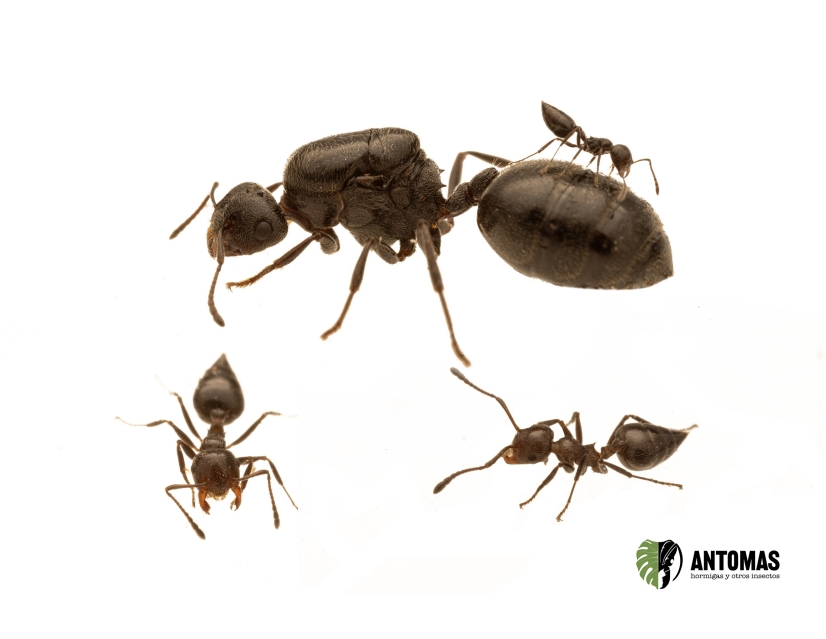
The queen was described back in 1863, together with the first workers, but we have not found any published measurement. In Antomas’s experience, she measures 12–15 mm. A single queen sustains the whole colony, so she is the piece that needs the most care in any handling.
The climate of its home: tropical coast and savannah
Our colonies come from West Africa, a region with two main types of climate that help us understand what they need at home:
- The tropical coast. Warm all year round, with monthly averages of about 26–29 °C, highs of 28–33 °C and lows of 22–27 °C. The difference between the warmest and coolest months is barely 3 °C. Air humidity is high, 75–85 %, and the rains fall in two seasons.
- The inland savannah. Much more extreme. In the hot dry season, from March to May, highs reach 40–41 °C; in the cool dry season, from December to February, when the harmattan blows, nights drop to 18–20 °C, and the rains arrive between June and October. For six or seven months of the year it hardly rains.
What does all this tell us? First, that there is no winter: neither on the coast nor in the savannah do the average lows fall below about 18 °C, so there is no reason for a diapause. Second, that it is a warmth-loving ant, living with annual averages of about 25–29 °C. And third, that a good part of its range spends many months dry. The extremes of the savannah, with afternoons above 40 °C, do not reach the nest: under stones and in the soil the temperature is much milder. That is why, at Antomas, we keep it at 24–28 °C all year round, in a dry, well-ventilated nest, with water always available.
Size and morphology
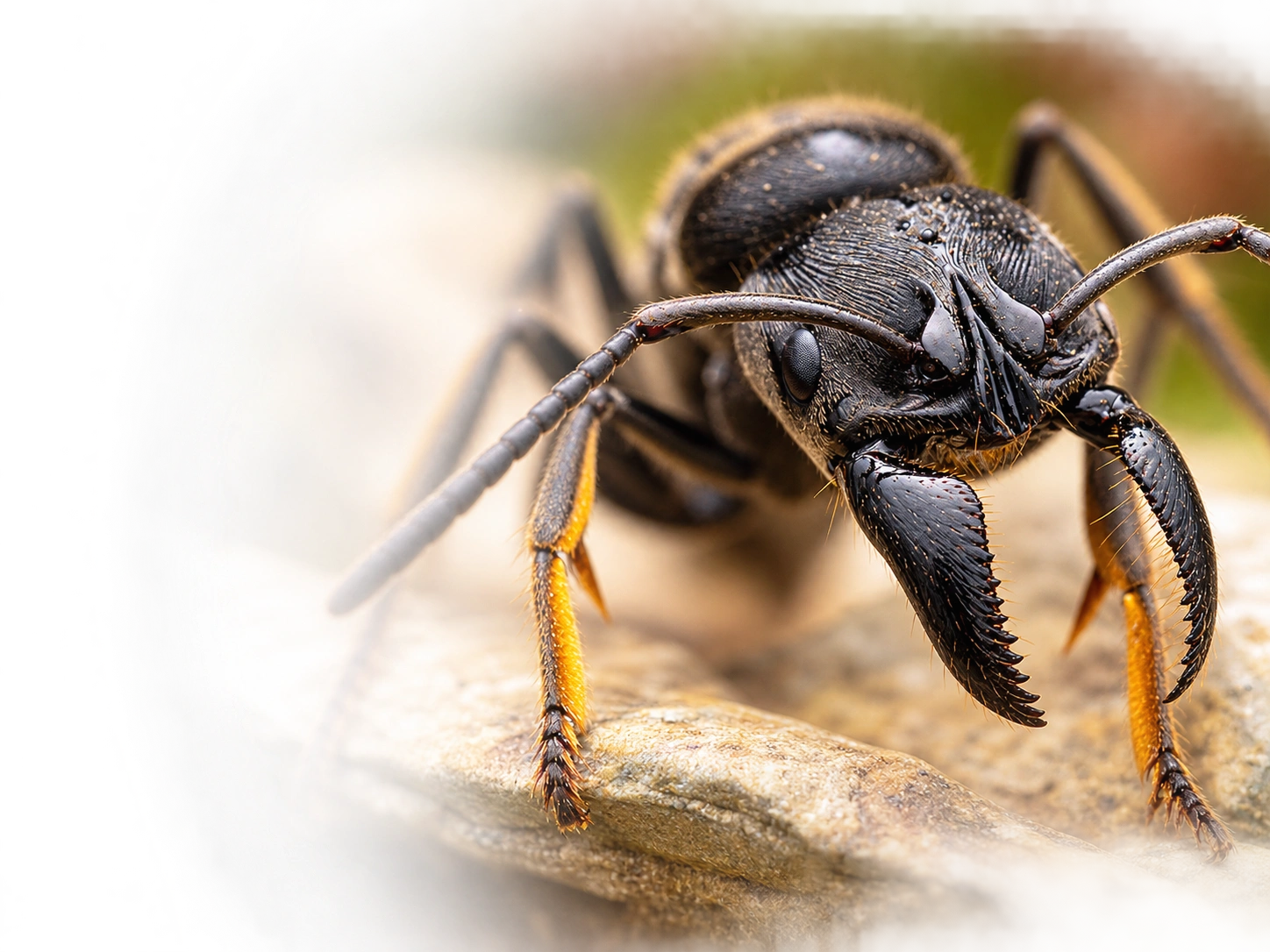
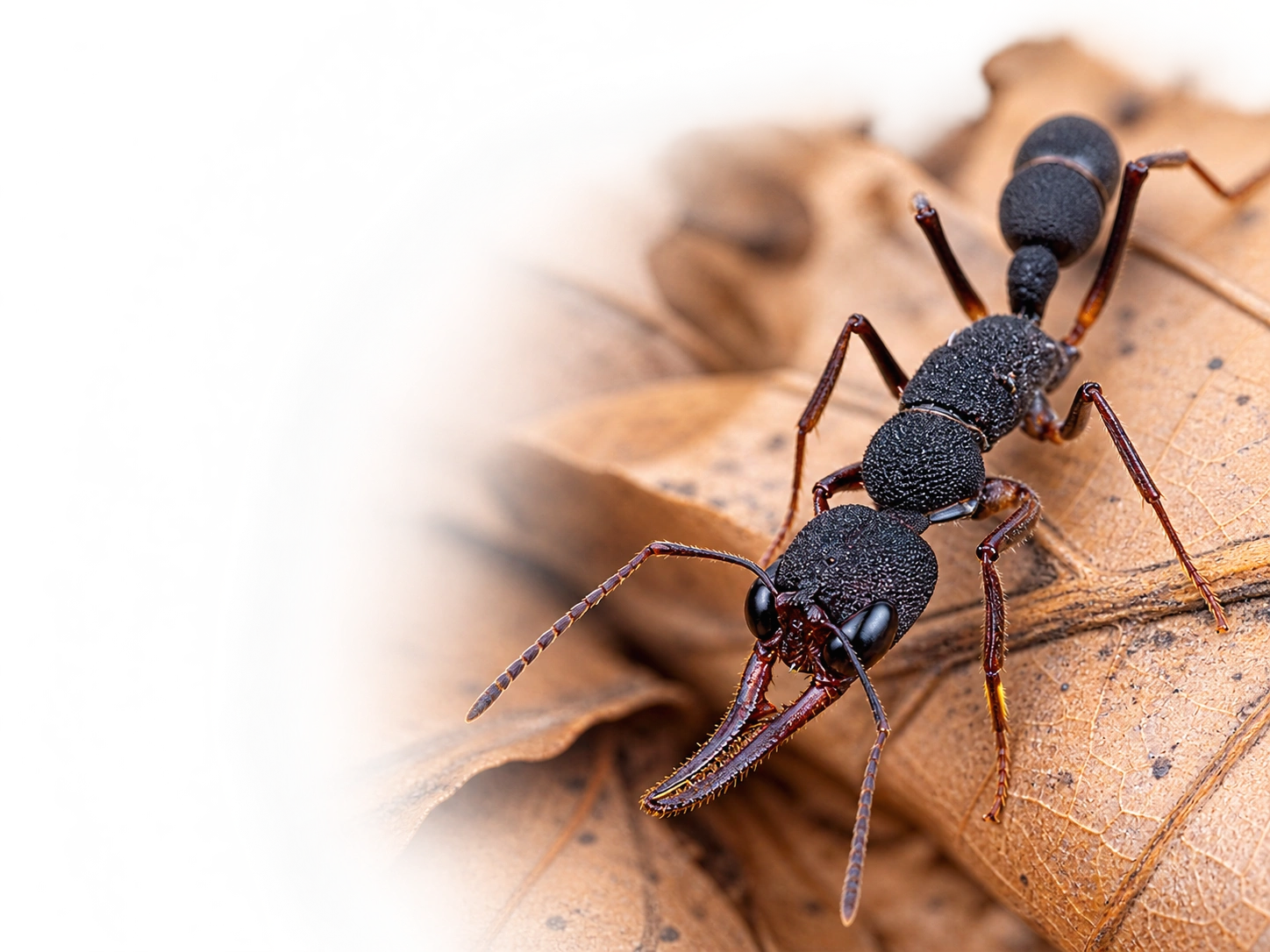
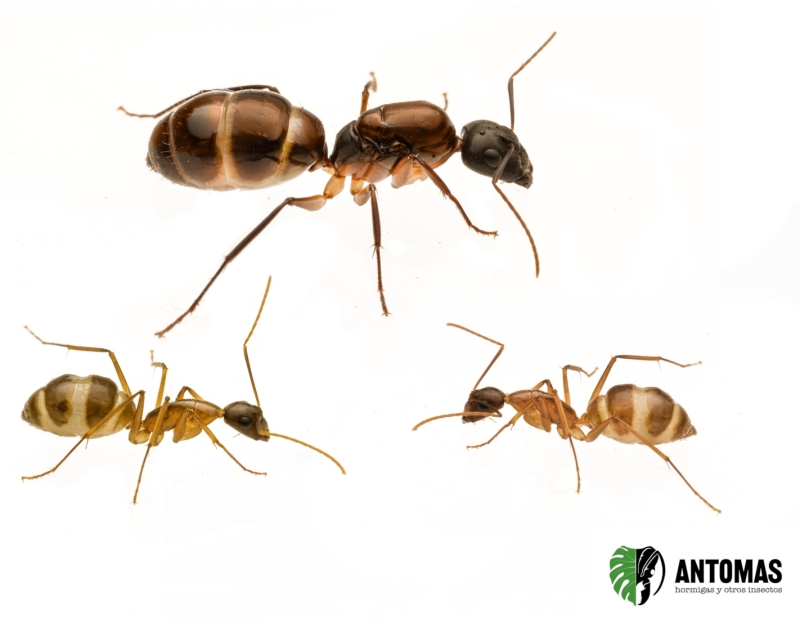
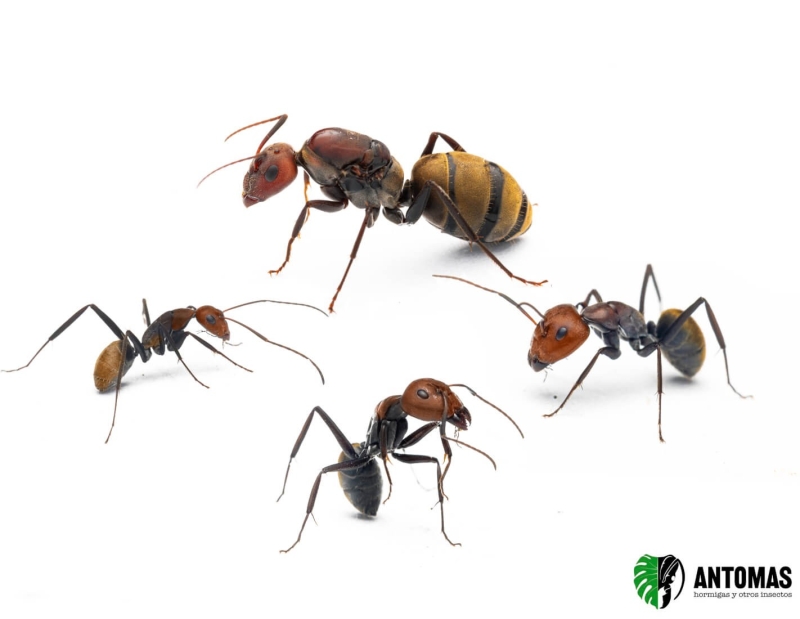
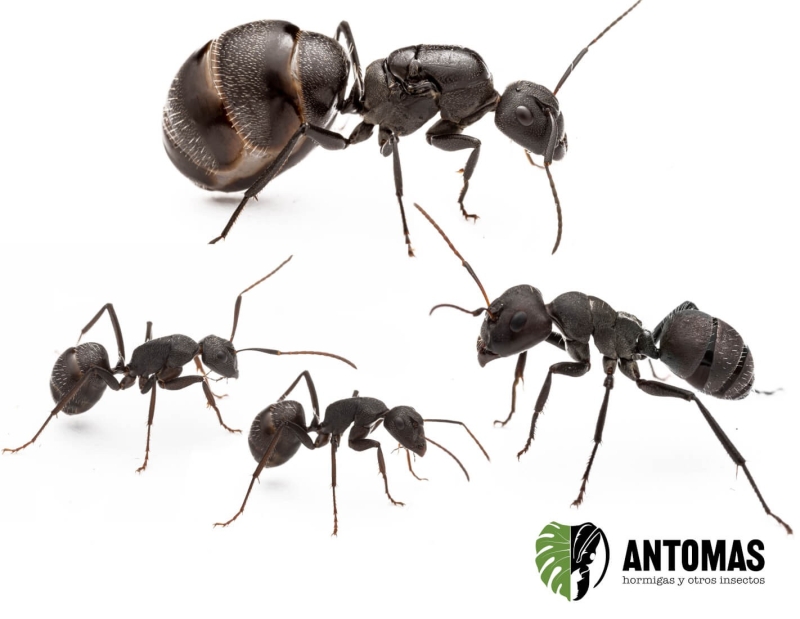
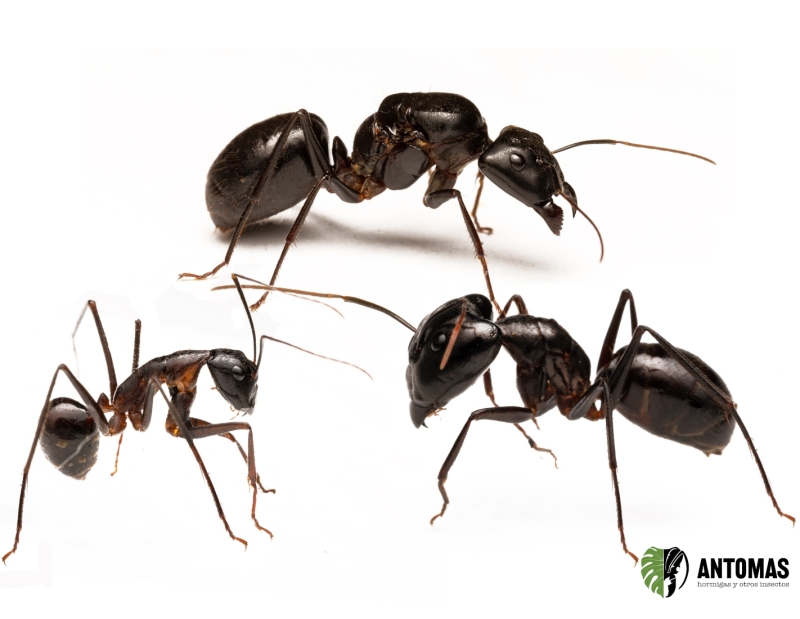
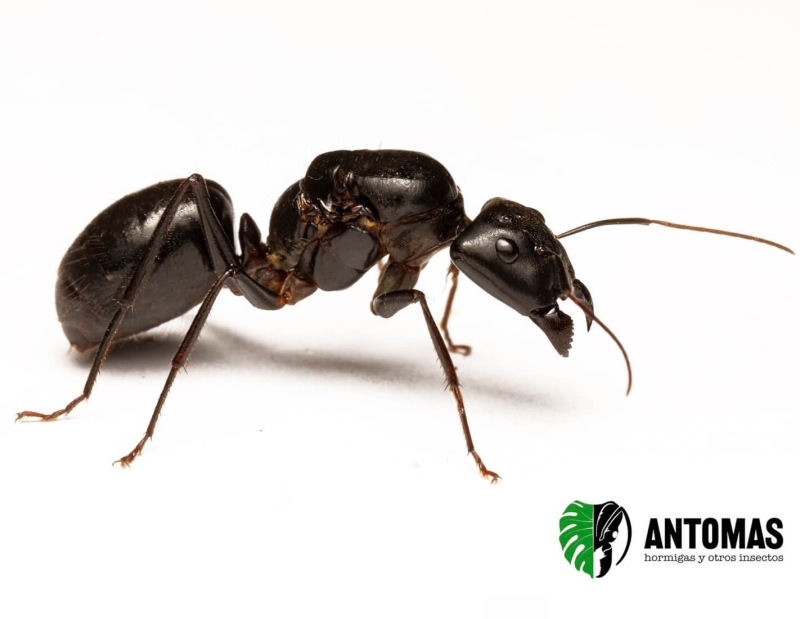
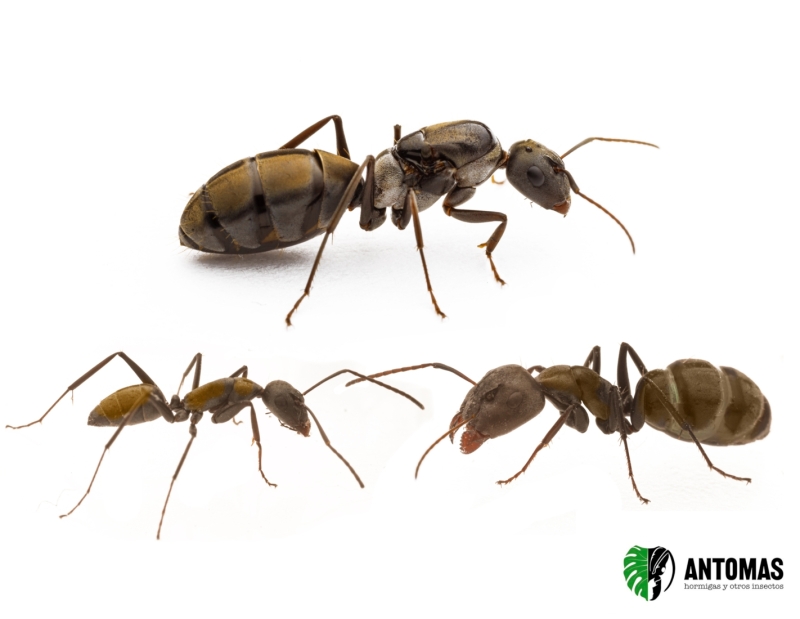
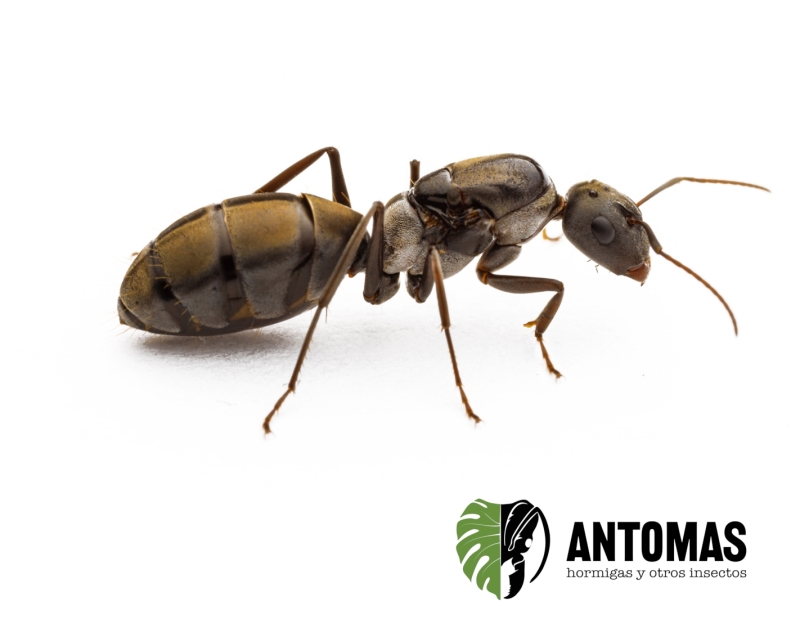
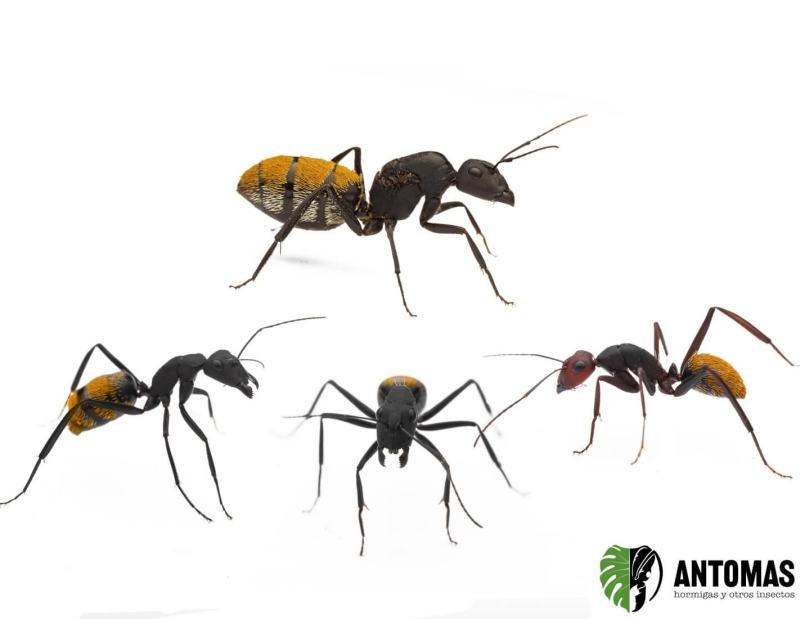
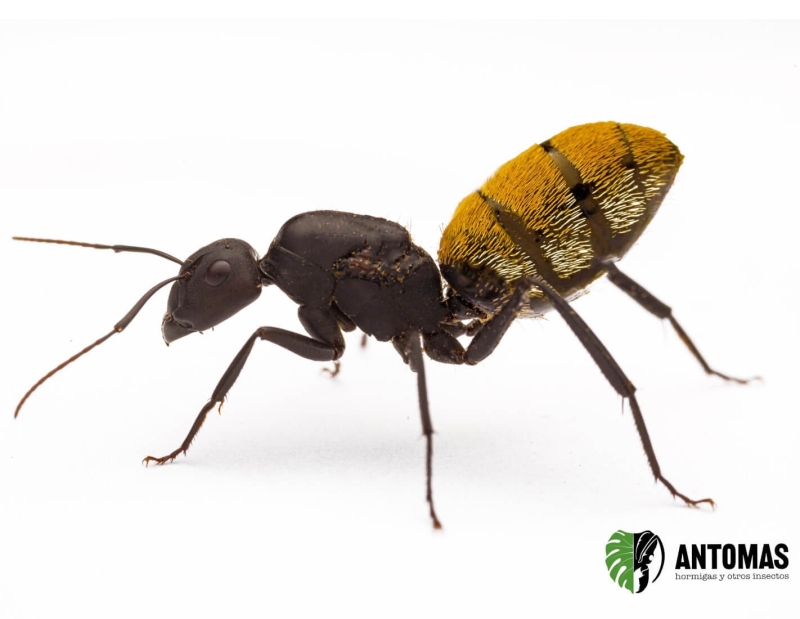
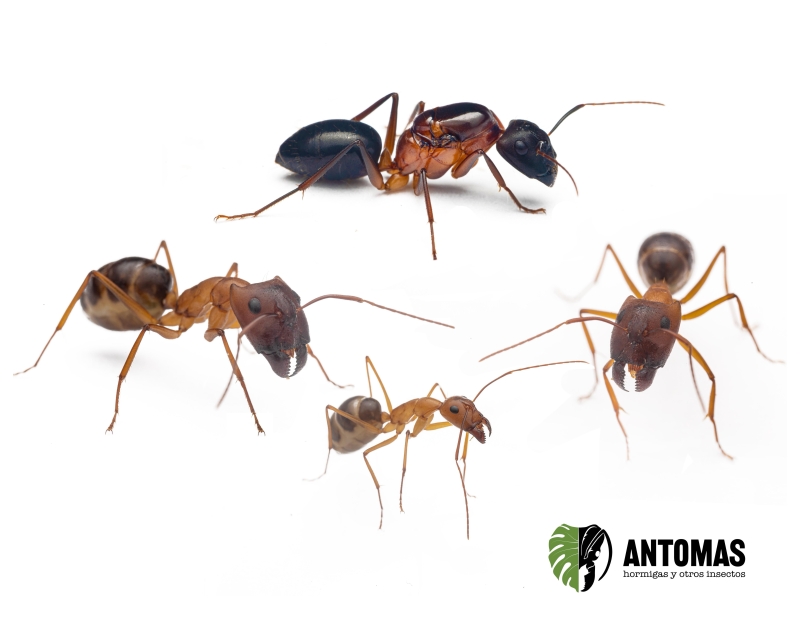
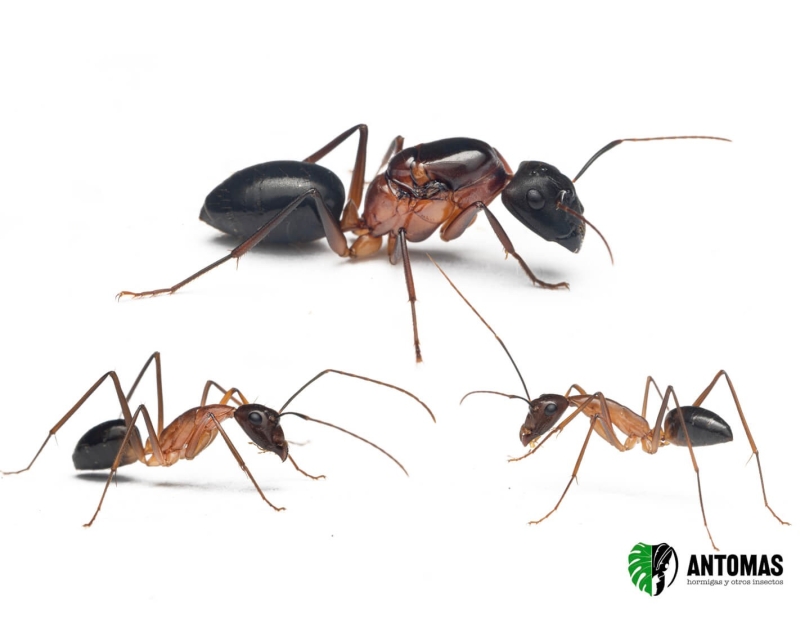
A medium-to-large myrmicine for its genus, dark, with a shiny head, long spines and the heart-shaped gaster typical of acrobat ants.
- Colouring. In Antomas’s experience, our colonies are black, with a reddish or slightly reddish tone when the light catches them. The literature describes something else: according to Taylor, the “true” C. senegalensis is brown, not red, the key by Sharaf et al. (2019) defines it as uniformly brown, and reddish specimens have been described from Arabia. Taylor also notes a great deal of colour variation between populations. The difference may be due to this variation or to several species hiding under this name (see “A name from 1863 for an unsolved puzzle”).
- Head. The clypeus, the plate above the mandibles, is smooth. The front half of the head has longitudinal striations, with smooth spaces between them, and the rear half is smooth and shiny.
- Spines. The propodeal spines, at the end of the thorax, are relatively long, longer than in similar forms.
- Waist and gaster. Petiole flattened on top and postpetiole attached to the upper surface of the gaster, which is heart-shaped and can be raised above the head.
- Sting. With a spatulate tip: it does not inject, it smears (see “It doesn’t sting: it smears”).
- Legs. With pads, the arolia, which help with climbing, and with the hind tibial gland that lays the trail.
- Workers of different sizes. Whether there are worker castes in this species has not been studied. In the genus, size variation is usually moderate, with no distinct soldier caste.
- Queen. Described by Roger in 1863, but with no published measurements. In Antomas’s experience, she measures 12–15 mm, much larger than the workers.
- Male. Known only from the description of robusta, one of its synonyms, and there are no published measurements.
- Development. There are no published data on how long the brood takes to develop in this species.
Approximate measurements
- Workers: 3.5–5.5 mm
- Queen: 12–15 mm (Antomas’s experience)
- Male: no published measurements
The worker measurement is the total length given in Taylor’s key to the African Crematogaster; the queen’s comes from our experience, because there are no published measurements. There is no modern morphometry for the species: the review by Sharaf et al. (2019) includes it in its key, but gives no measurements.
Care in captivity
Difficulty: 3/5 – Advanced
C. senegalensis is not a delicate species: it is hardy, eats everything, needs no diapause and lives dry. So why do we not recommend it as a first species? For three reasons:
- It grows very fast. A small colony soon becomes a large one, and you have to stay ahead: expand the formicarium in time, increase the food and clean more often.
- The colonies become massive. Many workers mean a lot of food, a lot of waste and many opportunities to find a gap.
- It has a chemical defence. When it feels threatened, the colony raises its gasters and comes out to smear the intruder, and the workers bite hard. It is not dangerous, but handling a large, agitated colony requires calm, tools and some experience.
At Antomas we place it at the advanced level, although on its first step: it is a good second species for anyone who has already kept a colony and wants to move up to a more numerous ant with more character.
And it is well worth it. Few ants bring so much life to a formicarium in so little time. You will see the colony grow almost week by week, trails full of workers, group hunts in which prey much larger than them disappears among dozens of mandibles, and that unmistakable gesture of the acrobat ants: the gaster raised, aimed at the enemy.
Recommended parameters
- Temperature: 24–28 °C all year round. This is the range on which the shops that breed it agree, and it fits the climate of its origin (see “The climate of its home”).
- Warm zone (optional): if you like, a slightly warmer side, up to about 30 °C, with a gentle heat source and a thermostat, so that the colony can choose where to place the brood.
- Nest humidity: a little humidity at the start, while the colony is small, and dry once the colony is large, as we do with Camponotus. As a reference, the shops that sell it give 30–50 % and warn that it does not like humidity.
- Ventilation: good, always. It is as important as dryness.
- Foraging area: dry and clean, with a tight-fitting lid, an oil barrier around the rim and water always available in a test tube with cotton wool.
- Light: it is enough to leave them their dark area in the nest and a lit foraging area, with a normal day–night cycle; in their native range, the day lasts about 11 to 13 hours all year round.
- Diapause: none (see “Diapause”).
Dry, but never thirsty
At Antomas we are clear about it: C. senegalensis must be kept dry. It is an ant of dry lands, and the shops that sell it agree that it does not like humidity. In other Crematogaster, keepers have seen that excess humidity triggers escape attempts, makes PTFE barriers useless and encourages mould.
With one nuance: at the start, while the colony is small, we give the nest a little humidity, and once the colony is large, we remove it and keep it dry, as we do with Camponotus. This way the young colony gets off to a comfortable start and, once it is numerous, the dry, well-ventilated nest prevents mould.
But dry does not mean thirsty. The colony needs water always available, and the simplest way to provide it is a test tube with water and cotton wool in the foraging area: they drink from the cotton when they need to and the nest stays dry. Keepers of other Crematogaster say the same: with water to drink, they thrive in very dry conditions.
The other half of the secret is ventilation: fresh air carries away the humidity produced by the ants, their waste and their food, and prevents condensation and mould.
Recommended formicaria
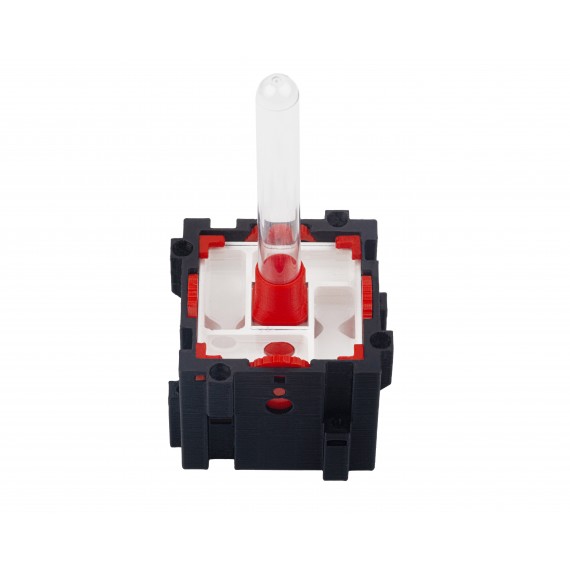
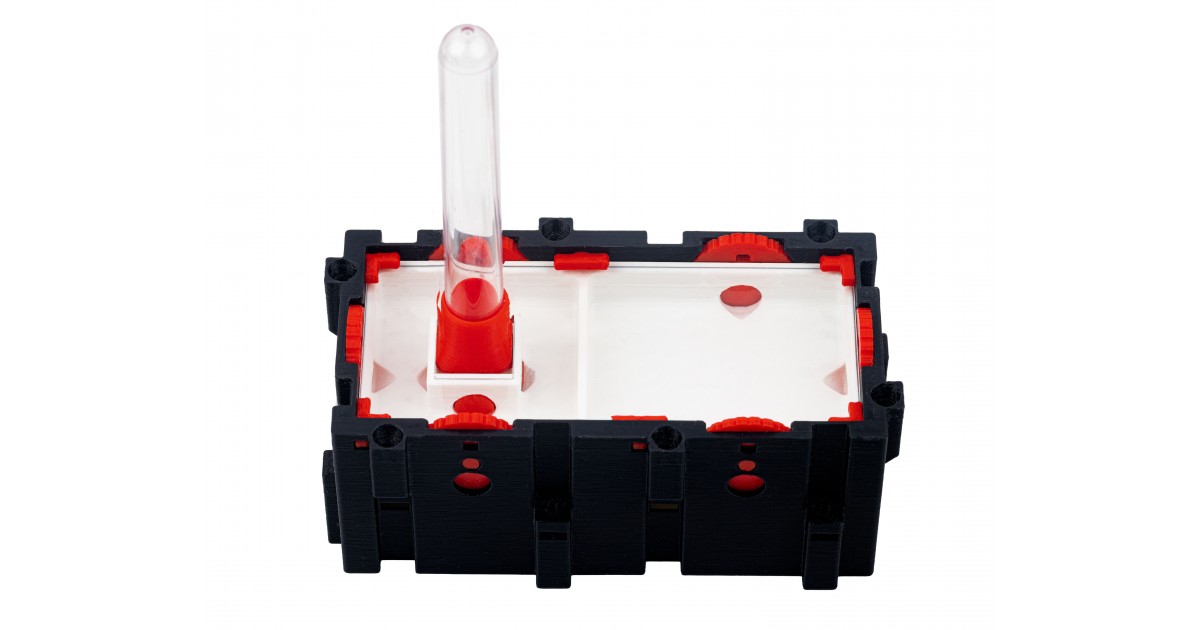
As they must be kept dry, at Antomas we recommend the Qbik Alpha range by Anthouse, the standard Qbiks: modular formicaria that grow with the colony. They have a single central humidity point, which can be adjusted or closed when less humidity is needed, and rotating doors, the “norias”, to open or close the passage between modules. For this species, use it as you would with Camponotus: with a little humidity at the start, while the colony is small, and closed once the colony is large. They will always have drinking water in the tube in the foraging area.
To start with, a QBIK ONE with small galleries. The workers are small, and galleries to their measure make them feel secure and let you keep a good eye on the queen and the brood while the colony is young.
And to continue, medium galleries. This species grows so fast that the expansion comes sooner than you expect. The next step is the QBIK DUO, with medium galleries:
For large colonies, the same range continues with the QuaDra, HeXa and NoNa formats, also with medium galleries. Expand when the nest becomes too small for them: a clear sign is seeing many workers sitting idle in the corners of the foraging area, with no room inside. Conversely, a nest too large for a small colony ends up with corners used as rubbish dumps, with mould and mites.
Complete the set-up with these details:
- A tight-fitting lid on the foraging area and an oil barrier around the rim (see “Escapes and barriers”).
- No play in the joints: norias, plugs and connections well fitted, because the small workers squeeze through any gap.
- Water in a test tube with cotton wool, in the foraging area.
- Feeders for sugar, never cotton wool (see “Feeding”).
- A clean foraging area, with no leftovers to breed mould and no decoration touching the barrier.
Arrival and moving
At Antomas we sell colonies with queen, workers and brood. When yours arrives, let it rest for a few hours in a quiet place at 24–28 °C and check that it has water. To move it into its formicarium, we do it by tipping: we open the tube inside the foraging area, next to the nest entrance, and tip the colony out, with workers, queen and brood, using a few gentle taps and helping the stragglers with a brush. Four tips for this species:
- The barrier before the ants. Apply the oil around the rim of the foraging area and check the lid before opening the tube.
- Always inside the foraging area. Tip them out inside, never over the rim, and keep the lid at hand.
- Stay calm when the gasters go up. It is normal for them to raise their gasters when moved: it is how they defend themselves. Work slowly and do not blow on them.
- Find the queen. Make sure she has gone into the nest before removing the tube.
As you are buying a colony that is already up and running, you skip the most delicate phase, the founding, and go straight to the best part: watching it grow.
Feeding
This is the key to this species: if you feed it well, it will grow at a spectacular pace.
Sugars, always available. Sugary liquids, ad libitum: they should never run out. For a varied diet, at Antomas we recommend Anthouse’s Blue Sugar nectar 4–5 times a week and another sugary liquid or nectar 1–2 times a week. You can also add protein to the nectar.
Always offer it in a feeder and never on cotton wool: cotton goes mouldy and the liquid spoils very quickly. Use a traditional or home-made feeder, where the drop stays “spread out” and accessible, and replace it before it ferments. With a large colony, set out several sugar points so that no queues form.
Protein: the more, the better. This is the engine of growth. At Antomas we say it plainly: the more protein, the better and faster they grow. If you do daily maintenance and remove leftovers, it is better to overfeed, because the colony understands that it has more resources and grows faster and in greater numbers. If you will not be able to clean often, it is better not to overfeed: leftover food rots and brings mould and mites. Always remove leftovers.
The type of prey depends on the size of the colony:
- Small colonies: for now, they only hunt small arthropods. Offer them Drosophila, mini crickets, firebrats (Thermobia) or pieces of larger insects.
- Large colonies: almost anything: crickets, cockroaches, flies and blowflies, mealworms… There are many of them, they bite hard and they use their chemical defence to annihilate their prey. Prey that would scare off a small colony is soon covered with workers in a large one.
Change the type of insect from one week to the next, so that they do not always eat the same thing, and buy them from a trusted supplier: insects treated with insecticides or acaricides can kill the colony. And do not leave them hungry: keepers of other Crematogaster report that when they lack something they go out to look for it, and a hungry colony puts any barrier to the test.
Water. Always, in the test tube with cotton wool in the foraging area. Even though they live dry, they must never be without water.
Diapause
No diapause. There is no winter in its region of origin: average lows do not fall below about 18 °C, either on the coast or in the inland savannah (see “The climate of its home”). The shops that sell it agree that it stays active all year round. At Antomas we keep it at 24–28 °C, with no winter drop. If your home falls below 24 °C in winter, use a gentle heat source with a thermostat on one side of the nest, never under the whole nest, so that the colony can choose. Avoid sudden changes.
Behaviour in captivity
Acrobats in view. When you open the foraging area or bring prey close, you will see plenty of raised gasters: one of the great spectacles of the species.
Group hunts. With large prey, you will see them surround it, hold it down together and either cut it up or drag it to the nest.
Watch without fear. At Antomas we believe ants are there to be enjoyed, observed and learned from, not kept hidden away. It is enough to leave them their dark area in the nest and a lit foraging area, and to watch them gently, intervening and stressing them as little as possible. They get used to your presence.
Warning signs:
- Many workers wandering around the barrier or the lid: check the nest humidity and make sure they are not short of food or water.
- Mould in the nest or the foraging area: excess humidity, poor ventilation or forgotten leftovers.
- Brood that stalls or disappears: almost always a lack of protein.
- Workers crowded in the foraging area with no room inside: time to expand.
Escapes and barriers
Crematogaster have a reputation as escape artists, and keepers’ forums agree that escapes are the greatest challenge of the genus. With C. senegalensis, in Antomas’s experience, things are simpler: an oil barrier works quite well and, as an extra reinforcement, you can add petroleum jelly. It is also much less of an escape artist than its Asian cousin, Crematogaster aurita.
Even so, do not be overconfident. The weak point is not the walls, but the gaps: the workers are small and squeeze through any crack. In a large colony, it only takes one to find a gap for a whole trail to follow. One keeper of another Crematogaster reported that his colony crossed a tiny spot without barrier in a single night and set up home in a desk. That is why:
- A tight-fitting lid with no cracks: check that it closes properly all the way round.
- Check joints, norias, plugs and connections: any play is a way out.
- A continuous oil barrier around the rim of the foraging area, without interruptions, renewed when it gets dirty.
- Nothing that can act as a bridge: no leftovers, no decoration and no feeder touching the barrier.
- A dry foraging area and a well-fed colony: in other Crematogaster, excess humidity and lack of food push them to look for a way out.
Handling and safety
Their sting does not inject: it is made for smearing other insects, not for stinging people. What they can do is bite, and for their size they bite hard, and leave some of their defensive secretion on the skin. We have not found any data on the effect of this species’ secretion on people, so, as a precaution, at Antomas we recommend always handling them with entomological tools, such as a soft brush or soft forceps, never with your hands, washing your hands after working with the colony and taking care if you are allergic to hymenopteran stings. Work slowly, especially with large colonies, so as not to disturb them more than necessary and not to lose or harm the queen. It is an exotic species: it must never be released.
What not to do
- Wetting the nest or keeping a large colony humid: they must be kept dry.
- Forgetting ventilation: still air brings condensation and mould.
- Leaving cracks in the lid, the joints or the connections: the small workers squeeze through any gap.
- Letting the oil barrier break or letting anything act as a bridge over it.
- Running out of water: dry, but never thirsty.
- Putting sugar on cotton wool: always in a feeder.
- Skimping on protein, always giving them the same insect or leaving leftovers.
- Giving them a diapause or lowering the temperature in winter.
- Waiting until the nest is overcrowded before expanding: they grow very fast.
- Handling them with your hands.
- Keeping them hidden away: they are there to be watched and enjoyed; do so gently, intervening as little as possible.
Scientific sources
This care sheet is based on the scientific literature on Crematogaster senegalensis and its genus, on climate data from its region of origin and on the experience of Antomas and other keepers. Main references:
- Sharaf, M. R., Aldawood, A. S. & Hita Garcia, F. (2019). Review of the Arabian Crematogaster Lund (Hymenoptera, Formicidae), synoptic list, distribution, and description of two new species from Oman and Saudi Arabia. ZooKeys 898: 27–81. doi:10.3897/zookeys.898.37531
- Blaimer, B. B. (2012). A subgeneric revision of Crematogaster and discussion of regional species-groups (Hymenoptera: Formicidae). Zootaxa 3482: 47–67. doi:10.11646/zootaxa.3482.1.3
- Blaimer, B. B. (2012). Acrobat ants go global – Origin, evolution and systematics of the genus Crematogaster (Hymenoptera: Formicidae). Molecular Phylogenetics and Evolution 65: 421–436. doi:10.1016/j.ympev.2012.06.028
- Rifflet, A. et al. (2011). Paralyzing action from a distance in an arboreal African ant species. PLoS ONE 6: e28571. doi:10.1371/journal.pone.0028571
- Pasteels, J. M., Daloze, D. & Boevé, J. L. (1989). Aldehydic contact poisons and alarm pheromone of the ant Crematogaster scutellaris (Hymenoptera: Myrmicinae). Journal of Chemical Ecology 15: 1501–1511. doi:10.1007/BF01012379
- Daloze, D., Kaisin, M., Detrain, C. & Pasteels, J. M. (1991). Chemical defense in the three European species of Crematogaster ants. Experientia 47: 1082–1089. doi:10.1007/BF01923348
- Marlier, J.-F., Quinet, Y. & de Biseau, J.-C. (2004). Defensive behaviour and biological activities of the abdominal secretion in the ant Crematogaster scutellaris (Hymenoptera: Myrmicinae). Behavioural Processes 67: 427–440. doi:10.1016/j.beproc.2004.07.003
- Quinet, Y. et al. (2012). Antibacterial properties of contact defensive secretions in neotropical Crematogaster ants. Journal of Venomous Animals and Toxins including Tropical Diseases 18: 441–445. doi:10.1590/S1678-91992012000400013
- Tragust, S. et al. (2020). Formicine ants swallow their highly acidic poison for gut microbial selection and control. eLife 9: e60287. doi:10.7554/eLife.60287
- Leuthold, R. H. (1968). A tibial gland scent-trail and trail-laying behavior in the ant Crematogaster ashmeadi Mayr. Psyche 75: 233–248. doi:10.1155/1968/73761
- Morgan, E. D., Brand, J. M., Mori, K. & Keegans, S. J. (2004). The trail pheromone of the ant Crematogaster castanea. Chemoecology 14: 119–120. doi:10.1007/s00049-003-0262-0
- Scarano, F. et al. (2024). Trail pheromone identification in the ant Crematogaster scutellaris. Scientific Reports 14: 7883. doi:10.1038/s41598-024-58383-2
- Leston, D. (1973). The ant mosaic – tropical tree crops and the limiting of pests and diseases. PANS 19: 311–341. doi:10.1080/09670877309412778
- Boyle, J. H. et al. (2018). Polygyny does not explain the superior competitive ability of dominant ant associates in the African ant-plant, Acacia (Vachellia) drepanolobium. Ecology and Evolution 8: 1441–1450. doi:10.1002/ece3.3752