Difficulty: 2/5 – Beginner
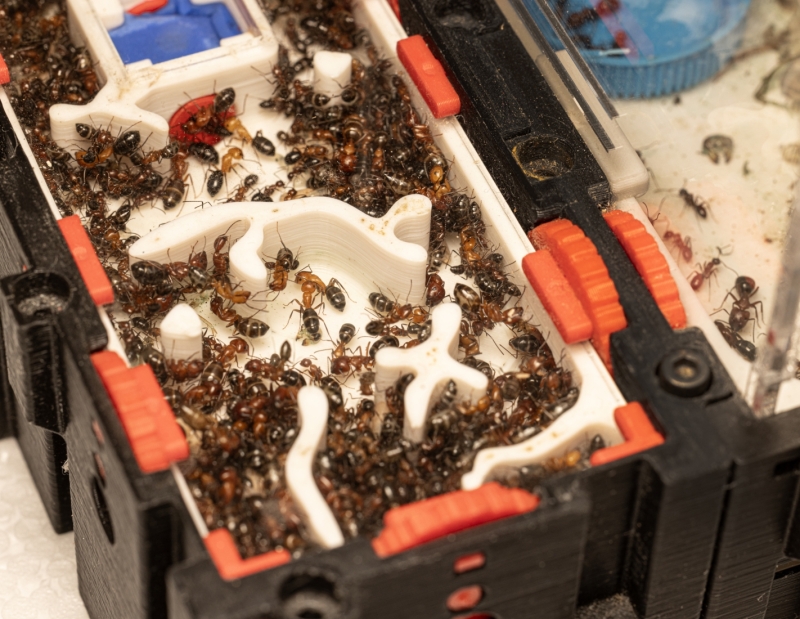
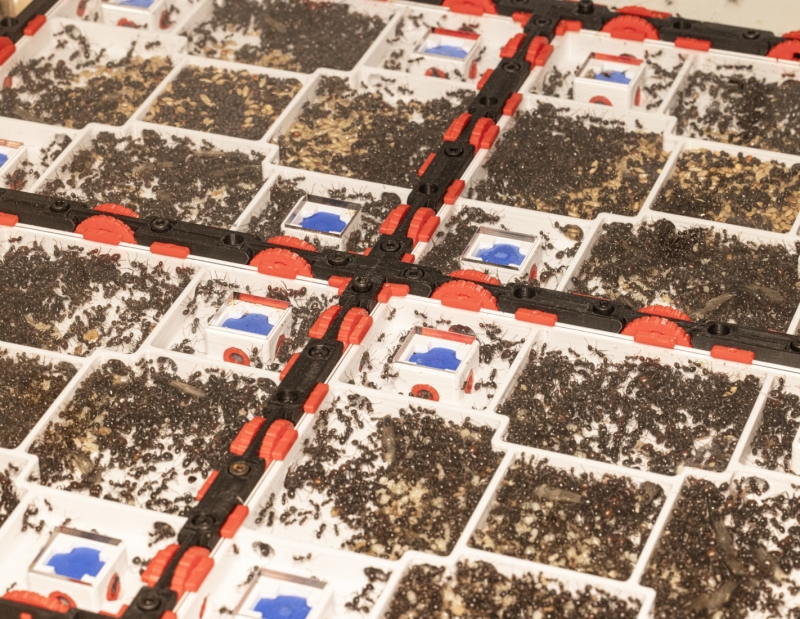
This is an established colony, bred in-house: it arrives with its queen and some 300–400 workers with brood, including major workers (majors). For those who want to skip the founding stage and start with a colony in full production.
A glossy black carpenter ant from the mountain forests of North Africa: robust, polymorphic and very active. The essentials: a roomy formicarium from day one (a QBIK DUO with large or cave-type galleries), a dry nest, 22–27 °C with one warmer side, sugar in a feeder and plenty of varied protein, water always available in a tube, a PTFE or paraffin oil barrier, moving by tipping out and a 4–5-month diapause at 5–10 °C, as befits a species from places with snowy winters.
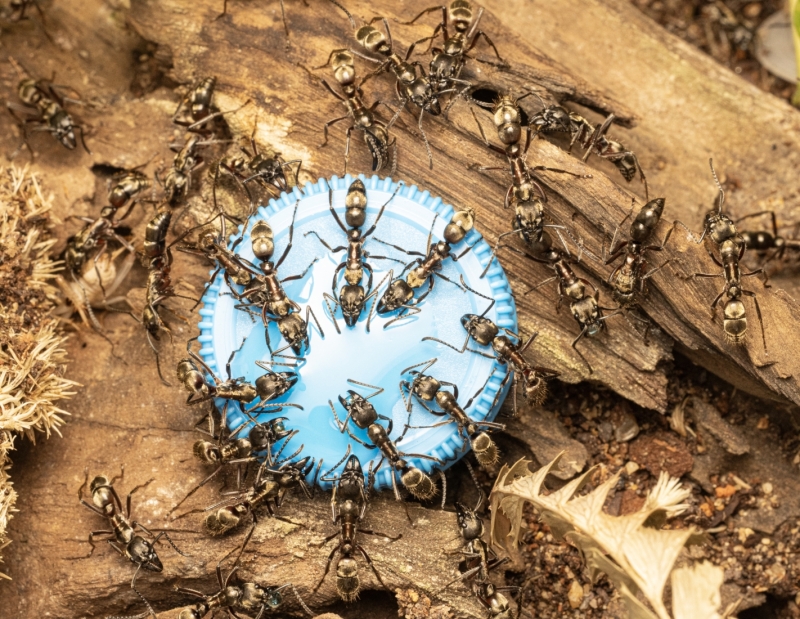
Camponotus alii Forel, 1890 is a carpenter ant from the Maghreb which, contrary to what its African category might suggest, lives neither in the desert nor in the savannah, but in mountain forests: pine, holm oak, oak and cedar woods of northern Algeria and Morocco, at roughly 1000 to 2000 m above sea level. In some of those forests it is the most abundant ant of all. Its workers are black and lustrous, long-legged, and the colony brings together workers of very different sizes, from nimble minors to broad-headed majors.
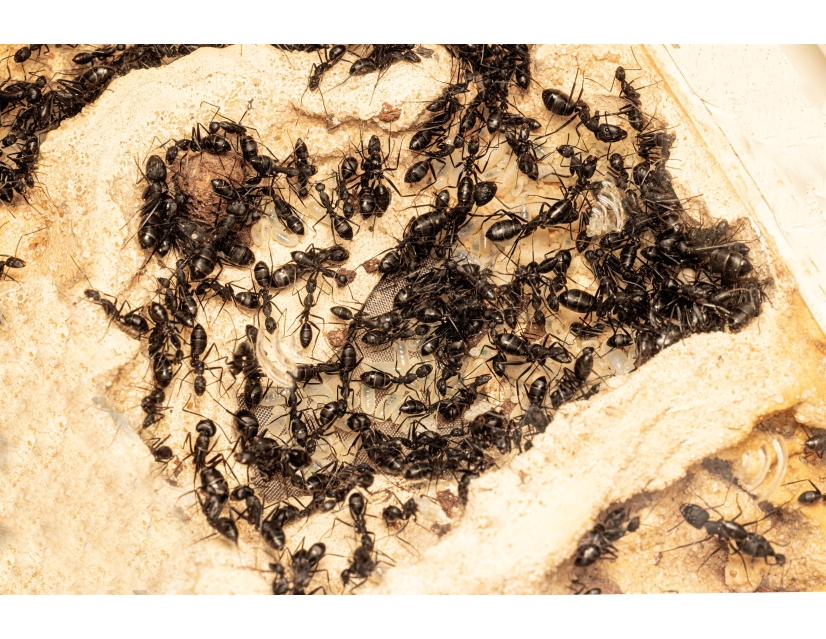
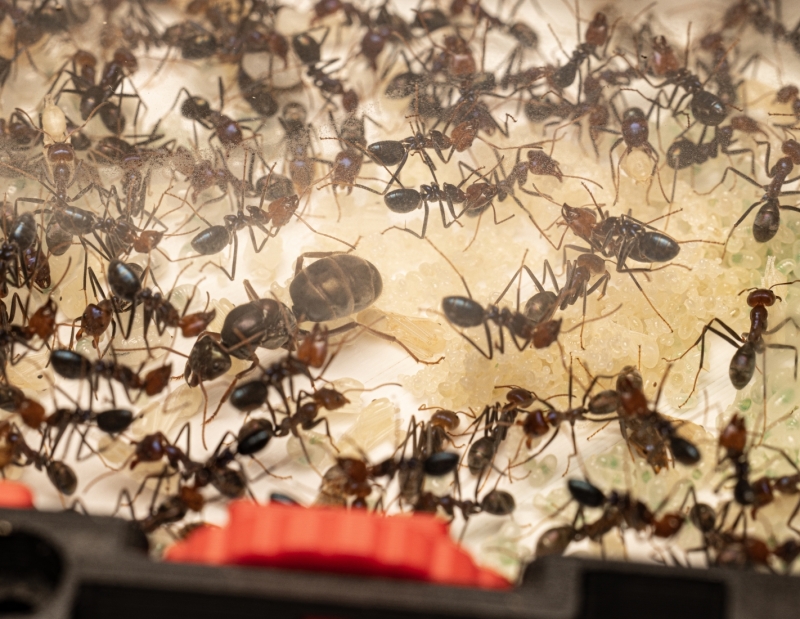
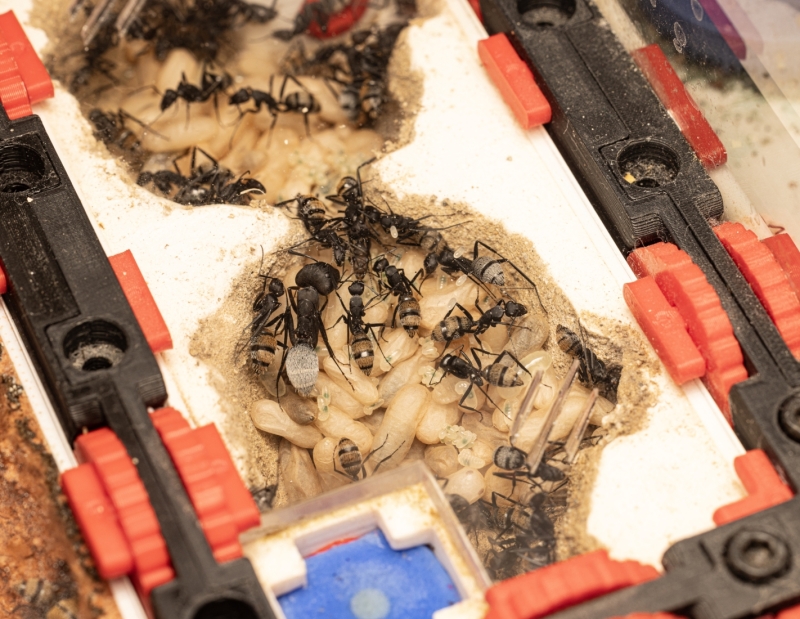
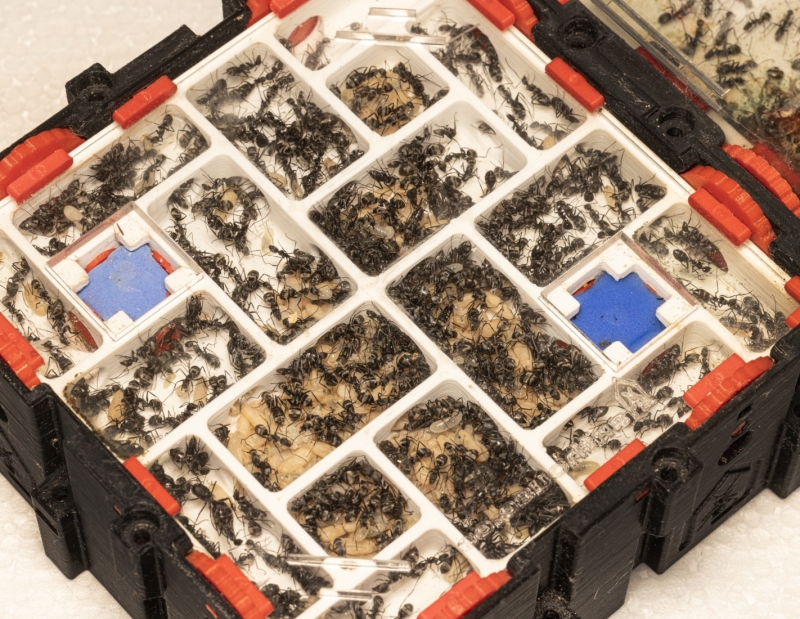
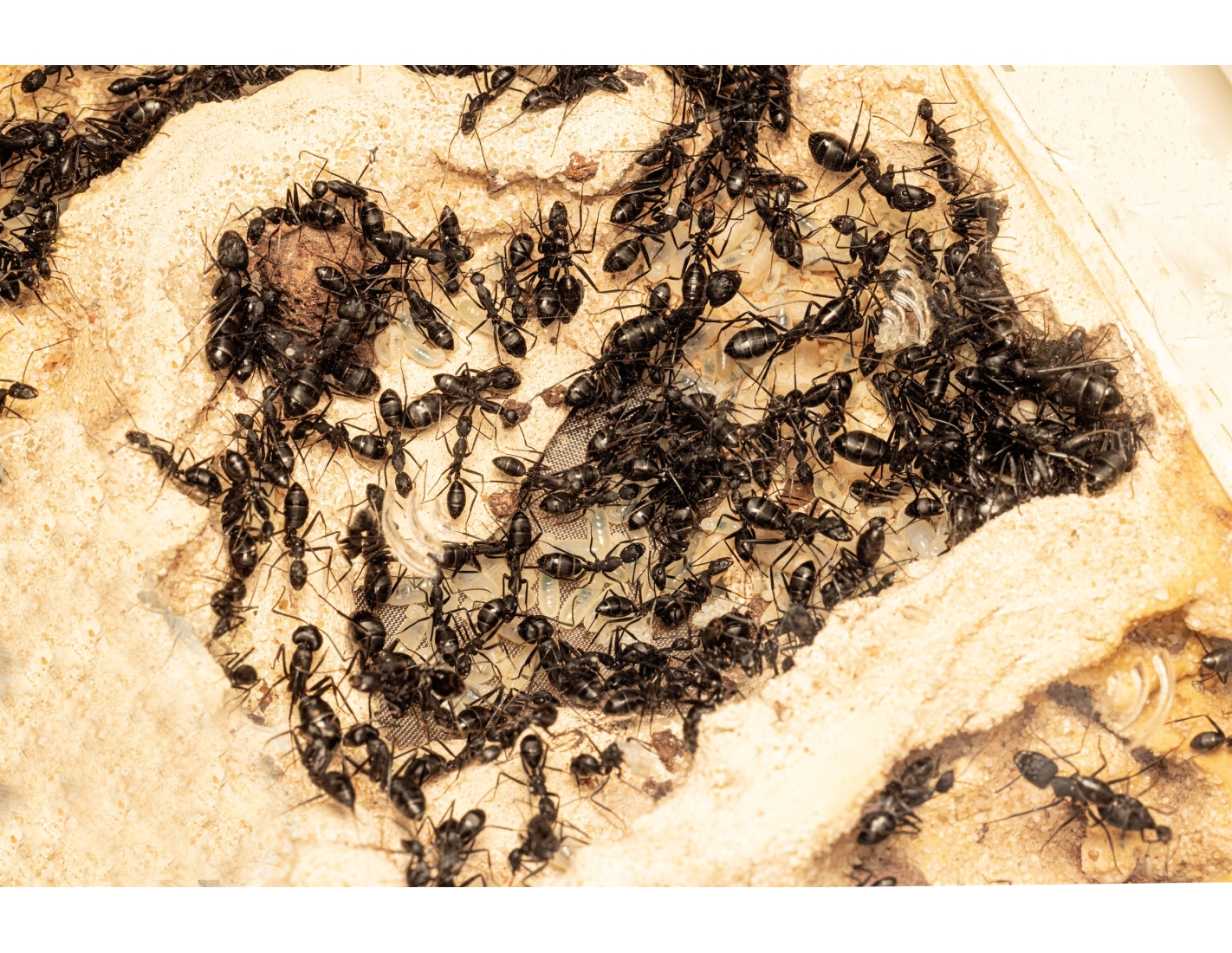
What you have in front of you is not a queen with her first workers, but an Empire: a large, mature colony with hundreds of workers, majors and brood at every stage, reared at Antomas. It has already left behind the slow years of founding, so from day one you will see what makes a populous Camponotus so interesting: columns of foragers, food passed mouth to mouth, majors guarding the entrance and brood production that does not stop all season.
If you would rather start with a small colony and watch it grow from the beginning, we also offer the young colony of Camponotus cf. alii.
Biology
What does ‘cf.’ mean in its name?
The abbreviation cf. comes from the Latin confer, ‘compare’. In a species name it indicates that the animal matches the species cited in everything that can be seen, but that the identification has not been confirmed with specialist keys and comparison with the type material, the specimen or series of specimens from which the species was described. In Camponotus, a genus of more than a thousand species with many similar-looking forms, this is a common and honest precaution. That is why we sell this line as Camponotus cf. alii: everything we know about it fits C. alii, and we treat it as such in this care sheet.
Discovered in an Algerian pine forest in 1889
The Swiss myrmecologist Auguste Forel described it in 1890 in a work on the ants of Tunisia and eastern Algeria. He presented it as a ‘race’ of another species, Camponotus rubripes r. alii, with workers collected in spring 1889 in the pine forests of Djebel Ozmor, near Tébessa, at 1100 to 1300 m. Shortly afterwards it came to be treated as a species in its own right, and today it is a valid species of the subgenus Tanaemyrmex, home to many large Camponotus from warm, dry parts of the Old World. In the current classification of the formicines, revised in 2016 by Ward, Blaimer and Fisher using molecular data, Camponotus belongs to the tribe Camponotini, that of the carpenter ants and their relatives.
Forel’s original specimens are still kept in Swiss museums. In 2017 Christoph Germann published an illustrated catalogue of the Forel collection at the Naturmuseum Solothurn, including three syntypes of C. alii and their handwritten label: ‘Djebel Ozmor p. Tebessa, 1380 m’. More than 125 years later, those workers are still the reference for deciding what is C. alii and what is not.
Over time several geographical forms were also described that are now regarded as subspecies, such as C. alii auresi Emery, 1920, from the Aurès massif, or C. alii hoggarensis, from the Hoggar massif, in the heart of the Sahara. It is a variable species, spread across mountains isolated from one another, and that usually gives rise to populations with small differences.
A mountain carpenter ant
Collection records and field studies paint a very clear picture. C. alii turns up in:
- Pine forests of Djebel Ozmor, the type locality, at around 1100–1380 m.
- Oak woods of north-eastern Algeria, at about 1000 m.
- Cedar, black pine and mixed forests of the Djurdjura, the great mountain range of Kabylia, at 1460–1605 m.
- The eastern High Atlas of Morocco, at close to 2000 m, and other Moroccan regions listed in Henri Cagniant’s catalogue.
- The Hoggar, the mountains of the central Sahara, at about 2000 m, in specimens from 1928.
It is no rarity: in the Yakouren forest, a mountain forest in Kabylia, a study published in 2021 by Abdi-Hamecha, Barech and colleagues, among them Cagniant himself, found that C. alii was the most abundant species in the forest, ahead of Pheidole pallidula and Crematogaster auberti. That a large Camponotus should dominate the ant community of a forest in this way says a great deal about its ability to find food and defend its territory.
In Arabia too?
Some works record C. alii outside the Maghreb: in Libya, Saudi Arabia and the United Arab Emirates, where Collingwood and colleagues recorded it in 2011 as new to the country, in Wadi Wurayah. However, a checklist of the ants of Iran published in 2026 points out that, according to the global ant distribution database (GABI), confirmed records of the species are limited to the western Mediterranean, and considers an old record from Iran unlikely.
Part of the confusion may stem from its relatives. Arabia is home to Camponotus arabicus Collingwood, 1985, which its author described as very similar to C. alii and which differs in the abundant hairs under the head and a more sculptured gaster. With ants this alike, caution is essential: the reliable core range of C. alii is the mountains of North Africa, and the Middle Eastern records remain to be confirmed.
Snowy winters: the clock of a mountain ant
Living in the mountain forests of the Maghreb has a direct consequence for keeping it. In those ranges the climate is Mediterranean montane: hot, dry summers with several months of almost no rain, and cold winters with frosts and snow that can last for months on the peaks of the Djurdjura. Colonies retreat deep into the soil, under stones or into wood, and spend the winter at rest.
That rhythm is built into the species. So, even though we list it in the Africa category, C. alii is not a tropical ant: it needs its winter diapause just like any European Camponotus, and rewards it with a spring of intense egg-laying.
Minors, medias and majors
Like other Tanaemyrmex, C. alii is a polymorphic species: workers of very different sizes and proportions live side by side in the same colony. The minors, with narrow heads and long legs, are the scouts and the ones that go out for food; the majors have a much broader head, driven by powerful mandibular muscles, and take care of defence, cutting up tough prey and, in many species of the genus, storing liquid food in the crop.
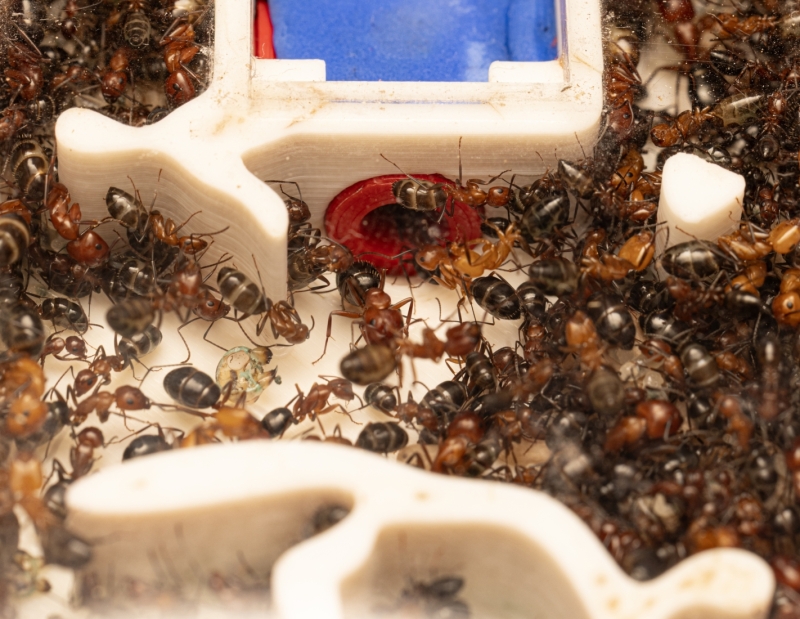
In a young colony you will hardly see any majors, because the queen first invests in small, cheap workers. Their appearance is a sign that the colony has matured, and in an Empire like this one they already form a sizeable group that shows itself at the nest entrance and whenever something out of the ordinary moves outside.
A social stomach
Camponotus share liquid food mouth to mouth, an exchange called trophallaxis. For a long time it was thought to serve only to distribute food, but in 2016 Adria LeBoeuf and her team analysed the fluid passed between workers of Camponotus floridanus and found much more: growth-related proteins, juvenile hormone, microRNAs and chemical recognition cues. By feeding this fluid to the larvae, workers influence how they develop.
It is a study on another species of the genus, but the mechanism is common to Camponotus, and in a colony of hundreds of workers it is easy to observe: you will see pairs with their heads together and mandibles open, one regurgitating a droplet and the other taking it. In this way, the nectar you put in the feeder is soon shared out across the whole colony.
Bacteria that make what is missing
Every Camponotus studied carries a symbiotic bacterium, Blochmannia, inside its cells, passed from the queen to her eggs. In 2007 Heike Feldhaar and colleagues showed in C. floridanus that this bacterium makes essential amino acids that the ants cannot produce, and that its contribution is most noticeable in brood growth when the diet is poor in protein.
It is one of the keys to the genus’s success: a diet rich in sugars, such as aphid honeydew, is topped up from within thanks to its microscopic partners. Even so, this is no substitute for animal protein: a large colony with lots of brood needs plenty of insects to grow at a good pace.
Formic acid: weapon and disinfectant
Like all formicines, C. alii has no sting. Its defence is formic acid, which it expels through the acidopore, a small opening at the tip of the gaster, and can spray from a distance while biting. But the acid has another, less well-known use. In 2020 Simon Tragust and his team saw that formicines, among them C. floridanus, bring the gaster to their mouth after feeding and swallow their own poison: this acidifies the crop and eliminates a good share of the microbes that arrive with the food, before it passes into the gut or is shared among nestmates.
If you watch the colony calmly after feeding it, you may see this gesture: a worker bending its gaster forwards and bringing it up to its mandibles. It is not simply cleaning itself; it is disinfecting itself from the inside.
One queen, one colony
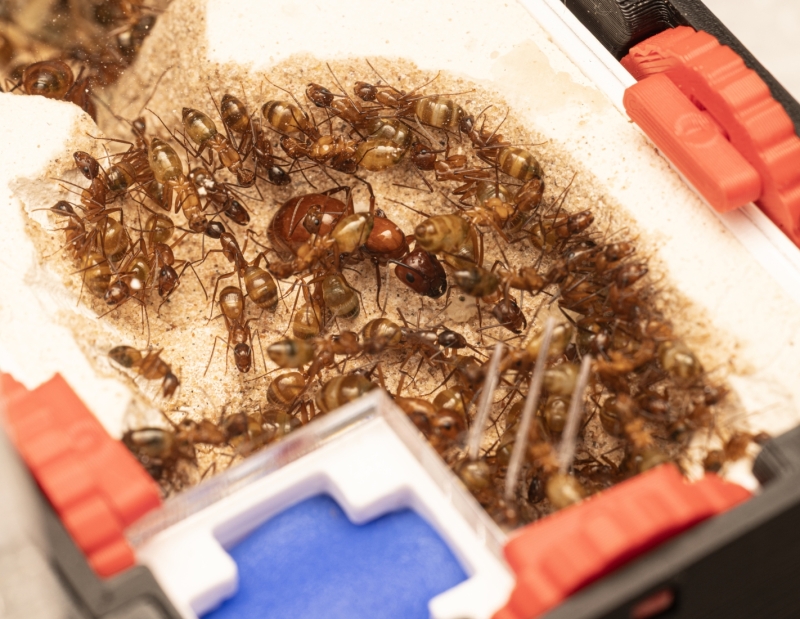
There are no studies on the social organisation of C. alii either, but in the genus the norm is for each colony to have a single queen, who founds alone after the nuptial flight and does not accept others. This Empire is the same: a single mated queen who lays all the colony’s eggs. The workers, on the other hand, divide the work by size and age: the young ones tend the brood inside the nest and the veterans go outside, which is the riskiest area.
Camponotus colonies can live for many years, as long as their queen. With good care and its diapause every winter, a colony like this one can keep you company for a long time.
Size and morphology
It is a robust Camponotus, with an elongated silhouette and long legs, a single-segmented waist (the petiole, scale-shaped) and no sting, like all formicines. These are the traits visible in our line:
- Colour. Black to blackish brown, with a marked sheen on the head, thorax and gaster. The mandibles and the tips of the antennae have a slightly reddish tone, and the gaster segments show a thin, paler edge.
- Minor workers. Slender, with a small, rounded head and very long legs and antennae: they are the ones you see most in the foraging area.
- Major workers. Much bulkier, with a broad head, almost square when seen from the front, and strong mandibles. Between the two there is a whole range of media workers.
- Queen. Clearly the largest in the colony, with a bulky thorax, where the wings were attached, and a large, shiny gaster.
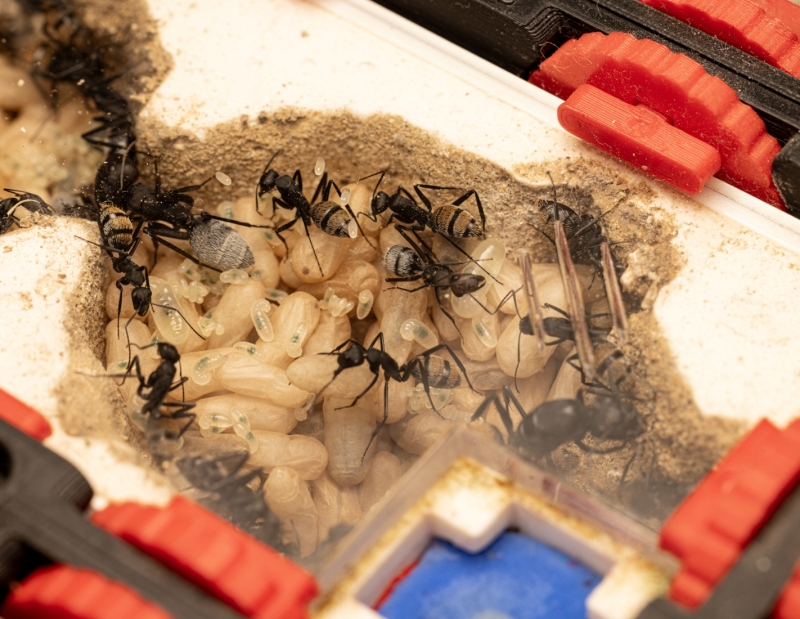
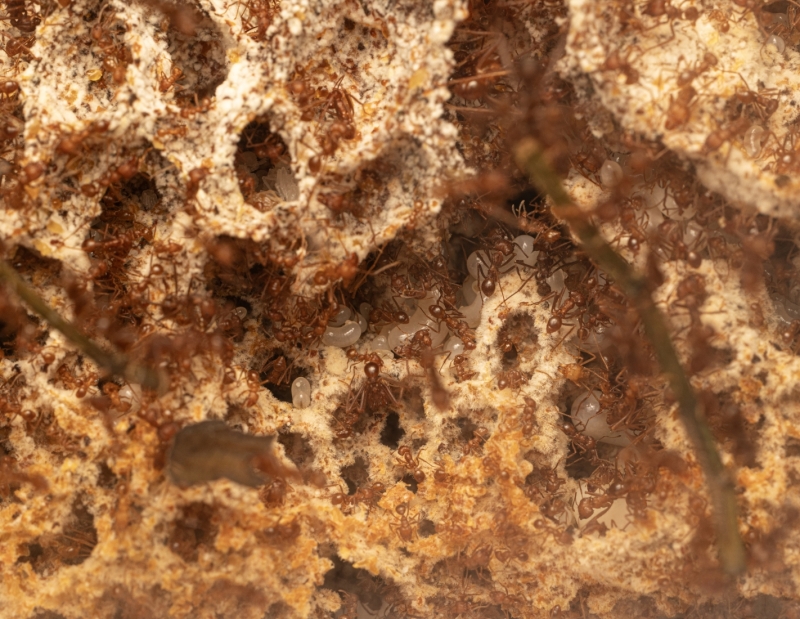
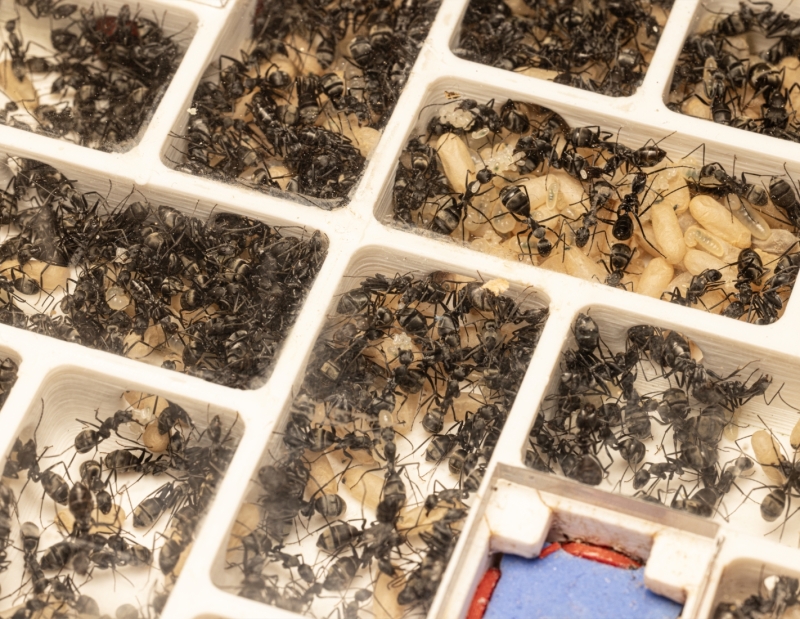
- Development. As in other formicines, the larvae spin a silk cocoon to pupate: the pale ‘eggs’ you see piled up in the nest are in fact cocoons with pupae inside.
To separate C. alii from its relatives, specialists look at fine details such as the hairs under the head, the sculpture of the gaster or the shape of the thorax; the reference key for Morocco is Cagniant’s (1996). That is why, without such a study, we speak of C. cf. alii.
Approximate measurements
We have not found published measurements of the castes of C. alii in accessible scientific sources: Forel’s original description is very brief and later works focus on its distribution. The length figures that circulate for other Camponotus do not apply to this species, so we prefer not to give numbers. What you can see with the naked eye is the great difference in size between the minors, the majors and the queen, one of the attractions of a mature colony.
Care in captivity
Difficulty: 2/5 – Beginner
It is a rewarding ant: it eats everything, takes well to formicaria of different materials, adapts to household temperatures and tolerates small lapses. With an already large colony, moreover, the risky first months, when a lone queen or a small colony can fail, are behind it. The only thing that cannot be skipped is the diapause every winter, and the only things it really asks for are space, plenty of food and cleanliness, because there are hundreds of mouths to feed.
What keeping an already large colony involves
An Empire of 300–400 workers is not handled like a founding colony. These are the differences worth being clear about before it arrives:
- Space from day one. It skips test tubes and small nests altogether: it goes straight into a suitably sized formicarium with roomy galleries and a large foraging area where the workers can move around without crowding.
- Lots of food and lots of cleaning. A colony like this consumes several times what a young one does each week. You need to top up the nectar often, offer protein daily or almost daily in the active season and remove leftovers so that mould and mites do not appear.
- A different pace of growth. It is no longer measured in individual workers but in batches of cocoons. With warmth and protein, in spring and summer the colony can grow very fast and need more modules in a single season.
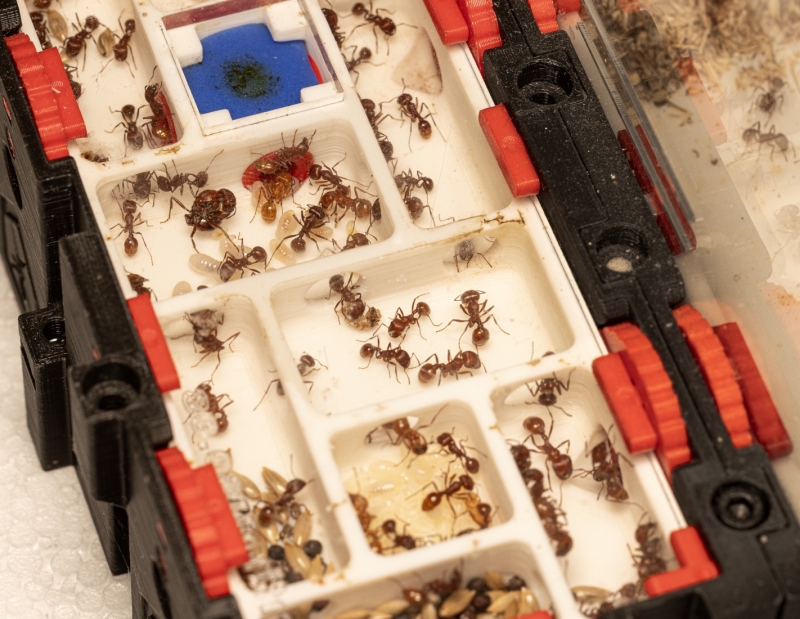
- Majors. The majors need wide galleries and passages, and larger or tougher prey they can cut up; they are also the ones you notice most when you open the formicarium.
- A move that takes more care. Tipping out hundreds of workers, with brood and queen, requires preparation (we explain it below).
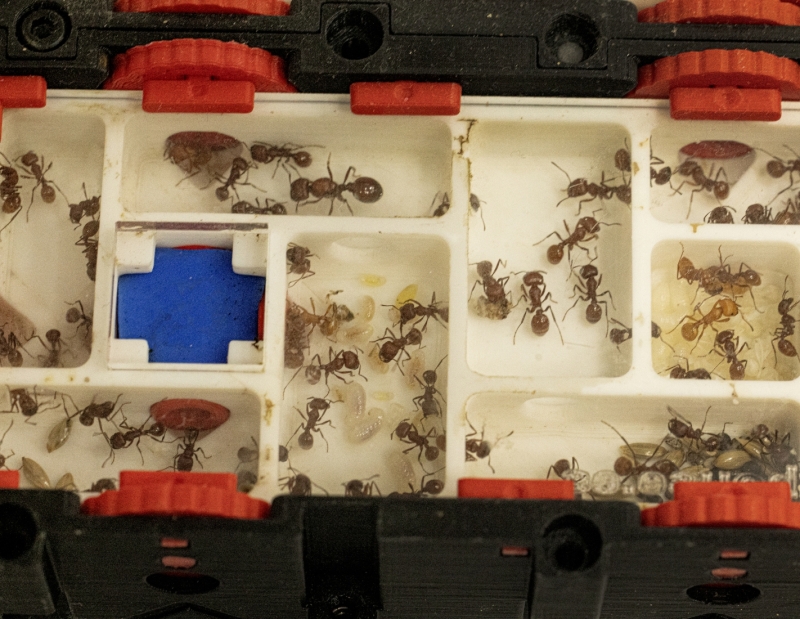
- More to watch. With so many workers, the foraging area is always busy, and the nest, with its heaps of cocoons and larvae, is a spectacle in itself.
Recommended parameters
- Nest temperature: 22–27 °C in the active season, roughly from March to October.
- Warmer side: 28–30 °C at one end, with a heat mat or heat cable controlled by a thermostat, so that the colony can choose where to put the brood. Never heat the whole nest.
- Nest humidity: dry. A slightly damper area at the start is enough, as explained below.
- Water: always available, in a test tube with water and cotton wool in the foraging area.
- Light: the nest in semi-darkness and the foraging area lit, with a normal day–night cycle.
- Diapause: 4–5 months, roughly from November to March, at 5–10 °C.
A dry nest, like almost all Camponotus. When setting up the colony, it is usual to moisten part of the nest slightly, or leave the humidity modules or reservoirs connected, so that the brood settles in. Afterwards they are removed and the nest is kept dry: the water goes in the tube in the foraging area, and the nectar also hydrates, because it is mostly water. A wet nest in a colony of this size is an invitation to mould.
Recommended formicarium
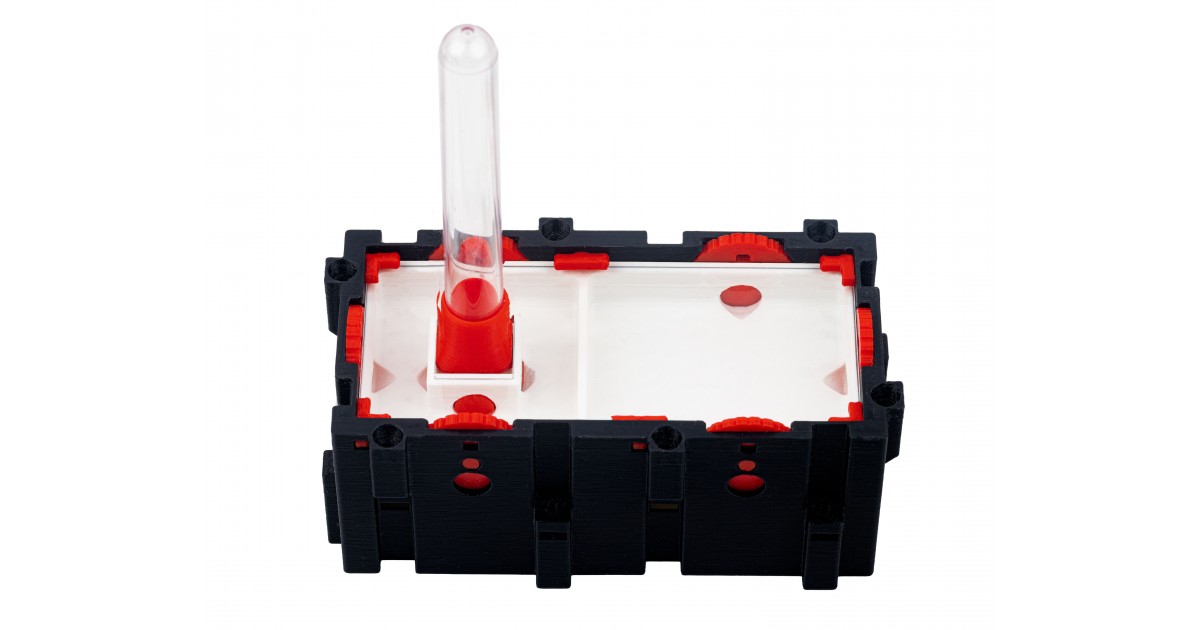
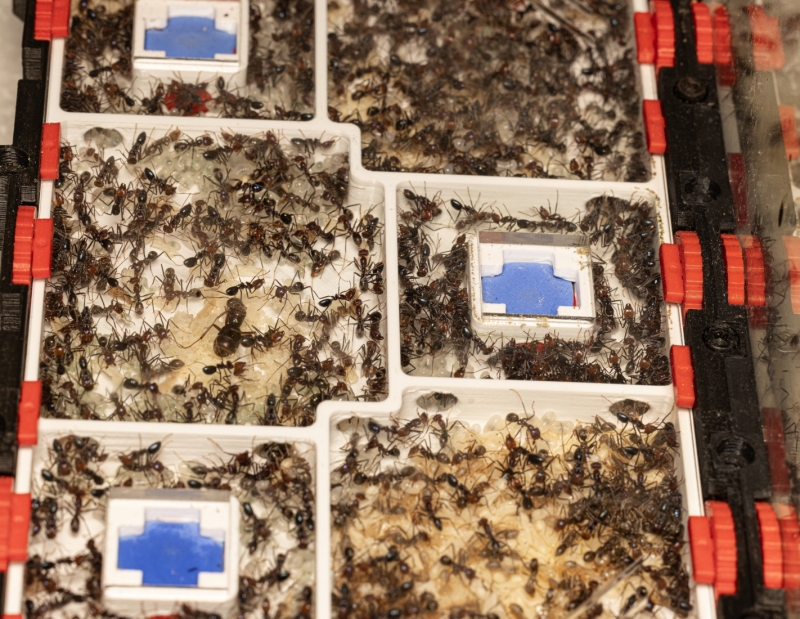
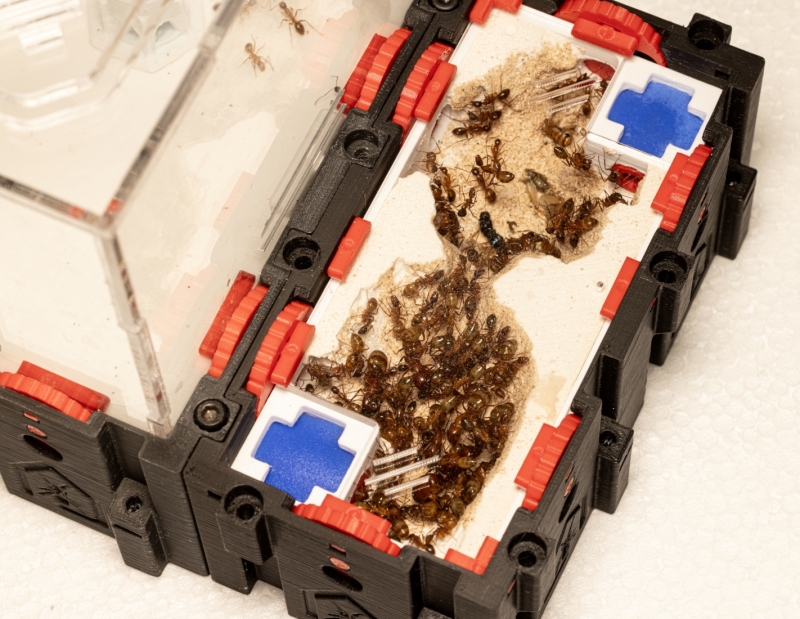
For a colony of 300–400 workers with majors, at Antomas we recommend a QBIK DUO from Anthouse’s Alpha range: modular and dry, with room to separate the brood chamber from the resting areas and to keep expanding. With Camponotus, always use large or cave-type galleries, never the small ones: the majors need plenty of room to get through.
If you prefer a plaster nest, in which the colony is very easy to see, the Qbik Wild Duo P 2C is also a good option; in that case, moisten it only at the start and then let it dry out.
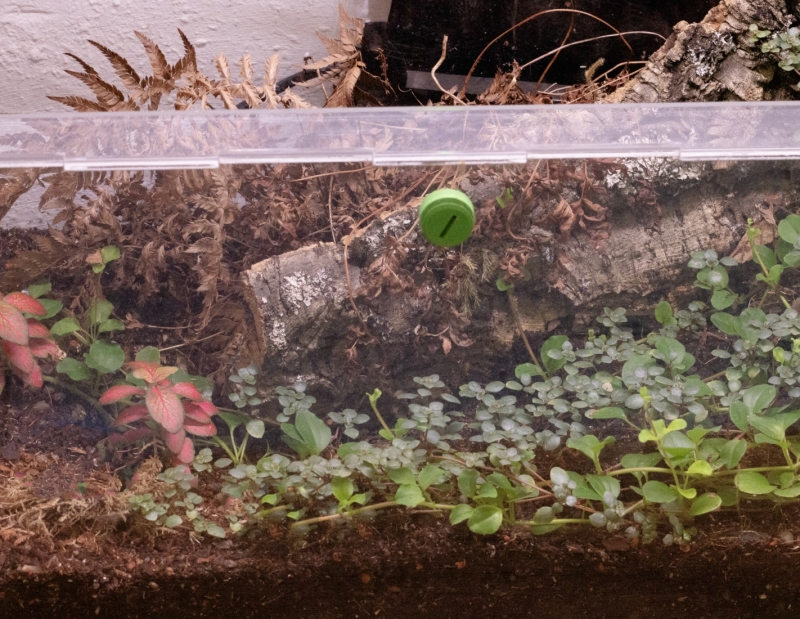
The foraging area should be roomy, with some dry substrate, flat stones and a branch or piece of bark to climb on. The sign that it is time to expand is clear: workers that stay overnight in the foraging area because there is no room inside, or cocoons piled up in the corridors. Expand one module at a time; a huge empty space ends up as a rubbish tip.
Arrival and moving by tipping out
When it arrives, leave the colony as it comes in a quiet place at room temperature and check that it has water. One day of rest is enough for it to recover from the journey. At Antomas moves are always done by tipping out, and with a colony of this size it pays to prepare well:
- Prepare the formicarium beforehand: the escape barrier already applied and dry, the water tube in place and a drop of nectar in the feeder.
- Work over a large tray, with long tweezers and a soft brush to hand, so that any ants that fall outside end up in the tray.
- Tip out into the foraging area, near the nest entrance, shaking gently until the queen, the workers and the brood fall out. If it comes in several containers, one at a time.
- No hurry: any that stay clinging on will come out by themselves if you leave the container open inside the foraging area for a few hours.
- Cover and leave the nest in semi-darkness. In a short time they will have carried the brood inside and organised themselves.
Feeding
A varied diet, always. In the wild, Camponotus live mainly on sugary liquids, such as the honeydew of aphids and other sap-sucking insects, and on prey and dead insects. In captivity you need to imitate that mix.
Sugars. Blue Sugar nectar by Anthouse 4–5 times a week, and another nectar or sugary liquid 1–2 times a week for variety. You can also add protein to the nectar. Always offer it in a feeder, never on cotton wool, which goes mouldy and spoils the liquid within a few days. With hundreds of workers, the feeder empties quickly: check it every day.
Protein: plenty of it. An Empire has a lot of brood at once, and protein is what makes it grow. At Antomas we are clear about this: if you do daily maintenance and remove leftovers, it is better to overdo it than to fall short, because the colony senses abundance and grows faster and in greater numbers; if you cannot clean often, it is better not to overfeed. Change the insect from one week to the next so that they do not always eat the same thing:
Always use captive-bred insects: wild-caught ones may carry insecticides. Remove leftovers within 24–48 hours.
Water: clean and always available, in the tube with cotton wool, separate from the nectar.
Diapause
This is an ant from mountains with snow in winter, so diapause is essential. At Antomas we recommend 4–5 months at 5–10 °C, roughly from November to March:
- Gradual cool-down. In autumn, switch off the warm side and leave the colony at 15–18 °C for a few weeks. The queen will stop laying and the colony will finish raising the brood it has.
- Where to do it. A cellar, a garage, a cold room or a wine cooler. Never below 0 °C.
- During the rest: water always in the tube and a little nectar available; protein, hardly any.
- Gradual return in spring, raising the temperature in stages up to 22–27 °C and switching the warm side back on.
Skipping diapause in a species like this usually ends with a queen that lays less and a colony that stalls.
Behaviour and observation
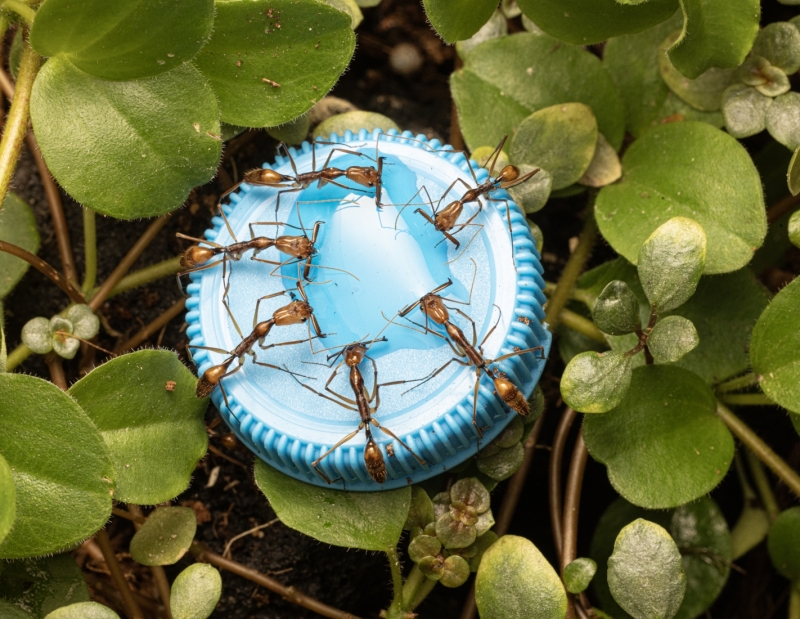
Plenty of visible activity. With warmth and light, the minors patrol the foraging area and climb branches and walls, and as soon as they find a large prey item they alert others. Several majors usually wait by the entrance, and a crowd gathers round the feeder.
Trophallaxis and sharing. It is one of the best species for watching mouth-to-mouth food exchange, especially right after topping up the nectar.
Watch without fear. At Antomas we believe ants are there to be enjoyed, observed and learnt from. With the nest in semi-darkness and the foraging area lit, you can look at them whenever you like; just do it gently and intervene only as much as necessary. A large colony soon gets used to your presence.
Warning signs: a colony that produces no cocoons in summer usually needs more warmth or more protein; mould in the nest points to too much humidity or uncleared leftovers; and many workers dying all at once is usually down to lack of water or spoilt food.
Escapes and barriers
It is a good climber and, with hundreds of workers, any failure shows. Use a PTFE (Fluon) or paraffin oil barrier on the upper part of the foraging area walls, renew it when it gets dirty and keep the lid tightly fitted. Make sure nothing leaning against the wall reaches the barrier: a tall branch or a tube acts as a bridge.
Handling and safety
It does not sting, but the majors bite hard and all of them can spray formic acid, which stings sensitive skin and the eyes. Use tweezers and a brush, not your hands. Do not put it together with other colonies or other species. It is an exotic species: it must never be released into the wild.
What not to do
- Skip diapause or go into and out of it with sudden changes in temperature.
- Keep the nest wet once the colony has settled in.
- Use small galleries: always large or cave-type.
- Give it far more space than it occupies all at once, instead of expanding little by little.
- Put the nectar on cotton wool or leave the feeder empty.
- Always give the same insect or the same sugar.
- Leave food remains in the formicarium.
- Heat the whole nest evenly.
- Merge different colonies or queens.
- Handle it with your hands.
Scientific sources
This care sheet is based on the scientific literature on Camponotus alii (description, catalogues and faunal studies of North Africa and Arabia) and on the biology of the genus Camponotus, as well as on Antomas’s own experience. Main references:
- Forel, A. (1890). Fourmis de Tunisie et de l'Algérie orientale. Annales de la Société Entomologique de Belgique 34 (Comptes-rendus): lxi–lxxvi.
- Cagniant, H. (1996). Les Camponotus du Maroc (Hymenoptera: Formicidae): clé et catalogue des espèces. Annales de la Société entomologique de France (N.S.) 32: 87–100. doi:10.1080/21686351.1996.12278857
- Cagniant, H. (2006). Liste actualisée des fourmis du Maroc (Hymenoptera: Formicidae). Myrmecologische Nachrichten 8: 193–200. zobodat.at
- Collingwood, C. A., Agosti, D., Sharaf, M. R. & van Harten, A. (2011). Order Hymenoptera, family Formicidae. Arthropod fauna of the UAE 4: 1–70. doi:10.5281/zenodo.1168586
- Germann, C. (2017). On the Auguste Forel ant collection in the Naturmuseum Solothurn, Switzerland: current state and illustrated type catalogue (Hymenoptera, Formicidae). Revue suisse de Zoologie 124(2): 241–254. doi:10.5281/zenodo.893513
- Guénard, B., Weiser, M. D., Gómez, K., Narula, N. & Economo, E. P. (2017). The Global Ant Biodiversity Informatics (GABI) database: synthesizing data on the geographic distribution of ant species (Hymenoptera: Formicidae). Myrmecological News 24: 83–89. doi:10.25849/myrmecol.news_024:083
- Abdi-Hamecha, L., Barech, G., Khaldi, M., Ali-Ahmed Sadoudi, D., Salem, S., Zazgad, I. & Cagniant, H. (2021). Diversité des fourmis (Hymenoptera, Formicidae) dans la forêt de Yakouren (Algérie): estimation de la richesse, biogéographie et taxonomie. Revue suisse de Zoologie 128(1): 61–72. doi:10.35929/RSZ.0035
- Sharaf, M. R., Wetterer, J. K., Mohamed, A. A. & Aldawood, A. S. (2022). Faunal composition, diversity, and distribution of ants (Hymenoptera: Formicidae) of Dhofar Governorate, Oman. European Journal of Taxonomy 838: 1–106. doi:10.5852/ejt.2022.838.1925
- Khalili-Moghadam, A. & Salata, S. (2026). Checklist of the Iranian ants (Hymenoptera: Formicidae): additions and updates. Zootaxa 5833(1): 1–75. doi:10.11646/zootaxa.5833.1.1
- Ward, P. S., Blaimer, B. B. & Fisher, B. L. (2016). A revised phylogenetic classification of the ant subfamily Formicinae (Hymenoptera: Formicidae), with resurrection of the genera Colobopsis and Dinomyrmex. Zootaxa 4072(3): 343–357. doi:10.11646/zootaxa.4072.3.4
- Feldhaar, H., Straka, J., Krischke, M., Berthold, K., Stoll, S., Mueller, M. J. & Gross, R. (2007). Nutritional upgrading for omnivorous carpenter ants by the endosymbiont Blochmannia. BMC Biology 5: 48. doi:10.1186/1741-7007-5-48
- LeBoeuf, A. C., Waridel, P., Brent, C. S., Gonçalves, A. N., Menin, L., Ortiz, D., Riba-Grognuz, O., Koto, A., Soares, Z. G., Privman, E., Miska, E. A., Benton, R. & Keller, L. (2016). Oral transfer of chemical cues, growth proteins and hormones in social insects. eLife 5: e20375. doi:10.7554/eLife.20375
- Tragust, S., Herrmann, C., Häfner, J., Braasch, R., Tilgen, C., Hoock, M., Milidakis, M. A., Gross, R. & Feldhaar, H. (2020). Formicine ants swallow their highly acidic poison for gut microbial selection and control. eLife 9: e60287. doi:10.7554/eLife.60287