Difficulty: 2/5 – Easy
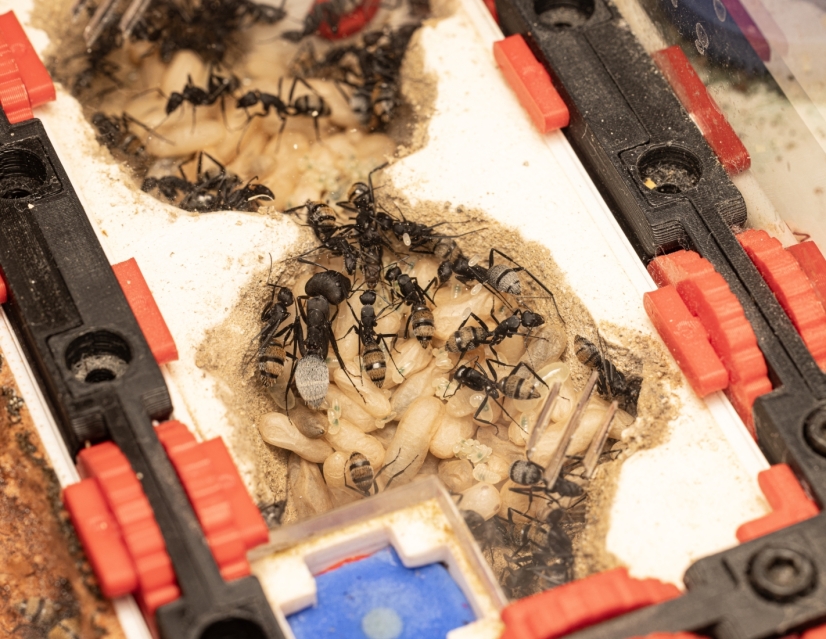
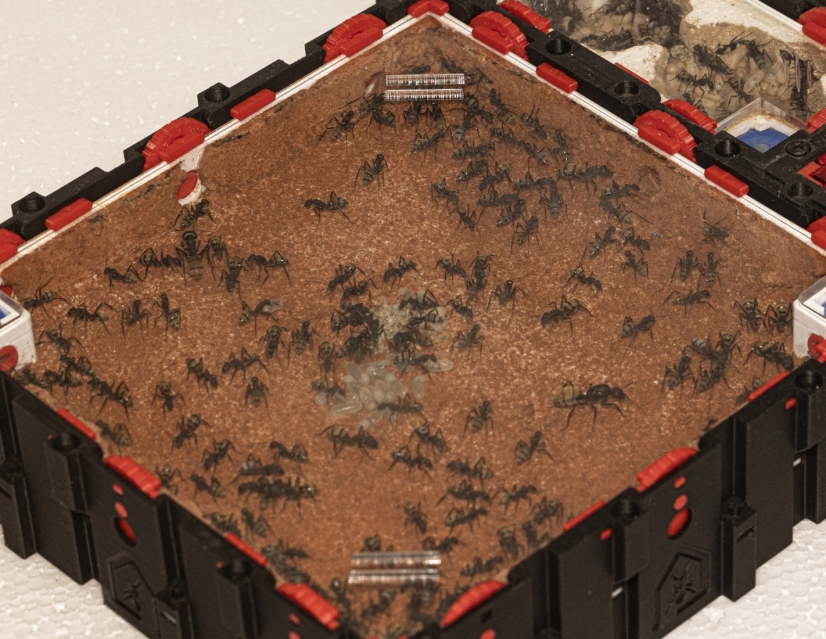
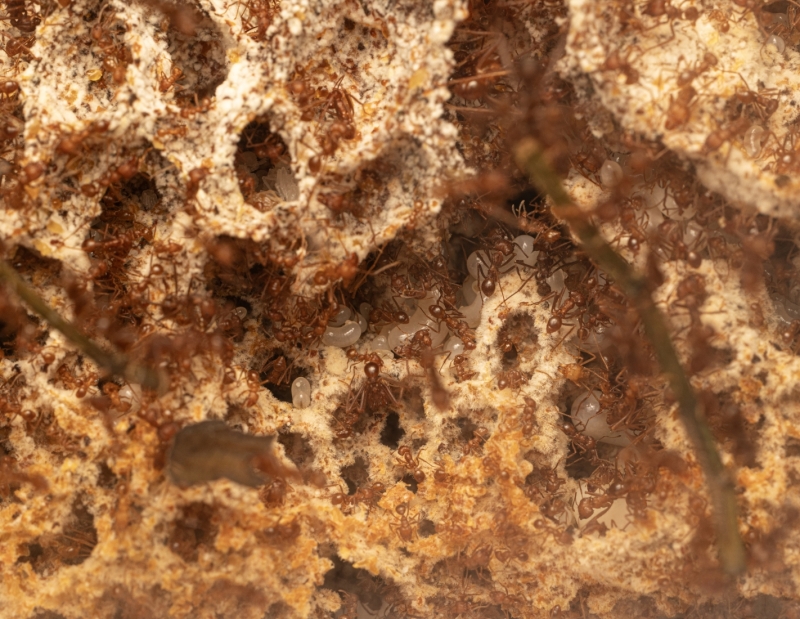
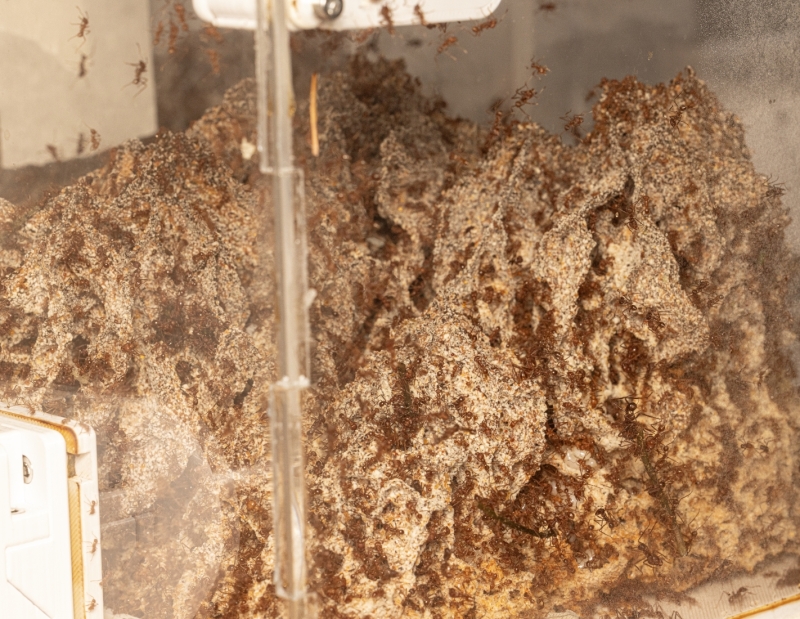
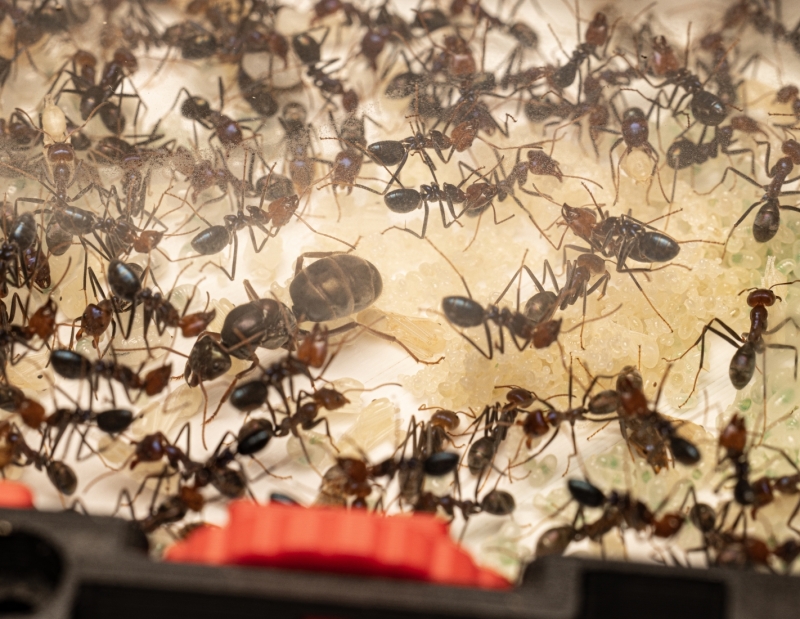
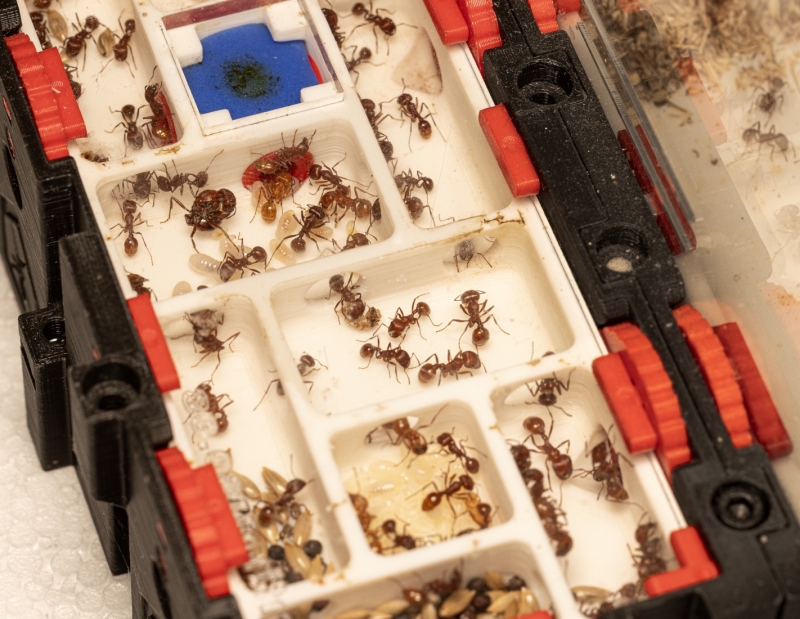
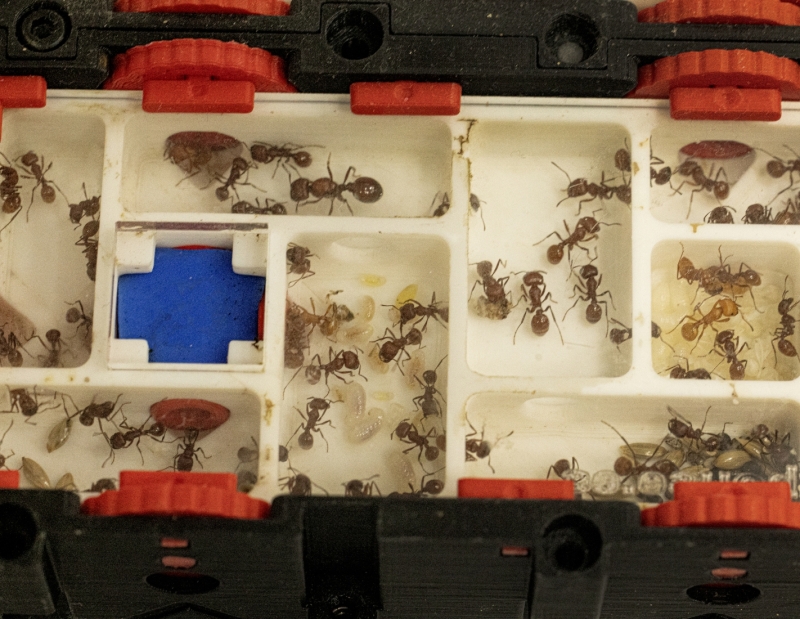
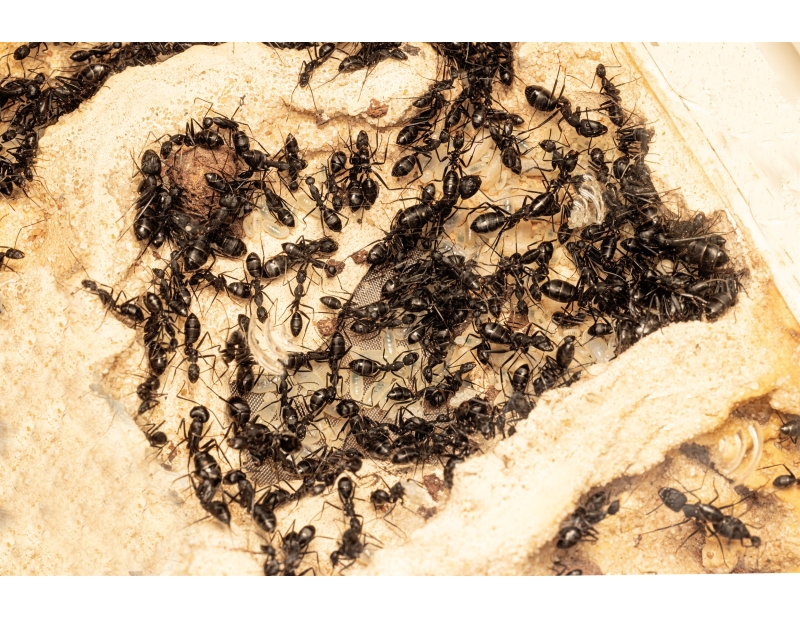
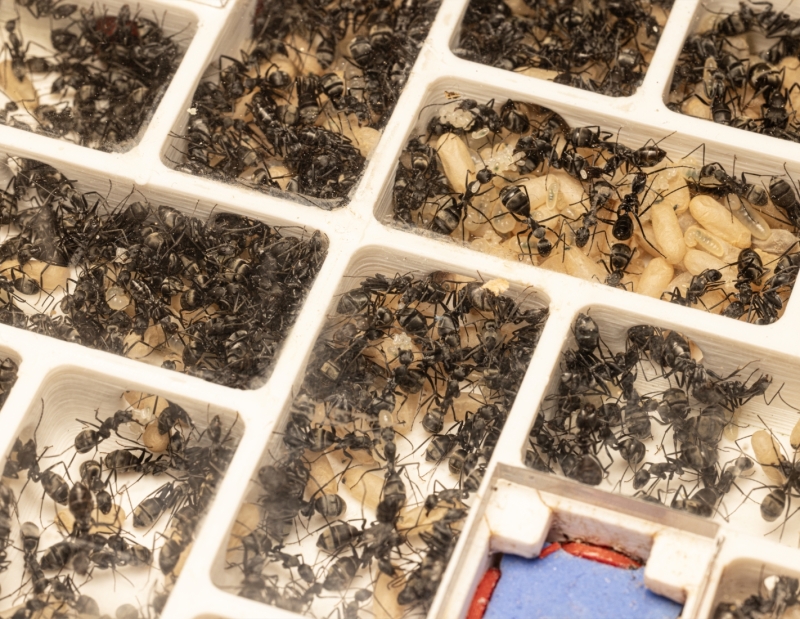
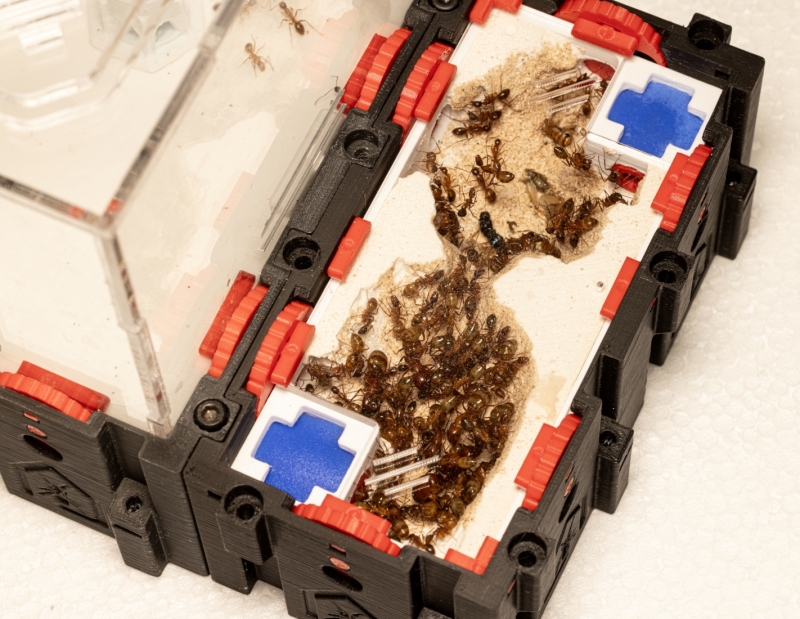
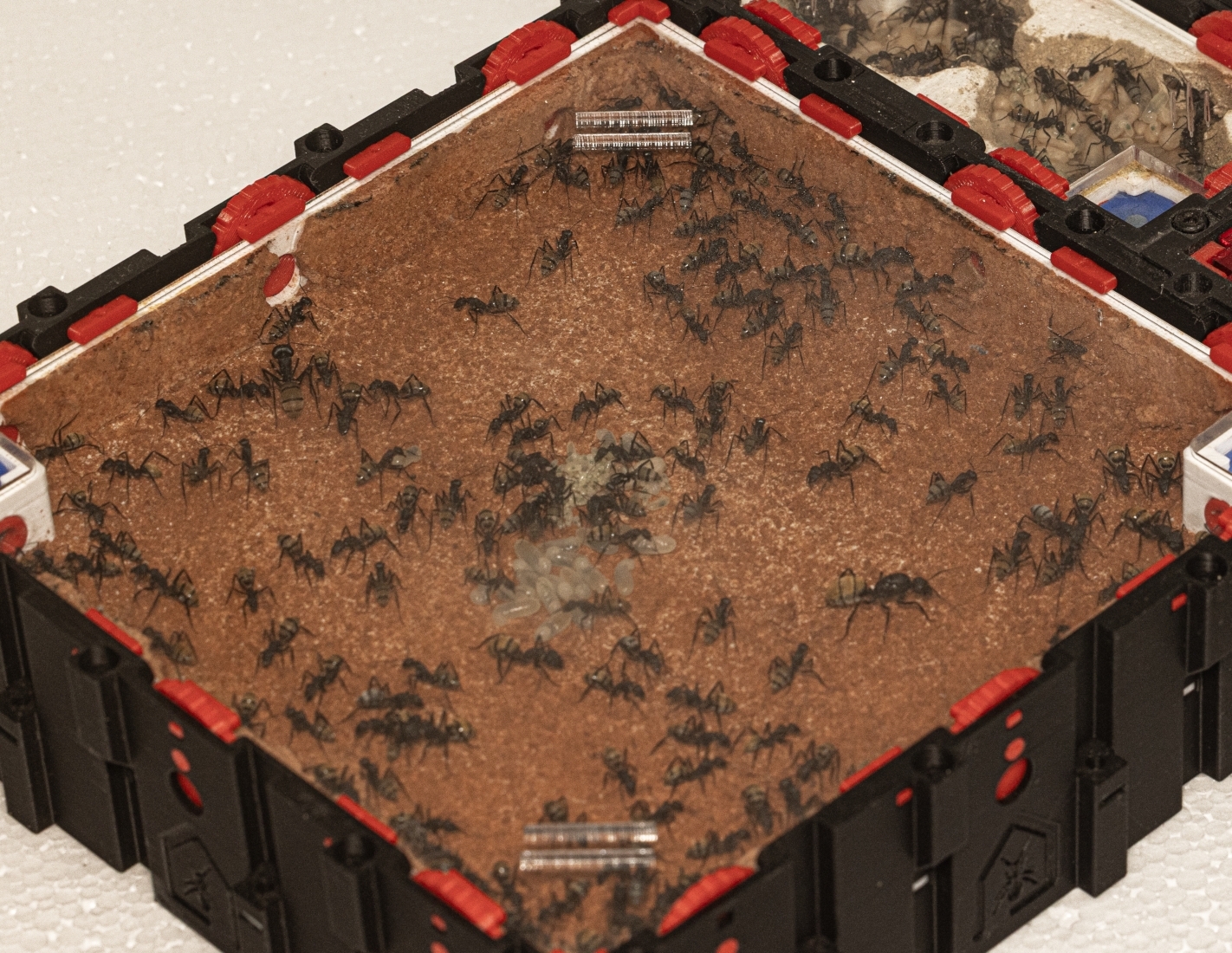
This is a colony about 2 years old, with a queen from the 2024 nuptial flights, raised at Antomas and already adapted to our cycle.
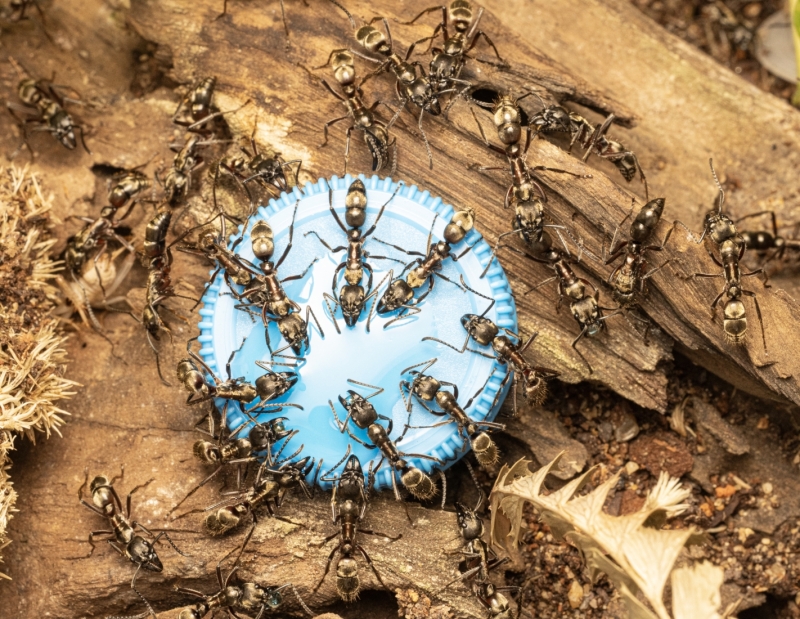
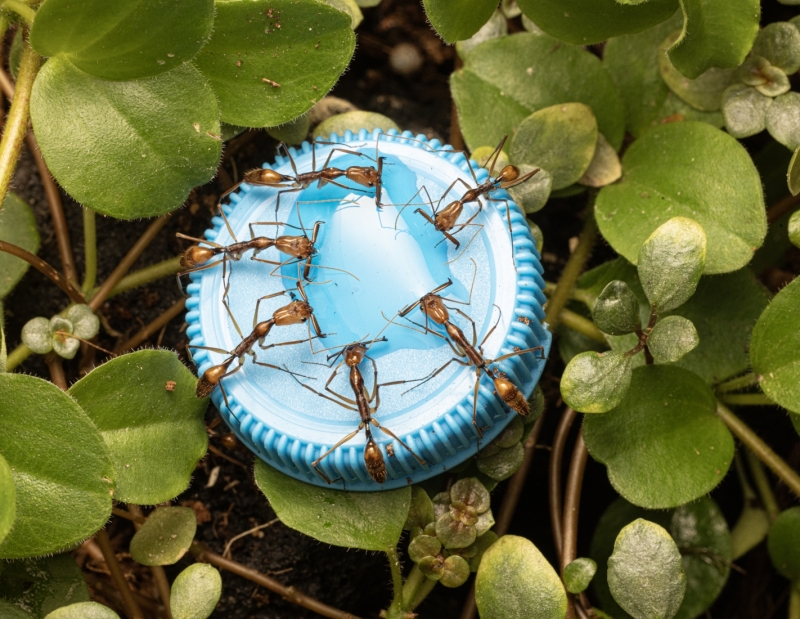
A large South African Camponotus with a black body and a gaster covered in dense hair that ranges from orange-gold to silver; in our line, silvery tones predominate. Active by day, a solitary navigator and easy to keep.
Camponotus fulvopilosus (De Geer, 1778) is one of the large carpenter ants of southern Africa and one of the most recognisable in the genus: the workers' gaster is covered by a dense coat of thick golden-yellow hairs that contrasts with a cuticle that is usually black. In South Africa it is known in English as the Karoo balbyter ant or yellow-haired sugar ant, and in Afrikaans as balbyter. It is diurnal, large and polymorphic, and it navigates with a precision that has caught the interest of neurobiologists. At home it is a rewarding, easy species, and this colony is already adapted to our calendar.
Biology
An eighteenth-century name
It was described by the Swedish naturalist Charles De Geer in 1778 as Formica fulvopilosa, from material collected at the Cape of Good Hope. The epithet comes from the Latin fulvus ("tawny, dark yellow") and pilosus ("hairy"): the name already describes its most striking feature. Over the following two centuries it received other names that are now considered synonyms, such as Formica pilosa Olivier, 1792, and Formica rufiventris Fabricius, 1804. It belongs to the subgenus Myrmopiromis (also cited as Myrmepomis) and gives its name to its own species group.
Distribution and habitat
It lives in the arid and semi-arid regions of western southern Africa and in open savanna, with records from South Africa, Namibia, Botswana, Angola and the Democratic Republic of the Congo. It occupies rocky terrain and the Karoo, which gives it its English name, and in northern Namibia it reaches the sand seas of the Kunene and the Skeleton Coast. It nests in the ground: under stones and slabs, under fallen logs and at the base of small shrubs.
These are landscapes of hot, stormy summers and dry, cool winters. That seasonal rhythm is the reverse of ours, but this colony, raised at Antomas, already follows our cycle.
Not to be confused with the Namib dune ant
It is easy to mix it up with the famous Namib dune ant, but that is a different species: Camponotus detritus, from the same group. The fulvopilosus group has four species: C. fulvopilosus (arid areas and open savanna), C. brevisetosus (granite outcrops of the Drakensberg), C. detritus (Namib dune sea) and C. storeatus (southern Cape). The last three were described as varieties of fulvopilosus and are now species in their own right. They are separated mainly by the gaster and the pronotum: in C. detritus the hairless bands on the tergites are wide, more than half the width of the tergite, whereas in C. fulvopilosus they are absent or narrow.
One species, three forms and hybrid zones
The revision of the group by Robertson and Zachariades (1997) recognises three morphological forms within C. fulvopilosus with a parapatric distribution, meaning that they occupy neighbouring areas with hardly any overlap, and it detects hybrid zones between them with intermediate individuals. They have no subspecies names; recent literature refers, for example, to the "savanna form". Colour varies too: on the Skeleton Coast the workers have a reddish-brown head, and elsewhere in the range a blackish-brown one. It is a species with a great deal of geographical variation, which is why lines of somewhat different appearance turn up in the trade.
A dual-system navigator
A field study in savanna in north-western South Africa, near Vryburg, followed workers on their way back to the nest and found that they combine two strategies. The first is path integration: as they move away, they keep adding up the direction and distance travelled, so that at every moment they carry a "vector" pointing home. The second is the recognition of visual landmarks in the landscape around the nest. The surprising part is the order: even less than 1.25 m from the nest, with the entrance practically within reach, the return trip starts guided by path integration, and only afterwards do they switch to the landmarks around them.
For a large, diurnal, sharp-sighted ant living in a landscape full of stones and shrubs, having two systems that back each other up is a clear advantage. In captivity you can see it in the way workers explore the outworld individually and return to the nest without following a fixed route.
Solitary foraging, without pheromone trails
Workers go out to look for food alone. In the same study, the outward and return routes differed from one individual to another, which indicates that they do not follow pheromone trails like so many other ants; only occasionally do they recruit a few nestmates, up to five. Foraging is done by minor and media workers, at an average distance of about 20 m from the nest (between 8 and 31 m). Activity is clearly diurnal: in February, at the height of the southern summer, it began between 6:00 and 6:30, peaked around 14:30–15:00 and faded out between 17:00 and 19:00. Some popular sources mention chemical trails, but the field study does not support this.
A honeydew farmer
Its English name sugar ant is well deserved. According to Lamb (2018), the species' diet consists mainly of honeydew from hemipterans, the sap-sucking insects (aphids, scale insects and their relatives) that ants protect in exchange for their sugary excretions. Workers forage on the ground, where they catch insects, and climb trees and shrubs in search of honeydew; in the wild they are almost always seen on their way to or from their honeydew sources. In the laboratory they accept caterpillars, cockroaches and other soft-bodied insects. Which hemipterans it tends, and on which plants, has not yet been published.
Formic acid: defence without a sting
Like all formicine ants, it has no functional sting: the gaster ends in an acidopore through which it expels formic acid from its venom gland. When the nest is threatened, workers attack the intruder by biting, spraying acid or both at once, and the majors, with their large heads and powerful mandibles, take charge of defence. Formic acid is not exclusive to this species (all formicines produce it, even if some popular sources say otherwise), but in an ant of this size the defence is forceful.
A deadly duel in the Namib
In 2018 a coleopterological journal published a curious find from the northern Namib Desert: a darkling beetle (tribe Adesmiini) with the head of a C. fulvopilosus major worker still clinging to one antenna. The author's interpretation, since he did not witness the scene, is that the worker bit the beetle near a damaged nest and that the beetle decapitated her while defending itself. It is a graphic reminder of how tenaciously the majors bite, and thanks to that head we also have one of the few scientific measurements published for the species (see "Size and morphology").
Golden hair: a shield against the sun?
It is impossible not to wonder what that golden coat is for in an ant that forages in full sun in arid regions. The honest answer is that nobody knows: no study has measured its function in C. fulvopilosus. What does exist is a suggestive analogy. In the Saharan silver ant (Cataglyphis bombycina), hairs with a triangular cross-section reflect visible and near-infrared light by total internal reflection and, at the same time, shed heat in the mid-infrared, lowering body temperature. In other Camponotus, hairiness and body size are associated with heat tolerance. By analogy, the hair of C. fulvopilosus might also play a thermal role, but for now this is only a hypothesis.
The dune cousin that walks on stilts
Its sister species C. detritus has been well studied in this respect and gives an idea of the extremes the group can withstand: the critical thermal maximum of its workers is 53 °C, the temperature preferred by workers and brood is around 35 °C, and they stop going out when the sand exceeds about 55 °C. With their long legs they hold their bodies in a layer of air that, 5 mm above the sand, is 10–15 °C cooler than the surface. Note: these data are for C. detritus, not C. fulvopilosus; they serve as a reference for the group, not as husbandry parameters.
Social organisation and a southern-hemisphere cycle
Colonies have a single queen (monogyny) and strongly polymorphic workers, from narrow-headed minors to large-headed majors. After the nuptial flight, the queen sheds her wings and founds a new nest; according to keepers and shops, founding is claustral, flights take place in the southern summer, from November to February, in the morning and often after rain, and mature colonies reach a few thousand individuals. Field studies to confirm this are lacking.
What matters for the keeper is the calendar. In its homeland the active season coincides with our winter and the rest period falls in June–August, the southern winter. Colonies arriving from South Africa bring that internal clock with them, and the German shops that have sold the species describe an endogenous diapause from July to August in captivity. This colony is already adapted: it hibernates in our winter.
Size and morphology
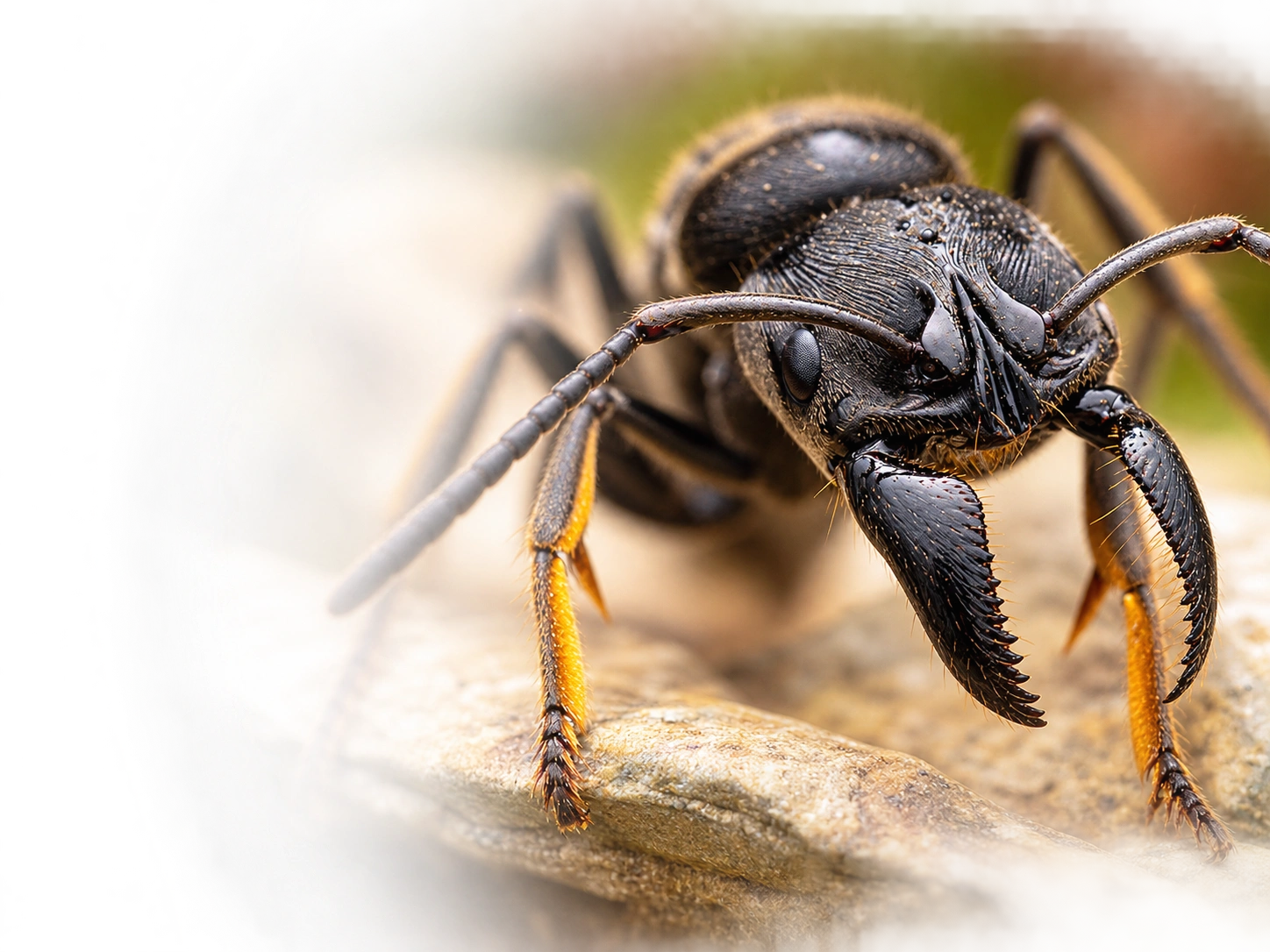
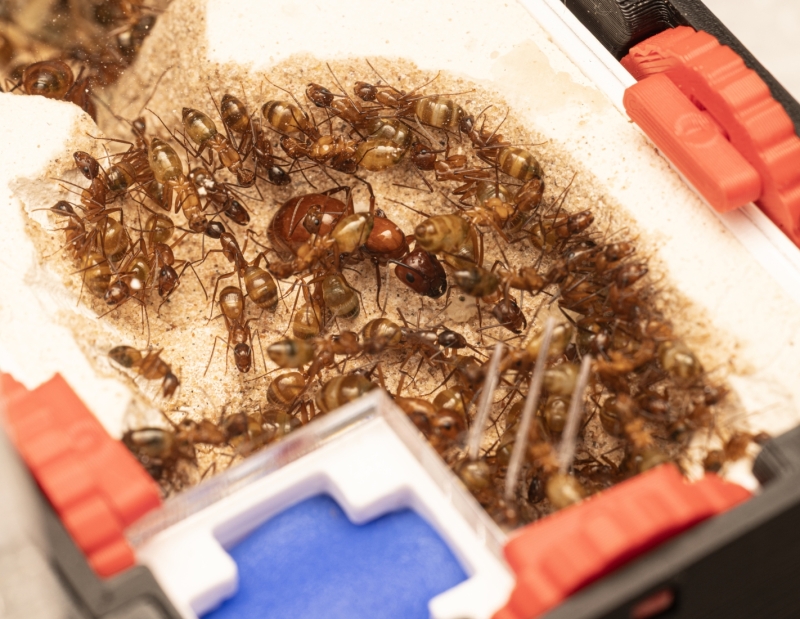
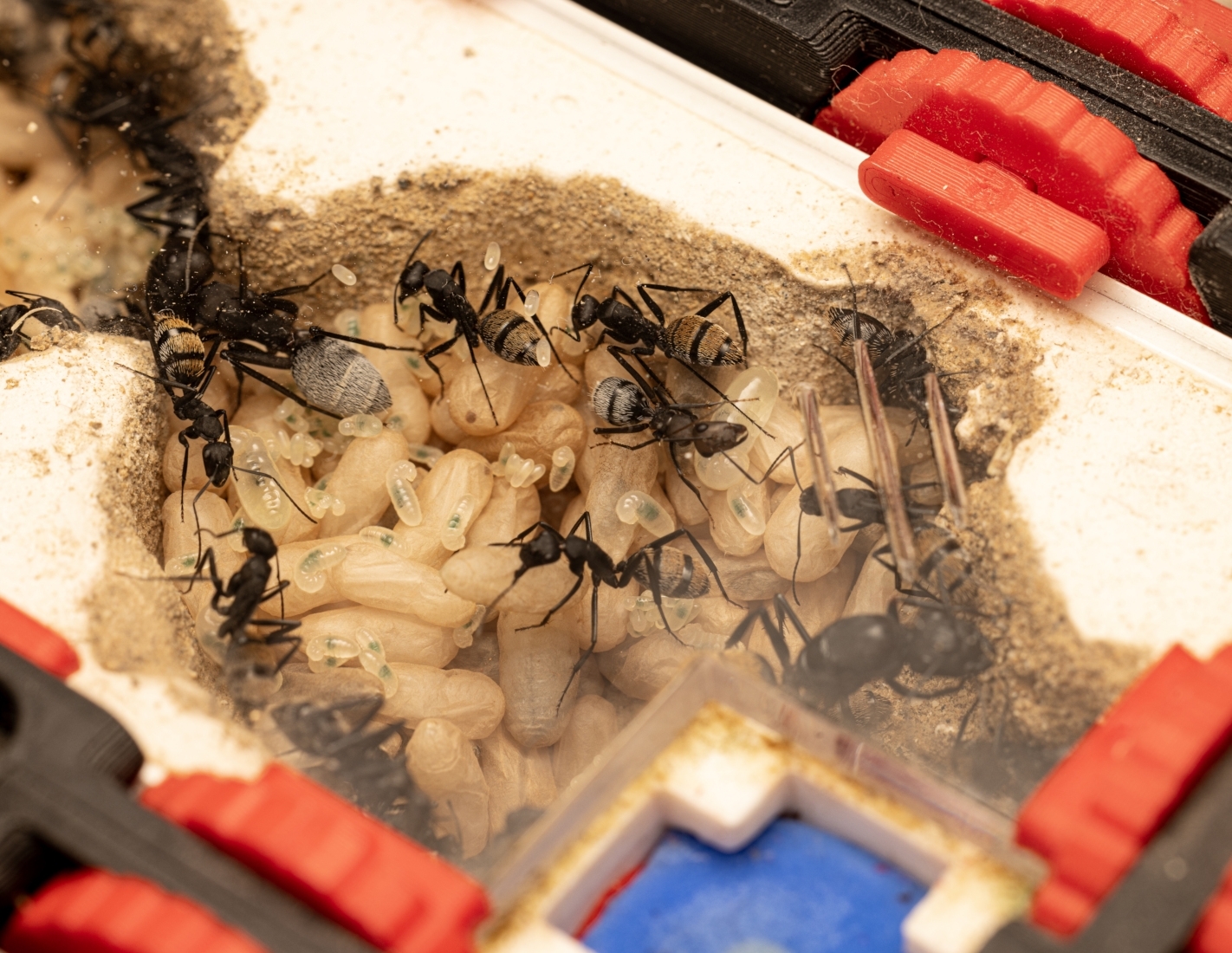
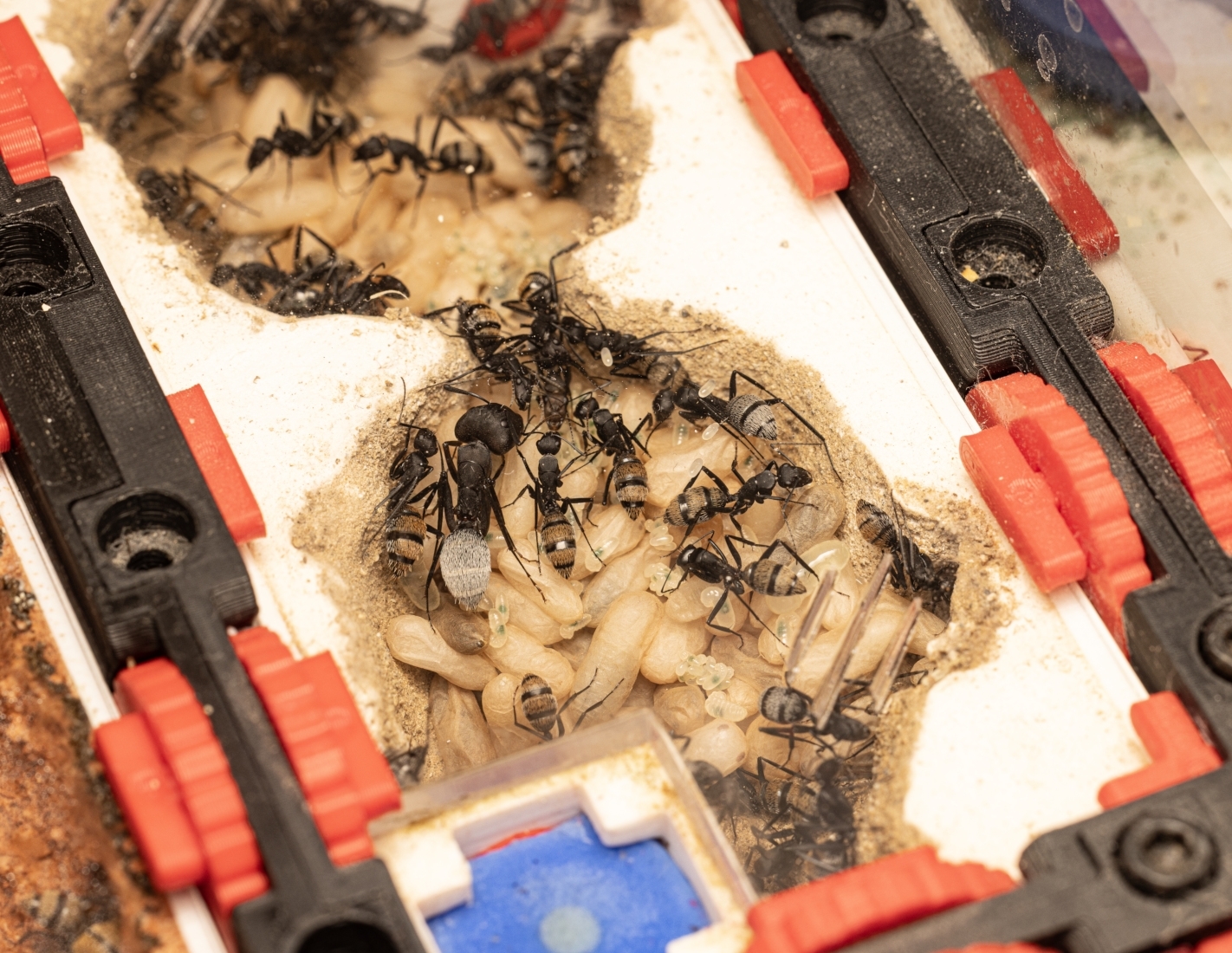
It is a large, robust Camponotus with a usually black cuticle (with a reddish-brown head in the Skeleton Coast populations) and a gaster covered in thick, dense, conspicuous setae that are yellow, tawny or golden; sometimes the coat is interrupted by three small hairless median areas. Shops describe the hair as golden yellow or silvery yellow and speak of "golden" and "silver" variants. In the Antomas line the body is black and the dense hair on the gaster ranges from orange-gold to silver: silvery and straw-coloured bands predominate in the colony, the queen has a silvery-grey gaster and the odd major worker shows a reddish-brown head. Polymorphism is marked: minor workers have narrow heads, and majors have broad heads and large mandibles with 8 teeth. In the major worker the pronotal humerus is obtuse, one of the characters that separate it from C. storeatus, which has an acute humerus and a reddish cuticle. The pronotum and the gaster are what identify it; head characters are not enough.
Approximate measurements
- Queen: ≈17–18 mm
- Minor workers: ≈9–10 mm
- Media workers: ≈11–14 mm
- Major workers: ≈15–19 mm
- Males: ≈10–12 mm
These figures come from popular sources (a South African field guide, repeated by shops) and have not been confirmed in the primary literature. The only published scientific measurement comes from a single major worker of the savanna form: head width 2.9 mm, head length 3.1 mm and eye length 0.94 mm. The same paper gives a length of 6–16 mm for the species of the subgenus as a whole, so the 19 mm figure should be taken as a doubtful maximum.
Care in captivity
Difficulty: 2/5 – Easy
It is an easy ant. It eats everything, adapts to formicaria made of different materials, is not demanding about escape barriers, and its size makes it easy to observe and to tend with tweezers. The species' reversed cycle is no longer an issue: this colony is adapted to our calendar.
Why it is worth it. It is one of the most eye-catching Camponotus in the hobby: impressive black-bodied majors, a gaster of dense hair that shines in the light, from the species' famous golden mane to the silvery tones common in our line, and diurnal, individual, highly visible foraging. It is also a scarce species on the European market.
Recommended parameters
- Nest temperature: 24–28 °C during the active season.
- Hot spot: 30–32 °C at one end of the outworld (heat mat or lamp), so that the colony can choose. Keepers who have kept it mention 30–34 °C in the warmest area.
- Nest humidity: dry. Only at the beginning (founding or a young colony) is the nest moistened or the humidity modules and tubes left connected; they are removed later.
- Outworld: dry, with a sandy substrate and good ventilation.
- Water: a drinker always available in the outworld.
- Light: it is diurnal; a normal light–dark cycle.
- Rest period: in our winter, about 8–10 weeks with a moderate drop in temperature (as a guide, 15–18 °C), with water and a little sugar available; the colony is already adapted to our cycle.
Humidity: a dry nest. As with most Camponotus, at the beginning (during founding or when setting up a young colony) the nest is usually moistened, or at least the humidity modules and tubes are left connected, but they are always removed later. Camponotus like a dry nest, and this species from arid regions, which nests under stones, even more so: keepers with published experience also keep it in dry nests, and one of them states that his colony, in completely dry Ytong, "is doing great". Water goes only in the drinkers in the outworld. Sugary liquids hydrate them too: most of their content is water, so they and the drinker are all they need. Some shop care sheets give 50–60 % humidity in the nest, but at Antomas we recommend a dry nest.
Set-up and recommended formicaria
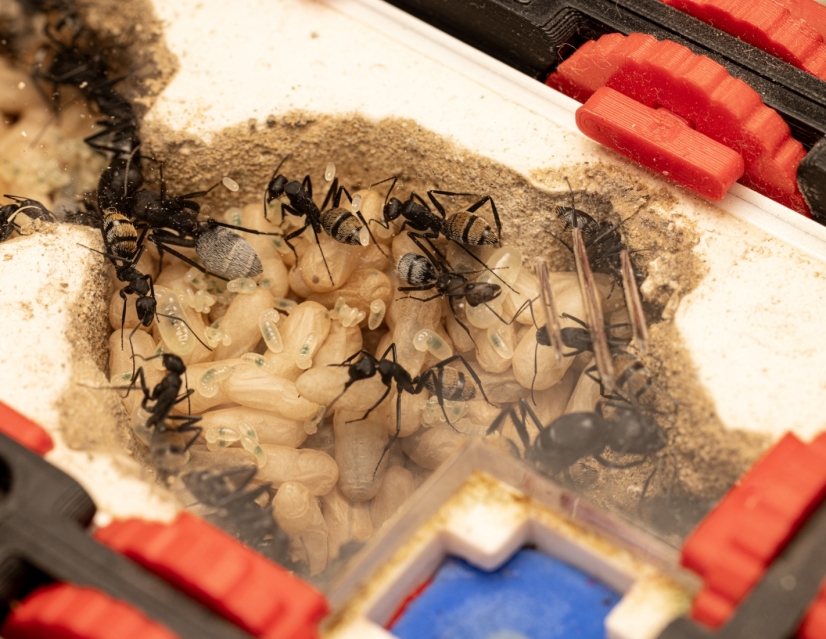
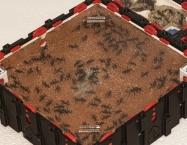
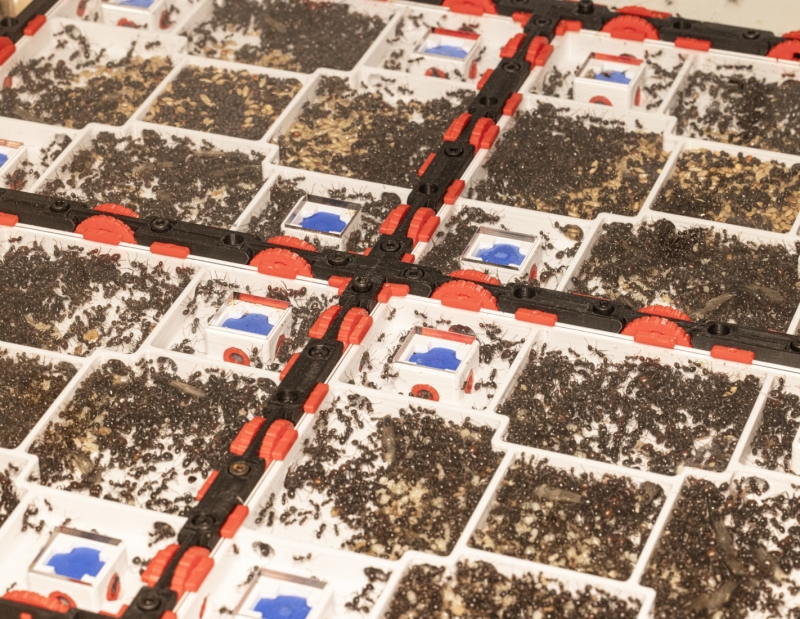
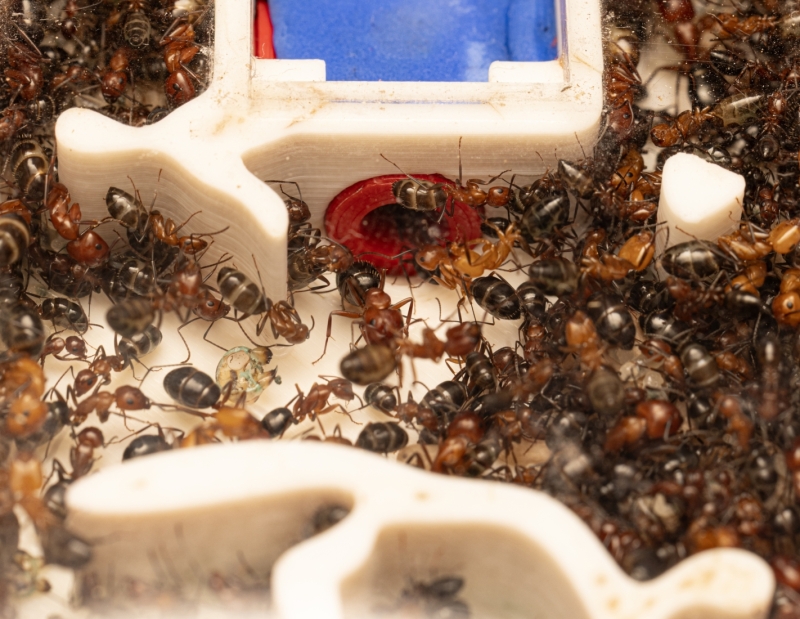
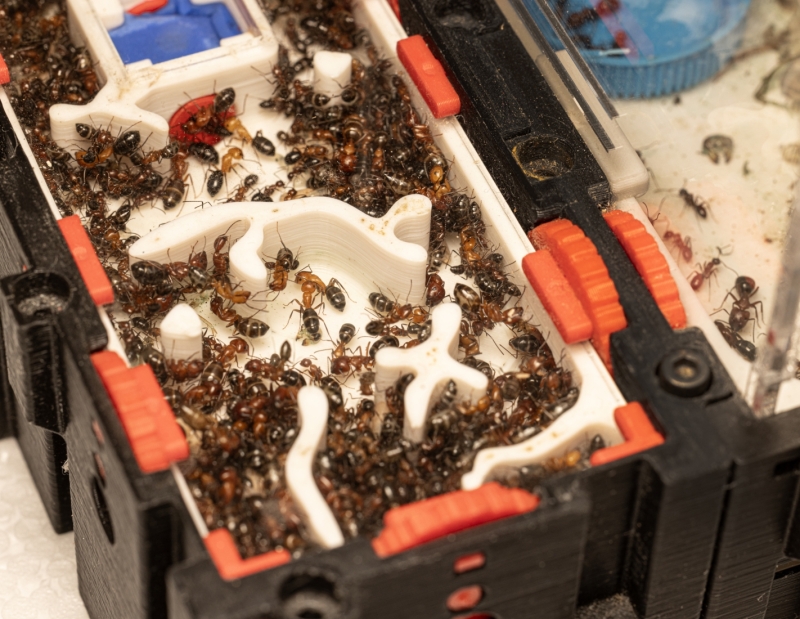
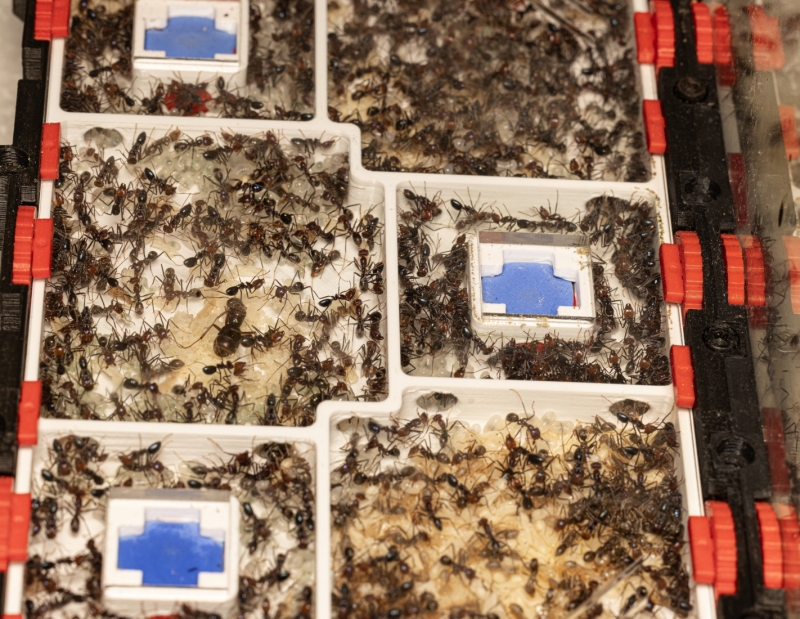
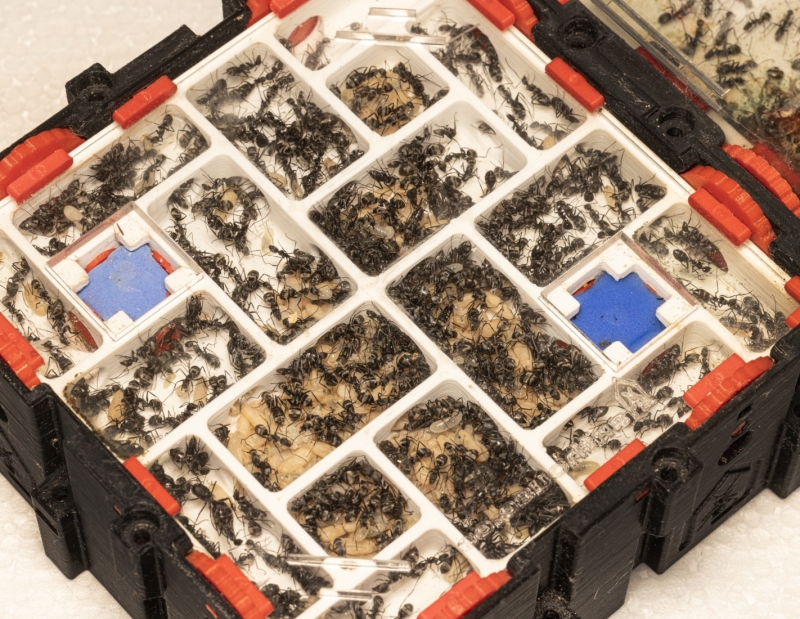
This is a large colony: choose roomy galleries and plan for expansions. At Antomas we recommend the Qbik Wild Duo P 2C and Anthouse's modular formicaria from the Qbik Alpha range, with large or cave-type galleries (always these, never the small ones), and the Qbik Wild range. Later on, add more modules as the colony fills the space.
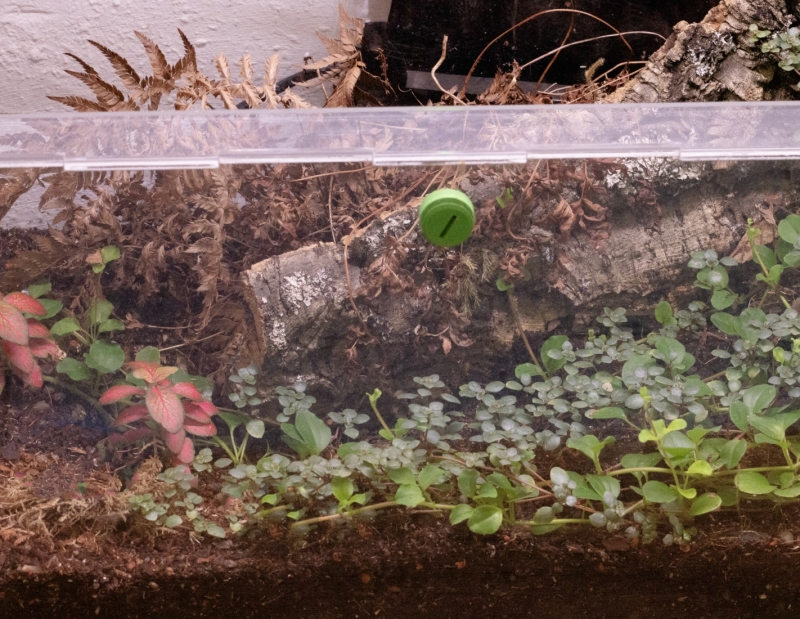
The outworld should be spacious, with a sandy substrate, flat stones and a branch or root to climb (in the wild they climb shrubs for honeydew). Put the heat at one end, away from the drinker.
See also the species page: Camponotus fulvopilosus
Feeding
A varied diet, always. In the wild it lives mainly on honeydew and supplements it with insects, so sugars are the foundation.
Carbohydrates. Anthouse Blue Sugar nectar 4–5 times a week, and another nectar or sugary liquid 1–2 times a week, to vary the sugars. Protein can also be added to the nectar.
Protein. Safe feeder insects: flies, crickets, small cockroaches (Blatta lateralis), chopped mealworms, feeder caterpillars and, for small colonies, Drosophila. Change the type of insect from one week to the next so that they do not always eat the same thing. For young colonies, chopped or freshly killed prey is best; for large colonies, small live prey as well. Adjust the amount to the brood and remove leftovers within 24–48 h.
Clean water always available, in addition to the nectar.
Behaviour in captivity
It is a diurnal, very visible ant: with light and warmth, minor and media workers patrol the outworld one by one, explore every corner and climb branches and stones. The majors tend to stay in the nest and appear as soon as there is a disturbance. It defends the nest resolutely against intruders. One keeper with years of experience describes it as fast-growing, although this is an isolated opinion.
Escapes and barriers
This is not a difficult species in this respect: in Antomas' experience practically any anti-escape system works (PTFE or Fluon, paraffin oil, talc), always with a well-fitting lid.
Handling and safety
It does not sting, but the majors bite hard and all workers can spray formic acid, which stings sensitive skin. Use tweezers and do not handle them with bare hands. Do not keep it next to other ant species. It is an exotic species: under no circumstances should it be released.
What not to do
- Keep the nest moist.
- Leave it without a drinker in the outworld.
- Skimp on heat during the active season.
- Use small Alpha galleries: always the large or cave-type ones.
- Always feed the same insect or the same sugar.
- Put different queens or colonies together, or keep it with other species.
- Handle it with bare hands.
Scientific sources
This care sheet was compiled from the scientific literature on the species and its group, and from the experience of Antomas and other keepers. Main references:
- Robertson, H.G. & Zachariades, C. (1997). Revision of the Camponotus fulvopilosus (De Geer) species-group (Hymenoptera: Formicidae). African Entomology 5(1): 1–18.
- Yilmaz, A., Gagnon, Y., Byrne, M.J., Foster, J.J., Baird, E. & Dacke, M. (2022). The balbyter ant Camponotus fulvopilosus combines several navigational strategies to support homing when foraging in the close vicinity of its nest. Frontiers in Integrative Neuroscience 16: 914246. doi:10.3389/fnint.2022.914246
- Lamb, T. (2018). A fatal agonistic interaction between ant and darkling beetle (Coleoptera: Tenebrionidae: Pimeliinae: Adesmiini) in the northern Namib Desert. The Coleopterists Bulletin 72(2): 314–316. doi:10.1649/0010-065X-72.2.314
- Marsh, A.C. (1986). Checklist, biological notes and distribution of ants in the central Namib Desert. Madoqua 14: 333–344. doi:10.5281/zenodo.25901
- Curtis, B.A. (1985). Activity of the Namib Desert dune ant, Camponotus detritus. South African Journal of Zoology 20(2): 41–48. doi:10.1080/02541858.1985.11447912
- Curtis, B.A. (1985). Nests of the Namib Desert dune ant Camponotus detritus Emery. Insectes Sociaux 32(3): 313–320. doi:10.1007/BF02224920
- Curtis, B.A. (1983). Behavioural and physiological ecology of the Namib Desert dune ant, Camponotus detritus Emery. MSc thesis, University of Cape Town. open.uct.ac.za
- Shi, N.N., Tsai, C.-C., Camino, F., Bernard, G.D., Yu, N. & Wehner, R. (2015). Keeping cool: enhanced optical reflection and radiative heat dissipation in Saharan silver ants. Science 349(6245): 298–301. doi:10.1126/science.aab3564
- Willot, Q., Simonis, P., Vigneron, J.-P. & Aron, S. (2016). Total internal reflection accounts for the bright color of the Saharan silver ant. PLoS ONE 11(4): e0152325. doi:10.1371/journal.pone.0152325