This website uses its own and third-party cookies to improve our services and show you advertising related to your preferences by analyzing your browsing habits. To give your consent to its use, press the Accept button.
Cookie preferences
| Cookie | Provider | Purpose | Expiry |
|---|---|---|---|
| PHP_SESSID | antomas.es | The PHPSESSID cookie is native to PHP and allows websites to store serialised status data. On the website it is used to establish a user session and to pass state data through a temporary cookie, which is commonly known as a session cookie. These Cookies will only remain on your computer until you close your browser. | Session |
| PrestaShop-# | antomas.es | This is a cookie used by Prestashop to store information and keep the user's session open. It stores information such as currency, language, customer ID, among other data necessary for the proper functioning of the shop. | 480 hours |
Myrmecia nigriceps
Biology
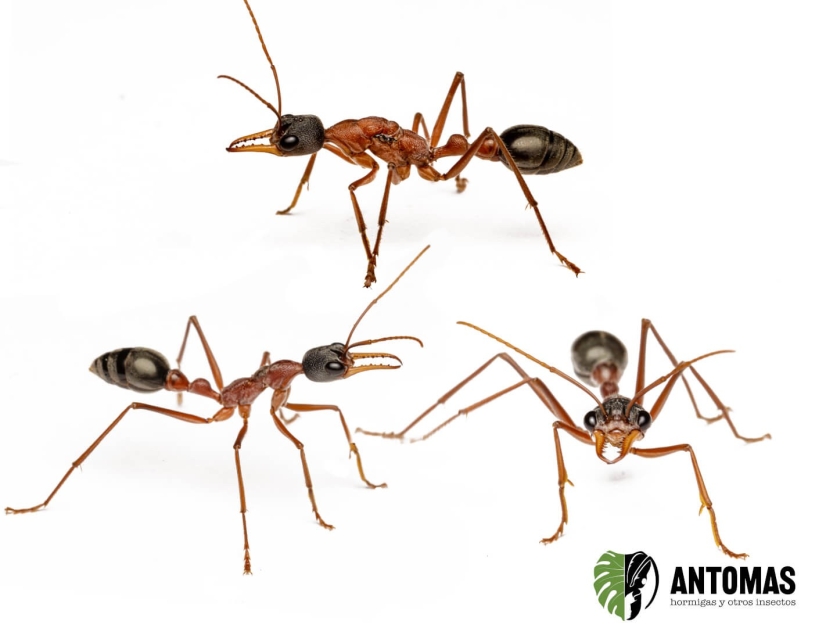
Myrmecia nigriceps is one of the most representative species of the genus Myrmecia, known for grouping some of the most primitive and behaviorally specialized ants in the world. Native to Australia, it stands out for its active nature, aggressiveness, and marked independence in hunting. Despite belonging to a generally demanding genus, it is considered one of the most accessible species for beginners, a point developed in detail in its captive care section.
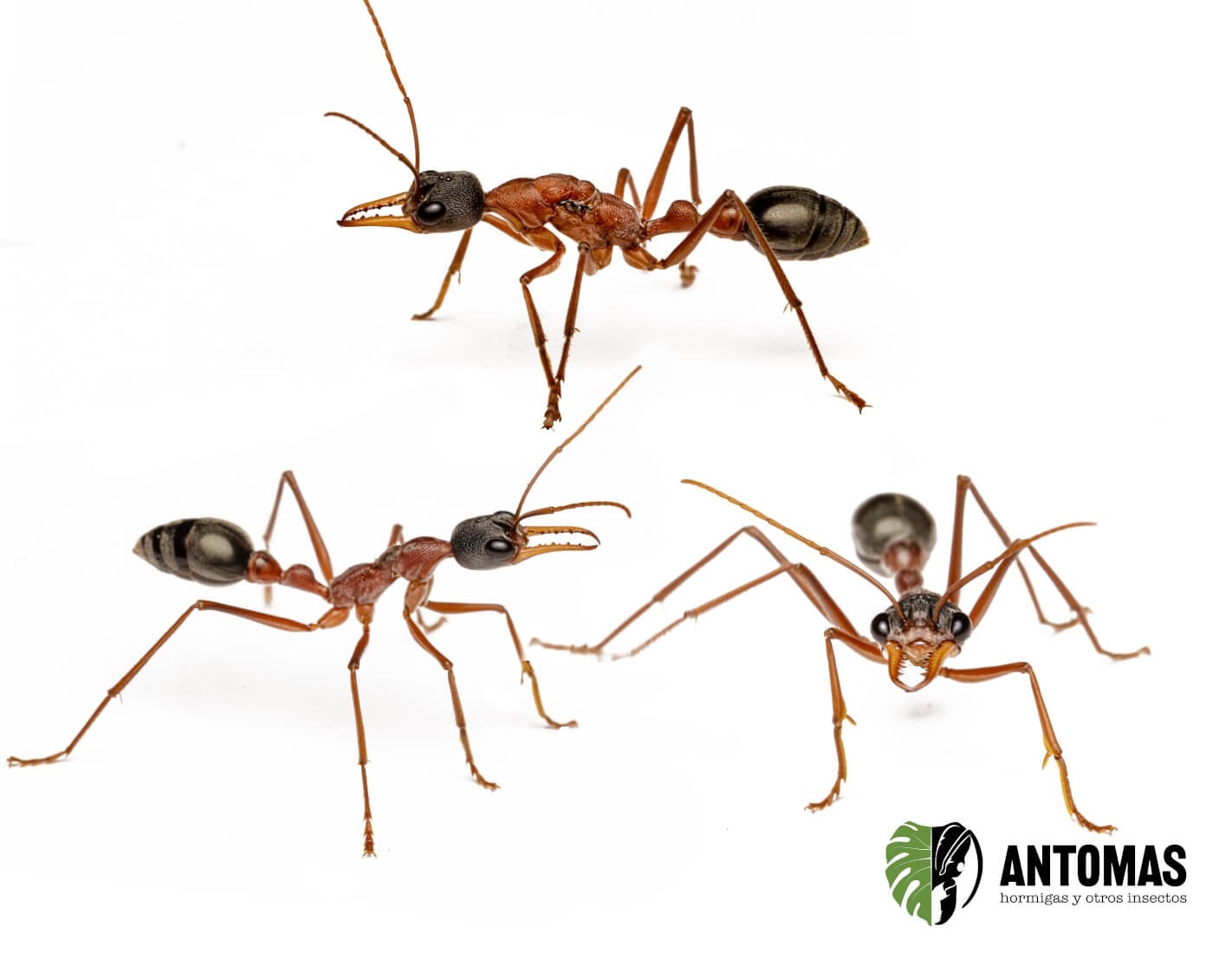
Unlike most ants, it bases much of its success on solitary hunting. Workers do not rely on massive pheromone recruitment, but instead locate and capture live prey individually, using their mandibles and stinger to immobilize them quickly and precisely. This behavior makes it resemble an individual predator more than a conventional ant.
It possesses a highly developed visual system, essential both for orientation and prey detection. Thanks to this, it is capable of exploring its surroundings with great efficiency and reacting rapidly to external stimuli, resulting in especially aggressive and territorial behavior.
It shows a markedly crepuscular activity pattern, concentrating most of its foraging activity during dawn and dusk. This pattern allows it to avoid the most extreme daytime temperatures and to take advantage of more favorable light conditions for its hunting strategy. During the central hours of the day, especially in warm environments, its activity decreases considerably.
Internally, it displays very interesting trophic behaviors. Workers use the neck of the larvae to regurgitate sugary liquids, thus allowing the queen and other workers remaining inside the nest to feed indirectly. In addition, it is common to observe the laying of trophic eggs by workers, intended for larval feeding, especially during their early instars.
It is a nervous and reactive species. Workers respond rapidly to vibrations or disturbances, adopting alert postures and showing a clear predisposition to attack. Its stinger is fully functional and constitutes one of its main defense mechanisms.
Colonies are relatively small, generally composed of a few hundred individuals. This reduced size is directly related to its lifestyle strategy, based on individual hunting and a lower dependence on the massive cooperation characteristic of more populous species.
Size and Morphology
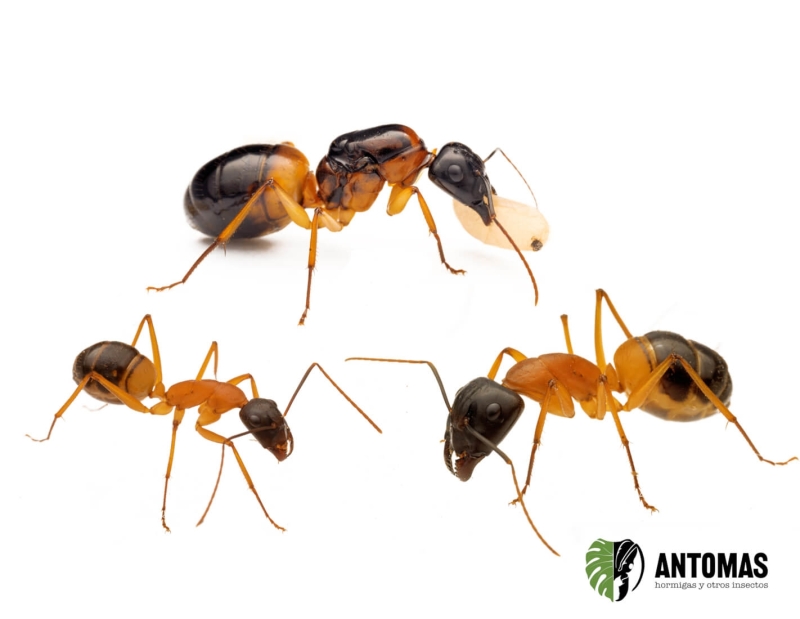
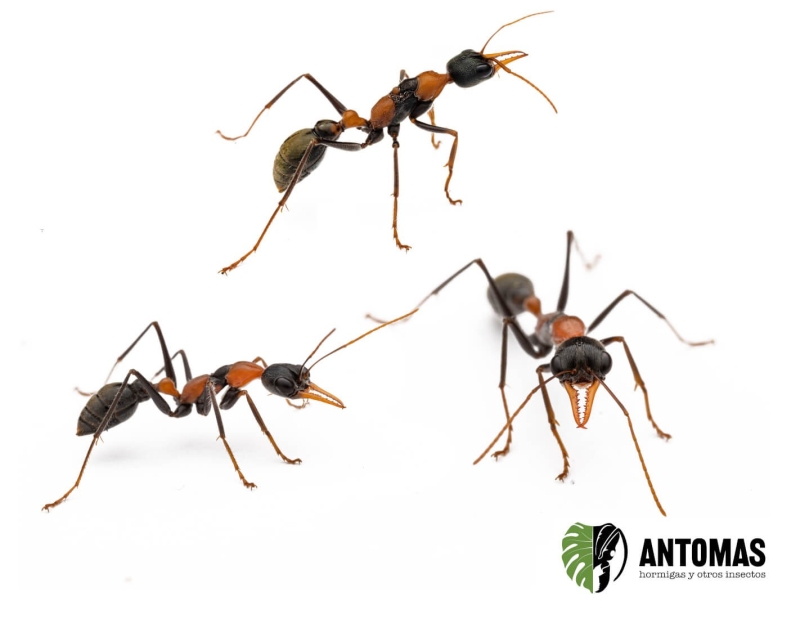
Myrmecia nigriceps is a large ant species, with a slender yet robust morphology adapted to active hunting.
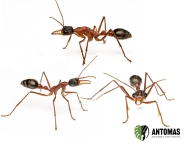
It displays a very characteristic contrasting coloration, with an intensely black head — the trait that gives the species its name — and the rest of the body in brown or orange tones. The legs are long and slender, providing great agility and speed of movement.
The eyes are large and prominent, clearly visible and reflecting its strong dependence on vision. The mandibles are elongated and powerful, designed to firmly grasp live prey.
Approximate measurements
- Workers: 1.5–2.7 cm
- Queen: 2.4–3 cm
Captive Care
It requires relatively stable temperatures, typical of its natural Australian habitat:
- Temperature: 24–27 °C
- Humidity: 50–70 %
- Nests: use of natural materials, with a suitable substrate mix (coconut fiber, fine sand, clay, etc.) and large chambers that allow proper cocoon spinning and the creation of humidity gradients
It may undergo a mild wintering period between June and August, with temperatures ranging between 10 and 20 °C, during which larval development slows significantly. However, in Europe it commonly adapts to the Northern Hemisphere climatic cycle, carrying out this mild diapause between December and February, while maintaining some activity and the presence of larvae in the nest.
It is important that the temperature does not exceed 28 °C, as higher values may negatively affect proper larval cocoon spinning.
A well-defined humidity gradient is required, essential for the correct development of each stage:
- Eggs: require high humidity to prevent desiccation
- Larvae: require medium-high humidity to develop and spin properly
- Pupae: must be placed in drier areas; excessive humidity may prevent proper transpiration, causing metamorphosis failures and pupal death
It is a very agile species, with excellent climbing ability and highly developed vision, making it an especially fast and difficult ant to handle. For this reason, manipulation is recommended exclusively with entomological tools, avoiding direct contact with the hands under any circumstances.
Despite all this, Myrmecia nigriceps is considered one of the easiest species of the genus to keep in captivity, making it an ideal option for beginners interested in this fascinating group. In fact, it is one of the species most commonly chosen by keepers wishing to enter the world of Myrmecia, as it tolerates a somewhat wider temperature range and displays more active behavior. Its queens and workers are usually more “lively” and care better for the brood, greatly facilitating the cocoon-spinning process and reducing the common problems seen in other species of the genus.