This website uses its own and third-party cookies to improve our services and show you advertising related to your preferences by analyzing your browsing habits. To give your consent to its use, press the Accept button.
Functional cookies are strictly necessary to provide the services of the shop, as well as for its proper functioning, so it is not possible to refuse their use. They allow the user to browse through our website and use the different options or services that exist on it.
Cookie
Provider
Purpose
Expiry
PHP_SESSID
antomas.es
The PHPSESSID cookie is native to PHP and allows websites to store serialised status data. On the website it is used to establish a user session and to pass state data through a temporary cookie, which is commonly known as a session cookie. These Cookies will only remain on your computer until you close your browser.
Session
PrestaShop-#
antomas.es
This is a cookie used by Prestashop to store information and keep the user's session open. It stores information such as currency, language, customer ID, among other data necessary for the proper functioning of the shop.
These are cookies that collect information about the advertisements shown to users of the website. They can be anonymous, if they only collect information about the advertising spaces shown without identifying the user, or personalised, if they collect personal information about the user of the shop by a third party, for the personalisation of these advertising spaces.
Collect information about the user's browsing experience in the shop, usually anonymously, although sometimes they also allow the user to be uniquely and unequivocally identified in order to obtain reports on the user's interests in the products or services offered by the shop.
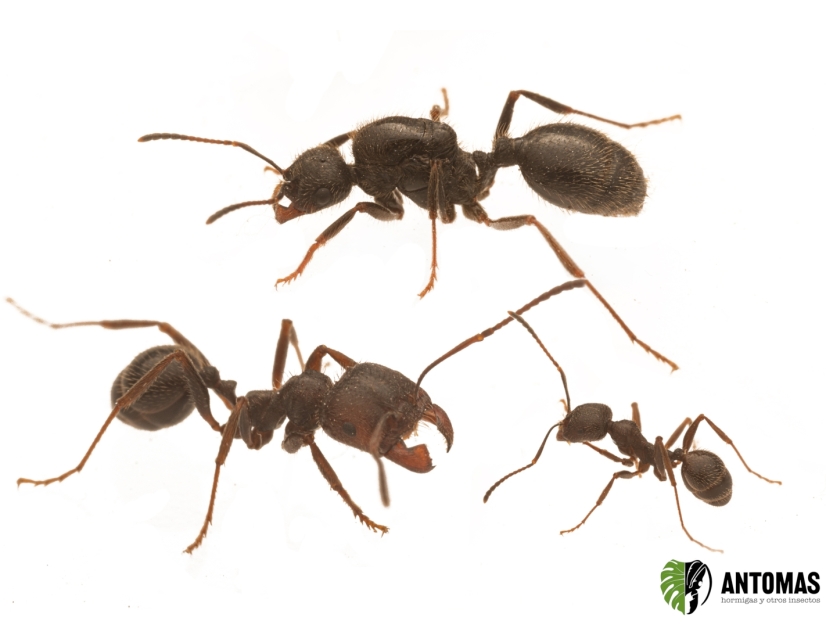
One mother, two species. Messor ibericus is the star of one of the most astonishing discoveries in recent biology, published in Nature in 2025: all its workers are hybrids with another species, Messor structor, and its queens give birth to cloned males of that species from the sperm they store, even in Sicily, more than 1,000 km from the nearest structor. Behind this science-fiction genetics lies a matt brown harvester that fills its granary with seeds, raises majors that mill the grain and is as easy to keep as they come: ideal for beginners. Highly polygynous, with queens that are not very long-lived, which is why we offer it with several. Colonies with one, two or three queens. Shipping across Europe, live arrival guaranteed.
The harvester ant that clones another species: all its workers are hybrids and its queens give birth to males of Messor structor, as revealed in Nature in 2025. Colonies with one, two or three queens, because in our experience it is highly polygynous. Alpha-range Qbik (it gnaws plaster), a dry granary kept apart from the humid area, varied seeds, plenty of protein and diapause from November to March below about 20 °C.
Messor ibericus Santschi, 1925, looks at first glance like just another Messor: matt brown workers filing back to the nest with a seed between their mandibles, an underground granary and robust-headed majors that crack the grain. It lives in southern and central Europe, from the Iberian Peninsula to the Balkans, and for almost a century it was mistaken for its relative M. structor. In 2025 it became one of the most famous ants on the planet.
That year, Jonathan Romiguier’s team at the University of Montpellier published a finding in Nature that the journal itself described as “almost unimaginable”: M. ibericus queens give birth to individuals of another species. All their workers are hybrids with Messor structor and, so as never to run out of that species’ sperm, the queen produces clones of M. structor males from the sperm she has stored since her nuptial flight. The authors named the phenomenon xenoparity, from the Greek xénos, “foreigner”, and the Latin parere, “to give birth”: giving birth to a stranger. It is the first known case of an animal that needs, as a normal part of its life, to bring another species into the world.
And behind this oddity lies a rewarding, easy ant, one of the best to start with. A tip from our experience: it is highly polygynous, which is why at Antomas we offer it with one, two or three queens.
Anthouse’s general video on the genus Messor: granaries, brood and battles in a great harvester empire (in Spanish).
Biology
“One mother, two species”: the first xenoparous ant
The title of the Nature paper sums it up in a few words: “One mother for two species”. In an M. ibericus nest, the same queen lays the eggs of four kinds of offspring, and two of them do not belong to her species:
Ibericus queens: hatch from eggs fertilised with sperm from ibericus males.
Ibericus males: hatch from unfertilised eggs, as in any ant. They are hairy.
Hybrid workers: hatch from eggs fertilised with M. structor sperm. They carry half their genetic make-up from each species.
Structor males: clones that carry only their father’s nuclear DNA, with nothing of their mother’s nuclear genome, though with her mitochondria. They are almost hairless.
In other words, an M. ibericus queen is the mother of her own species and, at the same time, of another. From her, the structor males keep only the mitochondria, the cell’s tiny power plants, which are always inherited through the egg. They are half-brothers through their mother, yet belong to species separated by more than 5 million years of evolution, which are not even sister species.
“La Xenoparidad”, by Anthouse: the queen that clones males of another species (in Spanish).
Workers that only exist thanks to another species
It all starts with the workers. An M. ibericus queen cannot produce workers with sperm from her own species: ibericus × ibericus eggs develop into queens, and workers only come from eggs fertilised with M. structor sperm. Romiguier’s team analysed 164 workers with a method for detecting first-generation hybrids from a single genome, developed in their own laboratory, and every one of them was a hybrid. Their heterozygosity, a measure of how much the two copies of each gene differ, averaged 0.797, against 0.047 in queens, and their genome was 49% ibericus and 51% structor.
This arrangement, in which caste depends on the father, is called social hybridogenesis. According to the authors, it began as sperm parasitism that became obligatory: the queen lost the ability to produce workers on her own, perhaps through incompatibilities between genes or through “selfish” genotypes that push pure-bred larvae to become queens. Without structor sperm there are no workers, and without workers there is no colony. That is why every young queen mates with males of both species: the spermatheca of two queens, the organ in which they store sperm for life, contained sperm from both ibericus and structor.
Sicily, more than 1,000 km from the nearest father
So far, the story was strange but logical. The mystery lay in the map: M. ibericus and M. structorbarely share a range. Structor is more continental, from central and eastern Europe, whereas ibericus mainly occupies the Mediterranean arc. Even so, there were hybrid workers in 69 Mediterranean populations without a single structor colony, and in Sicily they turned up more than 1,000 km from the nearest M. structor.
How can a queen have daughters by a father whose species does not live within hundreds of kilometres? Because that father had been born in an ibericus nest:
The queen keeps structor sperm in her spermatheca from her nuptial flight.
With part of that sperm she fertilises the eggs of the hybrid workers.
Every now and then she lays eggs whose nucleus carries only the DNA from that sperm, without her own nuclear genome. This is a form of androgenesis, and those eggs hatch into clonal structor males.
These males mate with young ibericus queens and leave them the structor sperm they will need to have workers.
Thus, generation after generation, M. ibericus carries its own structor lineage with it and can live far from any colony of that species. The cellular mechanism by which the maternal nucleus disappears from the egg is still unknown: it is one of the big questions the study leaves open.
Clones with borrowed mitochondria: how it was proved
Such an extraordinary claim needed evidence to match, and the paper’s 18 authors built it up over years:
A huge sample. Almost 400 samples from 125 European populations of the five species of the former “M. structor”, 65 ibericus colonies in the laboratory and a high-quality reference genome of the species.
Two kinds of males. Of 132 males from 26 colonies, 44% were hairy and 56% almost hairless, and in the genetic tree the hairless ones grouped with M. structor.
The mother’s signature. All 24 hairless males analysed carried ibericus mitochondria, a combination that did not appear in any of the 53 structor from colonies of their own species.
Caught in the egg. 11.5% of 286 eggs and larvae from five colonies carried only structor nuclear DNA, and 9% of the eggs laid in 24 hours by 16 isolated queens. None turned up in eggs laid by workers: the clones are laid by the queen.
Direct observation. In a laboratory colony with a single, pure ibericus queen, males of both species were born within 18 months.
Who is the father? Of 164 workers, 144 were daughters of clonal males and only 20 of wild structor, which only happens where the two species live side by side, as in eastern France: this is the ancestral state of the system.
The footprint of cloning. Clonal males have about five times less genetic diversity than wild structor and accumulate slightly harmful mutations, typical of a lineage that copies itself without recombining.
A domesticated species? The two-species superorganism
So what is the structor that lives inside ibericus colonies? The authors do not regard it as a new species, because it barely differs genetically from wild structor. Instead, they speak of a “domestication-like” relationship: M. ibericus maintains and multiplies a clonal lineage of another species for its own benefit. They compare it with mitochondria and chloroplasts, free-living bacteria that ended up built into cells, and with lichens, in which a fungus and an alga form a single organism. An M. ibericus colony would be, in their words, a two-species superorganism.
Until now, only occasional and dispensable cloning of another species was known, in the Saharan cypress, Cupressus dupreziana, and in freshwater clams of the genus Corbicula. In ants there was androgenesis within a single species, in Wasmannia auropunctata, Vollenhovia emeryi and Cardiocondyla kagutsuchi. What is new in M. ibericus is that it clones another species and cannot live without doing so.
What the press got wrong
The discovery went round the world, and much of the Spanish press presented it as the “Spanish ant” that was conquering Europe. An American expert who was not involved in the study admitted he found it almost impossible to believe. With so many headlines, a few mistakes crept in:
It is not a subspecies. It has been a full species since 2018 (see “The Iberian ‘structor’”).
The queens do mate. The clones do not come from reproduction “without a partner”, but from the sperm the queen stores after mating with males of both species.
It is not “domesticating Europe”. What it domesticates is a clonal structor lineage inside its own nests.
A family of strange genetics
Social hybridogenesis has arisen independently at least three times in Messor, according to a 2017 study of nine species. The closest case is Messor barbarus, with one key difference: its workers are hybrids between two hidden lineages of its own species, whereas those of ibericus are hybrids with another species, whose males the queen produces herself.
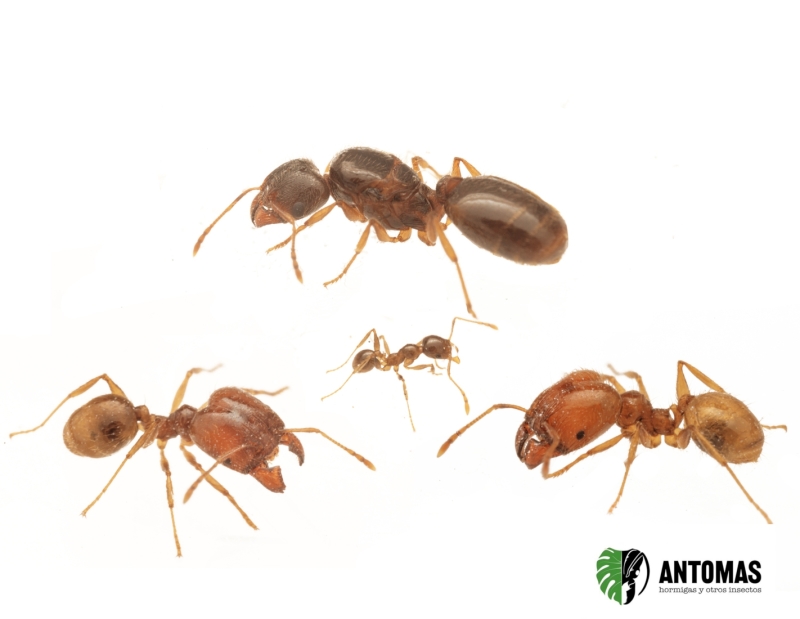
Outside the genus, the classic example is the North American harvester ants of the genus Pogonomyrmex, in which genetic caste determination of hybrid origin was described in 2003. If these mixed-genetics ants appeal to you, at Antomas we also have Pogonomyrmex rugosus hybrid. The theory of sperm parasitism, put forward in 2006, explains why a queen may benefit from mating with males of another species: that is how she gets workers. And in Anoplolepis gracilipes it was discovered in 2023 that the males are chimeras, with cells from two genetic lineages in the same body.
The Iberian “structor”: almost a century under a borrowed name
If xenoparity took so long to discover, it was partly because the species itself was hidden. For decades, a brown harvester ant found across half of Europe was called Messor structor, until in 2018 a team from the University of Innsbruck, combining morphology, genetics and ecological niche, showed that it was really five cryptic species. The title of the paper said it all: “Turning one into five”.
One of them already had a name. The Swiss Félix Santschi had described it in 1925 as Messor structor var. ibericus, from workers collected in the north-east of the Iberian Peninsula. That is why its author and year are Santschi, 1925; the “1931” that sometimes appears comes from the label of a type specimen. The five species of the complex are these:
M. ibericus: the southern European one (see “Where it lives”).
M. structor: the “true” one, more continental: France, Austria, Czechia, Hungary, Slovenia, Romania and Bulgaria.
M. muticus: from Romania and Ukraine to Russia, Armenia, Kazakhstan and Kyrgyzstan. It is the Caucasian one: if you read that ibericus reaches the Caucasus, it is a confusion inherited from the old “structor”.
M. ponticus: around the Black Sea, in Bulgaria, Romania, Turkey and Ukraine.
M. mcarthuri: from Greece and Turkey.
For hobbyists, the consequence is practical: much of what was written before 2018 about “Messor structor” in Spain, Italy, southern France or Germany, including many keeping journals, very probably refers to M. ibericus.
Where it lives: from the Mediterranean to the Rhine valleys
It lives in Spain, Portugal, France, Switzerland, Germany, Italy (including Sicily), Slovenia, Croatia, Romania, Bulgaria and Greece. According to the niche model by Steiner and colleagues, its most favourable areas lie along the northern arc of the Mediterranean, from north-eastern Iberia to the Balkans, and in the warm valleys of central Europe, such as those of the Rhine and the Danube. In the north of its range, as in the Rhineland, it retreats to warm, dry pockets.
It favours open, dry ground: grassland, scrub, verges, track edges and disturbed areas near villages. It nests in the soil, with granaries, and according to keepers its nests are deep and extensive, with few entrances. Its climate is seasonal: Mediterranean, with hot, dry summers and mild winters, or central European, with cold winters and frost. Either way, it works from spring to autumn and stops in winter: diapause is part of its life.
Many queens and short lives: the polygyny we see at Antomas
Here science has not yet caught up: no study has counted how many queens M. ibericus colonies have. In Montpellier they worked with single-queen colonies, and in the hobby you find everything: shops that sell it as monogynous and others that offer multi-queen colonies.
Our experience is clear: M. ibericus is highly polygynous, and several queens live together in its colonies. That is why we offer it with one, two or three, and we recommend colonies with several queens because, in our experience, the queens of this species are not very long-lived. With several, egg-laying does not depend on just one, and the colony has a much better chance of lasting.
Beware of the literature: a 1971 study described the German populations of the Rhineland, now identified as M. ibericus, as “multicolonial”. That does not mean they have many queens, but that each colony is a separate unit from its neighbours, the opposite of unicolonial populations, whose nests draw no boundaries between them. Multicoloniality is about how colonies relate to one another; polygyny, about how many queens live in each.
Flights, founding and combat queens
Every young queen needs to mate with males of both species: the ibericus males will give her princesses, and the structor males, clonal or wild, her workers. Nuptial flights are documented in the Rhineland, though without published dates, and according to keepers the founding is claustral: the queen raises her first workers sealed in, on her own reserves.
As in other Messor, mature colonies in captivity may produce combat queens: princesses that have been unable to fly and stay on working as workers, with striking aggressiveness. We cover this in depth in the care sheet for Messor barbarus.
Size and morphology
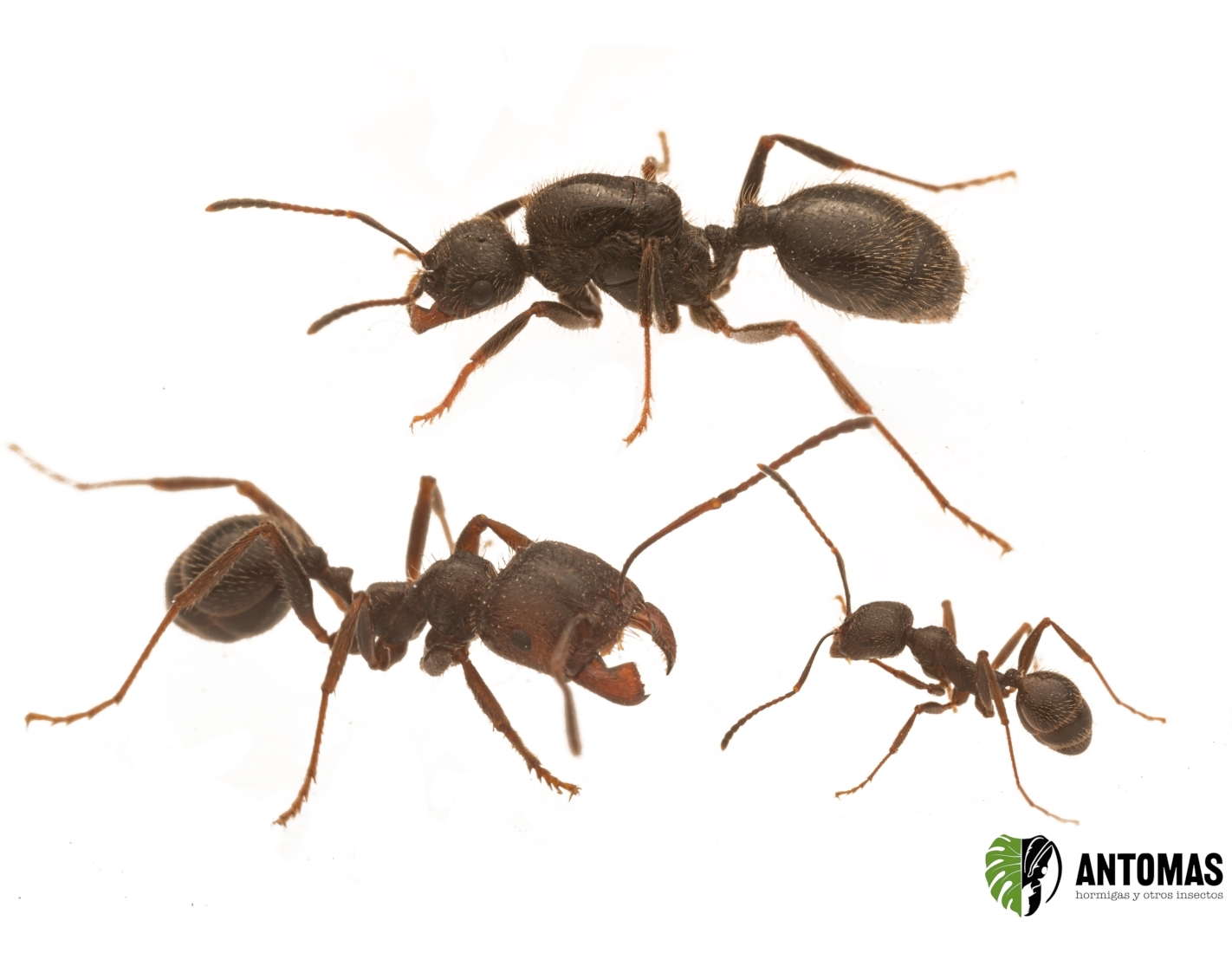
It is a medium-sized Messor, of the subfamily Myrmicinae, with polymorphic workers: minors, medias and majors, in a continuous gradation.
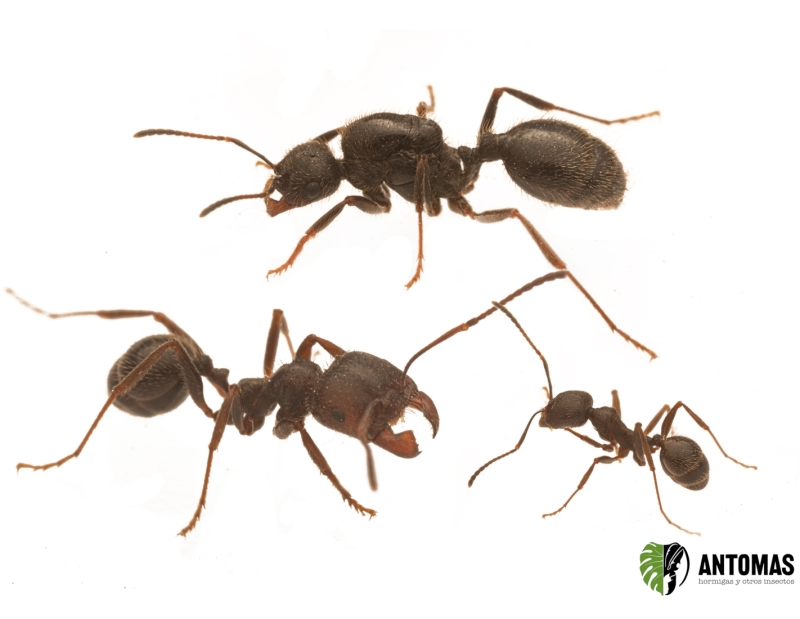
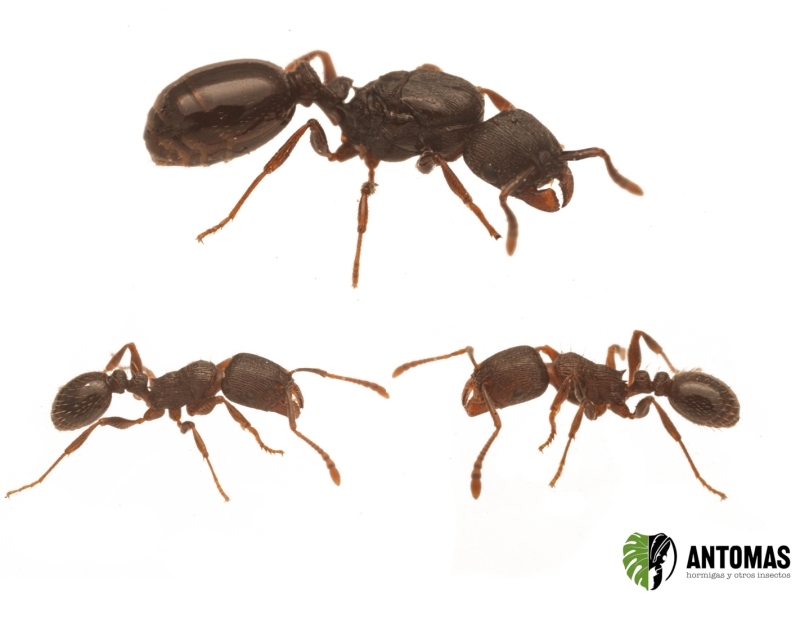
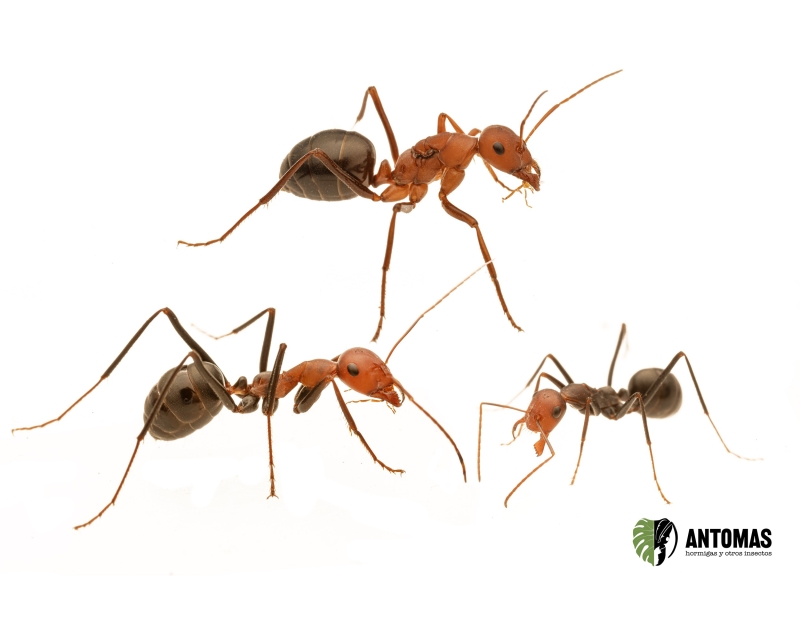
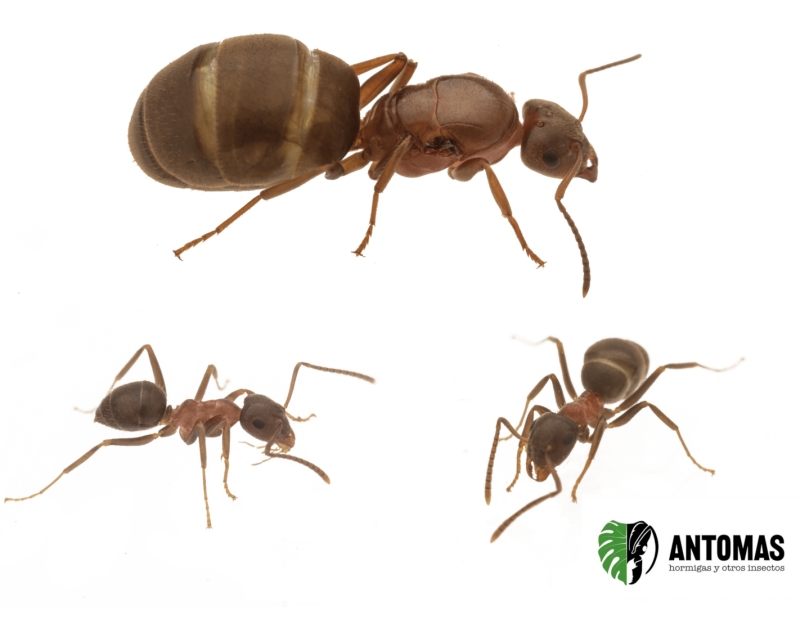
Matt and brown. This is its hallmark compared with the black, shiny Messor. According to the 2018 redescription, workers have the head and thorax light brown to reddish brown and a darker gaster, while majors and the queen are dark brown. In our colonies they look a matt blackish brown, with reddish legs and mandibles and majors with reddish-brown heads.
Hairy and sculptured. Fine ridges run across almost the whole head, with many erect hairs on the sides: this sculpture is what takes away its shine.
Majors. A robust head and powerful mandibles, though they are usually smaller than in M. ponticus or M. mcarthuri.
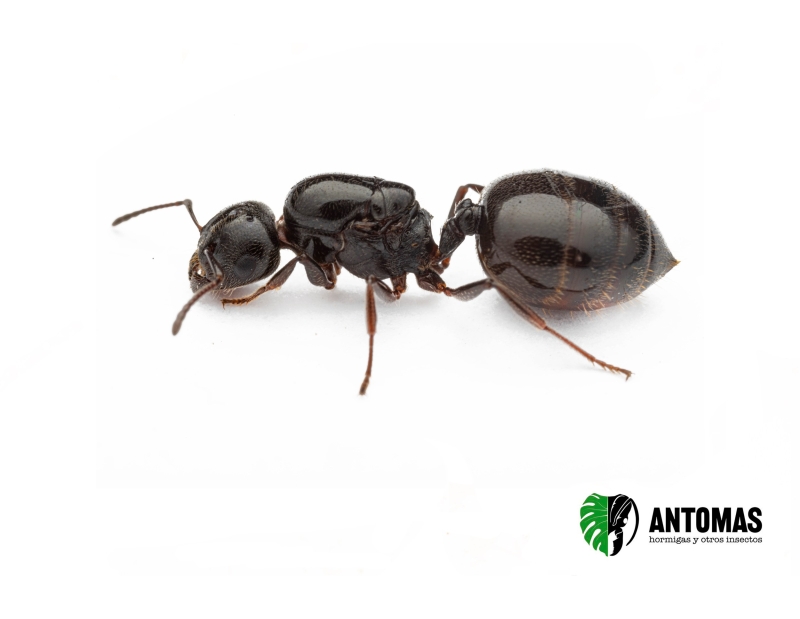
Queen. She is the smallest of the five species of the former “M. structor”, roughly the size of a major, with the sides of the thorax microreticulate and matt.
Development. As in all myrmicines, the pupae are naked, without a cocoon.
Hairy males and hairless males
In almost all ants, the males of a colony look alike. In M. ibericus two types live side by side: the hairy ones, which are ibericus, and the almost hairless ones, the clonal structor, which also differ in the shape of the thorax. In the nests studied there were roughly half of each. If your colony ever produces alates, look closely: you will be seeing xenoparity with your own eyes.
How to tell it from other Messor
From M. structor it cannot be told apart with the naked eye. Under a lens, ibericus has a short first funicular segment, the part of the antenna that follows the scape, and the base of the scape without a lobe, with a small tooth-like process; structor has that segment long and a rounded lobe. The structor queen, moreover, has the sides of the thorax smooth and shiny in the centre. For doubtful cases, the 2018 revision proposed a formula using two antennal measurements that is correct in 96.8% of cases.
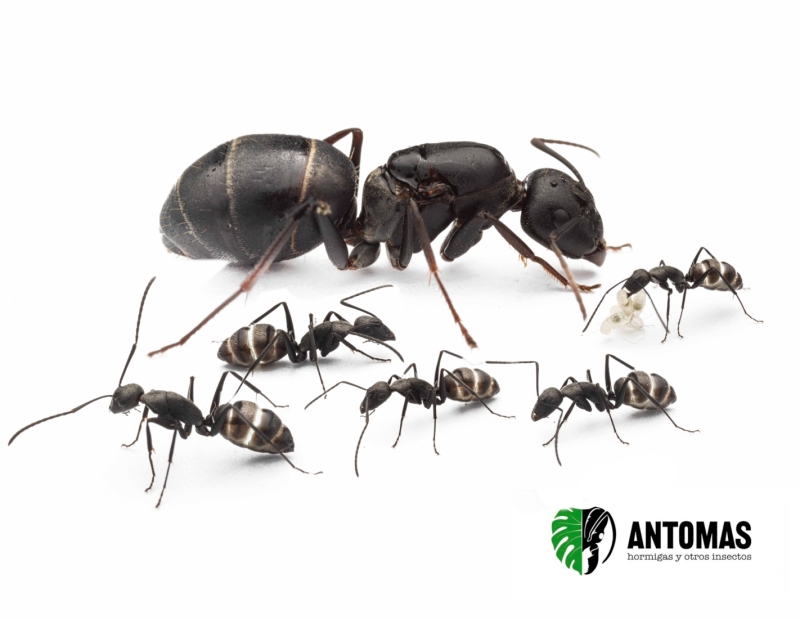
From M. barbarus it is easier: barbarus is black and shiny, with majors that usually have a red head, while ibericus is brown, matt and hairy, without that contrast. And it is also set apart from Messor capitatus by its lack of shine: capitatus is an intense, glossy black, with huge-headed majors.
Approximate measurements
The scientific literature gives no body lengths in millimetres: the 2018 revision measured the head and antennae, but did not publish sizes. What it does describe are the proportions:
Workers: medium-sized within the complex, similar to M. structor and M. muticus, with a lot of variation between minors and majors.
Majors: generally smaller than those of M. ponticus and M. mcarthuri.
Queen: the smallest of the five species, similar in size to a major.
The millimetre figures circulating online have no scientific backing, so we do not give them.
Care in captivity
Difficulty: 1/5 – Beginner
Behind its science-fiction genetics lies a very rewarding ant: it eats seeds from any larder and stores them in its granary, it does not sting, it is not an escape artist and it forgives small slip-ups. The keys are a nest it cannot gnaw, a dry granary separate from the humid area, water at all times, plenty of protein with leftovers cleared away, and diapause in winter.
And it offers something no other species can give you: every worker in your formicarium is a hybrid of two species, the daughter of a queen who carries the sperm of another species inside her and uses it, every now and then, to produce her males.
Recommended parameters
Temperature, from spring to autumn: 22–28 °C in the warmest part of the nest. For reference, the Montpellier laboratory kept its colonies at 25 °C. If you provide heat, keep it gentle and at one end, and do not let the nest go above 30 °C.
Humidity: in that laboratory, 40% relative humidity in the room. In the nest, a humid area, not waterlogged, for the brood, and a dry granary; the outworld, dry.
Water: always, in a test tube with water and cotton wool in the outworld, during diapause too.
Light: a dark nest and an outworld with the normal light of the room, without direct sun.
Diapause: from November to March, below about 20 °C.
Recommended formicaria
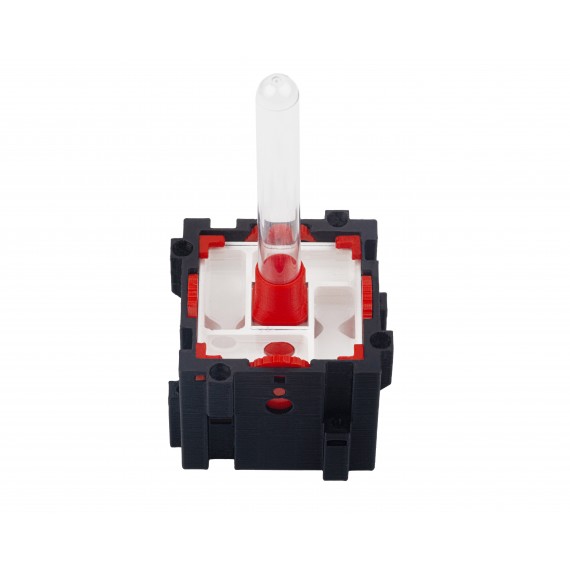
At Antomas we recommend the Alpha-range Qbiks by Anthouse, modular and made of materials a Messor cannot gnaw. To start with, a QBIK ONE with medium galleries, the right size for a colony of 50–200 workers.
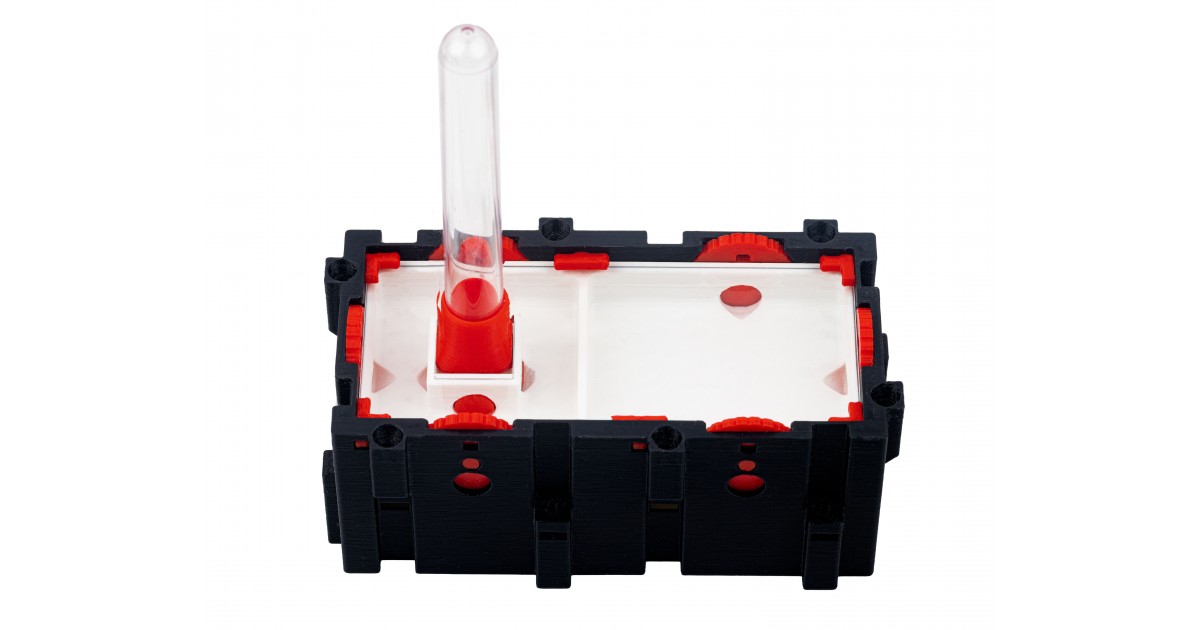
As the colony grows, expand with a QBIK DUO, always with larger galleries as soon as the majors appear, since they need wide passages to move with their loads.
No plaster, no Ytong, no soft materials. Like M. barbarus, this species gnaws: keepers report that it digs into plaster and aerated concrete, above all damp plaster, which is exactly what the brood area is made of. Hence the Alpha range rather than the plaster models.
Dry granary and humid area
This is the key detail with any Messor: excess humidity makes stored seeds sprout or go mouldy.
A humid area for the brood, without standing water.
A dry granary, away from that humidity, where they will pile up the seeds themselves.
Wide, flat-bottomed chambers, where keepers see them grind grain and make “ant bread”, the paste of chewed seeds they feed to the larvae.
No spraying water inside the nest: moisten only the intended area.
A feeder for sugar, never soaked cotton wool, which ferments and goes mouldy within a few days.
Colonies with several queens
A colony with two or three queens arrives already established and needs no special care. Just bear this in mind:
More queens, more space. According to keepers, these colonies grow faster and need expanding sooner.
More protein. Every queen needs it to lay.
Do not combine queens or colonies of different origin. A colony living happily with its own queens will not necessarily accept unknown ones: there is a risk of fighting.
If a queen dies, do not panic. That is the advantage of polygyny: the others keep laying. Remove the body if the workers have not already taken it to the midden.
Arrival and moving in
When the colony arrives, leave it somewhere quiet, at room temperature and with water. At Antomas we install it by tipping it in: the container is opened and everything (workers, queens, brood and seeds) is tipped into the new formicarium, with a few gentle taps and a soft brush for the stragglers. Do it without fear: within a few hours they will have settled in. With several queens, check that they have all gone in. Repeat the same procedure each time you expand.
Feeding
Seeds of every kind. In our experience, Messorlike practically everything. Combine canary seed, millet, amaranth, chia, grass and dandelion seeds, oats and other cereals, crushed hemp or small nuts, unsalted and unroasted; in Montpellier they were fed grass seeds. While there are no majors, give small, soft seeds; once there are majors, hard ones too. Leave them in the outworld for the ants to carry to the granary, and remove any that sprout or go mouldy.
Protein, and lots of it. It is the key to growth, all the more so with several queens laying. Insects and, as a supplement, meat or fish, preferably cooked: chicken, tuna or additive-free cooked ham. Because of its size, the firebrat, Thermobia domestica, is perfect for small colonies, and for large ones the cricket, Acheta domesticus, the dubia roach, Blaptica dubia, or the red runner roach, Shelfordella lateralis, work very well, cut up if necessary. Whatever they have not eaten within 24–48 hours comes out.
Feed a lot, clean often. With daily maintenance and leftovers cleared away, it pays to overfeed: a colony that senses abundance breeds more and faster. If you cannot clean often, adjust the amount, because forgotten protein attracts mould and mites.
Variety. Change the insect every week and alternate the seeds. Sugar is secondary for a seed-eater, and according to keepers honey attracts them less than it does other ants. As a supplement, Anthouse Blue Sugar Nectar, in a feeder and never on cotton wool: at Antomas we offer it once or twice a month. And water, always, in its tube.
Colony growth
At Antomas we sell this species as established colonies, with one, two or three queens and 50–200 workers, so you skip the founding stage. The pace depends on temperature and, above all, on protein. According to keepers, it takes about 4–7 weeks from egg to worker:
From egg to larva: about 9–15 days.
From larva to pupa: about 12–15 days.
From pupa to worker: about 10–20 days.
Majors take a little longer. Their arrival opens a new phase, with harder seeds and faster growth: it is time to expand. And if alates appear one day, remember that in the laboratory a single-queen colony took about 18–19 months to produce its first males, of both species.
Diapause
As an ant of a seasonal climate, it needs its winter rest. At Antomas we run it from November to March, below about 20 °C; many keepers go down to 10–15 °C, and both options work.
In autumn they will ask for less protein: offer it as they accept it and let them fill the granary.
No heat: a cool room without heating, or a place where the temperature drops on its own.
The water tube, full all winter.
Gradual changes going in and coming out, in November and March.
A look every week or two, in case of mould or lack of water.
According to keepers, without diapause the queen may stop laying and the colony decline. In spring, laying resumes and the colony takes off.
Behaviour in captivity
A tidy home. Within a few days they move the brood to the humid area, the seeds to the granary and the waste to a midden in the outworld. Empty it from time to time.
Millers. According to keepers, the majors crush the seeds the small workers cannot open.
Territorial. Do not connect their formicarium to that of another Messor colony, not even one of their own species.
Watch without fear. Ants are there to be enjoyed and learnt from: a dark nest area, light in the outworld, a gentle touch and minimal intervention. They soon get used to you.
Warning signs: queens outside the nest (water or space), mould in the granary (humidity where it should not be) or many deaths in a row (water, temperature and leftovers).
Escapes and handling
In our experience they are not escape artists, unless they lack food, water or space. With a barrier of mineral oil or PTFE in the outworld and a formicarium of the right size, they will cause no trouble; do keep an eye on stoppers and soft parts, though, because they gnaw.
In practice they do not sting, as myrmicines they have no formic acid, and the majors’ bite is mere pressure. Even so, use a brush or soft forceps to tip them in or clean, for the queens’ sake. And never release them into the wild.
What not to do
House them in plaster, Ytong or other soft materials: they gnaw them, especially when damp.
Mix the granary with the humid area or leave seeds next to the cotton wool.
Spray water inside the nest.
Skimp on protein, especially with several queens.
Leave animal protein for more than 24–48 hours or let the midden grow.
Give them sugar often: once or twice a month is enough.
Put sugary liquids on cotton wool instead of in a feeder.
Run short of space: colonies with several queens grow fast.
Force queens or colonies of different origin together.
Do without diapause or go suddenly from cold to warm.
Let the water tube run dry, in summer or in winter.
Hide them away: watch them calmly and enjoy them.
Scientific sources
This care sheet is based on the scientific literature on Messor ibericus, xenoparity and hybridogenesis in ants, and on the experience of Antomas and other keepers. Main references:
Helms Cahan, S. & Keller, L. (2003). Complex hybrid origin of genetic caste determination in harvester ants. Nature 424: 306–309. doi:10.1038/nature01744
Schlick-Steiner, B. C., Steiner, F. M., Konrad, H., Markó, B., Csősz, S., Heller, G., Ferencz, B., Sipos, B., Christian, E. & Stauffer, C. (2006). More than one species of Messor harvester ants (Hymenoptera: Formicidae) in Central Europe. European Journal of Entomology 103: 469–476. doi:10.14411/eje.2006.060
Romiguier, J., Fournier, A., Yek, S. H. & Keller, L. (2017). Convergent evolution of social hybridogenesis in Messor harvester ants. Molecular Ecology 26: 1108–1117. doi:10.1111/mec.13899
Steiner, F. M., Csősz, S., Markó, B., Gamisch, A., Rinnhofer, L., Folterbauer, C., Hammerle, S., Stauffer, C., Arthofer, W. & Schlick-Steiner, B. C. (2018). Turning one into five: integrative taxonomy uncovers complex evolution of cryptic species in the harvester ant Messor "structor". Molecular Phylogenetics and Evolution 127: 387–404. doi:10.1016/j.ympev.2018.04.005
Weyna, A., Bourouina, L., Galtier, N. & Romiguier, J. (2022). Detection of F1 hybrids from single-genome data reveals frequent hybridization in Hymenoptera and particularly ants. Molecular Biology and Evolution 39: msac071. doi:10.1093/molbev/msac071
Darras, H., Berney, C., Hasin, S., Drescher, J., Feldhaar, H. & Keller, L. (2023). Obligate chimerism in male yellow crazy ants. Science 380: 55–58. doi:10.1126/science.adf0419
Juvé, Y., Lutrat, C., Ha, A., Weyna, A., Lauroua, E., Afonso Silva, A. C., Roux, C., Schifani, E., Galkowski, C., Lebas, C., Allio, R., Stoyanov, I., Galtier, N., Schlick-Steiner, B. C., Steiner, F. M., Baas, D., Kaufmann, B. & Romiguier, J. (2025). One mother for two species via obligate cross-species cloning in ants. Nature 646: 372–377. doi:10.1038/s41586-025-09425-w
Kozlov, M. (2025). 'Almost unimaginable': these ants are different species but share a mother. Nature (news, 3 September 2025). doi:10.1038/d41586-025-02807-0