Difficulty: 4/5 – Advanced
A farming ant from the rainforests of northern South America: it eats neither insects nor nectar, but the fungus it grows itself in a small underground garden. It belongs to the "lower" attines, the oldest farmers on the planet, which feed their crop with plant debris and insect droppings instead of cutting fresh leaves. Small, calm, harmless colonies with a single queen. In short: QBIK ONE with a large gallery; 24–28 °C all year round and no diapause; high, stable humidity in the fungus chamber, because letting the garden dry out is the worst mistake you can make; the fungus is fed mainly with rolled oats, only as much as it uses, removing any leftovers that start to go mouldy.
Leafcutter ants, with their trails of green fragments and their giant nests, are the most famous farmers in the animal world. But they were not the first. Long before Atta and Acromyrmex existed, other, far more discreet ants were already growing fungi on the forest floors of South America, and some of their descendants still do it in almost the same way. Mycetophylax is one of them: workers just a few millimetres long, brown and rough-looking, living in colonies of a few hundred individuals and tending a white fungus garden the size of a walnut.
The name says it all: in Greek, mykes means "fungus" and phylax means "guardian". They are the guardians of the fungus. In this care sheet we explain what is known about the genus, why at Antomas we sell it as Mycetophylax sp. without a species name and, above all, how to keep a colony at home that does not feed itself, but feeds its crop. Almost all field studies on the genus have been carried out on coastal species whose habitat is very different from ours, so we always state which species each piece of data comes from.
Biology
Farmers for more than 55 million years
All ants in the tribe Attini grow a fungus and feed on it. According to phylogenetic studies, this agriculture arose only once, in the forests of South America, some 55–65 million years ago, shortly after the extinction of the dinosaurs. Since then the lineage has diversified into more than a dozen genera with very different ways of farming.
- Leafcutter ants (Atta and Acromyrmex) are the most modern extreme: they cut fresh vegetation, chew it up and use it as compost for a fungus that can no longer live without them.
- The "lower" attines, including Mycetophylax, keep the oldest form of agriculture: they grow fungi from the mushroom family (specifically, from the group of Leucocoprinus and its relatives) on organic matter collected from the ground.
- One plan, many versions. In 2008 Ted Schultz and Seán Brady reconstructed the history of these transitions and recognised several "agricultural systems" within the attines. That of Mycetophylax belongs to the oldest of them.
Keeping a Mycetophylax colony is, in a way, a glimpse of what the first farms on the planet looked like, tens of millions of years before humans sowed their first grain of wheat.
They don't cut leaves: they recycle
Lower attines do not go out pruning living plants. They gather from the ground what others have left behind: dry plant debris, bits of fallen leaf, wood, seeds, carcasses of small arthropods and, above all, insect droppings. That mixture is the substrate on which their fungus grows.
Larvae and workers feed on the fungus itself. They are not predators and do not depend on nectar: all their food passes through the garden. For the keeper, this completely changes the way you think about feeding. You don't feed the ants, you feed their crop, and the ants take care of the rest.
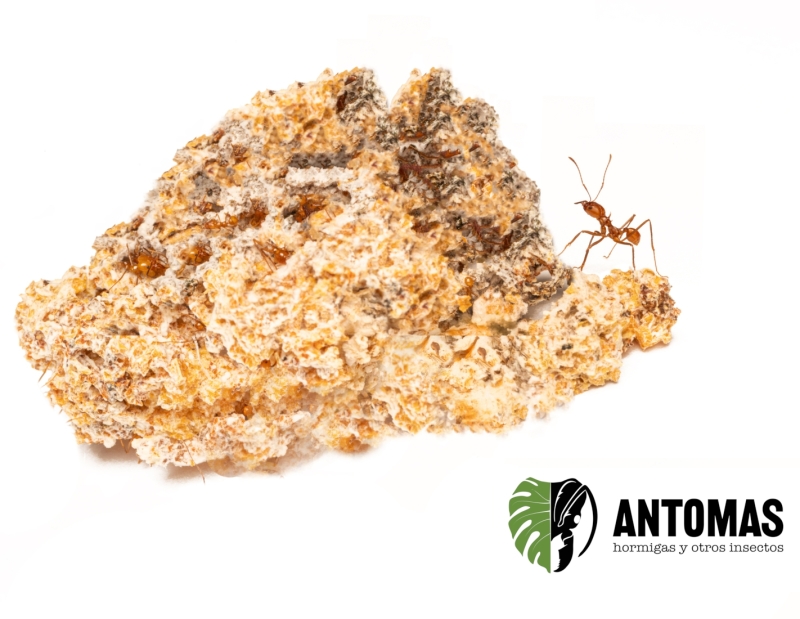
Analyses of the gardens of Mycetophylax morschi, a coastal species of the genus, identified fungi of the genus Leucocoprinus, from the same family as many garden mushrooms. A healthy lower-attine garden looks like white or cream, spongy mycelium shaped like a tiny cauliflower.
A genus that changed shape in 2017
Few ants have been shuffled around taxonomically as much as these. Their recent history partly explains why our care sheet says "sp." instead of a species name:
- Until 2009, Mycetophylax was a catch-all for species of uncertain placement. Christiana Klingenberg and Carlos Roberto F. Brandão revised it and reduced it to just three beach species (M. conformis, M. simplex and M. morschi), moving others to new or reinstated genera such as Kalathomyrmex and Paramycetophylax.
- In 2017, Jeffrey Sosa-Calvo and his team rediscovered an enigmatic attine, "Mycetosoritis" asper, and studied it with DNA. Along the way they showed that the large genus Cyphomyrmex was not a natural group: a whole set of its species, the so-called strigatus group, was more closely related to Mycetophylax than to the rest of Cyphomyrmex.
- Result: those species were moved to Mycetophylax, together with M. asper and another former Mycetosoritis, and the genus jumped from 3 to 21 species, ranging from Central America to Argentina.
Many of these species were described decades ago, from few specimens, as subspecies of others or under names that have changed several times. Some are known almost only from the paper in which they were first named, and specialists acknowledge that there are still species waiting to be described.
Why "Mycetophylax sp."?
"sp." is short for species and is used when the genus is certain but the species has not been confirmed. At Antomas we prefer to say so rather than give a name that later turns out to be wrong. The reasons:
- You need a microscope. Small attines are separated by characters of less than a millimetre: the number of teeth on the mandible, the shape of the groove where the ant folds its antenna (the scrobe), the relative size of the tubercles on the thorax or the position of certain carinae on the head. William Mackay and Francisco Serna, for example, distinguish the former strigatus group from the rimosus group of Cyphomyrmex by details of this kind. With the naked eye or in a photo, they are almost impossible to check.
- The keys are old. The reference revisions for many species are more than half a century old and do not always include enough measurements or illustrations.
- The 2017 reorganisation has not yet been followed by a modern, complete key to the whole genus.
- It may be an undescribed species. Attines that do not fit any known species keep turning up in South American rainforests.
What we can say for sure is that our ant is a lower attine with the typical appearance of the Mycetophylax of the former strigatus group, and that it comes from the rainforests of northern South America. If a specialist ever identifies it with certainty, we will update this care sheet.
From the dunes to the rainforest
For years, Mycetophylax was known as "the beach genus". Its three classic species live only on the Atlantic coast of South America and divide up the dunes with precision:
- M. conformis and M. simplex nest on the bare foredunes, next to the sea, in loose and highly disturbed sand.
- M. morschi prefers the restinga, the strip of sand with some vegetation that lies behind the dunes.
- Surprising densities: on a beach in southern Brazil, up to 837 nests of M. simplex were counted in a single hectare, clustered around the plants (Albuquerque and colleagues, 2005).
With the 2017 expansion, the genus gained many species that have nothing to do with sand: ants of the leaf litter and soil of humid forests, from Central America to northern Argentina. Ours is one of them, a tropical rainforest Mycetophylax. That is why dune conditions are no use to it; it needs the conditions of the rainforest floor: constant warmth, humidity close to saturation and a layer of leaf litter that never dries out completely.
A very special compost: insect poo
The only detailed inventory of what a Mycetophylax collects in the wild was made by Mariane Ronque, Rodrigo Feitosa and Paulo Oliveira in 2019 with M. morschi, in the Atlantic Forest. They followed the workers and examined 111 loads:
- Arthropod faeces: 35%.
- Unidentified plant debris: 34%.
- Leaf fragments: 11%.
- Wood: 3%.
- Arthropod carcasses: 3%.
- Seeds: 1%.
- Other materials: 13%.
In M. asper, the main substrate is the droppings of insects that eat green plants (Sosa-Calvo and colleagues, 2017). It makes sense: a caterpillar or grasshopper dropping is plant matter that has already been shredded and pre-digested, perfect for the fungus to colonise. These are data from other species of the genus, but they paint a good picture of the lifestyle of these little recyclers. At home, as we will see, the basis is much simpler: rolled oats.
A garden with its own pest
Like any farmer, attines have to defend their harvest. Their great enemy is Escovopsis, a genus of parasitic fungi that lives only in the gardens of fungus-farming ants and attacks the crop until it destroys it.
- A tailor-made parasite. In 2015, Escovopsis kreiselii, with pinkish spores, was described precisely from colonies of M. morschi (Meirelles and colleagues, 2015).
- Specialised in its victim. In 2019 Custodio and Rodrigues showed that this Escovopsis species is specialised in the gardens of its host ant, M. morschi.
- Workers as gardeners. Attines tend the crop and remove spent substrate; in M. morschi, this waste even accumulates inside the fungus chamber.
We don't know which parasites affect the garden of our species. What we do know is that, in captivity, the best defence is the one the ants already practise: hygiene, clean substrate and removing any leftovers that start to go mouldy.
Open day and night
In the same 2019 study, the authors tracked the activity of five Atlantic Forest attines throughout the day. M. morschi was the only one active at all hours, day and night, with no clear peak. Its activity increased with temperature and dropped as air humidity rose.
M. morschi workers went out alone or in small groups of up to ten, always on the ground, between 22 cm and 1.60 m from the nest, and each colony exploited a territory of just 0.6–2.6 m². It is a garden with the pantry two steps away. There are no data for our species, but at home you will also see it out and about at any hour, walking slowly and without the large recruitment trails of other ants.
Small chambers and hanging gardens
Lower-attine nests are modest, a far cry from the underground cities of leafcutter ants:
- In M. morschi, the entrance is surrounded by a circular or semicircular crater of soil pellets, with one or two openings. Below there are one to three chambers 2–7 cm wide, at a depth of 16–46 cm, with the garden resting on the chamber floor. Sometimes the first chamber is empty, and the garden waste accumulates inside the fungus chamber itself (Ronque and colleagues, 2019).
- In the dune species, Klingenberg and her team described a "primitive architecture" in 2007, with simple nests and small colonies, far removed from the complexity of leafcutter ants.
- In the rainforest species, the garden can vary a lot. In Mycetophylax faunulus, another forest-dwelling species of the genus, cavities of about 5–50 cm³ have been described, with the garden resting on and attached to the walls or hanging from the ceiling.
For the keeper, the lesson is clear: the fungus does not need a palace, but a small, dark, humid and stable chamber.
Pocket-sized colonies with a single queen
Forget the thousands of workers of a harvester ant or a Camponotus. Lower attines live in tiny colonies:
- On the beaches of southern Brazil, excavated Mycetophylax colonies averaged about 120 workers, and all were monogynous, with a single queen (Klingenberg and colleagues, 2007).
- In the Atlantic Forest, M. morschi colonies had between 129 and 319 workers, up to a hundred immatures and a few males. There, the odd colony had two dealate queens and others had none (Ronque and colleagues, 2019).
- Across the group in general, lower attines and Cyphomyrmex rarely exceed a few hundred workers; Mackay and Serna give fewer than 500 for the latter.
Our colonies have a single queen. Don't expect a teeming ant nest, but a small, balanced community in which every worker counts and the garden is the true heart of the colony.
The art of becoming a grain of soil
Small attines are not warriors. Ronque and colleagues observed that, when disturbed, the workers of five attine species, including M. morschi, froze and tucked their head and legs against their body, turning into a little brown speck almost indistinguishable from the soil.
This mix of thanatosis (playing dead) and crypsis (going unnoticed) fits with their matt, rough, soil-coloured body. For such a small ant with no conspicuous weapons, it is probably its best defence against leaf-litter predators. You will see it often at home: you open the outworld, a worker "freezes" and, after a while, carries on as if nothing had happened.
Picky eaters
One of the few feeding records for a rainforest species of the genus comes from some old trials by Neal A. Weber, the great attine specialist of the 20th century, with M. faunulus. He offered them a whole catalogue of dry laboratory products: haemoglobin, fibrin, egg white, dextrin, gelatine, peptone, maltose and diastase. They rejected them all.
What they did accept were lumps of garden from another attine, Cyphomyrmex rimosus, grown on flour. In other words, they accepted a cereal substrate already worked by a fungus, not a chemical product. For another species of the genus, M. auritus, it is reported that in artificial nests it accepted sawdust and cassava flour, although we have not been able to check the original source.
This is the background to what we apply at Antomas with our species: a simple, clean cereal, oats, which the fungus colonises well and which the workers incorporate into the garden.
Laboratory survivors
In 2011, Danon Cardoso, Maykon Cristiano and Mara Tavares published a method for rearing basal attines in the laboratory based on their experience with Mycetophylax. Their setup was very simple: two round containers of translucent polypropylene, one for the nest chamber and one for the outworld, both with lids to slow down desiccation.
- Results: of 29 colonies of several beach species, 22 lived for at least 30 weeks; M. morschi adapted best.
- The great enemy: according to the authors, loss of humidity, above any other problem.
These are dune species, not ours, but the conclusion holds for any small attine: if the garden dries out, the colony collapses.
What remains to be discovered
Very little is known about most rainforest Mycetophylax: the original taxonomic account, a few distribution records and not much more. So that you can tell data from inference, this is what has not been published for our species:
- Ecology: no studies of foraging, preferred substrates, daily rhythm or territory size.
- Reproduction: the flight season, mating and exact mode of colony foundation are unknown.
- Colony: no data on mature colony size, queen longevity or development times.
- Fungus: neither its cultivar nor its parasites have been identified.
If you record how much the garden grows, how much oats it uses, when larvae appear and how long it takes for workers to emerge, you will be gathering information that no scientific journal holds today.
Size and morphology
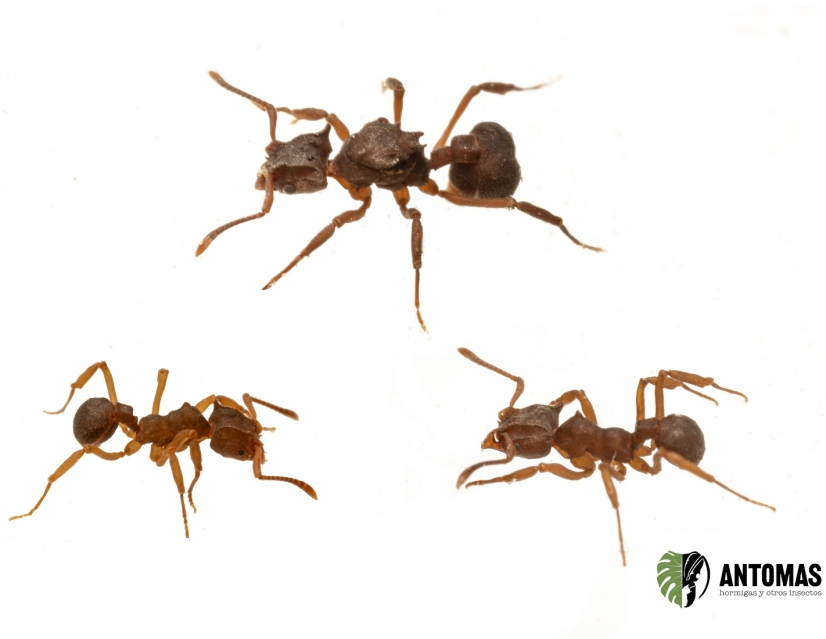
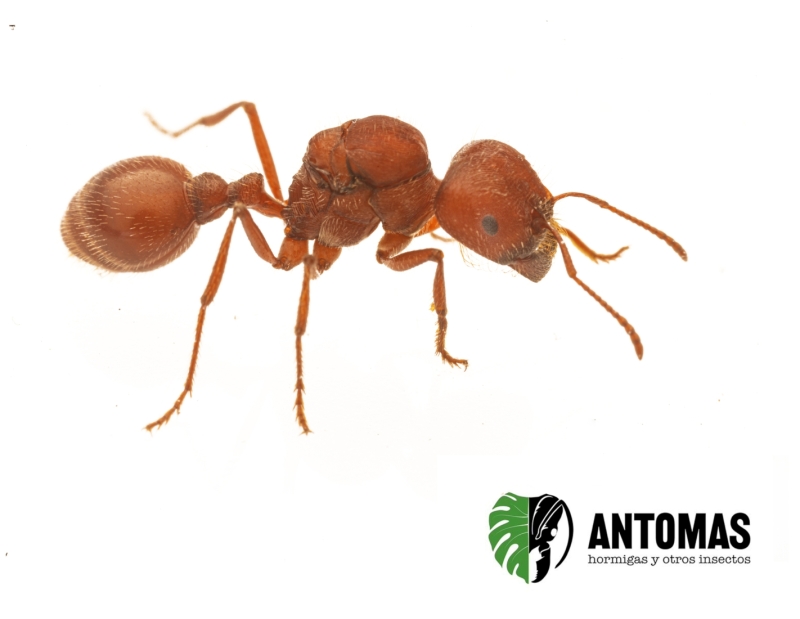
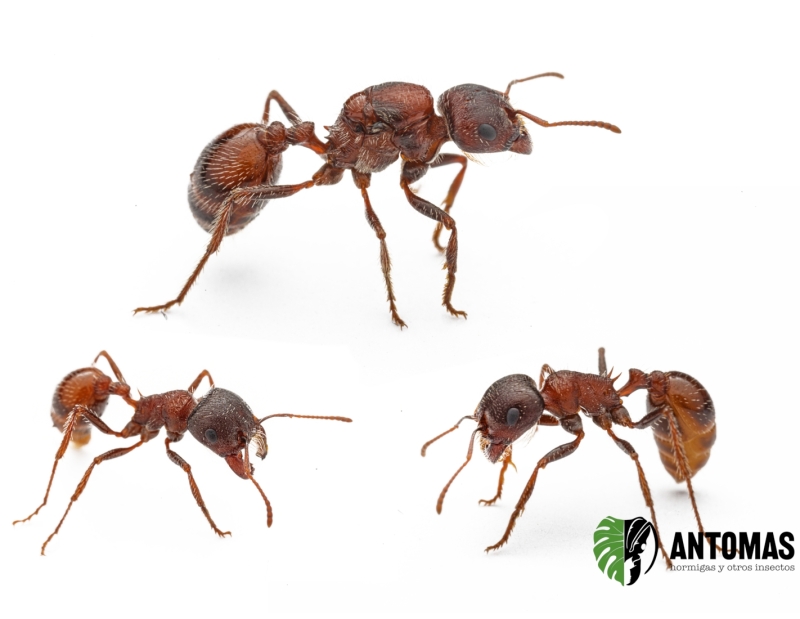
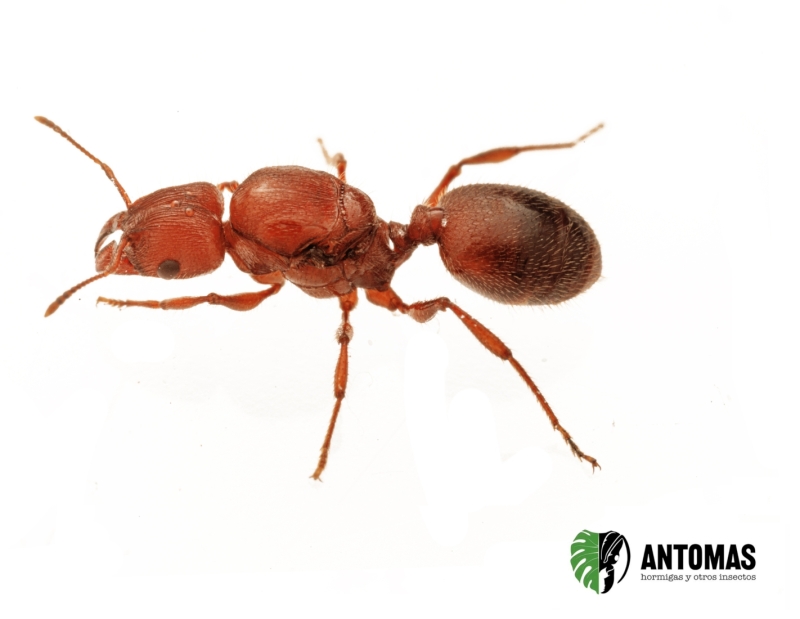
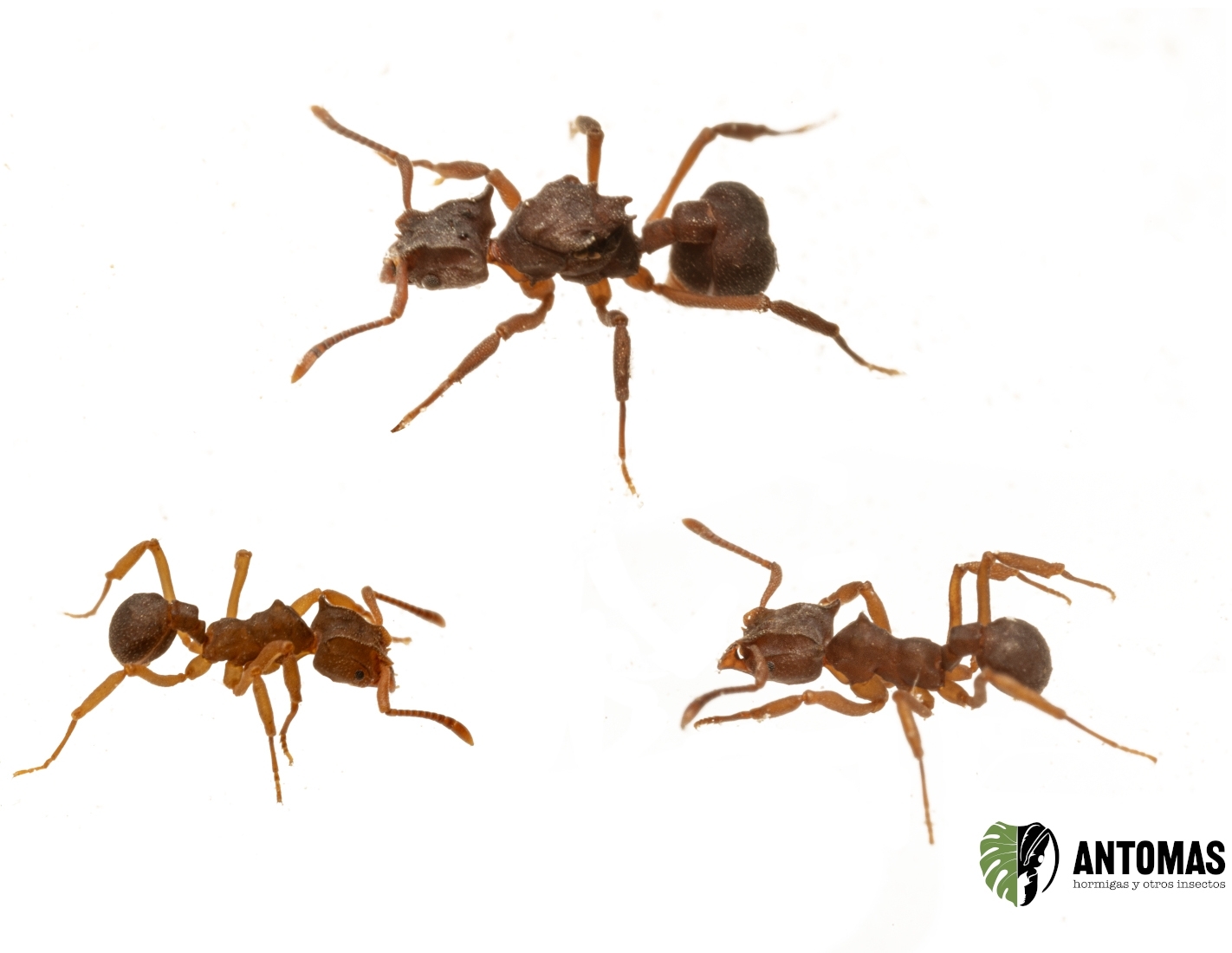
A small, robust myrmicine ant, monomorphic (no soldiers or major workers), with a matt, rough body. This is what the ants in our colonies look like:
- Workers: bicoloured, with dark brown head and gaster, reddish-brown thorax (mesosoma) and yellowish-brown legs and antennae. Matt surface with rugose sculpture and short, sparse hairs.
- Thorax with tubercles: the mesosoma bears low tubercles and, at the rear, on the propodeum, a pair of short, blunt teeth or spines.
- Head: longer than wide, with the frontal lobes somewhat expanded laterally and small eyes.
- Legs: relatively long for its size.
- Queen: clearly larger, uniformly dark brown with reddish-brown legs and antennae. Her thorax is very knobbly: bulges on the "shoulders", a broad, flattened scutum and a pair of blunt propodeal spines pointing backwards and upwards.
- Waist: small, node-shaped petiole and postpetiole, as in all myrmicines.
- Metamorphosis: pupae without a cocoon, another trait shared by all myrmicines.
The traits that really separate the species (number of mandibular teeth, shape of the scrobe, relative size of each tubercle) can only be seen properly under a 20–40× magnifier. That is why, as we explained in Biology, we sell it as Mycetophylax sp.
Approximate measurements
We have no published measurements for our species, so as a reference we give the total lengths of other species of the genus, all of them small:
- M. morschi: workers 2.54–3.03 mm; queens 3.45–3.90 mm; males 2.69–3.15 mm (Klingenberg and Brandão, 2009)
- M. conformis: workers 2.62–3.41 mm; queens 4.00–4.65 mm (Klingenberg and Brandão, 2009)
- M. simplex: workers 3.30–4.05 mm; queens 5.10–5.30 mm (Klingenberg and Brandão, 2009)
- M. asper: workers 3.34–3.74 mm; queens 4.26–4.76 mm (Sosa-Calvo and colleagues, 2017)
- M. faunulus, a rainforest species: workers 3.4–4.0 mm; queens 4.2–4.8 mm, according to the paper in which it was first named
In short: across the genus, workers measure 2.5 to 4 mm and queens 3.5 to 5 mm. It is a very small ant, something to bear in mind when it comes to barriers and gaps in the formicarium.
Care in captivity
Difficulty: 4/5 – Advanced
This is not a beginner's ant. It is easy to handle, being calm, not at all aggressive and harmless to people, but keeping it follows a rule different from almost every other species: you are not keeping ants, you are keeping a fungus, and the ants live off it. We rate it as advanced for these reasons:
- They depend on a delicate symbiont. If the garden dies, the colony dies with it, even if the workers are healthy.
- Humidity is unforgiving. A few days of neglect with a dry chamber can finish off the crop.
- Feeding without overdoing it. Whatever is left over goes mouldy and puts the garden at risk.
- Little published experience. There are hardly any keeping reports for the genus on forums or from European shops; what we describe here comes from the science and from Antomas's own experience.
In return, you will have one of the rarest ants in the hobby, behaviour that very few keepers have been able to watch at home and a species about which almost everything is still to be discovered. Watching the workers carry oat flakes to the garden and seeing it grow week after week is a unique experience.
Recommended parameters
Its natural climate is that of the equatorial rainforest: an average of about 27 °C all year round, night-time lows of about 22 °C, twelve-hour days that barely change and more than 2,000 mm of rain a year. In the soil, under the leaf litter, the temperature is even more stable and the air is almost always close to saturation.
- Temperature: 24–28 °C all year round. It can drop slightly at night, but ideally not below 21–22 °C. Avoid prolonged cold below 20 °C and heat above 31 °C.
- Gentle, even heat: in winter, in a European home, you will usually need a heating cable or mat with a thermostat, always on one side of the formicarium and never under the garden, so it doesn't dry out.
- Humidity: high and stable in the fungus chamber, around 80–90%, with no water droplets on the garden. The outworld can be somewhat drier.
- Water: a test tube with water and a cotton plug in the outworld, always available.
- Light: dark nest and outworld in normal light; if you use lighting, about 12 hours a day all year round.
- Diapause: no. There is no winter in its habitat: the difference between the coldest and warmest month is barely a degree and a half. Never cool it down.
Humidity: the golden rule
With an ordinary ant, a slightly dry nest is a problem that can be corrected over time. With an attine it is an emergency: the fungus is a soft, unprotected organism that loses water as soon as the air dries out. Letting the fungus chamber dry out is the worst mistake you can make with this species. A parched garden shrinks, changes colour and can collapse within a few days, taking the colony with it.
- Check the humidity often, ideally daily for the first few months, until you know how your formicarium behaves.
- Humid fungus chamber, with the floor and walls slightly damp, but no puddles or drops falling on the garden.
- Minimal ventilation. Cardoso and colleagues covered both the nest and the outworld to slow down desiccation. An outworld with a lid or a very small ventilation opening helps a lot.
- Don't flood it either. Excess water and condensation on the crop encourage bacteria and moulds. The ideal is a humid, stable environment, not a wet one.
- No sudden changes. Constant humidity is better than cycles of drought and watering.
- Imitate the dry season outside only. If you like, the outworld can be drier than the chamber, but the garden, never.
The signs that something is wrong show up in the fungus itself: a healthy garden is white or cream and spongy; if it turns grey, yellowish or smaller and the workers abandon it, check the humidity first.
Recommended formicarium
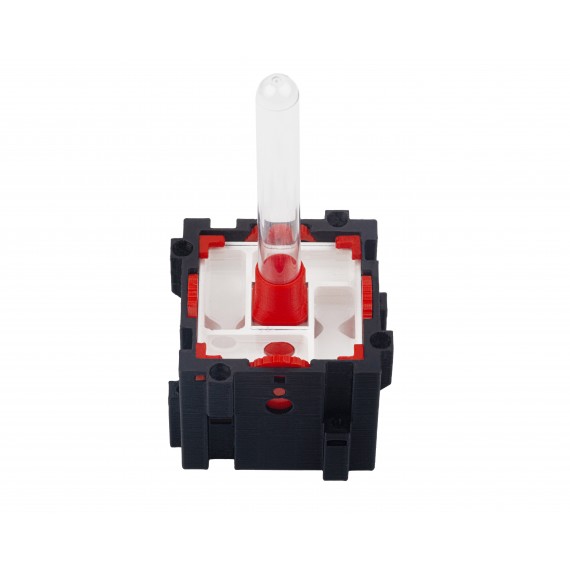
At Antomas we keep it in a standard nest: the QBIK ONE with a large gallery, from Anthouse's Qbik Alpha range. Large galleries leave room for the fungus garden, which needs a chamber that is spacious relative to the size of the workers, and the modular format makes it easy to watch the crop and its growth.
To make it work with an attine, bear in mind:
- One chamber for the garden, dark and with the high, stable humidity described above. The others can be drier: the workers will choose the best spot.
- A small, covered outworld, with the water tube and a clean area to leave the oats. It can have a fine bottom layer of sterilised soil or leaf litter, optional.
- An area for waste. The workers carry out spent substrate; remove it from time to time with fine tweezers, without touching the garden.
- Heat from the side, never under the fungus chamber.
- Tight-fitting connections: with workers of 3–4 mm, any gap is an exit (see "Escapes and barriers").
A lower-attine colony grows slowly and does not need frequent expansions. If the garden fills the chamber and you see workers and crop crammed together, it is time to think about more space.
How the colony arrives and moving it by tipping
We don't know how our species founds colonies in the wild. In attines in general, the young queen leaves the mother nest with a pinch of fungus stored in a pouch in her mouth and uses it to start her own garden. Colony foundation is one of the most delicate stages, which is why at Antomas we ship colonies with their queen, workers, brood and garden, with the riskiest part already behind them.
When it arrives:
- Let it rest for a few hours in a quiet, dark place at 24–28 °C.
- Check the humidity of the shipping container: it is the first thing that can fail during the journey.
- Prepare the nest in advance, with the fungus chamber already humid and the temperature stable.
We move the colony by tipping it into the new nest:
- With extra care for the fungus: gently tip the contents next to the chamber you want them to occupy, trying to get the garden there whole or in a few large pieces.
- Fine tools: soft tweezers and a brush to guide stragglers. The workers will gather the pieces of garden and the brood into the chamber.
- Lid on, darkness and calm for the first few hours, without letting anything dry out.
During the first days it is normal for them to reorganise the garden; as soon as you see it compact in one chamber and the workers coming out into the outworld, start with the oats.
Feeding: feeding the fungus
This is the big difference from any other ant in the shop. Mycetophylax does not feed itself: it feeds its fungus, and both workers and larvae eat from the crop. So the usual diet of nectar and insects does not apply here. There is no need to offer them nectar or prey: they are not part of their diet and, if left in the nest, they simply rot.
The basis: rolled oats. At Antomas we feed the fungus mainly with oats. It works very well and fits with the little that is known about the genus: a rainforest species accepted gardens grown on flour. This is how we do it:
- Natural, dry rolled oats with no additives: no sugar, salt or flavourings.
- In small pieces, crushed or broken up, that a 3–4 mm worker can carry.
- In the outworld, in a dry, clean spot near the nest entrance. The workers take them to the garden and incorporate them into the crop.
- Stored properly in a closed jar in a dry place, so they don't arrive damp or with mites.
The amount: just as much oats as the fungus uses. With other species we say it is better to give too much than too little; with an attine, the rule is the opposite. A colony of a few hundred workers needs very little, and whatever is left over goes mouldy:
- Little and often: a few small pieces, and top up when they have disappeared.
- Check every one or two days and remove any leftovers they haven't collected or that are starting to go mouldy.
- Adjust to the garden: if it grows and is white and spongy, you are on the right track; if unused oats build up, cut back.
- If anything goes mouldy inside the nest, remove it with fine tweezers as soon as you see it.
Other substrates, occasionally. The literature on related species mentions other materials you can offer from time to time, in tiny amounts, to vary the fungus's compost:
- Dry droppings of herbivorous insects, such as those of crickets or cockroaches fed on vegetables, the material most collected by M. morschi in the wild.
- Fine, dry plant debris: very small bits of petals or dry leaves.
These are supplements, not the basis. Introduce them gradually, watch whether they collect them and remove anything they don't use. If in doubt, stick with oats.
Water, always. The test tube with water and cotton in the outworld must always be full; check it every few days. The workers drink from it and, in addition, the water helps keep the whole setup humid.
How to tell if the garden is healthy
Learning to "read" the fungus is the attine keeper's best tool:
- Healthy: white or cream, spongy, shaped like a tiny cauliflower, with workers busy on it.
- Dry: shrunken, more compact, with grey or yellowish patches. Raise the humidity immediately.
- Waterlogged: shiny, matted, with drops on top. Ventilate a little and reduce the water.
- With foreign mould: green, black or pinkish patches. Remove that part with fine tweezers and review the amount of food and the cleanliness. In attines, pinkish moulds are reminiscent of Escovopsis, the parasite we talked about in Biology.
- Abandoned: if the workers leave the garden or move it again and again, something is wrong with the humidity or temperature of that chamber.
Behaviour and observation
Slow and methodical. Don't expect columns or rushing about: the workers come out one by one or in small groups, walk slowly and carry their piece of oat with admirable patience. In M. morschi activity was seen at any hour of the day and night, and yours will probably come out at any hour too.
Motionless in the face of danger. If you disturb them, they keep still with their legs tucked in. They are not dead: give them a few seconds.
Steady growth. Like all lower attines, they grow slowly and form small colonies. What changes most from one week to the next is the garden, not the number of workers.
Observe without fear. For Antomas, a colony is there to be enjoyed, watched and learned from, not hidden away. With the fungus chamber in semi-darkness and the outworld lit, all it takes is to observe gently and intervene only as much as needed. With a hand lens you will see fascinating details: how a worker "plants" an oat flake in the crop or how they tend the larvae, nestled in the mycelium.
Escapes and barriers
Their slowness is deceptive: the workers are so small that they find any gap.
- Tight-fitting connections between nest, tubes and outworld.
- Ventilation with very fine mesh, with openings smaller than a worker's body.
- Escape barrier on the rim of the outworld, made of PTFE (Fluon) or mineral oil, renewed when it loses effectiveness.
- A lid on the outworld, which also helps retain humidity.
Handling and safety
It is one of the most harmless ants you can keep: tiny, calm and not at all aggressive, with a defence based on hiding rather than attacking. It poses no risk to people.
- Fine, soft tools: gentle tweezers and a brush, especially near the garden.
- Open rarely and calmly, and close it when you're done so as not to lose humidity.
- Be careful with the fungus: don't touch or move it unnecessarily; the workers know better than anyone where to place it.
It is an exotic tropical species: never release it.
What not to do
- Let the fungus chamber dry out, even for a few days.
- Flood the nest or let drops fall on the garden.
- Put in more oats than they use or leave mouldy leftovers.
- Give them nectar, honey, fruit or insects as if they were a "normal" ant.
- Use oats with sugar, salt or flavourings, or stored in damp conditions.
- Put it into diapause or keep it below 20 °C for days.
- Place the heat source under the fungus chamber.
- Touch or dismantle the garden unnecessarily.
- Mix queens or colonies.
Scientific sources
Almost all field research on Mycetophylax has been carried out on the coastal species M. morschi, M. simplex and M. conformis. Data from those species are flagged as such in this care sheet; the rest comes from Antomas's experience. Main references:
- Albuquerque, E. Z. de, Diehl-Fleig, E. & Diehl, E. (2005). Density and distribution of nests of Mycetophylax simplex (Emery) (Hymenoptera, Formicidae) in areas with mobile dunes on the northern coast of Rio Grande do Sul, Brazil. Revista Brasileira de Entomologia 49: 123–126. doi:10.1590/s0085-56262005000100013
- Klingenberg, C., Brandão, C. R. F. & Engels, W. (2007). Primitive nest architecture and small monogynous colonies in basal Attini inhabiting sandy beaches of southern Brazil. Studies on Neotropical Fauna and Environment 42: 121–126. doi:10.1080/01650520601065509
- Diehl-Fleig, E. & Diehl, E. (2007). Nest architecture and colony size of the fungus-growing ant Mycetophylax simplex Emery, 1888 (Formicidae, Attini). Insectes Sociaux 54: 242–247. doi:10.1007/s00040-007-0936-7
- Schultz, T. R. & Brady, S. G. (2008). Major evolutionary transitions in ant agriculture. Proceedings of the National Academy of Sciences 105: 5435–5440. doi:10.1073/pnas.0711024105
- Klingenberg, C. & Brandão, C. R. F. (2009). Revision of the fungus-growing ant genera Mycetophylax Emery and Paramycetophylax Kusnezov rev. stat., and description of Kalathomyrmex n. gen. (Formicidae: Myrmicinae: Attini). Zootaxa 2052: 1–31. doi:10.11646/zootaxa.2052.1.1
- Mackay, W. P. & Serna, F. (2010). Two new species of the strigatus species complex of the ant genus Cyphomyrmex (Hymenoptera: Formicidae) from Costa Rica and Panama. Journal of Hymenoptera Research 19: 44–50.
- Cardoso, D. C., Cristiano, M. P. & Tavares, M. G. (2011). Methodological remarks on rearing basal Attini ants in the laboratory for biological and evolutionary studies: overview of the genus Mycetophylax. Insectes Sociaux 58: 427–430. doi:10.1007/s00040-011-0160-3
- Meirelles, L. A., Montoya, Q. V., Solomon, S. E. & Rodrigues, A. (2015). New light on the systematics of fungi associated with attine ant gardens and the description of Escovopsis kreiselii sp. nov. PLoS ONE 10: e0112067. doi:10.1371/journal.pone.0112067
- Sosa-Calvo, J., Ješovnik, A., Vasconcelos, H. L., Bacci, M. Jr. & Schultz, T. R. (2017). Rediscovery of the enigmatic fungus-farming ant «Mycetosoritis» asper Mayr (Hymenoptera: Formicidae): implications for taxonomy, phylogeny, and the evolution of agriculture in ants. PLoS ONE 12: e0176498. doi:10.1371/journal.pone.0176498
- Custodio, B. C. & Rodrigues, A. (2019). Escovopsis kreiselii specialization to its native hosts in the fungiculture of the lower attine ant Mycetophylax morschi. Antonie van Leeuwenhoek 112: 305–317. doi:10.1007/s10482-018-1158-x
- Ronque, M. U. V., Feitosa, R. M. & Oliveira, P. S. (2019). Natural history and ecology of fungus-farming ants: a field study in Atlantic rainforest. Insectes Sociaux 66: 375–387. doi:10.1007/s00040-019-00695-y