This website uses its own and third-party cookies to improve our services and show you advertising related to your preferences by analyzing your browsing habits. To give your consent to its use, press the Accept button.
Functional cookies are strictly necessary to provide the services of the shop, as well as for its proper functioning, so it is not possible to refuse their use. They allow the user to browse through our website and use the different options or services that exist on it.
These are cookies that collect information about the advertisements shown to users of the website. They can be anonymous, if they only collect information about the advertising spaces shown without identifying the user, or personalised, if they collect personal information about the user of the shop by a third party, for the personalisation of these advertising spaces.
Collect information about the user's browsing experience in the shop, usually anonymously, although sometimes they also allow the user to be uniquely and unequivocally identified in order to obtain reports on the user's interests in the products or services offered by the shop.
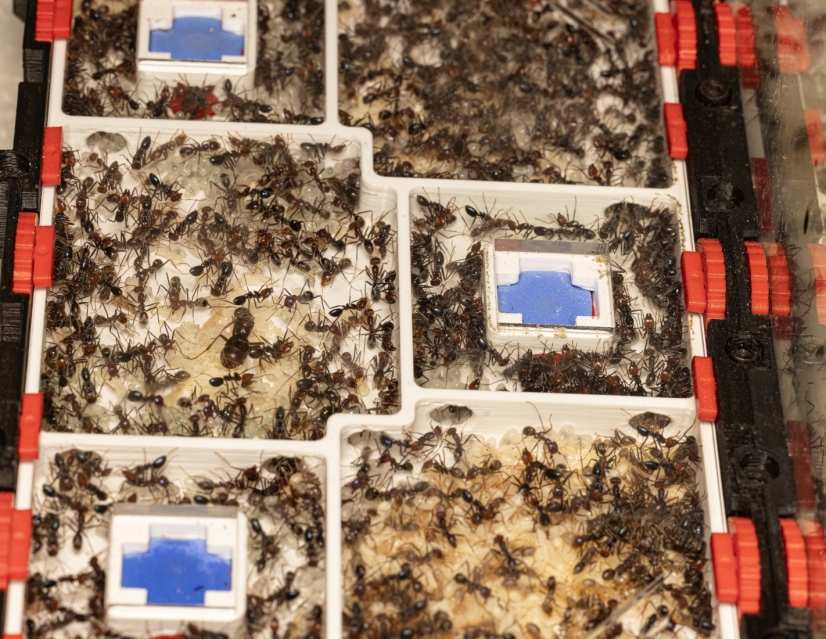
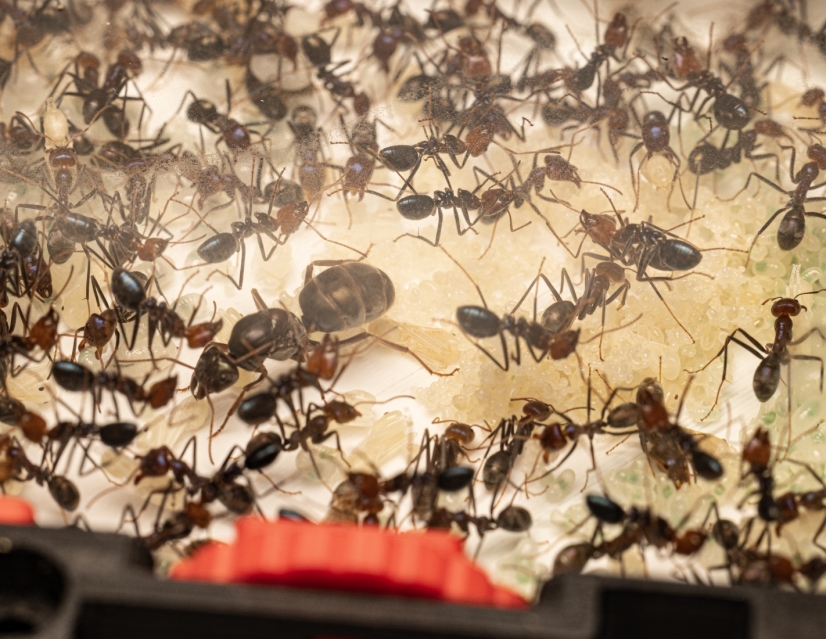
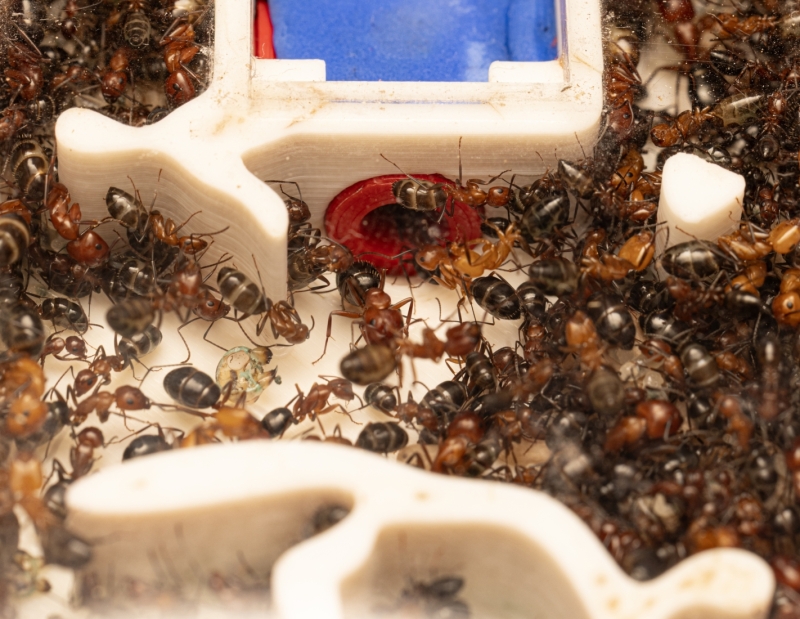
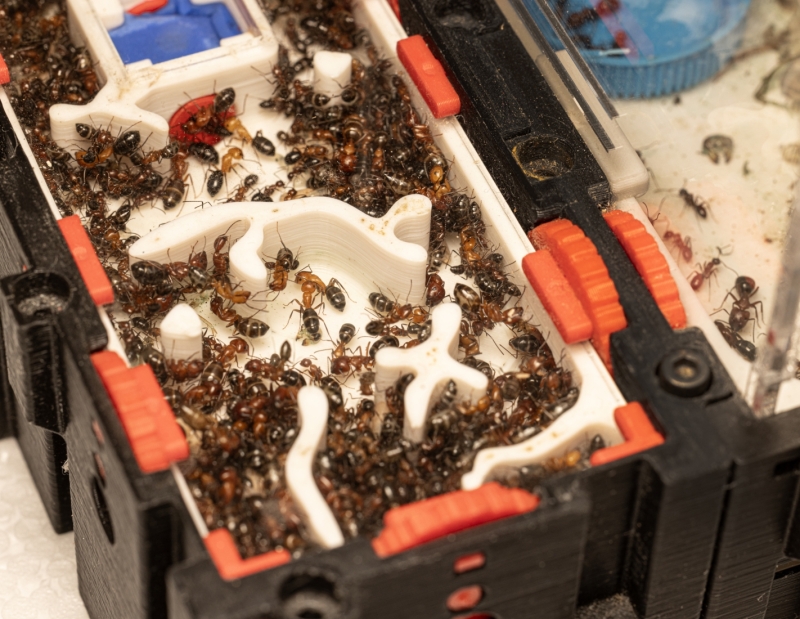
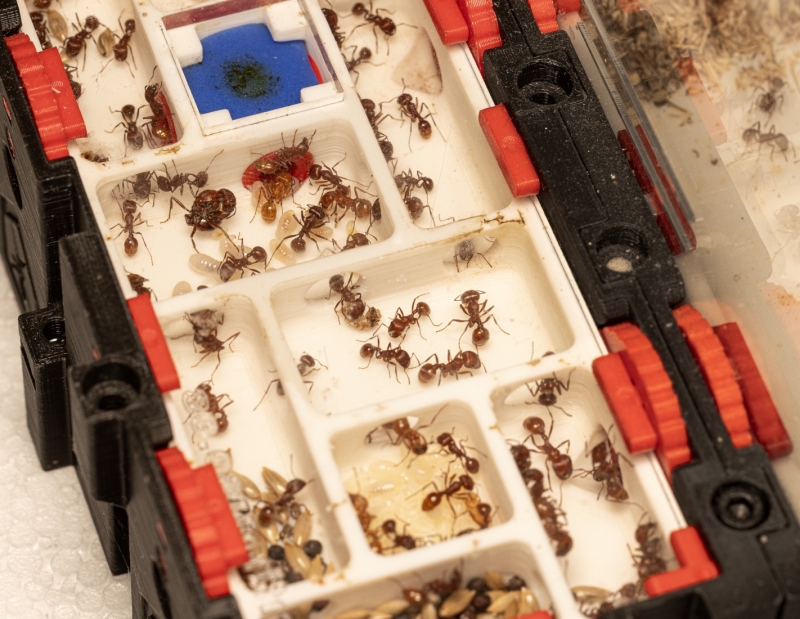
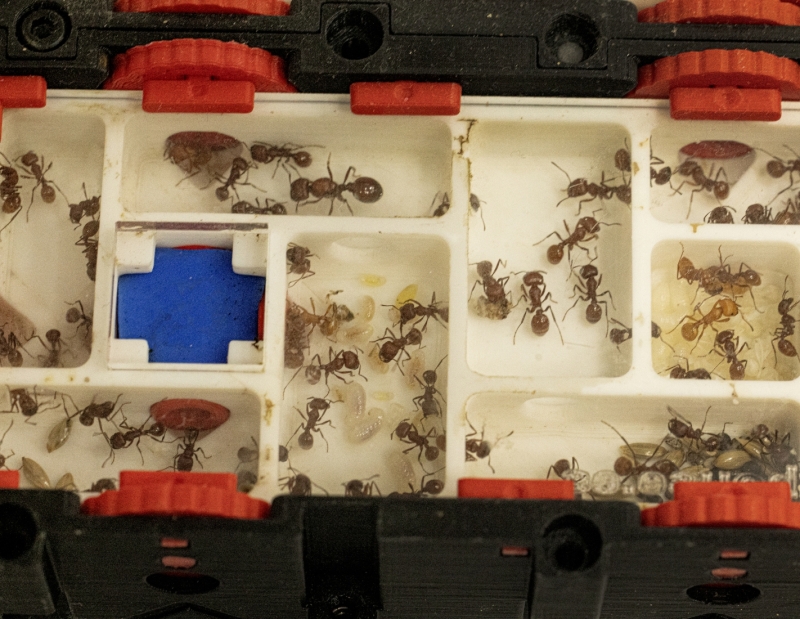
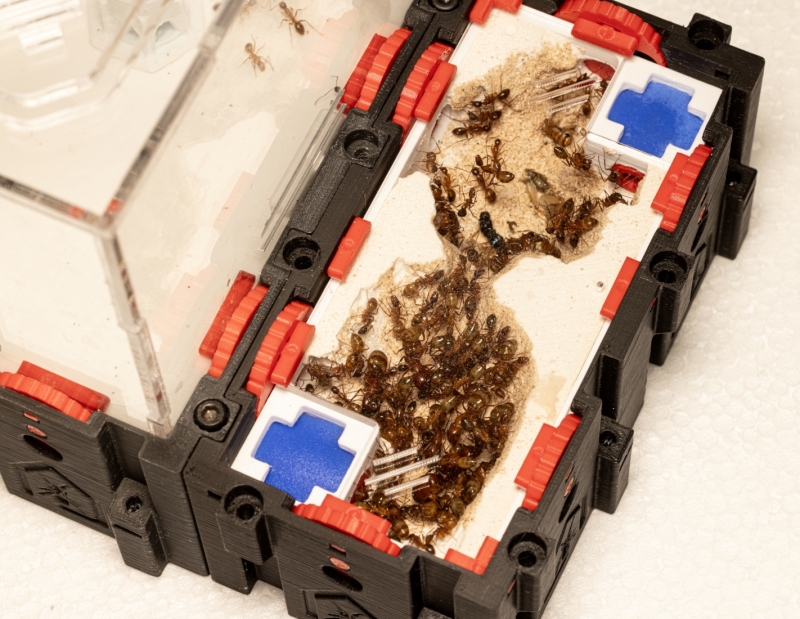
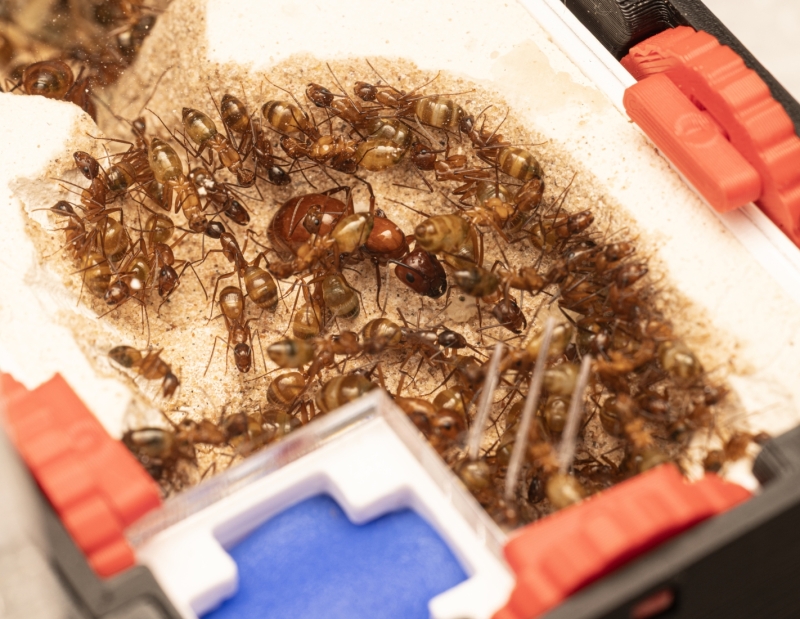
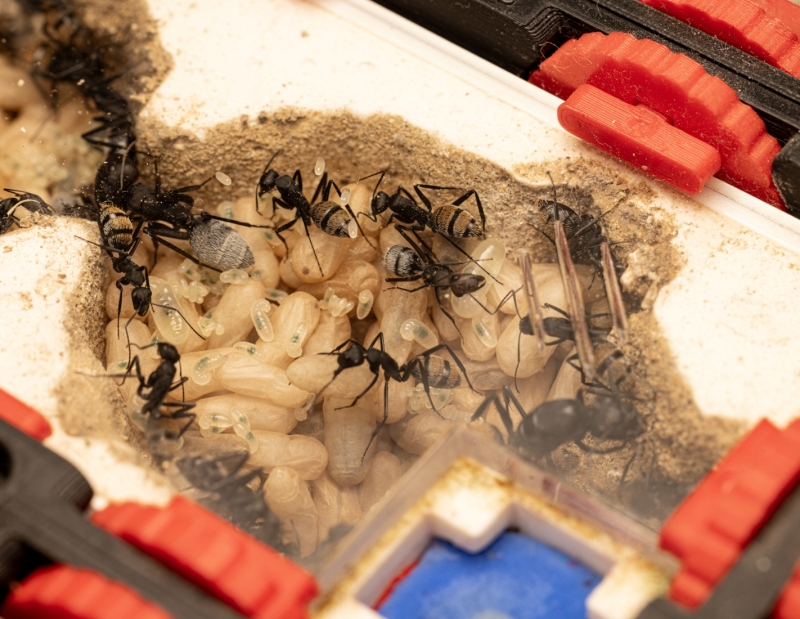
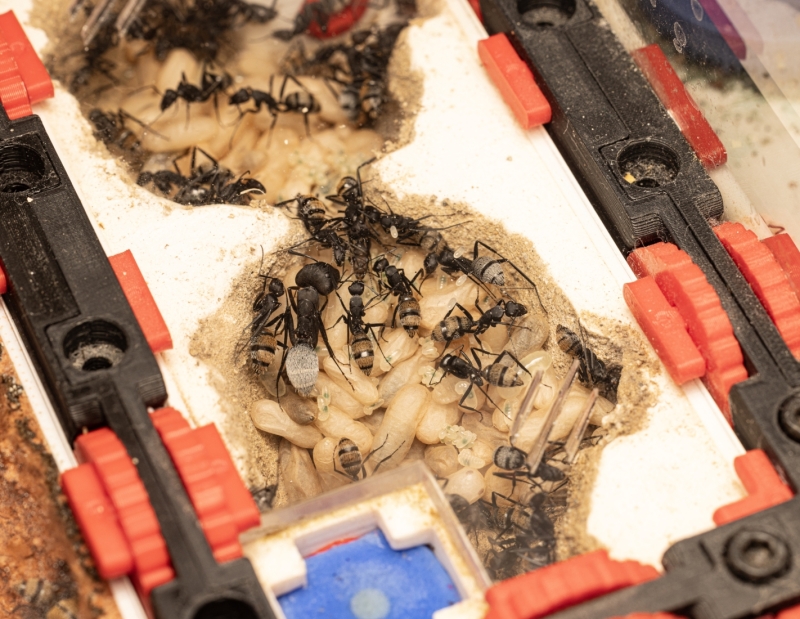
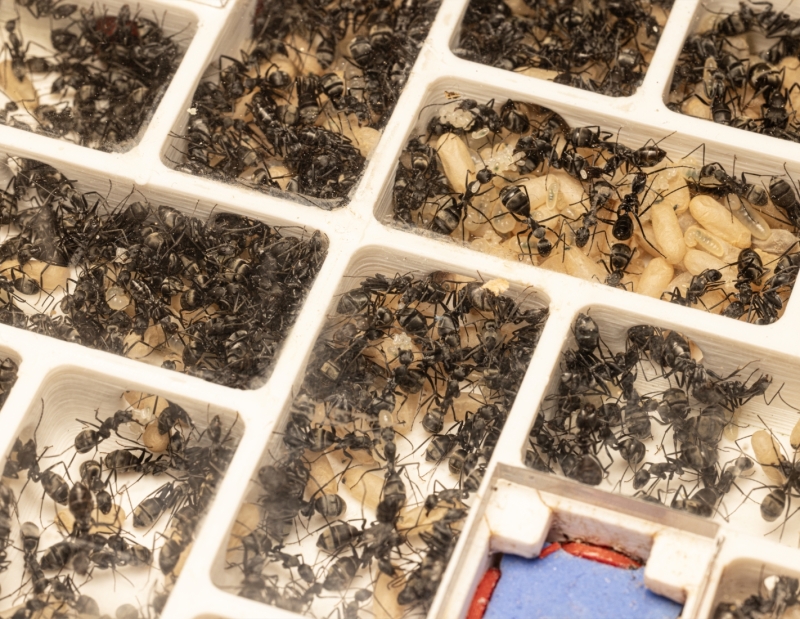
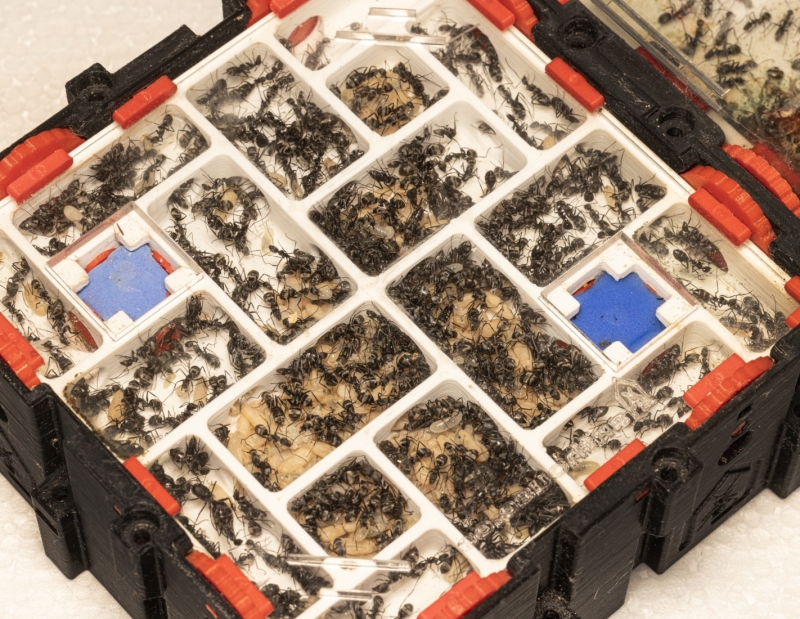
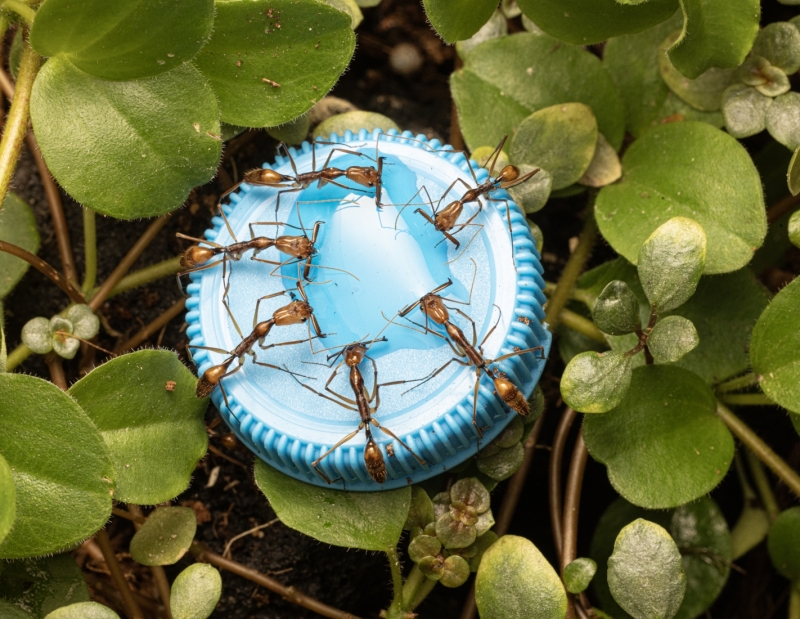
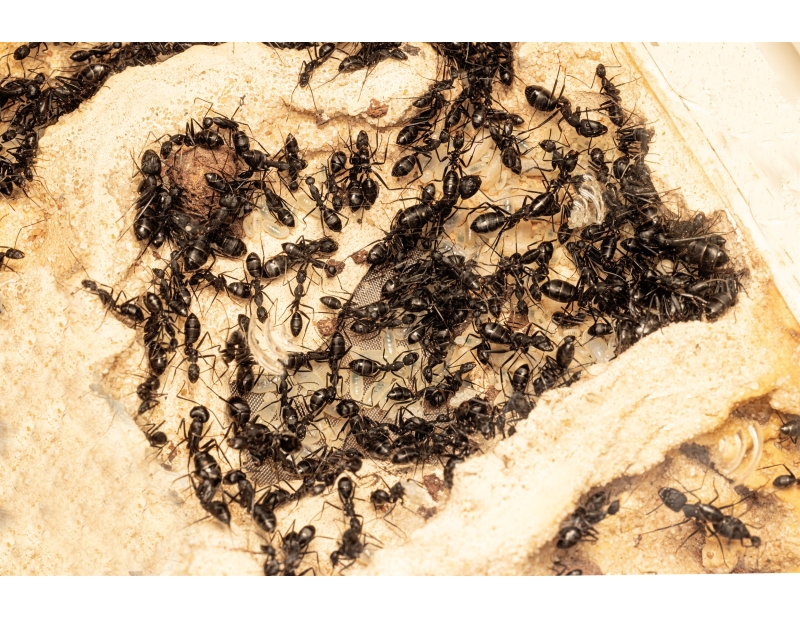
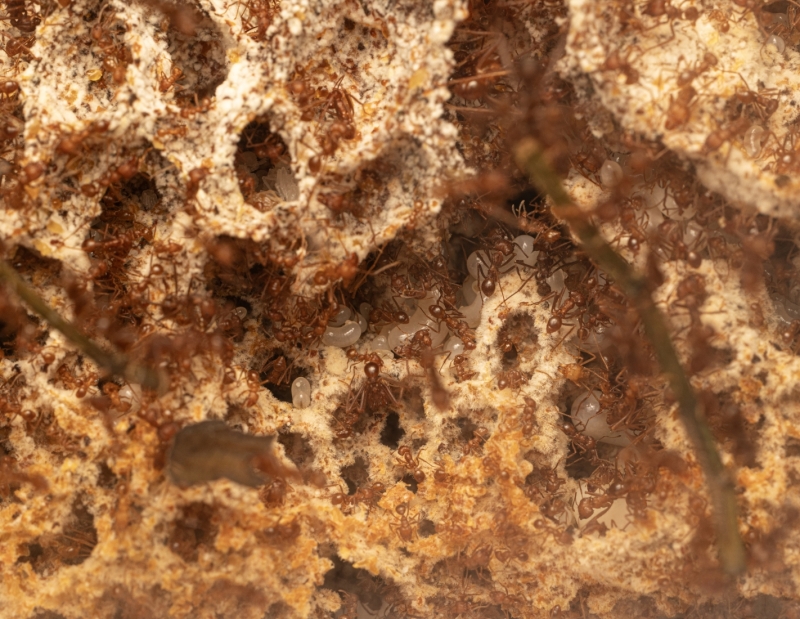
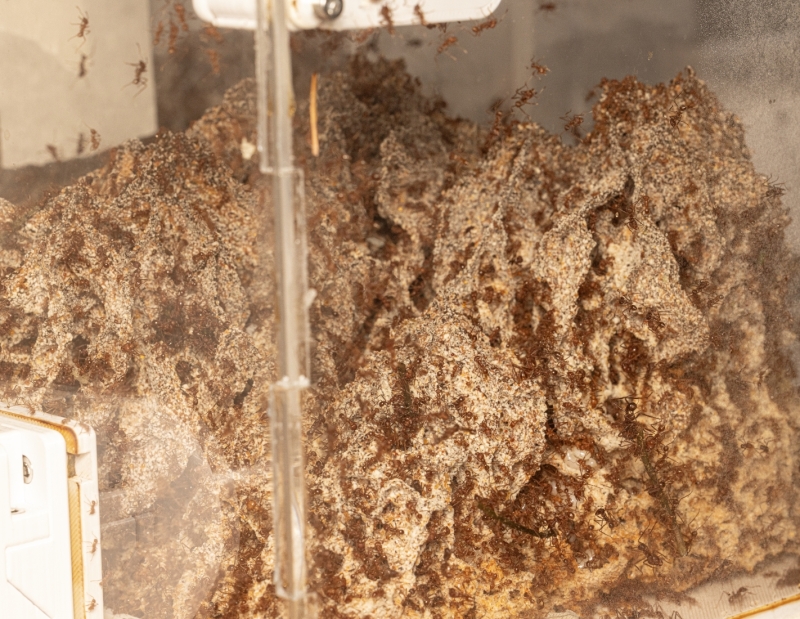
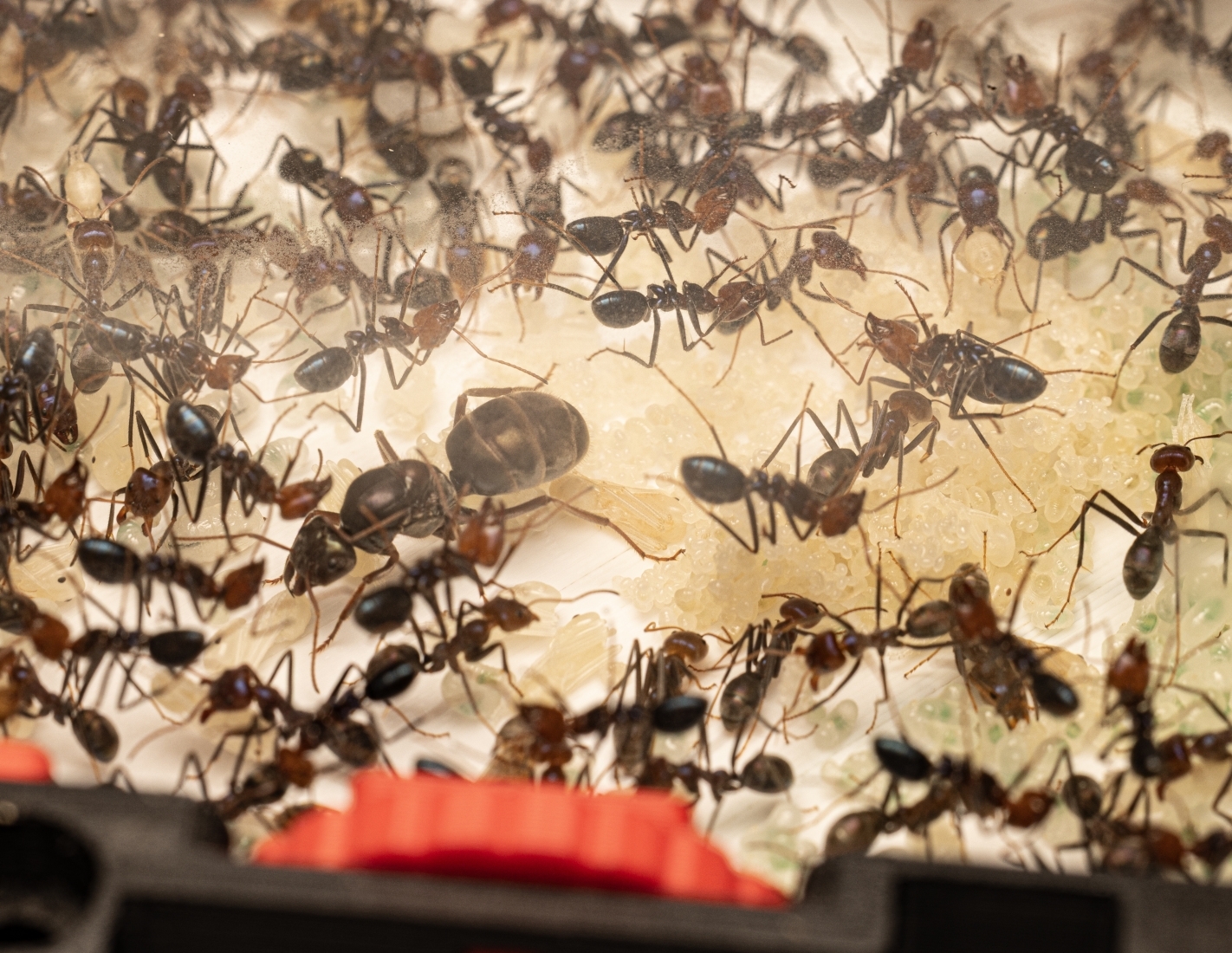
Age: ≈1 year Queen: October 2025 Population: +500 workers Description: Since October 2025, this queen has built a true "Meat Ant" empire at an impressive pace. More than 500 workers tirelessly roam their territory, mapping out foraging routes and mobilizing en masse against any intruder. A young, explosive, and already firmly established colony, ready to demonstrate the full potential of one of Australia's most territorial ant species.
This is an established colony, bred in-house: a queen from October 2025 and, depending on the option you choose, 500 or 1000 workers with brood. The founding stage and the first batches of workers, the slowest part, are already done: you receive a colony in full expansion.
The Australian meat ant on a grand scale: trails packed with workers, mass defence and an appetite that never ends. Diurnal, with no functional sting and very active. QBIK DUO from day one, a dry nest except for one humid corner for the brood, 24–28 °C with one side at 28–30 °C, water in a test tube, sugar every day in a feeder and plenty of varied protein. Gentle diapause of about 3 months at 12–15 °C. It climbs everything: escape barrier and lid, always.
Anyone who has seen a field in south-eastern Australia on a sunny day knows the scene: low mounds covered in gravel, cleared trails between them and a constant coming and going of reddish workers that does not stop until sunset. This is Iridomyrmex purpureus (F. Smith, 1858), the meat ant. Its strength lies not in each worker but in numbers: a mature colony spreads its thousands of individuals across several nests, links them with trails it clears itself and defends its food trees with collective displays that science has been studying for half a century.
This Meat Ant Empire is the large-scale version of that experience. It is a colony founded by a queen from October 2025 that has grown in our facilities at a pace that is surprising even for this species, to more than 500 workers. It is no longer a colony that needs to be nursed along, but one to accompany: give it space, lots of food, cleanliness and, above all, time to watch it.
If you would rather start with a small colony and watch it grow from the first workers, there is the Iridomyrmex purpureus – Meat Ant, with its full care sheet: the origin of the name, the chemistry of its defence, taxonomy and founding. Here we focus on what changes once the colony is large: how a society of hundreds or thousands of workers organises itself and how to care for it at home.
Biology
An empire spread across many homes
In the wild, an I. purpureus colony rarely stays in a single mound. It is polydomous: it occupies several nests at once, tens of metres apart and connected to one another. In a field study in New South Wales, Ellen van Wilgenburg and Mark Elgar (2007) mapped 140 colonies and found that each one occupied about seven nests on average, and some as many as sixteen. Their placement is not random: the nests follow the trees where the workers collect honeydew, and the newer ones are built closer to those trees than the older ones.
How does an empire like this come about? Greaves and Hughes (1974), who followed a population near Canberra for years, saw that colonies spread mainly by budding: groups of workers occupy a satellite nest that, in time, can function on its own. And they found something important for understanding the species: wherever possible, growing this way works better than founding from scratch with a lone queen, whose freshly dug chamber is very vulnerable. When a colony dies, its ground is taken over by its neighbours or by its own satellites.
At home you will not have nests tens of metres apart, but the tendency shows: a large colony readily occupies several connected modules and foraging areas, and distributes its workers among them.
Cheap, efficient motorways
The trails linking nests and trees form a transport network along which workers, brood and food travel. In 2015, two teams involving the University of Sydney analysed these networks with the tools engineers use to study roads and power grids:
Cheaper and more efficient than chance. Tanya Latty and her colleagues (Cabanes et al. 2015) compared the real networks with simulated networks of the same size: the ants’ networks needed less total trail length and connected the important points better.
In return, more fragile. They were less robust: if one section is cut, the network suffers more than a randomly designed one. Meat ants prioritise economy and efficiency over safety.
A simple rule. Arianna Bottinelli and her colleagues (2015) showed that a single local rule is enough to reproduce these networks: each new nest connects to the nearest existing nest and, if it is not far away, to a food tree. Nobody directs the work; the design emerges from thousands of small decisions.
The authors put forward these colonies as a model for designing human networks. It is a very concrete way of seeing what we call “collective intelligence”.
Trail gardeners
Meat ant trails are visible to the naked eye because they are cleared: the workers cut and remove the grass and any obstacles in the way. Eliza Middleton and her colleagues (2019) put this to the test by placing artificial barriers that imitated grass on the trails, with different densities and stiffness:
They cleared far more where the obstacles were few and soft, and much less where they were many and hard.
The result was not the perfect trail, but it was clearly shorter than if they had removed obstacles at random: the effort is allocated strategically.
That same year, Felix Oberhauser and his colleagues (2019) added another piece: workers cut more shortcuts when the alternative detour is long. In other words, they invest work where it saves the most afterwards. In a foraging area with sand, fine gravel and the odd light obstacle, you are likely to see your colony moving material and marking out its own routes.
Veterans look, novices smell
How do thousands of workers coming and going all day find their way? Ants that form trunk trails lay long-lasting pheromone trails, but they do not rely on smell alone. Card, McDermott and Narendra (2016) studied orientation in I. purpureus and found a curious difference:
Experienced foragers rely mainly on visual landmarks in the landscape.
Novices follow the scent trail.
If a worker is moved to an unfamiliar place, it falls back on path integration, a sort of odometer with a compass, but it does not cover the whole distance back to the nest: the farther away it is, the shorter the stretch it entrusts to that system.
This fits its way of life: it is a diurnal ant with good eyesight that forages in full sun. At home, the most experienced workers of an Empire quickly learn the layout of the foraging area.
A mound with many doors
Each nest is, in turn, a feat of engineering. In the late 1960s, the Australian G. Ettershank filled nests with molten lead to make casts of their galleries and see them in three dimensions. He found that almost every entrance of the mound opens into its own gallery system, separate from the others, and that the openings are not randomly distributed (Ettershank 1968). Later, Greaves and Hughes (1974) related the number of entrances to the nest population: the more ants, the more doors.
A nest with many independent entrances lets hundreds of workers go in and out at once without traffic jams. That is why, in a formicarium, a large colony appreciates roomy galleries and connections.
One queen or several? What the genetic studies say
The number of queens in the meat ant has been much debated, and for a colony like this one it is worth understanding properly:
Young colonies have a single queen. Van Wilgenburg, Mulder and Elgar (2006) analysed the relatedness of workers in a population of colonies less than 14 years old: in each colony, all the workers came from a single queen mated with a single male. Even though they occupied several nests, all were from the same family.
Some mature colonies have several, but kept apart. Hölldobler and Carlin (1985) described oligogyny: in colonies with more than one queen, the queens end up avoiding each other and occupying different parts of the nest, without sharing space.
Many nests, a single mother. If a single-queen colony occupies seven nests, most of them function without her: workers and brood spread across the network, linked to the rest by the trails.
Your Empire is a young colony with a single queen, exactly like those described in the genetic studies. That is how we recommend keeping it: without adding queens or merging colonies.
Displays beside the trees
The meat ant’s famous “boxing”, with workers squaring up and sparring with their legs without injuring each other, has been explained for decades as a way of marking borders. A study by Han and Elgar (2020) turned this on its head: comparing display sites, they found that beside trees with food far more workers gathered, and they were more aggressive than at sites halfway between nests. Their conclusion is that colonies are not so much defending a territory as their resources: the trees they feed from and the nests they live in.
For the keeper there is a practical lesson: what a large colony defends most intensely is its food and its home. That is why, when you top up the feeder or remove leftovers, you will see so many workers rush over at once.
The chemistry that calls to arms
When an I. purpureus worker is alarmed, it releases a volatile compound, 6-methyl-5-hepten-2-one, considered for decades to be its alarm pheromone. Han, Chen and Elgar (2022) tested it in the field with the synthetic substance and got a surprise: it did not increase the workers’ aggression by itself, but rather attracted them. More workers in the same spot means more encounters and, with them, more aggression.
You will notice it at home: if you open the formicarium abruptly, a handful of defenders comes out first and, within a few seconds, the scent draws many more. With a colony of this size, that chain reaction is plain to see, and it is the best reason always to work calmly.
A colony that lives on sunshine
The meat ant nests on open, sunny ground, and shade harms its colonies, especially young ones (Greaves and Hughes 1974). Andrew and colleagues (2013) measured its tolerance on the tablelands of New South Wales: workers withstand up to about 46 °C before losing control of their movements and make short trips over ground that far exceeds that figure. But they cannot raise that limit by acclimatising. This explains two things you will see at home: a colony that springs into action with light and heat, and the importance of keeping the heat on one side, never across the whole setup.
Size and morphology
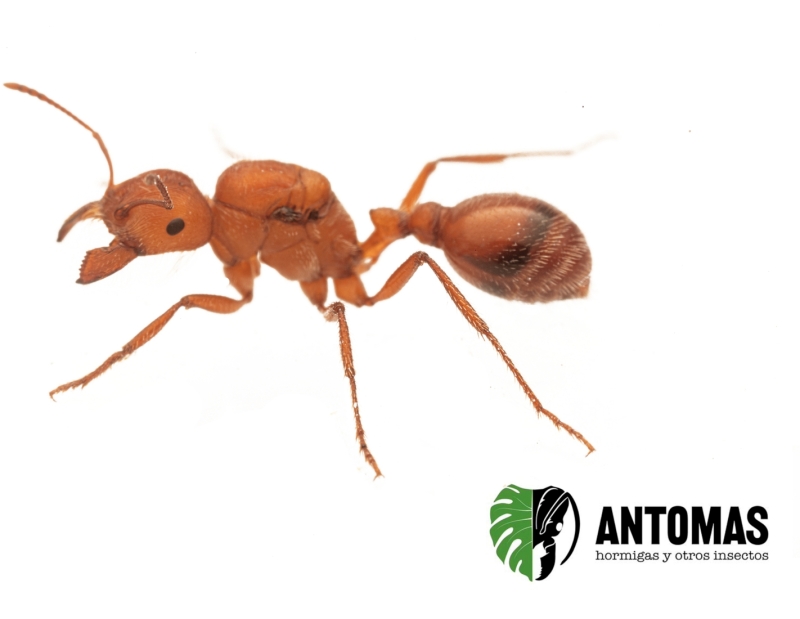
I. purpureus workers are medium-sized ants with long legs and a quick gait. There are no soldiers or separate major caste: in an Empire you will see workers of somewhat different sizes, with every intermediate, but all with the same shape.
Colour. Head orange to brick red, often with the front of the thorax the same shade, and gaster brown to black. In direct light, bluish, purplish or greenish iridescent sheens appear, which give the genus (iris, “rainbow”) and the species (purpureus, “purple”) their names. They vary from one population to another (Heterick and Shattuck 2011).
Large eyes. Well developed, as befits a diurnal forager that navigates by sight.
One-segmented waist. A petiole with a thin, upright scale, typical of the Dolichoderinae.
No functional sting. It defends itself by biting and with the odorous secretion of its anal gland; it does not spray formic acid.
Brood without cocoons. The pupae are naked and cream-coloured: in an Empire with lots of brood they are easy to tell apart from the larvae.
Queen. Clearly larger than the workers, darker in colour, and wingless after the nuptial flight.
Approximate measurements
Workers: up to about 10 mm long (Museums Victoria; Australian Museum).
Worker head width: 1.51–2.29 mm, in 84 workers measured by Heterick and Shattuck (2011); the variation is continuous.
Queen: about 12.7 mm, according to the only published measurement, that of a specimen described by Smith in 1858.
We do not quote figures from shops or forums: only published measurements.
Care in captivity
Difficulty: 2/5 – Beginner
The meat ant is hardy, eats everything and has no sting, and with an Empire the delicate stretch, the start, is already behind you. What a colony of this size asks for is not expertise but consistency: a good escape barrier, enough space, daily food and cleaning. If you provide that, it is one of the most spectacular and rewarding colonies you can keep.
What keeping an already large colony involves
Space from day one. With 500 or 1000 workers and their brood, the colony will not fit in a starter nest. It needs a formicarium of the right size from the moment it arrives; if you cramp it, it crowds into the foraging area, cleaning becomes harder and escapes increase.
Noticeable consumption. The nectar goes down every day and a cricket-sized prey item disappears in no time. Expect to feed it daily during the season.
More waste, more cleaning. A large colony produces a lot of waste: prey remains, dead workers and a growing refuse pile. Remove it regularly to prevent mould and mites.
Fast growth. This colony has gone from one queen to more than 500 workers in around a year. With warmth, sugar and protein it will keep growing quickly, so plan for expansions.
Moving a large colony by tipping it out. With hundreds of fast workers, the move needs preparation, a tray and a method (we explain it below).
Mass defence. When you open up, many come out at once and the alarm scent calls more. Nothing dangerous, but a good reason to keep the barrier ready at all times.
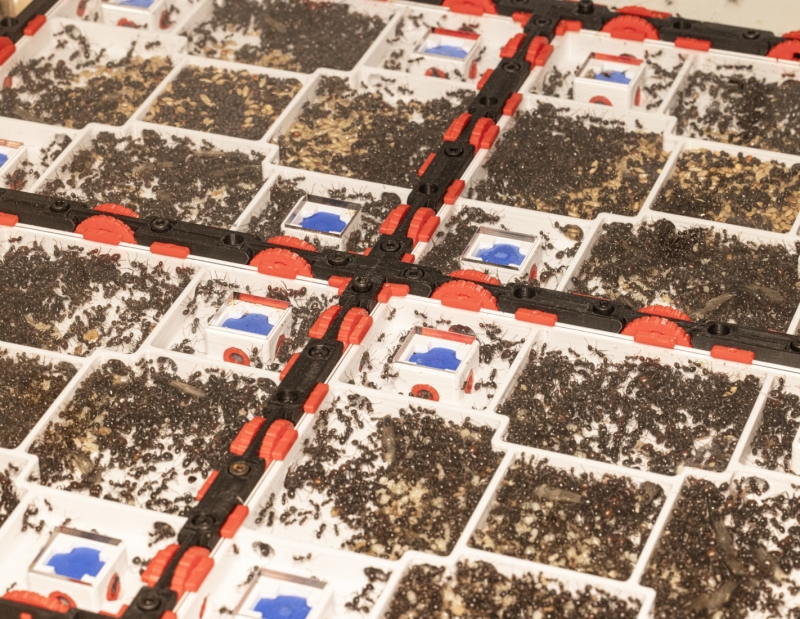
Plenty to observe. Trails, queues at the feeder, prey dismembered by dozens of workers, piles of pupae: at this size, the life of the colony is on show without waiting.
Recommended formicarium
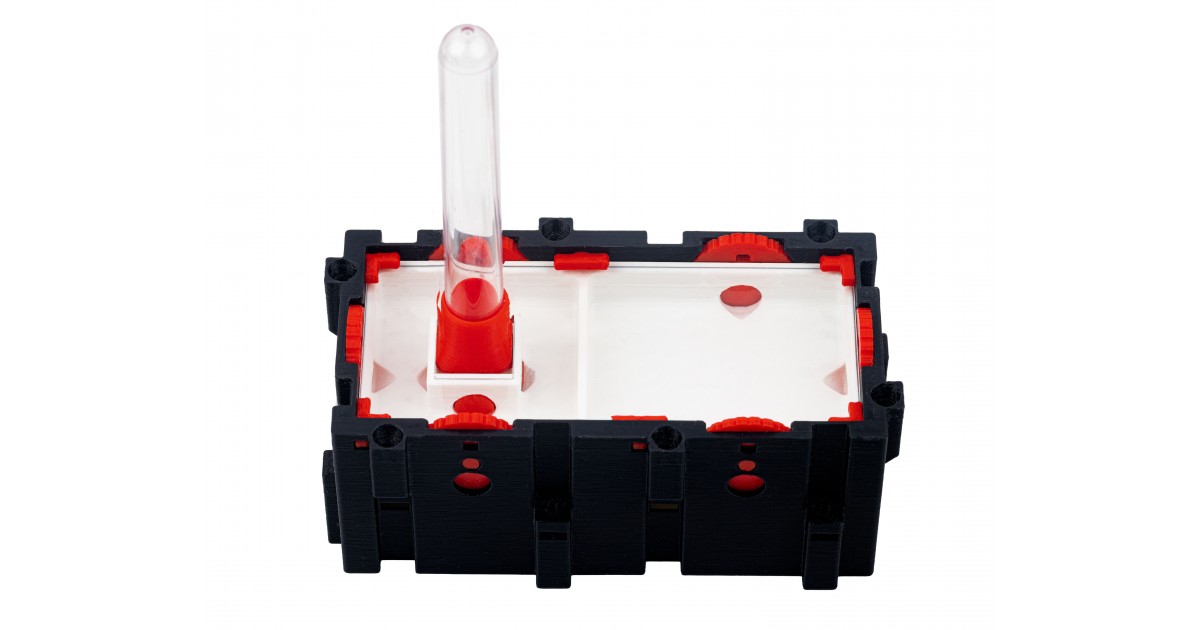
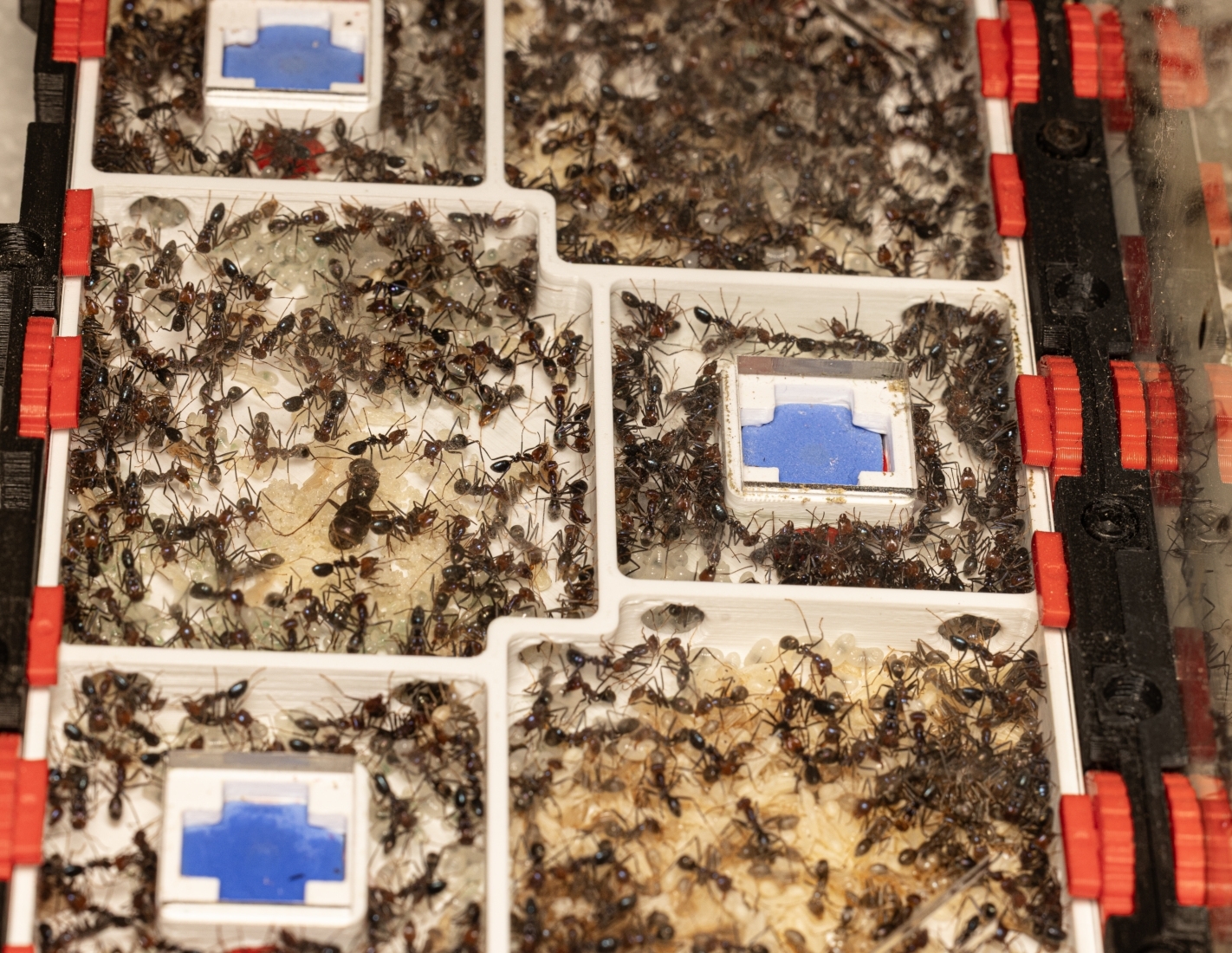
For the Meat Ant Empire we recommend starting straight away with a QBIK DUO from the Alpha range by Anthouse: modular, on the dry side and with humidity supplied by the water tubes, which is just what an ant from well-drained soils needs.
With 500 workers, a QBIK DUO with its foraging area is enough to start with.
With 1000 workers, or when the colony fills the DUO, add another module or a second connected foraging area. Make the most of the fact that in the wild the colony spreads across several nests linked by trails: a networked setup is the closest thing to its way of life.
Expand when needed, not before. Empty chambers become refuse dumps. The sign that it is time to expand is workers idling in the foraging area with no room inside.
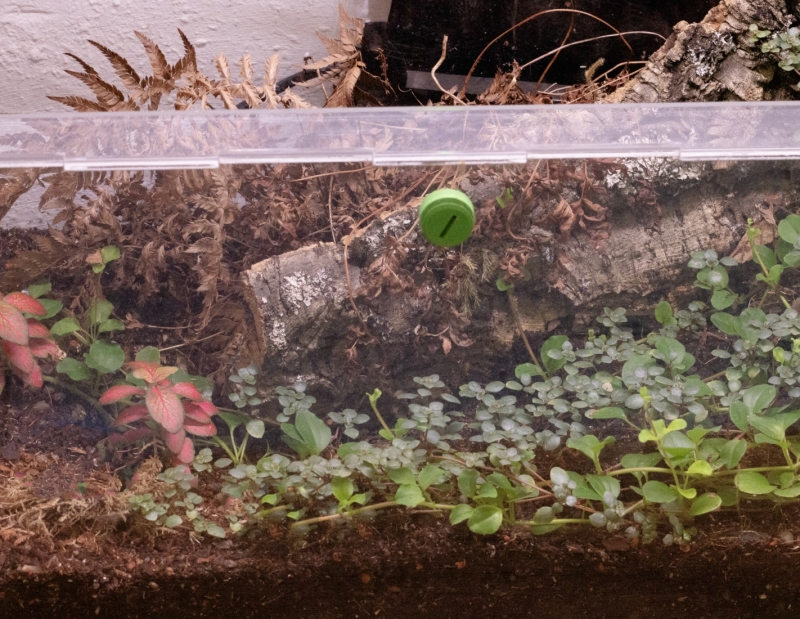
A large foraging area. The bigger, the better: with a thin layer of sand and some fine gravel, a flat stone or a piece of bark, you will see them lay out and clear their trails.
Water tube with cotton wool and a feeder in the foraging area, away from the barrier.
Temperature and humidity
Nest: 24–28 °C during the active season, with one side at 28–30 °C. Heat from one side and with a thermostat, so that the colony can choose where to place the brood.
Foraging area: with light and, if you like, a slightly warmer spot in one corner, away from the feeder, where workers warm up as they would on their mound.
Night: it can drop to 20–22 °C without any problem.
Humidity: a fairly dry nest, with a slightly humid area next to the water reservoir for eggs and larvae. No condensation on the walls.
Water: always available, in a test tube with water and cotton wool. With so many workers, check it often; if necessary, provide two.
Light: nest in semi-darkness and foraging area with room light or a lamp. Like any good diurnal ant, the brighter and warmer the foraging area, the more activity there will be.
Arrival and moving by tipping out
At Antomas we move colonies by tipping them out. With hundreds of workers as fast as these, the key is to have everything ready before opening:
Rest on arrival. Leave the colony as it arrives for a few hours or a day, somewhere quiet at 24–26 °C, with water and a drop of nectar.
Setup ready: QBIK DUO assembled, humid area prepared, water tube in place and, above all, the escape barrier already applied.
Everything on a large tray with its edges coated in barrier, so that any that fall do not reach the table.
Tip out into the foraging area, next to the nest entrance, with gentle taps. If the colony comes in several containers, one at a time, and the queen’s once there are already workers inside.
Stragglers: use a soft brush, or leave the container open inside the foraging area until they come out.
Lid closed and nest in darkness. Within a few hours they will have carried in the brood and the queen.
Expanding is not moving: the new module is added to the system and the colony occupies it when it needs to. If one day you have to transfer it to another formicarium, it is done the same way, by tipping out.
Feeding
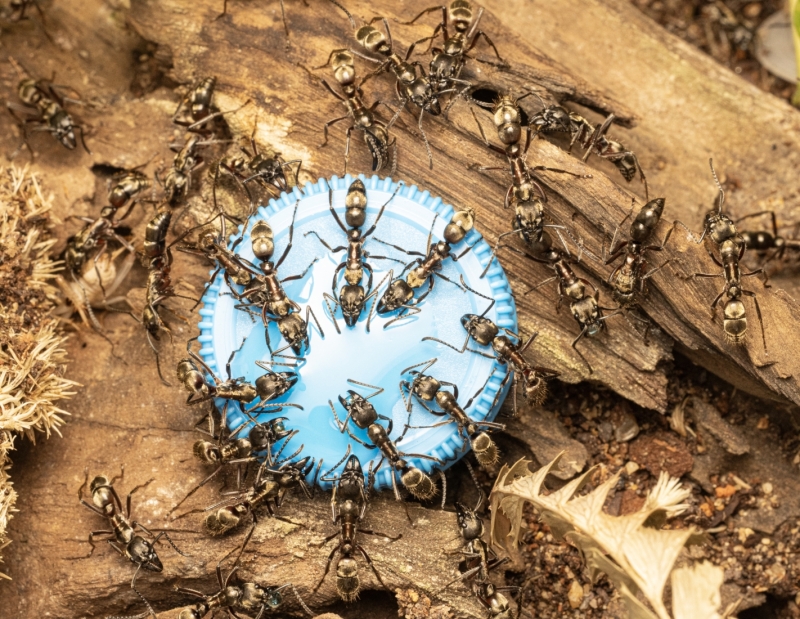
Sugar, every day. In the wild, much of the colony’s energy comes from honeydew from trees, and an Empire of hundreds of workers empties the feeder very quickly. Liquids go in a feeder, a container in which the drop stays spread out within the workers’ reach; cotton wool is no good, because it goes mouldy and spoils the nectar within a few days. With 1000 workers, two feeders prevent queues and jostling. It is a good idea to alternate sugars: our routine is Blue Sugar nectar by Anthouse 4–5 days a week and, on the other 1–2, a different nectar or water with honey. If you like, enrich the nectar with a little protein.
Protein, plentiful and varied. With so much brood at once, the colony asks for protein almost daily during the season. In Antomas’s experience, the more they get, the faster and the larger they grow. If you do daily maintenance and remove leftovers, it is better to overdo it than to fall short: the colony understands that it has resources to spare and raises more brood. If you will not be able to clean often, it is better not to overfeed. And change the prey every week, so that they do not always eat the same thing:
Flies and, now and then, as we do at Antomas, a small piece of raw chicken or turkey, with no salt or spices. They live up to their name, but remove it the next day.
Use bred insects, never ones collected outdoors, which may carry insecticides. Place food away from the barrier and remove leftovers within 24 hours at most; with a large colony, that habit is what separates a clean setup from a mouldy one.
Diapause
In much of its natural range, winter is cool and inland it frequently freezes; the colony retreats to its deep galleries and barely comes out. No study has shown that diapause is obligatory, but at Antomas we recommend respecting that rhythm with a gentle rest:
How long and at what temperature: around 3 months, roughly from 15 December to the end of February, at 12–15 °C, in a garage, a cellar or a cool room that does not drop below about 10 °C.
This colony’s calendar: it has been raised in our facilities following the seasons here, so it follows the European calendar. If you receive it in autumn, let it settle for a week or two at season temperature and then begin the cool-down.
Gradual entry and exit: switch off the side heating and lower the temperature a few degrees at a time over 2–3 weeks, with less protein each time; in March, raise it in stages back to 24–28 °C.
During the rest: water always, a little nectar if there are active workers and almost no protein. Check the colony from time to time, without disturbing it unnecessarily.
What you will see: from what we see at Antomas, during the rest the larvae stop developing and there are usually no eggs or pupae. With the warmth of spring, brood rearing resumes strongly.
Behaviour and observation
Watch without fear. A colony like this is meant to be watched, enjoyed and learnt from, not hidden away. A nest in semi-darkness and a lit foraging area are enough, and you can watch them whenever you like, gently and intervening only as much as necessary. This species, with good eyesight and very active by day, quickly gets used to your presence.
Ideas for observing an Empire:
Trails: put the food at the opposite end of the foraging area and watch how a stable route forms between the nest and the food, and whether they keep it the next day.
Clearing: with sand, fine gravel and the odd light obstacle, see whether they move material aside to shorten the route.
Recruitment: count how many workers reach a new prey item in the first minute and how many after ten.
Trophallaxis: workers returning from the feeder share the nectar mouth to mouth inside the nest.
Several modules: if the setup has more than one, see how workers and brood are distributed among them, as in their satellite nests.
Two short videos by Anthouse with the meat ant in action:
The Australian meat ant, on the Anthouse channel.
“The blood empire wants meat”: workers racing over their food, in a video by Anthouse.
Signs that something is wrong: if it does not grow in the middle of the season, it usually lacks heat or protein; if they crowd into one corner, the rest of the nest may be too dry or cold; mould in the chambers indicates too much humidity or forgotten food; and many workers idling in the foraging area are asking for more space.
Escapes and handling
With hundreds of fast, curious workers, escapes are the point that demands most attention, especially at feeding time.
Escape barrier on the upper part of the foraging area walls: paraffin oil or petroleum jelly, or PTFE (Fluon). Renew it as soon as it collects dust or sand, which make it useless.
A tight-fitting lid, with fine mesh over the vents and no gaps at connections or plugs.
Nothing that can act as a bridge to the barrier: no long twigs, forgotten tweezers or tubes leaning against the wall.
Open only as much as needed and always over a tray, with long tweezers and a soft brush.
It does not sting, it bites. With no functional sting, it defends itself with repeated bites and its odorous secretion. It is a nuisance, not a danger, but with hundreds of defenders, putting your hand in the foraging area is asking for a shower of bites. With children or pets at home, keep the formicarium closed and out of their reach.
Never release it: it is an Australian species.
What not to do
Put a colony of 500 or 1000 workers in a small nest or one with a tiny foraging area.
Suddenly give it far more space than it can occupy.
Add another queen or merge it with another colony.
Open the formicarium without the barrier ready or without a tray.
Heat the whole setup evenly or keep it cold and dark in the middle of the season.
Wet the whole nest or let the water in the tube run out.
Put the nectar on cotton wool, always give the same prey or skimp on protein.
Leave food remains for more than a day.
Go above 15 °C during diapause, or enter and leave it without a transition.
Scientific sources
This care sheet is based on the scientific literature on Iridomyrmex purpureus, on Antomas’s care sheet for the species and on our experience with its colonies. Main references:
Ettershank, G. (1968). The three dimensional gallery structure of the nest of the meat ant Iridomyrmex purpureus (Sm.) (Hymenoptera: Formicidae). Australian Journal of Zoology 16: 715–723. doi:10.1071/ZO9680715
Greaves, T. & Hughes, R. D. (1974). The population biology of the meat ant. Journal of the Australian Entomological Society 13: 329–351. doi:10.1111/j.1440-6055.1974.tb02212.x
Hölldobler, B. & Carlin, N. F. (1985). Colony founding, queen dominance and oligogyny in the Australian meat ant Iridomyrmex purpureus. Behavioral Ecology and Sociobiology 18: 45–58. doi:10.1007/BF00299237
van Wilgenburg, E., Mulder, R. A. & Elgar, M. A. (2006). Intracolony relatedness and polydomy in the Australian meat ant, Iridomyrmex purpureus. Australian Journal of Zoology 54: 117–122. doi:10.1071/ZO05075
van Wilgenburg, E. & Elgar, M. A. (2007). Colony structure and spatial distribution of food resources in the polydomous meat ant Iridomyrmex purpureus. Insectes Sociaux 54: 5–10. doi:10.1007/s00040-007-0903-3
Heterick, B. E. & Shattuck, S. (2011). Revision of the ant genus Iridomyrmex (Hymenoptera: Formicidae). Zootaxa 2845: 1–174. doi:10.11646/zootaxa.2845.1.1
Andrew, N. R., Hart, R. A., Jung, M.-P., Hemmings, Z. & Terblanche, J. S. (2013). Can temperate insects take the heat? A case study of the physiological and behavioural responses in a common ant, Iridomyrmex purpureus (Formicidae), with potential climate change. Journal of Insect Physiology 59: 870–880. doi:10.1016/j.jinsphys.2013.06.003
Cabanes, G., van Wilgenburg, E., Beekman, M. & Latty, T. (2015). Ants build transportation networks that optimize cost and efficiency at the expense of robustness. Behavioral Ecology 26: 223–231. doi:10.1093/beheco/aru175
Bottinelli, A., van Wilgenburg, E., Sumpter, D. J. T. & Latty, T. (2015). Local cost minimization in ant transport networks: from small-scale data to large-scale trade-offs. Journal of the Royal Society Interface 12: 20150780. doi:10.1098/rsif.2015.0780
Card, A., McDermott, C. & Narendra, A. (2016). Multiple orientation cues in an Australian trunk-trail-forming ant, Iridomyrmex purpureus. Australian Journal of Zoology 64: 227–232. doi:10.1071/ZO16046
Middleton, E. J. T., Garnier, S., Latty, T. & Reid, C. R. (2019). Temporal and spatial pattern of trail clearing in the Australian meat ant, Iridomyrmex purpureus. Animal Behaviour 150: 97–111. doi:10.1016/j.anbehav.2019.02.006
Oberhauser, F. B., Middleton, E. J. T., Latty, T. & Czaczkes, T. J. (2019). Meat ants cut more trail shortcuts when facing long detours. Journal of Experimental Biology 222: jeb205773. doi:10.1242/jeb.205773
Han, S. & Elgar, M. A. (2020). Territoriality in ants revisited: iconic collective displays reflect resource, not territorial defense in meat ants Iridomyrmex purpureus. The Science of Nature 107: 38. doi:10.1007/s00114-020-01693-y
Han, S., Chen, W. & Elgar, M. A. (2022). An ambiguous function of an alarm pheromone in the collective displays of the Australian meat ant, Iridomyrmex purpureus. Ethology 128: 70–76. doi:10.1111/eth.13241
Dificultad
Novice
No reviews yet
Comments (0)
No customer reviews for the moment.
Your review appreciation cannot be sent
Report comment
Are you sure that you want to report this comment?
Report sent
Your report has been submitted and will be considered by a moderator.
Your report cannot be sent
Write your review
Review sent
Your comment has been submitted and will be available once approved by a moderator.