Difficulty: 3/5 – Intermediate
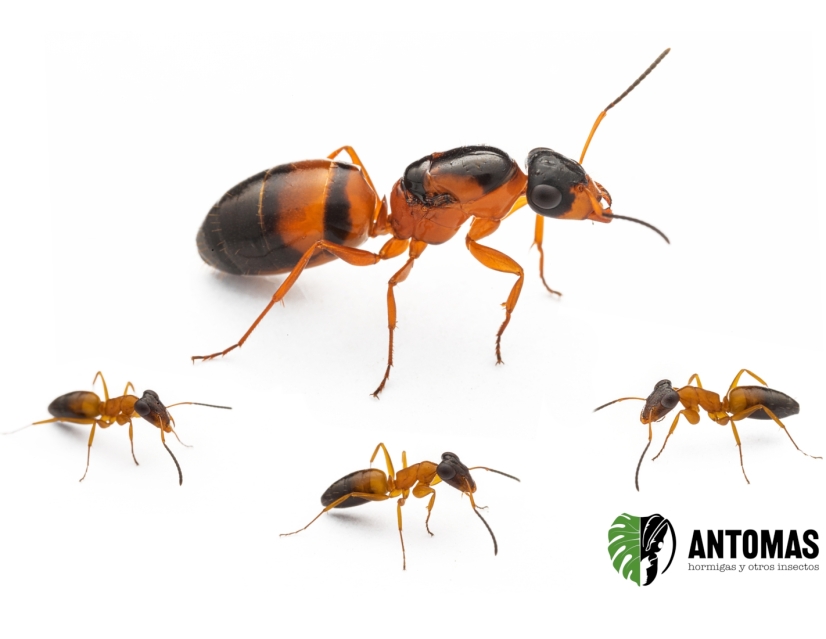
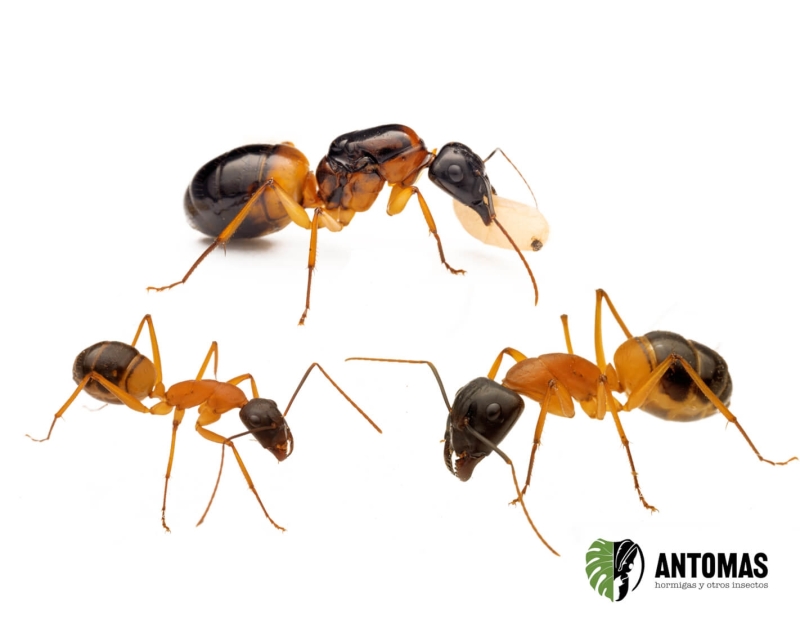
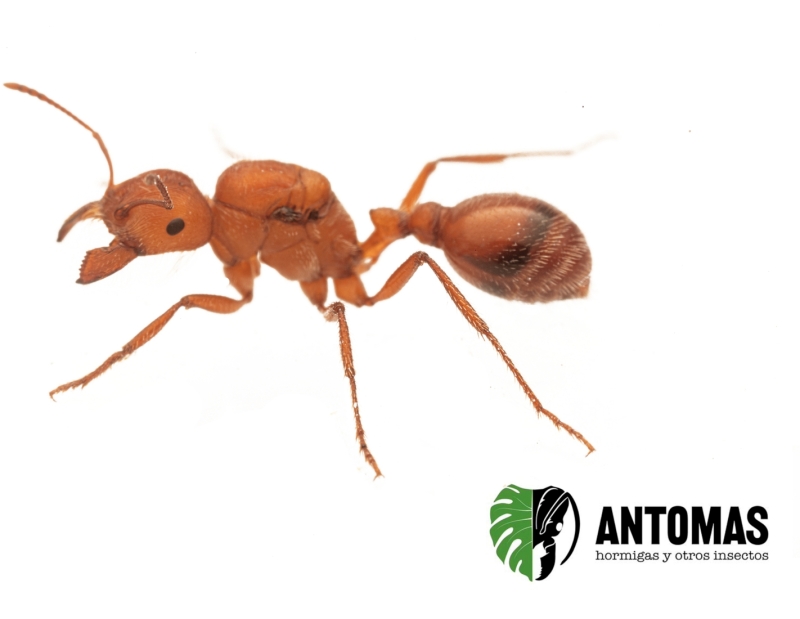
The Australian Strobe Ant: a small formicine with a black head and an orange thorax, and huge eyes set at the rear corners of the head that let it see behind as well. It runs in full sun over tree trunks and open ground with a "strobing" gait of sudden starts and stops unlike that of any other ant in the hobby. We ship young colonies with their queen, workers and brood. In short: QBIK ONE or Qbik Wild One P 1C with small chambers; nest at 23–27 °C and 50–70 % humidity with a gradient, on the dry side; a well-lit foraging area with vertical branches or bark; Blue Sugar Nectar in a feeder and varied protein; no diapause, with an optional mild rest at 18–20 °C. They are extremely fast: a serious escape barrier and a lid, always.
Opisthopsis rufithorax Emery, 1895 is one of those ants you recognise by the way it moves before you notice what it looks like. Its workers, barely 4–5 mm long, cover the trunks of eucalypts and the floor of Australian open woodland in full sun, stopping dead every few centimetres as if lit by a disco strobe light. Hence the English name naturalists use for the whole genus, strobe ants, and the one we use in our shop: Strobe Ant.
The other great oddity is in the head. Opisthopsis have large, bulging eyes placed far back, at the rear corners of the head, so they look sideways, forwards and backwards too. This is an ant that lives by sight: it finds its way by sight, escapes by sight and, in your setup, follows with its eyes whatever happens on the other side of the glass. In this care sheet we bring together what is known about it, which is not much, always separating what science says from what keepers report and from what we have learned at Antomas.
Biology
"Eyes behind": a genus named after its gaze
The genus name says almost everything. Opisthopsis joins two Greek roots, opisthen, "behind", and opsis, "sight": "the one with eyes behind". Carlo Emery erected the genus at the end of the 19th century, and William Morton Wheeler, in the revision he devoted to it in 1918, described it like this:
- Very large, prominent eyes, elliptical in outline.
- Very fine facets, that is, many small, tightly packed ommatidia.
- Placed at the posterior corners of the head, rather than halfway along the sides as in most ants.
According to Wheeler, they have "extremely acute vision" and "look backward as well as laterally and forward". He does not explain the etymology in these words; we infer it from the Greek, but it fits his description like a glove. The result is an ant with an almost panoramic field of view: hard to take by surprise from behind.
An eye mounted "the wrong way round"
In most ants, the finest and most sensitive part of the eye faces forwards, in the direction the animal walks. Not in Opisthopsis. The researcher G. M. Ramón-Cabrera, from Ajay Narendra's group at Macquarie University (Australia), studies the visual ecology of the genus, and his two study species are precisely O. haddoni and O. rufithorax. By counting ommatidia on casts of the eyes of our species, he found two things:
- A relatively high number of ommatidia for an ant of its size.
- The widest ommatidia, which are the ones that gather the most light, lie in the dorsal and posterior region of the eye, that is, up and behind, whereas in most ants they are concentrated at the front.
His PhD thesis adds, as far as we have been able to read in its abstract, that Opisthopsis eyes are relatively large and set further back than those of other formicines. Why it pays to have the most sensitive part of the eye looking up and backwards has not yet been published in detail, but it makes perfect sense for an animal that runs in full sun on vertical trunks and needs to spot in time whatever is approaching. To study eyes like these, the same group has published the techniques for investigating the anatomy of the ant visual system that it uses in the lab (Ramirez-Esquivel and colleagues, 2017).
Pearl-coloured eyes
A curiosity that Wheeler noted in 1918 and that is rarely mentioned: the retinal pigments of Opisthopsis are so unstable that they vanish when specimens are kept in alcohol, and in many species of the genus the eyes of dry specimens are pale grey or whitish, almost pearl-coloured. In other words, many of the old descriptions were made from "bleached" eyes.
Wheeler does not say what colour the eyes of living O. rufithorax are, so we will not claim anything. If you keep a colony, a good loupe or a macro lens will let you check for yourself: in an ant that lives by sight, it is worth looking it in the eye.
The strobing gait: run, brake, run
Anyone seeing an Opisthopsis on the move for the first time usually thinks something is wrong with the picture. The workers do not advance smoothly like a Camponotus: they make short, abrupt dashes separated by instant stops, so they look as if lit by a strobe light. Wheeler already spoke of "quick, jerky movements" and compared them with those of the big-eyed Neotropical Pseudomyrma, also highly visual ants.
The only study that has measured this gait was carried out on the sister species, O. haddoni. James S. Waters and Terrence P. McGlynn filmed it at 240 frames per second and published their results in 2018:
- More time still than moving: workers stand still roughly twice as long as they are in motion.
- A normal insect gait: they use the usual tripod gait, three legs on the ground and three in the air. They do not jump, although for very brief moments all six legs are off the ground.
- Starting "on the cue" of the antennae: running resumes just as they fully raise their antennae (more on this in the next section).
There are no measurements for O. rufithorax itself, but its way of moving is the same one that gives the genus its name. Whatever holds for O. haddoni is, with due caution, the closest thing we have.
Antennae that tap the ground at every stop
The most surprising part of Waters and McGlynn's study happens during the pauses. At each stop, the workers tap the ground with the tips of their antennae. The authors showed this with a classic trick: they made them walk on smoked glass, where every touch leaves a mark, and the sequence of taps between dashes was recorded.
What is all this for? There is no proven answer. Two hypotheses are put forward:
- Vision cannot keep up. This is the one most often cited: they run so fast that their eyes cannot process the image on the move, so they need to stop to "refresh" what they see. The same has been proposed for certain tiger beetles, which also run in bursts.
- Camouflage. Jerky movement would be harder for a predator to track than continuous movement.
The antennal tapping suggests that at each pause they also pick up chemical or tactile information from the ground. Whatever the explanation, it is a behaviour you can see perfectly well at home, in the foraging area, without any high-speed camera: you just need to watch closely.
Navigating by the landscape
Many ants related to Opisthopsis, starting with Camponotus, rely heavily on chemical trails to travel to and from food. As Ramón-Cabrera explains in the outreach material on his work, strobe ants seem to work differently: they are guided mainly by their large eyes and by the visual panorama (the outline of the trees, the contrast between sky and canopy) rather than by pheromone cues.
This fits what you see in the field and at home: workers that go out alone or in very small groups, without forming the processions of other formicines, and that explore with constant stops to look around. His thesis also studies how they react to stimuli rushing towards them, what is known as looming: an object that rapidly grows in the visual field, such as a hand, a jumping spider or an ant approaching at full speed.
Sprinters in full sun
While many ants of the Australian bush wait for dusk, O. rufithorax is a clearly diurnal species. Ramón-Cabrera describes workers leaving the nest at dawn, heading to particular trees to look for food and returning at nightfall: a working day from sunrise to sunset.
Wheeler, who watched them in eastern Australia over a century ago, saw them "running in the hot sunshine up and down the trunks of large trees, especially eucalypts and Melaleuca". Of O. rufithorax in particular he noted that they ran on eucalypt trunks and on the ground. And he added a detail that gives an idea of their surroundings: they shared those trunks with workers of Camponotus, Calomyrmex, Polyrhachis and Podomyrma, a real neighbourhood of arboreal formicines and myrmicines.
For the keeper the takeaway is simple: this is an ant that seeks light when foraging and that climbs. We will make use of this in the setup with vertical branches and bark, so they can "patrol" as they would on a trunk.
Flee rather than fight
With small mandibles and no sting, O. rufithorax relies not on strength but on vigilance and speed. Wheeler reported that they dodged with "clever zigzag movements" and that it was "almost impossible to seize them with forceps or fingers": the only way he found to catch them was to slap the trunk quickly with his hand.
What are they running from? In his thesis, Ramón-Cabrera studied how strobe ants react to two very visual, very fast predators:
- Jumping spiders (family Salticidae), ambush hunters with excellent eyesight.
- Jumping ants of the genus Myrmecia, the famous Australian jack jumpers, which also hunt by sight.
Against enemies like these, seeing behind you and reacting first is a matter of life and death. At home, that same strategy translates into discreet, evasive behaviour: when disturbed, they tend to flee or hide rather than attack. Some popular guides say that if disturbed they also drop off the substrate; we have not seen this confirmed in any study, but it fits everything above.
Nest in the ground, pantry in the trees
Given their arboreal look, Wheeler expected to find Opisthopsis nesting in trees. He was wrong, at least in part, and he said so himself: nesting habits vary within the genus.
- O. rufithorax: the Swedish naturalist Eric Mjöberg found its nests in clay, around the roots of trees (Forel, 1915, cited by Wheeler). Australian popular guides describe a small nest in the ground with a single entrance.
- O. haddoni: lives in termite mounds.
- O. linnaei and O. manni: nest in logs.
So our species gets the best of both worlds: it sleeps and rears its brood underground, sheltered by the roots, and goes out to forage up the trunk. That is exactly the layout we will reproduce at home: a nest with small chambers and a foraging area with vertical elements.
Hunters, scavengers and sweet tooths
No study describes the natural diet of O. rufithorax in detail, and it is worth saying so plainly. What is known:
- Hunting: workers catch small insects, alone or in groups, both on the ground and on trunks (Australian popular guides).
- Scavenging: some guides present it as a generalist scavenger, even able to raid rubbish bins in urban areas. They cite this from a guide to the ants of Western Australia that we have not been able to read, so we take it with caution.
- Sugar: all ants of its tribe, the Camponotini, are heavy consumers of honeydew and nectar (we explain why in the next section). That O. rufithorax tends aphids or scale insects is not documented; it is a reasonable inference from its group.
Keepers agree that in captivity they readily accept sugar and insects, as you would expect from an opportunistic ant. In the feeding section we explain exactly how we do it at Antomas.
A bacterium that lives inside its cells
Like all Camponotini, Opisthopsis carries Blochmannia, a symbiotic bacterium that lives inside specialised cells of the gut. Its role is nutritional: it makes amino acids and other nutrients that a honeydew-rich diet, very poor in nitrogen, does not provide.
In 2009 Jennifer Wernegreen and her team reconstructed the evolutionary history of this alliance and reached a conclusion with an almost literary title: "one nutritional symbiosis begat another". According to their analysis, the tribe acquired Blochmannia precisely by tending sap-feeding insects, such as aphids and scale insects, which have their own symbiotic bacteria. What is more, Opisthopsis has its own lineage of Blochmannia, distinct from that of Polyrhachis and from the one shared by Camponotus, Calomyrmex and Echinopla. The phylogeny of the tribe published in 2025 by Philip S. Ward and colleagues confirms that bacteria and ants have evolved together throughout the history of the tribe.
A cousin of Camponotus, not its descendant
Anyone who has kept Camponotus or Polyrhachis will notice a family likeness in Opisthopsis. That is no coincidence: all three genera belong to the tribe Camponotini, within the formicines, together with Colobopsis, Calomyrmex and Echinopla, according to the classification revised by Ward, Blaimer and Fisher in 2016.
- Much in common with Camponotus: Wheeler stressed that Opisthopsis is "evidently very closely related" to it; it has the same proventriculus (the valve that controls the passage of food from the crop to the stomach) and almost identical males.
- But a more primitive trait: it retains a cell in the forewing, the discoidal cell, which Camponotus has lost. That is why Wheeler concluded that Opisthopsis does not descend from Camponotus, but that both come from a common ancestor.
- Modern genetics: following the analyses of formicines using hundreds of genes by Blaimer and colleagues (2015), the phylogeny of the tribe by Ward and colleagues (2025), covering 225 species, recognises eight lineages within the tribe, three of them very large (Camponotus, Colobopsis and Polyrhachis). Exactly where Opisthopsis fits does not appear in what we have been able to consult.
- No sting: like all formicines, instead of a sting it has an acidopore, the opening through which they spray formic acid.
Its closest species is O. pictus Emery, 1895. Wheeler went as far as writing that O. rufithorax is so close to it that it could be considered a subspecies or variety, and that one form of pictus is "clearly transitional" towards our species. Today both are kept as valid species, and O. rufithorax has no known synonyms or subspecies in the sources we have consulted.
Small colonies, slow lives
This is where science falls short: neither colony size nor queen number has been published for O. rufithorax. The closest data are Wheeler's observations on O. haddoni:
- Small colonies of about 100–200 workers, with one or several dealate queens.
- White larvae with short hairs.
- Cocooned pupae, pale ochre in colour, as in most formicines.
- A possible piratical habit: in O. haddoni nests he found workers of two other species and suggested it might steal other ants' pupae. It is an old hypothesis that nobody has confirmed.
The little that keepers report points the same way: modest colonies, far from the huge populations of other Australian genera, and slow development. An Australian keeper who followed a colony for months remarked that the brood "takes ages to eclose", but that the workers "seem to live a long time". It is an isolated opinion, but it matches what you would expect from a species with small colonies.
The most widespread Opisthopsis in Australia
The genus has 13 valid species spread across Australia, New Guinea, the Bismarck Archipelago, the Solomon Islands and Halmahera. Emery described O. rufithorax in 1895 from a worker from Queensland, and Forel described the queen in 1915. Since then it has been known as the species of the genus with the widest range and the one that reaches furthest south:
- East: Queensland, from north to south, and New South Wales.
- Centre and south: South Australia, including the Flinders Ranges.
- West: Western Australia. Some sources state that it is the only Opisthopsis in the south-west of that state, a point we have not been able to check in the original guide.
Its typical habitat is lowland open eucalypt woodland, where it is common. In the eastern part of its range the climate is subtropical: warm, wet summers, with averages of 25–26 °C and highs of 30–31 °C, and mild, dry, sunny winters, with days of 22–23 °C and nights of 8–10 °C, without regular frosts. Southern and inland populations cope with cooler, drier winters. This range of climates suggests a certain tolerance, but at home it does best with stability: neither soaked nor cold.
Size and morphology
A small, slender formicine with no sting and no soldiers: the workers are monomorphic or show very weak dimorphism, with the largest having a slightly broader head (Wheeler, 1918). Everything about it is built for seeing and running, not for biting hard.
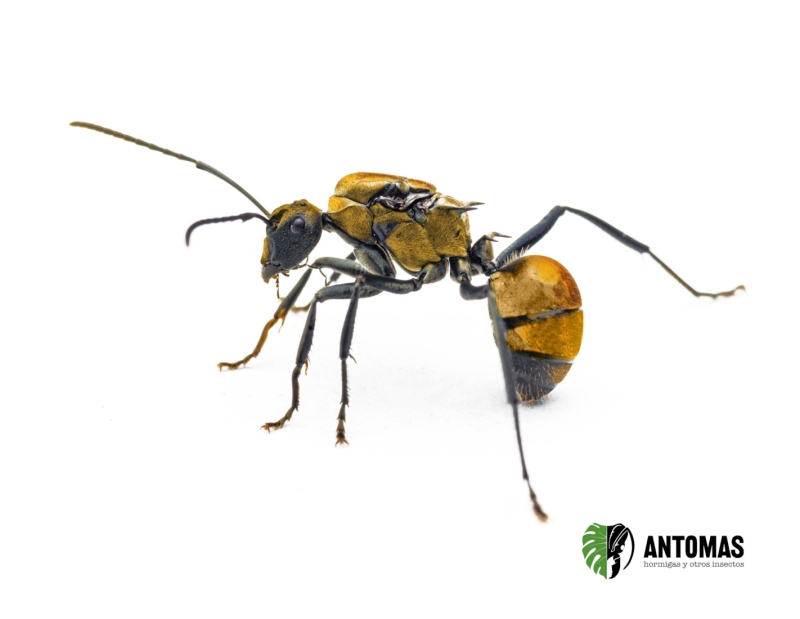
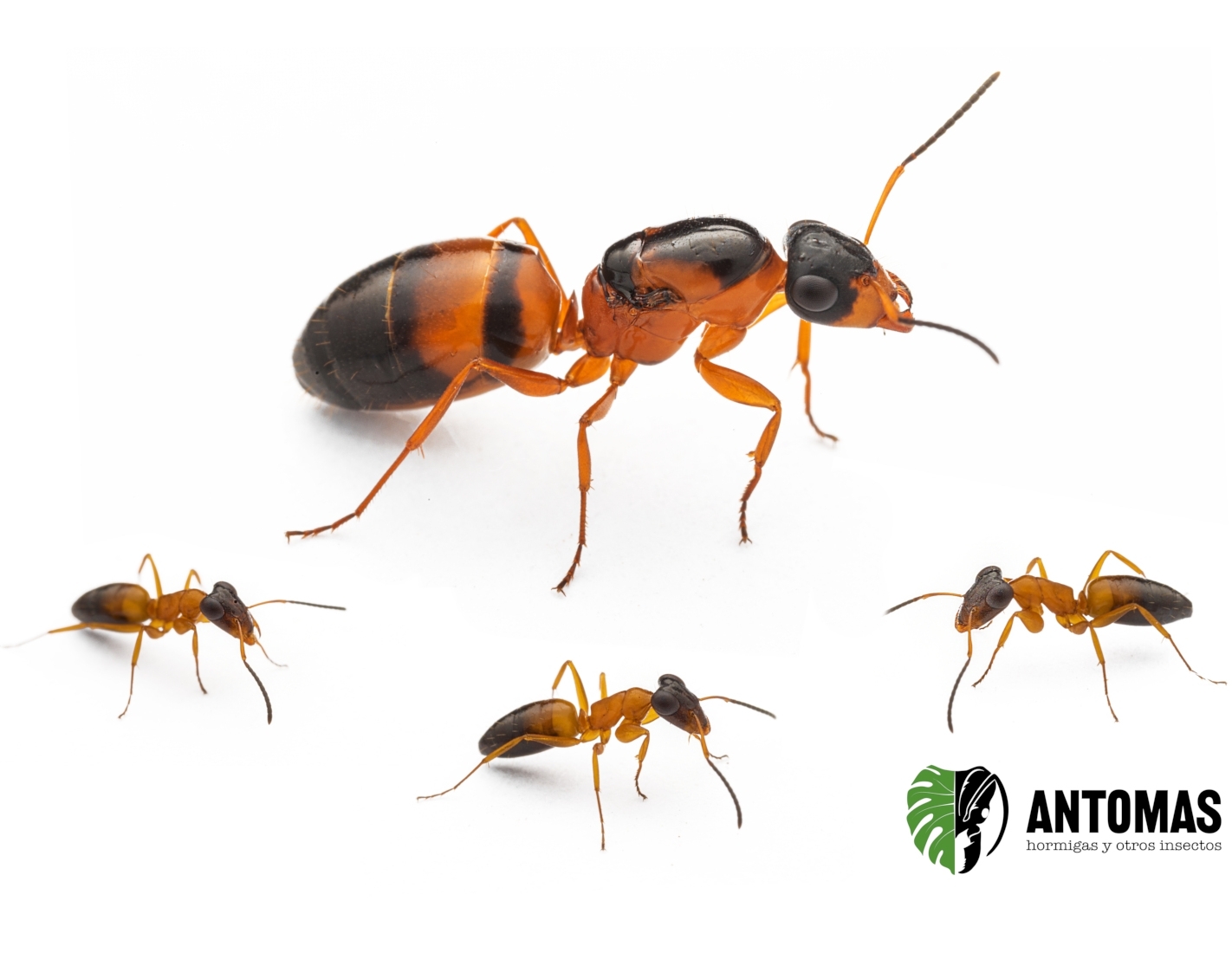
- Worker: black head and antennae; thorax, legs and petiole yellowish orange; last tarsal segment blackish; black gaster with the first two segments yellowish orange, sometimes with the sides and rear of the second darkened. This is the pattern behind the species name (rufithorax, "reddish thorax") and behind the English name black-headed strobe ant.
- Queen: much paler than her workers, mostly yellowish red, with the occiput, vertex and antennae brown, and the scutellum and a narrow band on each gastral segment black. Her head is broader behind than the worker's, the cheeks are not swollen, the thorax is as broad as the head and the eyes and ocelli are well developed (Forel, 1915, in Wheeler, 1918). An Australian keeper described her as an "attractive orange colour".
- Male: not described for this species. In the genus, males are the size of the workers and look very much like those of Camponotus.
- Eyes: large, elliptical, with extremely fine facets and placed at the posterior corners of the head. Workers normally have no ocelli.
- Mandibles: small and triangular, with five teeth. Nothing like those of the long-jawed Australian predators.
- Antennae: 12-segmented in females and 13-segmented in the male.
- Legs: long and slender, with thickened fore femora.
- Body: smooth, somewhat shiny and with very few hairs; the petiolar scale is thin.
- Metamorphosis: in the genus, pupae spin cocoons, as in almost all formicines. One keeper saw a naked pupa in his colony; it may be occasional.
A note for anyone who collects Opisthopsis: the species of the genus are told apart mainly by how the black and yellow markings are distributed. Wheeler even wrote that a "lumping" taxonomist could regard them all as varieties of a single, very variable species. Colours are therefore a good clue, but not definitive proof.
Approximate measurements
- Workers: 4–5 mm (Wheeler, 1918)
- Queen: 7–10 mm (Forel, 1915, as reported by Wheeler)
- Male: no published measurements for this species; in the genus, the size of the workers
- Soldiers: none
Larger figures circulate online, such as 6–8 mm workers or queens up to 14 mm. They do not come from published measurements, so we stick to those in the scientific descriptions.
Care in captivity
Difficulty: 3/5 – Intermediate, and why it is worth it
O. rufithorax is still rare in the hobby and very poorly documented in captivity: there are barely a couple of published keeper journals. Its diet is simple and it is not aggressive, but we rate it as intermediate for these reasons:
- Speed. Tiny, extremely fast, climbing workers that are almost impossible to catch if they get out. The setup has to be designed from day one so they cannot escape.
- A nervous temperament. They react instantly to any movement, and maintenance has to be done calmly.
- Environmental sensitivity. It copes badly with extremes: neither a waterlogged nest nor a parched one, nor prolonged cold.
- Slow growth. Small colonies that develop slowly and call for patience.
In return, you get something few ants offer: a species that looks at you. Watching the workers stop dead, feel the ground with their antennae, turn their heads towards your hand on the other side of the glass and dart off again is a show in itself. If you like Camponotus and Polyrhachis, this Australian cousin will show you another way of being an ant.
Recommended parameters
- Nest temperature: 23–27 °C. This is the range we work with at Antomas, and it matches the summer in its habitat. A heat cable or heat mat with a thermostat at one end of the nest creates a gradient so the colony can choose.
- Foraging area: room temperature, or slightly warmer if the room is cold; here light matters more than heat.
- Humidity: 50–70 %, with a moderate gradient: one part of the nest slightly damp and the rest drier. This is an ant of open eucalypt woodland, not rainforest: avoid both drying out and a saturated nest.
- Ventilation: good, so that water does not condense in the chambers.
- Water: always available, in a test tube with cotton wool in the foraging area.
- Light: nest in semi-darkness and foraging area well lit, with a day–night rhythm. It is a diurnal species that comes out with the sun: light in the foraging area encourages it to explore.
- Diapause: not needed (see "Diapause and winter rest").
Setup and recommended formicaria
In the wild, the nest is a small system of galleries in the ground, in clay beside the roots, with a single entrance. At home we aim for the same: small chambers, good ventilation and localised humidity. At Antomas we recommend two Anthouse formicaria; choose depending on whether you prefer to see the whole interior or a more natural look.
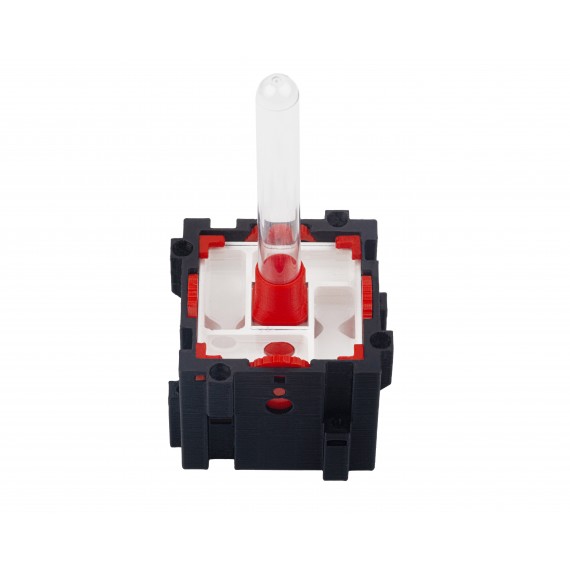
If you want a modular, clean nest where you can see everything, the QBIK ONE, the smallest in the Qbik Alpha range, is perfect for a starting colony:
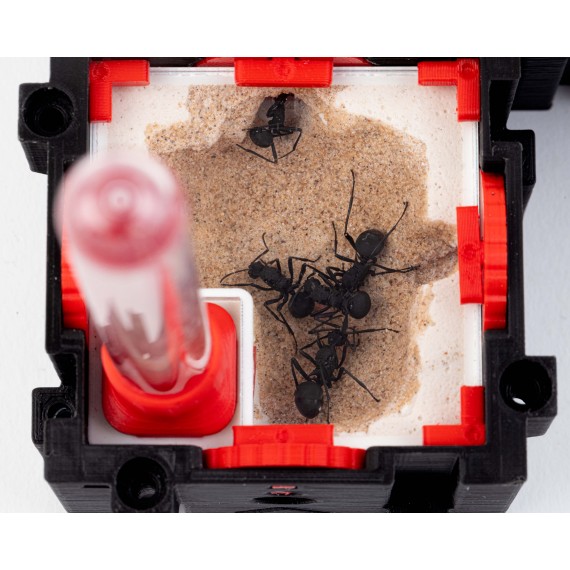
If you prefer a plaster nest, which keeps humidity stable with little effort and is closer to the clay they nest in, the choice is the Qbik Wild One P 1C:
Natural or semi-natural nests also work, with substrates such as sand, clay soil or coco fibre, as long as they have good ventilation and small chambers. Whatever the nest, match its size to the population: a small colony in a huge nest leaves empty chambers that fill up with waste, mould and mites. When you see workers that no longer fit inside and stay in the foraging area, it is time to expand; in the Qbik Alpha range, the next step is the QBIK DUO.
In this species, the foraging area is half the show:
- Vertical branches or bark. They recreate the eucalypt trunks they run up and down in full sun. Fix them firmly and well away from the barrier and the lid, so they cannot act as a bridge to the outside.
- Partly clear ground, with a little sand or dry soil, so you can watch their strobing gait.
- Light: a bright foraging area encourages them to come out. The nest, on the other hand, keeps its dark area.
- Water tube and feeder fixed in place, always in the same spot.
- Escape barrier and lid from day one (see "Escapes and barriers").
A practical detail from one keeper: his queen stayed restless in a red tube holder, as if she could see through it, and only calmed down once the tube was covered with something opaque. In an ant with eyesight like this, red cellophane is not enough: for the dark area of the nest, use an opaque cover or sleeve. Beyond that, there is no need to keep it in the dark: this is a species to be watched.
Founding and how the colony arrives
Almost nothing is known about how O. rufithorax founds colonies in the wild: there are no nuptial flight dates and no studies of how its first workers develop. Shops present it as claustral, meaning a queen that raises her first workers sealed in and without eating, living off her reserves, but that is a commercial claim, not a scientific one; in other members of the tribe, claustral founding is the norm.
At Antomas you will not have to go through that phase: colonies are shipped young, with their queen, workers and brood. What one keeper who followed a colony from a queen with brood reports gives an idea of the pace:
- The first worker emerged about six weeks after he got the queen.
- In the middle of the southern winter the colony was still rearing brood: it had seven workers and a dozen larvae.
- His overall impression: very slow development, but long-lived workers.
With a small colony, what matters most is the right nest size, water at all times, stable warmth and varied, regular food. Some shops advise moving from the test tube to the nest once the colony passes about 15 workers; with Antomas colonies you can do it as soon as your setup is ready.
Arrival and moving in by tipping
When the colony arrives, leave it for a few hours somewhere quiet, at 23–27 °C and free of vibrations, and check that it has water. We move it into the nest by tipping it in, and with this species it pays to prepare as if you were working with ants that escape, because that is what they are:
- Everything ready before opening: nest with its damp area, foraging area set up, water, feeder and escape barrier already in place.
- Inside the foraging area or over a tray with a barrier: never open the tube in the open on your table.
- Gentle tipping: open the tube next to the nest entrance and tip out all its contents, queen and brood included; nudge the stragglers along with a soft brush.
- Close the lid straight away and leave the nest with its dark area. Within a few hours they will have settled the brood.
To move them later into a larger module, follow the same procedure, always with the barrier checked.
Feeding
It is an opportunistic ant and easy to feed. At Antomas we follow two rules: a varied and plentiful diet.
Sugar. As a true Camponotini, sweet food is an essential part of its diet:
- Staple: Anthouse Blue Sugar Nectar, 4–5 times a week.
- Variety: 1–2 times a week, another sugary liquid or nectar, or diluted honey.
- Extra: you can add a little protein to the nectar.
- Always in a feeder, never on cotton wool: on cotton the liquid ferments and goes mouldy very quickly. Use a traditional or home-made feeder where the drop stays spread out and accessible.
Protein. This is what makes the colony grow: the queen needs it to lay and the larvae to develop. Offer small prey, whole if tiny or in pieces if large, and change the type of insect from one week to the next:
- Fruit flies (Drosophila) and small flies, ideal for young colonies.
- Micro crickets or pieces of cricket; one keeper saw his queen hold a piece of cricket with her front legs and eat it herself.
- Termites.
- Small pieces of mealworm (Tenebrio) or cockroach.
Use feeder insects bred for the purpose: one with insecticide residues can wipe out the colony.
How much. The more protein, the better and faster they grow. If you do daily maintenance and remove leftovers the next day, it is better to overdo it than to fall short: the colony senses that it has resources to spare and rears more brood, faster. If you cannot clean often, do not overfeed, because leftovers attract mould and mites. In a slow-growing species like this one, good feeding makes all the difference.
Water, always, in its tube with cotton wool, checked every few days.
Diapause and winter rest
O. rufithorax does not need diapause. In its habitat there is no European-style winter: days stay mild and the soil, at nest depth, remains temperate. An Australian keeper found that his colony kept rearing brood in the middle of the southern winter.
What you can do, if you want to mimic its cycle more closely, is an optional mild rest:
- Temperature: 18–20 °C, which is what an unheated room usually gives you in winter.
- Duration: 6–8 weeks.
- During the rest: water and some sugar always available, and protein in smaller amounts; growth will probably slow down.
- Lower and raise the temperature gradually, without sudden jumps.
- Never truly cold: do not put it in a fridge or a cold cellar as you would a European species.
If you prefer to keep it active all year round at 23–27 °C, that is fine too.
Behaviour and observation
An ant that watches. It is a highly visual species and reacts at once to movement outside. It is especially intriguing to see how workers follow visual stimuli even from inside the nest: bring a finger slowly up to the glass and you will see. One keeper said his queen had "a lot more personality" than a Camponotus: she would come to the lit end of the tube and look around.
The strobing gait, live. In the foraging area you will see their dashes and stops and, if you look closely, the antennae tapping the ground at each pause. On vertical branches and bark the effect is even more striking.
Solitary foraging. Workers usually go out alone or in small groups, without long trails, and explore with pauses to look around. If you are after an ant with great processions, this is not it; if you enjoy watching individuals with character, it is.
Discreet, not aggressive. It does not usually show extreme aggression. When disturbed it prefers to flee or hide, although that very reaction is what forces you to work carefully: its answer is to run, and they run fast.
Growth. Unhurried. Do not expect a boom in workers within a few months: a healthy, well-fed colony at the right temperature will grow little by little. Note down laying dates, emergences and temperatures: there is so little data on this species that your notes have real value.
Watch without fear. For Antomas, a colony is there to be enjoyed, watched and learned from, not kept hidden away. With a dark area in the nest and a lit foraging area, all it takes is gentle watching and minimal intervention. And in an ant with eyesight like this, observation works both ways: it is watching you too.
If something goes wrong: if it does not grow in the middle of the season, check temperature and protein; if mould appears, there is too much humidity or leftover food; if you lose workers one after another, check the water, the heat and that the nest is neither waterlogged nor parched.
Escapes and barriers
This is the most important point in the whole care sheet. The workers are small, extremely fast and good climbers, and if they escape, getting them back is almost impossible: remember that Wheeler, a true expert, could only catch them by slapping the trunk. The rule is simple: they must never get out.
- A serious escape barrier along the whole top edge of the foraging area: a continuous strip of paraffin oil or an anti-escape product for ants, renewed when it gets dirty or loses effectiveness.
- A lid with fine mesh for ventilation, fitting tightly. Barrier and lid together, not one or the other.
- No gaps at the joints: check tube connections and module joints often; a 4 mm worker gets through almost any crack.
- No bridges: no branch, bark, feeder or tube touching the barrier or the lid. With vertical decoration, this detail is critical.
- Check before opening: inspect the barrier every time you are about to feed or clean.
Handling and safety
For people it is a harmless ant: it has no sting and its mandibles are tiny. As a formicine it can release formic acid, but it is not a species that defends itself by attacking. The handling challenge is a different one: not letting a single worker escape.
- No direct handling: always work with entomological tools, such as soft forceps, a brush and tubes with adapters.
- Calm maintenance: open only as much as needed, move slowly and close as soon as you finish. Sudden movements set them off.
- Work over a tray with a barrier whenever you need to move the tube or the nest.
- Feeding and cleaning in one go: use the same opening to remove leftovers and add food, instead of opening several times.
This is an exotic species: never release it into the wild.
What not to do
- Open the nest or the foraging area without an escape barrier or without a lid.
- Leave branches, bark or any object touching the barrier or the lid.
- Handle it with your fingers or make sudden movements during maintenance.
- Waterlog the nest or, on the contrary, let it dry out completely.
- Serve nectar on cotton wool.
- Always offer the same prey or ration protein when there are larvae.
- Leave food remains for several days.
- Put it through a cold diapause like that of a European species.
- Give it a nest that is too big for its population.
- Expect fast growth and change conditions every few weeks out of impatience.
Scientific sources
Most of what is known about Opisthopsis rufithorax comes from W. M. Wheeler's revision of the genus (1918), which includes Emery's original description and Forel's description of the queen. The strobing gait has only been measured in the sister species O. haddoni, and vision in the genus is currently being studied by A. Narendra's group at Macquarie University. The rest of this care sheet draws on studies of the tribe Camponotini and on the experience of Antomas and other keepers. Main references:
- Emery, C. (1895). Original description of Opisthopsis rufithorax. Annales de la Société Entomologique de Belgique 39: 354.
- Forel, A. (1915). Results of Dr. E. Mjöberg's Swedish Scientific Expeditions to Australia 1910–1913. 2. Ameisen. Arkiv för Zoologi 9(16): 1–119.
- Wheeler, W. M. (1918). The ants of the genus Opisthopsis Emery. Bulletin of the Museum of Comparative Zoology 62: 341–362. PDF on Internet Archive
- Wernegreen, J. J., Kauppinen, S. N., Brady, S. G. & Ward, P. S. (2009). One nutritional symbiosis begat another: phylogenetic evidence that the ant tribe Camponotini acquired Blochmannia by tending sap-feeding insects. BMC Evolutionary Biology 9: 292. doi:10.1186/1471-2148-9-292
- Blaimer, B. B., Brady, S. G., Schultz, T. R., Lloyd, M. W., Fisher, B. L. & Ward, P. S. (2015). Phylogenomic methods outperform traditional multi-locus approaches in resolving deep evolutionary history: a case study of formicine ants. BMC Evolutionary Biology 15: 271. doi:10.1186/s12862-015-0552-5
- Ward, P. S., Blaimer, B. B. & Fisher, B. L. (2016). A revised phylogenetic classification of the ant subfamily Formicinae (Hymenoptera: Formicidae), with resurrection of the genera Colobopsis and Dinomyrmex. Zootaxa 4072(3): 343–357. doi:10.11646/zootaxa.4072.3.4
- Ramirez-Esquivel, F., Ribi, W. A. & Narendra, A. (2017). Techniques for investigating the anatomy of the ant visual system. Journal of Visualized Experiments (129): e56339. doi:10.3791/56339
- Waters, J. S. & McGlynn, T. P. (2018). Natural history observations and kinematics of strobing in Australian strobe ants, Opisthopsis haddoni. Myrmecological News 27: 7–11.
- Ward, P. S., Fisher, B. L., Wernegreen, J. J. & Blaimer, B. B. (2025). Evolutionary history, novel lineages and symbiont coevolution in the ant tribe Camponotini (Hymenoptera: Formicidae). Systematic Entomology 50(3): 646–676. doi:10.1111/syen.12678
- Ramón-Cabrera, G. M. Foraging ecology, navigation and the visual systems of the strobe ants (Opisthopsis). PhD thesis, Macquarie University. Macquarie University repository