Difficulty: 3/5 – Advanced
A large Camponotus from the sugar-ant group of eastern Australia: strongly polymorphic, nocturnal in summer and very rarely seen in the hobby. For us, one of the easiest giant Australian Camponotus to keep. Queens with brood, with claustral founding. A Qbik Alpha nest with large galleries, kept rather dry (moisture only in the tubes at first), 21–26 °C, sugar always available and plenty of protein. No diapause in the first year, so that it adapts to our calendar; from the second year, a 4–5-month diapause at 15–18 °C in our winter. They climb acrylic: use a mineral-oil barrier.
Camponotus eastwoodi McArthur, 1996 is one of Australia’s great sugar ants: a robust and strongly polymorphic Camponotus, endemic to eastern Australia, that lives in the open eucalypt forest of south-east Queensland and north-east New South Wales. It belongs to the C. nigriceps species group, that of the Australian sugar ants, and is a relative of two of the best-known Camponotus on the continent: C. nigriceps and C. consobrinus.
It is a species very rarely seen in the hobby. It has no common name, has hardly been studied outside museum collections and, as far as we know, there is no other care sheet devoted to it: this is one of the first. That is why, throughout this care sheet, we always keep three things apart: what is documented for C. eastwoodi, what is known about its relatives in the nigriceps group and what we have learnt by keeping it at Antomas. And what we have learnt comes down to one idea: it is one of the easiest giant Australian Camponotus to keep, as long as you respect its pace, its dry nest and its southern-hemisphere clock.
Biology
A sugar ant described in 1996
It was described by the Australian myrmecologist A. J. McArthur in 1996, in the revision of the C. nigriceps group that he co-authored with M. Adams in the journal Invertebrate Taxonomy, now called Invertebrate Systematics. It was a modern piece of work for its time: it combined classical morphology with allozymes, molecular markers based on protein variants, to separate species that look extremely alike to the naked eye. It recognised nine species in the group and described four new ones: C. dryandrae, C. loweryi, C. longideclivis and C. eastwoodi.
The reference specimen for the name, the holotype, is a major worker collected in November 1993 in north-east New South Wales by R. Eastwood, and it is kept in the South Australian Museum; there are also paratypes, major and minor workers, in that museum and in the Australian National Insect Collection (ANIC). The name almost certainly honours that collector, Rod Eastwood, an entomologist who specialises in the relationships between butterflies and ants in Australia. We have not been able to read the original etymology, so we say so with that caution. In 2007, McArthur redescribed it in his key to the Camponotus of Australia, which is today the reference for identifying it.
It has no common name, and we are not going to invent one. It is sometimes placed in the subgenus Tanaemyrmex, but the subgenera of Camponotus are awaiting a thorough revision, as the 2016 reclassification of the formicines acknowledged, so the most useful thing is to stick to its species group, the nigriceps group. And a word of context: Australia is one of the great cradles of the genus. A phylogenetic study of Indo-Pacific Camponotus identified the Australian continent as one of the sources from which the genus colonised the Pacific islands in successive waves.
Hairs under the head: how to recognise it
Identifying a Camponotus of the nigriceps group is not easy, and C. eastwoodi is no exception. It looks most like C. nigriceps and C. loweryi, with which it shares size, colour and hairiness, and to separate them reliably the key asks for both major and minor workers. The decisive feature is where hardly anyone looks: on the gula, the underside of the head, the ant’s “chin”.
- C. eastwoodi: the minors have a few long, fine erect hairs on the gula, covering less than half of its surface; in the majors they are even sparser.
- C. nigriceps: in the minors, these hairs cover more than half of the gula.
- C. consobrinus, C. loweryi and C. longideclivis: the gula has no erect hairs.
There is a second detail, also in the minors: in the smallest ones, seen from above, the head of C. eastwoodi narrows towards the back, whereas in C. loweryi and C. nigriceps its sides are parallel. The naturalists who identify it on citizen-science platforms do exactly this, with photos of the head in profile or from below, looking for those “few almost invisible hairs” under the head. With a magnifying glass and a calm worker on the other side of the glass, you can try it too.
C. eastwoodi or C. terebrans? The forum mix-up
On ant-keeping forums, when a large Camponotus queen from eastern Australia turns up, two names may be put forward at once: C. eastwoodi or C. terebrans. That is what happened in the only thread we have found about a possible C. eastwoodi queen: the hobbyists hesitated between the two, and the person who made the suggestion asked people not to take it too seriously. The confusion is understandable: both are large Camponotus, both have been placed in the same subgenus, Tanaemyrmex, both nest in the ground and both belong to the world of the “sugar ants”.
But they are not close relatives. C. eastwoodi belongs to the nigriceps group; C. terebrans to the wiederkehri group, within its own complex, the terebrans complex, and its most similar species is C. gouldianus. What is more, their ranges barely overlap: C. terebrans is an ant of southern Australia, very common on sandy soils, and would only overlap with C. eastwoodi in New South Wales.
How do you tell them apart? Not by colour. The revision of C. terebrans by McArthur, Adams and Shattuck showed that it is an enormously variable species, with gradual variation from one region to another in size, colour and hairiness. A C. terebrans can be almost any shade, and a pale colony of C. eastwoodi is still C. eastwoodi. What separates them is the hairs and the petiole:
- The hairs. In C. eastwoodi, the key focuses on the erect hairs on the gula of the minors (see “Hairs under the head: how to recognise it”). In C. terebrans, on the erect hairs on the antennal scapes and the tibiae and on the erect hairs on the propodeum, the rear part of the thorax, which usually number between 10 and 25.
- The petiole. This is the node that joins the thorax to the gaster, the ant’s “waist”, and the shape of its profile is another of the characters the key uses to separate species. In C. eastwoodi, the petiolar node ends in a sharp apex; in C. terebrans it is described as angular in profile, in both minors and majors.
No study compares the two species directly, and a fine identification requires McArthur’s full key (2007) and, ideally, majors and minors from the same colony. What we can tell you is that, if someone assures you that yours “is too pale to be an eastwoodi”, that proves nothing: look at the hairs.
From the subtropical eucalypt forest
C. eastwoodi is endemic to eastern Australia. Of the 136 records in the Atlas of Living Australia, 94 are from Queensland, 32 from New South Wales and the rest do not give the state, and almost eight out of ten are concentrated in a single bioregion, that of south-east Queensland. There are scattered records further north and further south, from tropical northern Queensland to the central coast of New South Wales, although the extremes have very few, and a handful from the semi-arid interior that are unconfirmed and may be misidentifications.
Its home is open eucalypt forest, medium or tall sclerophyll forest, with sunlit ground between the trunks: this is the vegetation of more than half of its records; it is followed by non-forest areas, largely urban and suburban settings, and, a long way behind, other forests. It is not a desert ant nor a tropical rainforest ant, but an ant of a humid subtropical climate.
Where does it nest? No scientific publication describes it, but naturalists’ observations paint a clear pattern: nests in the ground under stones and in dead wood, such as rotten stumps and fallen logs. This matches what is known of its group: C. nigriceps nests in the ground, often under stones, in dry eucalypt forest, and the queen studied by Haskins and Haskins was found under a large stone (see “A 23-year-old queen in a dry nest”). For keeping, this is good news: a nest with roomy chambers, dry and with the water kept separate, is very close to what they choose in the wild.
Stormy summers, mild winters… and the other way round from here
The climate of its range is humid subtropical, with hot, rainy summers and mild, dry winters. These are its four seasons:
- Summer (December–February). Average maximums of 28–30 °C and minimums of 17–22 °C, with frequent storms and most of the year’s rain. Afternoon relative humidity is around 55–60%.
- Autumn (March–May). It cools down and gradually dries out, although March is still rainy.
- Winter (June–August). Mild and dry: maximums of 17–22 °C and minimums of 5–12 °C depending on the area, with light frosts only inland and at altitude. It is the driest season, with an afternoon relative humidity of 43–50%.
- Spring (September–November). It warms up early. September is dry, and it is the month with the most records of the species.
Day length ranges from about 10.4 hours at the June solstice to about 13.9 at the December one; in central Spain, by contrast, it ranges from about 9.3 to about 15.1 hours. And there are records of activity in every month of the year, including the southern winter: in the middle of July, a naturalist found a nest with eggs under a stone. It is a single observation and not enough to say that the queen lays all year round, but it is enough to understand that its winter is a soft winter, nothing like that of much of Europe.
What matters for keeping is in the title: its seasons run the other way round from ours. Its winter is our summer. A C. eastwoodi queen arrives in Europe with a southern-hemisphere clock, and in the first year, without diapause, it gradually adapts to our calendar (see “Diapause and inverted seasons”).
Nocturnal in summer, diurnal in winter
When does it go out to forage? There is no study of C. eastwoodi, but naturalists’ photos tell a curious story. We have gone through the 60 verifiable observations of the species on iNaturalist: between November and February, the southern summer, 9 of the 14 observations are nocturnal, with ants photographed after midnight; between June and August, the southern winter, 12 of 14 are by day, almost always around midday or in the early afternoon. Everything suggests that in summer it is nocturnal and crepuscular and that in winter, with cool nights, it makes the most of the mild hours of the day.
This should be taken with caution, because these observations are biased: in summer many people go out at night with light traps, and in winter people look for ants by turning over stones at midday. But it fits with what is known of its relatives. C. nigriceps is considered a nocturnal forager, and Haskins and Haskins described C. perthiana, a form now included in C. nigriceps, as a “partially nocturnal” forager. And in C. consobrinus it has been measured precisely: in Canberra, workers start leaving the nest about 150 minutes before sunset, the peak of departures coincides with dusk, they forage on trees at night and return to the nest in the light of dawn.
Living at night calls for night eyes. The same study compared the eyes of workers, winged queens and males of C. consobrinus and found that workers have wider lenses and rhabdoms, with an optical sensitivity about 26 times greater than that of males: an adaptation for moving in low light. You will notice it at home: when it is warm, the colony livens up at dusk and at night, and it is normal to see little movement at midday.
Flights at dusk, before the rain
Nobody has yet published a nuptial flight of C. eastwoodi. But that of its relative C. consobrinus has been followed at twelve nests in Canberra between 2008 and 2015, and it is a real display of precision:
- It flies from December to March, in the height of the southern summer.
- Usually the day before it rains.
- And always within a one-hour window around dusk, from about 45 minutes before to 15 minutes after sunset.
The males are equipped for it: their eyes trade sensitivity for resolution, which helps them spot the females silhouetted against the evening sky. Given its climate and its relationships, it is reasonable to assume that C. eastwoodi also flies in late spring or in the southern summer, at dusk and on warm, humid days, but this is our own inference, not a fact.
After the flight, the mated queen sheds her wings and shuts herself away to found a colony. In C. nigriceps, Haskins and Haskins found a newly founding queen on 12 January, in the height of the southern summer: she was alone, still without brood, in a clean initial chamber under a large stone, about six metres from a populous nest of her species, probably her nest of origin. This is the model of claustral founding: the queen does not go out to eat and rears her first workers on her own reserves. It is what you will see in your queen’s tube (see “Founding: queen with brood, step by step”).
Honeydew, home trees and tandem runs
The nickname “sugar ant” is well deserved. The Camponotus of its group live largely on honeydew, the sugary liquid excreted by aphids, scale insects and other hemipterans, and on nectar. C. consobrinus tends aphids and collects their honeydew and, as has been described, at night it exploits the same trees whose hemipterans are exploited by day by the Australian meat ant, Iridomyrmex purpureus: a real “night shift” on the same livestock. There are no data on the diet of C. eastwoodi in the wild, although naturalists have photographed it on eucalypt trunks.
Its relatives also have their own trees. In C. consobrinus, each nest forages on particular native trees, and the workers reach them in two ways: alone or by tandem running, in which one worker guides a nestmate that follows close behind her. A 2015 study removed the leaders halfway and got a surprise: many of the followers knew how to reach the tree on their own. They were not novices, but experienced foragers.
And a clarification, because the two are often confused: a sugar ant is not the same as a honeypot ant. Australia also has honeypot Camponotus, such as C. inflatus, from the arid zones, with repletes, workers that store nectar in their swollen gaster, and whose honey has an antimicrobial activity of its own, different from that of bee honey. C. eastwoodi is on the other team: no repletes are known in this species, so do not expect them in your formicarium.
Formic acid: weapon and disinfectant
Like all formicines, C. eastwoodi has no sting. Its chemical weapon is formic acid, which it produces in the venom gland and expels through the acidopore, a small nozzle surrounded by tiny hairs at the tip of the gaster that only ants of this subfamily have. Its relatives use it in defence and against prey and rivals, and the majors also bite hard: a bite followed by a spray of acid onto the wound is the group’s typical defence.
But formic acid is not just a weapon. In 2020, a team of German researchers showed that formicines swallow their own venom. During acidopore grooming, the ant bends its gaster, brings the tip to its mouth and takes up a few drops of acid, which keeps the crop very acidic: the “social stomach” where they store the food they later share mouth to mouth. This acid filters out the microbes that come in with the food and slows the spread of pathogens within the colony. It was studied in C. floridanus and seven other formicines, not in C. eastwoodi, but it is a trait of the whole subfamily: a venom that also disinfects the pantry.
At home you will hardly notice it: they are calm ants, and the acid only appears when they feel attacked (see “Handling and safety”).
Blochmannia, the amino-acid factory inside
All Camponotus carry a microscopic partner inside them: the bacterium Blochmannia, which lives in specialised cells of the midgut and in the queen’s ovaries, and which passes from mother to daughters through the eggs. The relationship is so ancient and so close that a study published in Nature in 2020 presented it as a major evolutionary transition to a new level of individuality: the ant embryo integrates the bacterium into its own development, as one more part of its body.
What do they want it for? Its genome retains the pathways to make almost all the essential amino acids, the ones the ant cannot produce by itself, and an enzyme, urease, that makes it possible to recycle nitrogen. In an experiment with C. floridanus, workers whose bacteria had been removed with antibiotics and that were fed a diet without essential amino acids raised much less brood. It is one of the reasons why Camponotus thrive on diets as sugary as honeydew.
Mind you: it is no excuse to skimp on protein. The larvae need insects to grow, and the colony grows more and better the more protein it receives (see “Feeding”).
A 23-year-old queen in a dry nest
One of the most astonishing stories in ant keeping stars a close relative of C. eastwoodi. The entomologists Caryl and Edna Haskins kept in their laboratory a queen of C. perthiana, a form of the nigriceps group now considered the same species as C. nigriceps. She was the founding queen they had found under a stone (see “Flights at dusk, before the rain”), and she lived 23.2 years from before her first eggs. Over her lifetime she raised between 5,000 and 7,000 workers. When it was published, in 1992, it was one of the greatest longevities documented in an ant, second only to a queen of Lasius niger.
The most interesting thing for a keeper is the conditions she lived in:
- A relative humidity of 35–50%, because the authors considered it a “semi-xerophilous” species, adapted to rather dry environments.
- Sugar water and chopped insects every 4–5 days on average.
- Glass nests with soil, enlarged as needed, and a large foraging area with a mesh lid.
In other words, a rather dry nest and a simple diet of sugar and insects: the same as we recommend at Antomas for C. eastwoodi (see “Moisture in the tubes at first; dry afterwards”).
The follow-up of that colony produced other curious data. The majors were concentrated at the beginning of the colony’s life and around the middle, and the last broods were all minors; and in 23 years a single male and no new queen were produced. We do not know how long a C. eastwoodi queen lives, because nobody has measured it. But if it resembles its relative, a queen of this species is a companion for many years.
One queen and workers of every size
C. eastwoodi colonies have a single queen. That is how ours are, and that is how it is in its relatives, where one queen per colony is the norm, although some colonies with several queens have been found in C. consobrinus. At Antomas we do not combine queens.
What stands out is the polymorphism, which is very marked. McArthur’s key describes it as a polymorphic species, with minor and major workers that differ not only in size but also in shape:
- The majors have a large head, with convex sides and narrowed towards the front, flat eyes and the metanotum, a small segment of the thorax, marked by fine lines.
- The minors have a head with straight, parallel sides and a convex back, bulging eyes and no metanotum.
- Head width ranges from 1.60 mm in the smallest minors to 4.10 mm in the largest majors: more than double.
To get an idea of what a 4.1 mm head means: in its relative C. consobrinus, the mean head width was 3.13 mm in the workers measured and 3.25 mm in the winged queens. On paper, the majors of C. eastwoodi have a wider head than a queen of its relative.
What decides whether a larva becomes a minor or a major? In most ants, mainly the food it receives; but not only that. In C. consobrinus, a genetic study found that heredity also influences the caste of the workers.
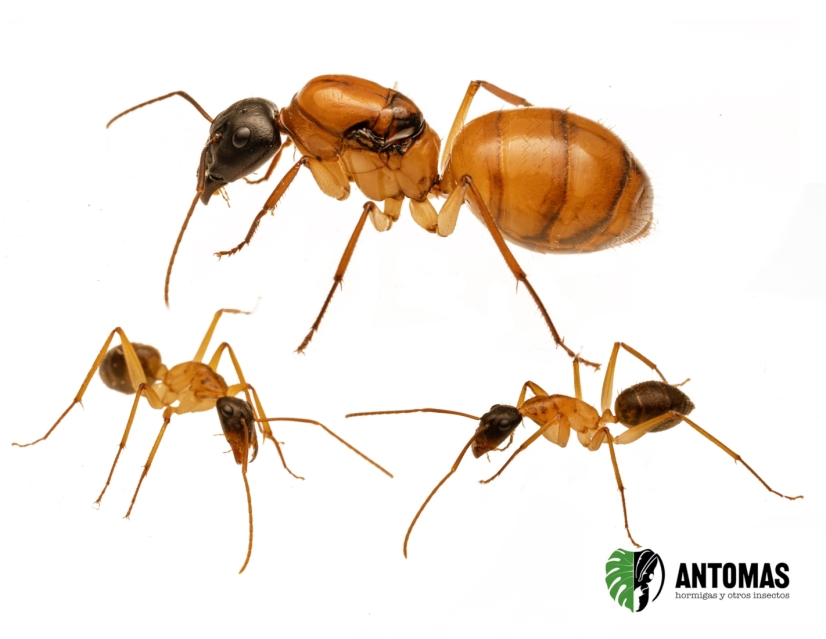
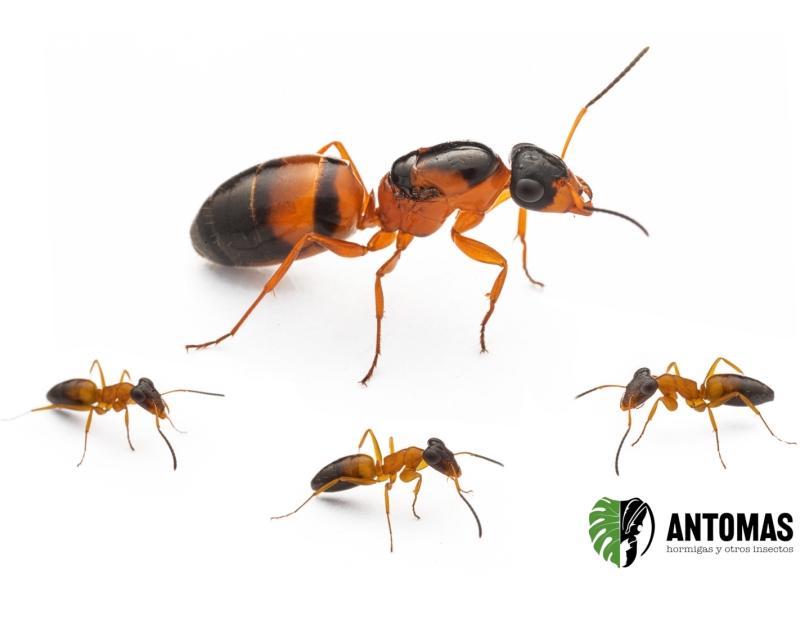
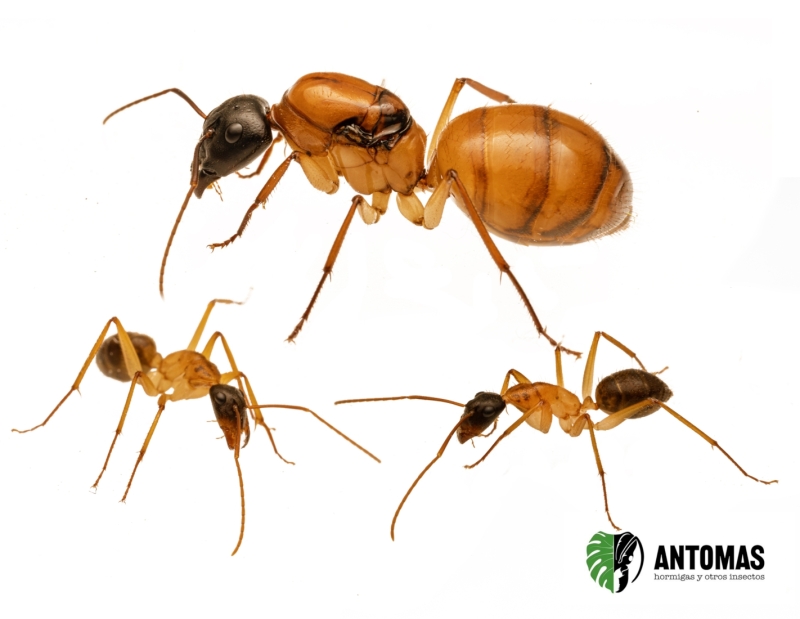
In our experience, you need patience: the first workers are small, and the majors usually appear in the second or third year. When they arrive, the colony changes its look: in our experience, they can grow larger than the queen herself. Seeing a huge-headed major next to the minors is one of the great moments of keeping this species.
Acrobatic spiders and blind snakes: its specialist enemies
A large ant that bites and sprays acid does not look like easy prey. And yet Australian Camponotus have enemies that specialise in them. On the trunks of Australian trees lives Euryopis umbilicata, a small spider of the family Theridiidae that hunts Camponotus much larger and better defended than itself. A 2022 study analysed its attacks: a ritual sequence of steps performed in fractions of a second, vertically on the bark, with an exceptionally high capture success. According to popular sources, its favourite prey is C. consobrinus.
The other enemy comes from below. Australian blind snakes (family Typhlopidae), small and almost eyeless, feed on ant brood and find the nests by following the workers’ chemical trails, as a 1992 study showed. Among those trails are those of the sugar ants. There are no spiders or snakes in your formicarium, of course, but these stories explain why a colony defends its nest so resolutely.
Size and morphology
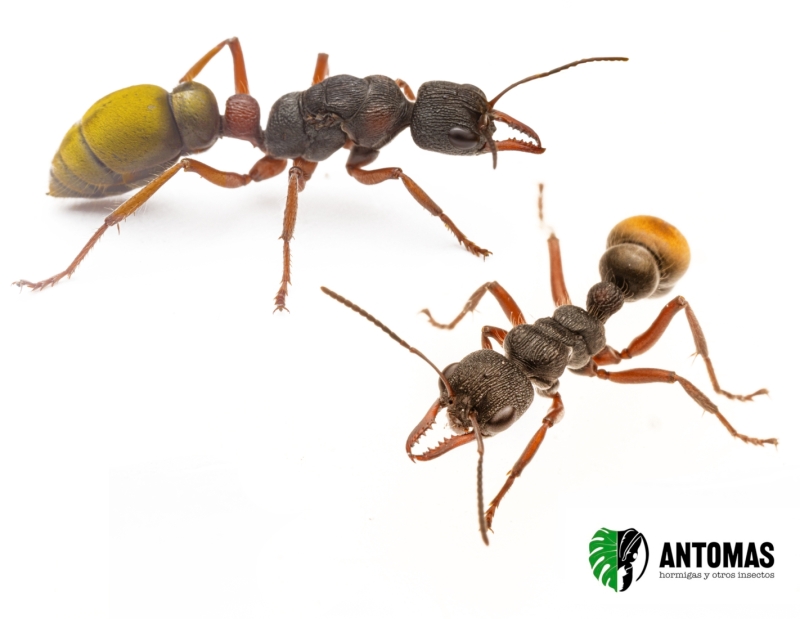
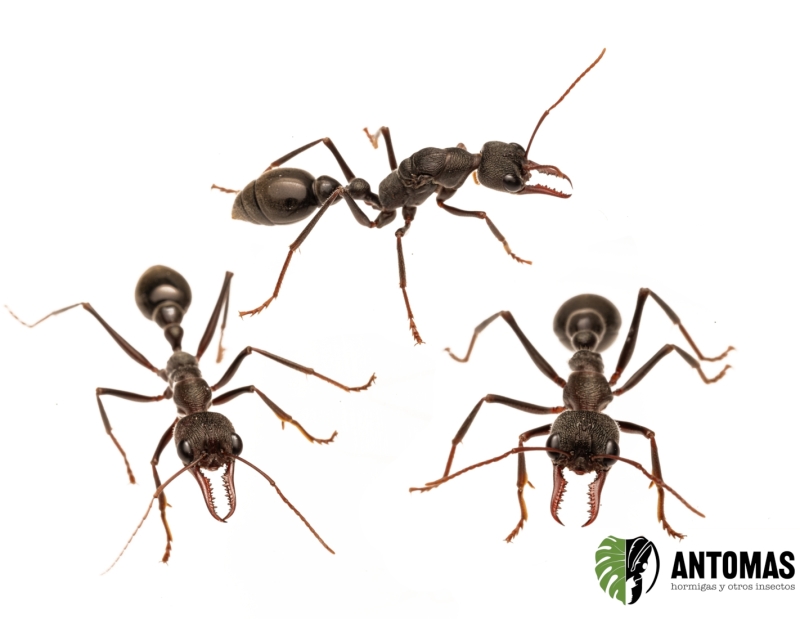
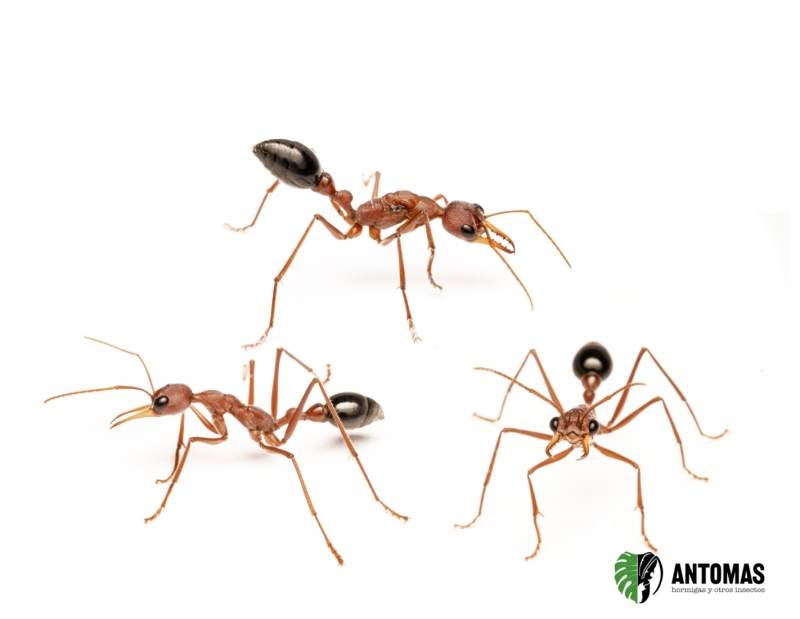
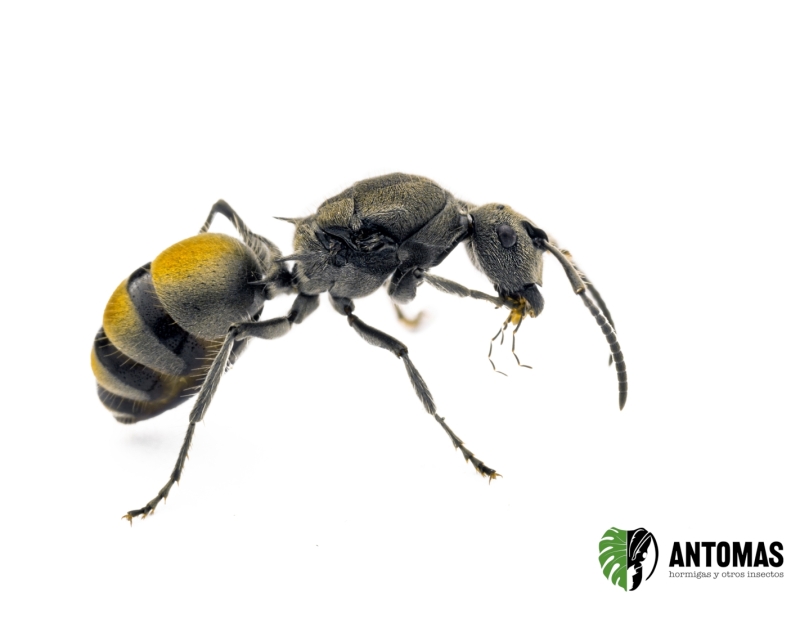
A large, robust and strongly polymorphic Camponotus, with minor and major workers that differ in size and shape, and without a sting.
- Colouring according to the key. Head and mesosoma (the thorax) black or dark brown. The colour of the gaster does not appear in the part of the description we have been able to consult.
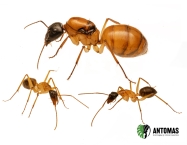
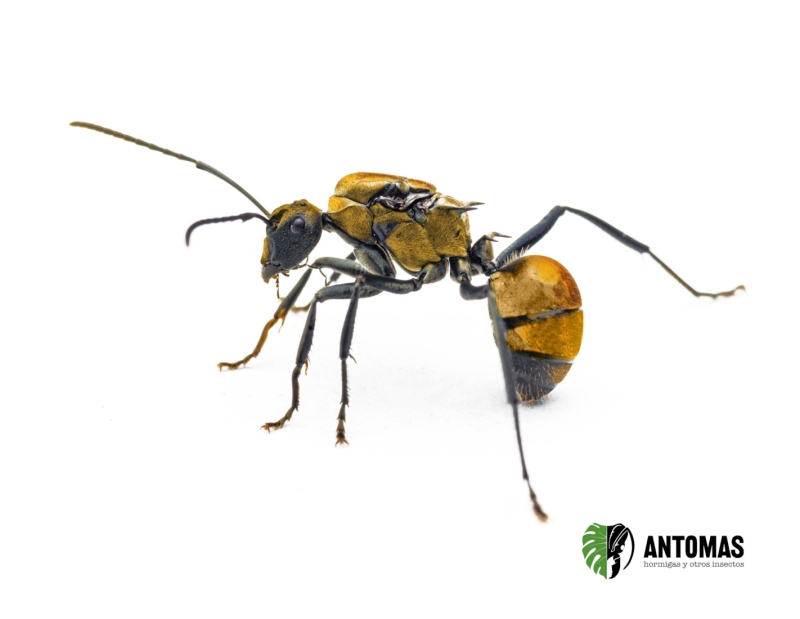
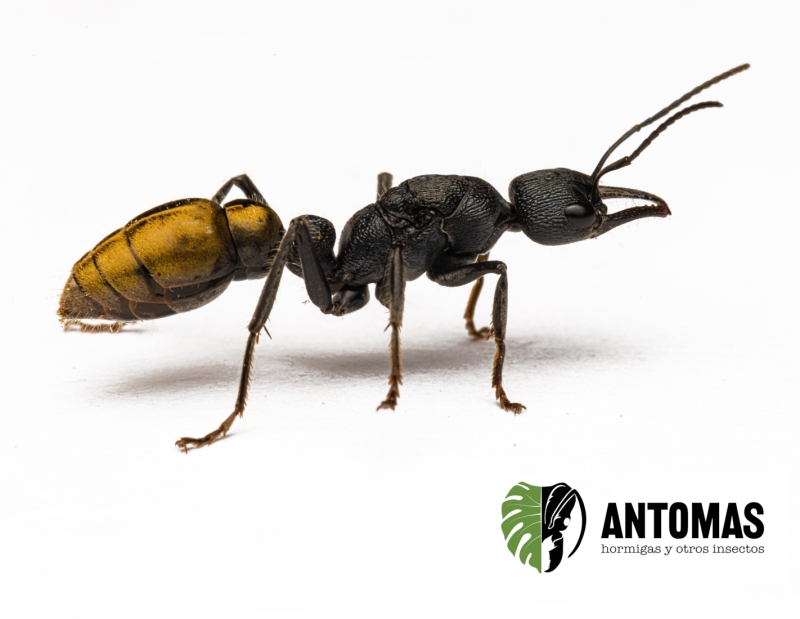
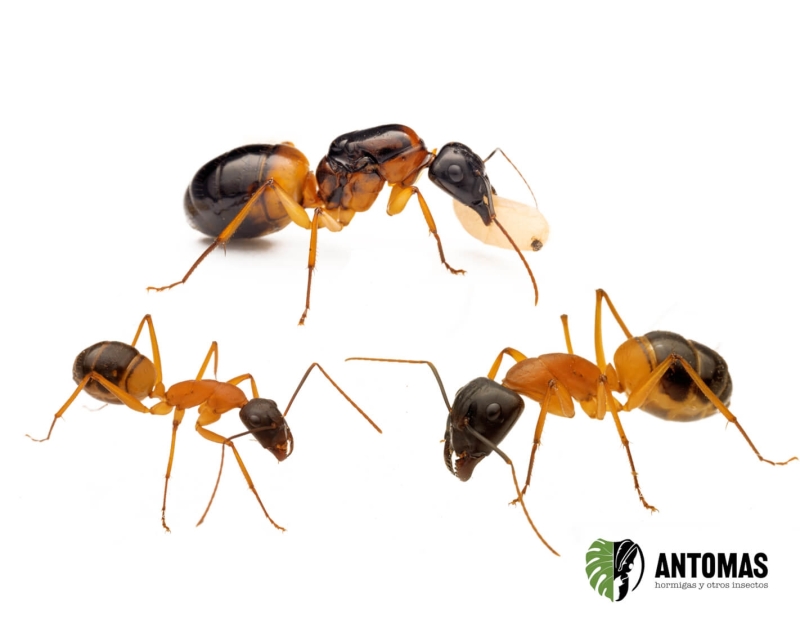
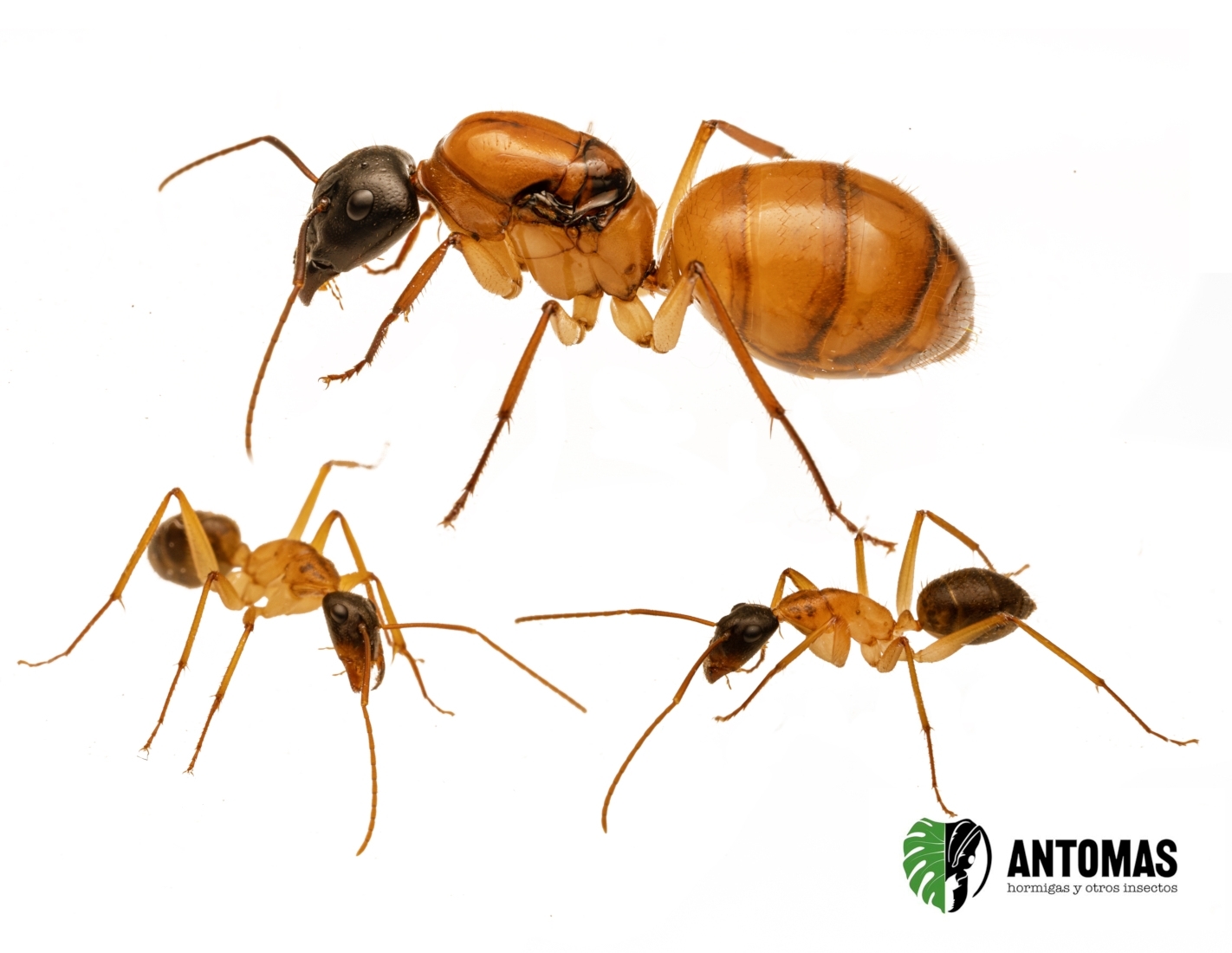
- Colouring of our colonies. They are quite pale. The queen has a black head and an amber or light honey-coloured thorax and gaster, with dark bands on the gaster. The workers have a dark head, a light amber thorax and legs and a dark brown gaster.
- Hairiness. A few long, fine erect hairs on the gula, somewhat more numerous in the minors; scattered golden erect hairs on the thorax, over an abundant layer of short hairs lying flat against the body; and short hairs raised at about 30° on the tibiae and the antennal scapes.
- Head. In the majors, large, with convex sides and flat eyes; in the minors, with straight, parallel sides and bulging eyes, and in the smallest minors, narrowed towards the back.
- Thorax. Evenly convex dorsum; metanotum marked in the majors and absent in the minors.
- Petiole. Node with a sharp apex.
- Surface. Finely reticulate.
- Gaster. It ends in the acidopore, through which it expels formic acid; it has no sting.
- Queen. No published description. Antomas queens measure 17–19 mm.
- Male. No published description.
Why are our colonies paler? The key describes the head and thorax of the workers as black or dark brown, and our queens and workers have an amber thorax. And it is not a matter of age: in our colonies, the workers do not darken as they get older. We cannot explain it with certainty. Colour often varies within a single Camponotus species (its forum “double”, C. terebrans, is an extreme case), and descriptions are based on a few museum specimens, so we interpret it as variation within the species. But we prefer to say it clearly: colour is no use for identifying a C. eastwoodi, and the hairs on the gula are (see “Hairs under the head: how to recognise it”).
Approximate sizes
- Queen: 17–19 mm (Antomas queens; no published measurements)
- Workers: head width, 1.60–4.10 mm; head length, 2.20–4.10 mm; pronotum width, 1.4–2.6 mm
- Major workers: in Antomas’s experience, they can be larger than the queen; head up to 4.10 mm wide
- Total length of the workers: not published
- Male: no published measurements
The worker measurements come from McArthur’s key (2007) and run from the smallest minor to the largest major. There are no published measurements of the total length of the workers, nor of the queen or the male; the queen’s is ours. We do not yet have an exact measurement for the majors, but in our experience they can grow larger than the queen herself: with a head up to 4.1 mm wide, they are the true giants of the colony.
Care in captivity
Difficulty: 3/5 – Advanced
At Antomas we consider it one of the easiest giant Australian Camponotus to keep. And it is not an isolated opinion: in the hobby, its closest relatives have a reputation as species suitable for beginners or intermediate keepers, and C. consobrinus, the most widely kept species of the group, is often recommended as a first Australian Camponotus. C. eastwoodi eats everything, does not need excessive heat, is happy with a dry nest, its diapause needs no real cold and its temperament is calm.
So why is it not a 1/5? For three reasons:
- A slow start. Like so many large Camponotus, the founding stage and the first year go slowly: few workers, and small ones, and growth that does not speed up until the colony gains size. A care guide for its relative C. consobrinus sums it up: you have to think “in weeks and months, not days”. You need patience and should not tamper with what works.
- The inverted seasons. It arrives with a southern-hemisphere clock: in the first year it is kept without diapause so that it adapts, and from the second year it goes through a long diapause in our winter (see “Diapause and inverted seasons”). It is not difficult, but you need to understand it so as not to worry if the queen slows down her laying in the middle of summer.
- The majors. They appear in the second or third year and change the colony: they need large galleries, eat more and bite hard. A mature C. eastwoodi colony is no longer a beginner’s colony.
In addition, they climb acrylic, so an escape barrier is needed from day one, although with this species mineral oil is enough (see “Escapes and barriers”).
And it is well worth it. It is an Australian giant very rarely seen in the hobby, with spectacular polymorphism, queens in pale, warm tones, a nocturnal rhythm that is a joy to watch at dusk and the promise, if it resembles its relative, of a queen for many years. And this is one of the first care sheets for the species: if you take it on, you will be among the first to keep it and to watch its majors grow.
Recommended parameters
- Nest temperature: 21–26 °C in the active season. This is the range on which keepers of its relatives in the group agree, and it matches the summer averages of its range, around 23–26 °C. It does not need excessive heat.
- Foraging area: it can be somewhat warmer, up to about 30 °C at one end, so that the colony can choose. Never strong heat inside the nest.
- Humidity: moisture in the tubes at first; afterwards, a rather dry nest (see “Moisture in the tubes at first; dry afterwards”). The foraging area, dry.
- Water: always available, in a test tube with water and cotton wool in the foraging area.
- Light: it is enough to leave them a dark area in the nest and a lit foraging area, with a normal day–night cycle.
- Diapause: none in the first year; from the second year, 4–5 months at 15–18 °C in our winter (see “Diapause and inverted seasons”).
Avoid direct sunlight, radiators and cold draughts: more than an exact figure, what they want is a mild, stable nest.
Moisture in the tubes at first; dry afterwards
This is the key to the set-up. C. eastwoodi needs a rather dry environment, which is why we recommend formicaria from the Qbik Alpha range. But, like all Camponotus, at first they need moisture in the tubes: the queen and her first brood live in the test tube, with its water reservoir behind the cotton wool, and when they move into the nest it is a good idea to leave a water tube connected, so that they have a humid area while the colony is small. Afterwards, you can gradually leave it drier: the ants themselves regulate the humidity they need, with the water in the foraging area and that of the sugary liquids, which are mostly water.
Everything fits with what is known about it: it lives in open eucalypt forest, nests under stones and in dead wood, and in its range the dry season coincides with winter. And the relative that lived 23 years did so at a relative humidity of 35–50%. Shop care sheets for its relatives give nest humidity figures ranging from 30 to 80%, with no consensus. At Antomas we prefer the simple rule: moisture in the tubes at first, and dry afterwards.
Dry does not mean without water: the water tube in the foraging area must never be missing. What you must avoid is wetting the whole nest, because excess moisture brings condensation, mould and mites.
Recommended formicaria
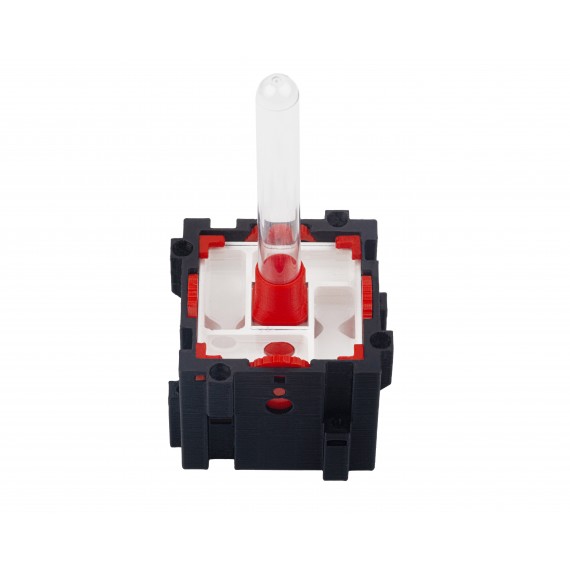
At Antomas we recommend the Anthouse Qbik Alpha range: modular formicaria, suitable for dry-nesting species, that grow with the colony. With this species, always with large galleries: the majors need room to move around and to move the brood. To start with, a QBIK ONE with large galleries:
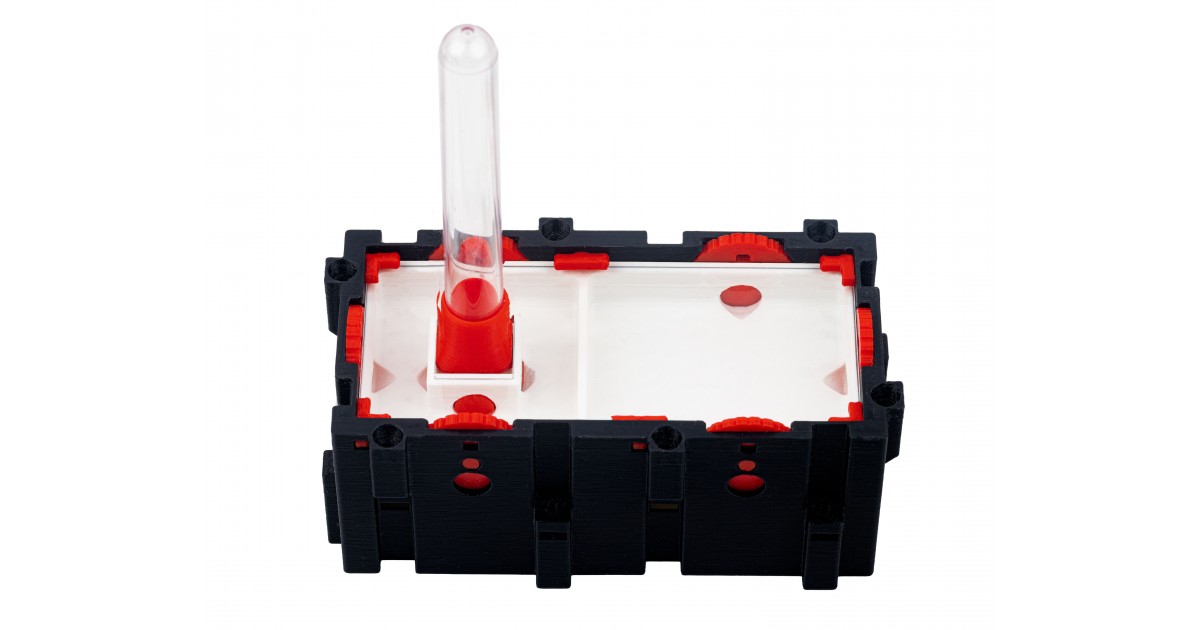
To expand, the QBIK DUO, also with large galleries, and then the larger formats of the same range:
Expand when the nest becomes too small for them: a clear sign is seeing lots of workers sitting still in the corners of the foraging area, with no room inside. But do not jump ahead: in a huge nest for a small colony, the spare chambers end up as rubbish dumps. Complete the set-up with these details:
- Escape barrier: a band of mineral oil on the upper part of the walls of the foraging area and a well-fitting lid (see “Escapes and barriers”).
- A dry foraging area, with some sand, flat stones and a twig or piece of bark to climb on, with nothing that could act as a bridge to the barrier.
- Water always available, in a test tube with water and cotton wool.
- A feeder for sugary liquids, never on cotton wool (see “Feeding”).
- Gentle heat, only if needed, on one side of the nest and away from the feeder, with a thermostat.
Founding: queen with brood, step by step
At Antomas we sell founding queens with brood, in two versions: “Queen with brood” and “Queen and 1 worker with brood”. In other words, queens that have already started their colony in a test tube, with eggs, larvae or pupae and, in the second option, with their first worker. Founding in C. eastwoodi is claustral, as in the rest of its group: the queen rears her first workers without going out to eat, on her own body reserves.
- Tube and darkness. Keep the tube just as it arrives, with its water reservoir behind the cotton wool, in a dark, quiet place free of vibrations, at 24–26 °C, the upper part of the nest range. You can cover it with a cloth or a piece of card.
- Moisture in the tube. This is the stage when it matters most: check from time to time that the cotton wool is still damp and that the reservoir still has water. If the water runs out or the tube gets very dirty, move her to a new tube by tipping her in, carefully.
- Do not disturb. Take a brief look once a week, not every day, and do not change her tube unless necessary. Constant disturbance stresses the queen, and a stressed queen may even eat her eggs.
- Food. Although founding is claustral, at Antomas we recommend offering the queen, from time to time, a tiny drop of sugary liquid on something that does not soak the cotton wool, such as a small piece of aluminium foil. Never on the cotton wool of the tube: it goes mouldy and spoils the water reservoir. If any is left over, remove it the next day. Once there are workers (or from the start, if your queen comes with one), add a small piece of insect once or twice a week and remove the leftovers the next day as well.
- Patience. In its relatives, the first workers, the so-called nanitics, take about 6–10 weeks from the egg, depending on temperature. They are small: worker size increases with each generation.
When to move her into the nest? There is no need to wait long: at Antomas we move her with as few as 3–6 workers, always into a nest suited to the colony’s size, and earlier if the tube becomes too small, dirty or runs out of water. What matters is that the nest is not too big for the colony: oversized nests make humidity and defence harder for young colonies. We move them by tipping (see “Arrival and moving”) into a QBIK ONE with large galleries, leaving a water tube connected at first so that they have their humid area.
Arrival and moving
When you receive your queen, let her rest in a quiet, dark place, at 24–26 °C, and check that the tube has water. Do not change her tube or move her into the nest as soon as she arrives. When the time comes to move her into the formicarium, at Antomas we do it by tipping: we open the tube inside the foraging area, next to the nest entrance, and gently tip out the queen, the workers and the brood, helping the stragglers with a soft brush. Three tips:
- Prepare everything beforehand: the formicarium set up, with the oil barrier in place and the water tube connected.
- Work over a tray, in case a worker climbs up the tube or your tools.
- Take it calmly: after tipping, the workers gather the brood and carry it into the nest. Keep the nest area dark so that they occupy it straight away.
If you ever need to move the colony to another formicarium, use the same method.
Feeding
Sugary liquids, always available. They are sugar ants, and in the wild their group lives largely on honeydew and nectar. Vary the sugars: at Antomas we recommend Anthouse’s Blue Sugar nectar 4–5 times a week and another sugary liquid or nectar 1–2 times a week. You can also add some protein to the nectar. Always offer them in a feeder and never on cotton wool, because cotton wool goes mouldy and spoils the liquid very quickly. Use a traditional or home-made feeder, where the drop stays “spread out” and accessible, and replace it before it ferments.
Protein: the more, the better. It is the engine of their growth, and it is the Antomas philosophy: if you do daily maintenance and remove the leftovers, it is better to overfeed, because the colony understands that it has more resources and grows faster and in greater numbers. If you will not be able to clean often, it is better not to overfeed: leftover food rots and brings mould and mites. Change the type of insect from one week to the next, so that they do not always eat the same thing: flies, crickets, small cockroaches, chopped mealworms and, for small colonies, Drosophila. For young colonies, preferably chopped or freshly killed; for large ones, small live prey as well. And buy insects from a reliable supplier: insects treated with insecticides can kill the colony.
A tip for a nocturnal species: put the protein in late in the afternoon, when they start to move, and remove the leftovers the next morning.
That plentiful food works is illustrated by the experience of a C. nigriceps keeper: with a constant supply of nectar and lots of insects, his colony went from 3 workers to about 100 in about ten months, something unusual for a Camponotus. It is an isolated opinion, but it illustrates our philosophy well: the more protein, the better.
Water: always, in the test tube with cotton wool in the foraging area. Even though their nest is dry, they must never lack drinking water.
Diapause and inverted seasons
In its range, winter runs from June to August, and a C. eastwoodi queen arrives in Europe with that clock. At Antomas the rule is simple: no diapause in the first year, whenever she arrives. During that first year, warmth and food are kept up all the time, also in our winter, so that the colony adapts to the European climate. And, above all, do not cool it down in our summer, which is when it would rest in its homeland. Between June and September the queen may slow down her laying or the colony may eat less: some shops describe in its relatives an internal resting rhythm linked to the southern winter. This is normal, and it is enough to keep offering food and not lower the temperature.
From the second year, diapause in our winter. The following year they already cool down in our winter and follow the cycle inverted with respect to Australia, that is, the European one. And their diapause is long, practically like that of our local species: 4–5 months at 15–18 °C, for example from November to March. This matches what some European shops recommend for its relatives: a rest from the end of October to the end of March at 15–18 °C.
- Lower the temperature gradually, over one or two weeks, and raise it the same way at the end.
- Do not go below 15 °C: it is a long diapause, but not a cold one. Its winter is mild, with daily averages of about 12–17 °C in the coolest months, and none of the keepers of its relatives go below that.
- During diapause: water always available, a little sugary liquid and little or no protein. Disturb the colony as little as possible.
- At the end, go back to protein as soon as you see activity and brood.
Normal signs in the first year: the colony may stop or eat little between June and September even when it is warm, and return to activity around September or October. By the second year it is already on the European cycle. This is what we see at Antomas with southern-hemisphere Camponotus, which adapt well. There is no study on the diapause of C. eastwoodi, so if in doubt, write to us.
Behaviour in captivity
Nocturnal. They are most active at dusk and at night, especially when it is warm; when it is cool, they may come out by day, as in their winter. If you want to see them in full activity, watch them at nightfall. It is normal to see little movement at midday.
Calm, but they defend the nest. Day to day they are calm ants that do not look for trouble. But if the nest is opened or knocked, they come out to defend it: they bite and may spray formic acid. Their relatives are described in the same way: not very aggressive towards the outside and very determined when the nest is disturbed.
A division of labour you can see. As is usual in polymorphic Camponotus, the minors do most of the foraging, and the majors, once they appear, spend more time in the nest and show themselves mainly when there is a disturbance or a large prey item to cut up.
Watch without fear. At Antomas we believe ants are there to be enjoyed, watched and learnt from, not kept hidden away. It is enough to leave them their dark area in the nest and a lit foraging area, and to watch them gently, intervening and stressing them as little as possible. They get used to your presence.
Warning signs:
- Brood that stalls or disappears outside the first-summer pause: almost always a lack of protein.
- Condensation on the walls or mould: too much moisture or forgotten leftovers.
- A founding queen that eats her eggs: too much disturbance.
- Lots of workers sitting still in the foraging area, with no room inside: time to expand.
Escapes and barriers
C. eastwoodi climbs acrylic, and that goes for the first workers too. Australian Camponotus are good climbers, able to climb glass and plastic. In our experience, mineral oil is enough:
- A band of mineral oil on the upper part of the walls of the foraging area, thin and continuous. Renew it when you see it collecting dust or debris.
- A well-fitting lid, as a second line of defence.
- No gaps: check the connections, the plugs and the tubes.
- Nothing that could act as a bridge: no twigs or stones leaning near the barrier.
- Care when opening: open only as much as necessary, work calmly and close up when you finish.
With the oil barrier and everything well fitted, they cause no problems.
Handling and safety
They cannot sting: they have no sting. But if they feel attacked, they bite (the majors, hard) and may spray formic acid, which stings on sensitive skin or in a small cut. Nothing to worry about if you work calmly. As with any species, handle them with entomological tools (a soft brush or soft forceps), not with your hands, and work slowly so as not to lose or harm any worker, let alone the queen. Do not combine queens or different colonies, or keep them with other species. It is an exotic species: it must never be released.
What not to do
- Wet the whole nest, or keep moistening it once the colony is regulating its own humidity: moisture only in the tubes at first.
- Give it a diapause in the first year, and above all cool it down in our summer (June–August), even if the queen slows down her laying.
- Cut the diapause short from the second year onwards: it is 4–5 months, not a few weeks.
- Give it a cold diapause, as for European ants: never below about 15 °C.
- Leave gaps, loose connections or ill-fitting lids, or let the barrier go unrenewed: they climb acrylic.
- Open the founding tube often, or move her into a nest too big for her size.
- Use small galleries: always large ones.
- Put sugary liquids on cotton wool or let them run out.
- Always give them the same insect or leave leftovers uncleaned.
- Combine queens or different colonies.
- Handle them with your hands.
Scientific sources
This care sheet is based on the scientific literature on Camponotus eastwoodi, its species group and its genus, on distribution records and climate data from its range, and on the experience of Antomas and other keepers. Main references:
- McArthur, A. J. & Adams, M. (1996). A morphological and molecular revision of the Camponotus nigriceps group (Hymenoptera: Formicidae) from Australia. Invertebrate Taxonomy 10: 1–46. doi:10.1071/IT9960001
- McArthur, A. J., Adams, M. & Shattuck, S. O. (1998). A morphological and molecular review of Camponotus terebrans (Lowne) (Hymenoptera: Formicidae). Australian Journal of Zoology 45: 579–598. doi:10.1071/ZO97055
- Ward, P. S., Blaimer, B. B. & Fisher, B. L. (2016). A revised phylogenetic classification of the ant subfamily Formicinae (Hymenoptera: Formicidae), with resurrection of the genera Colobopsis and Dinomyrmex. Zootaxa 4072: 343–357. doi:10.11646/zootaxa.4072.3.4
- Clouse, R. M. et al. (2015). Molecular phylogeny of Indo-Pacific carpenter ants (Hymenoptera: Formicidae, Camponotus) reveals waves of dispersal and colonization from diverse source areas. Cladistics 31: 424–437. doi:10.1111/cla.12099
- Narendra, A., Ramirez-Esquivel, F. & Ribi, W. A. (2016). Compound eye and ocellar structure for walking and flying modes of locomotion in the Australian ant, Camponotus consobrinus. Scientific Reports 6: 22331. doi:10.1038/srep22331
- Schultheiss, P., Raderschall, C. A. & Narendra, A. (2015). Follower ants in a tandem pair are not always naïve. Scientific Reports 5: 10747. doi:10.1038/srep10747
- Haskins, C. P. & Haskins, E. F. (1992). Note on extraordinary longevity in a queen of the formicine ant genus Camponotus. Psyche 99: 31–33. doi:10.1155/1992/53614
- Fraser, V. S., Kaufmann, B., Oldroyd, B. P. & Crozier, R. H. (2000). Genetic influence on caste in the ant Camponotus consobrinus. Behavioral Ecology and Sociobiology 47: 188–194. doi:10.1007/s002650050010
- Tragust, S. et al. (2020). Formicine ants swallow their highly acidic poison for gut microbial selection and control. eLife 9: e60287. doi:10.7554/eLife.60287
- Feldhaar, H. et al. (2007). Nutritional upgrading for omnivorous carpenter ants by the endosymbiont Blochmannia. BMC Biology 5: 48. doi:10.1186/1741-7007-5-48
- Rafiqi, A. M., Rajakumar, A. & Abouheif, E. (2020). Origin and elaboration of a major evolutionary transition in individuality. Nature 585: 239–244. doi:10.1038/s41586-020-2653-6
- Dong, A. Z., Cokcetin, N., Carter, D. A. & Fernandes, K. E. (2023). Unique antimicrobial activity in honey from the Australian honeypot ant (Camponotus inflatus). PeerJ 11: e15645. doi:10.7717/peerj.15645
- Aceves-Aparicio, A. et al. (2022). Fast acrobatic maneuvers enable arboreal spiders to hunt dangerous prey. Proceedings of the National Academy of Sciences 119: e2205942119. doi:10.1073/pnas.2205942119
- Webb, J. K. & Shine, R. (1992). To find an ant: trail-following in Australian blindsnakes (Typhlopidae). Animal Behaviour 43: 941–948. doi:10.1016/S0003-3472(06)80007-2