Difficulty: 3/5 – Advanced
This is an established colony bred by us: founded in 2023, around 3 years old, and it arrives with its queen and between 300 and 500 workers. For keepers who want to skip the founding stage and start straight away with an army of hunters already up and running. Limited availability.
The large ponerine from tropical America, black with golden hair, fast, a skilled climber and armed with a sting, at a colony size that only the very largest reach in the wild. From day one it needs a Qbik Wild Duo P 2C or equivalent, with one humid chamber and the rest drier, 24–28 °C, plenty of varied protein and nectar in a feeder, water always available in a tube and frequent cleaning. No diapause. With hundreds of climbing workers: PTFE (Fluon) barrier, a tight-fitting lid and moving by tipping out over a tray.
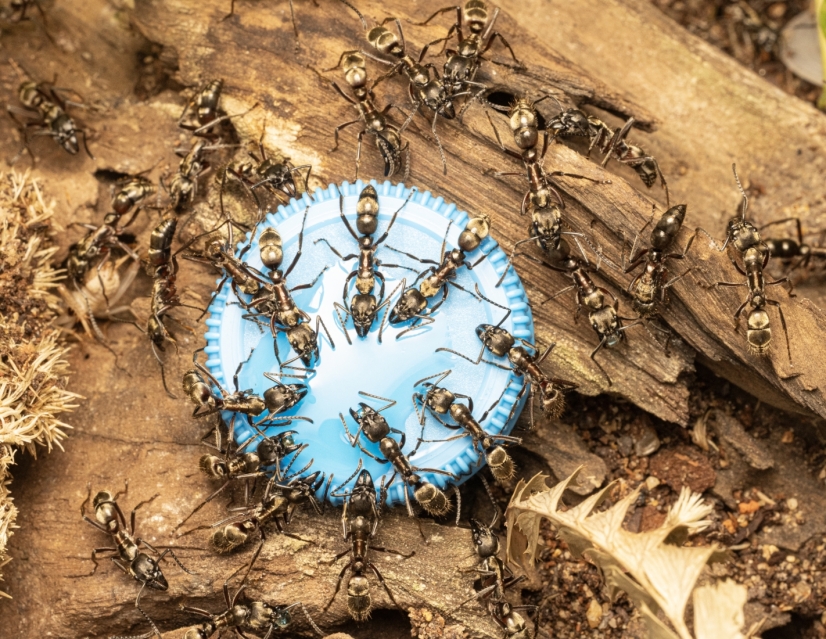
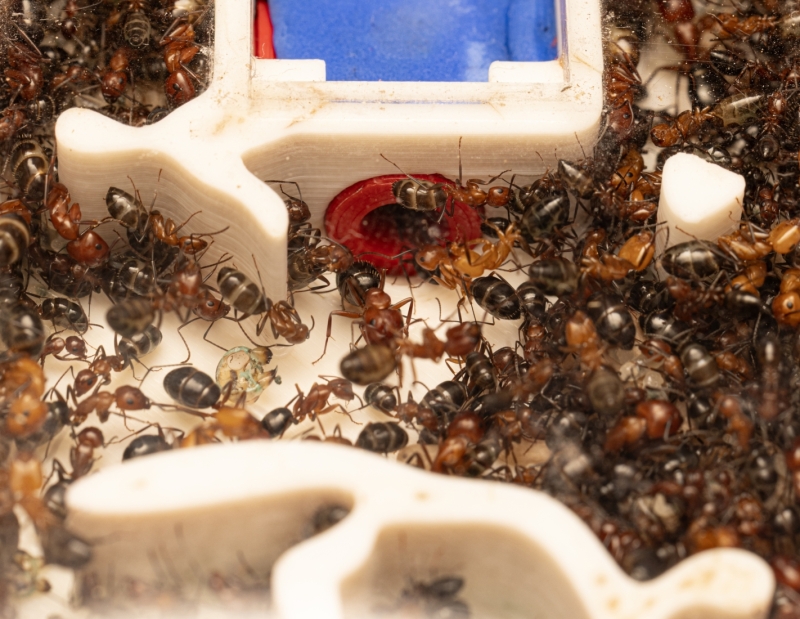
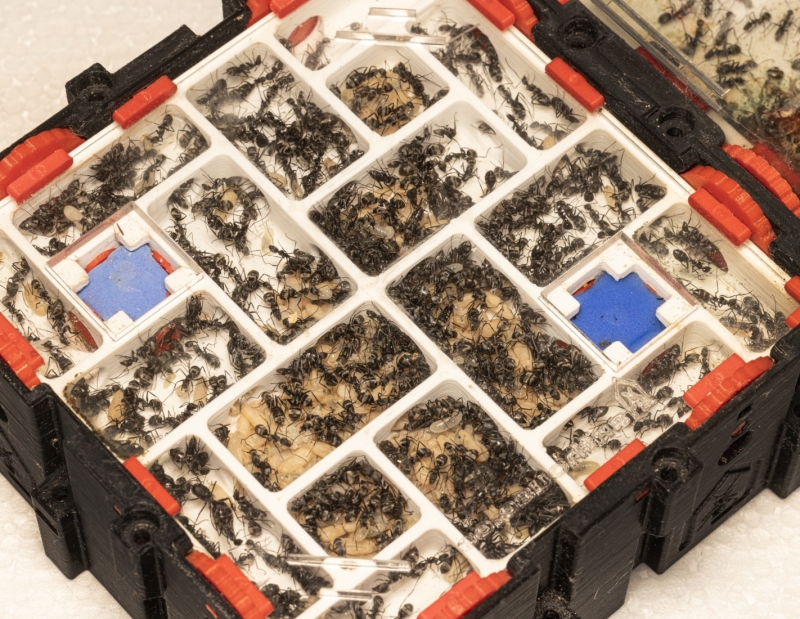
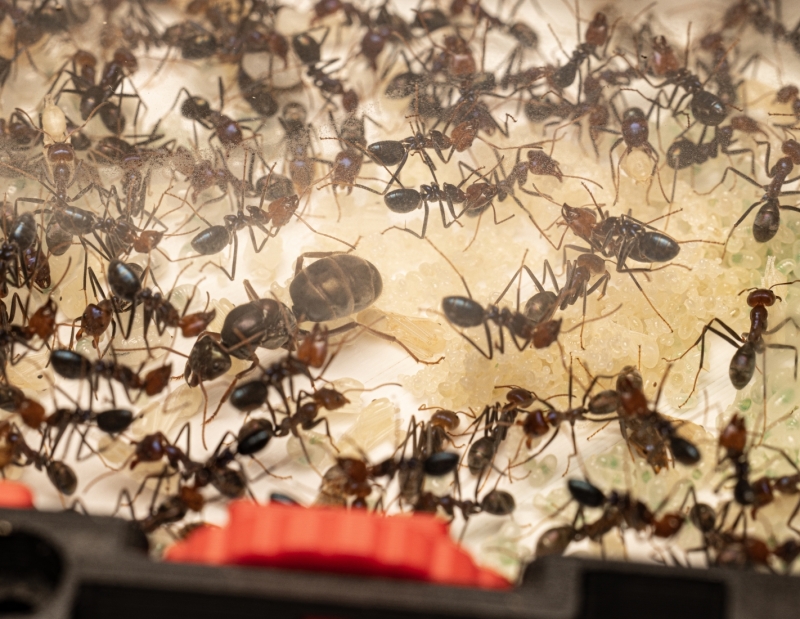
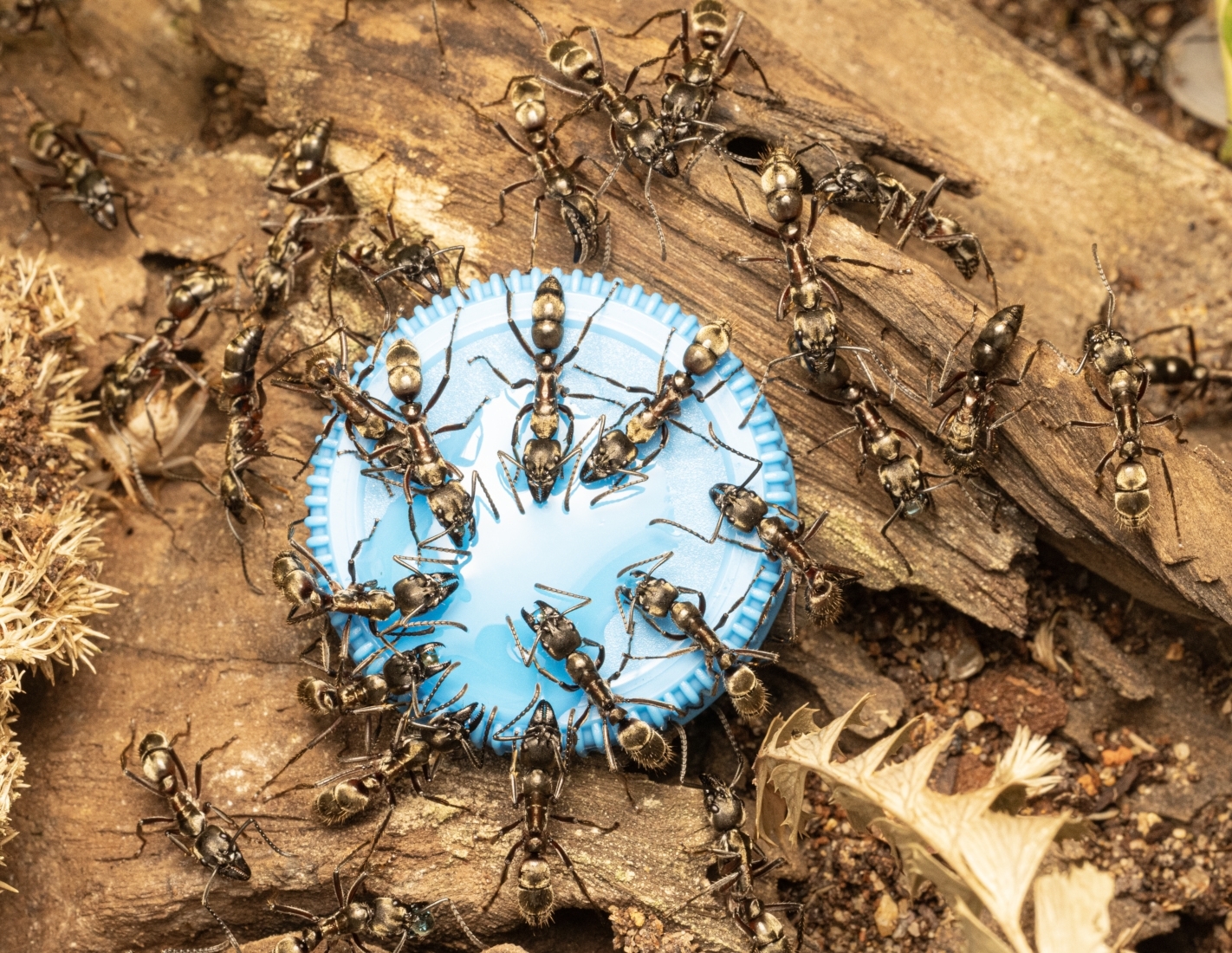
The Panther Empire is a mature colony of Neoponera villosa (Fabricius, 1804), one of the great hunting ponerines of the Neotropics. It ranges from southern Texas and northern Mexico to northern Argentina and southern Brazil, and its workers, 12–13 mm long, black and covered in the golden down that gives the species its name, hunt alone, climb everything and carry a functional sting. But what makes this product special is not the species, it is the scale: three hundred workers or more around a single queen, a colony that has already left behind the founding stage, the slow first year and the test-tube phase.
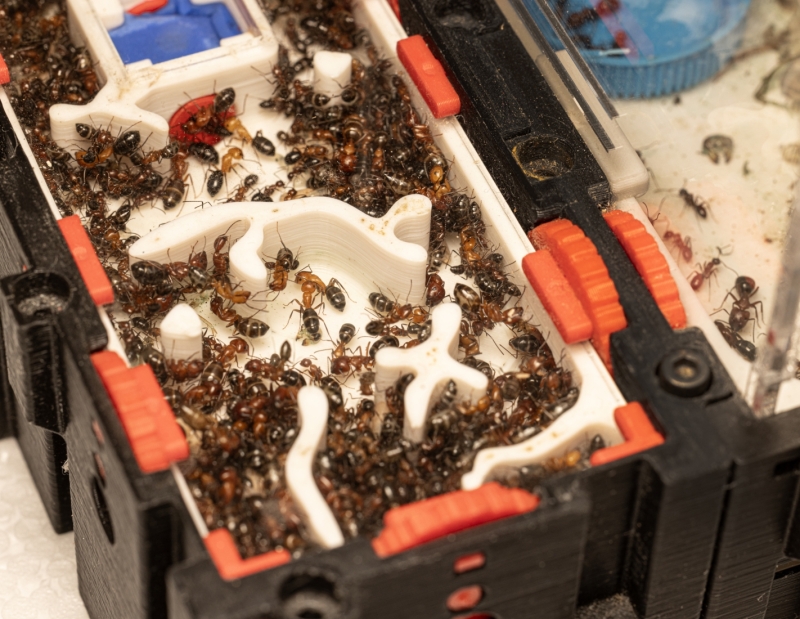
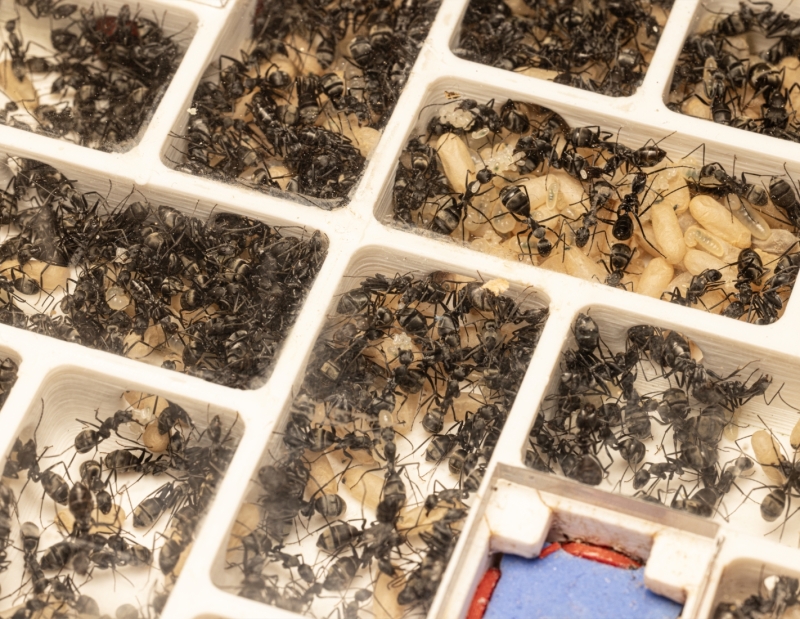
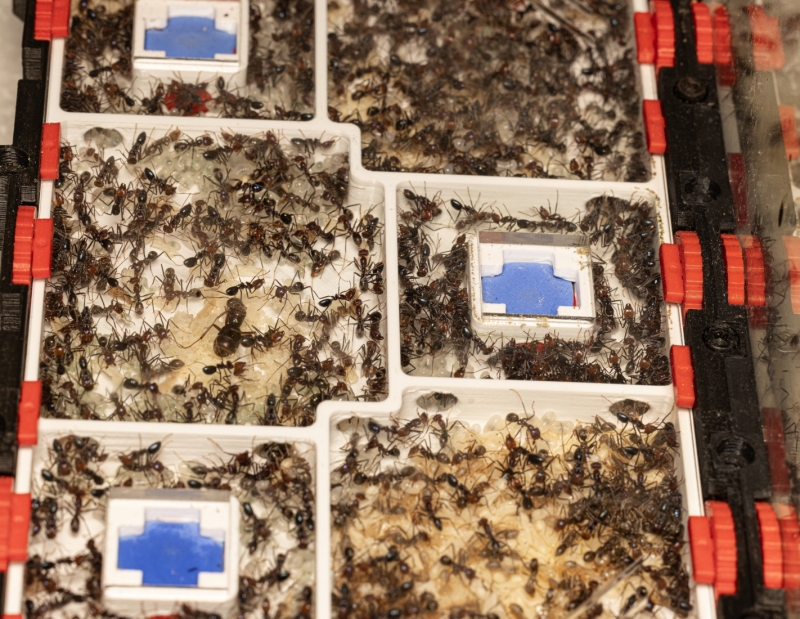
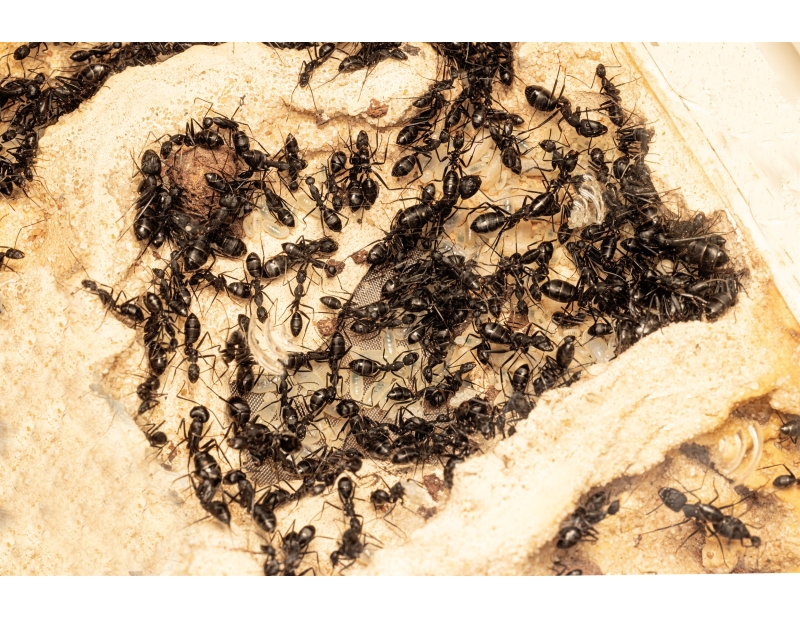
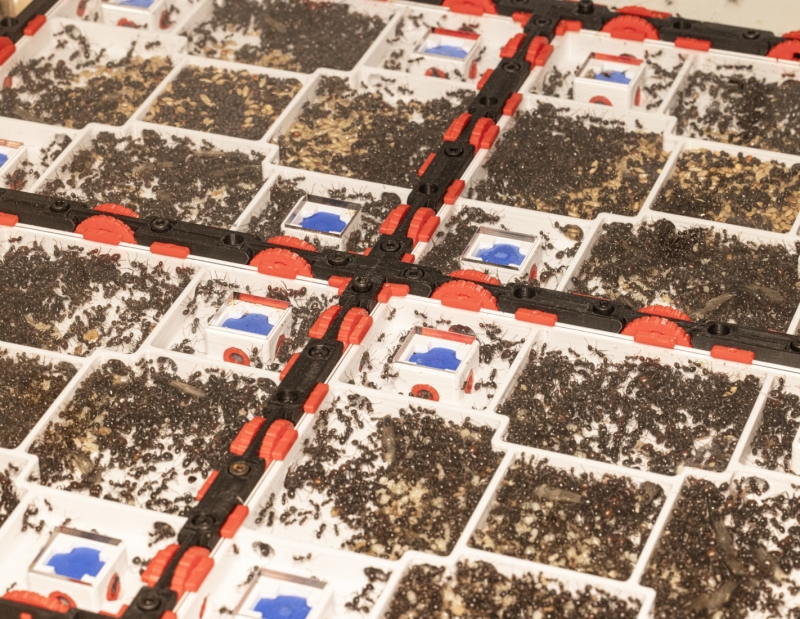
With a colony like this, what you can only glimpse in a founding colony is on show all at once and at all hours: patrols covering every branch of the outworld, several hunts going on in parallel, workers returning with nectar, heaps of silk cocoons in the humid chamber. In return, it asks for more than a young colony: more space, more food, more cleaning and a flawless escape-proof set-up. In this care sheet we focus on exactly that, on what it means to keep a large colony of N. villosa at home, and on the biology that is easier to understand when there are hundreds of individuals.
If you would rather start from the beginning, with a queen and her first brood, and watch the colony grow from scratch, you will find the full species care sheet at Neoponera villosa, with semi-claustral founding explained step by step.
Biology
A colony at the upper limit of what is known
How many workers does a wild colony of this species have? The best published figure comes from the Yucatán Peninsula, where the species nests in tank bromeliads. In a sample of 82 colonies collected inside Aechmea bracteata, the average was around 98 workers, with colonies ranging from just 3 up to 322 (data gathered by Rocha and colleagues in 2020). In other words: in the field, colonies of about a hundred individuals are the norm, and those of more than 300 are the exception.
The Panther Empire, with 300–500 workers, sits at that upper end or above it. There is nothing odd about this: in captivity, with plenty of food all year round, no predators, no competitors for the nest and no hurricanes to knock the bromeliad down, a colony can grow larger than in the wild. But it is worth bearing in mind, because it explains almost everything that follows: you are dealing with a colony that has already reached a size its species rarely attains, and its set-up has to be up to the job.
A note on names before we go on. For much of the 20th century this species was called Pachycondyla villosa, and that is how it appears in most of the classic studies. In 2014, Schmidt and Shattuck’s reclassification of the subfamily Ponerinae restored the genus Neoponera for a group of large and often arboreal Neotropical ponerines. In addition, N. villosa belongs to the N. foetida species complex, and in 2002 Lucas and his team showed that the “P. villosa” of the cocoa plantations of southern Bahia (Brazil) were in fact three distinct taxa. Some of the studies we cite below were carried out on those sister species, and we say so where that is the case.
The size of the home does matter
N. villosa is an opportunistic cavity nester: hollow trunks, branches, fallen wood and epiphytes, in humid forests and in dry forests too. In the low flooded forest of the Sian Ka’an reserve, in Yucatán, Dejean, Olmsted and Snelling described in 1995 how it almost always occupies the heart of the bromeliad Ae. bracteata, between the bases of its leaves. Further north, where that plant is scarce, it settles in cavities of trees such as Bursera simaruba, Lysiloma latisiliquum or Leucaena leucocephala.
What is interesting for anyone with a large colony is how it chooses. In the choice experiments by Rocha and colleagues (2020), given two Ae. bracteata plants, the workers almost always picked the large one, 80 cm tall, over the small one, 25 cm tall. A bigger bromeliad offers more chambers between the leaves, more shelter and more room for the brood. That preference for space appeared even in workers from colonies that lived in trees and had never seen the plant, which points to a partly innate attraction. And in 1990, Alain Dejean had shown that what a worker experiences as a larva and in her first days as an adult influences where she will later choose to nest.
Translated to the terrarium: a colony of hundreds of workers that has grown up in artificial nests recognises them as home, but it needs one that fits. A nest too small for its population forces it to crowd outside, in the outworld; an oversized one leaves empty chambers that end up as rubbish dumps. The rule is the same one they follow in the field: just the right space for the colony there is, with room to grow.
Moving house two by two
In Yucatán, hurricanes and droughts knock down bromeliads and force colonies to look for a new home, and on top of that they have to compete for it with the ant Dolichoderus bispinosus and with Nasutitermes termites. How does a colony of N. villosa move? Not in a large chemical column, like so many ants, but in tandem: a scout that already knows the new shelter comes back, performs a quick vertical jerk of the body, and a nestmate mimics it and follows close behind, touching it with her antennae. Sometimes the leader pulls the straggler’s legs with her mandibles. According to Rocha and his team, in this species tandem running is used for moving house, not for going out to hunt.
Think about what that system means with 300 or 400 workers, plus the queen and all the brood: hundreds of round trips, two at a time. In a wild colony of a hundred individuals it is manageable; in a large colony, a spontaneous move can take days and leave it exposed. That is why at Antomas we do not wait for them to move on their own: we transfer them to a new nest by tipping them out, in a single operation (we explain it in “Arrival and moving a large colony by tipping out”). And if one day you see pairs of workers walking close together, one behind the other, you will know that a scout is showing another the way.
Hundreds of hunters that learn
Like almost all ponerines, N. villosa does not hunt in groups or with mass recruitment: each worker goes out alone, finds a prey item, grips it with her triangular mandibles and, if necessary, curls her gaster under her body and stings it. It is a generalist predator of arthropods, and its best-studied prey are termites.
With termites it has a problem: the soldiers, armed with mandibles. In 1990, Dejean, Corbara and Oliva-Rivera demonstrated in the journal Behaviour a form of learning in prey capture: the workers do not treat a termite worker the same way as a soldier, and with experience they adjust their technique against soldiers to take fewer risks. It is an individual trait, belonging to each hunter, and that is why a large colony is the best showcase: hundreds of workers, each with her own record of prey, go out at the same time and display the relentless pursuit hunting we see at Antomas, with persistent chasing, a fresh attempt if the prey escapes and pressure until it is immobilised.
The workers also collect sugary liquids from vegetation, such as floral and extrafloral nectar. And here it has a very ponerine habit: it does not share nectar by regurgitating it from the crop, like most ants. It carries it as a droplet held between the mandibles, kept in place by surface tension, and offers it like that to its nestmates, who drink straight from it. The myrmecologist Bert Hölldobler described this droplet sharing in N. villosa in the mid-1980s. In a colony of this size you will see it often: some workers return with insects for the larvae and others with a shining droplet between their mandibles, surrounded by nestmates coming up to drink.
A queen who keeps the peace
In a large colony, all the workers depend on a single queen, and not only because she lays the eggs. In 1996, Heinze, Trunzer, Oliveira and Hölldobler studied how reproduction is regulated in this species. When the queen was removed, the workers began to confront one another with antennal boxing (rapid blows with the antennae) and biting, formed a hierarchy, and the high-ranking ones laid eggs; the dominant workers even ate the eggs of the others. With the queen present, on the other hand, the workers barely lay and do not compete. The presence of larvae also curbed egg-laying by workers.
This species and its relatives in the complex also have a famous history with queens: in the cocoa plantations of Bahia, many foundations were made up of two or three queens together (Trunzer and colleagues, 1998; D’Ettorre and colleagues, 2005), which sorted themselves by rank within minutes (Kolmer and Heinze, 2000, in P. cf. inversa). The Panther Empire arrives with a single queen, and it must stay that way: in a mature colony, adding another queen or merging it with another colony is asking for war. The peace of three hundred workers depends on their queen remaining there, healthy and well fed.
The whisper of a disturbed colony
Many ponerines can produce sound with a stridulatory organ located between the first segments of the gaster: they rub an edge against a finely ridged surface, like a fingernail over a comb. In 1997, Pavan and his team recorded the stridulation of several Neotropical ponerines, including Neoponera apicalis, from the same genus as our species, with pulses above 75 kHz, inaudible to us; they emitted it mainly when the workers or the colony were disturbed. We have not found a study on N. villosa specifically, so we present it as a trait of the genus. You will most probably not hear it, because much of the signal is ultrasonic; what you will see, if you open the outworld abruptly, is dozens of workers rushing out at once to see what is going on. That collective alarm, whether chemical, acoustic or both, is a good reason always to work calmly.
Size and morphology
In a large colony, the first thing that stands out is the uniformity: N. villosa is monomorphic. There are no major workers, no big-headed soldiers and no tiny workers: the 300–500 workers of the Panther Empire are practically identical to one another, and what sets them apart is each one’s job, not her body.
- Colour and hair. Black or very dark brown body, with abundant golden pubescence that, under the outworld light, gives bronze highlights. The name villosa comes from the Latin villosus, “hairy”.
- Silhouette. Slender, with the long legs of a climber and a single-segment waist, the petiole, shaped like a thick node.
- Head and mandibles. Robust head, well-developed eyes and strong triangular mandibles, built to hold prey that fights back.
- Sting. Functional, at the tip of the gaster.
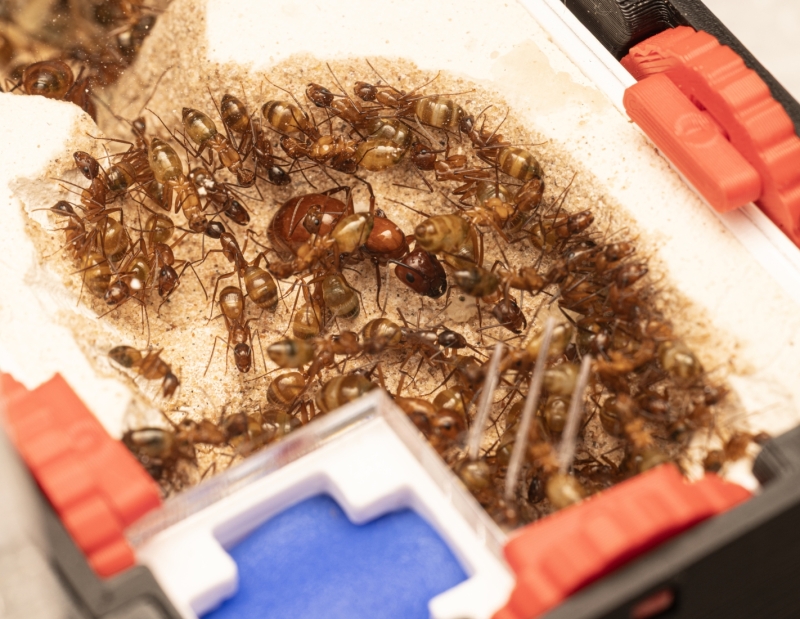
- Queen. Very similar to the workers, somewhat larger and with a bulkier thorax, on which the wing scars are visible. In a colony of hundreds of individuals she is hard to spot with the naked eye: she is usually in the brood chamber, surrounded by workers.
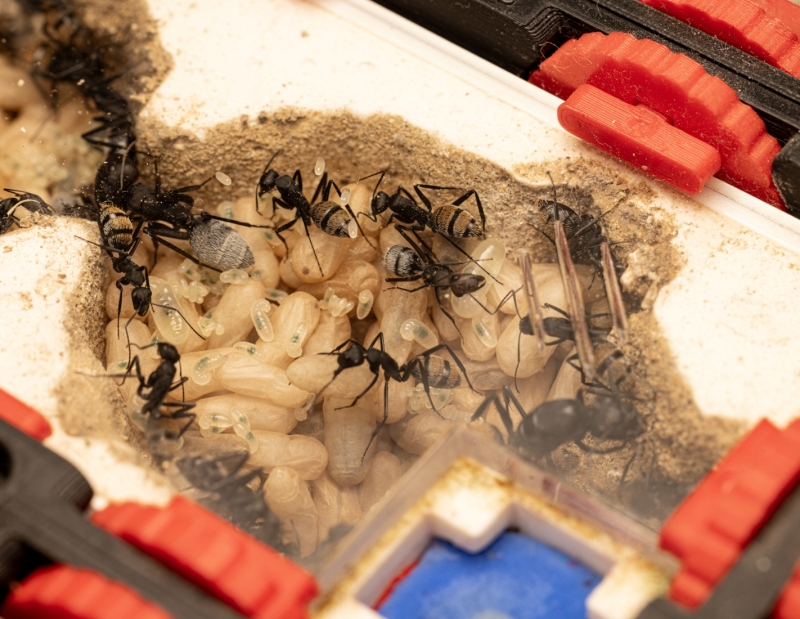
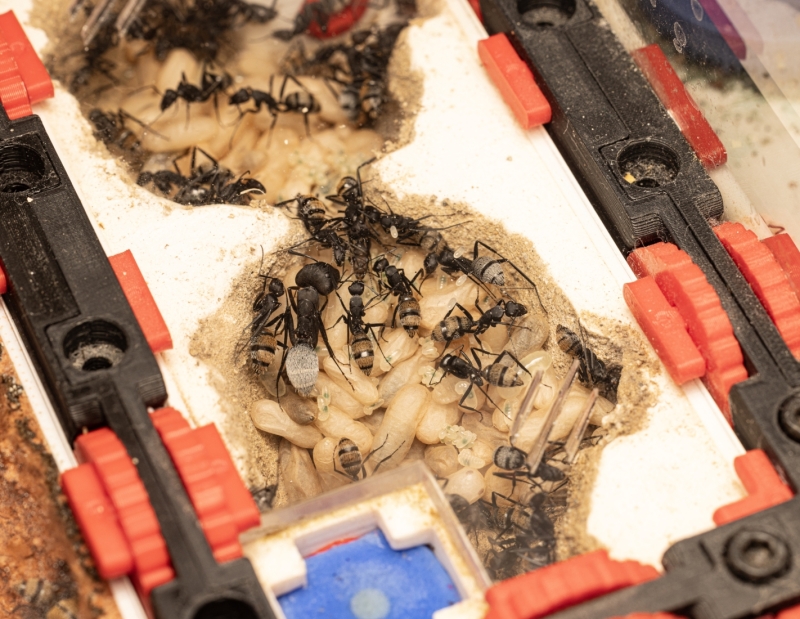
- Brood. Somewhat mobile larvae, on which the workers place pieces of prey, and pupae inside silk cocoons. In a large colony you will see piles of cocoons, often kept apart from the larvae.
Approximate measurements
- Workers: 12–13 mm (Yucatán populations, according to Rocha et al. 2020)
- Queen: somewhat larger than the workers; we have not found a published measurement
- No major workers or soldiers
The figures of 13 to 18 mm that circulate in shops and forums do not come from scientific measurements, and we do not give them. That said, 12–13 mm multiplied by several hundred workers takes up a lot of room: that is why this colony needs a medium-sized nest from day one.
Care in captivity
Difficulty: 3/5 – Advanced
In our experience, N. villosa is a hardy and adaptable ponerine, and a mature colony is even more so than a founding one: it has reserves, plenty of workers and a well-established queen. We rate it as advanced because of handling, not because it is delicate:
- Hundreds of fast, climbing workers, instead of just a few: any failure of the barrier shows up immediately.
- A sting and a fast collective defence if disturbed.
- High protein consumption, and the cleaning that goes with it.
- A humidity gradient that has to be maintained in a larger nest.
What keeping an already large colony involves
Buying a showcase colony is not buying “more ants”: it is starting the hobby at a different point. This is what changes compared with a queen and brood:
- Space. From the outset you need to set aside a stable spot, at the right temperature and out of direct sunlight, for a medium-sized formicarium with a large, tall outworld. This is not a colony for a narrow shelf.
- A formicarium of its size from day one. No test tubes and no founding nests: the colony goes straight into its permanent nest (see “Recommended formicaria”).
- Lots of food and lots of cleaning. Several hundred hunters and their brood eat every day. That means prey several times a week, nectar that is always fresh and removing leftovers frequently, because a large colony also produces a lot of waste.
- Growth rate. At 3 years old, the colony has left the slow phase behind. Its growth is no longer measured in individual workers but in batches: with constant warmth and protein, the queen lays continuously and new workers replace the old ones and add to their number. We have not found published data on how long development takes in this species, so we do not give figures; what we do know is that protein is the engine.
- No majors to wait for. Unlike other large species, no soldiers will appear over time here: the colony grows in numbers, not in variety of castes. The variety comes from the jobs: hunters, nurses, refuse workers.
- Moving it is an operation. Rehousing 300–500 workers calls for preparation, a large tray and calm (see “Arrival and moving a large colony by tipping out”).
- Watching it. This is the big advantage. With so many workers, there is always something to watch: hunts, brood being carried, workers grooming their golden hair, nectar droplets passing from mandible to mandible. Good lighting over the outworld and a hand lens are the best purchases you can make.
Recommended parameters
- Nest temperature: 24–28 °C all year round, with a warmer side and a milder one so that the colony can place its brood where it suits it.
- Outworld: at room temperature or slightly warmer, with one end reaching about 28–30 °C.
- Humidity: moderate to high in one part of the nest, drier in the rest.
- Ventilation: essential; with hundreds of ants breathing and a humid area, condensation appears without it.
- Water: always, in one or two test tubes with water and cotton wool in the outworld.
- Light: dark nest and lit outworld, with a normal day–night cycle.
- Diapause: none.
Humidity: the gradient on a large scale
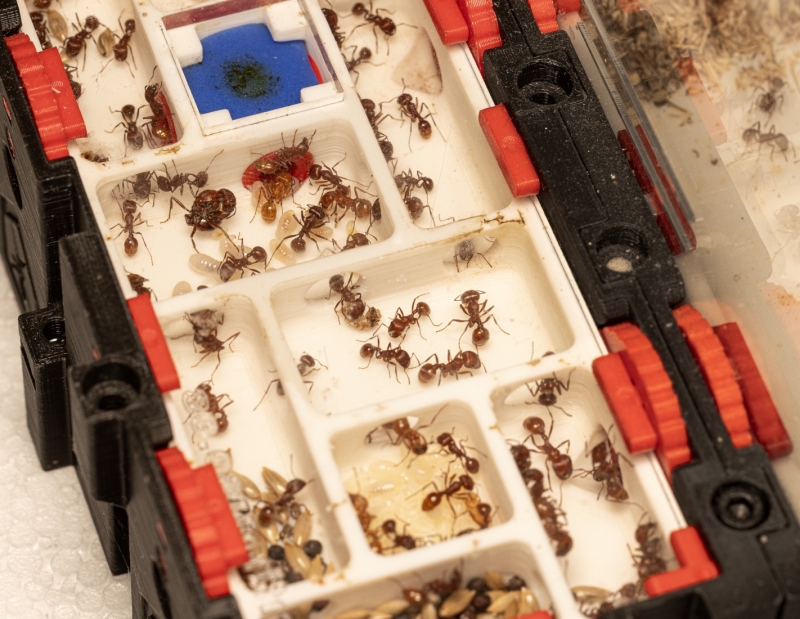
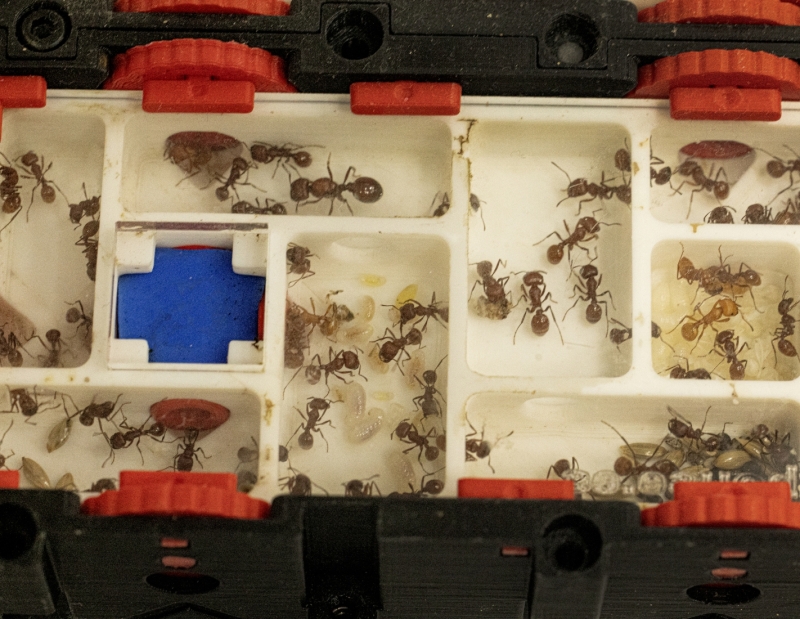
The heart of a bromeliad or the inside of a hollow trunk has a stable, somewhat humid microclimate, but not a waterlogged one. In the formicarium, that translates into one humid chamber and others that are progressively drier. In a large colony you will see it clearly: eggs and small larvae in the humid part; cocoons and resting workers, often in drier areas.
With a larger nest, the risk of getting it wrong is greater in both directions. If you add too much water, the moisture from hundreds of ants and their leftovers adds to that of the plaster, and mould and mites appear. If you forget to water, the humid chamber dries out sooner than you think, because a large colony occupies it and “uses it up”. Water only the humid area, a little and often, watch where they put the brood and adjust according to what they tell you.
Recommended formicaria
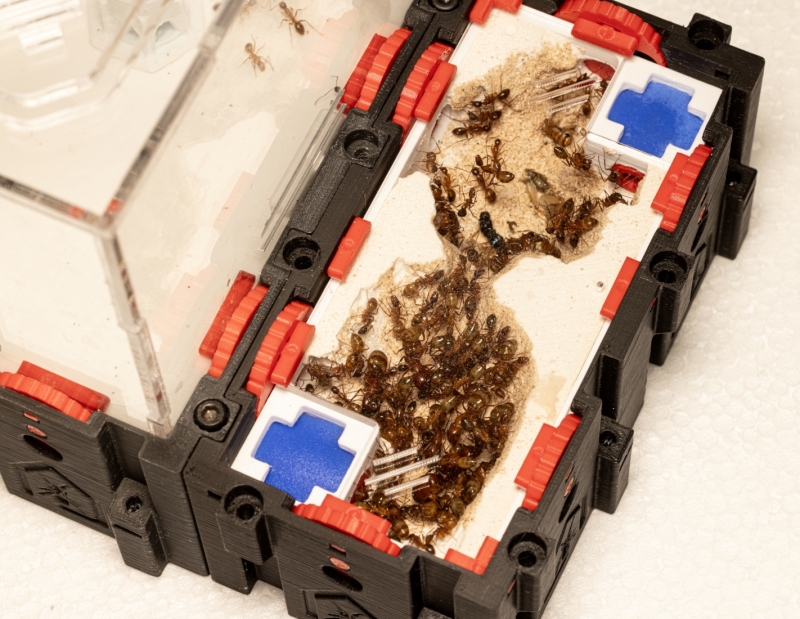
For a colony of 300–500 workers of this size, at Antomas we go straight for the Qbik Wild Duo P 2C from Anthouse: made of plaster, which holds moisture, with enough surface area to house the whole colony and space to create the gradient between one humid chamber and other drier ones. It suits a species that lives in plant cavities with a stable microclimate.
If the colony keeps growing and starts running out of room, connect a second nest instead of moving it into a huge one: that way the colony takes over the new space at its own pace, with no empty chambers. The signs that it is time to expand are clear: lots of workers standing still in the outworld because they do not fit inside, or brood piled up at the entrance. Complete the set-up like this:
- A large, tall outworld: branches, bark and vertical elements, because in the wild it roams the vegetation. With hundreds of workers, the more surface area, the more spread out the activity will be and the better you will see it. Nothing that reaches the barrier or the lid.
- Escape barrier of PTFE (Fluon) and a tight-fitting lid with ventilation mesh.
- One or two water tubes with cotton wool, so it never runs short.
- Feeder for the nectar, never cotton wool.
- A corner for leftovers. The colony will end up choosing one as its rubbish dump; keep it accessible for cleaning.
Arrival and moving a large colony by tipping out
When it arrives, leave the colony exactly as it comes, in a quiet, dimly lit place at 26–28 °C, and check that it has water. A few hours’ rest is enough. To move it into the formicarium, at Antomas we always tip it out, and with 300–500 fast, climbing workers armed with a sting, you need to prepare it well:
- Everything ready before opening: the formicarium set up, the humid chamber watered, the water tubes in place and the PTFE barrier applied and dry.
- A large tray under the whole set-up, with its edges also protected with barrier if possible. Any that fall will stay there and not on the table.
- Tools to hand: long tweezers and a soft brush.
- Tip it out inside the outworld, next to the nest entrance: open the container right there and shake gently until the queen, the workers and the brood fall out. If it arrives in several containers, one at a time, closing the lid in between.
- No rush. Many will stay clinging to the walls: leave the container open inside the outworld so they come out on their own.
- Nest in the dark and lid closed. Within a few hours they will have carried the queen and the brood inside. You will see some tandem running: these are scouts showing the way.
If it ever needs to be moved to another formicarium, it is done the same way: it is tipped out into the new one, rather than waiting for it to move on its own.
Feeding an empire
Protein: lots of it, and varied. Hundreds of hunters and a queen in full lay need insects several times a week, and the amount should follow the brood: the more larvae you see, the more prey. This is the Antomas philosophy: if you do maintenance every day and remove leftovers, it is better to overfeed, because the colony senses abundance and grows faster and in greater numbers; if you cannot clean often, it is better not to overfeed, because whatever is left over rots. With a colony of this size, removing leftovers every day or every other day is not optional. Change the insect every week:
A large colony can be given live prey without any problem: that is when it shows off best. Always use bred insects, because wild-caught ones may carry insecticides.
Nectar: always available. A large colony uses a lot of energy patrolling. At Antomas we recommend Blue Sugar nectar by Anthouse 4–5 times a week and another nectar or sugary liquid 1–2 times, for variety. Offer it in a feeder, never on cotton wool, which goes mouldy straight away. A feeder where the droplet is left exposed suits them perfectly: it is exactly how they collect nectar, as a droplet between the mandibles. Replace it before it ferments; with hundreds of workers, it empties sooner than you expect.
Water: always, in the test tubes with cotton wool.
No diapause: active all year round
N. villosa is tropical and subtropical: across its range, activity is governed by rainfall and temperature, not by a cold winter. At Antomas we keep it active twelve months a year, with constant warmth, humidity and food. If your home cools down in winter and the nest drops to around 22–24 °C for a few weeks, the colony will slow down a little and that is fine, but do not let it fall below about 20 °C and do not give it a European-species diapause. If you notice the brood decreasing, think first about protein, warmth or a recent change.
Behaviour and warning signs
Active at any hour. A large colony always has workers outside: they patrol the outworld, climb the branches and come to food straight away. It responds quickly to any intrusion into its territory.
Watch without fear. At Antomas we believe ants are there to be enjoyed, watched and learnt from. With a dark nest and a lit outworld, you can look at it whenever you like; you just need to do it gently and intervene only as much as necessary. It has good eyesight and gets used to your presence.
Signs that something is wrong:
- Few larvae or brood disappearing: not enough protein.
- Brood piled up in the most humid spot or shrivelled cocoons: not enough humidity.
- Condensation, mould or mites: too much water or forgotten leftovers.
- Lots of motionless workers outside the nest: they do not fit, time to expand.
- Workers confronting one another with antennal boxing and biting: check that the queen is all right.
Escapes and barriers
With a founding colony, an escape means one worker; with a showcase colony, it can mean a dozen in a minute. N. villosa is an excellent climber and makes use of any gap:
- PTFE (Fluon) barrier, unbroken, on the upper part of the outworld walls, renewed as soon as it wears or gathers dust. Paraffin oil works as back-up.
- Tight-fitting lid with fine-mesh ventilation.
- Connections, stoppers and tubes checked regularly.
- Not a single bridge: branches, decoration or tubes reaching the barrier or the lid.
- Before opening, check where the workers closest to the edge are; open only as much as needed and close it when you have finished.
Handling and safety
It has a functional sting. In Antomas’s experience, its sting is rather mild among the large ponerines, although the literature usually describes it as painful. What changes with a large colony is the probability: there are many more workers ready to defend the nest. Always work with long tweezers and a brush, never with your hands, calmly and over a tray. Any hymenopteran can cause an allergic reaction in a sensitised person: keep it away from small children and pets. Do not house it with other colonies or other species, and remember that it is an exotic species: it must never be released.
What not to do
- Putting it in a small nest or in tubes “until there is time”: it needs its formicarium from day one.
- Giving it a huge space all at once instead of expanding by connecting another nest.
- Skimping on protein or leaving leftovers in place.
- Waterlogging the nest or letting the humid chamber dry out.
- Letting it run out of water or nectar, or putting the nectar on cotton wool.
- Adding queens or merging it with another colony.
- Giving it a diapause or cooling it below about 20 °C.
- Opening the outworld without a barrier, without a tray or in a hurry.
- Handling it with your hands.
Scientific sources
This care sheet is based on the scientific literature on Neoponera villosa, its species complex and its genus, and on Antomas’s experience breeding large colonies of the species. Main references:
- Schmidt, C. A. & Shattuck, S. O. (2014). The higher classification of the ant subfamily Ponerinae (Hymenoptera: Formicidae), with a review of ponerine ecology and behavior. Zootaxa 3817: 1–242. doi:10.11646/zootaxa.3817.1.1
- Lucas, C., Fresneau, D., Kolmer, K., Heinze, J., Delabie, J. H. C. & Pho, D. B. (2002). A multidisciplinary approach to discriminating different taxa in the species complex Pachycondyla villosa (Formicidae). Biological Journal of the Linnean Society 75: 249–259. doi:10.1046/j.1095-8312.2002.00017.x
- Rocha, F. H., Lachaud, J.-P., Hénaut, Y., Pozo, C. & Pérez-Lachaud, G. (2020). Nest site selection during colony relocation in Yucatan Peninsula populations of the ponerine ants Neoponera villosa (Hymenoptera: Formicidae). Insects 11: 200. doi:10.3390/insects11030200
- Dejean, A., Olmsted, I. & Snelling, R. R. (1995). Tree-epiphyte-ant relationships in the low inundated forest of Sian Ka'an Biosphere Reserve, Quintana Roo, Mexico. Biotropica 27: 57–70. doi:10.2307/2388903
- Dejean, A. (1990). Influence de l'environnement pré-imaginal et précoce dans le choix du site de nidification de Pachycondyla (=Neoponera) villosa (Fabr.) (Formicidae, Ponerinae). Behavioural Processes 21: 107–125. doi:10.1016/0376-6357(90)90019-C
- Dejean, A., Corbara, B. & Oliva-Rivera, J. (1990). Mise en évidence d'une forme d'apprentissage dans le comportement de capture des proies chez Pachycondyla (=Neoponera) villosa (Formicidae, Ponerinae). Behaviour 115: 175–187. doi:10.1163/156853990X00563
- Heinze, J., Trunzer, B., Oliveira, P. S. & Hölldobler, B. (1996). Regulation of reproduction in the neotropical ponerine ant, Pachycondyla villosa. Journal of Insect Behavior 9: 441–450. doi:10.1007/BF02214021
- Trunzer, B., Heinze, J. & Hölldobler, B. (1998). Cooperative colony founding and experimental primary polygyny in the ponerine ant Pachycondyla villosa. Insectes Sociaux 45: 267–276. doi:10.1007/s000400050087
- Kolmer, K. & Heinze, J. (2000). Rank orders and division of labour among unrelated cofounding ant queens. Proceedings of the Royal Society B 267: 1729–1734. doi:10.1098/rspb.2000.1202
- D'Ettorre, P., Kellner, K., Delabie, J. H. C. & Heinze, J. (2005). Number of queens in founding associations of the ponerine ant Pachycondyla villosa. Insectes Sociaux 52: 327–332. doi:10.1007/s00040-005-0815-z
- Pavan, G., Priano, M., De Carli, P., Fanfani, A. & Giovannotti, M. (1997). Stridulatory organ and ultrasonic emission in certain species of ponerine ants (genus: Ectatomma and Pachycondyla, Hymenoptera, Formicidae). Bioacoustics 8: 209–221. doi:10.1080/09524622.1997.9753363