Difficulty: 1/5 – Beginner
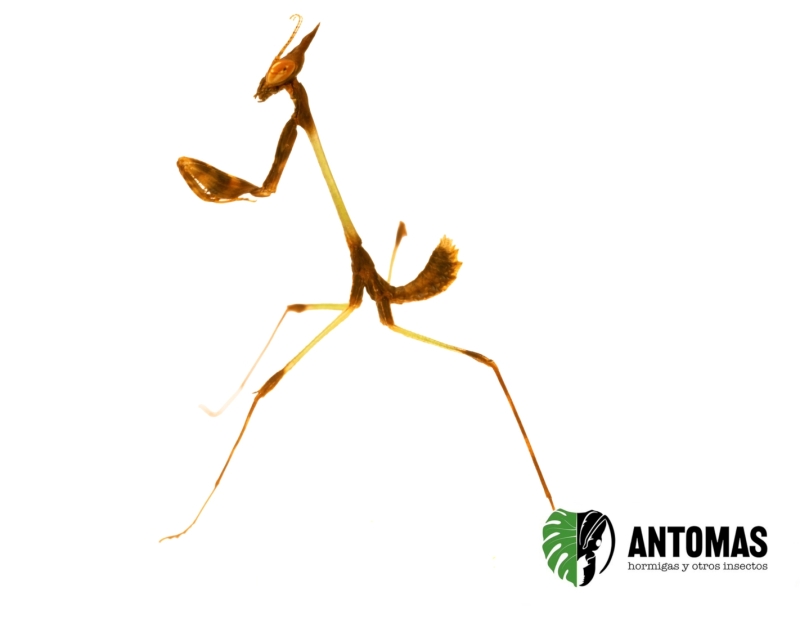
A large, robust mantis that grows fast and is an excellent hunter. Sold as an L2 nymph: tall, ventilated container, 22–28 °C, light misting and Drosophila from day one. Always kept alone: it is cannibalistic.
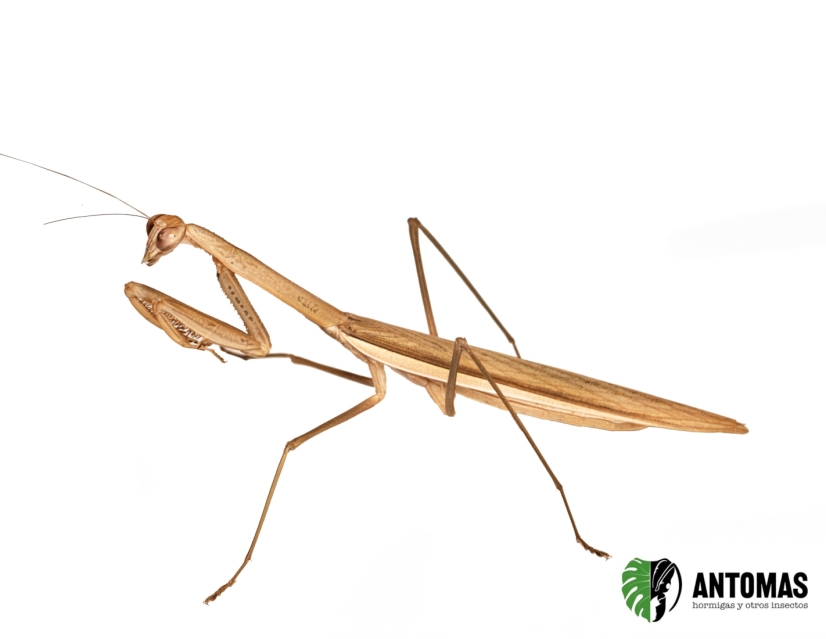
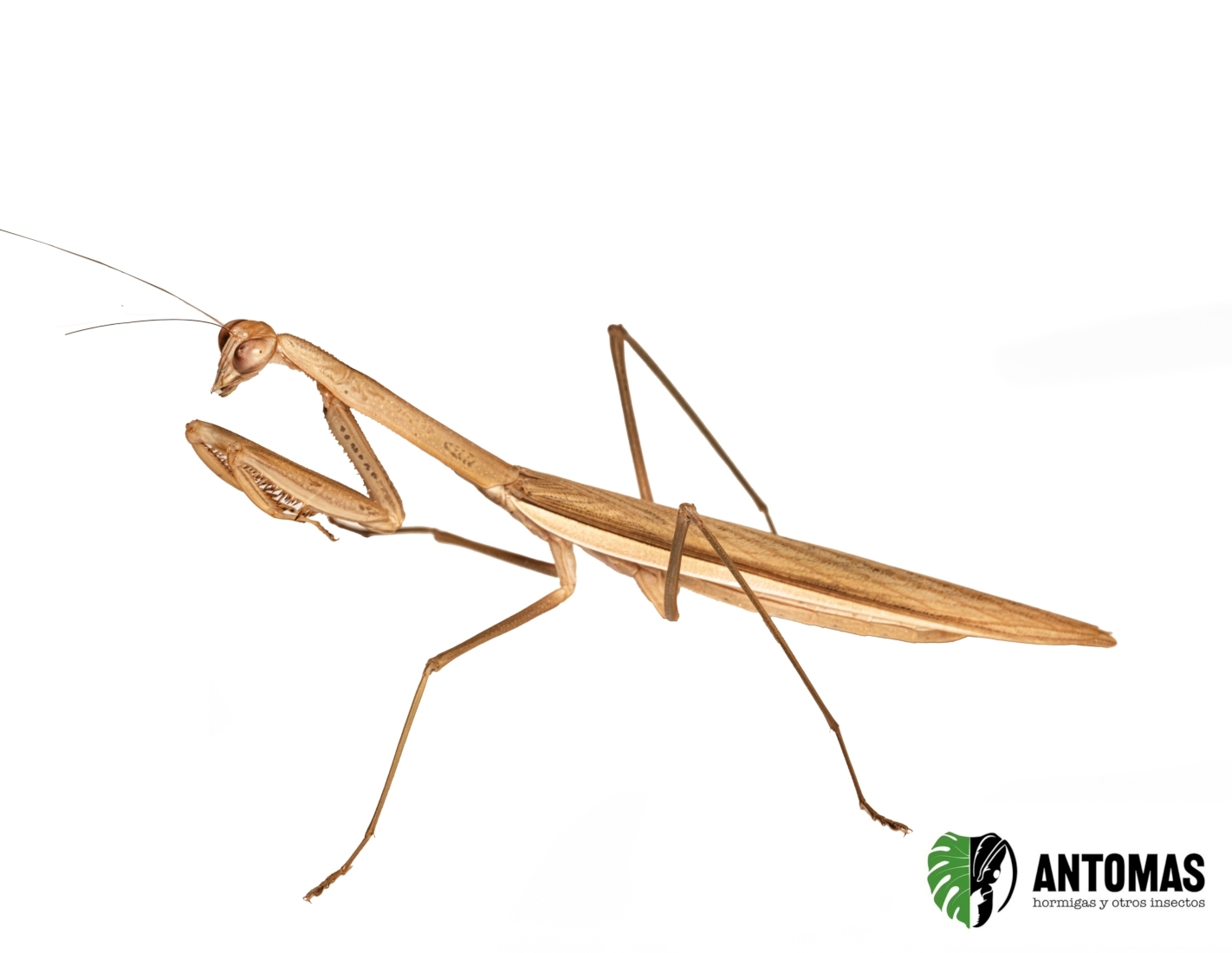
Tenodera is a genus of mantises in the family Mantidae, with a long, slender body, green or straw-brown, and wings that cover the abdomen in adults. It includes East Asian species such as T. sinensis, T. aridifolia and T. angustipennis; T. sinensis has also been introduced to North America. Young nymphs cannot be reliably told apart at species level, which is why we sell it as Tenodera sp.
Identification and size
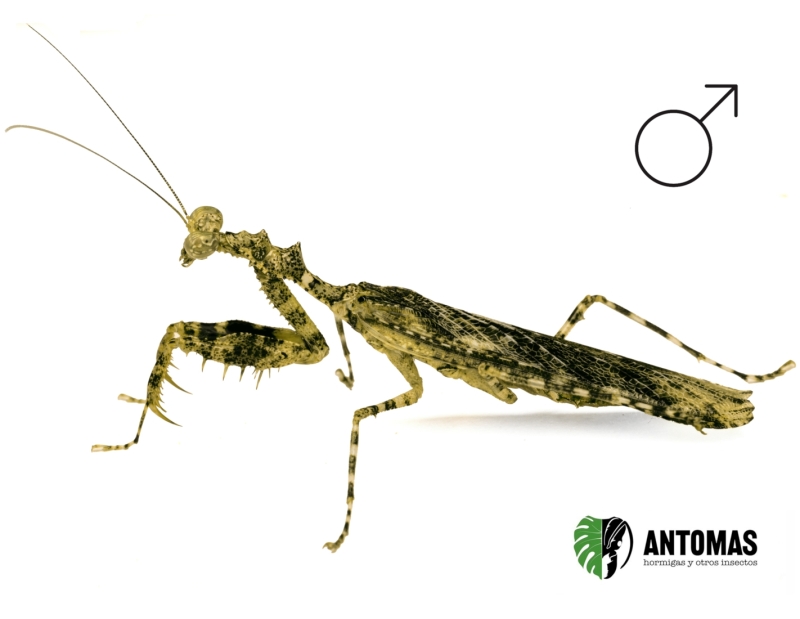
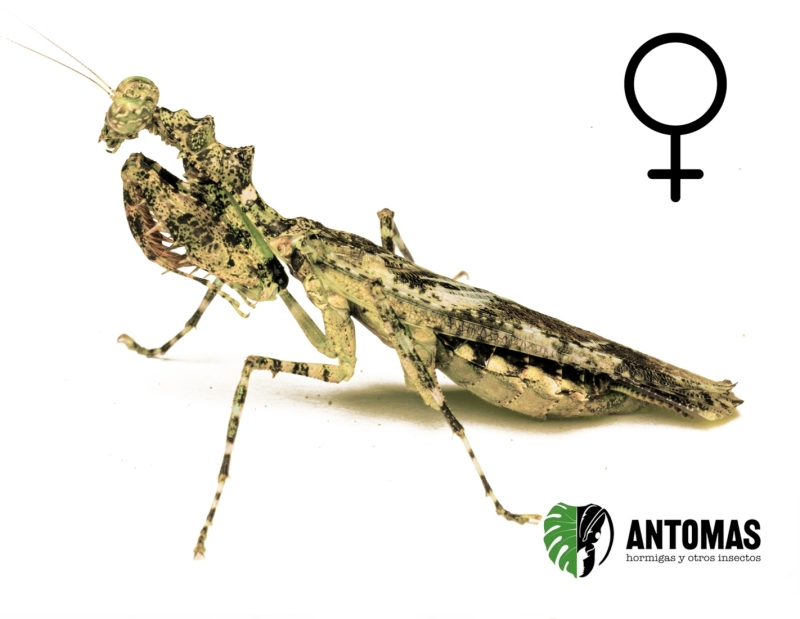
- Body: slender, with a very long pronotum and spiny raptorial forelegs. The wing pads (pterothecae) become visible in the last nymphal instars.
- Colour: green, brown or a mix of both; it indicates neither sex nor species.
- Clues in the adult: according to field keys, the spot between the front coxae is yellow in T. sinensis and orange in T. angustipennis, and the hindwings of T. sinensis are heavily mottled with brown. The species is confirmed on the adult.
- Adult size: in T. sinensis from Japan, males measure 79.0–88.5 mm and females 83.5–90.5 mm, from the pronotum to the wing tips (Oshima and Toshima 2024). Other species in the genus are somewhat smaller.
It is a generalist, voracious sit-and-wait predator. A curious fact: newly hatched T. sinensis nymphs eat pollen, which keeps them alive when there is no prey yet (Beckman and Hurd 2003). In captivity, this is no substitute for insects.
Care in captivity
Enclosure
- Height: at least 3 times the mantis’s length, so it can hang and moult without touching the floor. For an L2, a pot of about 250–500 ml is enough; the adult needs about 30 cm of height.
- Ventilation: mesh lid and, if possible, a ventilated side. Still, humid air brings mould and failed moults.
- Grip: thin twigs placed diagonally and mesh on the ceiling; moults take place hanging upside down.
- Substrate: kitchen paper or a thin layer of coco fibre, easy to clean.
Temperature, humidity and water
- Temperature: 22–28 °C by day; at night it can drop to room temperature. Warmer conditions mean faster growth: in T. sinensis, the L2 instar lasted about 9 days at 25 °C and more than 15 at 20 °C (Hurd et al. 1989).
- Humidity: 50–70%.
- Water: mist the walls every 1–2 days with fine droplets, without wetting the nymph. It drinks from the droplets.
Feeding by instar
It hunts live, moving prey no larger than its own body:
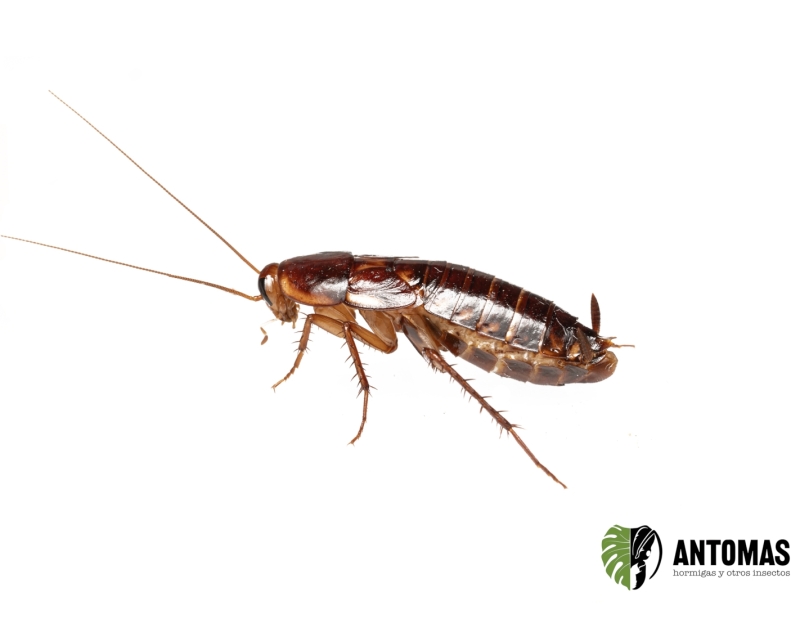
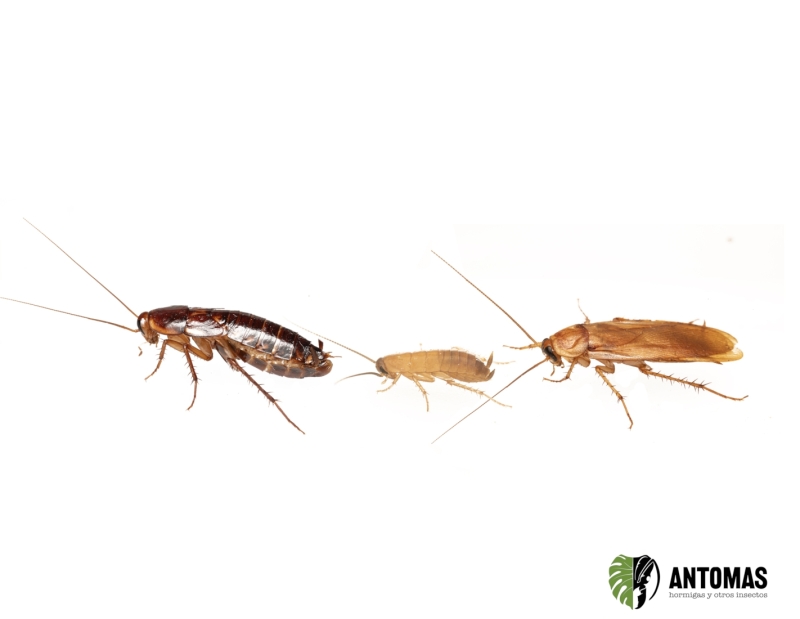
- L2–L3: Drosophila hydei or D. melanogaster. In the trial by Hurd et al. (1989), each L2 nymph ate 35–44 flies over the whole instar, about 4–5 a day at 25 °C. Springtails make a good supplement and also clean up leftovers.
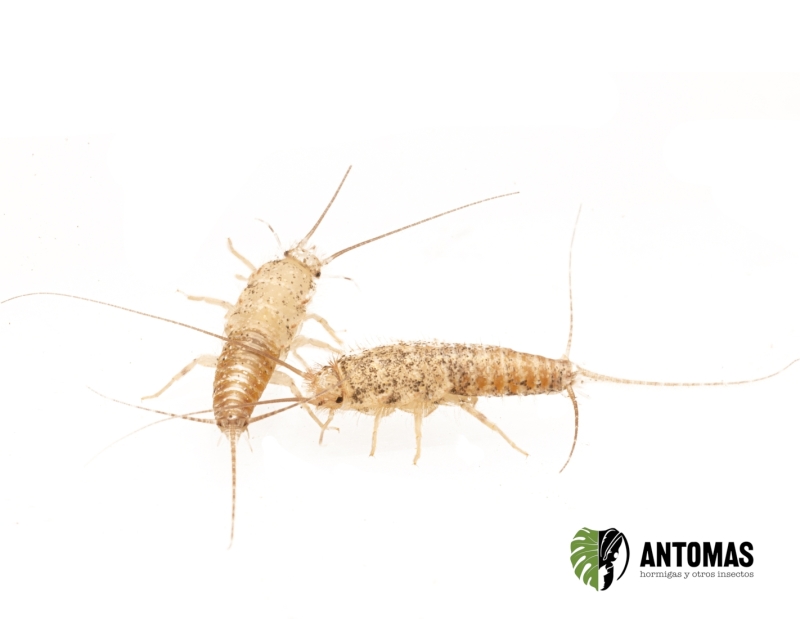
- L4–L5: houseflies, firebrats (Thermobia domestica) and small crickets.
- Subadults and adults: flies and blowflies as the staple, medium crickets and other varied prey.
- Frequency: small nymphs daily or every 2 days, with prey always available; adults every 2–3 days. A flat abdomen means it is time to eat. Remove any prey not eaten within a day.
Moulting
- Premoult: it stops eating for a day or two, stays still and hangs. From that moment, do not touch it and remove any live prey.
- After the moult, wait about 24 hours before feeding: the cuticle needs to harden.
- Imaginal moult: the final one, in which the fully developed wings appear. After it, there are no more moults.
Cannibalism: always kept singly
Tenodera eat one another at any age. In the field, female cannibalism of males can even shift the adult sex ratio (Hurd et al. 1994). Each specimen in its own container.
Breeding
Sexing
Count the segments on the underside of the abdomen: the female shows about 6, because the seventh sternite forms a large subgenital plate; the male, about 8 (terminology in Brannoch et al. 2017). This is easy to see from the middle instars onwards. The adult male is slimmer, with thicker antennae and larger ocelli (Oshima and Toshima 2024).
Mating
- Wait about 2 weeks after the imaginal moult before pairing them.
- Feed the female well before and during the encounter, and introduce the male from behind, in a roomy space.
- Supervise and remove the male once mating is over. Females that eat him transfer nutrients from the male into the eggs (Brown and Barry 2016), but this is not needed for a fertile clutch.
Ootheca and incubation
The female attaches the ootheca, a foamy mass that hardens, to a twig or to the mesh. In temperate species such as T. sinensis, the ootheca overwinters in diapause and hatches in spring; in the study by Hurd et al. (1989) oothecae were stored at 10 °C and incubated at 25 °C. Breeders’ practice is to give it a few weeks of cold (8–10 °C) and then incubate at 24–28 °C, hanging as it was laid, with light misting in the container. The nymphs hatch together and must be separated early.
What NOT to do
- Touch, move or mist it directly during premoult or moulting.
- Leave crickets or other live prey in the enclosure while it moults: they can bite it.
- Help it out of the exuvia or reposition it if it falls.
- Use a low container, with no grip on the ceiling or no ventilation.
- Wet the nymph or keep the enclosure waterlogged.
- Keep two specimens together, not even small nymphs.
- Offer prey larger than the mantis or prey that could injure it, such as large crickets, wasps or spiders.
- Feed insects collected in areas treated with insecticides.
- Put the male with a freshly moulted or hungry female.
- Release specimens or oothecae into the wild: it is an exotic species.
Scientific sources
This care sheet is based on the scientific literature on Tenodera, especially T. sinensis, and on breeders’ practice. Main references:
- Hurd, L. E., Marinari, P. E. & Eisenberg, R. M. (1989). Influence of temperature and photoperiod on early developmental rate of Tenodera sinensis Saussure (Mantodea: Mantidae). Proceedings of the Entomological Society of Washington 91: 529–533. BioStor 56408
- Hurd, L. E., Eisenberg, R. M., Fagan, W. F., Tilmon, K. J., Snyder, W. E., Vandersall, K. S., Datz, S. G. & Welch, J. D. (1994). Cannibalism reverses male-biased sex ratio in adult mantids: female strategy against food limitation? Oikos 69: 193–198. doi:10.2307/3546137
- Beckman, N. & Hurd, L. E. (2003). Pollen feeding and fitness in praying mantids: the vegetarian side of a tritrophic predator. Environmental Entomology 32: 881–885. doi:10.1603/0046-225X-32.4.881
- Brown, W. D. & Barry, K. L. (2016). Sexual cannibalism increases male material investment in offspring: quantifying terminal reproductive effort in a praying mantis. Proceedings of the Royal Society B 283: 20160656. doi:10.1098/rspb.2016.0656
- Brannoch, S. K., Wieland, F., Rivera, J., Klass, K.-D., Béthoux, O. & Svenson, G. J. (2017). Manual of praying mantis morphology, nomenclature, and practices (Insecta, Mantodea). ZooKeys 696: 1–100. doi:10.3897/zookeys.696.12542
- Oshima, K. & Toshima, K. (2024). A bilateral gynandromorph of Tenodera sinensis Saussure, 1871 (Mantodea: Mantidae) from Japan. Zootaxa 5551: 369–379. doi:10.11646/zootaxa.5551.2.7