Difficulty: 5/5 – Expert
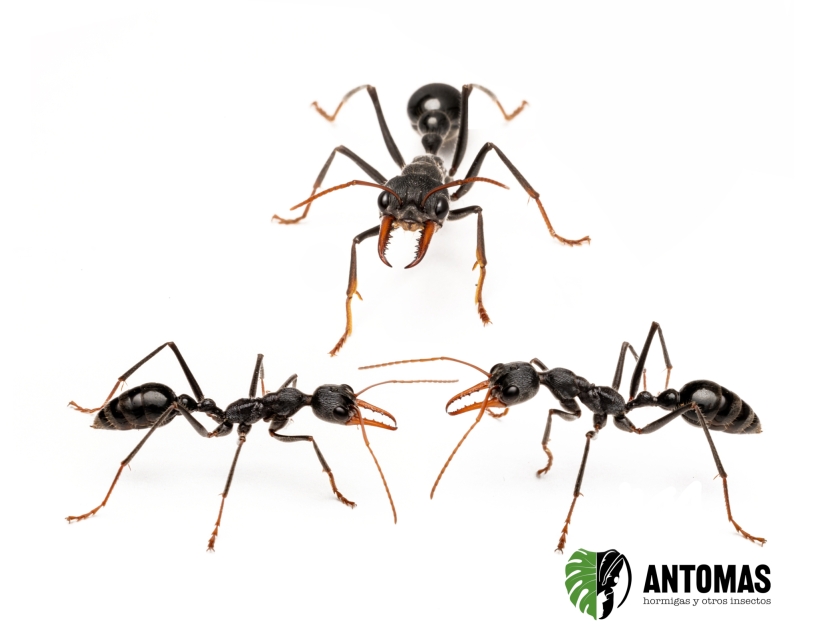
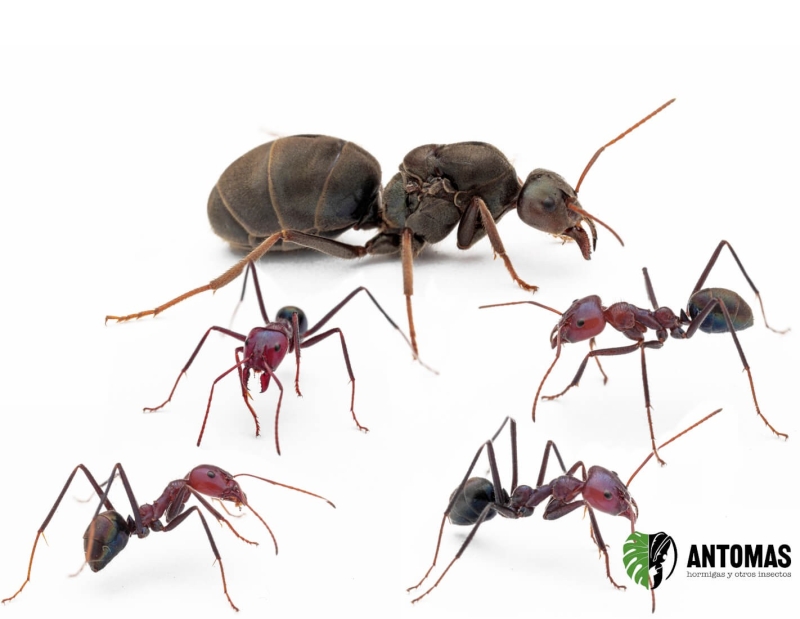
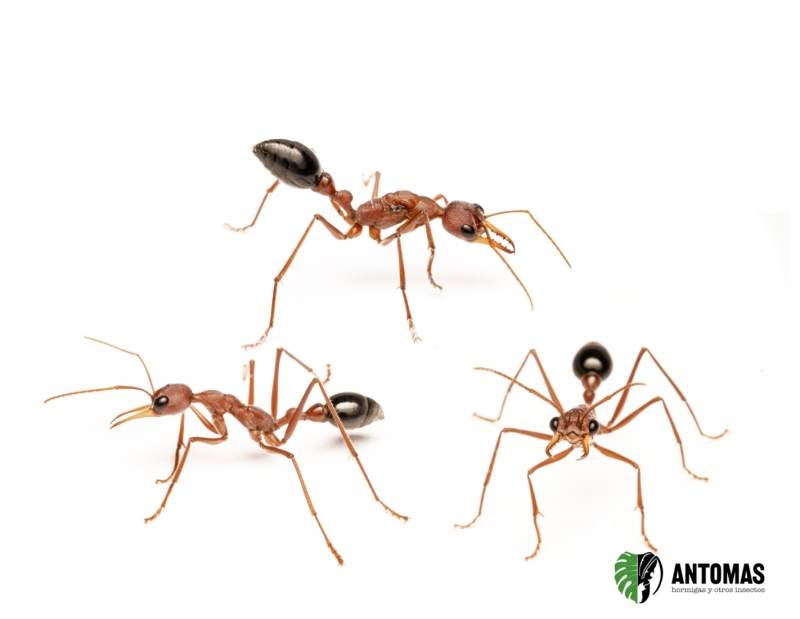
A large bulldog ant from the gulosa group, native to temperate south-eastern Australia: workers of 19–23 mm, long legs, toothed mandibles and excellent eyesight. A species with short-winged queens that can be hard to tell apart from a large worker. Shipped as a queen with brood; founding is semi-claustral: a moist starter tube that is allowed to dry out, kept in the dark, then a QBIK DUO with large galleries and a Qbik Wild NoNa Diáfano. 24–27 °C with a gradient and mature larvae never above 28 °C. Sugar every day, protein in step with the larvae, and dead prey at first. Diapause of about 3 months at 10–15 °C. Its sting is very painful: not suitable for people with allergies or for homes with young children or pets.
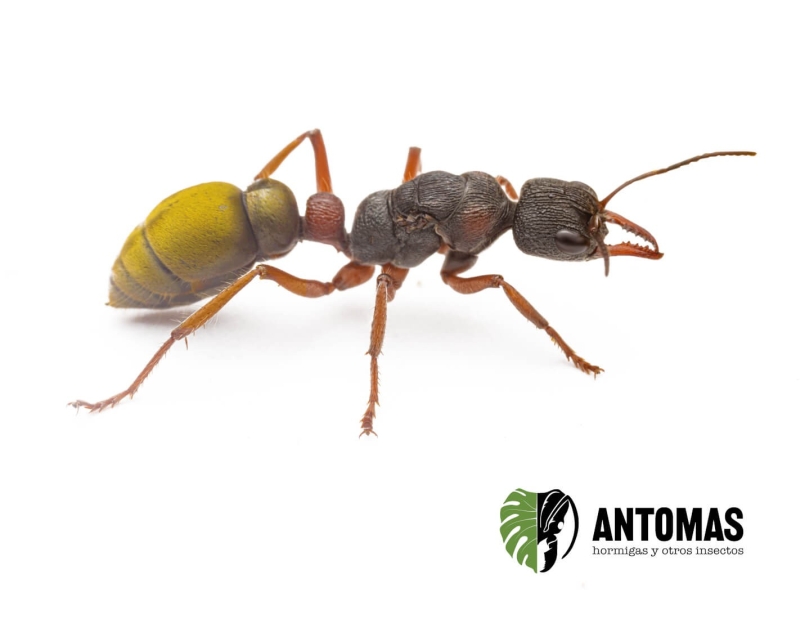
Myrmecia simillima Smith, 1858 is one of the classic bulldog ants of south-eastern Australia: a solitary hunter almost two and a half centimetres long, with long mandibles lined with teeth, eyes that take up half the face and a sting that commands respect. It belongs to the gulosa group, the large bulldog ants, and shares with its relatives a primitive way of raising brood, hunting by sight and an annual cycle that shuts down in winter.
It also has a peculiarity that sets it apart from almost all its neighbours: the literature describes brachypterous, short-winged queens that at first glance pass for large workers. It is a common species at home and surprisingly rarely kept elsewhere: we have not found a single published rearing journal. This care sheet brings together everything we know about the genus and its close relatives, separates what is documented for the species from what is extrapolated, and adds what we do at Antomas with our own Myrmecia.
Biology
Seven names for a single bulldog ant
Frederick Smith described it in 1858 in his catalogue of the Hymenoptera in the British Museum, and the epithet says it all: simillima is the Latin superlative of «similar», that is, «the most similar». A very fitting name in a genus where many species are separated by details of colour and sculpture.
Later history proved him right. According to the Atlas of Living Australia, it was described several times under different names during the 19th century: M. crudelis (Smith himself, 1858), M. affinis, M. nigriventris, M. spadicea and M. tricolor (all four by Mayr, 1862), M. paucidens (Forel, 1910) and M. tricolor rogeri (Emery, 1914). Today all of them are regarded as synonyms. When one ant piles up seven names, it usually means it varies a lot in colour from one population to another; tricolor itself sums up its classic three-tone livery.
John Clark redescribed it in 1951, in his work on the Formicidae of Australia, and that is the source of the measurements and the account of its colour repeated in every compilation.
In the big league: the gulosa group
The genus Myrmecia contains just over 90 species, divided into several groups that Ogata (1991) and Ogata and Taylor (1991) defined on morphology. M. simillima sits in the gulosa group, the largest bulldog ants, together with M. gulosa, M. forceps, M. fulgida and M. nigriscapa. It is a different group from the small jack jumpers (M. pilosula and allies) and from that of M. nigrocincta.
Genetic studies confirm that the group is a natural lineage: Hasegawa and Crozier (2006) recovered it as one of the well-defined branches of the genus, and the phylogenomic work of Mera-Rodríguez and colleagues (2023), with data from dozens of species, places bulldog ants as a very old and almost exclusively Australian lineage. In practice, belonging to this group means large workers, long mandibles and colonies that grow slowly.
Short-winged queens
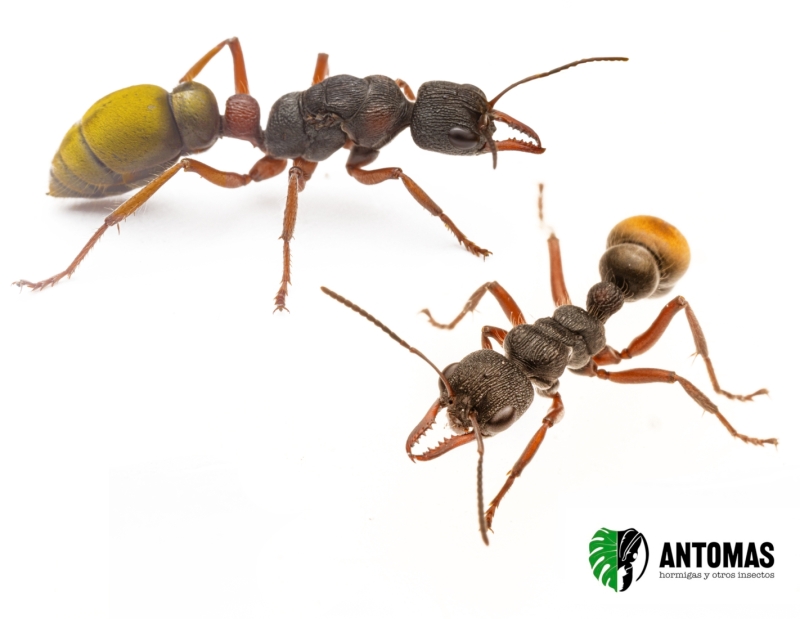
In most Myrmecia, queens are born with four fully developed wings, fly to mate and tear them off before founding. In M. simillima the literature records something different: brachypterous queens, with reduced, barely functional wings. The information comes from unpublished notes by John Freeland, one of the great students of bulldog ant biology in the mid-20th century, and from Clark (1951), as summarised by AntWiki. The literature also mentions ergatoid queens, wingless and with a worker's body, but the queens we see at Antomas are not ergatoid but brachypterous.
What does a queen that cannot fly well imply? In other ants with queens like this, the usual pattern is that the queen mates near the nest and founds a short distance away, on foot, or that the colony splits, what myrmecologists call budding. In M. simillima no study has confirmed this, so we present it as a reasonable possibility, not as a fact. What it does have is an immediate practical consequence: a brachypterous queen is easily mistaken for a large worker, although an eye with a little practice tells her apart without trouble by her bulkier thorax (see «Founding: how your colony arrives»).
A lineage with deep roots
Together with Nothomyrmecia macrops, the Myrmecia make up the subfamily Myrmeciinae. Ward and Brady (2003) reconstructed their history: an ancient lineage that today lives almost only in Australia, with a single species in New Caledonia. Its relative Nothomyrmecia made headlines when it was rediscovered in South Australia in the late 1970s, and earned the nickname «living fossil».
It is worth putting this correctly: a bulldog ant is not «the ancestor of ants». It is a modern ant that retains many ancestral traits: solitary hunters, larvae that feed by themselves on prey, workers able to lay eggs and queens that look quite like their workers. Keeping M. simillima is a glimpse of how the first ant societies may have lived.
An ant of the temperate south-east
Its natural range is south-eastern Australia. The Atlas of Living Australia holds more than 2,000 records, the vast majority from Victoria (just over 1,100) and New South Wales (around 800), with a good number in the Australian Capital Territory and odd records in South Australia and southern Queensland. Museum specimens are concentrated along the coastal strip of New South Wales and in the south-eastern highlands, and there are also collections from the inland tablelands.
So this is a temperate-climate bulldog ant: warm summers, with mean maximums of 27–29 °C in the uplands, cool winters with July means ranging from about 6 °C inland to about 13 °C on the coast, and rainfall spread across the year, with no marked dry season. Nothing like a tropical ant. It nests in the soil, mostly in open eucalypt country, under large stones, at the base of trees or beside logs, and from there the workers go out to hunt on the ground and often climb into the vegetation.
When the cold comes, everything stops
The Atlas records draw a very clear calendar. From September to April there are between 160 and 250 observations a month; in May they drop to about a hundred, and in June and July there are barely 26 each month, a fall of around 90 % compared with the austral spring and summer. Part of that drop is because fewer people go out into the field in winter, but the pattern matches that of its relative M. nigriscapa, for which a field study showed no brood and no activity in winter.
The takeaway for the keeper is simple: M. simillima lives by a seasonal clock. It works flat out in the warm season and slows down in the cold. At Antomas we see it adapt to the European winter, from December to February, with a gentle pause in which it never shuts down completely (see «Diapause: three quiet months»).
Eyes that miss nothing
Just look at it head-on: two large, bulging compound eyes take up much of the sides of the head. Myrmecia hunt by sight, without following pheromone trails, and each worker finds, chases and seizes its prey on its own. It is a way of life that demands good optics, and the genus has them: Greiner and colleagues (2007) showed that the eye structure of these ants changes with the time of day each species forages, and Narendra and colleagues (2011) that even workers, queens and males of the same species have eyes tuned to their own schedule.
The eyes of M. simillima have not been studied in detail. In our colonies it is a day hunter that comes out with light and warmth. At home you will notice straight away that it sees you: it turns its head towards the tweezers, follows the movement of your hand and reacts to a shadow. It is not bad temper, it is how it perceives the world, and that is why founding is done in the dark.
Two worker sizes, two jobs
Myrmecia have no soldiers or distinct worker castes, but in M. simillima you can see two fairly well-defined size ranges among the workers. It is not true polymorphism, because there are intermediates, but at Antomas we see it linked to the work they do: the smaller workers tend to stay inside the nest with the brood, while the large ones go out more to forage and defend.
There is a relative in the same group where this has been studied. In M. gulosa, Dietemann, Hölldobler and Peeters (2002) found that large and small workers play different roles and that many of them lay trophic eggs, undeveloped eggs that serve as food for the larvae and the queen. Something similar very probably happens in M. simillima, although nobody has measured it.
Old-school brood rearing
In almost all modern ants, the workers feed the larvae mouth to mouth. Bulldog ants do not: their elongated, fairly mobile larvae feed by themselves, directly on the pieces of prey the workers leave beside them. When they finish growing they spin a cocoon, and to do so they need soil or fibre particles around them; in the genus, workers have been seen to cover them in soil to help.
The queen, for her part, is no great nanny. In Tomás's words, Myrmecia queens are «a bit useless» with brood: sometimes they neglect it or move it around roughly, and if the first larvae hatch and there is no food, they may even eat them. It is part of their primitive biology and has to be taken into account during founding.
A venom for hunting and defence
The venom of M. simillima has not been analysed, but that of its group relative M. gulosa has, and it is one of the best known among ants. Robinson and colleagues (2018) found that almost all its peptides belong to a single gene family, the aculeatoxins, with divided roles: some paralyse insects and others activate the sensory neurons of mammals, in other words, they cause pain. A single venom serves both to hunt and to defend the nest.
Eagles and colleagues (2022) described in that same venom a toxin that mimics vertebrate EGF hormones and, in mice, causes pain hypersensitivity lasting for days. With a sting this size and such a close relationship, the sensible thing is to assume that M. simillima plays in the same league (see «Handling and safety»).
Open questions
For an ant that is common in its range, little is known about M. simillima. There are no censuses of its colonies: the figures of several hundred or a thousand workers that circulate online have no study behind them, and our only reference is M. gulosa, with mature colonies of around 1,600 workers. There is also no reliable data on its nuptial flights or on whether a colony can have several queens, and we still lack a study of how a short-winged queen founds in the wild. Every well-kept colony adds a little new information about a species that still hides a great deal.
Size and morphology
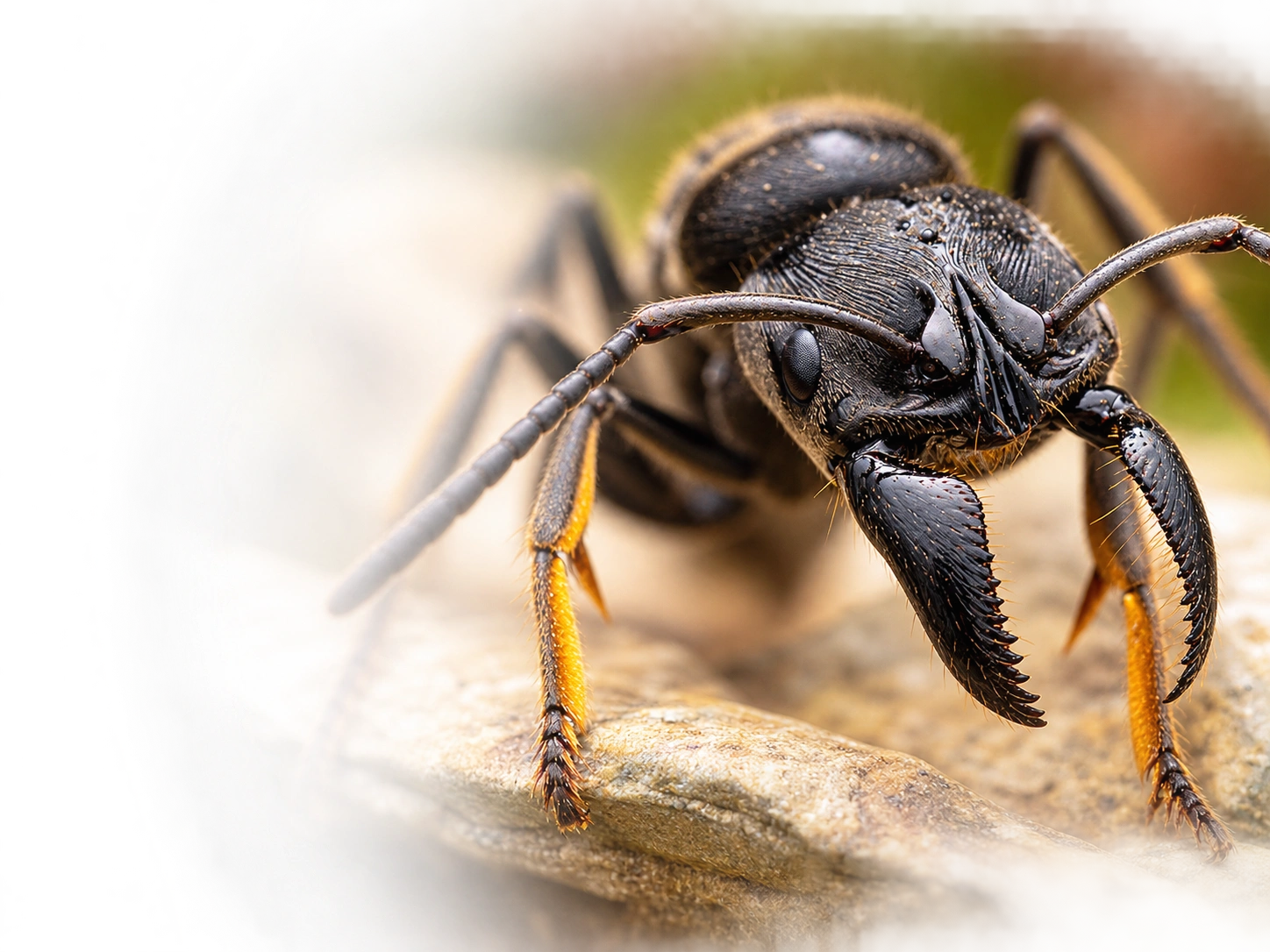
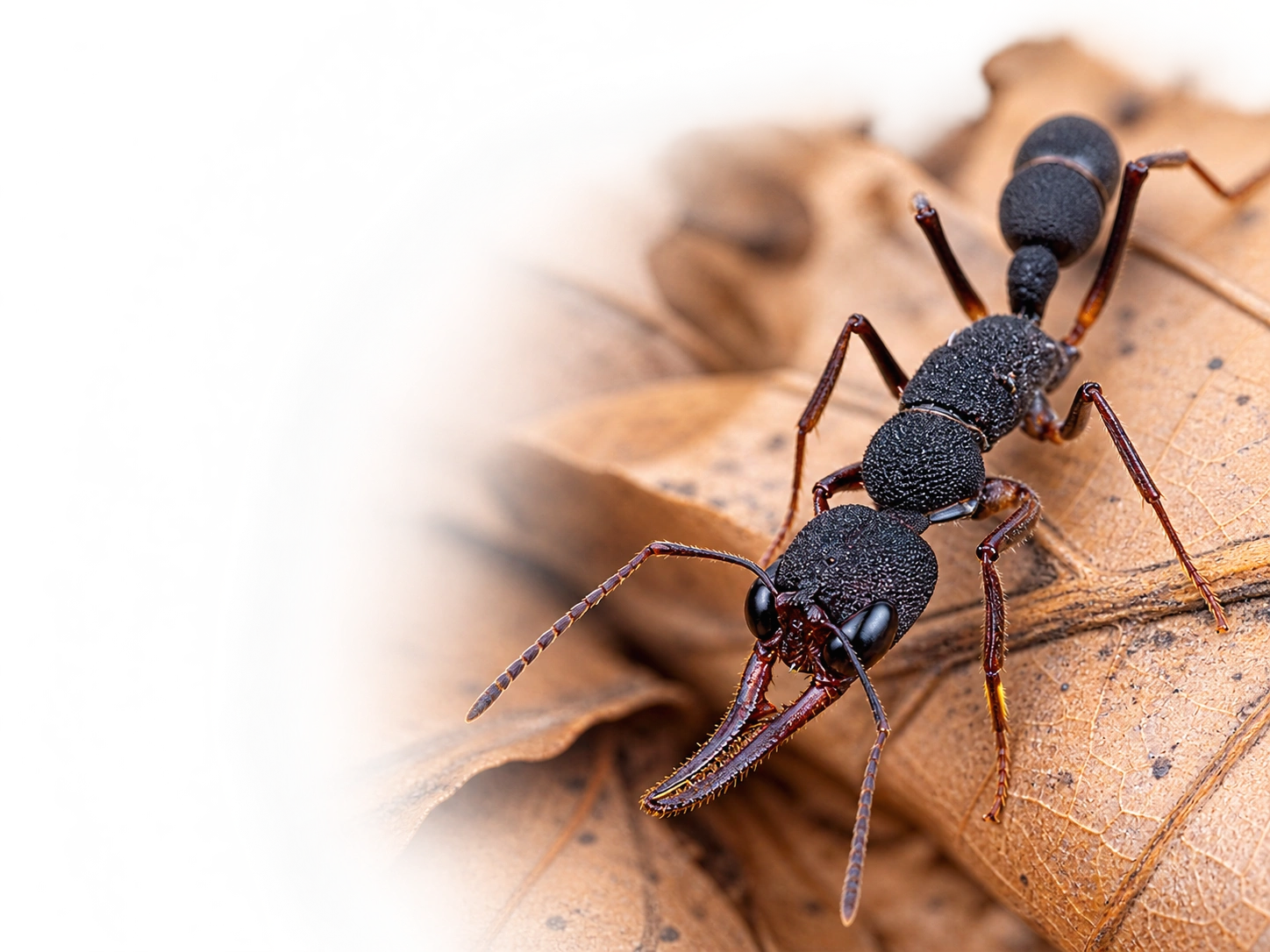
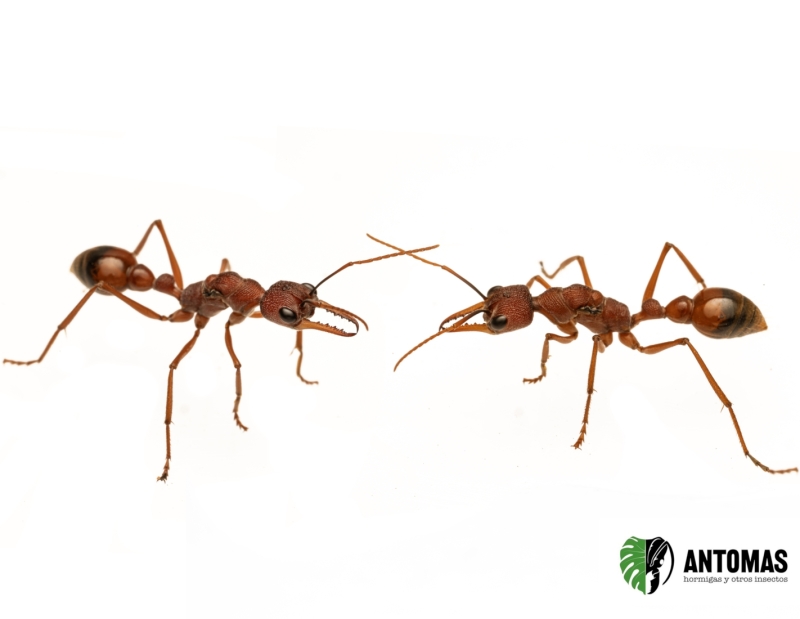
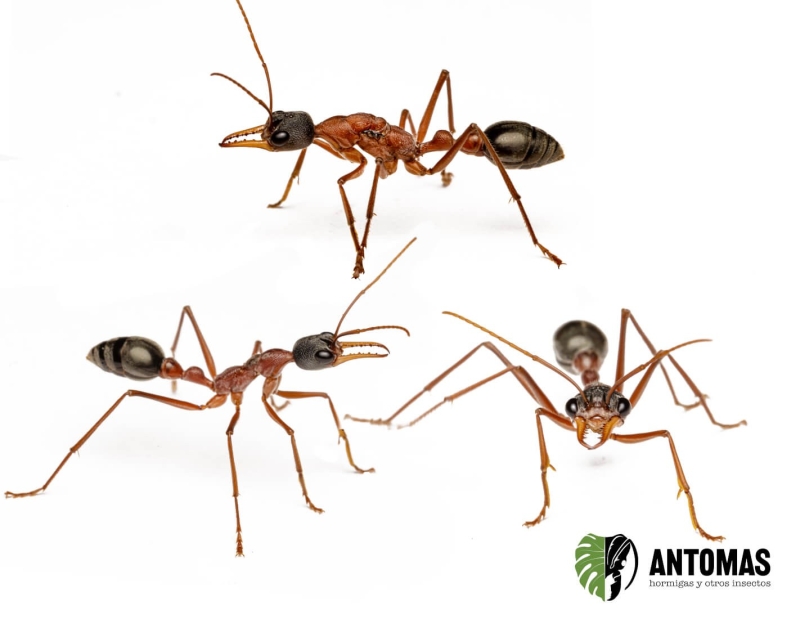
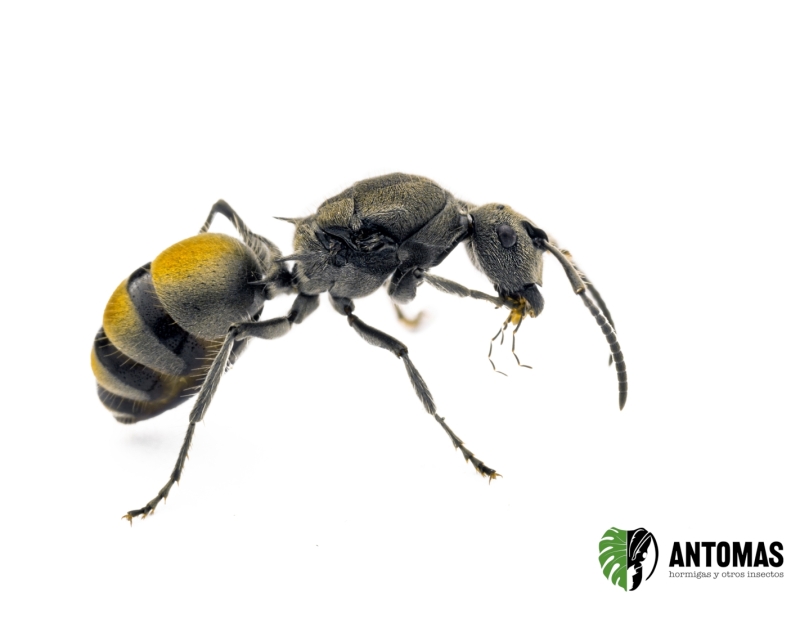
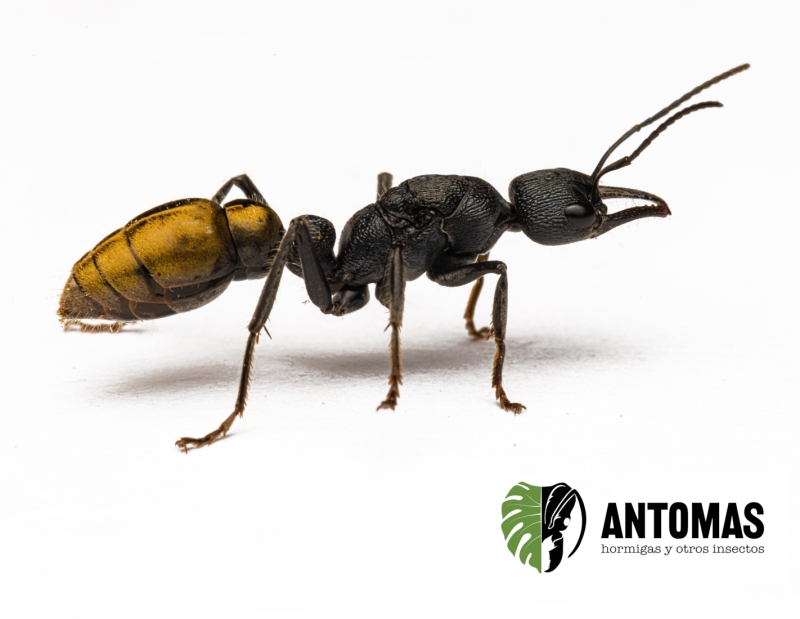
A large, slender, long-legged bulldog ant, which gives it speed and great reactivity on the ground. The queen looks like a large worker and, in the short-winged forms, the difference can be subtle.
- Colouration according to the literature. Clark (1951) describes it with the head, mesosoma (thorax) and node brown, the gaster black, the mandibles and legs reddish, and the tarsi and tips of the antennae reddish yellow.
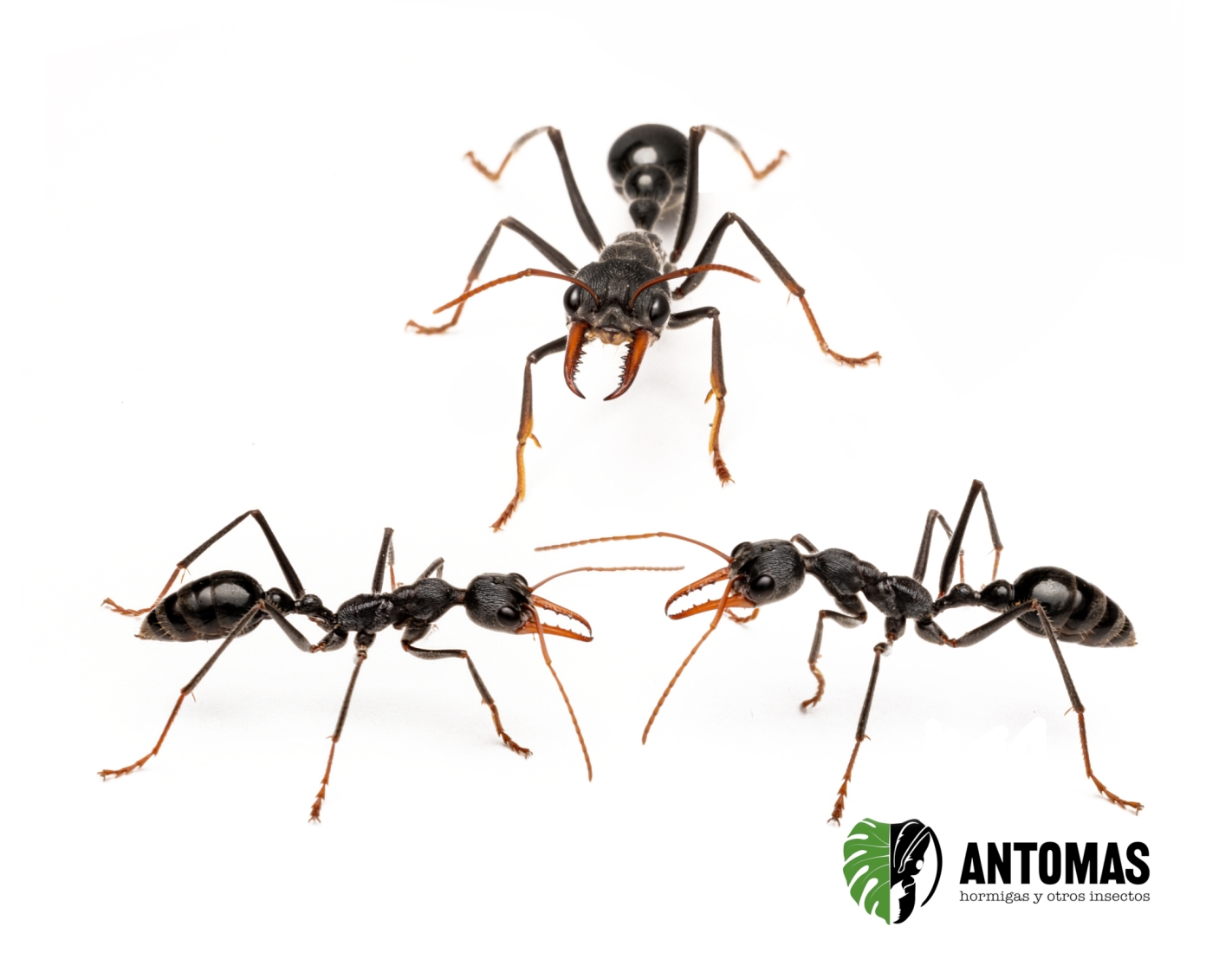
- Colour variation. In the wild, specimens with reddish tones and a black gaster are very common, with a striking contrast. By contrast, the form that usually reaches the hobby, and the one the keeper is most likely to find, is almost entirely black.
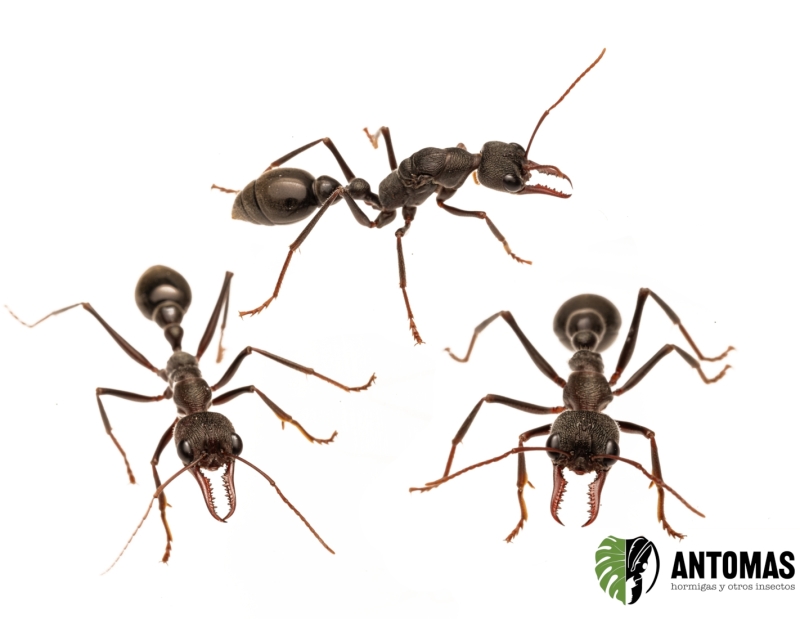
- Mandibles. Long, straight and toothed, built to hold live prey with precision. As in the whole gulosa group, they carry an extra tooth on the underside, near the tip.
- Eyes. Large and prominent: sight is its main sense.
- Legs. Very long, among the longest in the genus in proportion, in our experience.
- Workers. Monomorphic, without castes, but with two clearly visible size ranges in the colony.
- Queens. Brachypterous (short-winged), easy to confuse with large workers, but with a bulkier mesosoma; with a little practice they are easy to tell apart. The literature also cites ergatoid queens, which we have not seen at Antomas.
- Sting. Functional and long, without barbs, so they can sting several times.
- Brood. The larvae enclose themselves in a silk cocoon before pupating; a naked pupa is a sign that something has gone wrong.
Approximate measurements
- Workers: 19–23 mm
- Queen: 22–24 mm
These are Clark's (1951) measurements as given in the compilations; we have not been able to consult the original and there is no published data for males. Some shops give smaller figures, without any source. With workers over two centimetres long and a queen that has to turn around with a large larva in her mandibles, the practical conclusion is clear: large galleries from the start.
Care in captivity
Difficulty: 5/5 – Expert
We place it at the very top of our scale. It is not an impossible ant, but it is one that demands skill and consistency:
- Slow, fragile founding. The queen is semi-claustral, tends the brood in her own way, and losing the odd cocoon along the way is normal.
- A strict temperature limit. Mature larvae do not tolerate spending days above 28 °C, and the European summer puts this to the test.
- Humidity and substrate done methodically. Without particles in the nest they do not spin, and with too much water the cocoons are lost.
- Seasonal rhythm. It needs its winter rest and grows slowly.
- Eyesight, speed and sting. It gets stressed easily, it is very fast and its sting really hurts.
If this is your first bulldog ant, in our experience M. nigriceps and M. pavida are more forgiving. M. simillima is for keepers who have already raised a Myrmecia successfully and want to step up to one of the big ones, along the lines of M. pyriformis or M. gulosa. And there is good news: once the colony has its first workers, everything becomes a lot easier.
Recommended parameters
- Temperature: 24–27 °C in the active season, with part of the nest slightly cooler so they can choose.
- Mature larvae: never above 28 °C for sustained periods.
- Humidity: moderate ambient humidity, 50–70 %, with a gradient inside the nest: moist for eggs and small larvae, dry and ventilated for cocoons.
- Substrate: always inside the chambers, with some plant fibre.
- Water: always within reach, in a test tube with water and cotton in the foraging area.
- Light: total darkness during founding; once there are workers, a dark nest and a foraging area that follows its day–night cycle.
- Diapause: about 3 months (8–12 weeks) at 10–15 °C, from December to February.
28 °C: the larvae's red line
If you remember only one rule for the genus, make it this one. At Antomas we have seen it with several Myrmecia: when large larvae spend days above 28 °C, spinning fails. They start the cocoon and leave it half-finished, redo it over and over, or end up pupating without one, and those naked pupae almost never make it. Other keepers report the same; in an M. nigrocincta journal, the larvae pupated without cocoons and almost the entire brood was lost. The mechanism is unknown, but the outcome repeats itself too often to ignore.
- Apply heat from one side, with a thermostat, and let the colony choose where to place the brood.
- Never heat from beneath the brood chamber, and do not raise the temperature to make the colony grow faster.
- In summer, find the coolest corner of the house, away from sunny windows, and turn on the air conditioning if needed.
Excess heat also slows the queen down: in an M. pavida journal, she stopped laying for seven weeks with the foraging area at 33–35 °C and resumed laying when it dropped a few degrees.
Humidity: from moist to dry
With his Myrmecia, Tomás uses a simple method that heads off almost every humidity problem:
- Moist start. The queen goes into a fairly moist starter tube or module, because eggs and small larvae do well that way.
- Gradual drying. As the larvae grow, no more water is added.
- Dry cocoons. When it is time to spin, the nest already has just the right humidity. A wet cocoon suffocates and the workers discard it.
Connecting a separate dry module seems like a good idea, but queens do not always carry the cocoons to the dry area by themselves. If you do have to add water, do it very carefully: if it reaches the brood, it kills it. With workers it is easier, because they spread the brood between the moist and dry areas themselves, as long as the nest offers both.
Substrate: cocoon-building material
Bulldog ant larvae cannot spin in a vacuum: they need grains and fibres around them to build the cocoon. That is why it is never bare chambers:
- During founding: a thin layer of fine sand with a little plant fibre in the starter tube or module.
- In the formicarium: a mix of coco fibre, fine sand and a little clay or blond peat, in small heaps inside the chambers, without filling them.
- Roomy chambers: they make larval development and spinning easier, and a bulldog ant larva is big.
- Topping up: a growing colony uses up material; if the chambers look clean, add more.
An M. pyriformis keeper lost six of his seven larvae in an aerated-concrete nest without substrate, and he himself put it down to the lack of spinning material.
Recommended formicaria
The setup follows the colony's growth in three stages, and the same rule applies to all of them: large galleries.
1. Founding: starter tube with a layer of fine sand. Moist at first and connected to a small foraging area. A small, dark space calms the queen and lets her keep her brood under control.
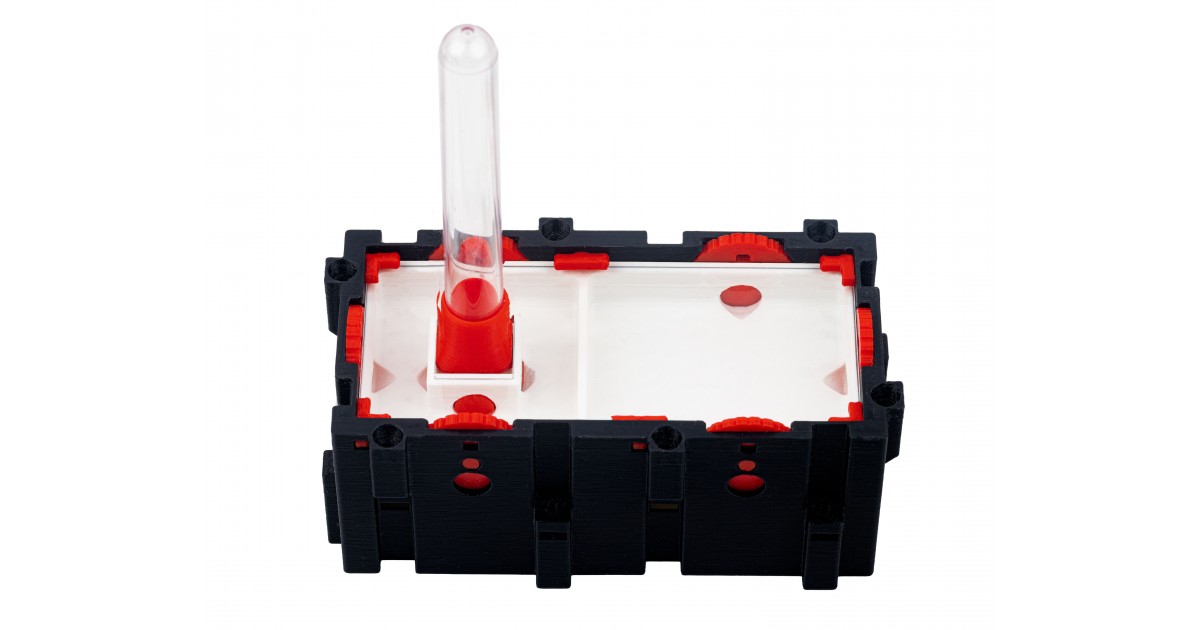
2. First workers: QBIK DUO with large galleries. A modular formicarium from Anthouse's Alpha range, kept on the dry side, with the starter tube connected as the moist area for as long as needed, and small heaps of substrate in the chambers.
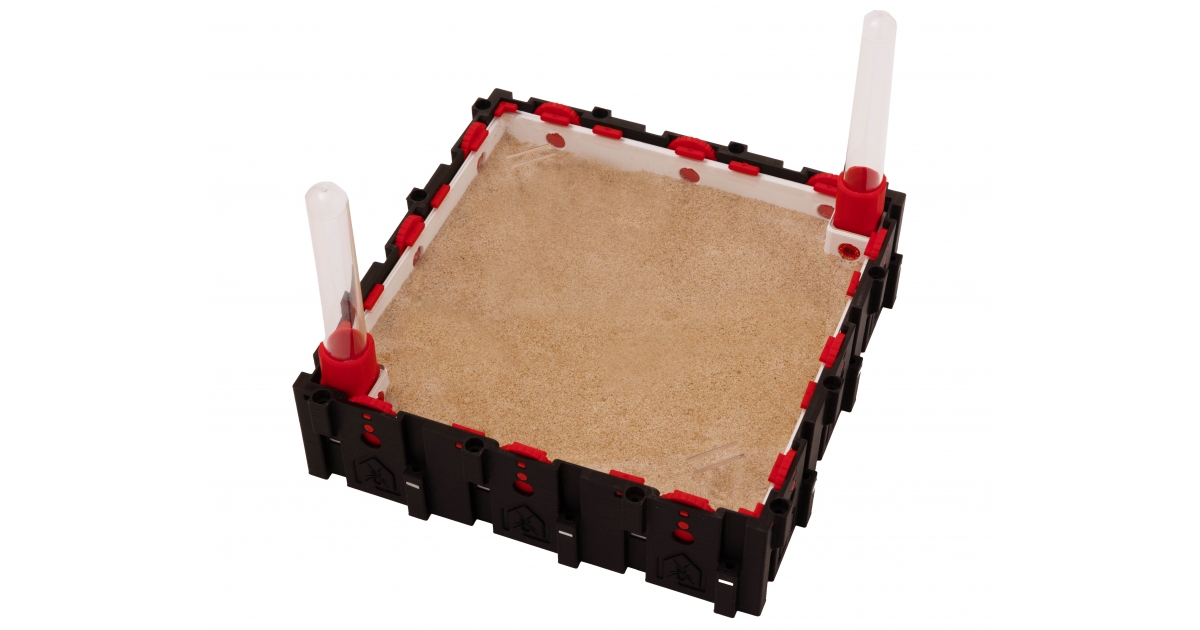
3. Large colony: Qbik Wild NoNa Diáfano. Made of plaster, which holds moisture well, and with no pre-made chambers: you fill it with substrate and the workers dig their own nest, with the mix of materials their larvae need close at hand.
Do not rush to move them into a bigger nest: in a nest that is too large, a small colony cannot control humidity or hygiene properly. As well as the nest, prepare:
- A roomy foraging area, with sand, flat stones and pieces of bark, where they can patrol and hunt.
- A wide barrier and a lid from day one (see «Escapes and barriers»).
- A water tube with cotton and a feeder for sugary liquids.
- A thermometer next to the nest, essential with a species this sensitive to heat.
Founding: how your colony arrives
At Antomas we ship M. simillima as a queen with brood: the queen arrives with eggs, larvae or cocoons. Her founding is semi-claustral, as in almost all Myrmecia: the queen does not live on her reserves alone, but goes out to drink, takes sugar and hunts to feed her larvae. That shapes the whole stage:
- In the dark and free of vibration. Cover the tube and its small foraging area with opaque card or aluminium foil and place it somewhere quiet, away from busy areas, pets and vibrating appliances.
- One check a day. Brief and from the outside: make sure there is water, sugar and protein, and no leftovers.
- Dead or freshly killed prey. Myrmecia queens are keen hunters and detect any vibration, but live prey that fights back can injure them, and an injured queen is a lost founding.
- Watch for hatching. When the first larvae hatch, there has to be protein every day: without it, the queen may eat her own brood. In an M. dispar journal, the queen ate a larva after about 12 hours without prey.
- Normal losses. Losing one or two cocoons out of ten is within what you would expect; if many are lost, check humidity and temperature.
Where is the queen? Its queens are brachypterous (short-winged) and at first glance are easily mistaken for a large worker; with a little practice they are easy to tell apart. Look for the bulkiest individual, with the most swollen and broad mesosoma, that spends the most time with the brood. If in doubt, write to us with a photo.
Timescales are long. With warmth and no pauses, other Myrmecia keepers report 6 to 10 weeks from egg to worker, but with laying pauses or a winter rest in between it can easily stretch to several months. A first year that ends with a handful of workers is a good founding. From then on, the workers hunt, tend the larvae and look after the cocoons, and the colony gains stability.
Arrival and moving by tipping out
When it arrives, leave it somewhere dark and quiet at 22–25 °C, check that it has water and offer a drop of sugar and a small dead prey item. Do not change its tube during the first few days. To move it into the QBIK DUO, at Antomas we do the move by tipping out:
- Prepare the formicarium first: substrate in the chambers, barrier on and water ready.
- Work inside a large box or a tray with its own barrier, in case a worker makes a run for it.
- Carefully tip out the contents of the tube, with the queen, workers and brood, next to the nest entrance, and guide the stragglers with a thick paintbrush or long tweezers, never with your fingers.
- Cover the nest and leave them in peace for a couple of days.
When the time comes for the NoNa, it is done the same way.
Feeding
Sugar every day, and with variety. Adult workers run on sugar; in the wild they get it from nectar and from the secretions of other insects. As the main liquid, 4–5 times a week, at Antomas we use Anthouse Blue Sugar Nectar, to which you can add a little protein. On the other days, alternate with honey water or sugar water and, now and then, a very small piece of ripe fruit such as banana, apple or grape. Liquids always go in a feeder, never on cotton: cotton goes mouldy and the liquid spoils very quickly. A traditional feeder works, or a homemade one where the drop sits spread out and accessible; replace it before it ferments.
Protein in step with the larvae. When there are larvae, the colony hunts eagerly; when there are none, prey loses almost all its appeal. Adjust the amount to the brood you see and the prey size to the colony:
- Queen with her first larvae: small prey, dead or freshly killed, every day, such as small flies, firebrats, Thermobia domestica, or a small cricket cut in half.
- Young colony: flies, medium crickets, red runner roaches, Shelfordella lateralis, which are among their favourites, and chopped mealworms.
- Large colony: prey sized for two-centimetre workers, such as adult crickets, large flies or nymphs of the dubia roach, Blaptica dubia. The occasional live prey item will let you watch them hunt.
Change the type of insect from one week to the next, so they do not always eat the same thing. And feed generously: at Antomas we have found that, with daily maintenance and removal of leftovers, it is better to give too much, because the colony senses it has resources and grows faster and larger. If you will not be able to clean often, cut back on the quantity, because leftovers attract mould and mites. Use insects from a reliable supplier, free of insecticides, and leave the prey near the entrance: the workers cut it up and the larvae feed directly on it.
Diapause: three quiet months
For M. simillima, at Antomas we recommend a diapause of about 3 months, between 8 and 12 weeks, at 10–15 °C, coinciding with our winter, from December to February. This rests on several things: its native climate has genuinely cool winters; its records in the wild plummet in the depths of the austral winter; and in the Myrmecia we keep, the rest, although not so vital in some species, helps the queen come back to laying strongly. In other species of the genus, skipping it can cut off the production of a large batch of larvae.
It is a gentle diapause: the colony slows down a lot and brood development is held back, but it does not stop completely, and the odd worker will keep coming out to drink or take sugar.
- When. The easiest option is to make it coincide with the European winter; over time, the colony falls into step with our calendar. It is best to start with the brood already in cocoons, or without small larvae that depend on eating a lot.
- How. Lower the temperature gradually, over one or two weeks, down to a stable spot at 10–15 °C, such as an unheated room, a cellar or a wine cooler. Water at all times, a little sugar if there are active workers, and protein only if they accept it.
- Afterwards. Raise it just as slowly back to the 24–27 °C of the active season. The queen should start laying again within a few weeks and, with the larvae, daily feeding returns.
If the queen stops laying for weeks after the first batch, do not write her off: in Myrmecia it is normal to lay in batches, with long pauses, and the cold is often what reactivates her.
Behaviour and observation
Once the colony is settled, apply the Antomas philosophy: ants are there to be enjoyed, observed and learned from, not kept hidden away. Just keep their area of the nest dark and the foraging area lit, and observe them gently, intervening only as much as needed. This is what you will see:
- A daytime hunter. Workers patrol the foraging area by day, each on its own, and pounce on prey as soon as they detect it.
- Highly reactive. It is a territorial species with lightning-fast reflexes: it responds instantly to vibrations, taps on the glass or an approaching hand.
- Alert to everything. It will follow you with its eyes; over time, the colony gets used to your presence.
- Two sizes at work. The large ones outside, hunting and keeping watch; the small ones inside, with the brood.
- More hunting when there are larvae. Without brood, the colony seems uninterested in food: this is normal.
Warning signs:
- Opened cocoons or pupae without cocoons: excessive heat or lack of substrate.
- Mouldy cocoons, or cocoons carried out to the foraging area: too much humidity.
- Larvae disappearing during founding: hunger or a stressed queen.
- Workers pacing the edge of the foraging area non-stop: check the barrier.
Escapes and barriers
A worker more than two centimetres long, with a sting and extremely long legs, crosses the top of a table in an instant. Speed is its best escape weapon, and several Myrmecia climb smooth surfaces, so the setup has to be ready from day one:
- A wide barrier of paraffin oil or PTFE at the top of the foraging area, renewed often. A generous band is better than a thin line, because some species in the genus can clear several centimetres in a single jump; bear in mind too that PTFE works less well in high humidity.
- A secure lid on the foraging area and tight-fitting connections.
- Nothing that can act as a bridge: no decoration leaning against the walls and no remains of large prey near the edge.
- Take care when feeding: this is when many escapes happen. Have the food ready, open only as much as needed and close straight away.
- Moves inside a tray with its own barrier.
Handling and safety
The sting of Myrmecia hurts a lot: it is among the most painful of any ant, on a par with a bee sting or worse. Because the sting has no barbs, it does not stay embedded and they can sting several times. In addition, the venom can cause severe allergic reactions: in Australia, Myrmecia caused almost nine out of ten ant-sting anaphylaxis cases where the species was identified, and 56 of them were attributed to «bulldog ants» without the species being specified (Brown and colleagues, 2011). There is no need to fear it, but it does deserve respect:
- Never handle it with your hands. Always use long tweezers or a thick paintbrush, work calmly and do not put your hand over the nest entrance.
- We do not recommend it for people allergic to hymenopteran stings, or for homes with young children or pets.
- If you are stung, wash the area and apply cold. At any sign of a general reaction (difficulty breathing, facial swelling or dizziness), go to A&E immediately.
- Never merge two colonies or two queens, and never release it into the wild: it is an exotic species.
What not to do
- Let mature larvae spend days above 28 °C, or heat the setup to speed up the colony.
- Use a nest without substrate or with small galleries.
- Keep adding water while the larvae are growing, or wet the cocoons.
- Forget the protein on the day the larvae hatch, or offer the queen large live prey.
- Set up the founding in the light, in a busy area or near a source of vibration.
- Mistake the queen for a worker and remove or neglect her.
- Skip diapause, or write off as sterile a queen that stops laying after the first batch.
- Move them into a large nest too soon.
- Serve sugary liquids on cotton, or always offer the same prey.
- Neglect the barrier, or open the foraging area without the food ready.
- Touch it with your fingers, or leave the setup where children or animals can reach it.
Scientific sources
This care sheet is based on the literature on Myrmecia simillima, the gulosa group and the genus, on distribution records from the Atlas of Living Australia and on the experience of Antomas and other Myrmecia keepers. Main references:
- Smith, F. (1858). Catalogue of hymenopterous insects in the collection of the British Museum. Part VI. Formicidae. British Museum, p. 144.
- Clark, J. (1951). The Formicidae of Australia. Vol. 1. Subfamily Myrmeciinae. CSIRO, pp. 89–91.
- Ogata, K. & Taylor, R. W. (1991). Ants of the genus Myrmecia Fabricius: a preliminary review and key to the named species (Hymenoptera: Formicidae: Myrmeciinae). Journal of Natural History 25: 1623–1673. doi:10.1080/00222939100771021
- Ogata, K. (1991). Ants of the genus Myrmecia Fabricius: a review of the species groups and their phylogenetic relationships (Hymenoptera: Formicidae: Myrmeciinae). Systematic Entomology 16: 353–381. doi:10.1111/j.1365-3113.1991.tb00694.x
- Hasegawa, E. & Crozier, R. H. (2006). Phylogenetic relationships among species groups of the ant genus Myrmecia. Molecular Phylogenetics and Evolution 38: 575–582. doi:10.1016/j.ympev.2005.09.021
- Mera-Rodríguez, D. et al. (2023). Biogeography and evolution of social parasitism in Australian Myrmecia bulldog ants revealed by phylogenomics. Molecular Phylogenetics and Evolution 186: 107825. doi:10.1016/j.ympev.2023.107825
- Ward, P. S. & Brady, S. G. (2003). Phylogeny and biogeography of the ant subfamily Myrmeciinae (Hymenoptera: Formicidae). Invertebrate Systematics 17: 361–386. doi:10.1071/IS02046
- Freeland, J. (1958). Biological and social patterns in the Australian bulldog ants of the genus Myrmecia. Australian Journal of Zoology 6: 1–18. doi:10.1071/ZO9580001
- Greiner, B., Narendra, A., Reid, S. F., Dacke, M., Ribi, W. A. & Zeil, J. (2007). Eye structure correlates with distinct foraging-bout timing in primitive ants. Current Biology 17: R879–R880. doi:10.1016/j.cub.2007.08.015
- Narendra, A., Reid, S. F., Greiner, B., Peters, R. A., Hemmi, J. M., Ribi, W. A. & Zeil, J. (2011). Caste-specific visual adaptations to distinct daily activity schedules in Australian Myrmecia ants. Proceedings of the Royal Society B 278: 1141–1149. doi:10.1098/rspb.2010.1378
- Dietemann, V., Hölldobler, B. & Peeters, C. (2002). Caste specialization and differentiation in reproductive potential in the phylogenetically primitive ant Myrmecia gulosa. Insectes Sociaux 49: 289–298. doi:10.1007/s00040-002-8316-9
- Robinson, S. D. et al. (2018). A comprehensive portrait of the venom of the giant red bull ant, Myrmecia gulosa, reveals a hyperdiverse hymenopteran toxin gene family. Science Advances 4: eaau4640. doi:10.1126/sciadv.aau4640
- Eagles, D. A. et al. (2022). A peptide toxin in ant venom mimics vertebrate EGF-like hormones to cause long-lasting hypersensitivity in mammals. Proceedings of the National Academy of Sciences 119: e2112630119. doi:10.1073/pnas.2112630119
- Brown, S. G. A. et al. (2011). Causes of ant sting anaphylaxis in Australia: the Australian Ant Venom Allergy Study. Medical Journal of Australia 195: 69–73. doi:10.5694/j.1326-5377.2011.tb03209.x