Difficulty: 3/5 – Advanced
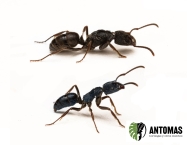
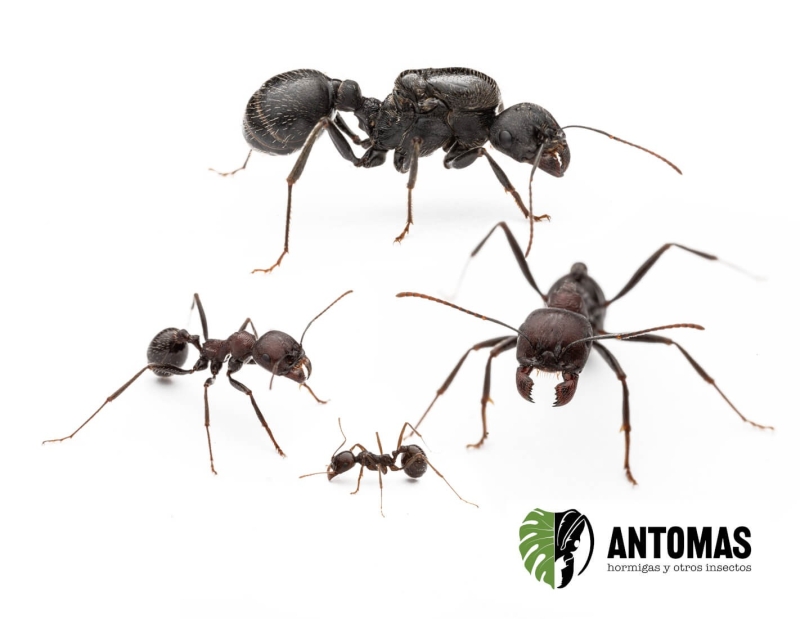
A hunting ponerine from South-East Asia, black, robust and armed with a sting, one of the commonest ground-dwelling ants in its range and a great enemy of termites. It has a true queen, not a gamergate, and its colonies can grow beyond a thousand workers. Queens with brood and small colonies with a queen. Semi-claustral founding: the queen needs prey from day one. Plaster nest with medium humidity (Qbik Wild range), 24–28 °C, plenty of varied prey and a little sugar. No diapause. Barrier of paraffin oil or petroleum jelly.
Odontoponera denticulata (F. Smith, 1858) is a ponerine ant from South and South-East Asia: a hunter with a dark, sculptured body, armed with short, massive mandibles, a functional sting and a row of small teeth on the edge of the face that give the genus its name. It ranges from the Indian subcontinent to the Philippines and southern China, and across much of that area it is one of the ants you see most often on the ground.
And yet, for almost a century and a half, nobody recognised it as a species: it was mistaken for its only relative, Odontoponera transversa, until in 2009 the Japanese myrmecologist Seiki Yamane showed that they were two different ants. In this care sheet we separate what has been studied in O. denticulata, what is known about the genus (often published as transversa) and what we apply at Antomas with our ponerines. It has no common name: it is simply O. denticulata.
Biology
A species hidden for a century and a half
The British entomologist Frederick Smith described it in 1858, in his catalogue of the Hymenoptera in the British Museum, under the name Ponera denticulata. A year earlier he had described Ponera transversa. In 1862 the Austrian Gustav Mayr created a genus of their own for these ants, Odontoponera, and in 1893 the cataloguer Karl Wilhelm von Dalla Torre decided that the two were the same species: denticulata became a mere synonym of transversa.
That was the start of a muddle that lasted more than a century. In 1929 William S. Creighton described several subspecies of O. transversa, but, according to Yamane, what Creighton took to be the «typical» transversa was actually denticulata. For decades, guides and studies called both of them transversa.
The answer came from fieldwork. While studying the ants of Borneo, Yamane (2009) saw that this name hid two biological species, always separable by their shape and by where they live, and he revived Smith's name. Schmidt and Shattuck's review of the ponerines (2014) still listed it as a synonym, but the synopsis of the ants of Vietnam by Eguchi, Bui and Yamane (2014) already treats it as a valid species, as do current catalogues.
denticulata or transversa? How to tell them apart
They are so similar that they were confused for 150 years, but there are clear differences, according to Yamane (2009):
- The antennal scape (the first, long segment). In O. transversa it is long: laid back over the head, it clearly extends beyond the rear margin. In O. denticulata it is much shorter and usually stops just short of that margin.
- The vertex (the upper rear part of the head). O. transversa has a very well-marked raised area in the centre, semicircular or triangular in shape. In O. denticulata this area is much less defined.
- Habitat. O. transversa lives in fairly well-preserved forest. O. denticulata prefers disturbed areas, often with bare soil. In Lambir Hills National Park, in Sarawak, they are never found together: transversa in the primary rainforest and denticulata around the buildings.
- Distribution. O. transversa ranges from the Malay Peninsula to the Sunda Islands. O. denticulata has a much larger range, from mainland Asia to the Philippines.
That is why many papers published as «O. transversa», above all those before 2009 or those from areas where transversa does not occur, such as southern China or Indochina, may in fact refer to O. denticulata. In this care sheet we present them as data for the genus.
«Ponera with teeth»: where the name comes from
Odontoponera means «Ponera with teeth», and denticulata, «with denticles». According to Schmidt and Shattuck (2014), the genus has several features unique among the ponerines, and nearly all of them are teeth:
- The front edge of the clypeus, the plate above the mandibles, bears a row of some 7–9 denticles, like a tiny saw.
- The pronotum, the front part of the thorax, has a short spine on each «shoulder».
- The petiolar scale, the «waist», has a toothed, notched edge.
- Beneath the tip of the gaster there is a small tooth pointing downwards.
In the molecular phylogeny of the ponerines (Schmidt, 2013), Odontoponera falls within the Odontomachus group, the trap-jaw ants, although without any clear close relative: it is a lineage of its own.
From Pakistan to the Philippines
According to the catalogues, O. denticulata has been recorded in Pakistan, India, Bangladesh, Myanmar, southern China, Thailand, Laos, Vietnam, Malaysia (Sabah and Sarawak), Indonesia (Java) and the Philippines (Luzon, Negros, Panay, Basilan and Romblon). Because of the old confusion with O. transversa, the map may still contain errors. In Vietnam, Eguchi, Bui and Yamane (2014) found it in wooded areas, forest edges and disturbed areas, nesting in the soil and foraging on the surface.
Its climate is tropical, monsoon or savanna over most of its range (Köppen-Geiger types Am and Aw), warm all year round; in the north there is also a dry, slightly cooler winter. For keeping: stable warmth, medium humidity and, at most, a gentle winter rest.
One of the commonest ground ants in Asia
Schmidt and Shattuck (2014) bring the data together: abundant in the Philippines, common in Borneo, dominant in Vietnam, the dominant ground-nesting ant in Thailand and one of the most abundant in southern China.
Its nests are subterranean and polydomous: a single colony occupies several nests linked by tunnels. In a Bornean rainforest, Levy (1996) counted some 3,000 Odontoponera nest entrances per hectare, that is, one every few metres. And yet each worker is a real homebody: according to Eguchi and colleagues (2004), workers only forage about a metre from the entrance of their nest.
Termite hunter… and scavenger
Odontoponera forage singly on the soil surface and are generalist predators and scavengers (Schmidt and Shattuck, 2014). But they have a weakness. As early as 1925, William M. Wheeler and James Chapman wrote from the Philippines that the genus «is especially fond of termites and is often seen raiding their colonies». In Borneo, Levy (1996) found that ants and termites made up almost half of the prey the workers carried back to the nest.
A very recent study has taken this further. Wen and colleagues (2026) offered «O. transversa» from southern China three species of termites and saw that it does not treat them equally: it attacked Ancistrotermes and Macrotermes more eagerly, and when these were present it all but ignored Coptotermes, the Formosan termite. The key was smell: the workers follow the trail pheromones of the termites. Given the distribution of the two species, those ants may well have been O. denticulata.
Standing up to army ants
The soil of the Asian rainforests is home to Dorylus laevigatus, an army ant that hunts underground in columns of thousands of workers and sweeps away almost everything in its path. Berghoff, Maschwitz and Linsenmair (2003) studied its effect on soil arthropods in Borneo and observed something striking: Odontoponera workers stood guard at their nest entrances against the army ants and, far from fleeing, hunted them. Few ants can say the same.
A true queen, not a gamergate
In many Asian ponerines, such as Diacamma or Harpegnathos, reproduction is carried out by a gamergate (from the Greek gamos, marriage, and ergates, worker): a mated worker that lays eggs, with neither wings nor a queen's body. O. denticulata is not one of them. It has a true queen, winged at birth, which flies, mates and sheds her wings to found a colony. In the only laboratory study of the species, every colony had a single dealate queen (Aupanun and colleagues, 2022).
That said, she is a modest queen. According to the classic data for the genus, queens measure about 11–13 mm and workers about 9–12 mm: there is very little difference in size between them, a small queen–worker dimorphism. Peeters (1997) and Peeters and Ito (2001) showed that such queens, with few body reserves, usually found colonies by going out to hunt rather than sealing themselves in. To spot her, look at her side-on: a bulkier thorax and wing scars.
Gift eggs for the queen… who turns them down
This is the most curious fact ever published about the species. Sunittra Aupanun, Fuminori Ito and colleagues (2022) reared colonies of O. denticulata from founding queens in the laboratory and discovered that the workers lay trophic eggs: non-viable eggs, rounder than normal ones, that serve as food.
The worker lays the egg, picks it up in her mandibles, carries it to the queen and stands still in front of her, offering it. The surprising part is what happens next:
- The queen accepted only about 20 % of the eggs: of 132 trophic eggs observed, she ignored 107.
- Of the 25 she ate, she finished only two whole: she half-ate the rest and dropped the remains on the floor. The workers picked up these leftovers and gave them to the larvae or ate them themselves.
- And, when she did want the egg, she sometimes snatched it from the worker aggressively, biting at her mandibles.
- Each worker laid, on average, one trophic egg every three and a half days or so, and the queen took about ten minutes to eat a whole one.
Why does she reject them? The authors suggest a simple explanation: in large colonies there are so many workers that the queen has more food than she needs. Some queens fed almost exclusively on trophic eggs, while others alternated them with prey. If you see a worker standing in front of the queen with an egg in her jaws, now you know what is going on.
Colonies of hundreds… or of over a thousand workers
Many ponerines form tiny colonies of a few dozen workers. Not Odontoponera: Schmidt and Shattuck (2014) mention colonies of more than a hundred workers, and the study by Aupanun and colleagues (2022) gives specific figures for O. denticulata. Their five colonies, founded by queens collected in May 2014, had by 2016 between about 90 and about 1,280 workers, in damp plaster nests, at 20–28 °C and fed on mealworms, cockroaches and other arthropods. This is a ponerine that really does grow: plan for the space.
Chemistry, a sting and an organ for «singing»
Like all ponerines, Odontoponera keeps a functional sting, which it uses to paralyse its prey and to defend itself. Leluk, Schmidt and Jones (1989) analysed the proteins in its venom, and Morgan and colleagues the secretions of its mandibular (1999) and abdominal (2003) glands, as part of comparative studies of many species.
There is a lesser-known detail. On the gaster, at the front of the fourth abdominal segment, Odontoponera have a stridulitrum (Schmidt and Shattuck, 2014): a plate with extremely fine ridges that produces vibrations when rubbed against the previous segment. In ants, stridulation usually serves as an alarm signal or a call for help; in Odontoponera nobody has yet studied what it is used for.
Size and morphology
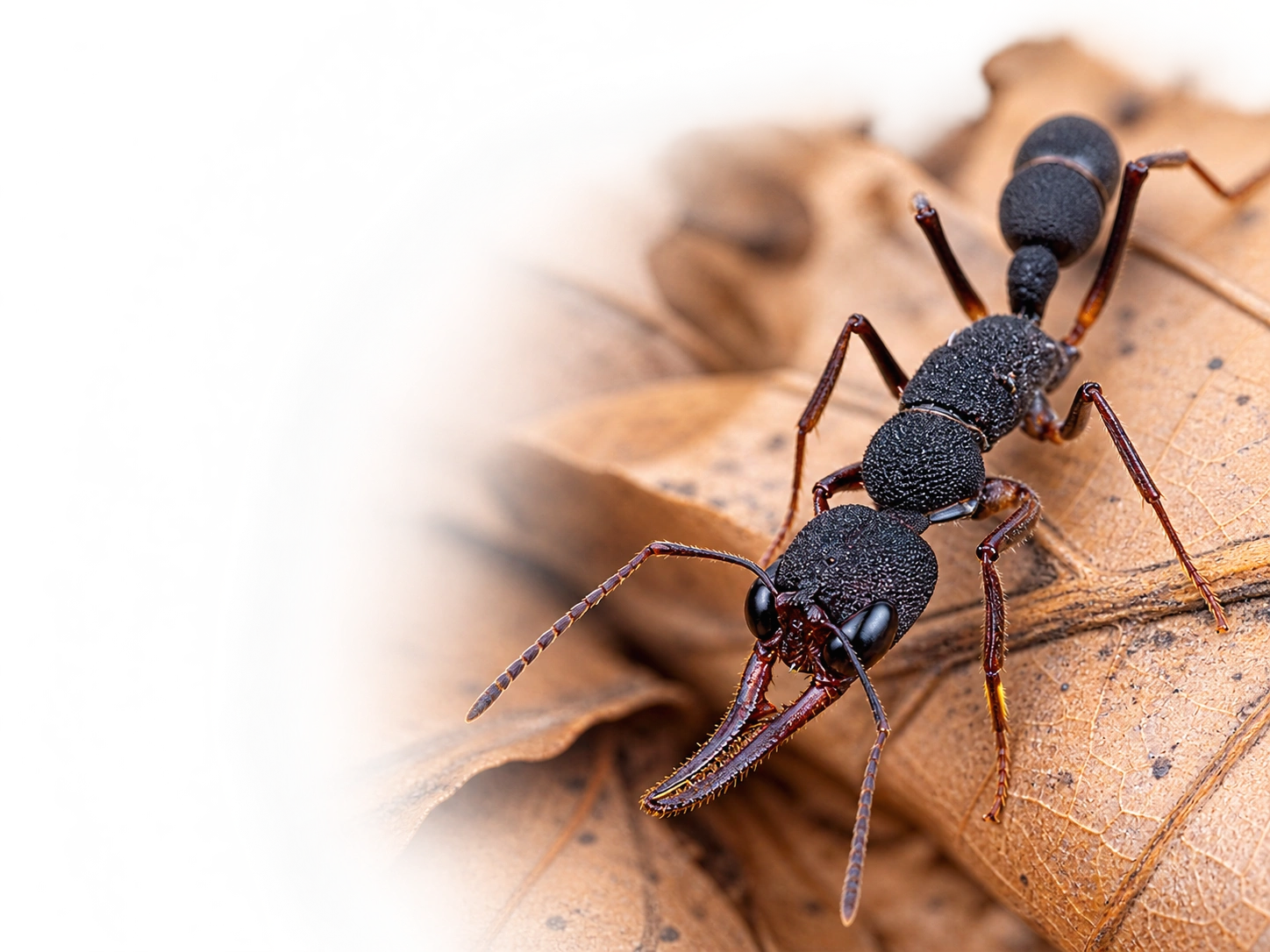
A large, robust ponerine with no polymorphism: all the workers look alike.
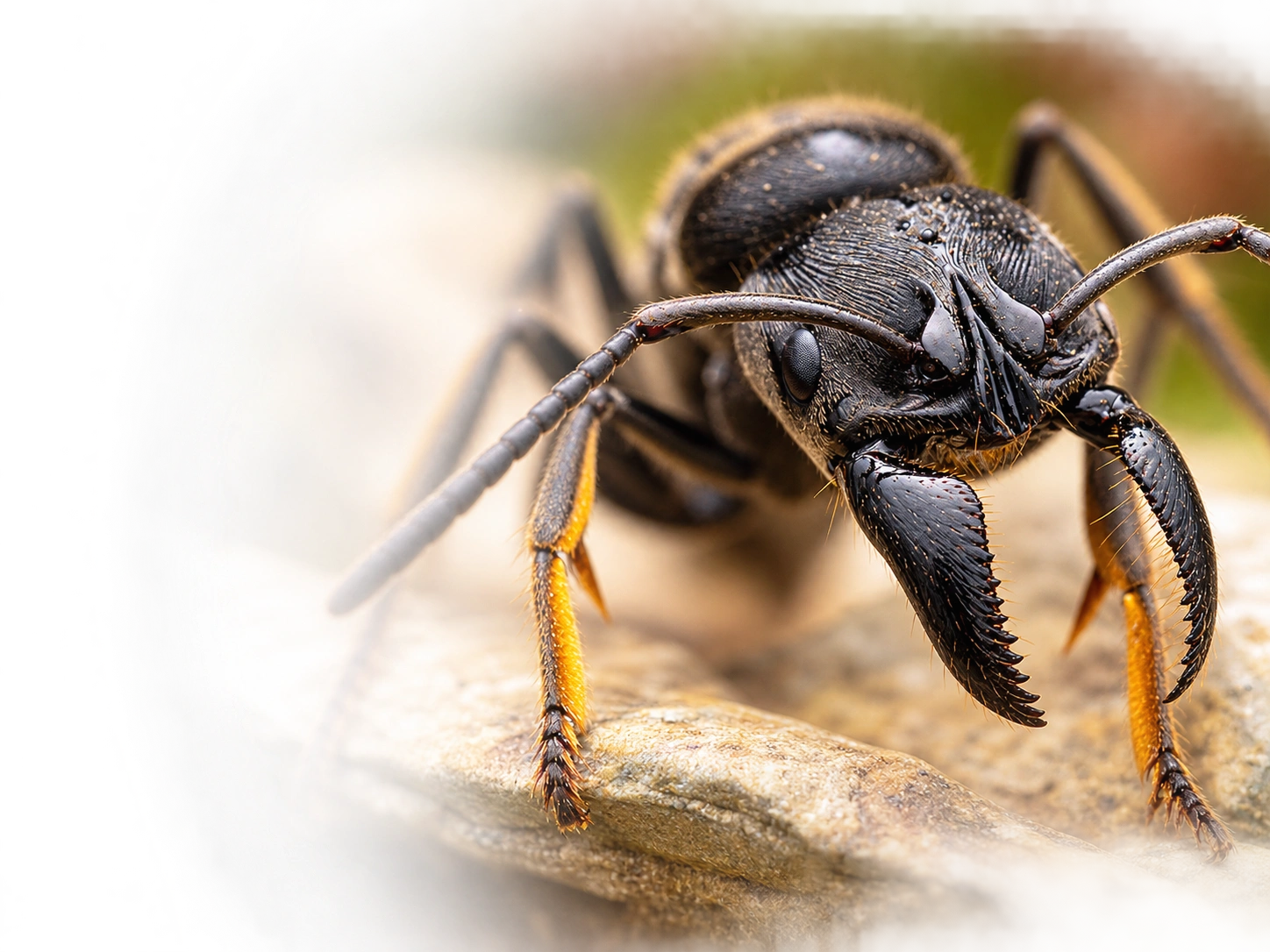
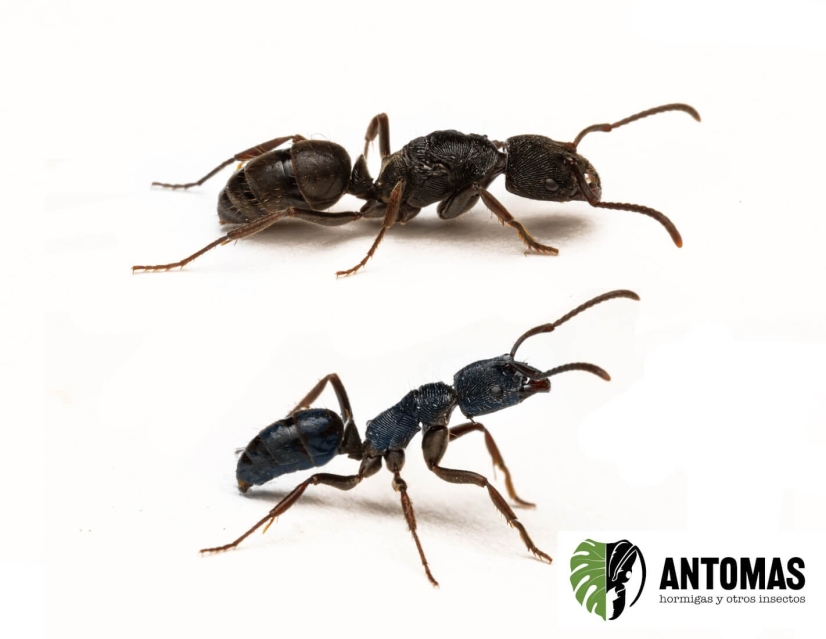
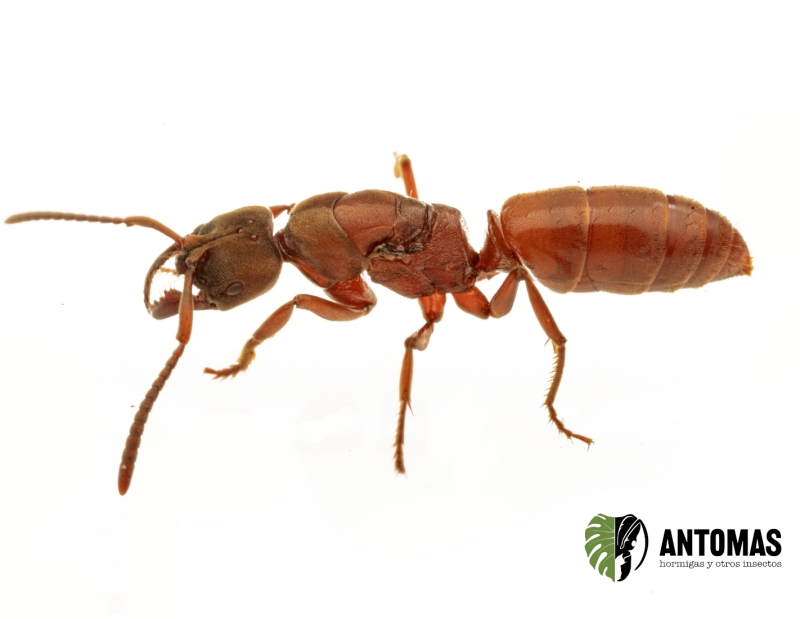
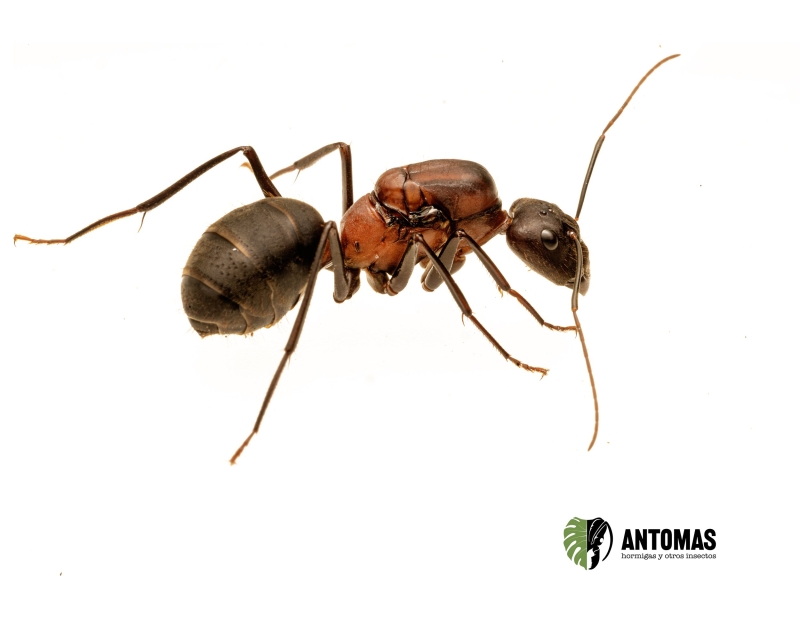
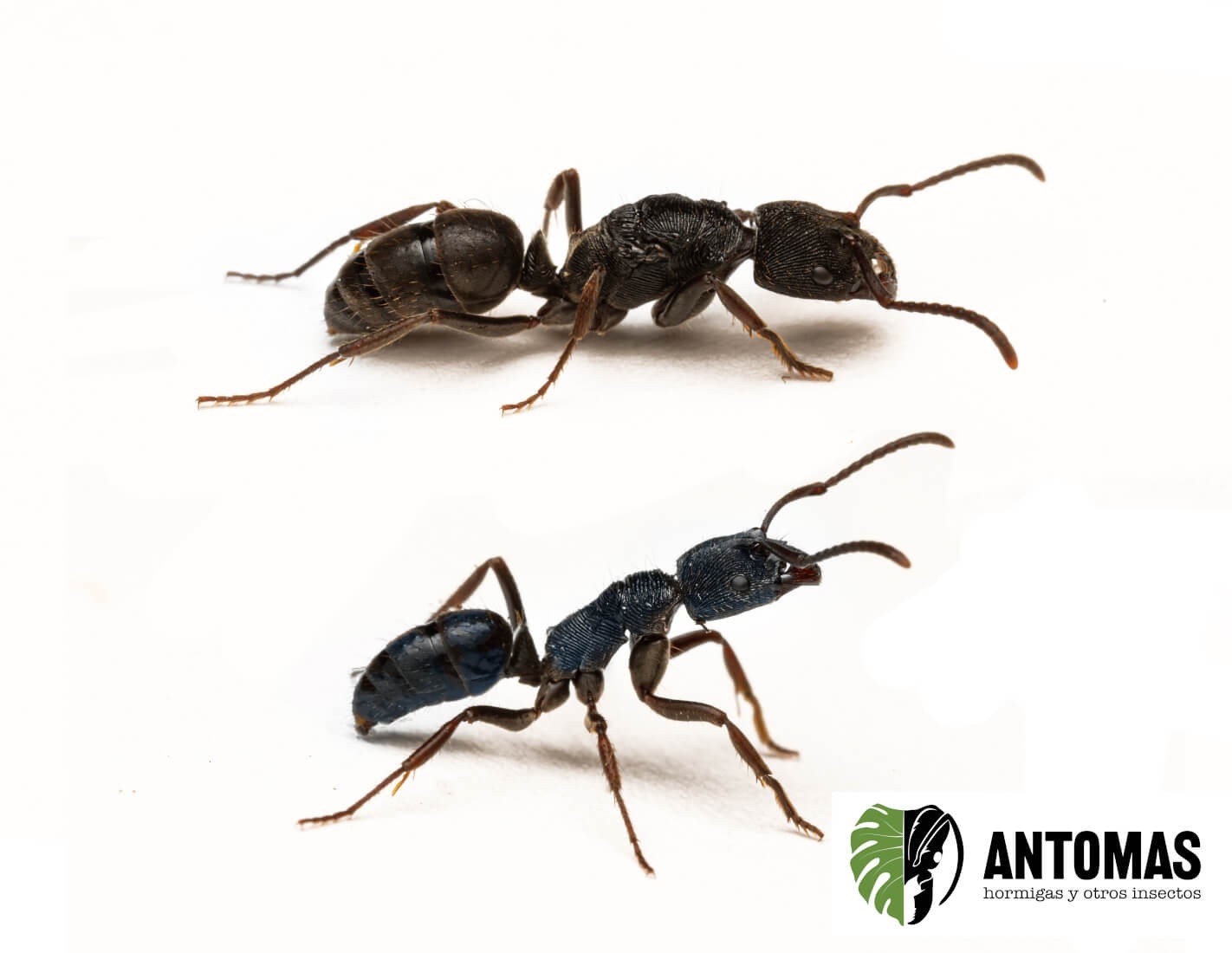
- Colouring of our colonies. The genus ranges from reddish brown to black. Our workers are black, with a bluish sheen that shows in good light, especially on the gaster, with reddish-brown legs, antennal tips and mandibles. The head and thorax look matt because of the striations; the gaster is shinier.
- Head. With deep longitudinal striations, the clypeus with its row of denticles and the vertex without the well-marked raised area of O. transversa.
- Mandibles. Short, triangular and massive: pincers for gripping and shredding prey, not the traps of an Odontomachus.
- Antennae. With 12 segments and a relatively short scape: it does not extend beyond the rear margin of the head (the key character versus O. transversa).
- Mesosoma (the thorax). With deep transverse striations on the pronotum and a short spine at each front corner.
- Petiole. A single segment shaped like a thick scale, with a toothed, notched upper edge.
- Gaster. Smooth and sparsely punctate, with the typical constriction between the first and second segments, the stridulitrum and the sting at the tip.
- Queen. Very similar to the worker, slightly larger and with the thorax of a winged female.
- Male. Winged, with large eyes and small mandibles, as in other ponerines.
Approximate measurements
- Workers of the genus Odontoponera: total length 9–12 mm (Bingham, 1903, cited in Schmidt and Shattuck, 2014)
- Queens of the genus: 11–13 mm (same source)
- Male: no published measurements available to us
These measurements predate the separation of the two species; we know of no published measurements specific to O. denticulata.
Keeping in captivity
Difficulty: 3/5 – Advanced
At Antomas we consider it a good first ponerine for keepers who have already raised a species successfully. Why isn't it for beginners?
- It is a hunter. It needs abundant, varied and frequent prey: without protein, brood production stops.
- Founding is semi-claustral. If you buy a queen with brood, you will have to feed her prey from day one.
- It has a sting and fast, determined workers: handle it with tools and calmly.
- There is little species-specific information. Our guidelines come from the only laboratory study of the species, from its genus and from our experience with other tropical ponerines.
And it is well worth it. It is a robust, adaptable species that grows much larger than most ponerines and hunts in plain view.
Recommended parameters
- Nest temperature: 24–28 °C, the range of its climate and of our Asian ponerines (in the laboratory they grew at 20–28 °C).
- Foraging area: at room temperature or slightly warmer at one end, up to about 28–30 °C.
- Humidity: medium in the nest, with a gradient: one damp part and another drier one, so the colony can place the brood where it suits it. The foraging area, dry.
- Water: always available, in a test tube with water and cotton wool in the foraging area.
- Light: simply leave them their dark area in the nest and a lit foraging area, with a normal day–night cycle.
- Diapause: no (see «No diapause»).
Avoid direct sunlight on the nest, radiators and draughts.
Recommended formicaria
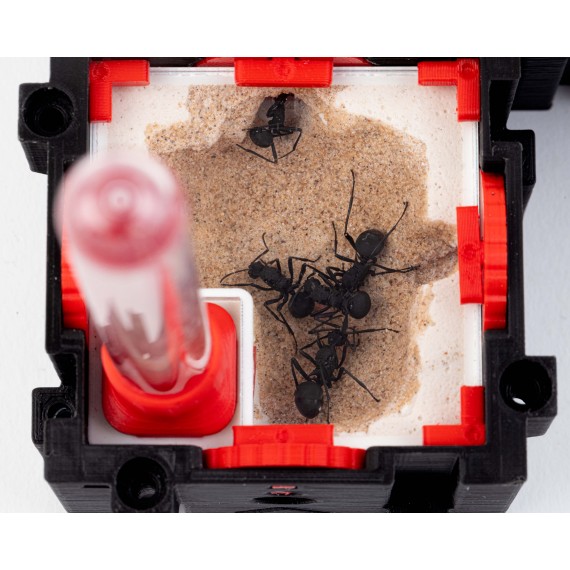
For a ponerine that nests in the soil of a tropical climate, at Antomas we recommend Anthouse's plaster nests from the Qbik Wild range, which hold humidity and make it easy to keep a gradient: the same kind of damp plaster nest used in the laboratory with this species.
For a queen with brood or a colony with a queen and 3–5 workers, start with the smallest, the Qbik Wild One P 1C: a single chamber, easy to monitor and keep clean during the delicate stage.
Once the colony grows beyond a few dozen workers, move it to the Qbik Wild Duo P 2C, with two chambers: a damper one for the brood and a slightly drier one. As O. denticulata can reach hundreds of workers, over time you will need to keep adding modules.
Expand when the nest becomes too small for them, but don't jump ahead: in a nest that is too big, the spare chambers turn into rubbish dumps. Hydrate the plaster reservoir regularly so that part of the nest is always damp: if you see condensation on the glass, water less often; if the plaster turns white, water sooner. In the foraging area, a thin layer of sand with a little soil or coconut fibre and a flat stone or two, with nothing that could act as a bridge to the barrier. If heat is needed, keep it gentle, on one side and with a thermostat.
Humidity: the happy medium
Here O. denticulata is easier than many rainforest ponerines. In the wild it prefers clearings and bare soil, while its relative O. transversa stays in the damp, shady forest, so it copes better with a somewhat drier environment. But it is still an ant from a tropical climate that nests underground: a completely dry nest kills the brood, and a waterlogged, fogged-up nest brings mould and mites, especially in a species that eats so much prey. The solution is the gradient, and the workers will tell you where their sweet spot is: if they always pile the brood in the dampest part, the nest is a little dry; if they move it to the dry part or out into the foraging area, it is too wet.
Founding: a queen who goes out hunting
At Antomas we sell O. denticulata as a queen with brood or as a queen with 3–5 workers and brood. If you start with the queen alone, you are about to experience the most beautiful and most delicate stage: founding.
The O. denticulata queen is small for a queen (see «A true queen, not a gamergate») and has few body reserves. That is why, like most ponerines with little difference between queen and worker, her founding is semi-claustral: she does not seal herself in to live off her reserves, like a Camponotus or a Messor, but goes out to hunt to feed her first larvae (Peeters, 1997; Peeters and Ito, 2001). There is no published observation of its founding in the wild: this is what is known about the group and what keepers report. Some shops list it as claustral; we treat it as semi-claustral.
- Setup: the queen and her brood in a test tube with water and cotton wool, or in the Qbik Wild One P 1C, connected to a small foraging area so she can go out to hunt. The nest kept dark and free from vibrations.
- Prey from day one: small and soft, two or three times a week: a firebrat, a piece of cricket or cockroach, an opened mealworm larva. Remove whatever she leaves the next day. And, now and then, a drop of nectar in a feeder.
- The brood: as in other ponerines, the larvae eat pieces of prey placed on top of them and, at the end, spin a brown cocoon. Don't separate or touch the cocoons.
Growth. The first workers soon take over the hunting. Growth is slow at first, as in all ponerines, but then speeds up: in the laboratory, colonies founded by a single queen reached hundreds or over a thousand workers in about two years (Aupanun and colleagues, 2022).
Moving by tipping. At Antomas we move colonies by tipping: with the new formicarium set up, the barrier in place and the nest hydrated, we open the tube or old nest in the foraging area, next to the entrance, and gently tip out the queen, the workers and the brood, helping any stragglers with a brush. Work over a tray and keep the nest dark: the workers will carry the brood inside in no time.
Feeding
Protein: the basis of everything. O. denticulata is a hunter and a scavenger, and protein is what makes the colony grow. It is the Antomas philosophy: the more protein, the better. If you do daily maintenance and remove leftovers, it is better to overfeed, because the colony understands that it has more resources and grows faster and larger. If you won't be able to clean often, it is better not to overfeed: surplus food rots and brings mould and mites.
- Live or freshly killed prey. It accepts both: in the wild it hunts and also makes use of carcasses.
- For the queen and small colonies, the firebrat, Thermobia domestica, is perfect prey: small, soft and easy to breed. Springtails, Sinella curviseta, make a good supplement.
- Change the type of insect from one week to the next, so they don't always eat the same thing: crickets, Acheta domesticus; nymphs of the red runner roach, Shelfordella lateralis, or the dubia roach, Blaptica dubia; mealworms, Tenebrio molitor; flies. Mealworms and cockroaches were, in fact, the basis of the diet in the laboratory.
- Termites, if you can get them: they are its favourite prey in the wild, and watching them raid a few is quite a spectacle.
- Frequency: prey 3–5 times a week for an established colony. The more larvae you see, the more prey.
- A tip: place the prey in the foraging area, not inside the nest, and remove leftovers the next day.
Buy your insects from a reliable supplier: insects treated with insecticides can wipe out the colony.
Sugary liquids: yes, as a supplement. Like many ponerines, it takes sugary liquids, although far less than a Camponotus. Vary the sugars: at Antomas we recommend Blue Sugar nectar by Anthouse 4–5 times a week and another sugary liquid or nectar 1–2 times a week, in small amounts. You can also add a little protein to the nectar. Always offer them in a feeder and never on cotton wool, because cotton wool goes mouldy and spoils the liquid very quickly. Use a traditional or home-made feeder, or a small cap, where the drop sits «spread out» and accessible, and replace it before it ferments.
Water: always, in the test tube with cotton wool in the foraging area.
No diapause
Across almost all of its range it is warm all year round, and there is no winter that would justify a diapause. At Antomas we keep it without diapause, with warmth and food all year.
In the north of its range, the winter is dry and slightly cooler. If your nest drops to 21–23 °C for a few weeks in winter, that is fine: the colony will eat less and the queen will slow down her laying, and as soon as the warmth returns it will become active again. What you must avoid is keeping it below about 20 °C for long: it is a tropical ant. If your home is cold, use a heating cable or heat mat with a thermostat on one side of the nest.
Behaviour in captivity
Solitary hunters and homebodies. The workers go out one at a time and don't stray far from the nest, just as in the wild. As soon as they find prey, they grip it with their mandibles and sting it.
Watch without fear. At Antomas we believe ants are there to be enjoyed, watched and learnt from, not kept hidden away. Simply leave them their dark area in the nest and a lit foraging area, and watch them gently, intervening as little as possible. They get used to your presence.
Warning signs:
- Larvae that don't grow or disappear: almost always a lack of protein.
- Brood always piled in the dampest part, or cocoons that are not completed: the nest is too dry.
- Condensation, mould or mites: too much humidity or forgotten leftovers.
- Workers carrying the brood out into the foraging area: they don't like the nest, because of too much humidity, heat or dirt.
- Lots of workers standing idle in the foraging area, with no room inside: time to expand.
Escapes and barriers
O. denticulata workers are fast, good walkers and climb rough surfaces and, to a greater or lesser extent, plastic. As with all our ponerines, we take no chances:
- A strip of paraffin oil or petroleum jelly on the upper part of the foraging area walls, thin and continuous. Renew it when it collects dust or debris. In humid conditions, oil or petroleum jelly works better than PTFE (Fluon).
- A tight-fitting lid as a second line of defence, especially as the colony grows.
- No gaps: check the connections, stoppers and tubes.
- Nothing that could act as a bridge: no bark or stones leaning near the barrier.
Handling and safety
O. denticulata has a sting and may sting if held, squashed or if you put your hand into the nest. We know of no study on its sting in humans. People allergic to hymenopteran stings should take particular care. Always handle it with entomological tools, such as a soft brush or soft forceps, never with your hands, and work slowly so as not to harm any worker, let alone the queen, who is easily mistaken for them. Do not combine queens or different colonies, or keep them with other species. It is an exotic species: it must never be released.
What not to do
- Leave a founding queen without prey, as if she were claustral.
- Skimp on protein or always give them the same insect.
- Let the nest dry out completely or let them run out of water.
- Waterlog the nest: condensation brings mould and mites.
- Leave prey remains inside the nest or not remove them the next day.
- Put sugary liquids on cotton wool.
- Give it a diapause or keep it below 20 °C for long.
- Move it to a nest too large for the size of the colony.
- Neglect the barrier or leave gaps.
- Handle it with your hands: it has a sting.
Scientific sources
This care sheet has been compiled from the scientific literature on Odontoponera denticulata, its genus and the subfamily Ponerinae, from taxonomic and distribution catalogues, from climate data for its range and from Antomas's experience with other tropical ponerines. The following have no DOI: the original description (Smith, 1858, Catalogue of Hymenopterous Insects in the Collection of the British Museum, part VI), that of the genus (Mayr, 1862), the revalidation of the species (Yamane, S., 2009, Ari 32: 1–8) and the works of Wheeler and Chapman (1925), Bingham (1903) and Levy (1996), cited via Schmidt and Shattuck (2014). Main references:
- Aupanun, S., Obika, M., Mizuno, R., Jaitrong, W., Suttiprapan, P., Hashim, R. & Ito, F. (2022). Trophic eggs in three ponerine ant species: Harpegnathos venator, Odontomachus simillimus and Odontoponera denticulata. Asian Myrmecology 15: e015001. doi:10.20362/am.015001
- Eguchi, K., Bui, T. V. & Yamane, S. (2014). Generic synopsis of the Formicidae of Vietnam (Insecta: Hymenoptera), Part II. Zootaxa 3860: 1–46. doi:10.11646/zootaxa.3860.1.1
- Schmidt, C. A. & Shattuck, S. O. (2014). The higher classification of the ant subfamily Ponerinae (Hymenoptera: Formicidae), with a review of ponerine ecology and behavior. Zootaxa 3817: 1–242. doi:10.11646/zootaxa.3817.1.1
- Schmidt, C. A. (2013). Molecular phylogenetics of ponerine ants (Hymenoptera: Formicidae: Ponerinae). Zootaxa 3647: 201–250. doi:10.11646/zootaxa.3647.2.1
- Creighton, W. S. (1929). New forms of Odontoponera transversa. Psyche 36: 150–154. doi:10.1155/1929/92879
- Berghoff, S. M., Maschwitz, U. & Linsenmair, K. E. (2003). Influence of the hypogaeic army ant Dorylus (Dichthadia) laevigatus on tropical arthropod communities. Oecologia 135: 149–157. doi:10.1007/s00442-002-1173-4
- Wen, X.-L., Fan, S.-M., Jia, B., Wu, Y.-R. & Li, Z.-T. (2026). Differential responses of the ant Odontoponera transversa to termite chemical signals: evidence for prey preference. Insects 17: 501. doi:10.3390/insects17050501
- Morgan, E. D., do Nascimento, R. R., Keegans, S. J. & Billen, J. (1999). Comparative study of mandibular gland secretions of workers of ponerine ants. Journal of Chemical Ecology 25: 1395–1409. doi:10.1023/A:1020987028163
- Morgan, E. D., Jungnickel, H., Keegans, S. J., do Nascimento, R. R., Billen, J., Gobin, B. et al. (2003). Comparative survey of abdominal gland secretions of the ant subfamily Ponerinae. Journal of Chemical Ecology 29: 95–114. doi:10.1023/A:1021928630441
- Leluk, J., Schmidt, J. & Jones, D. (1989). Comparative studies on the protein composition of hymenopteran venom reservoirs. Toxicon 27: 105–114. doi:10.1016/0041-0101(89)90410-8
- Peeters, C. (1997). Morphologically «primitive» ants: comparative review of social characters, and the importance of queen–worker dimorphism. In: Choe, J. C. & Crespi, B. J. (eds.), The Evolution of Social Behavior in Insects and Arachnids. Cambridge University Press: 372–391. doi:10.1017/CBO9780511721953.019
- Peeters, C. & Ito, F. (2001). Colony dispersal and the evolution of queen morphology in social Hymenoptera. Annual Review of Entomology 46: 601–630. doi:10.1146/annurev.ento.46.1.601
- Peel, M. C., Finlayson, B. L. & McMahon, T. A. (2007). Updated world map of the Köppen-Geiger climate classification. Hydrology and Earth System Sciences 11: 1633–1644. doi:10.5194/hess-11-1633-2007