This website uses its own and third-party cookies to improve our services and show you advertising related to your preferences by analyzing your browsing habits. To give your consent to its use, press the Accept button.
Functional cookies are strictly necessary to provide the services of the shop, as well as for its proper functioning, so it is not possible to refuse their use. They allow the user to browse through our website and use the different options or services that exist on it.
Cookie
Provider
Purpose
Expiry
PHP_SESSID
antomas.es
The PHPSESSID cookie is native to PHP and allows websites to store serialised status data. On the website it is used to establish a user session and to pass state data through a temporary cookie, which is commonly known as a session cookie. These Cookies will only remain on your computer until you close your browser.
Session
PrestaShop-#
antomas.es
This is a cookie used by Prestashop to store information and keep the user's session open. It stores information such as currency, language, customer ID, among other data necessary for the proper functioning of the shop.
These are cookies that collect information about the advertisements shown to users of the website. They can be anonymous, if they only collect information about the advertising spaces shown without identifying the user, or personalised, if they collect personal information about the user of the shop by a third party, for the personalisation of these advertising spaces.
Collect information about the user's browsing experience in the shop, usually anonymously, although sometimes they also allow the user to be uniquely and unequivocally identified in order to obtain reports on the user's interests in the products or services offered by the shop.
Pheidole militicida is a harvester ant native to the arid regions of the southwestern United States, especially southern Arizona, New Mexico, and far western Texas, with records also attributed to northern Mexico.
It inhabits deserts and dry grasslands, generally on sandy or sandy-loam soils. Its nests usually occur among stones and have one or more entrances surrounded by small soil craters and accumulations of seed husks.
Its natural diet is based mainly on grass seeds and those of other herbaceous plants. Minor workers collect them from the ground and transport them to the nest along well-organized trails. These routes may remain active for days or weeks while food remains available in the area.
The trails resemble a road network: a main route leads from the nest to the collection area, then divides into branches and finally into small paths that change as workers exploit new seed deposits.
Chemical signals regulate traffic, guide foragers, and recruit new workers when an abundant resource appears. This organization makes P. militicida especially interesting to observe outside the nest.
Although mainly granivorous, it also accepts insects and other protein-rich foods. In captivity, a regular supply of prey promotes larval growth and accelerates colony development.
The soldiers and the origin of its name
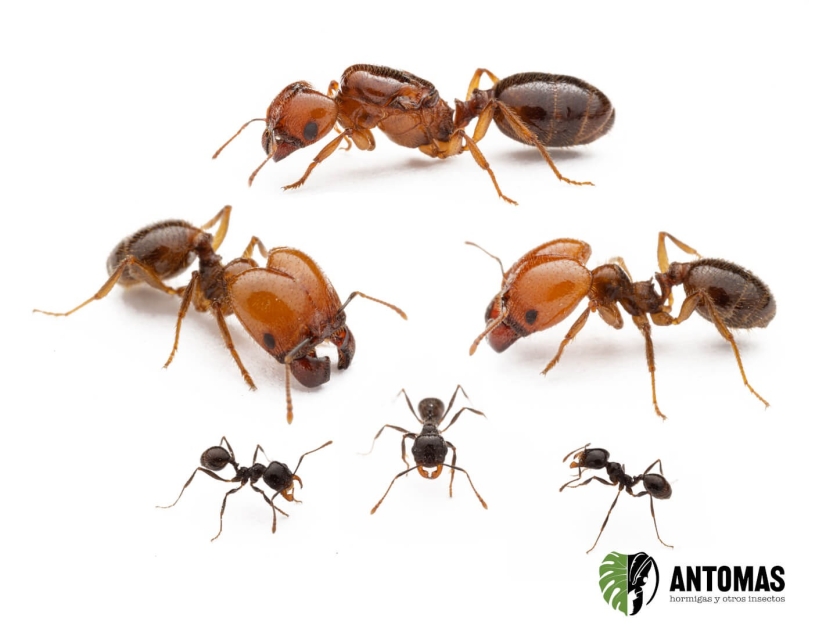
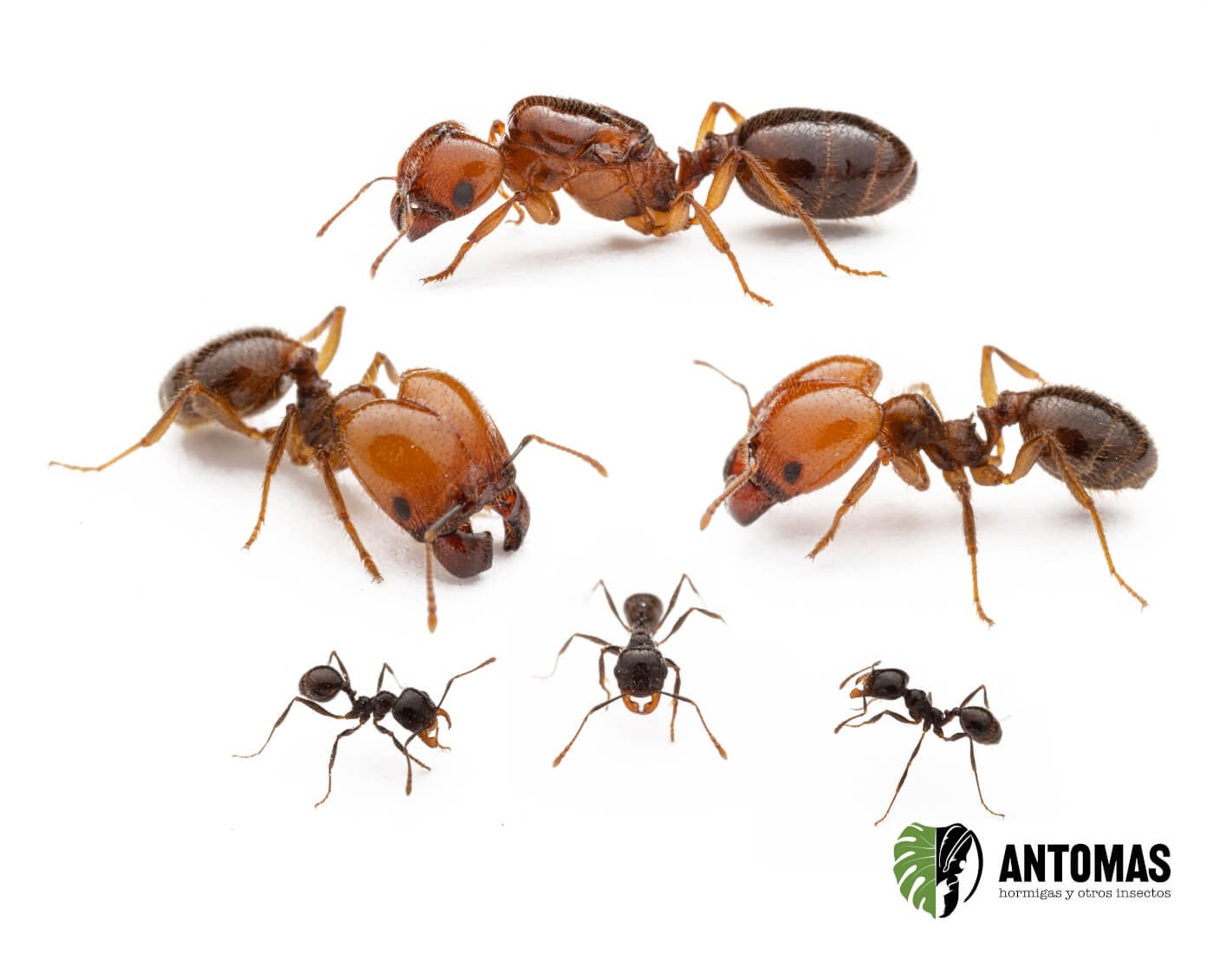
The most spectacular feature of the species is the enormous difference between its two worker castes. Minors barely exceed 3 mm, while soldiers have gigantic heads and can reach around 8 mm.
The name militicida means approximately “soldier killer”. When William Morton Wheeler first studied the species, he found remains of soldiers and interpreted them as evidence that the colony eliminated them before winter.
Later studies showed that this interpretation was incorrect. Soldiers remain alive during winter, but are usually found in deeper areas or blocking nest entrances.
The remains probably came from fights with other ants. Far from being eliminated by the colony, majors are true military specialists.
When they detect an invasion, they can arrange themselves in several rows inside the galleries, using their enormous heads as a barricade. The result resembles a defensive formation protecting a narrow passage.
During fights they do not attack chaotically. They have been observed waiting for the right moment to seize the mandibles of rival ants, damaging and disabling them.
Paradoxically, these soldiers play only a limited role in opening seeds. Minors perform most of the collection, cleaning, and consumption of grains.
The colony can also adapt its response to the type of enemy. Minor workers can produce alarm signals and recruit soldiers against certain competing ants.
The reproductive organization appears to be mainly monogynous, with a single queen per colony. Queens from different flights or colonies should not be combined.
In captivity, the queen can be maintained through claustral founding in a quiet, protected test tube until the first workers emerge.
Once established, the colony can grow rapidly if provided with warmth, varied seeds, and protein. There is no reliable figure defining the maximum size of all colonies.
Size and Morphology
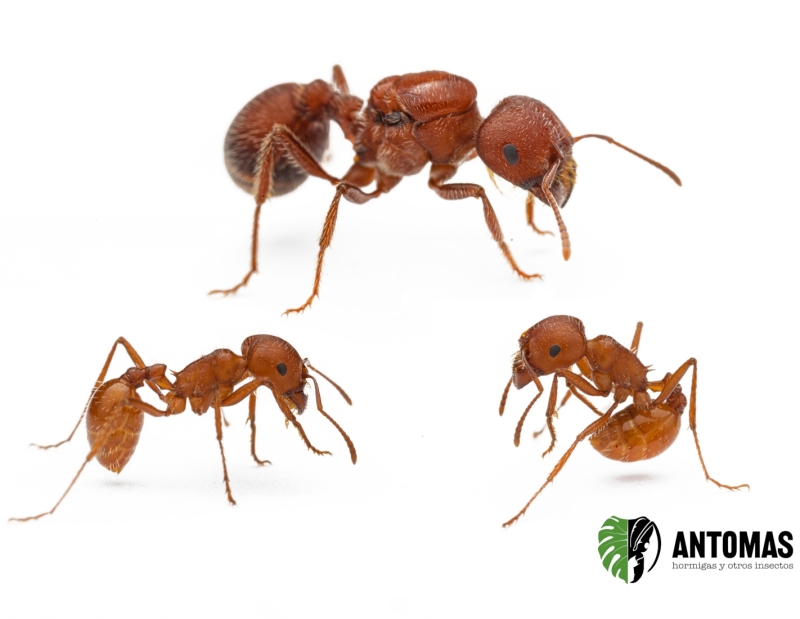
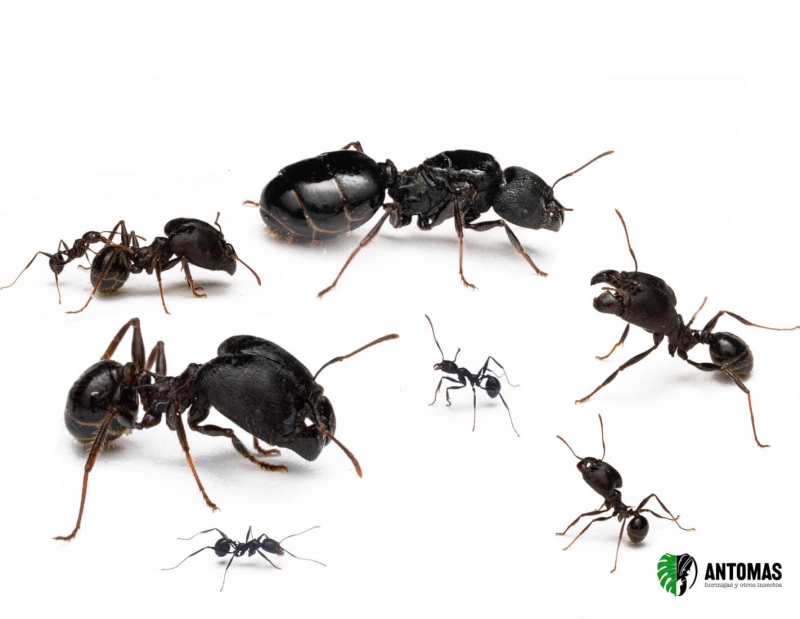
Pheidole militicida shows extreme dimorphism between minor and major workers.
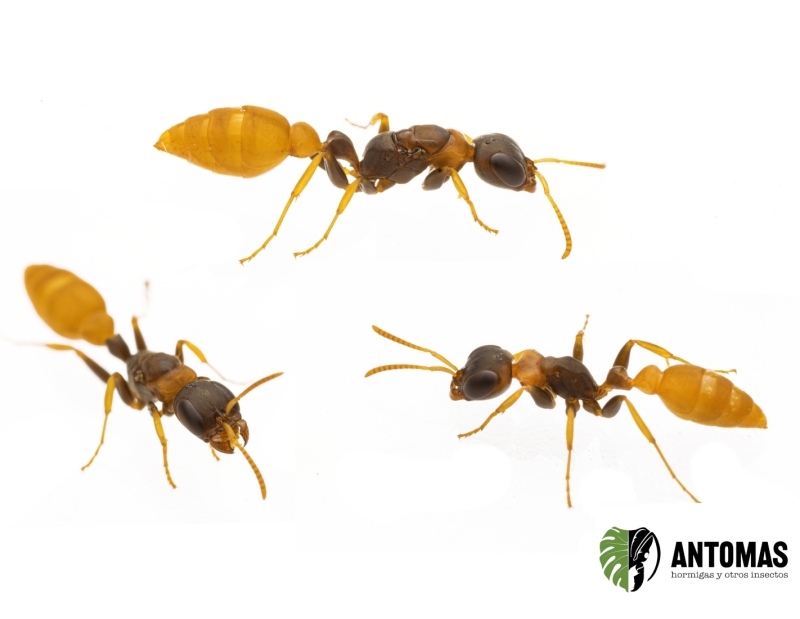
Minors are small, slender, and usually dark reddish-brown, with slightly lighter antennae and legs. They have a proportionate head, relatively small eyes, and a build adapted to speed and seed transport.
Majors or soldiers are reddish, orange, or chestnut and considerably lighter. Their head is enormous, slightly heart-shaped, and much wider than the rest of the body.
The front of the head has longitudinal grooves, while the rear is mainly smooth and shiny. The mandibles are robust and powered by highly developed muscles.
The difference between the two castes is so great that a soldier resembles heavy machinery surrounded by a team of tiny operators. Minors provide speed, numbers, and versatility.
They should not be called supersoldiers, as the species has two main worker castes: minor and major. The extraordinary size of the majors is part of the species’ normal dimorphism.
Approximate measurements
Minor workers: around 2–3 mm
Major workers or soldiers: approximately 6–8 mm
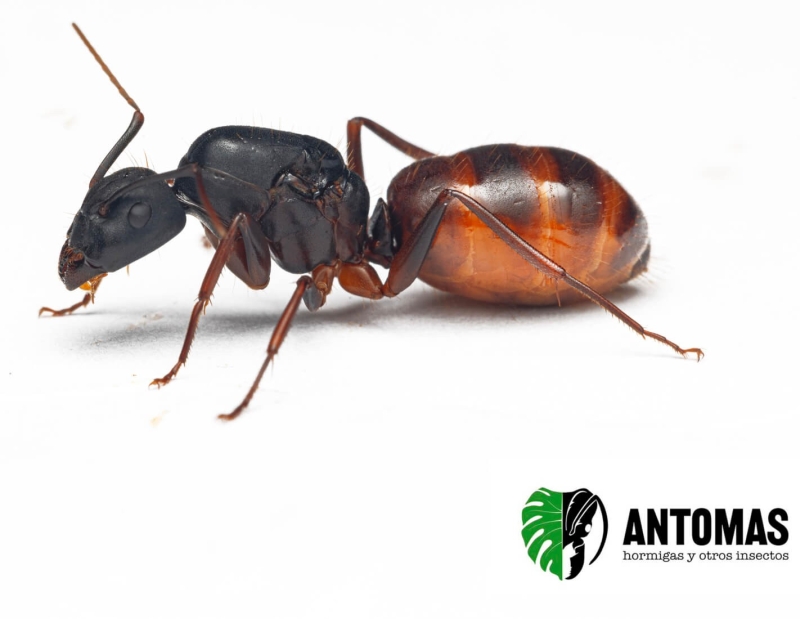
Queen: approximately 8–10 mm
The original published measurement for soldiers reached 8 mm. The queen is bulky, but her size may vary between populations and commercial lines.
CAPTIVE CARE
The difficulty of Pheidole militicida can be considered intermediate.
Its diet is simple and its behavior very attractive, but founding can be delicate, requiring a constant supply of very small prey protein that the first workers can use.
Recommended parameters
Active temperature: 24–29 °C
Warm spot: 28–30 °C
Brood area: moderately humid
Seed-storage area: dry
Ventilation: good
It should not be kept completely dry simply because it comes from a desert environment. Natural nests retain moisture underground, especially in the queen and brood chambers.
A humidity gradient is necessary. Eggs and larvae need a hydrated area, while seeds require dry chambers to avoid germination or mold.
The hydration system must be protected with very fine mesh. Minors can access reservoirs and connections that would be safe for larger ants.
RECOMMENDED FORMICARIUM
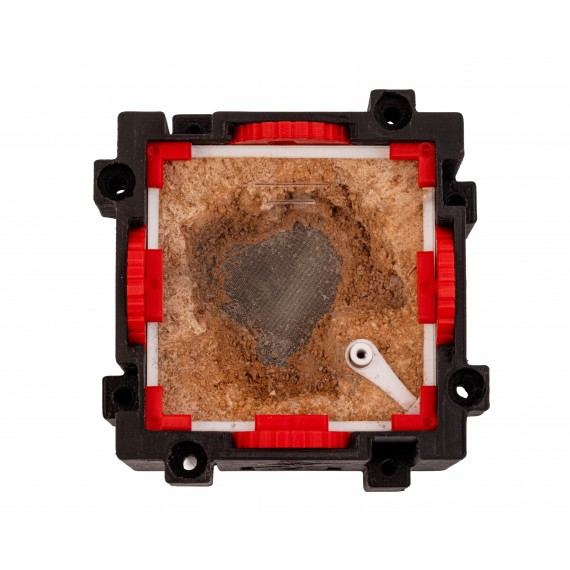
For colony founding, Anthouse evaporation nests are suitable:
The small galleries suit the minors and prevent a young colony from occupying excessive space. However, at least one chamber must be high and wide enough for the queen and future majors.
The nest must close precisely and have no gaps between the PLA, acrylic, lids, or connection ports.
A small colony should not be placed in an oversized nest. It is better to expand the system with modules as the population increases.
A thin layer of sand can be used in the foraging area to observe digging and transport, but accumulations that allow workers to build bridges over escape barriers should be avoided.
Feeding
Seeds
Seeds should form a fundamental part of the diet:
grass seeds;
millet;
canary seed;
poppy;
amaranth;
quinoa;
dandelion seeds;
small wild seeds.
A varied mixture with grains of different sizes is advisable. Minors can handle surprisingly small seeds and organize them in separate stores.
Seeds must be free of pesticides, salt, oils, and agricultural treatments. Any damp, germinated, or damaged grain should be removed.
Proteins
fruit flies;
flies;
micro crickets;
small or chopped cockroaches;
moths;
cut mealworm;
other safe feeder insects.
Protein consumption increases when many larvae are present. Insects allow observation of minor mobilization and the appearance of soldiers around food.
Small colonies should receive killed or pre-opened prey. Leftovers should be removed before they dry out, ferment, or accumulate mites.
Carbohydrates and water
Nectar, sugar water, or diluted honey may be offered as a supplement. Sugary foods should not be overused with this species, as they could displace seeds and protein from the diet.
Drops must be tiny or offered through micro-feeders, as minors can become trapped easily.
A safe source of clean water must always be available.
Diapause
Pheidole militicida does not undergo a cold diapause comparable to that of many European or temperate North American species.
In Arizona, minors have been observed foraging during January, February, and early March, even in areas where rain, snow, and cold nights occasionally occur.
Therefore, it is not advisable to keep the species for months near 10 °C. A mild winter slowdown may be provided for about eight to ten weeks at approximately 16–20 °C.
During this period, water and seeds should remain available. Protein can be reduced if active larvae disappear.
Behavior in Captivity
Minors form dense, well-defined trails toward seeds and prey. Because of their small size, a colony with hundreds of workers may occupy less space than expected.
Soldiers often remain inside the nest and appear when large prey, vibrations, or disturbances occur near the entrance. This difference makes caste specialization easy to observe.
Minors can pass through extremely small mesh, joints, and openings. The escape barrier must be checked frequently, and the enclosure should have a secure lid.
Handling and Safety
It should not be handled directly with bare hands.
Soldiers can grip with their mandibles, and minors are very difficult to recover once they escape. Maintenance should be carried out using tweezers, tubes, auxiliary containers, and escape barriers.
The main challenge is not contact with a single worker, but correctly containing a large colony made up of individuals barely 3 mm long.