Difficulty: 2/5 – Beginner
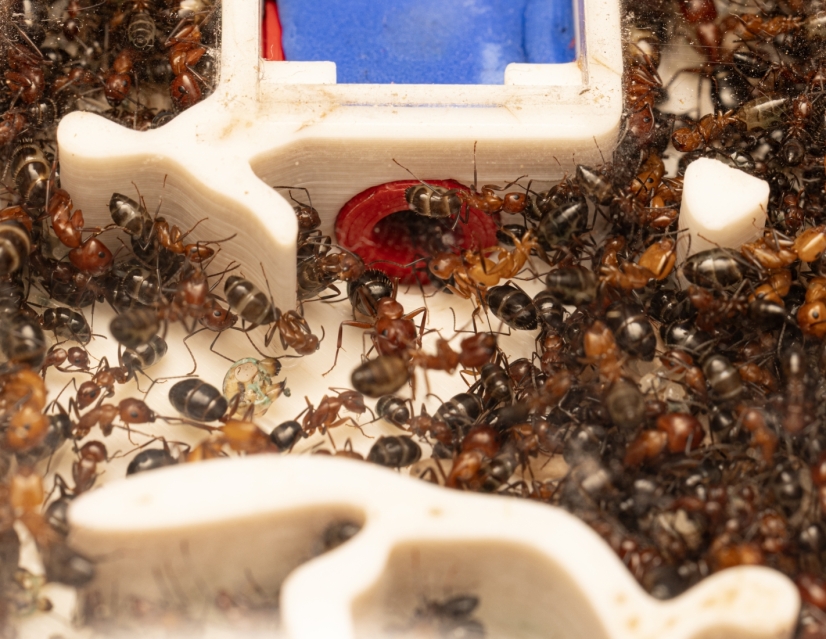
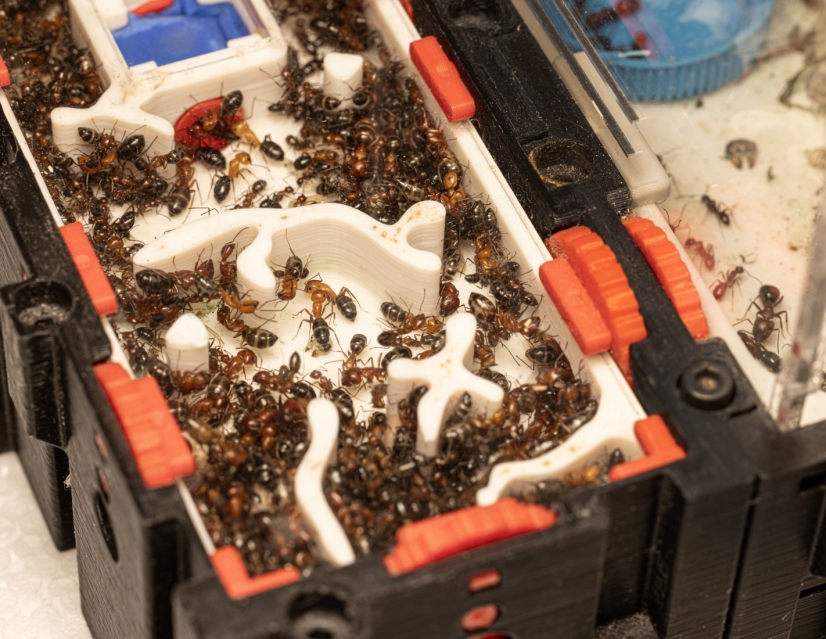
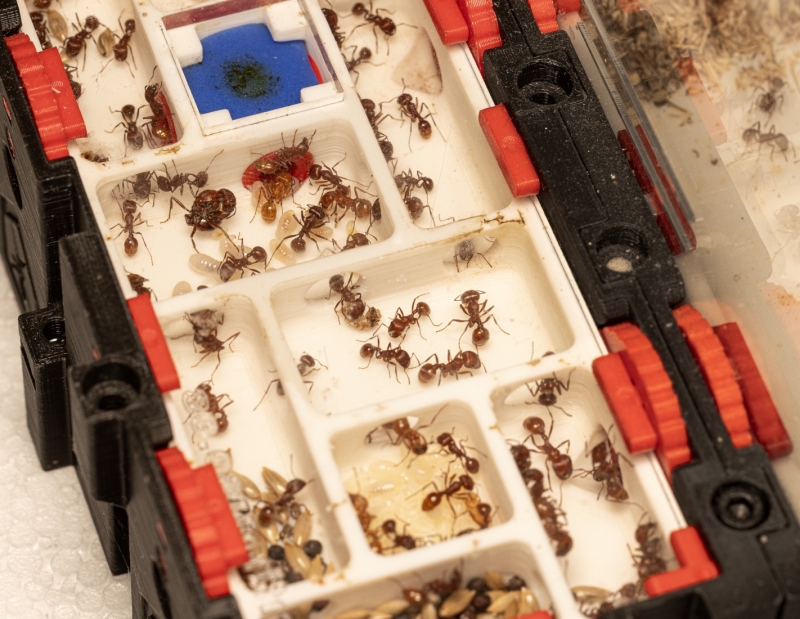
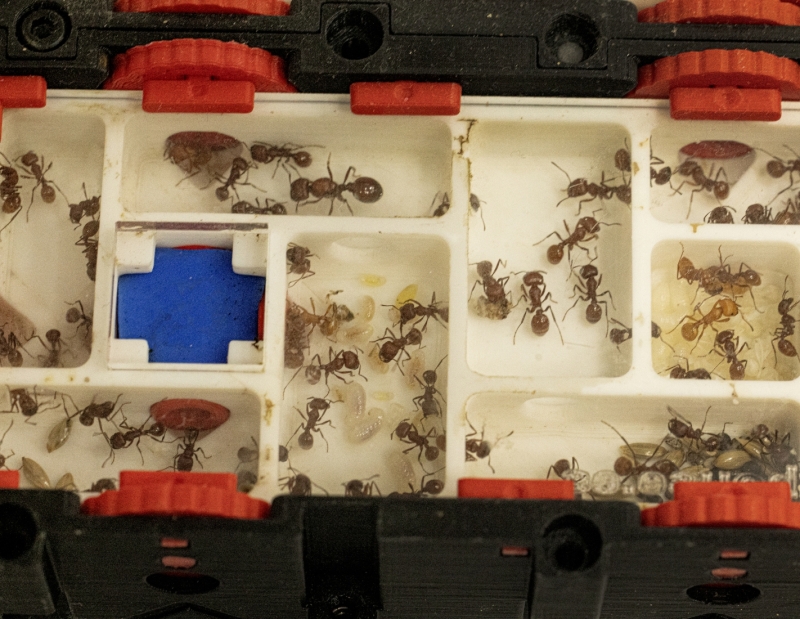
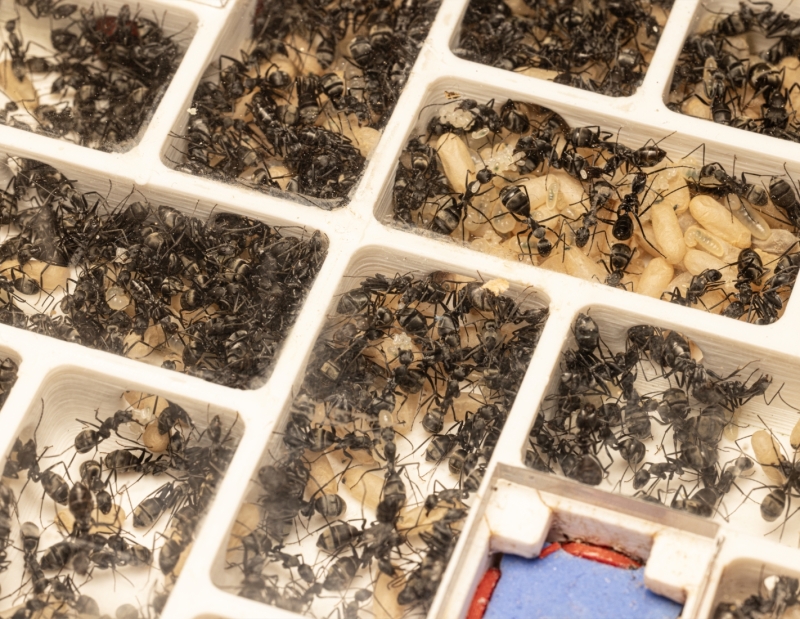
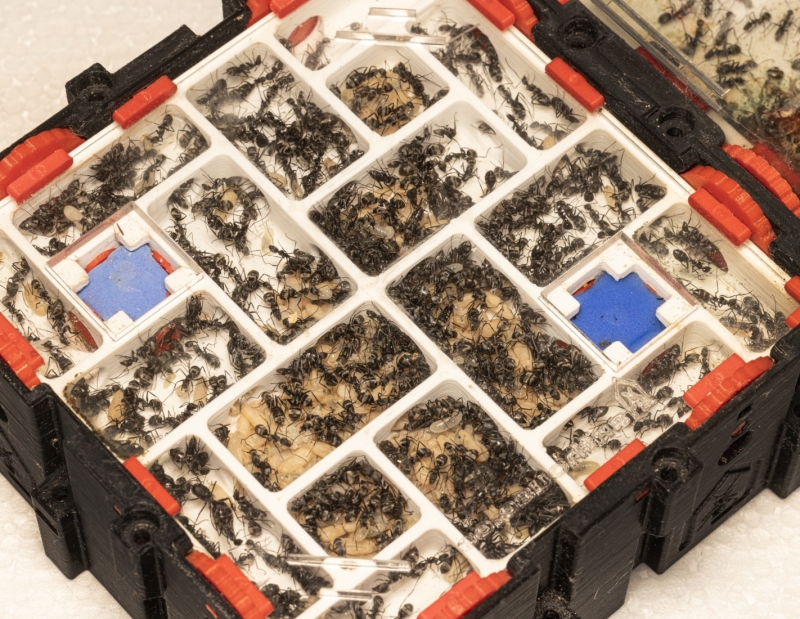
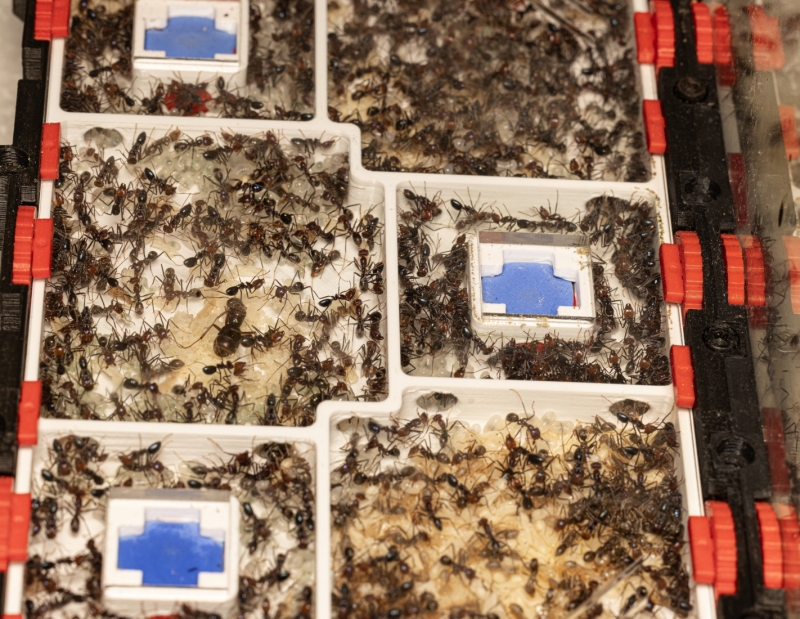
This is an established colony, bred in-house: a 2022 queen, some 4 years of history and 200–300 workers with brood, majors included. The founding stage and the first, slowest years are already behind it.
A carpenter ant from south-western North America, with a yellowish-red head and thorax and a glossy black gaster, described by science in 1893 and still very little known. Monogynous, calm and stingless. QBIK DUO from day one, nest at 24–29 °C with one side at 30 °C, a humid area and the rest dry, water always available in a tube, sugar in a feeder and plenty of varied protein. Diapause of 8–12 weeks at 10–15 °C. It climbs glass: escape barrier and lid.
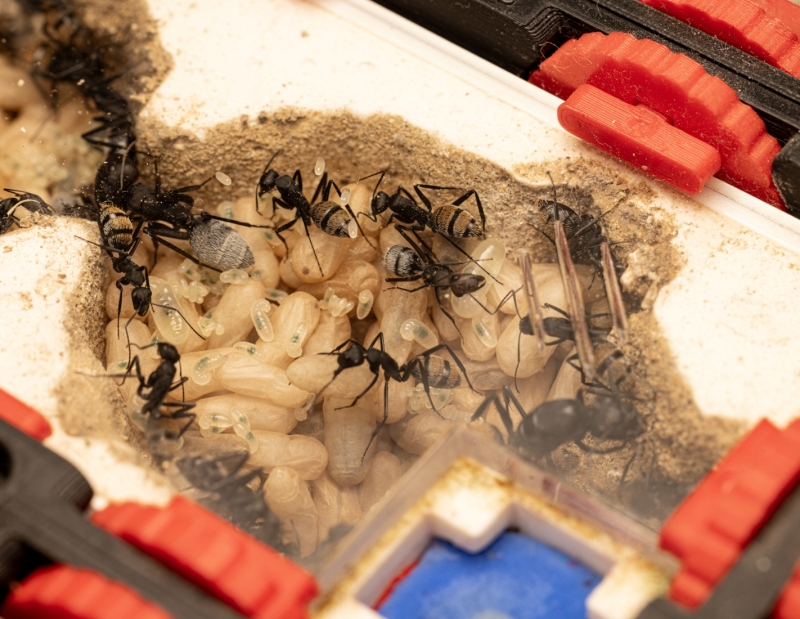
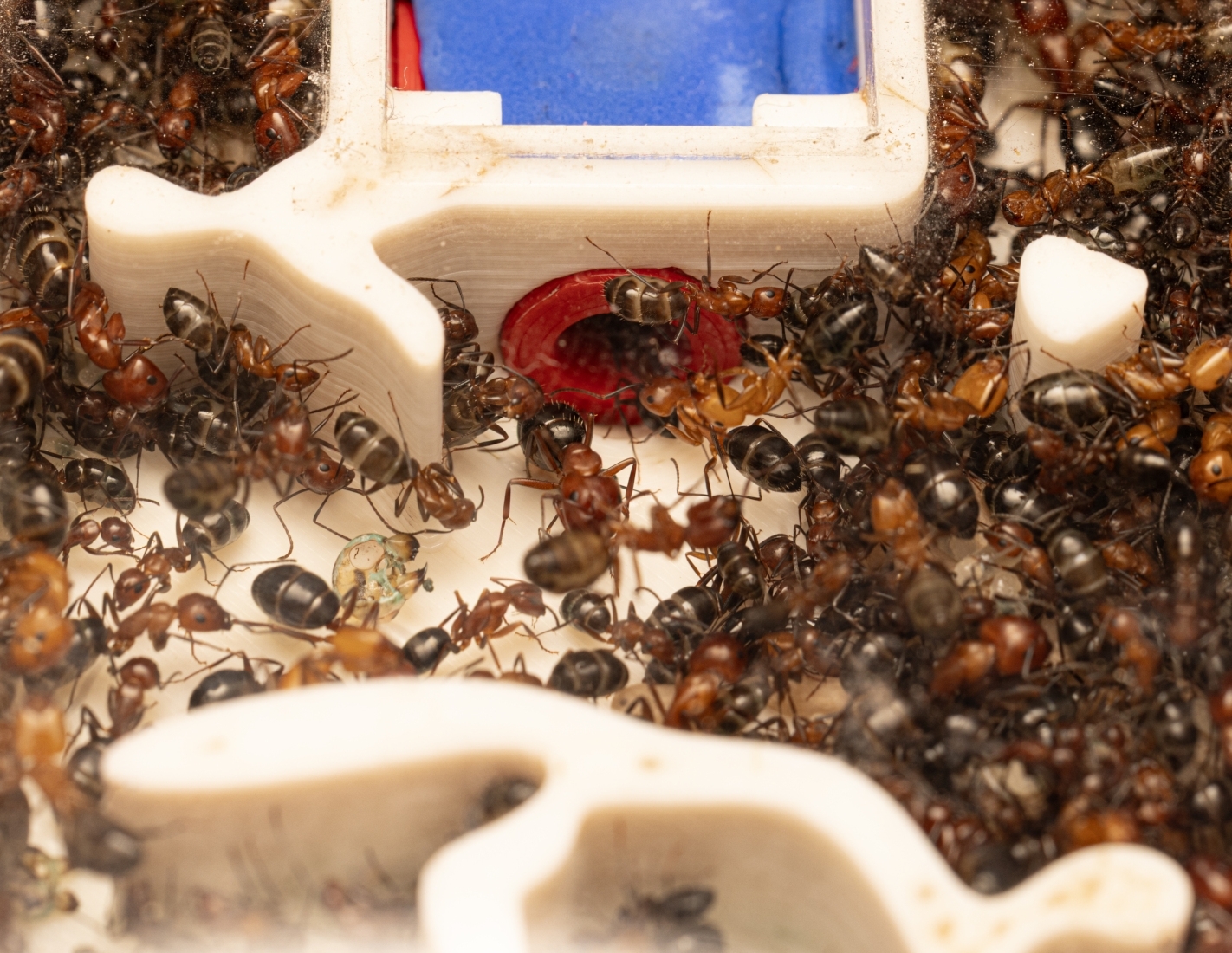
Camponotus sayi Emery, 1893 is a carpenter ant from the arid regions of the south-western United States and north-western Mexico. Its workers look as if they had been painted in two goes: the head, thorax and legs in a warm yellowish red; the gaster lacquer-black, with a thin yellow edge on each segment. Hence the name we give it at Antomas: Bicoloured Empire. The majors carry a large head, almost as broad as it is long and notched at the back, which catches the eye as soon as they appear in the foraging area.
It is also a species with an air of mystery. Since the Italian Carlo Emery described it from a few workers collected in Phoenix (Arizona), hardly anything has been written about it: nobody has published how it founds, how many workers it reaches in the wild or when its queens fly. In this care sheet we carefully separate what is known about C. sayi, what is known about its genus and what we have learnt ourselves by rearing it.
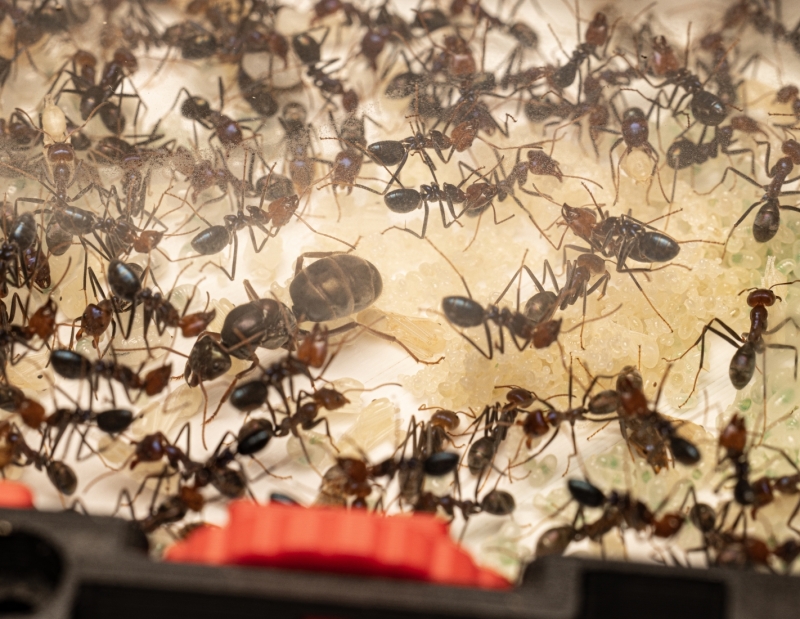
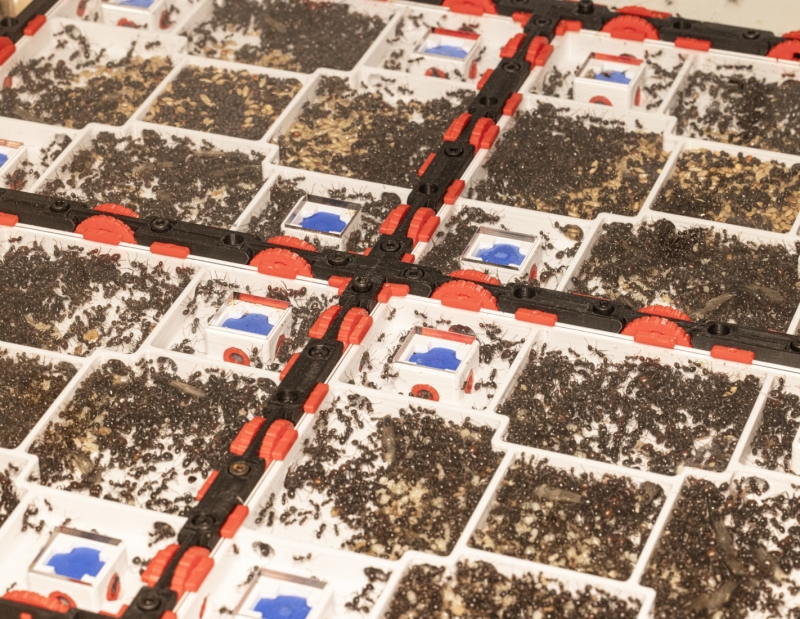
This Empire is a colony born in 2022 that has grown generation after generation in our facilities to more than 200 workers, with majors already present. It is the easiest way to keep a North American Camponotus in full maturity: no waiting years for the first major, and activity you will notice from day one.
Biology
An ant from 1893 that hardly anyone has studied
Emery published C. sayi in 1893, in a paper on North American ants, based on workers sent to him from Phoenix by the entomologist Theodore Pergande. Seventeen years later William Morton Wheeler, the great Harvard myrmecologist, redescribed it in detail in his revision of the North American Camponotus and counted it among ‘a few large and showy species’ from Arizona and Texas. In 1950 William Creighton, in his reference work on the ants of North America, summed it up frankly: ‘we know very little about its distribution’.
Not much has changed since then. There is no study devoted to its biology: not to its founding, its nest or its nuptial flights. That is why every colony that is reared and watched closely adds something that is not yet in the books. With an Empire of more than 200 workers, you can see it too.
A carpenter ant with a notched clypeus
The genus Camponotus is huge, with more than a thousand species, and taxonomists divide it into subgenera. C. sayi belongs to Myrmentoma, according to Creighton and the AntWeb catalogue. The hallmark of the subgenus is small but clear under a magnifying glass: the clypeus, the plate just above the mandibles, has a narrow notch in the middle of its front edge. In C. sayi, according to Wheeler, that notch is small.
Wheeler compared it with its closest relatives in the so-called fallax group and even wrote that it might have to be reduced to a subspecies ‘when better known’. That never happened: it remains a valid species, and it differs from its neighbours in its sturdier, more deeply notched head, stronger thorax, finer sculpture and greater shine.
Cottonwoods, sycamores and dry washes
Wheeler found it in Phoenix and in Prescott, in central Arizona, running on the trunks of poplars, the cottonwoods that grow along desert rivers. The collection records compiled by AntWiki paint the same landscape: stony slopes beside dry washes and shaded banks of seasonal streams, with sycamores, walnuts, junipers and grey oaks (Quercus grisea). In other words, a desert ant, but one of its corners with trees and a little water.
Its known range covers the south-western United States, with Arizona at its core, and north-western Mexico: the catalogue of the ants of northern Mexico by Alatorre-Bracamontes and Vásquez-Bolaños (2010) lists it for Baja California and Sonora, based on Johnson and Ward’s work on the ants of the peninsula. There are further scattered records that nobody has reviewed yet.
The North Dakota mystery
In 1944 the Wheelers (George C. and Esther, not William Morton) recorded C. sayi from the badlands of North Dakota, more than 1,500 km north of Arizona. Creighton did not believe it: he found the record ‘scarcely credible’ and, since the species had never been found in Utah or Colorado, he considered it ‘absolutely impossible’ that it should turn up there. The case is a good example of how hard it is to tell these carpenter ants apart: in Myrmentoma, colour varies a great deal and the differences in shape are subtle.
Majors with notched heads
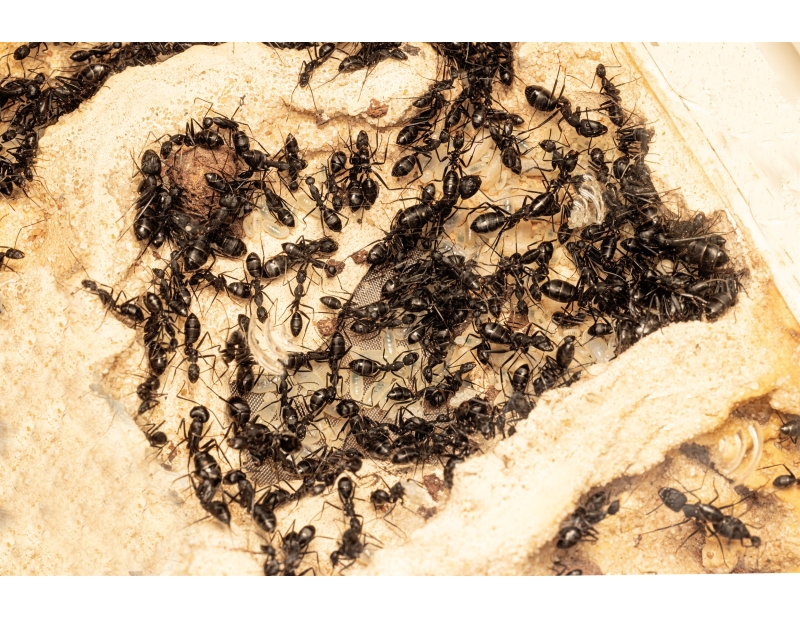
Like almost all Camponotus, C. sayi is polymorphic: a single colony contains small workers, with elongated heads and proportionally long legs, and majors with broad heads and strong mandibles, plus every size in between. In 1953 Edward O. Wilson explained how this system arises: the large workers are not a separate caste but the end of a growth curve in which the head grows faster than the rest of the body. That is why a major is not a minor ‘to scale’, but an ant with a different architecture, built for cutting, defending and blocking galleries.
For C. sayi, Wheeler described the major’s head as ‘large, scarcely longer than broad, broader behind, with the posterior border broadly excised and the corners marked’. A young colony has no majors: they appear once the colony is large and well fed. In this Empire you already have them.
What we have learnt from its genus: the egg that carries the queen’s signature
There are no behavioural studies of C. sayi, but there are many of its genus, above all of Camponotus floridanus, the Florida carpenter ant, which has become a laboratory ant. One of the most elegant is by Annett Endler and colleagues (2004): queen eggs carry on their surface a mix of hydrocarbons that differs from that of worker-laid eggs. This ‘signature’ tells the colony that the queen is fertile; the workers respect her eggs, destroy those laid by other workers and do not develop their own ovaries. In a monogynous colony like yours, this chemistry keeps the peace.
A bacterium in every cell of its gut
Every Camponotus studied lives with an endosymbiotic bacterium, Blochmannia, housed inside special cells of the midgut and passed from the queen to her eggs. In 2007 Heike Feldhaar and her team showed that the bacterium produces essential amino acids that the ant’s diet does not always supply: when they removed the bacterium with antibiotics, colonies reared brood less well, especially on a poor diet. In 2020 Rafiqi, Rajakumar and Abouheif showed that this alliance, some 50 million years old, is so deeply integrated that the bacterium is part of the development of the embryo itself. It is one of the reasons for the genus’s success: they eat everything and get more out of it.
Formic acid: weapon and disinfectant
Camponotus have no sting. Like other formicines, they defend themselves by spraying formic acid from the tip of the gaster. In 2020 Simon Tragust and colleagues discovered that this venom has another use: after eating or drinking, workers curl over and swallow a droplet of their own acid. In this way they acidify the crop, the ‘social stomach’ where they store food, and kill a good share of the microbes that come in with the food. It is a small internal pharmacy worth remembering: a very stressed colony in a closed container builds up acid, and that really does harm it.
Mouth-to-mouth messages
Workers share liquid food by regurgitating it mouth to mouth: this is trophallaxis. In 2016 Adria LeBoeuf and her team analysed this fluid in C. floridanus and found much more than food: juvenile hormone, growth proteins, small RNAs and recognition cues of the colony. When two workers touch mouths, they also exchange information that influences how the larvae grow. With an Empire this size, you will see these ‘conversations’ every day by the feeder.
Majors that become young again
What makes a major stay at home and a minor go out foraging? In 2016 a University of Pennsylvania team led by Shelley Berger published in Science that, in C. floridanus, the difference lies partly in epigenetics, in how genes are switched ‘on’ and ‘off’. When they injected newly emerged majors’ brains with a substance that alters these chemical marks, the majors began foraging like minors. The effect only worked in young majors: with age, their character becomes fixed. The same genome, two ways of living.
Size and morphology
The most complete description is still the one Wheeler made in 1910 from the original workers from Phoenix. These are its features:
- Colour. Head, antennae, thorax and legs yellowish red, the head somewhat darker; black gaster, with the hind edge of each segment yellow. Creighton sums it up in his key: ‘head and thorax yellowish red, only the gaster black’.
- Shine. The whole body is shiny and covered in an extremely fine shagreening; the gaster shines even more than the head and thorax, with scattered tiny punctures from which the odd hair arises.
- Hairs. Very few: erect white or pale yellow hairs in rows on the gaster, the angle of the propodeum and the edge of the petiole. Pubescence is almost absent, which is why it looks so polished.
- Major’s head. Large, little longer than broad and broader behind, with the hind border broadly excised and the corners well marked. Moderate eyes, convex mandibles with 4–5 teeth and antennae that do not reach the corners of the head.
- Minor’s head. More elongated, with straight, nearly parallel sides; its antennae extend beyond the head by a third of their length.
- Thorax and legs. Short, robust thorax, narrower than the head; short legs with thick femora. Unlike other carpenter ants in the region, its tibiae have no rows of bristles.
- Waist. A single segment, the petiole, tall and narrow, as in all formicines.
- No sting. It defends itself with its mandibles and with formic acid.
Approximate measurements
- Minor workers: 4.5–6 mm.
- Major workers: 7–8 mm, with the head 2.5 mm long and 2.4 mm wide.
- Queen and male: there are no published measurements we have been able to verify, so we give no figures.
The worker measurements are Wheeler’s (1910), taken from the cotypes. A mature, well-fed colony may produce the odd worker slightly larger than the museum specimens, but we do not give figures that have not been measured.
Care in captivity
Difficulty: 2/5 – Beginner
At Antomas we rate it at beginner level, and all the more so as an Empire: the tricky part of a Camponotus, the founding stage and the first years of slow growth, is already done. It is a calm, stingless ant that eats everything and adapts well to modern formicaria. It asks for three things: moderate warmth during the active season, a gentle diapause every winter and an escape barrier that works, because it is an excellent climber.
What keeping an already large colony involves
- Space from day one. With more than 200 workers and their brood, the colony will not fit in test tubes or a starter nest. It needs a suitably sized formicarium from the moment it arrives: if you put it in something small, it crowds into the foraging area and gets stressed.
- Lots of food and lots of cleaning. A colony like this has many larvae at once and takes protein almost daily during the season. In return, it produces more waste: remove it often so that mould and mites do not appear.
- A different growth rate. Young Camponotus colonies progress slowly; a mature one, with warmth and protein, raises large batches of workers every season. Plan to expand the formicarium over time.
- Majors already present. They are the ones that dismember large prey and guard the entrances. They need galleries they can move through easily.
- Moving a large colony by tipping it out. With so many workers, the move takes more preparation than with a young colony (we explain it below).
- More to watch. Foraging trails, trophallaxis at the feeder, majors on guard, piles of pupae: at this size, colony life is there to see without waiting.
Recommended formicarium
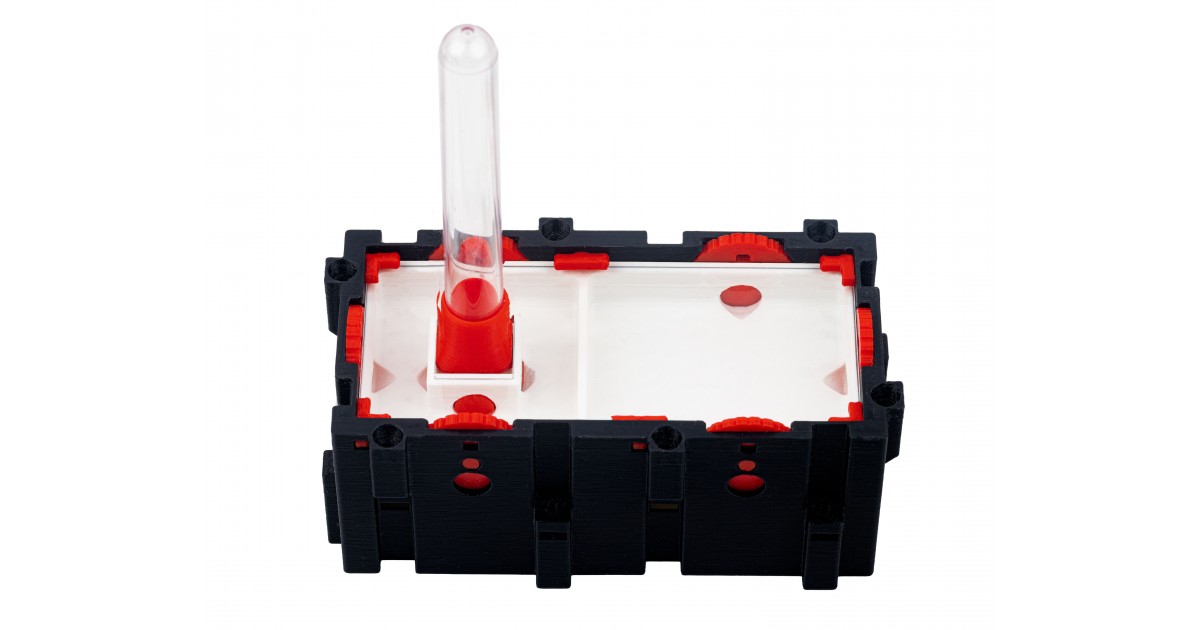
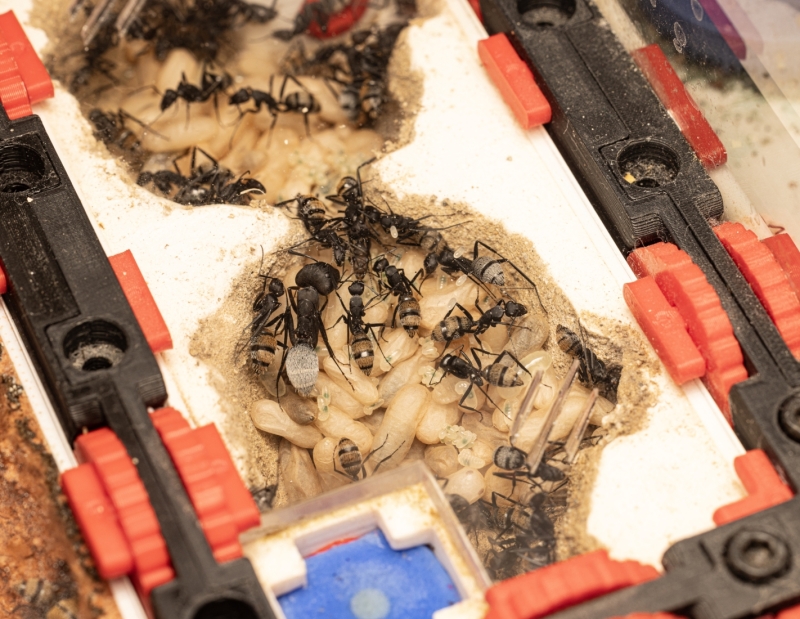
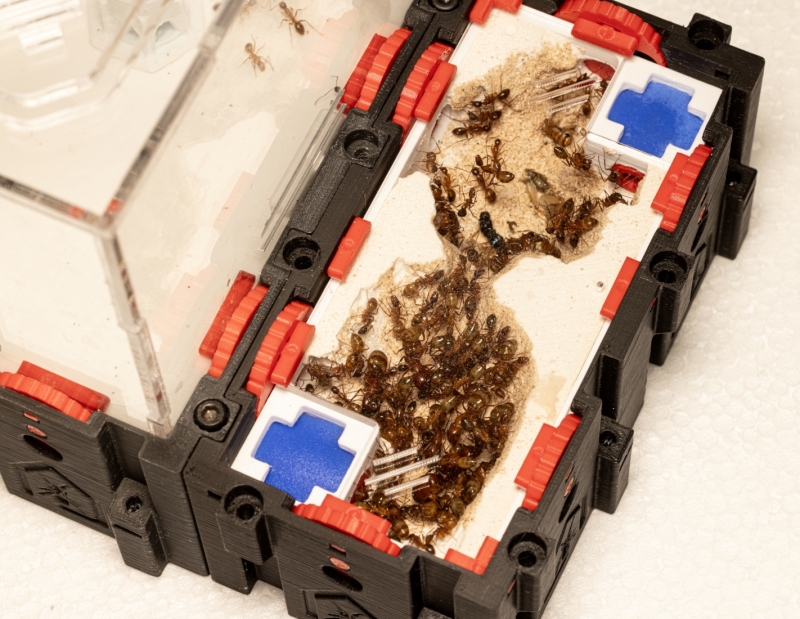
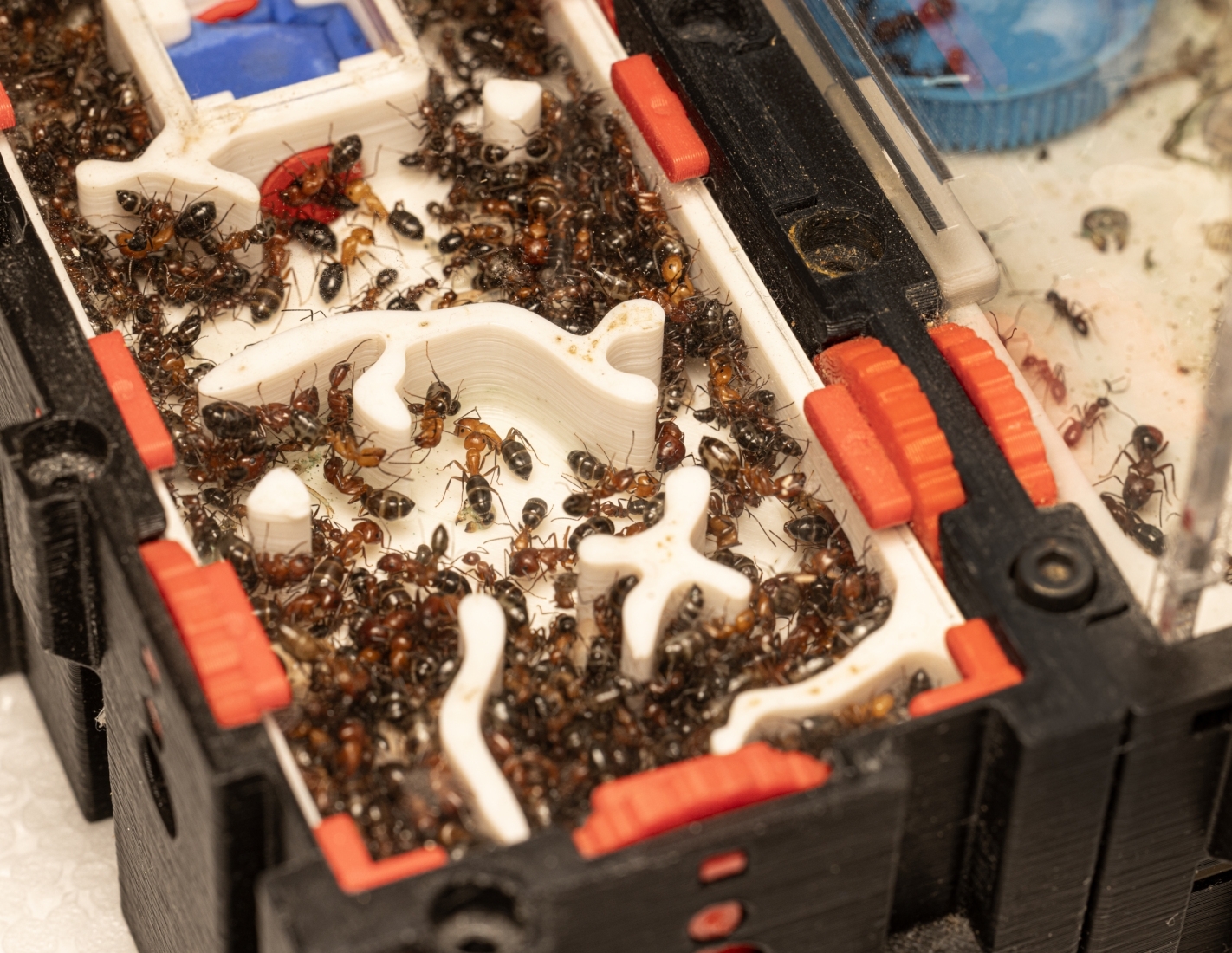
For the Bicoloured Empire we recommend a QBIK DUO from the Alpha range by Anthouse: modular, made of PLA and acrylic, on the dry side, with humidity supplied by the water tubes. That is just what a carpenter ant from an arid environment needs, and it gives an excellent view of the brood and the majors. With this species’ majors, at around 7–8 mm, medium galleries are enough.
When the colony fills the chambers, add modules from the same range; not before, because empty chambers end up as rubbish dumps. Set up a large foraging area, dry, with sand or soil, a piece of bark or a twig to climb on, the water tube with cotton wool and the feeder, always well away from the barrier.
Temperature and humidity
- Nest: 24–29 °C during the season, with a warmer side at around 30 °C, heated from one side and never from beneath the whole nest, so that the colony can choose where to put the brood. Use a thermostat.
- Why these figures: across its range, from the low desert of Arizona and Sonora to the mountain oak woodland and chaparral, summers are very hot, but the brood is reared in the shade, in wood or underground, where the temperature is much more stable than at the surface.
- Humidity: a humid area next to the water reservoir for eggs and larvae, and the rest of the nest dry, which is where they usually place the pupae. Neither waterlogged nor completely dry.
- Water: always available, in a tube with water and cotton wool in the foraging area.
- Light: the nest in darkness and the foraging area under normal room light.
Arrival and moving by tipping out
At Antomas we always move colonies by tipping them out. With more than 200 workers, it pays to prepare well:
- A day of rest. On arrival, leave the colony as it comes, in dim light and at room temperature, with water and a little sugar.
- Everything ready beforehand: the QBIK DUO assembled, with the humid area prepared, the water tube in place and the barrier already applied.
- On a large tray, with the formicarium inside it, so that any that fall outside do not end up on the table.
- Tip them into the foraging area, next to the nest entrance: open the container and empty it with gentle taps. If it comes in several containers, one at a time.
- Stragglers: use a brush, or leave the container open inside the foraging area until they come out on their own.
- Nest in darkness: cover it with something opaque and the colony will carry the brood and the queen inside within a few hours.
- No blowing or shaking. A very disturbed colony releases formic acid, which harms it in a closed space.
If one day the formicarium becomes too small and you do not want to expand it, the procedure is the same: tip the colony into the new one.
Feeding
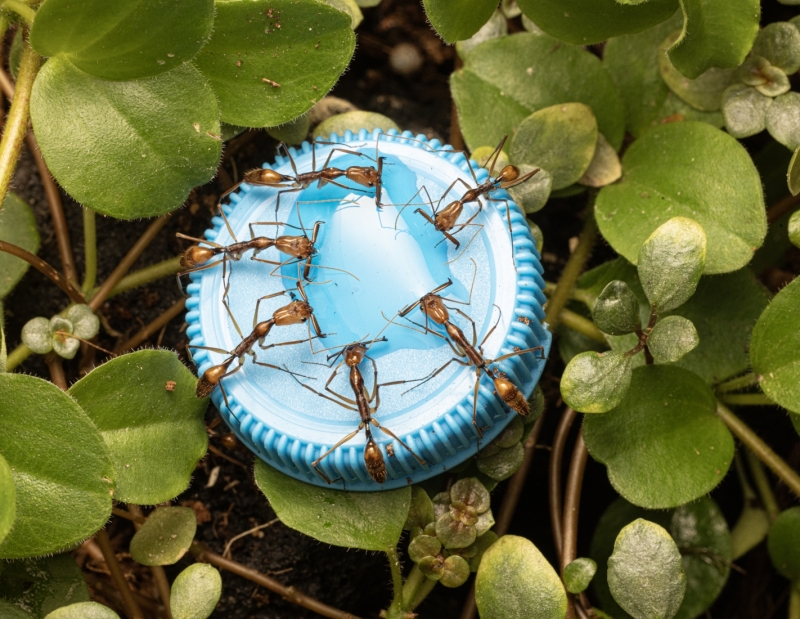
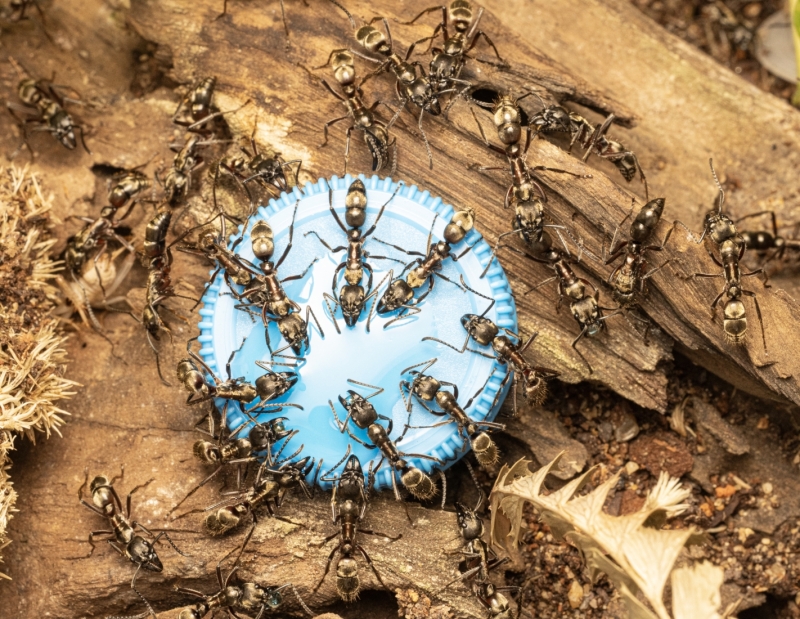
Sugar, always available, in a feeder where the drop stays spread out and accessible, and never on cotton wool, which goes mouldy and spoils the liquid within a few days. Vary the sugars: at Antomas we recommend Blue Sugar nectar by Anthouse 4–5 times a week and another nectar or honey water 1–2 times a week; you can also enrich it with a little protein. Well-fed workers have swollen gasters, with their pale membranes showing between the black segments.
Protein, and lots of it. With a colony this size, offer it almost daily during the season. If you do maintenance every day and remove leftovers, it is better to overdo it than to fall short: the colony understands that resources are plentiful and rears more brood, faster. If you cannot clean often, it is better not to overfeed. And change the prey every week, so they do not always eat the same thing:
Always use captive-bred insects, never ones collected outdoors, which may carry insecticides. Remove leftovers within 24 hours at most.
Diapause
In central Arizona and north-western Mexico, winter is mild in the low desert and cold in the mountain ranges, where it frequently freezes. In both cases the colony slows down: the queen stops laying and foraging drops. At Antomas we give it a moderate winter rest:
- How long and at what temperature: 8–12 weeks at 10–15 °C, roughly from December to February, in an unheated room, a cellar or a frost-free garage.
- Gradually: in November switch off the warm side and leave the colony for a few weeks at 18–20 °C before moving it into the cold; in March, raise it in stages back to 24–29 °C.
- During the rest: water always, the humid area maintained, a little sugar if there are active workers and no protein.
- Why do it: it respects the rhythm of its climate, in which every winter brings a pause, and in Antomas’s experience the colony starts the spring with more vigour.
Behaviour and observation
Watch without fear. At Antomas we believe ants are there to be enjoyed, watched and learnt from. Keep the nest dark and the foraging area lit, and look at them whenever you like, gently and intervening only as much as necessary. It is a calm ant that soon gets used to your presence.
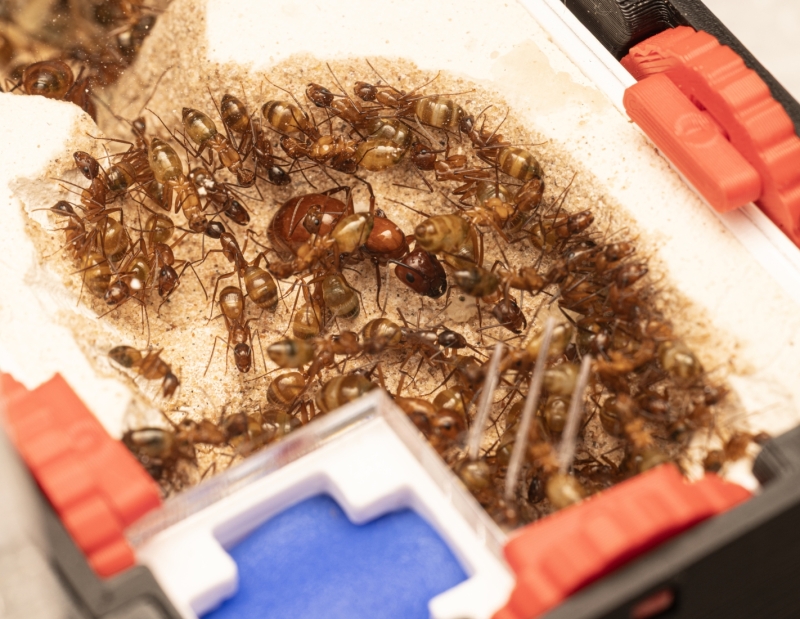
What you will see. Workers exploring the foraging area and climbing the bark, as they do on cottonwood trunks; queues at the feeder exchanging food mouth to mouth; majors coming out when there is large prey to dismember or something to defend; and piles of pupae, wrapped in their cocoons like those of all Camponotus, neatly arranged in the dry part of the nest.
Your contribution. As almost nothing has been published about this species, note down what you see: when laying slows, at what time of day it forages most, how many batches of brood it raises per year. This is information that is not yet in any book.
Signs that something is wrong: a colony that does not grow in summer usually needs more warmth or more protein; sudden worker deaths are usually due to lack of water, excessive heat or decomposing leftovers; and mould in the chambers to too much humidity or forgotten food.
Escapes and handling
It climbs glass, plastic and joints, like all Camponotus. Apply a barrier of paraffin oil or petroleum jelly, or of PTFE (Fluon), to the top of the foraging area walls, fit a tight lid with fine mesh over the ventilation holes and leave nothing that could act as a bridge to the barrier. Renew the barrier when it gets dirty with dust or sand.
Stingless and harmless to people. A major can give a pinch and all of them can spray formic acid, nothing more. Work with long forceps, a brush and tubes, over a tray, and never release it: it is a North American species.
What not to do
- Combine it with another queen or another colony: it is monogynous.
- Put a colony of more than 200 workers in a small nest, or suddenly give it far more space than it occupies.
- Heat the whole formicarium evenly or go above about 30 °C in the nest.
- Let the water tube run dry or let the nest dry out completely.
- Put the sugar on cotton wool or always give it the same prey.
- Leave food remains for more than a day.
- Skip the diapause or change the temperature abruptly.
- Neglect the barrier or the lid.
Scientific sources
Camponotus sayi is a very poorly studied species. The species-specific information comes from Wheeler’s redescription (1910), from Creighton’s work (1950, The ants of North America, open access) and from faunal catalogues; the biology in the sections about its genus is based on studies of other Camponotus, above all C. floridanus. The rest is the experience of Antomas and other keepers. Main references:
- Wheeler, W. M. (1910). The North American ants of the genus Camponotus Mayr. Annals of the New York Academy of Sciences 20: 295–354. doi:10.1111/j.1749-6632.1910.tb55152.x
- Wilson, E. O. (1953). The origin and evolution of polymorphism in ants. The Quarterly Review of Biology 28: 136–156. doi:10.1086/399512
- Johnson, R. A. & Ward, P. S. (2002). Biogeography and endemism of ants (Hymenoptera: Formicidae) in Baja California, Mexico: a first overview. Journal of Biogeography 29: 1009–1026. doi:10.1046/j.1365-2699.2002.00746.x
- Endler, A., Liebig, J., Schmitt, T., Parker, J. E., Jones, G. R., Schreier, P. & Hölldobler, B. (2004). Surface hydrocarbons of queen eggs regulate worker reproduction in a social insect. Proceedings of the National Academy of Sciences of the USA 101: 2945–2950. doi:10.1073/pnas.0308447101
- Feldhaar, H., Straka, J., Krischke, M., Berthold, K., Stoll, S., Mueller, M. J. & Gross, R. (2007). Nutritional upgrading for omnivorous carpenter ants by the endosymbiont Blochmannia. BMC Biology 5: 48. doi:10.1186/1741-7007-5-48
- Alatorre-Bracamontes, C. E. & Vásquez-Bolaños, M. (2010). Lista comentada de las hormigas (Hymenoptera: Formicidae) del norte de México. Dugesiana 17: 9–36. doi:10.32870/dugesiana.v17i1.3939
- Blaimer, B. B., Brady, S. G., Schultz, T. R., Lloyd, M. W., Fisher, B. L. & Ward, P. S. (2015). Phylogenomic methods outperform traditional multi-locus approaches in resolving deep evolutionary history: a case study of formicine ants. BMC Evolutionary Biology 15: 271. doi:10.1186/s12862-015-0552-5
- Ward, P. S., Blaimer, B. B. & Fisher, B. L. (2016). A revised phylogenetic classification of the ant subfamily Formicinae (Hymenoptera: Formicidae), with resurrection of the genera Colobopsis and Dinomyrmex. Zootaxa 4072: 343–357. doi:10.11646/zootaxa.4072.3.4
- Simola, D. F., Graham, R. J., Brady, C. M., Enzmann, B. L., Desplan, C., Ray, A., Zwiebel, L. J., Bonasio, R., Reinberg, D., Liebig, J. & Berger, S. L. (2016). Epigenetic (re)programming of caste-specific behavior in the ant Camponotus floridanus. Science 351: aac6633. doi:10.1126/science.aac6633
- LeBoeuf, A. C., Waridel, P., Brent, C. S., Gonçalves, A. N., Menin, L., Ortiz, D., Riba-Grognuz, O., Koto, A., Soares, Z. G., Privman, E., Miska, E. A., Benton, R. & Keller, L. (2016). Oral transfer of chemical cues, growth proteins and hormones in social insects. eLife 5: e20375. doi:10.7554/eLife.20375
- Rafiqi, A. M., Rajakumar, A. & Abouheif, E. (2020). Origin and elaboration of a major evolutionary transition in individuality. Nature 585: 239–244. doi:10.1038/s41586-020-2653-6
- Tragust, S., Herrmann, C., Häfner, J., Braasch, R., Tilgen, C., Hoock, M., Milidakis, M. A., Gross, R. & Feldhaar, H. (2020). Formicine ants swallow their highly acidic poison for gut microbial selection and control. eLife 9: e60287. doi:10.7554/eLife.60287