This website uses its own and third-party cookies to improve our services and show you advertising related to your preferences by analyzing your browsing habits. To give your consent to its use, press the Accept button.
Cookie preferences
| Cookie | Provider | Purpose | Expiry |
|---|---|---|---|
| PHP_SESSID | antomas.es | The PHPSESSID cookie is native to PHP and allows websites to store serialised status data. On the website it is used to establish a user session and to pass state data through a temporary cookie, which is commonly known as a session cookie. These Cookies will only remain on your computer until you close your browser. | Session |
| PrestaShop-# | antomas.es | This is a cookie used by Prestashop to store information and keep the user's session open. It stores information such as currency, language, customer ID, among other data necessary for the proper functioning of the shop. | 480 hours |
| rc::a | It is used to read and filter bot requests. | Persistent | |
| rc::c | It is used to read and filter bot requests. | Persistent |
| Cookie | Provider | Purpose | Expiry |
|---|---|---|---|
| _ga | Registers a unique ID that is used to generate statistical data on how the visitor uses the website. | 2 years | |
| _gat | Used by Google Analytics to throttle request rate | 1 day | |
| _gat_gtag_UA_# | Used to throttle request rate. | 1 minute | |
| _gd# | This is a Google Analytics Session cookie used to generate statistical data on how you use the website which is removed when you quit your browser. | Session | |
| _gid | Registers a unique ID that is used to generate statistical data on how the visitor uses the website. | 1 day |
Polyrhachis ammon – Golden-tailed Spiny Ant
Biology
Polyrhachis ammon, known in Australia as the Golden-tailed Spiny Ant, is one of the most striking spiny ants on the continent. It is mainly distributed along the eastern coast of Australia.
It mainly inhabits open eucalyptus forests, wooded areas, and habitats with relatively sparse vegetation. Despite its slender appearance and its ability to move easily among branches, it is not considered a strictly arboreal species.
Its natural diet is omnivorous and opportunistic. Workers feed on nectar, pollen, plant secretions, and honeydew produced by scale insects, leafhoppers, and other phytophagous insects.
In captivity, it is especially notable for its attraction to ripe fruit. Apple, banana, pear, and other sweet fruits usually generate immediate interest. For the workers, a piece of ripe fruit can quickly become the colony’s main activity point.
One of the most distinctive behaviors of P. ammon is its tendency to change nests relatively frequently. In nature, it may abandon a cavity when microclimatic conditions change or when new shelter opportunities become available.
This behavior has important consequences in captivity. A colony that insists on occupying the connection tube, gathers in the foraging area, or continuously moves brood may be indicating that the nest does not fully meet its requirements.
Workers forage both on the ground and on trunks, branches, and leaves. They are active, visual, and quite agile, although they are usually not extremely aggressive.
The social organization of this species is not fully clarified for all populations. Natural colonies with a single queen have been reported, although the existence of colonies with more than one functional queen cannot be ruled out in some populations.
Founding is semi-claustral. Unlike a fully claustral Camponotus queen, the queen of P. ammon needs to feed during the first stages and cannot rely solely on her body reserves.
During this stage, microdrops of nectar or sugar water, small pieces of fruit, and tiny freshly killed prey should be offered.
The larvae develop into pupae protected by cocoons, so they benefit from having small substrate particles available to help them spin properly.
Size and Morphology
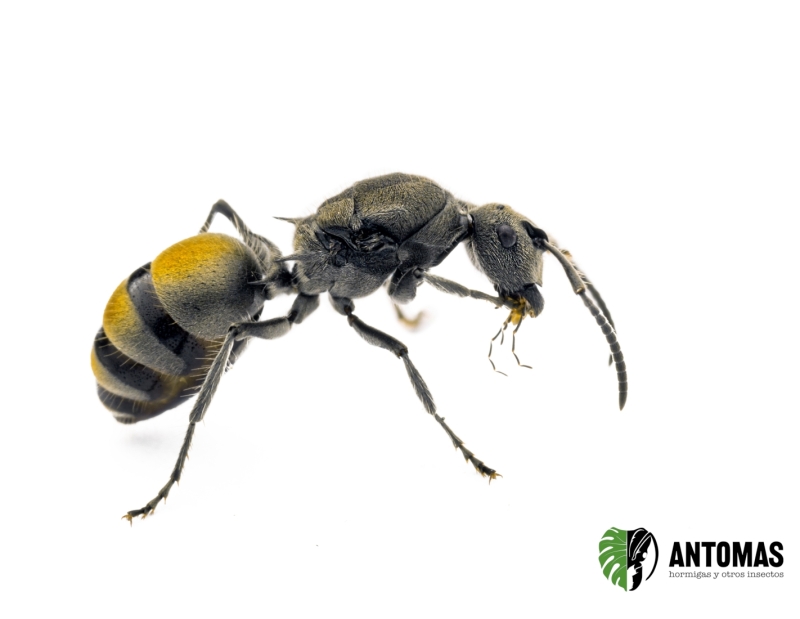
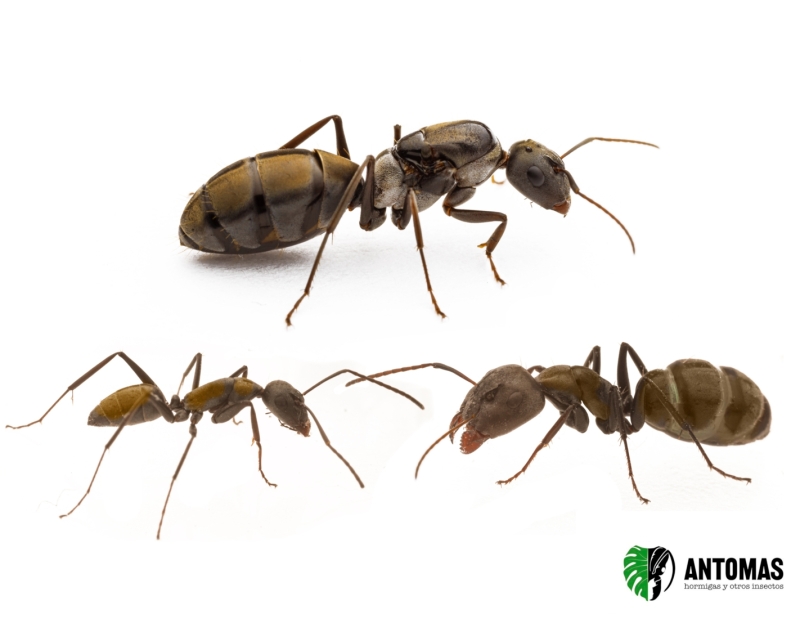
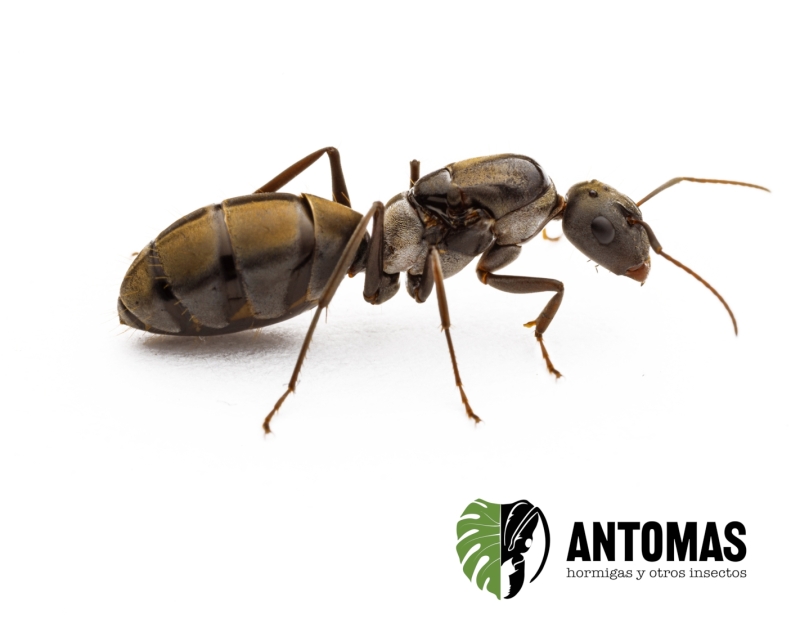
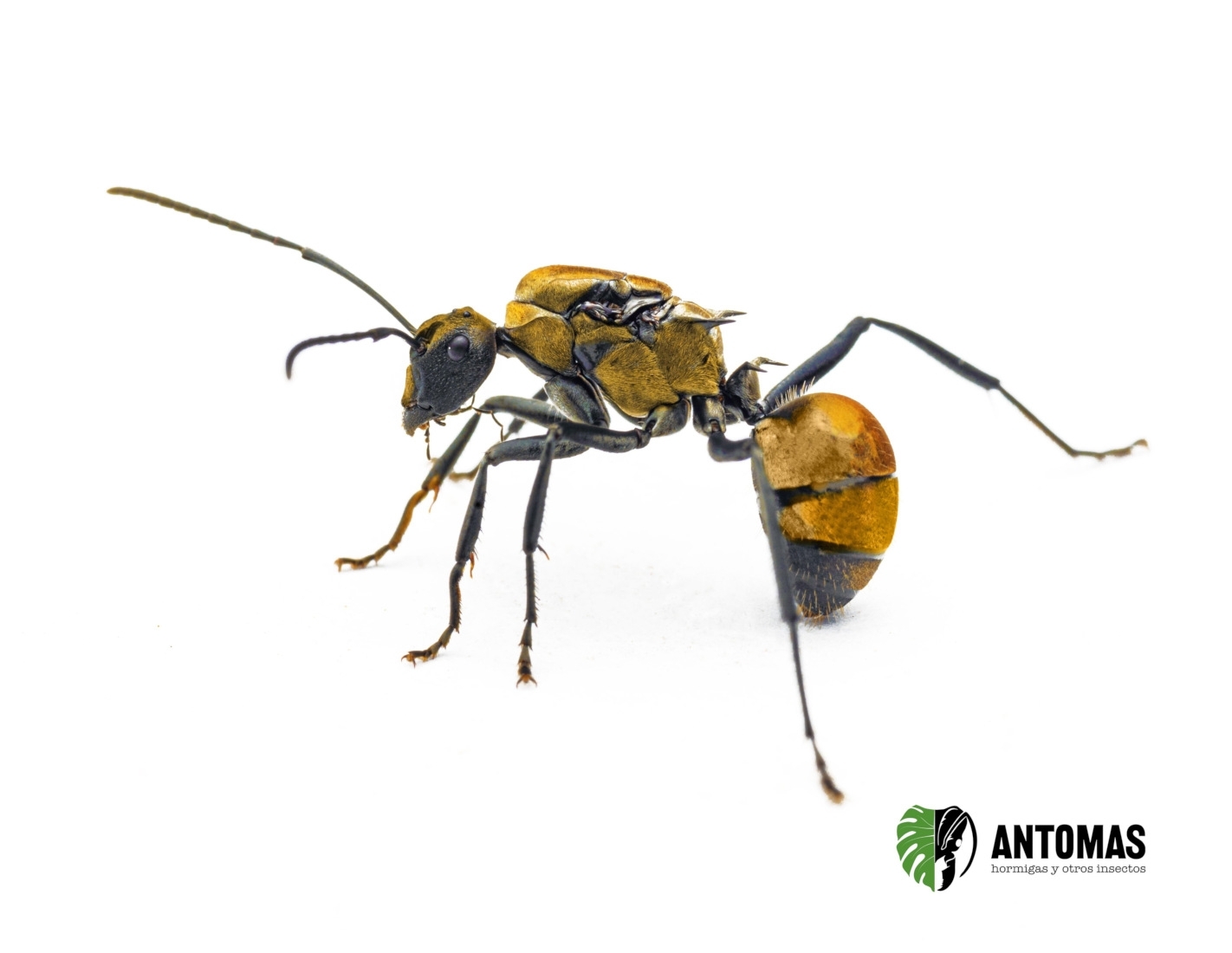
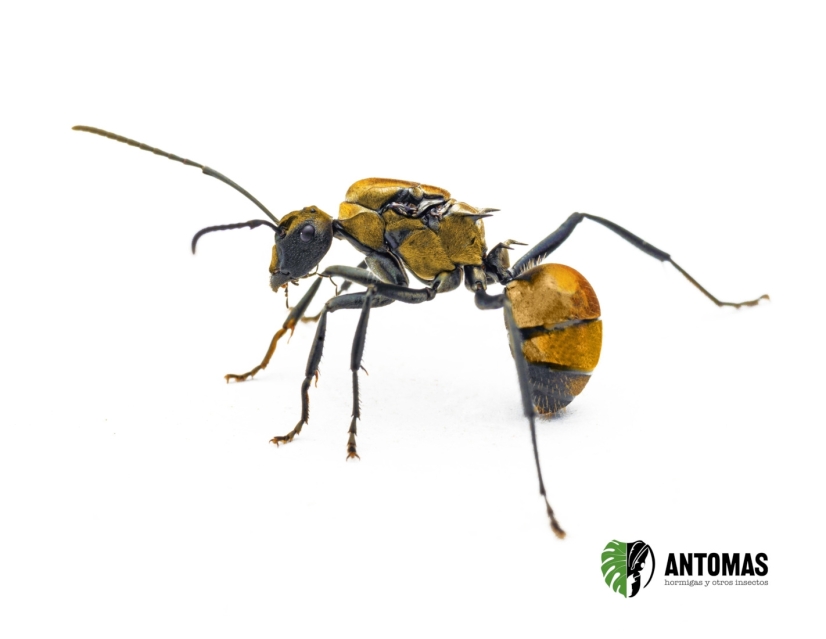
Polyrhachis ammon is a medium-sized species, but its slender silhouette and long legs make it appear larger. The body is dark and contrasts strongly with the golden pubescence at the end of the gaster.
Depending on the lighting, this covering may reflect golden, bronze, or even slightly orange tones. It is not a flat color, but an iridescent visual effect produced by the body hairs.
The mesosoma and petiole bear several long, sharp spines. These structures do not contain venom, but they make it more difficult for small predators to seize the ant.
Workers are relatively homogeneous and there is no differentiated soldier caste. Some individual size variation may be found, but without the marked polymorphism seen in other genera.
The legs are long and slender, adapted for moving quickly both on the ground and through vegetation. The mandibles are functional but not especially massive.
As a member of the subfamily Formicinae, it lacks a sting. Instead, it has an acidopore at the end of the gaster and can use formic acid as a defensive mechanism.
Approximate measurements
- Workers: 8–10 mm
- Queen: 10–11.5 mm
CAPTIVE CARE
The difficulty of Polyrhachis ammon can be considered intermediate. It is not especially delicate once established, but founding requires attention, and humidity, ventilation, and nest choice must be managed correctly.
Its natural tendency to change shelters also requires correct interpretation of colony behavior and a flexible setup.
Recommended parameters
- Development temperature: 23–27 °C
- Optional warm spot: up to 28 °C
- Humidity: medium-high, with good ventilation
- Nest: cork, wood, naturalistic systems, or well-ventilated nests with a humidity gradient
The nest should not remain completely soaked. It is advisable to provide a moderately humid area for eggs and larvae and another drier, well-ventilated area for pupae and resting workers.
During founding, a test tube placed inside a small foraging area works well. The entrance can be narrowed with cotton or cork to increase the queen’s sense of security.
It should not be moved prematurely into a large formicarium. A solitary queen or a colony with few workers feels safer in compact spaces.
Seasonal rest
The distribution of P. ammon covers very different climatic regions, from warm northern Queensland to Victoria and more temperate areas.
A mandatory physiological diapause has not been demonstrated for the entire species. However, southern populations are exposed to cooler winters and can benefit from a mild rest period.
When the locality of origin is known:
- Populations from Victoria, ACT, or southern New South Wales: rest for approximately 8–12 weeks at 12 to 16 °C.
- Populations from warmer regions: a slight seasonal reduction may be enough.
If the exact origin is unknown, it is more prudent to provide a gradual temperature drop and observe the colony’s response rather than applying an intense diapause.
Feeding
Carbohydrates
- Ant-specific nectar
- Sugar water
- Diluted honey
- Apple
- Banana
- Pear
- Grape
- Other ripe fruits
Fruit can be offered several times a week, especially if the colony shows a clear preference. It should be washed, peeled when appropriate, and removed before fermenting.
Sugary liquids should continue to form the regular energy base, as they are easier to control and preserve than fresh fruit.
Proteins
- Flies
- Small crickets
- Feeder cockroaches
- Silverfish
- Chopped mealworm
- Other suitable feeder insects
During founding, small and preferably killed prey should be offered. With several workers, live insects can be introduced if they are not dangerous to the colony.
Protein demand increases when the colony maintains large larvae. If only eggs, pupae, or cocoons are present, protein interest may normally decrease.
Behavior in captivity
Initial growth is usually moderate. The queen must alternate egg laying and brood care with foraging trips, so the process can be slower than in fully claustral species.
Once the first workers appear, the colony gains confidence and gradually increases consumption. Workers are visible, active, and exploratory.
They have good climbing ability and can use silicone joints, cables, rough surfaces, and small irregularities. The foraging area must be well protected.
Their tendency to move makes modular formicaria advisable. Instead of forcing them to remain in a single chamber, it can be useful to offer alternative shelters and allow them to choose.
Handling and Safety
Polyrhachis ammon has no sting and poses no real danger. It may bite and use formic acid as a defense, but it is not considered a dangerous species.
The spines are defensive, but they do not inject any substance. Even so, direct handling of the ants is not recommended, nor should they be held by the legs or gaster.
Transfers should be carried out using auxiliary containers, suitable entomological aspirators, or tweezers, never by pressing directly on the body.