This website uses its own and third-party cookies to improve our services and show you advertising related to your preferences by analyzing your browsing habits. To give your consent to its use, press the Accept button.
Cookie preferences
| Cookie | Provider | Purpose | Expiry |
|---|---|---|---|
| PHP_SESSID | antomas.es | The PHPSESSID cookie is native to PHP and allows websites to store serialised status data. On the website it is used to establish a user session and to pass state data through a temporary cookie, which is commonly known as a session cookie. These Cookies will only remain on your computer until you close your browser. | Session |
| PrestaShop-# | antomas.es | This is a cookie used by Prestashop to store information and keep the user's session open. It stores information such as currency, language, customer ID, among other data necessary for the proper functioning of the shop. | 480 hours |
| rc::a | It is used to read and filter bot requests. | Persistent | |
| rc::c | It is used to read and filter bot requests. | Persistent |
| Cookie | Provider | Purpose | Expiry |
|---|---|---|---|
| _ga | Registers a unique ID that is used to generate statistical data on how the visitor uses the website. | 2 years | |
| _gat | Used by Google Analytics to throttle request rate | 1 day | |
| _gat_gtag_UA_# | Used to throttle request rate. | 1 minute | |
| _gd# | This is a Google Analytics Session cookie used to generate statistical data on how you use the website which is removed when you quit your browser. | Session | |
| _gid | Registers a unique ID that is used to generate statistical data on how the visitor uses the website. | 1 day |
Camponotus consobrinus – Giant Banded Sugar Ant
Biology
Camponotus consobrinus, known in Australia as the Banded Sugar Ant, is one of the most recognizable ants on the continent. It is a large, robust, and highly active species belonging to the genus Camponotus.
It occupies relatively varied environments, from eucalyptus forests and sclerophyll formations to heathlands, grasslands, and urban gardens. This ecological flexibility makes it a very adaptable species.
Its English common name, Banded Sugar Ant, refers both to its preference for sweet foods and to the banded color pattern that characterizes many workers.
Protein comes mainly from live insects, carcasses, and small arthropods found during foraging. Sugary liquids are especially important for adult workers and colony maintenance.
It is fundamentally a crepuscular and nocturnal species. In populations studied in Canberra, the first workers leave the nest at dusk and activity continues throughout the night, declining after sunrise.
One of its most interesting behaviors is recruitment through tandem running. A worker that knows the route guides another nestmate toward a food source or a new location, allowing information to be transmitted accurately.
These ants also have highly developed visual memory. They recognize trees, silhouettes, and landscape references to orient themselves during foraging routes.
Social structure is variable. Most analyzed nests were headed by a single queen, but polygynous colonies with more than one functional queen have also been documented.
Founding is claustral. The queen seals herself inside a chamber and raises the first generation using her body reserves.
Nuptial flights take place mainly during the austral summer. In Canberra they have been observed between December and March, usually after warm days and favorable conditions.
Mature colonies can become large, active societies with intense worker movement. There is no well-defined maximum population size, but established colonies may reach several thousand workers.
Size and Morphology
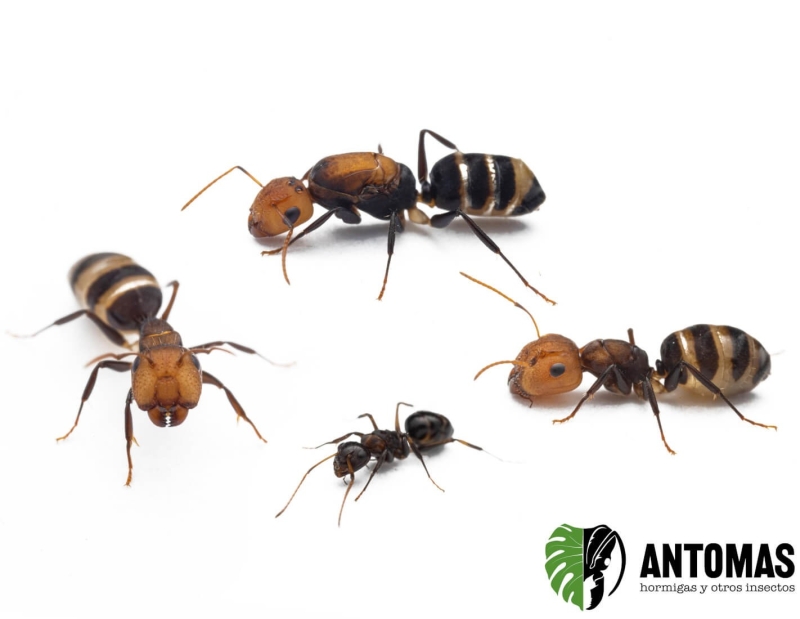
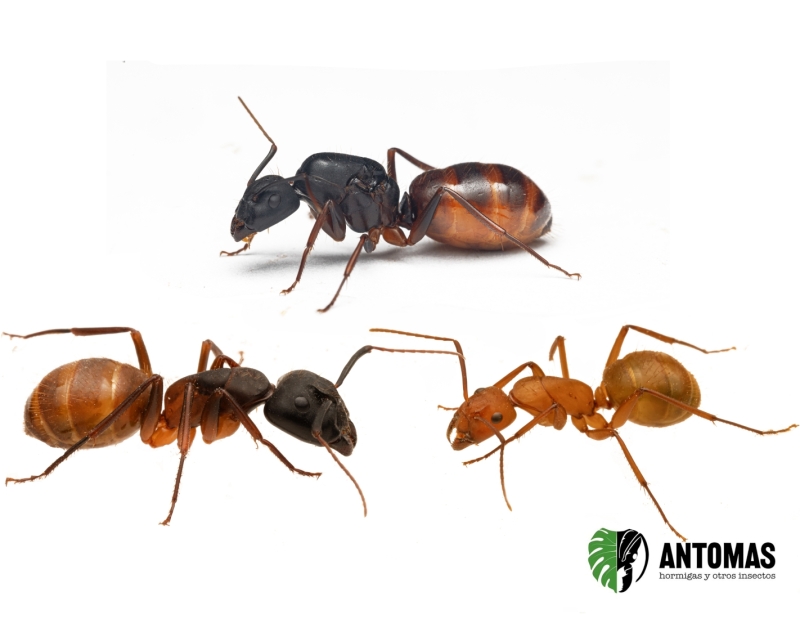
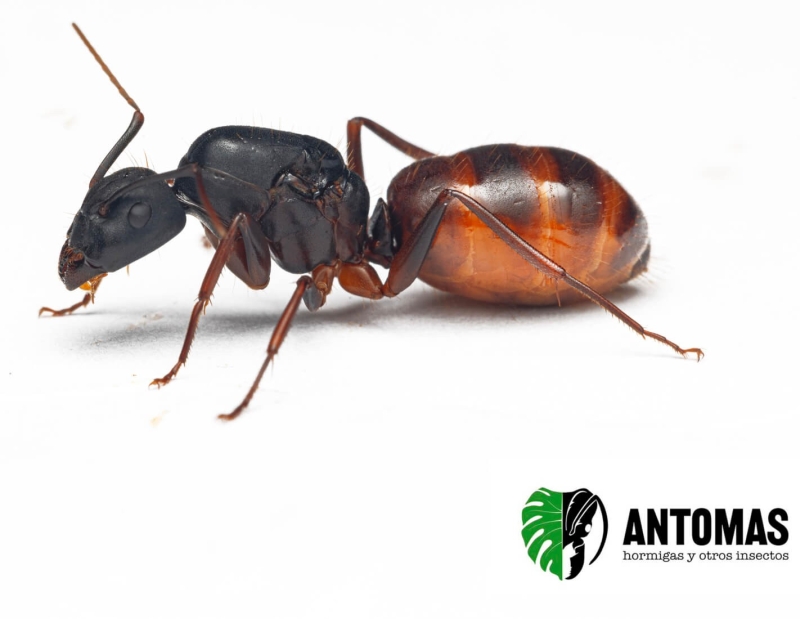
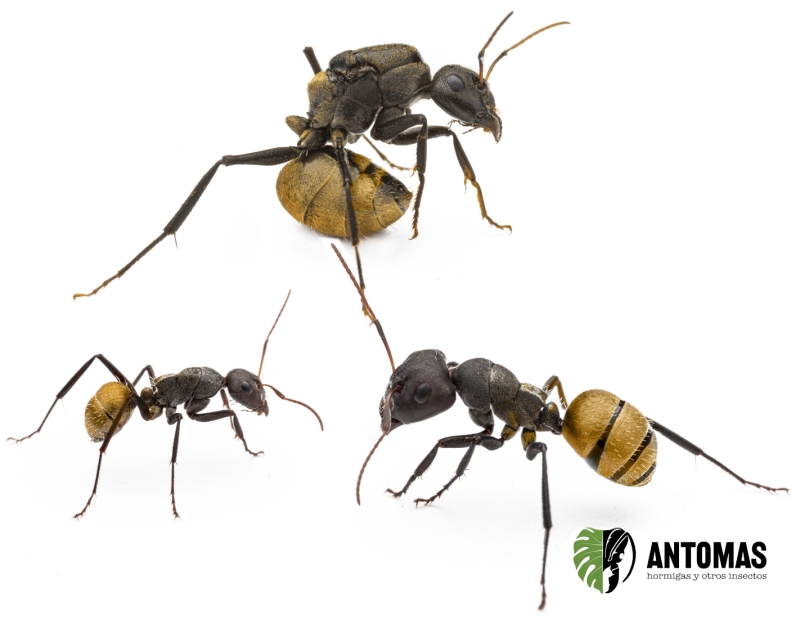
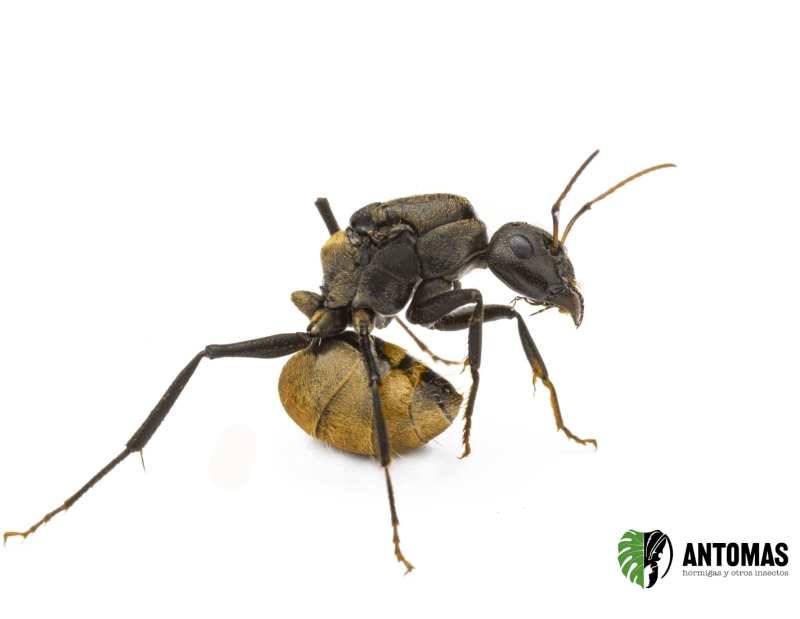
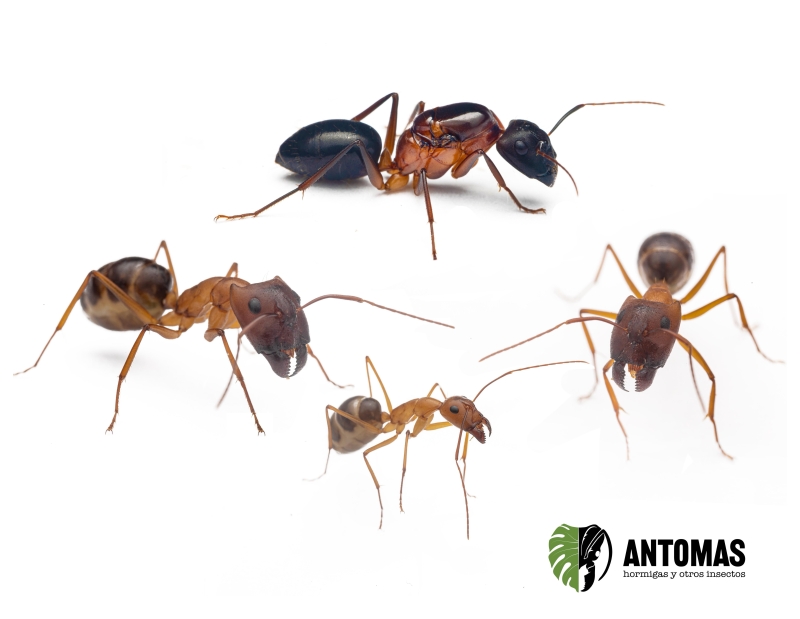
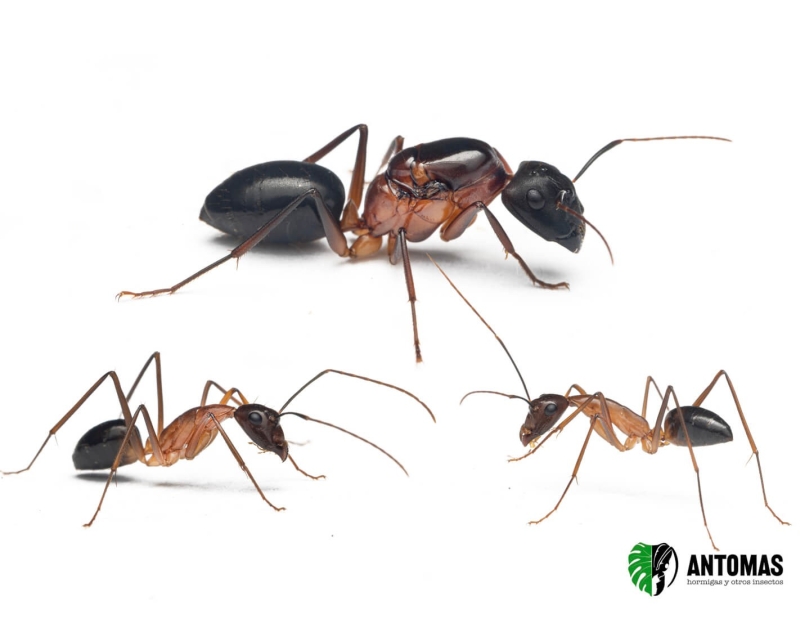
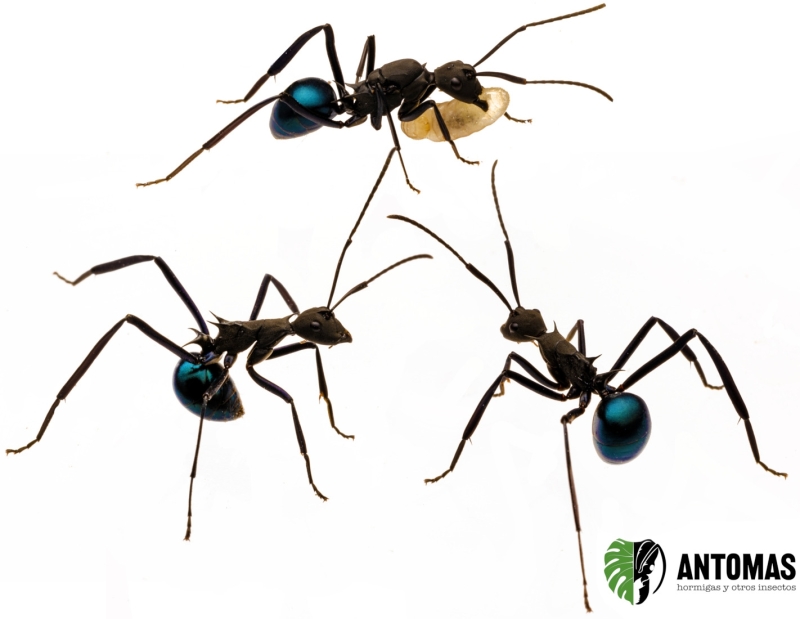
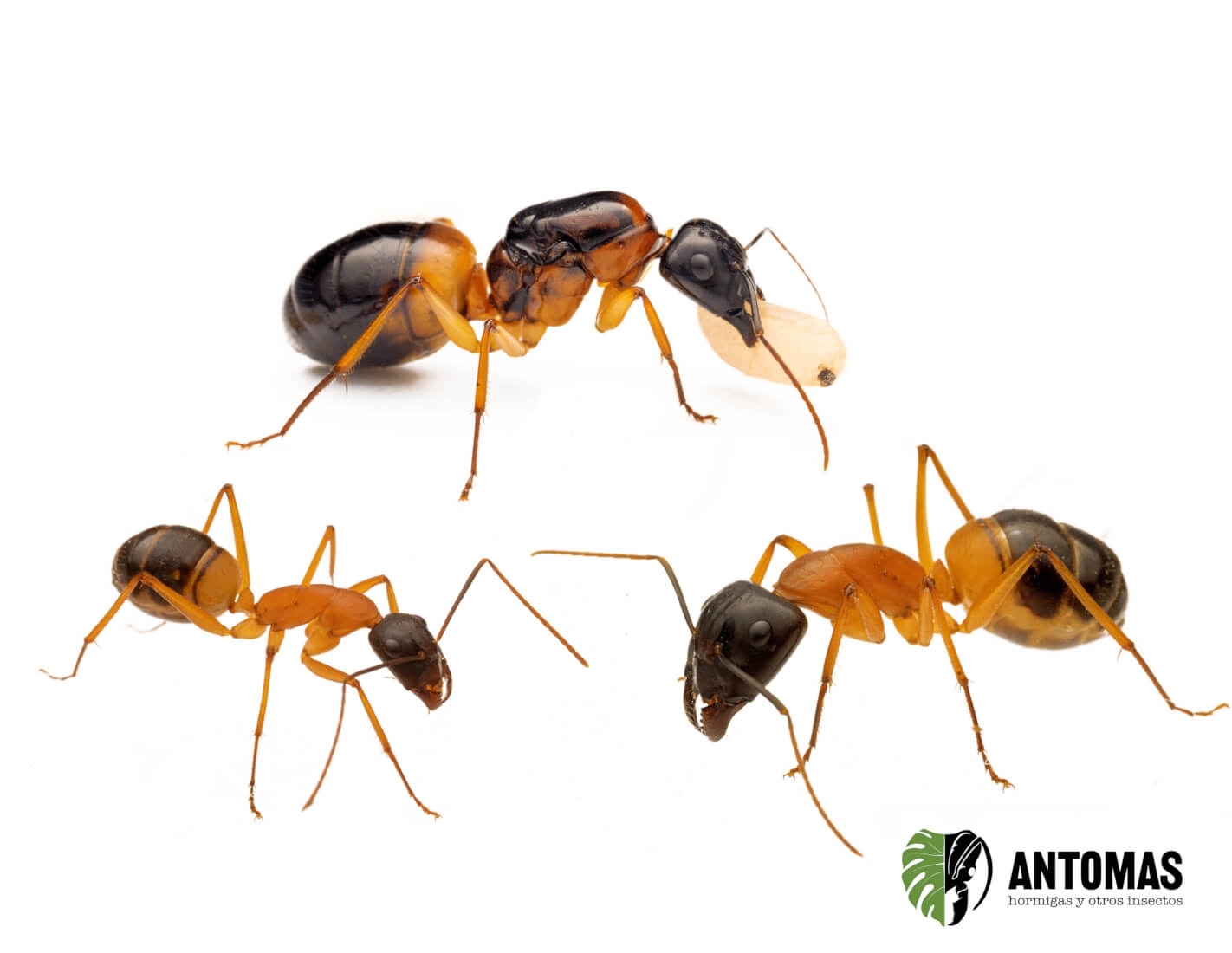
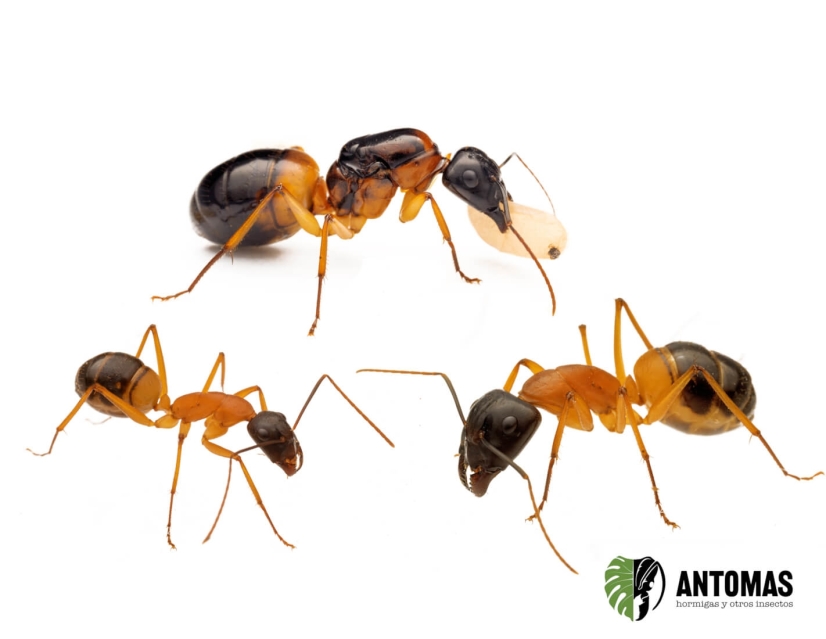
Camponotus consobrinus is a large, slender, and strongly polymorphic ant. The combination of a shiny black head and a banded orange or brownish body makes it very distinctive.
The exact coloration may vary between colonies. Some specimens show bright orange, while others display darker brown, reddish, or nearly black tones.
Workers form a continuous size series:
- Minor workers: approximately 5–8 mm
- Media workers: approximately 9–13 mm
- Major workers: approximately 14–16 mm
- Queen: approximately 16–18 mm
Majors, commonly known as soldiers, have a much larger head and robust mandibles. They are not a separate caste in the strict sense, but rather the largest end of the worker size range.
Their compound eyes are especially adapted to low light. The visual system can regulate light intake through structures that improve vision under nocturnal conditions.
As a member of the subfamily Formicinae, it lacks a sting. Instead, it has an acidopore at the end of the gaster, through which it can release formic acid as a defense.
Captive Care
The difficulty of Camponotus consobrinus can be considered low-intermediate. Founding is usually straightforward and colonies adapt well to artificial nests if their basic requirements are met.
Recommended parameters:
- Growth temperature: 22–27 °C
- Optional warm spot: 27–28 °C
- Humidity: moderate, with one humid area and several drier zones
- Nest type: acrylic, mineral, wood, or naturalistic systems
It does not need a fully saturated nest. It is preferable to establish a humidity gradient, keeping one part moderately humid and the rest drier.
The chambers should be tall enough to comfortably house the queen and majors. Excessively large spaces during the founding stage can cause stress and should be avoided.
Diapause
Camponotus consobrinus colonies sold by Antomas usually come from populations located in New South Wales, Australia, where winters are cool and seasonal. For this reason, they require a real winter rest period.
During this period, the queen reduces or stops egg laying, brood development slows considerably, and workers reduce their activity.
It is recommended to keep them for approximately three months between 10 and 15 °C, always lowering the temperature gradually. After this period, temperatures should also be increased progressively.
During diapause they should always have access to water and small amounts of sugary liquids. Proteins can be greatly reduced, as the colony usually has little or no active brood.
Although temperatures close to 0 °C and even frosts can occur in their places of origin, it is not necessary to reproduce these extremes in captivity.
Feeding
Carbohydrates
- Ant-specific nectar
- Sugar water
- Diluted honey
- Carbohydrate syrups
- Small portions of sweet fruit
Sugary liquids should be offered very regularly. This species is especially dependent on carbohydrates, and a colony with many workers can consume them quickly.
Proteins
- Flies
- Crickets
- Cockroaches
- Chopped mealworms
- Moths
- Other safe feeder insects
Small colonies accept freshly killed or cut prey more readily. When large larvae and majors appear, protein consumption increases significantly.
Behavior in captivity
Initial growth is usually moderate, as in many large Camponotus species. Once the number of workers increases, the colony becomes much more active and visible.
Activity is best observed under dim lighting or during nighttime hours. A large foraging area allows exploration, tandem running, and nocturnal activity to be observed.
It climbs easily on glass, plastic, and silicone joints, so it requires an escape barrier in good condition. Large colonies may detect small gaps very efficiently.
Handling and Safety
It has no sting and is not considered a particularly dangerous species. However, majors have strong mandibles and can cause painful bites.
When threatened, it may curve the gaster and release formic acid. Particular care should be taken to prevent a worker from approaching the eyes or mucous membranes.
Direct handling is not recommended. Transfers and maintenance tasks should be carried out using long tweezers, auxiliary containers, and patience.