This website uses its own and third-party cookies to improve our services and show you advertising related to your preferences by analyzing your browsing habits. To give your consent to its use, press the Accept button.
Cookie preferences
| Cookie | Provider | Purpose | Expiry |
|---|---|---|---|
| PHP_SESSID | antomas.es | The PHPSESSID cookie is native to PHP and allows websites to store serialised status data. On the website it is used to establish a user session and to pass state data through a temporary cookie, which is commonly known as a session cookie. These Cookies will only remain on your computer until you close your browser. | Session |
| PrestaShop-# | antomas.es | This is a cookie used by Prestashop to store information and keep the user's session open. It stores information such as currency, language, customer ID, among other data necessary for the proper functioning of the shop. | 480 hours |
| rc::a | It is used to read and filter bot requests. | Persistent | |
| rc::c | It is used to read and filter bot requests. | Persistent |
| Cookie | Provider | Purpose | Expiry |
|---|---|---|---|
| _ga | Registers a unique ID that is used to generate statistical data on how the visitor uses the website. | 2 years | |
| _gat | Used by Google Analytics to throttle request rate | 1 day | |
| _gat_gtag_UA_# | Used to throttle request rate. | 1 minute | |
| _gd# | This is a Google Analytics Session cookie used to generate statistical data on how you use the website which is removed when you quit your browser. | Session | |
| _gid | Registers a unique ID that is used to generate statistical data on how the visitor uses the website. | 1 day |
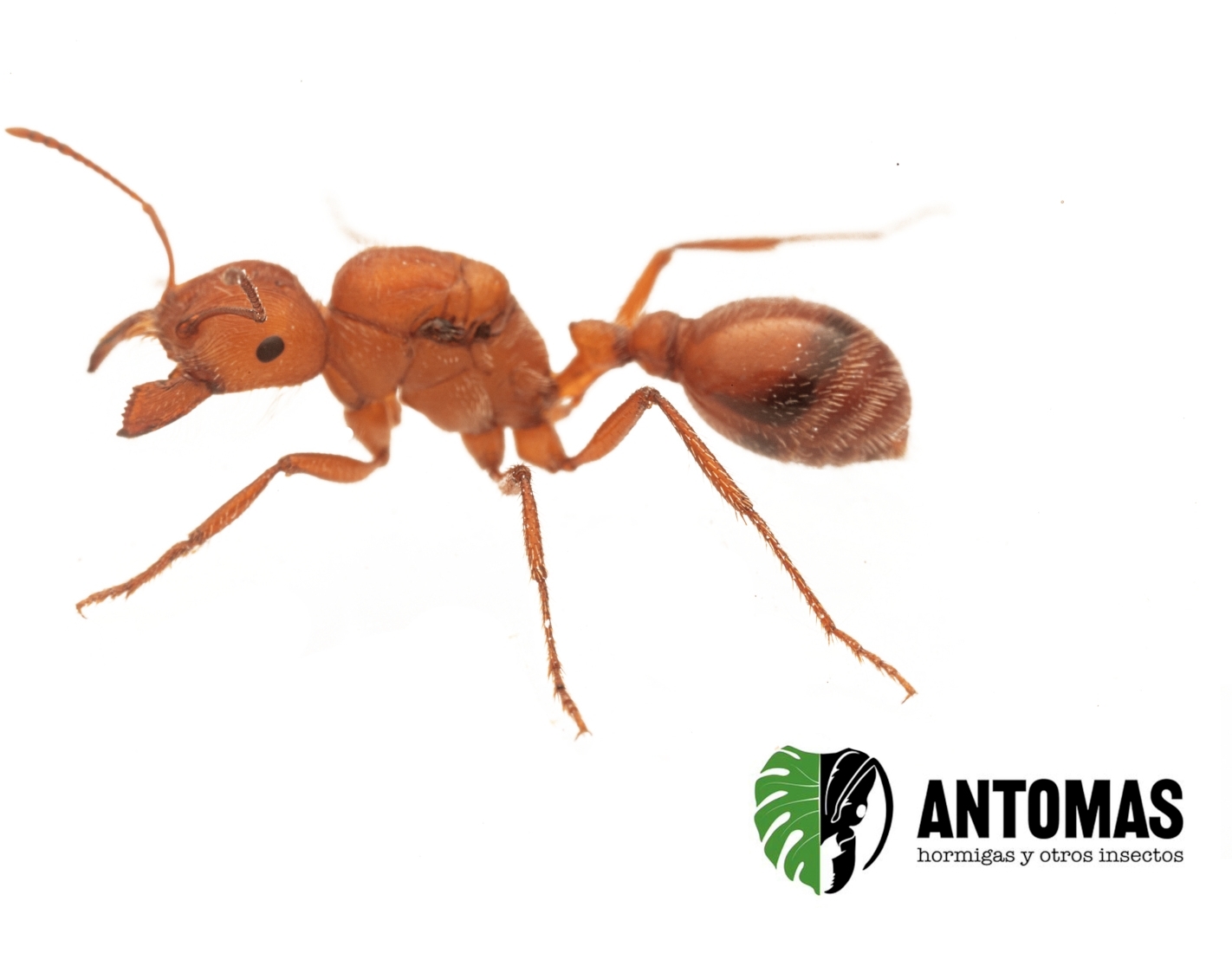
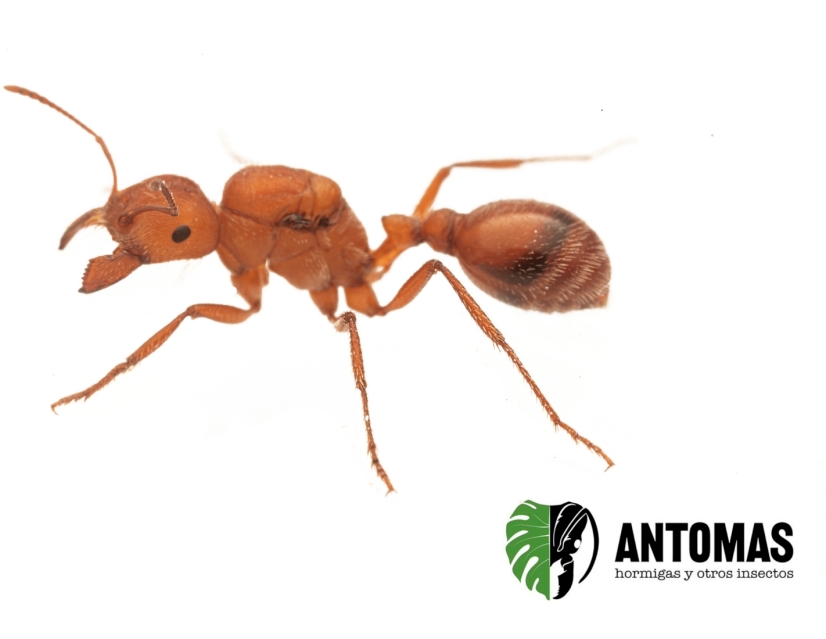
Pogonomyrmex maricopa – Maricopa Red Harvester Ant
BIOLOGY
Pogonomyrmex maricopa is a harvester ant native to the arid regions of the southwestern United States and northern Mexico. It occurs from California, Nevada, Utah, Arizona, New Mexico, Colorado and Texas to Baja California, Sonora, Chihuahua and Sinaloa. It is particularly associated with open desert and semi-arid environments, often on sandy, sandy-loam soils or even dunes.
Its activity revolves mainly around seed collection. Workers leave the nest to forage primarily on an individual basis, locate scattered seeds and return to the nest carrying them between their mandibles. Unlike some other North American harvester ants, it does not necessarily rely on large permanent foraging columns.
Under natural conditions, workers may travel considerable distances in search of resources, and studies conducted with Pogonomyrmex show that, for these ants, the time required to find a profitable seed may be more important than the actual energetic cost of walking to it. Seed availability, size and distribution also influence the number of foragers mobilised.
Natural nests can reach considerable dimensions. In certain populations, large cleared areas appear around the entrance, together with mounds of excavated soil and an extensive network of underground galleries that allows the colony to separate brood, seed stores and waste areas.
One of the most interesting adaptations has been documented in populations living on fine sand dunes. There, workers transport calcium carbonate-rich particles from deeper layers and construct a hardened surface crust around the nest. These structures can contain a very high proportion of calcium carbonate and help stabilise the nest against wind erosion.
It is a good example of the extent to which an ant colony can physically modify its environment.
Nuptial flights are closely associated with the summer rains of the North American monsoon. In Arizona, they usually occur during summer and frequently after significant rainfall. Morning flights have been documented, although the exact timing depends on location, temperature and weather conditions and should not be considered universal throughout the species’ range.
Colonies are normally monogynous, with a single reproductive queen.
Colony founding
From a physiological and natural-history perspective, Pogonomyrmex maricopa is considered a species with claustral colony founding.
Queens accumulate large body reserves before the nuptial flight and are capable of producing the first generation using these reserves without strictly needing to leave the nest to forage.
However, at Antomas we recommend treating founding queens in captivity using an assisted semiclaustral approach.
The distinction is important.
The fact that a queen is physiologically capable of producing a few first workers exclusively from her own reserves does not necessarily mean that this is the best protocol for establishing a strong colony in captivity. A founding queen that produces only a few nanitic workers may reach her first winter with a population that is too small and may subsequently have difficulty resuming growth the following spring.
For this reason, we recommend offering food from the earliest stages, allowing the queen to retain a greater proportion of her body reserves and encouraging a stronger first generation.
A large foraging area is not necessary. A small founding chamber connected to a mini foraging arena, or a system that allows food to be placed next to the entrance, is sufficient.
There is no need to overfeed either.
During this stage, dandelion seeds (Taraxacum officinale) work particularly well. Technically, what we call a seed is an achene, which is very small and light, and in Antomas’ experience it is one of the easiest foods for this species to process.
The difference compared with other seeds is enormous: even a founding queen can open dandelion achenes by herself.
Small amounts of protein can also be offered once larvae appear, for example a fruit fly or a very small piece of cockroach.
Therefore, for Antomas the correct definition is:
Biologically: claustral colony founding.
Antomas’ recommended protocol in captivity: assisted semiclaustral colony founding.
SIZE AND MORPHOLOGY
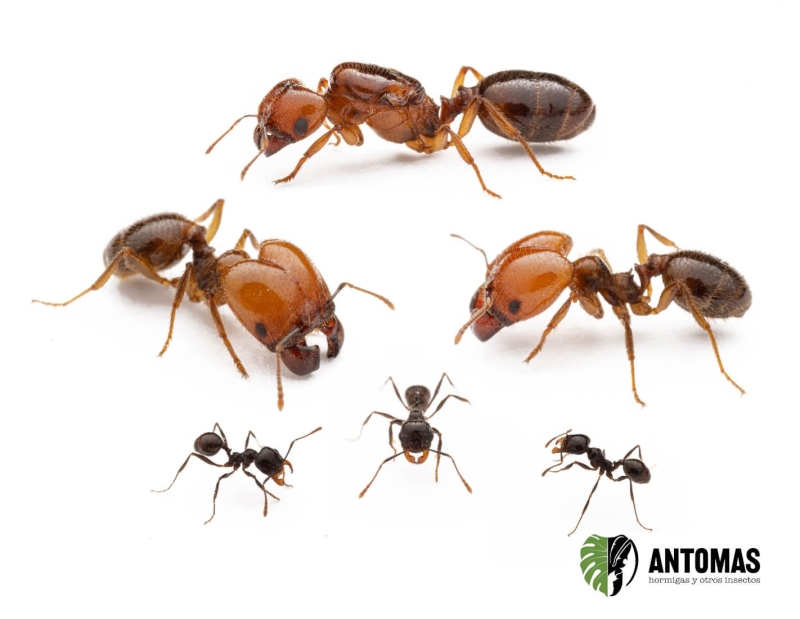
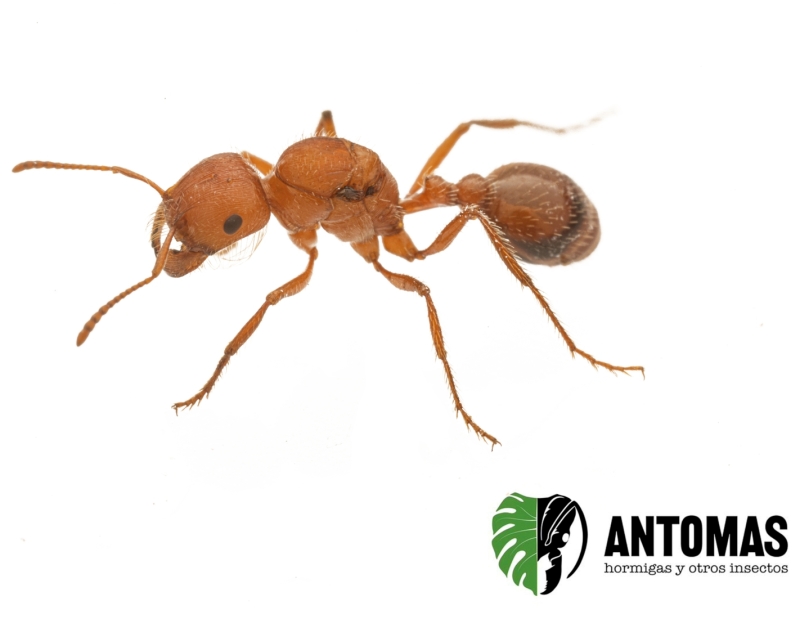
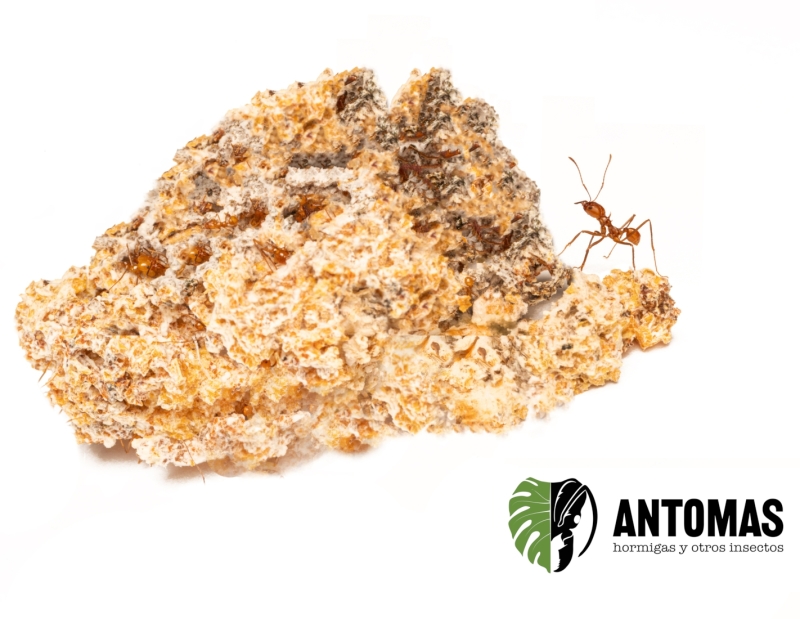
Pogonomyrmex maricopa is a robust harvester ant with predominantly red, orange-red or ferruginous colouration, hence the common name we use at Antomas: Maricopa Red Harvester Ant.
Workers measure approximately 6–9 mm, although there is geographical variation. The queen is usually approximately 9–11 mm.
It does not have a true soldier caste or distinctly differentiated large majors.
The head is robust and the mandibles are adapted for carrying, handling and processing seeds, although their ability to break extremely hard seed coats is considerably lower than what we observe in large European Messor species.
Beneath the head is the characteristic psammophore, a series of long setae forming a kind of “beard” that assists with excavation and the handling of small soil particles.
The sting is fully developed and is one of the most important characteristics of this species.
The pupae are naked.
KEEPING IN CAPTIVITY
Difficulty: 4/5 – Advanced
Pogonomyrmex maricopa is not particularly delicate in terms of environmental conditions. Its difficulty comes mainly from the combination of a highly effective sting, defensive behaviour, slow colony founding, and the need to correctly manage the dry seed-storage chambers and the hydrated brood area.
During the growing season, it does well at approximately 25–30 °C, heating only one part of the nest.
The extreme temperatures that a forager can withstand for a few minutes on the desert surface should not be confused with suitable conditions for keeping the queen and brood for weeks.
The colony must be able to choose between a warm area and other considerably cooler areas.
Humidity should likewise be localised.
Eggs and larvae need a moderately hydrated area, while the seed-storage chambers must remain dry. If seeds are permanently stored next to condensation or wet substrate, they will eventually germinate, ferment or develop mould.
Recommended ant nests
One of the advantages of P. maricopa is that it accepts practically any type of well-designed ant nest.
In Antomas’ experience, it does perfectly well in both Qbik Alpha and Qbik Wild systems.
The Alpha systems are particularly practical for observing the queen, monitoring the brood, locating the seed-storage chambers and maintaining a very clear separation between humid and dry chambers.
The Wild systems allow for a much more naturalistic setup and give the colony the opportunity to excavate, transport substrate and partially modify the structure of the nest.
We do not consider either system biologically superior to the other for this species.
The choice mainly depends on the type of setup preferred by the keeper.
For small colonies, we should use modules appropriate to the number of workers. There is no point in placing a queen or a mini-colony in an enormous ant nest.
As the colony grows, additional modules can be connected.
A small amount of sand, fine gravel or stones can be added to the foraging area to observe natural substrate-handling behaviours.
Feeding
The diet should be based primarily on small, relatively soft or previously cracked seeds, supplemented with animal protein when brood is present.
There is an important difference here compared with European Messor.
Although P. maricopa is a true harvester ant, it does not have the same mandibular power to break extremely hard seeds as a developed colony of Messor barbarus, Messor capitatus or other large Messor species.
We should not interpret “granivorous” as meaning “capable of opening any seed”.
At Antomas, we recommend prioritising small seeds with a coat that is relatively easy to break.
Among them, dandelion (Taraxacum officinale) stands out in particular and, in our experience, is one of the favourite seeds of P. maricopa.
What we call a dandelion seed is actually a very small and lightweight achene. There is no universal hardness index that would allow us to assign it a useful numerical value for ant keeping, but in practice its resistance is low enough for even founding queens themselves to open and make use of it.
For this reason, it is one of our first choices for founding queens and mini-colonies.
Other small seeds that also work well include:
- poppy;
- amaranth;
- small millet;
- small grass seeds;
- mixtures of small wild seeds.
For larger seeds or those with a hard coat, we recommend cracking or crushing them beforehand.
There is no need to grind them into powder. Simply breaking the outer coat or splitting the grain is enough to allow the workers to access the inside.
This recommendation is especially important for founding queens and colonies with only a few nanitic workers.
As the population increases and larger workers appear, their processing ability improves, but even an adult colony still has less ability to break certain hard grains than a large Messor colony.
We do not recommend moistening seeds to soften them.
Moisture encourages germination and increases the risk of fungal growth inside the seed-storage chambers. It is much better to mechanically crack the seed and offer it dry.
Animal protein is supplementary but important while brood is developing. Fruit flies, flies, small crickets, cockroaches, mealworms and other safely bred feeder insects can be used.
The amount should approximately correspond to the number of larvae present.
Clean water should always be available.
Sugary liquids can be offered occasionally, but they do not form the basis of the diet.
Pogonomyrmex maricopa — Video of Pogonomyrmex maricopa, a North American red harvester ant, showing its behaviour, granivorous diet and general characteristics in captivity.
Diapause
The species experiences genuine annual seasonality, but its wide distribution means that there is no single winter regime applicable to all populations.
A colony originating from the warm lowlands of Arizona does not experience the same conditions as one from inland regions of New Mexico, Utah or Colorado.
There is insufficient evidence to establish an obligatory physiological diapause with a single temperature threshold for the entire species.
For lines originating from Arizona or northern Mexico, we recommend a slowdown of approximately 8–10 weeks at around 16–20 °C, gradually removing the heat source.
During this period, the amount of protein and food offered should be clearly reduced, but water must always remain available.
Populations originating from inland and colder regions may justify lower temperatures, although we do not recommend directly reproducing the outdoor night-time minimum temperatures inside the ant nest.
The origin of the line is therefore important.
Furthermore, one of the reasons why we recommend feeding queens during colony founding despite their claustral capacity is to ensure that the colony reaches this first slowdown with a sufficient population.
A colony that enters winter with very few nanitic workers has very little margin when it becomes active again in spring.
A well-fed founding colony during its first year has a much better chance of facing this restart with enough workers to care for the new brood, forage for food and maintain the nest.
There is insufficient solid information to state whether P. maricopa goes through this phase predominantly with eggs, larvae, pupae or completely without brood.
We therefore do not assign a specific brood stage as an established fact.
Behaviour and safety
The venom is one of the most interesting aspects of Pogonomyrmex maricopa.
In classic toxicological assays, its venom showed an intravenous LD₅₀ in mice of approximately 0.12 mg/kg, one of the highest toxicities per unit of mass published for an insect venom.
This figure needs to be explained correctly.
It does not mean that we can extrapolate this value directly to a person or use it to calculate a specific number of stings that would be lethal to a human.
It comes from an experiment conducted in mice using a specific experimental route of administration and is mainly useful for comparing the toxicological activity of different venoms.
For the keeper, the practical conclusion is much simpler: P. maricopa has a highly effective sting and an intensely painful sting.
The venom contains different bioactive peptides capable of altering the activity of ion channels present in sensory neurons, which contributes to the pain and inflammatory reaction caused by the sting.
This defence makes ecological sense in an ant that stores large quantities of seeds and represents a potential food source for desert vertebrates.
Some horned lizards of the genus Phrynosoma, specialised predators of Pogonomyrmex, have even evolved an extraordinary resistance to their venoms.
In captivity, they should not be handled directly by hand.
We recommend long tweezers, a secure lid and a reliable escape-proof barrier.
A large colony can rapidly mobilise numerous workers when the nest entrance is disturbed, so it is preferable to design the setup in such a way that feeding, waste removal and maintenance can be carried out without placing your hands among the foragers.
- Dificultad
- Experienced