Difficulty: 4/5 – Advanced
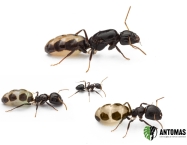
An arboreal carpenter ant from South-East Asia, from a group whose soldiers have a head truncated like a plug, so similar to that of the “doorkeeper” ants that several of its relatives were once classified as such. Colonies with queen, 30–50 workers and brood. Fairly dry modular nest, 24–28 °C, moderate humidity with a gradient, sugar always available and varied protein. No diapause. A climber: paraffin oil barrier.
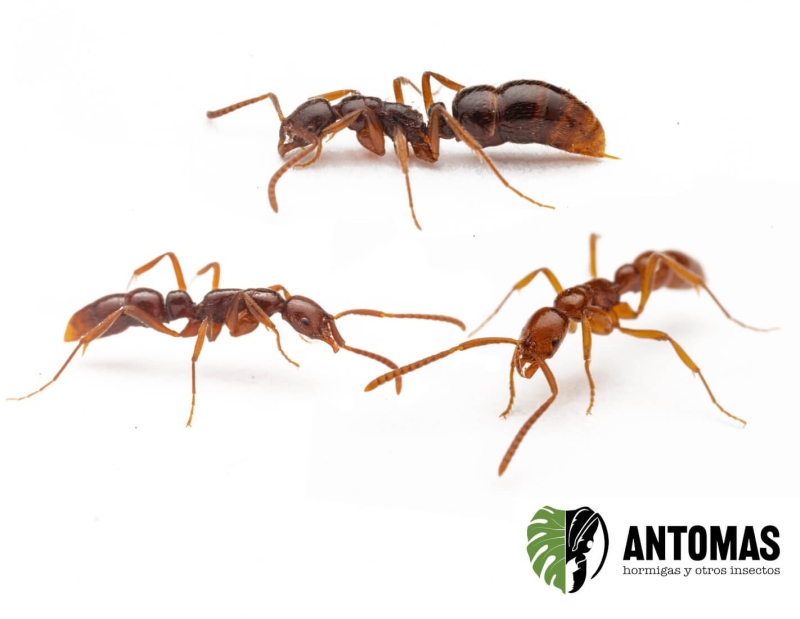
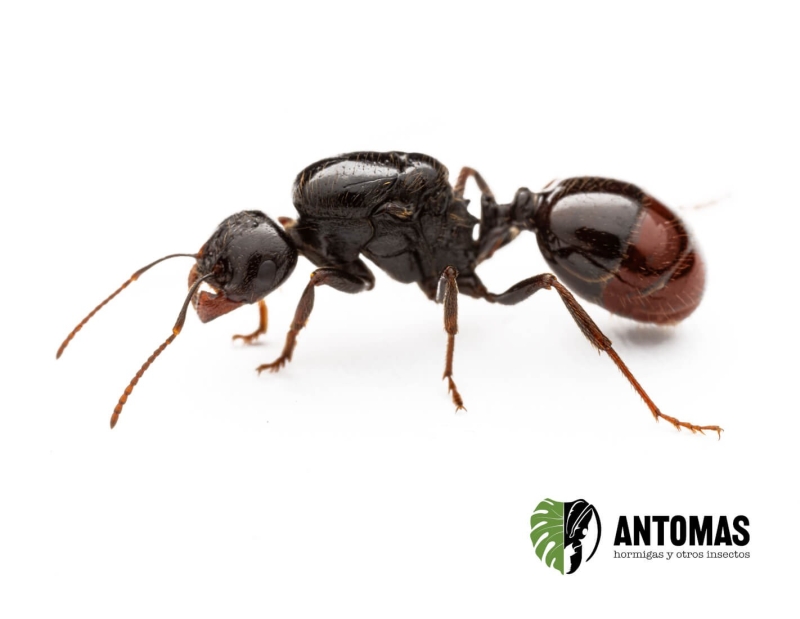
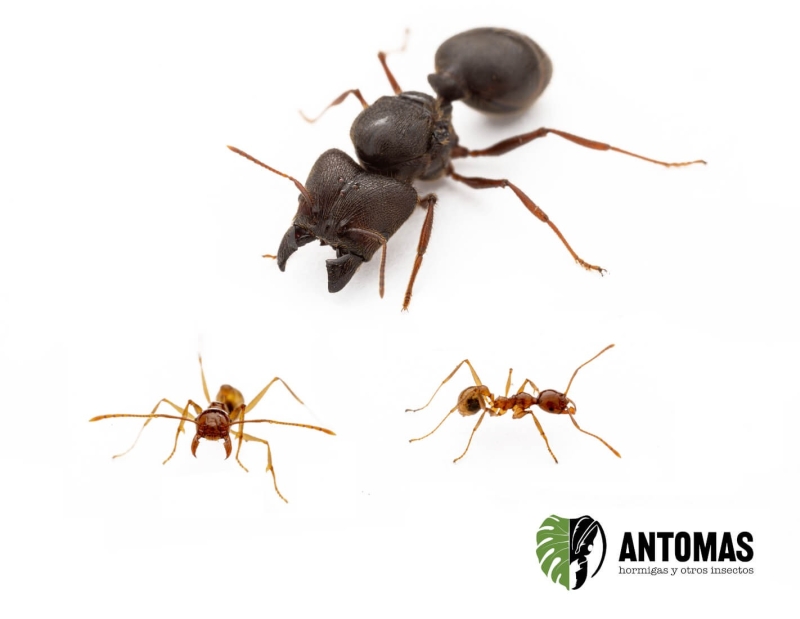
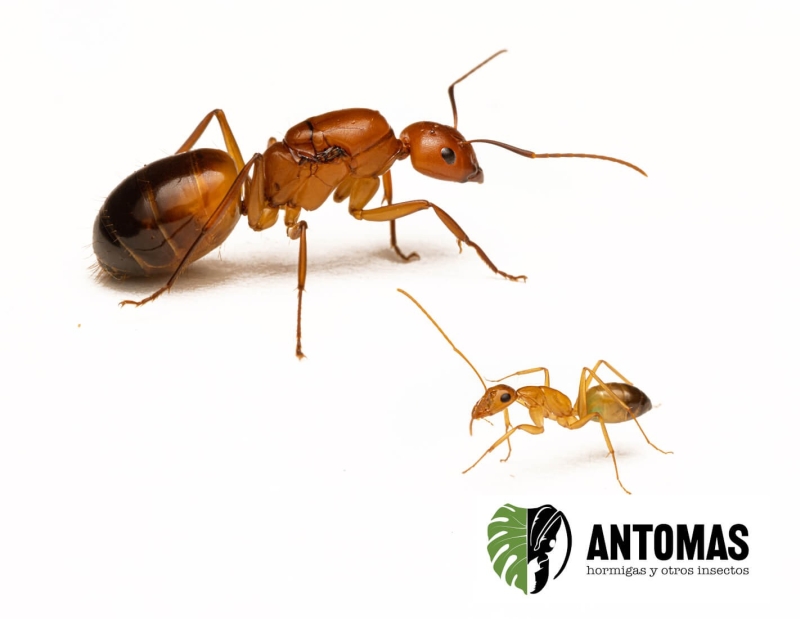
Camponotus bellus Forel, 1908 is a carpenter ant from the tropical forests of South-East Asia that lives in the trees: its colonies have been found inside dry bamboo canes and hollow branches. Its name means “pretty” in Latin, and it is no whim: it has a matt body covered in erect hairs and a caste system with workers of several sizes, in which the largest, the soldiers, carry an elongated head cut off at the front, made for plugging the entrance of a narrow nest.
It is a little-studied species. What science knows about it comes mainly from descriptions from the early 20th century and from a 2021 revision that brought order to its group, the Camponotus that for decades were confused with another genus, Colobopsis. In this care sheet we always separate what is documented for the species, what is known about its group and its genus, and Antomas’s experience with tropical arboreal Camponotus. It is an ant for keepers who already have some experience and want a different species, one you will not find in every collection.
Biology
“Pretty” by necessity: an ant that had to change its name
It was described by the great Swiss myrmecologist Auguste Forel in 1907, from a single soldier collected by the Hungarian naturalist Lajos Biró on Ambon, a small island in the Moluccas, Indonesia. He named it Camponotus ornatus, “the adorned one”. But there was a problem: the name ornatus had already been used by the Italian Carlo Emery for another Camponotus, and in zoology two species of the same genus cannot share a name. So, the following year, Forel gave it a replacement name: bellus, “pretty”. From “adorned” to “pretty”: the compliment survived.
That soldier from Ambon, the reference specimen of the species, is kept in the Natural History Museum of Geneva, and today it can be seen photographed in the ant databases. The other castes came later: Forel described the queen in 1912, and the small worker and the male were described in 1916 by the German Hugo Viehmeyer, from ants that the collector H. Overbeck had gathered in Singapore between 1912 and 1914.
Soldiers with plug-shaped heads
C. bellus belongs to the subgenus Myrmamblys, a group of Camponotus found mainly in the Indo-Australian region. According to the revision by Philip Ward and Brendon Boudinot (2021), its workers are small to medium-sized and show very marked polymorphism: small workers, the minors, live in the same colony as much larger workers, the majors or soldiers, with intermediate sizes in between. This is what Edward O. Wilson described in 1953 as a polymorphism in which the head grows faster than the rest of the body: the larger the worker, the more disproportionate its head. And, according to the idea of “mosaic castes” put forward by Molet, Wheeler and Peeters (2012), the soldiers of many ants are new combinations of developmental pieces from other castes.
The difference shows above all in the head:
- Minors: head proportionally broader, with rounded sides. They are the ones that go out foraging and look after the brood.
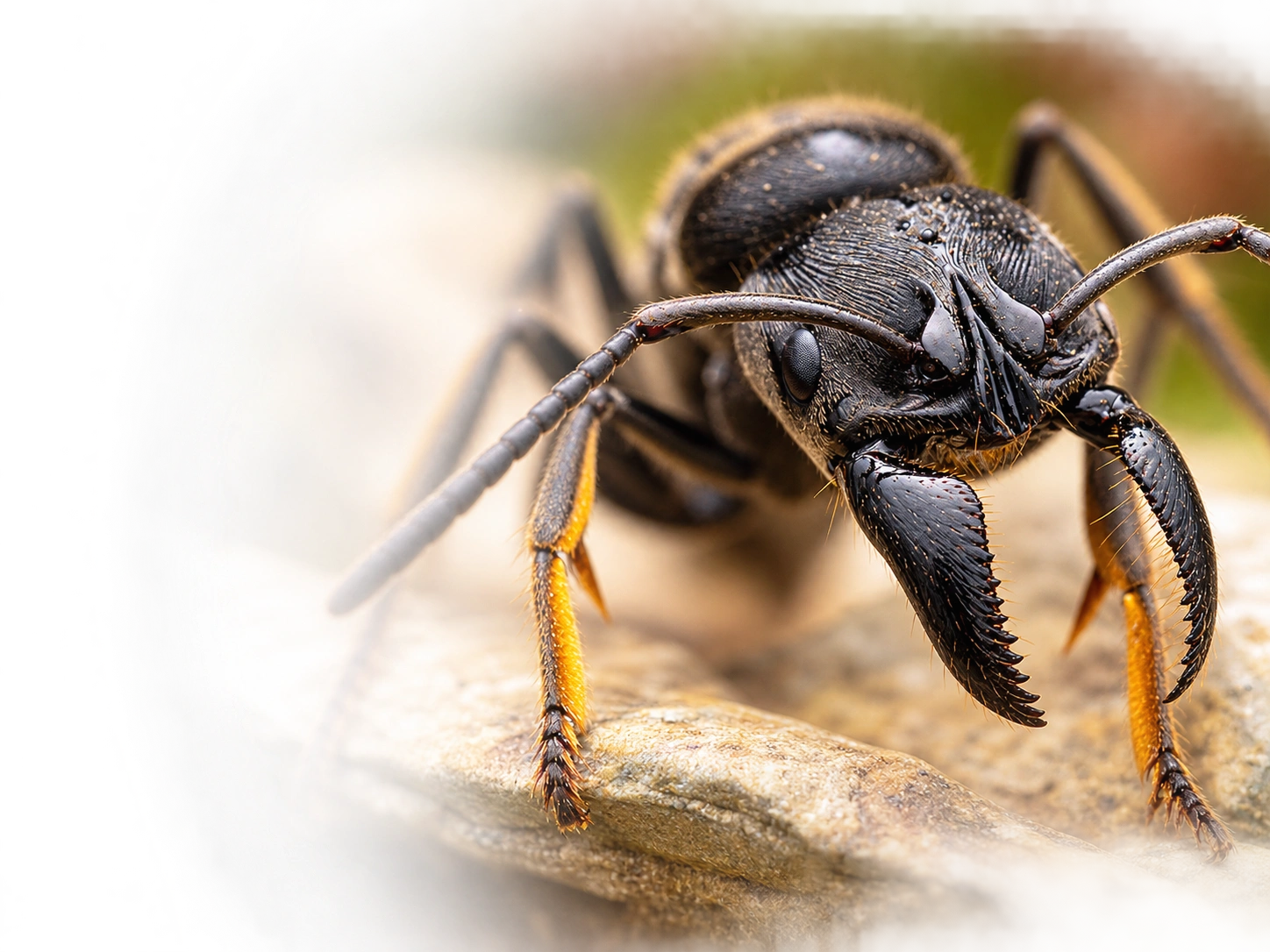
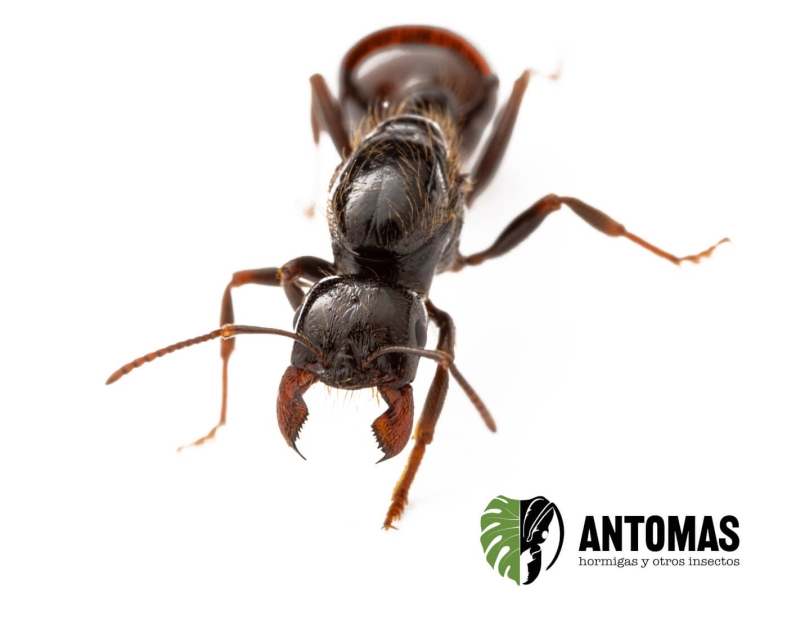
- Soldiers: head longer than broad and often obliquely truncated: the front part, including the clypeus (the “plate” above the mandibles), forms a cut-off, almost flat surface.
In the species group to which C. bellus belongs, the C. reticulatus group, the soldiers have a partially phragmotic head. Phragmosis is the use of one’s own body as a door: the soldier positions itself at the nest entrance and closes it with its head, like a living plug. For an ant that lives inside a bamboo cane or a hollow branch with a small entrance, it is the best defence possible: a single soldier is enough to block the way to ants of other species and to other intruders.
Cousins mistaken for the “doorkeeper” ants
The truncated head of its soldiers has given its group more than one taxonomic headache. That trait is the hallmark of Colobopsis, the “doorkeeper” ants, whose soldiers have a head cut off like a perfect plug. It is the genus of the famous “exploding ants” of South-East Asia, such as Colobopsis explodens, described in 2018 from Borneo, whose workers burst themselves open to drench the enemy in a sticky secretion while the soldiers plug the entrances. C. bellus does not explode: it is a Camponotus in its own right. For much of the 20th century, Colobopsis was a subgenus of Camponotus, and in 2016 Ward, Bonnie Blaimer and Brian Fisher restored it to the rank of a genus of its own, backed by genetics.
Separating the two genera created a muddle. Some species of the C. reticulatus group, that of C. bellus, look very much like Colobopsis because of their small size, the shape of the rear of the thorax and those soldiers with cut-off heads. So much so that four species that had been classified as Colobopsis turned out to be relatives of C. bellus: Ward and Boudinot returned them to Camponotus in 2021, by looking at more reliable details such as the distance between the antennal insertions, the width of the clypeus or the shape of the propodeum. To separate the two genera they also proposed characters of the male genitalia. Genetic studies had already confirmed that the C. reticulatus group is Camponotus in its own right.
The authors explain it in one word: homoplasy, that is, the separate evolution of similar traits. Living in narrow tree cavities favours, again and again, the appearance of soldiers with plug-shaped heads, even when the species are not close relatives. It is a case of convergent evolution that you can see in your own formicarium: compare the head of a C. bellus soldier with that of its little sisters.
Matt, hairy and with colourful cousins
On re-examining the type soldier from Ambon, Ward and Boudinot highlighted two traits of C. bellus: a matt integument, without shine, and abundant erect pilosity on the thorax, including its front part, the pronotum. These are precisely the traits that set it apart from two forms that for a century were regarded as its subspecies and that in 2021 became species in their own right:
- C. adustus, from Singapore: shiny and almost without erect hairs on the thorax. Viehmeyer had already noted in 1916 that C. bellus and C. adustus live side by side in Singapore without mixing, good evidence that they are distinct species.
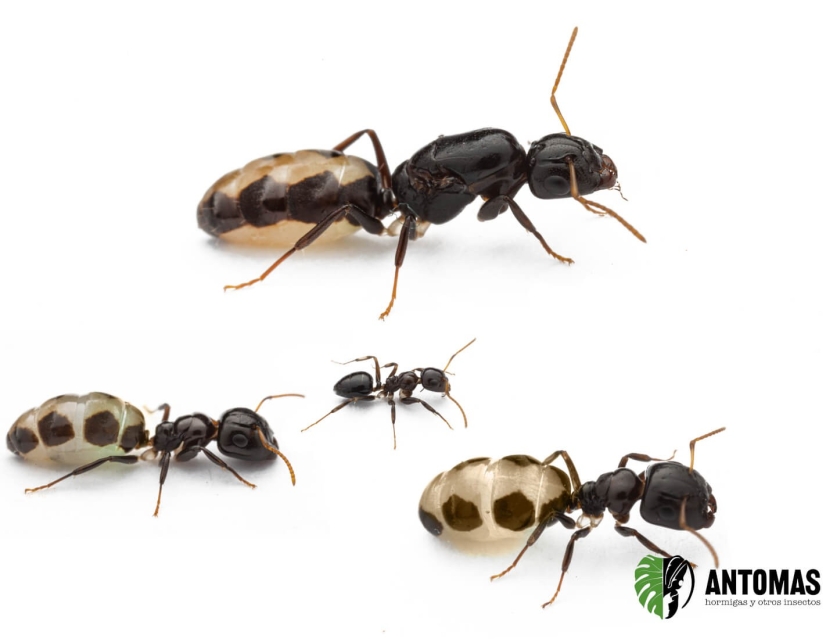
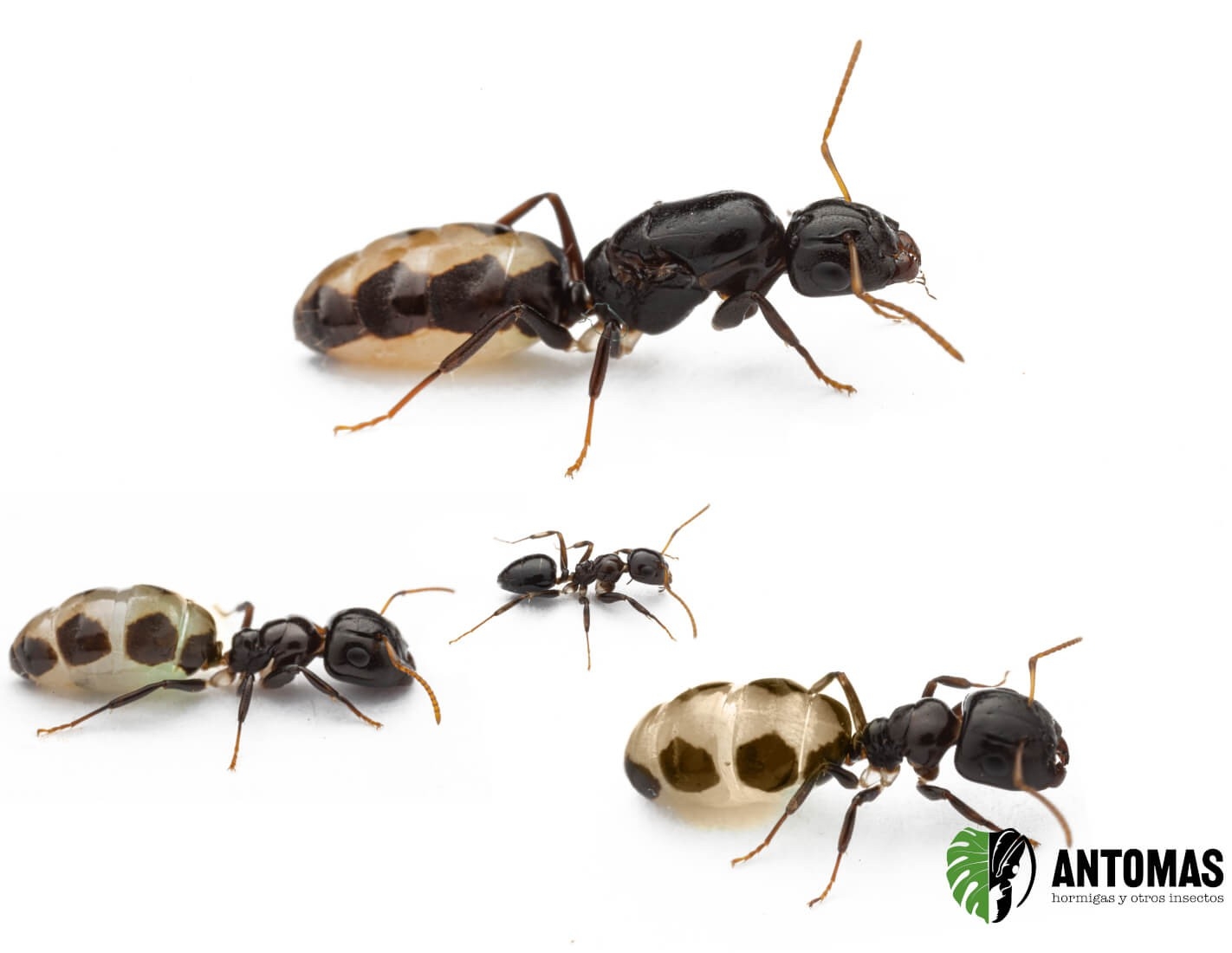
- C. leucodiscus, from Borneo and the Philippines: also shiny and with a striking black-and-white pattern on the gaster.
The authors acknowledge that this group contains a “bewildering diversity of colour forms” whose taxonomic status is unclear, and that a full revision is needed. In other words, C. bellus and its cousins are still a puzzle for specialists: another reason to watch them closely.
A life inside bamboo
The little that is known about its life in the wild comes from Overbeck’s observations in Singapore, recorded by Viehmeyer and summarised in the checklist of the ants of Singapore by Matthew Hamer and colleagues (2022): the colonies of C. bellus were found in a garden, inside dry bamboo and in hollow tree branches. It is an arboreal ant that does not dig, but occupies ready-made cavities in wood or in canes, where the entrance is small and easy to defend.
This way of life has consequences for the keeper. Its natural nests are dry inside, with no damp soil, although the air of the tropical forest is humid. That is why at Antomas we keep it in fairly dry nests, with a somewhat damper area that the colony can choose.
From the Moluccas to Singapore
Its reliably documented range is short: Indonesia (Ambon, in the Moluccas, the type locality) and Singapore. Old records of “C. bellus” from Borneo and the Philippines referred to C. leucodiscus, which is now a separate species. It most likely lives on more islands of the Malay Archipelago, but with such a poorly known group there are no reliable data to say so.
Its climate. Both Ambon and Singapore have an equatorial climate: warm all year round, with averages of about 26–28 °C, abundant rain in every season and high air humidity. There is no winter or cold season. That is why C. bellus has no diapause, and at home it is comfortable at 24–28 °C.
Formic acid, a bacterium and a clean crop
Like all Camponotus, it has no sting: it defends itself by biting and spraying formic acid from the acidopore, a small nozzle at the tip of the gaster. In 2020, a German team showed that the ants of its subfamily, the formicines, swallow their own poison: during grooming they bring the tip of the gaster to their mouth and take a few drops of acid, which keep the crop very acidic, the “social stomach” where they store the food they share mouth to mouth. In this way they filter out the microbes that come in with the food. And in 2026 it was discovered that the venom of several Camponotus also contains peptides that inhibit fungi and help protect the brood. These are traits of the genus; C. bellus was not among the species studied.
It also carries an invisible partner. All ants of the tribe Camponotini harbour a bacterium, Blochmannia, which lives in special cells of the gut and passes from the queen to her daughters through the eggs. It makes essential amino acids that the ant cannot produce and allows it to live largely on sugary liquids, which are poor in protein. According to the most widely accepted hypothesis, the tribe acquired the bacterium by tending sap-sucking insects. But note: it is no excuse to skimp on protein; the larvae need insects to grow.
A queen for many years
There are no studies of the structure of its colonies or of how many workers they reach. Like the vast majority of Camponotus, its founding is claustral: after the nuptial flight, the queen shuts herself away in a cavity and raises her first workers without going out to feed, using the reserves of her own body. The first workers are small minors; the soldiers come later, once the colony has a certain size and resources.
Nor is it known how long a queen of this species lives, but Camponotus queens are among the longest-lived insects. The genus holds a famous record: Caryl and Elizabeth Haskins kept in their laboratory a queen of an Australian Camponotus that lived 23.2 years. It is another species, but it gives an idea: a C. bellus colony is a project for many years.
Size and morphology
A small to medium-sized carpenter ant, polymorphic and without a sting. The scientific references are the original descriptions by Forel and Viehmeyer and the revision by Ward and Boudinot (2021).
- Integument. Matt, without shine, with abundant erect hairs on the thorax, including the pronotum. This is the trait that distinguishes it from its shiny relatives, such as C. adustus.
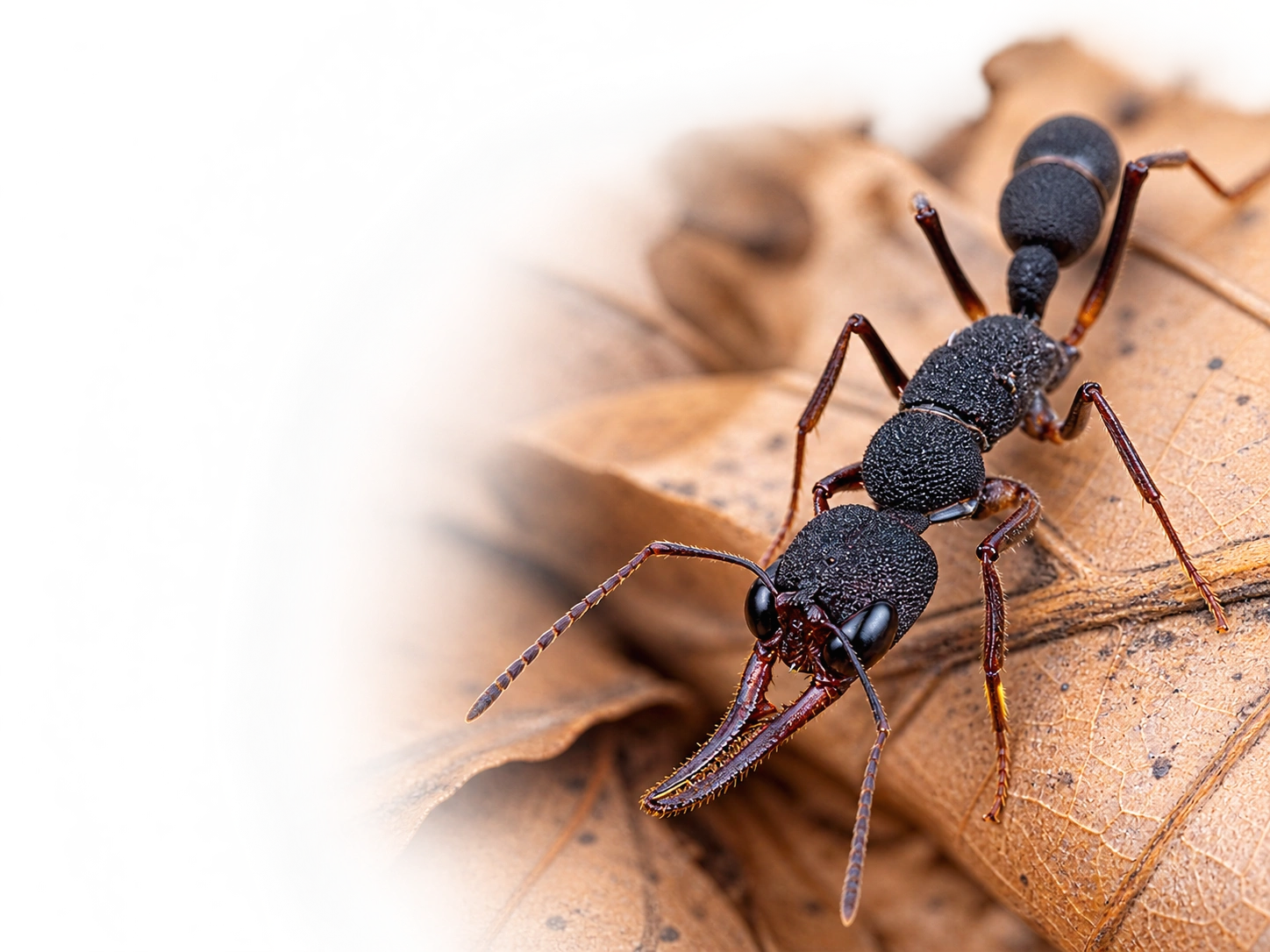
- Minors. Head proportionally broad with rounded sides, long antennae. They are the ones you see most in the foraging area.
- Soldiers (majors). Head longer than broad and cut off obliquely at the front, with the clypeus included in that surface: a partial “plug” head, designed to close the nest entrance.
- Thorax. As in the whole of its group, the dorsum of the thorax does not narrow in front of the propodeum, the last segment, and in profile the propodeum is saddle-shaped, with the upper and rear faces slightly concave.
- Queen. Larger than the workers, with a thorax developed for flight, large eyes and a broad gaster.
Approximate measurements
We have not found published lengths for the castes of C. bellus in accessible scientific sources, and at Antomas we do not quote figures from shops. What is documented is that the workers of its subgenus, Myrmamblys, are small to medium-sized, smaller than the large ground-dwelling Camponotus, and that the size difference between minors and soldiers is very marked. In a young colony, the first workers are small minors, and the average size rises with each generation as the colony grows and is well fed.
Care in captivity
Difficulty: 4/5 – Advanced
At Antomas we consider it a species for keepers with some experience. It is not delicate day to day, but it asks for more than a beginner’s Camponotus:
- Stable warmth. It is equatorial and has no diapause: it needs 24–28 °C all year round, and cold brings it to a halt.
- Well-managed humidity. A fairly dry nest, with a somewhat damp area for the colony to choose, and air that is never parched.
- Little information. There are very few published data and almost no experience shared by other keepers: you have to observe and adjust.
- Good barriers. It is arboreal, climbs with ease and the minors are small and fast.
And it is worth it: it is an uncommon species in collections, with a very striking caste system and soldiers that illustrate convergent evolution like few others.
Recommended parameters
- Nest temperature: 24–28 °C all year round, with a slightly warmer area if you like. This matches the equatorial climate of its range. Below about 22 °C it slows down a great deal.
- Foraging area: at a warm room temperature, 22–28 °C.
- Humidity: moderate, with a gradient: the nest fairly dry and one part somewhat damp (see “Humidity: dry nest, tropical air”).
- Water: always available, in a test tube with water and cotton wool in the foraging area.
- Light: a dark area in the nest and a lit foraging area, with a normal day–night cycle.
- Diapause: none.
For heat, a heating cable or mat on one side of the nest, with a thermostat, is better than a source that warms the whole formicarium evenly. That way the colony chooses its temperature. Avoid direct sunlight and radiators.
Humidity: dry nest, tropical air
In the wild it lives inside dry bamboo and hollow branches: cavities that are dry inside, in a forest with high air humidity. At Antomas we translate this as follows: a fairly dry nest, with a somewhat damp area where the colony can move the brood if it needs to, and water always available to drink. The colony is the one that chooses.
- Signs of too much humidity: condensation on the walls, mould or mites.
- Signs of too little: the brood piled up next to the damp area or workers crowding the water tube.
Recommended formicarium
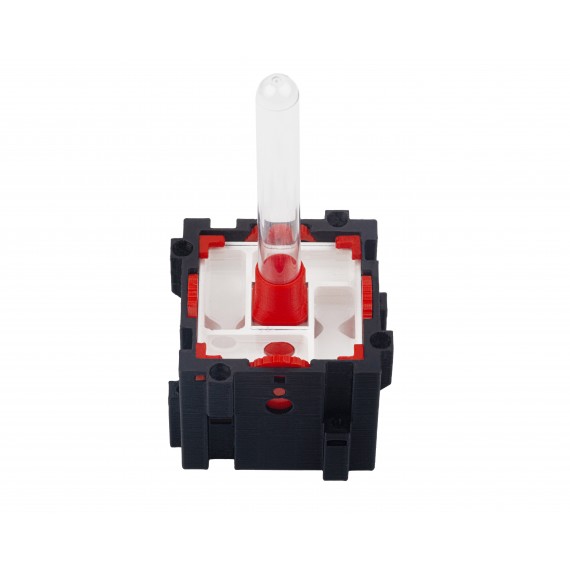
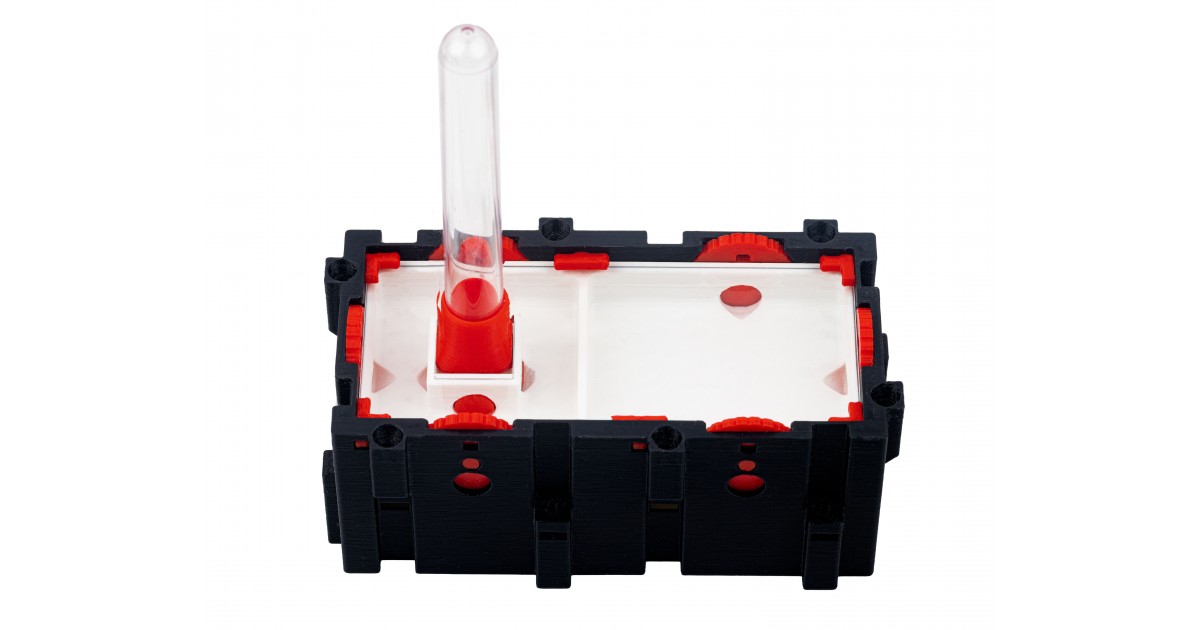
For an ant that nests in bamboo and hollow branches, at Antomas we recommend the modular formicaria by Anthouse from the Alpha range, kept fairly dry: the QBIK ONE to start with and the QBIK DUO when the colony grows. Being modular, you can add modules as the colony needs them, and humidity is controlled with a localised damp spot:
If you prefer a plaster nest with very controlled humidity, a good alternative is the Qbik Wild Duo P 2C Hybrid: a lower reservoir, separate from the galleries, passes humidity through a mesh, so you can keep one chamber damp and the other dry:
Do not get ahead of yourself with the size: in a huge nest for a colony of a few dozen workers, the spare chambers end up as rubbish dumps. Complete the set-up with these details:
- Escape barrier: a strip of paraffin oil or liquid petroleum jelly on the upper part of the foraging-area walls, and a well-fitting lid (see “Escapes and barriers”).
- A foraging area with vertical elements: twigs, bark or a piece of dry bamboo cane, so they can climb and explore as in the trees, without anything acting as a bridge to the barrier.
- Water always available, in a test tube with water and cotton wool.
- A feeder for sugary liquids, never on cotton wool (see “Feeding”).
- Gentle heat on one side of the nest, away from the feeder, with a thermostat.
Arrival, the first weeks and moving house
At Antomas we sell C. bellus as an established colony: queen with 30–50 workers and brood, in a test tube. The most delicate phase of founding, when the queen is alone, is already over, and the colony has plenty of workers to tend the brood.
- On arrival, let it rest in a quiet, dark place at 24–28 °C, and check that the tube has water. Do not move it into the nest as soon as it arrives.
- Food from day one: a drop of sugary liquid in a feeder or on a small piece of aluminium foil, never on the cotton wool, and a small piece of insect a couple of times a week. Remove the leftovers the next day.
- Patience: in the first weeks the colony settles in. The normal thing is to see the brood grow and, later on, the first soldiers appear.
Moving house. When it is time to move it into the formicarium, at Antomas we do it by tipping: we open the tube inside the foraging area, next to the nest entrance, and gently tip out the queen, the workers and the brood, helping the stragglers with a soft brush. Three tips:
- Prepare everything beforehand: the formicarium assembled, with the barrier in place and the water connected.
- Work over a tray, in case a worker climbs up the tube or the tools. The minors are small and very agile.
- Keep the nest area dark so that they occupy it straight away. The workers will gather the brood and carry it inside.
If you ever need to move the colony to a new formicarium, use the same method.
Feeding
Sugary liquids, always available. Like so many arboreal Camponotus, it lives largely on honeydew and nectar, and at home it should never run out of sugar. Vary the sugars: at Antomas we recommend Blue Sugar nectar by Anthouse 4–5 times a week and another sugary liquid or nectar 1–2 times a week. You can also add some protein to the nectar. Always offer them in a feeder and never on cotton wool, because cotton wool goes mouldy and spoils the liquid very quickly. Use a traditional or home-made feeder, where the drop stays “spread out” and accessible, and replace it before it ferments.
Protein: the more, the better. To raise workers, and above all soldiers, the colony needs a lot of protein. This is the Antomas philosophy: if you do daily maintenance and remove the leftovers, it is better to overfeed, because the colony senses that it has more resources and grows faster and in greater numbers. If you will not be able to clean often, better not to overfeed: leftover food rots and brings mould and mites.
- Change the type of insect from one week to the next, so they do not always eat the same thing: crickets, red runner roaches or dubia roaches, flies or chopped mealworms.
- Small, soft prey: Thermobia domestica is perfect for an ant of this size: small, soft and easy to breed at home.
- Chopped or freshly killed prey is the most practical; open the abdomen of large insects so the minors can reach the soft parts.
- Fresh and from a trusted source. Freeze-dried protein works as a supplement, but fresh is better. Buy insects from a reliable supplier: those treated with insecticides can kill the colony.
No diapause
C. bellus has no diapause: there is no cold season in its equatorial range, and it should stay active all year round. If your home gets cold in winter, keep the nest warm with the cable or mat and the thermostat. At Antomas we recommend not going below about 22 °C for long periods: with more cold the colony stops, the brood stalls and a small colony can be lost.
Behaviour in captivity
A colony that shares out the work. No one has yet studied the division of labour in this species, but other polymorphic Camponotus show the same pattern, and its anatomy points in the same direction: the minors go out foraging, explore and look after the brood; the soldiers stay closer to the nest, guard the entrances and help to cut up prey. If you see a soldier planted in a narrow entrance, head first, you are watching phragmosis live.
A climber. It is a tree ant: it likes to climb any vertical element in the foraging area, and twigs and bark keep it busy and make it more visible.
Watch without fear. At Antomas we believe ants are there to be enjoyed, observed and learnt from, not kept hidden away. Just leave them their dark area in the nest and a lit foraging area, and observe them gently, intervening and stressing them as little as possible. With a magnifying glass you will clearly see their erect hairs and can compare the cut-off head of a soldier with that of a minor.
Warning signs:
- Brood that stalls or disappears: almost always a lack of protein or warmth.
- A colony that stays still and does not come out for days: check the temperature.
- Condensation on the walls or mould: too much humidity or forgotten leftovers.
- Many workers idle in the foraging area, with no room inside: time to expand.
Escapes and barriers
Like almost all Camponotus, and all the more so as an arboreal species, it climbs smooth surfaces, and the small minors take advantage of any gap or badly fitting lid. The barrier we use at Antomas is oil:
- A strip of paraffin oil or liquid petroleum jelly on the upper part of the foraging-area walls, thin and continuous. Renew it when it collects dust or debris.
- A well-fitting lid, with fine-mesh ventilation, as a second line.
- No gaps: check connections, stoppers and tubes, especially as the colony grows.
- Nothing that acts as a bridge: make sure the twigs and bark in the foraging area do not reach or rest near the barrier.
- Care when opening: open only as much as needed, work calmly and close up when you finish.
Handling and safety
They do not sting: they have no sting. They can bite and spray formic acid, but they are small to medium-sized ants and pose no danger to people. Handle them with entomological tools, such as a soft brush or soft forceps, never with your hands, and take special care with the queen: if she is lost, the colony has no replacement. Do not merge different colonies or keep it with other species. It is an exotic species: it must never be released.
What not to do
- Let it get cold or put it through a diapause: it is equatorial.
- Waterlog the nest or, conversely, let it run short of drinking water.
- Move a small colony into a nest that is too big for its size.
- Put sugary liquids on cotton wool, or let them run out.
- Always give them the same insect, or leave leftovers uncleaned.
- Neglect the barriers: gaps, loose connections, oil that is not renewed or branches that act as bridges.
- Try to add another queen or merge different colonies.
- Handle them with your hands.
Scientific sources
This care sheet has been prepared from the scientific literature on Camponotus bellus, its group and its genus (including the original descriptions by Forel, 1907, 1908 and 1912, and Viehmeyer, 1916), from climate data for its range and from Antomas’s experience with other tropical arboreal Camponotus. Main references:
- Ward, P. S. & Boudinot, B. E. (2021). Grappling with homoplasy: taxonomic refinements and reassignments in the ant genera Camponotus and Colobopsis (Hymenoptera: Formicidae). Arthropod Systematics & Phylogeny 79: 37–56. doi:10.3897/asp.79.e66978
- Hamer, M. T., Lee, J. H. C., Tse, C. Y. L., Silva, T. S. R. & Guénard, B. (2022). Remarkable diversity in a little red dot: a comprehensive checklist of known ant species in Singapore (Hymenoptera: Formicidae) with notes on ecology and taxonomy. Asian Myrmecology 15: e015006. doi:10.20362/am.015006
- Ward, P. S., Blaimer, B. B. & Fisher, B. L. (2016). A revised phylogenetic classification of the ant subfamily Formicinae (Hymenoptera: Formicidae), with resurrection of the genera Colobopsis and Dinomyrmex. Zootaxa 4072: 343–357. doi:10.11646/zootaxa.4072.3.4
- Blaimer, B. B., Brady, S. G., Schultz, T. R., Lloyd, M. W., Fisher, B. L. & Ward, P. S. (2015). Phylogenomic methods outperform traditional multi-locus approaches in resolving deep evolutionary history: a case study of formicine ants. BMC Evolutionary Biology 15: 271. doi:10.1186/s12862-015-0552-5
- Laciny, A., Zettel, H., Kopchinskiy, A. et al. (2018). Colobopsis explodens sp. n., model species for studies on «exploding ants» (Hymenoptera, Formicidae), with biological notes and first illustrations of males of the Colobopsis cylindrica group. ZooKeys 751: 1–40. doi:10.3897/zookeys.751.22661
- Wilson, E. O. (1953). The origin and evolution of polymorphism in ants. The Quarterly Review of Biology 28: 136–156. doi:10.1086/399512
- Molet, M., Wheeler, D. E. & Peeters, C. (2012). Evolution of novel mosaic castes in ants: modularity, phenotypic plasticity, and colonial buffering. The American Naturalist 180: 328–341. doi:10.1086/667368
- Tragust, S. et al. (2020). Formicine ants swallow their highly acidic poison for gut microbial selection and control. eLife 9: e60287. doi:10.7554/eLife.60287
- Koch, L., Andreotti, S., Schubert, M. et al. (2026). Beyond formic acid: Peptides in carpenter ant venoms aid in disease protection. Science Advances 12: eaed4078. doi:10.1126/sciadv.aed4078
- Feldhaar, H. et al. (2007). Nutritional upgrading for omnivorous carpenter ants by the endosymbiont Blochmannia. BMC Biology 5: 48. doi:10.1186/1741-7007-5-48
- Wernegreen, J. J., Kauppinen, S. N., Brady, S. G. & Ward, P. S. (2009). One nutritional symbiosis begat another: phylogenetic evidence that the ant tribe Camponotini acquired Blochmannia by tending sap-feeding insects. BMC Evolutionary Biology 9: 292. doi:10.1186/1471-2148-9-292
- Ward, P. S., Fisher, B. L., Wernegreen, J. J. & Blaimer, B. B. (2025). Evolutionary history, novel lineages and symbiont coevolution in the ant tribe Camponotini (Hymenoptera: Formicidae). Systematic Entomology 50: 646–676. doi:10.1111/syen.12678
- Haskins, C. P. & Haskins, E. F. (1992). Note on extraordinary longevity in a queen of the formicine ant genus Camponotus. Psyche 99: 31–33. doi:10.1155/1992/53614