This website uses its own and third-party cookies to improve our services and show you advertising related to your preferences by analyzing your browsing habits. To give your consent to its use, press the Accept button.
Cookie preferences
| Cookie | Provider | Purpose | Expiry |
|---|---|---|---|
| PHP_SESSID | antomas.es | The PHPSESSID cookie is native to PHP and allows websites to store serialised status data. On the website it is used to establish a user session and to pass state data through a temporary cookie, which is commonly known as a session cookie. These Cookies will only remain on your computer until you close your browser. | Session |
| PrestaShop-# | antomas.es | This is a cookie used by Prestashop to store information and keep the user's session open. It stores information such as currency, language, customer ID, among other data necessary for the proper functioning of the shop. | 480 hours |
| rc::a | It is used to read and filter bot requests. | Persistent | |
| rc::c | It is used to read and filter bot requests. | Persistent |
| Cookie | Provider | Purpose | Expiry |
|---|---|---|---|
| _ga | Registers a unique ID that is used to generate statistical data on how the visitor uses the website. | 2 years | |
| _gat | Used by Google Analytics to throttle request rate | 1 day | |
| _gat_gtag_UA_# | Used to throttle request rate. | 1 minute | |
| _gd# | This is a Google Analytics Session cookie used to generate statistical data on how you use the website which is removed when you quit your browser. | Session | |
| _gid | Registers a unique ID that is used to generate statistical data on how the visitor uses the website. | 1 day |
Polyrhachis cyaniventris – Cobalt Blue Spiny Ant
Biology
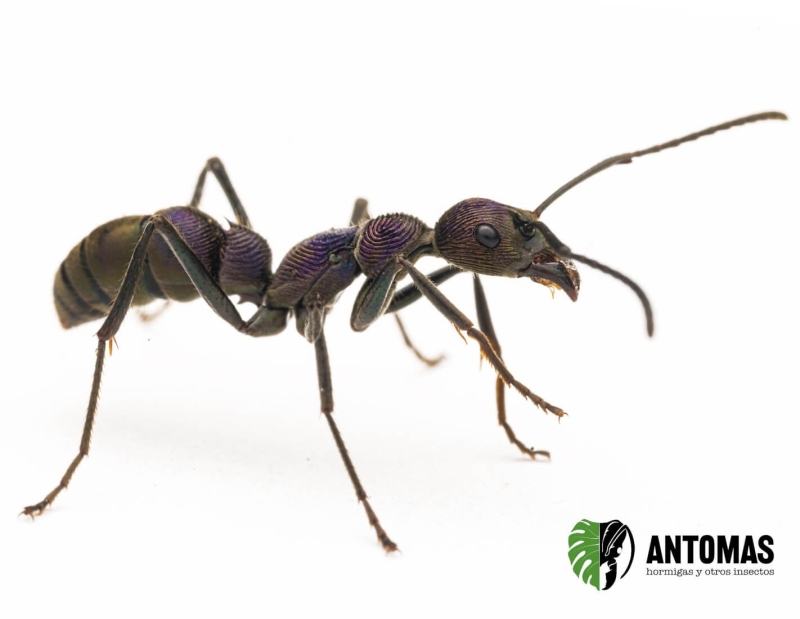
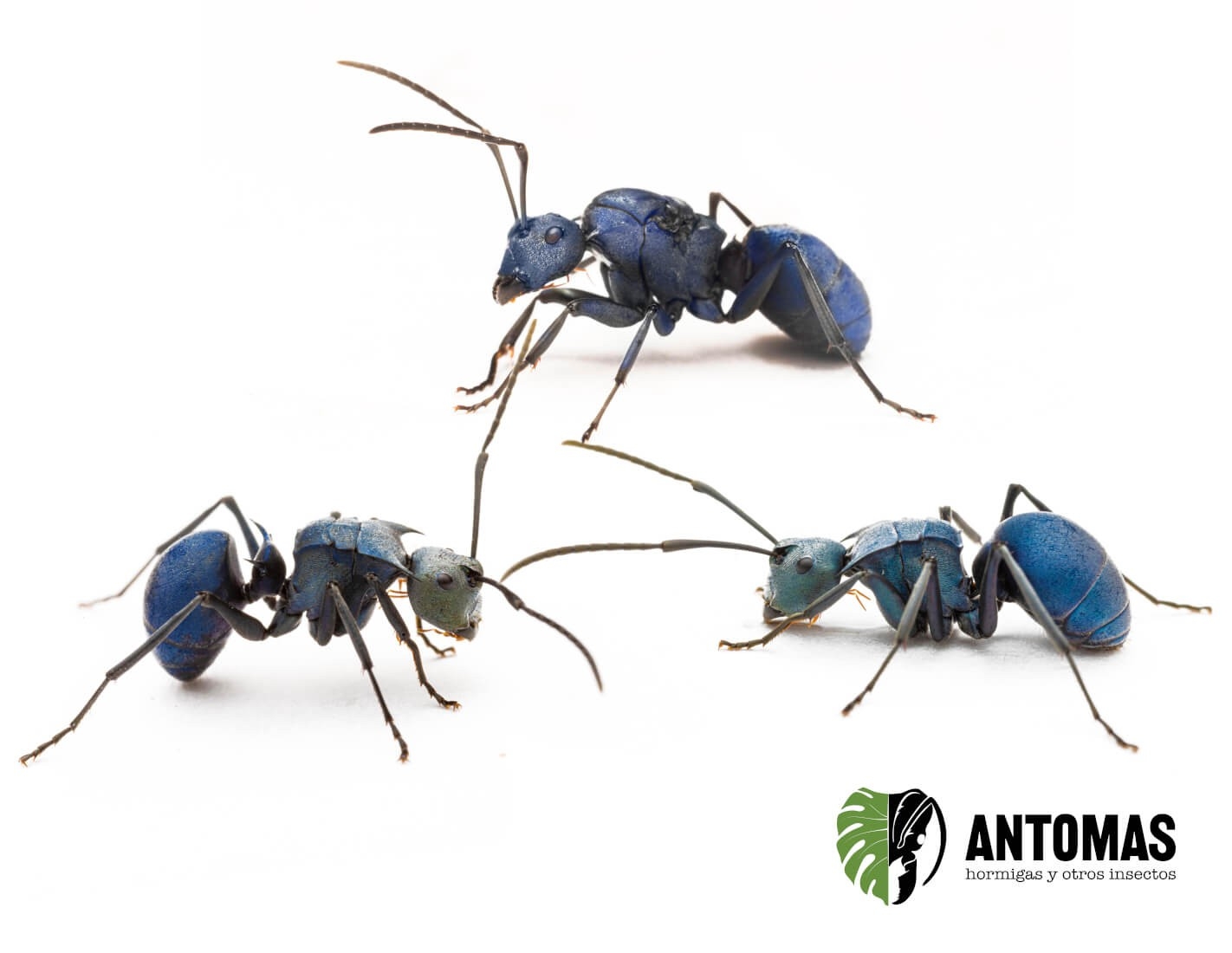
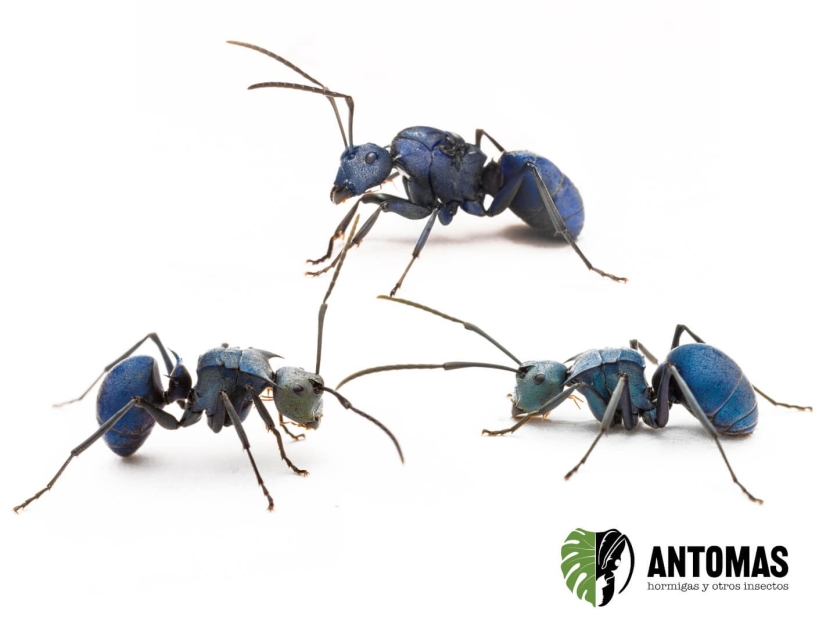
Polyrhachis cyaniventris is a spectacular ant endemic to the Philippines, known for the intense metallic blue iridescence that covers almost its entire body.
Its confirmed distribution includes central and southern Luzon, Catanduanes, Mindoro, Samar and Leyte. It occurs in partially degraded primary dipterocarp forests, secondary forests and even coconut plantations with abundant undergrowth, from lowland areas to lower montane regions.
This tolerance of relatively varied environments helps explain one of its major attractions in captivity: P. cyaniventris is a fairly adaptable and rewarding Polyrhachis, suitable even for hobbyists who do not yet have extensive experience with tropical ants.
At Antomas, we consider it a species with a difficulty level of 2/5, making it perfectly suitable for beginners who have a secure setup and are able to maintain reasonably stable tropical humidity and temperature.
In nature, it is mainly diurnal. Workers move across leaves, branches and small shrubs, and it is much less common to find them walking directly on the ground.
They have a certain degree of visual acuity and react quickly to nearby movement. In captivity, this ability becomes especially apparent when they detect live food: they can orient their bodies towards small prey, actively pursue it and attempt to cut off its escape route.
Their diet combines sugary liquids with small invertebrates. Adults depend largely on carbohydrates to sustain their high activity levels, while insects provide the proteins required for larval development.
They readily accept flies, fruit flies, small cockroaches, young crickets and moths. Small prey allows one of the species’ most entertaining behaviours to be observed, as the workers enjoy chasing and capturing live food.
Speed, small jumps and communication
P. cyaniventris is an extraordinarily fast ant.
The workers run at high speed on both horizontal and vertical surfaces and climb branches, plastic, glass and other elements of the terrarium with ease. They can also make small jumps when attempting to escape, quickly changing surfaces or reacting to a disturbance.
These jumps are not comparable to those of some Myrmecia, but rather small bursts that, combined with their speed, can make a worker disappear from view in a matter of seconds.
According to our observations in captivity, they can also perform a curious gaster drumming behaviour, repeatedly striking it against the surface they are standing on.
This behaviour occurs especially when they are excited, detect a threat or when there is a disturbance near the nest. The impacts transmit vibrations through the material and probably function as an alarm signal or a means of communication between nestmates.
It can be compared to someone rapidly knocking on a wall to alert people in the adjoining room: they do not need to see them directly to transmit a signal through the structure.
Nesting and colony structure
In the wild, nests have been found occupying pre-existing cavities in branches, both in wood lying above the ground and in branches located among low vegetation.
This fits perfectly with their semi-arboreal behaviour. They do not need to build enormous silk structures or have a specific host plant: they make use of small, protected cavities inside wood.
Colonies are monogynous, with a single reproductive queen.
The queen is noticeably larger and more robust than the workers, with a more developed mesosoma as a result of the flight musculature she possessed before shedding her wings.
Established colonies can reach several hundred workers, although growth is progressive and easy to manage in captivity.
The brood develops through the usual stages of egg, larva and pupa. As in other members of the genus, larvae play an important role in nest construction because they can produce silk.
This silk may be used to reinforce nesting areas or join materials together, although P. cyaniventris does not build the large leaf nests characteristic of some other Polyrhachis.
Colony founding
Colony founding is claustral. After mating, the queen can raise her first generation of workers using her own reserves, without needing to forage regularly.
During this stage, the queen should be kept in a small, dark, humid and very stable space.
Constant disturbance should be avoided. Opening the setup repeatedly, exposing it to strong light or moving it unnecessarily can delay development and increase stress.
Once the first workers emerge, the colony can begin receiving small amounts of sugary liquids and tiny insects.
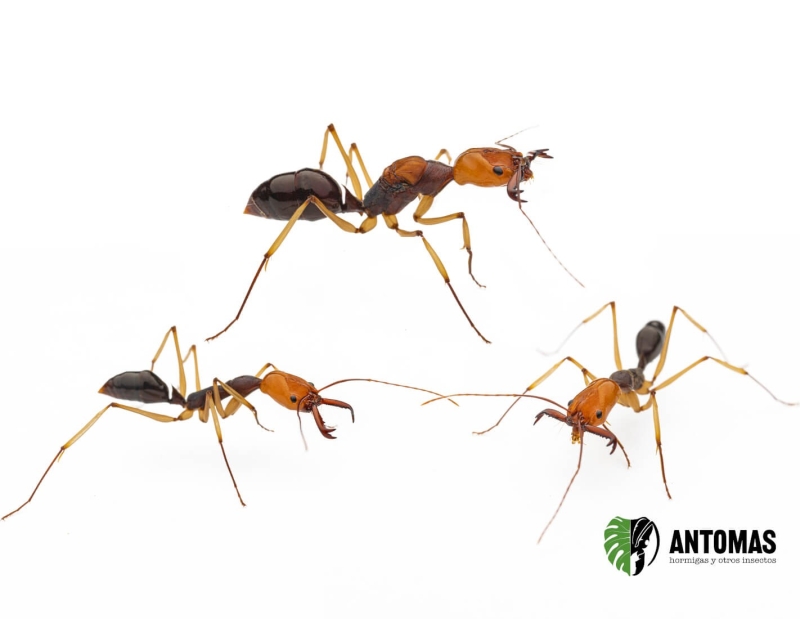
The body is covered with numerous golden or yellowish hairs, especially visible on the gaster and legs, creating a very attractive contrast with the metallic blue background.
Like other members of the genus Polyrhachis, it has prominent spines on the mesosoma and petiole. These projections give it a robust, almost armoured appearance.
The workers have a powerful build, long legs and a relatively large head. The queen is larger and more robust, with a noticeably more developed mesosoma.
Approximate measurements
- Workers: approximately 8–10 mm
- Queen: approximately 12–14 mm
The exact size may vary slightly between individuals and populations.
Polyrhachis cyaniventris is a relatively easy tropical species to keep, provided that its two main requirements are respected: high humidity and excellent escape prevention.
Its speed and climbing ability make the security of the setup more important than the intrinsic difficulty of its care.
A colony with suitable temperature, permanent water, regular carbohydrates and a varied supply of insects can develop without the need for particularly complex techniques.
It is a suitable species for hobbyists who already understand the basic operation of an ant nest, but it does not require advanced experience with exotic ants.
The main difficulty lies not in keeping the colony alive, but in controlling workers during feeding and maintenance.
They are fast, agile, climb very well and can make small jumps, so the foraging area should always have an effective anti-escape barrier.
Recommended parameters
- Temperature: 24–28 °C
- Warm spot: 27–29 °C
- Humidity: approximately 60–80%
- Nest: moderately humid, with good ventilation
- Foraging area: spacious and with branches or vertical structures
It is not necessary for the entire setup to remain saturated with moisture. It is preferable to provide a humid nesting area and a somewhat drier, well-ventilated foraging area.
This gradient allows the ants themselves to choose the most suitable microclimate at any given moment.
Good ventilation is especially important in warm environments, as a combination of excessive moisture, heat and stagnant air can encourage mould and deterioration of food remains.
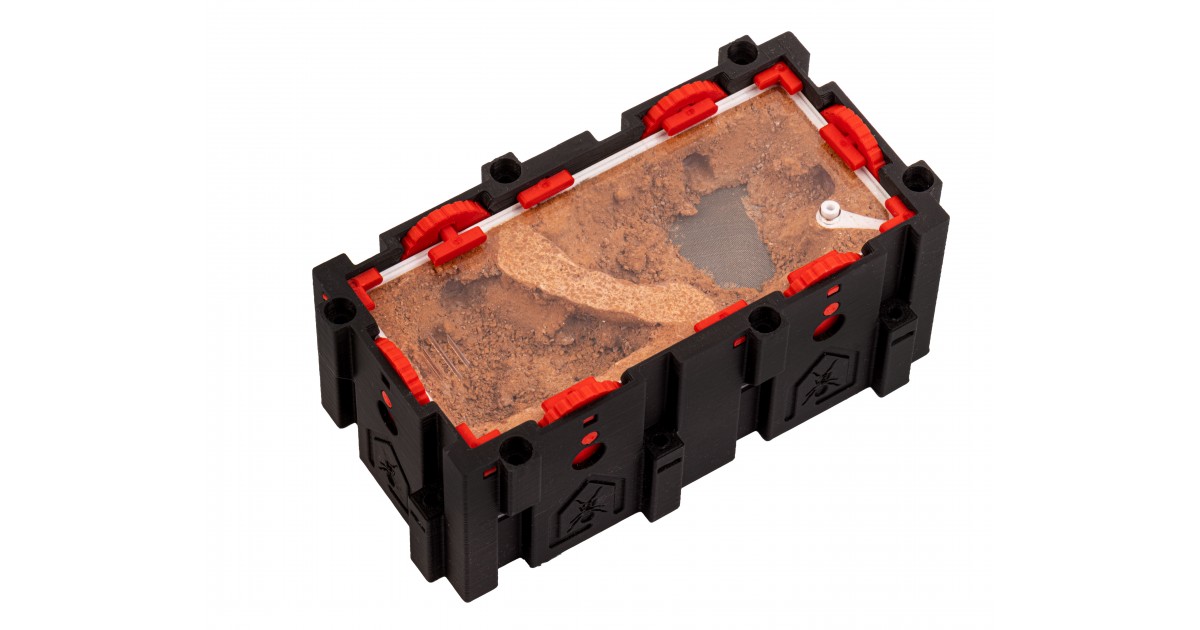
Recommended ant nests
Due to its semi-arboreal habits and tendency to occupy cavities in wood, P. cyaniventris adapts very well to compact nests connected to a vertical or naturalistic foraging area.
For small colonies we recommend:
Wooden nests are also a particularly interesting option because they reproduce the natural nesting environment of the species.
Whatever system is chosen, it is advisable to connect it to a foraging area with branches, cork, bark or other vertical elements.
This allows the workers to display their natural climbing behaviour and makes the colony much more interesting to observe.
Escape prevention
This is probably the most important practical aspect of keeping P. cyaniventris.
The workers are extremely fast and can climb smooth surfaces very effectively.
Feeding
Carbohydrates
Carbohydrates are essential for maintaining the activity of adult workers.
The following can be offered:
- nectar specifically formulated for ants;
- sugar water;
- very diluted honey;
- small pieces of sweet fruit occasionally.
A small feeder with a permanent supply of nectar works especially well in established colonies.
Protein
During larval development, the colony should receive insects regularly.
Suitable options include:
- fruit flies;
- flies;
- small or medium-sized crickets;
- young cockroaches;
- moths;
- small insect larvae.
This not only provides protein, but also allows one of the most interesting aspects of the species’ natural behaviour to be observed.
For small colonies, it is better to offer small prey more frequently than a single oversized insect.
Diapause
Polyrhachis cyaniventris does not require a cold winter diapause.
It comes from a tropical climate in the Philippines, where seasonal changes are mainly associated with rainfall rather than prolonged periods of low temperatures.
In captivity, it can therefore remain active throughout the year.
A slight reduction in activity or brood production may occur during certain periods, but it is not necessary to refrigerate the colony or expose it to temperatures typical of temperate species.
It is advisable to maintain a stable temperature of approximately 23–28 °C throughout the year.
Behaviour in captivity
It is a very active species and one of the most entertaining Polyrhachis to observe.
Workers spend much of the day exploring the foraging area, climbing branches and inspecting any new object introduced into the setup.
When food is detected, several workers may quickly gather around it.
Small live prey is especially stimulating and can trigger active hunting behaviour.
When disturbed, the colony can become very fast and nervous. Workers may run in different directions, climb the walls and make small jumps.
For this reason, maintenance should always be carried out calmly and with the escape barrier in perfect condition.
Handling and safety
Direct handling with the hands is not recommended.
Although it is not an especially aggressive species, workers can defend themselves if trapped or handled.
Their speed is the main practical risk: an escaped worker can move several tens of centimetres in just a few seconds and quickly hide behind furniture or equipment.
It is advisable to use tweezers, tubes and auxiliary containers whenever individuals need to be moved.
With a secure setup, Polyrhachis cyaniventris is a spectacular, active and relatively easy species to enjoy in captivity.
- Dificultad
- Intermediate