Difficulty: 3/5 – Advanced
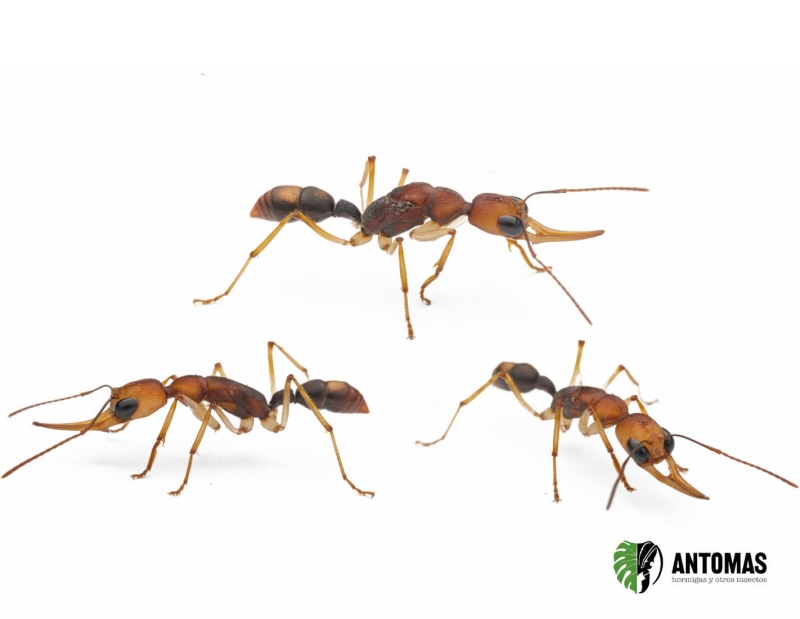
A tiny acrobat ant from the Indian subcontinent, honey-yellow and barely 2 mm long, that nests in the soil and raises its heart-shaped gaster whenever something disturbs it. Colonies with a queen, workers and brood. 24–28 °C, no obligatory diapause, a small plaster nest with moderate humidity, sugar always in a feeder and plenty of small, varied protein. Key point: its workers squeeze through gaps you cannot even see; seal everything well, use ultra-fine mesh and a barrier of paraffin oil or petroleum jelly.
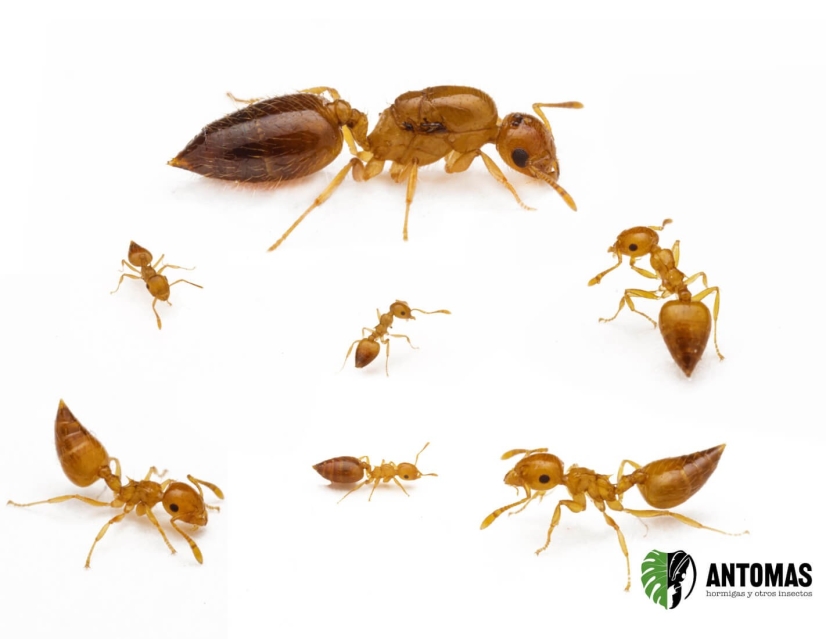
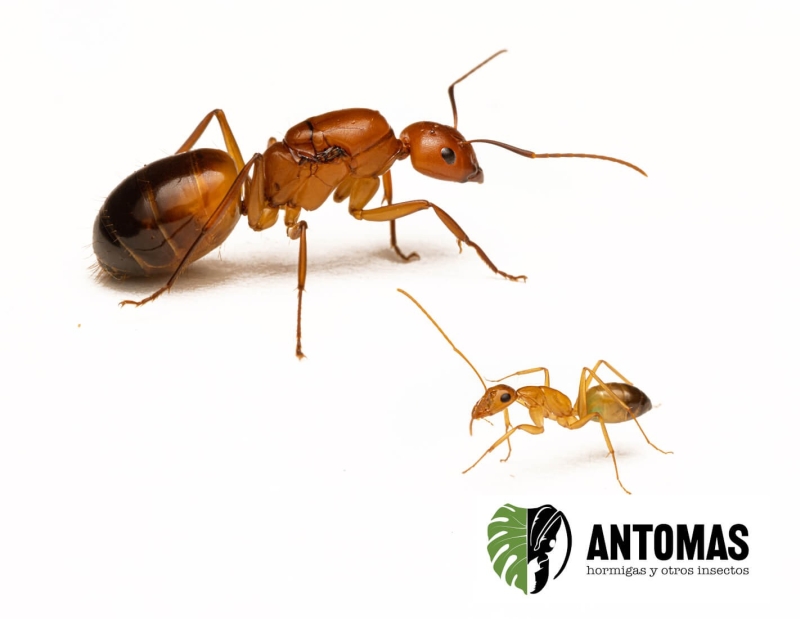
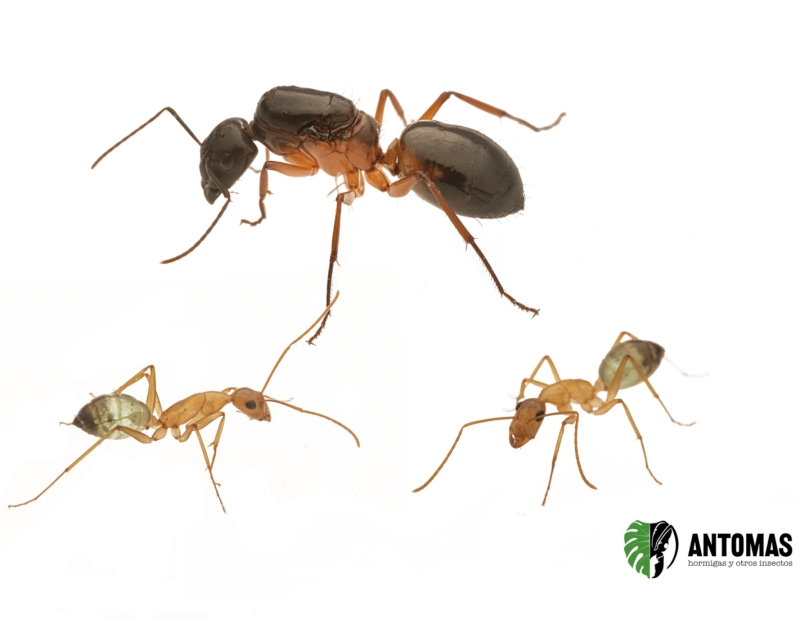
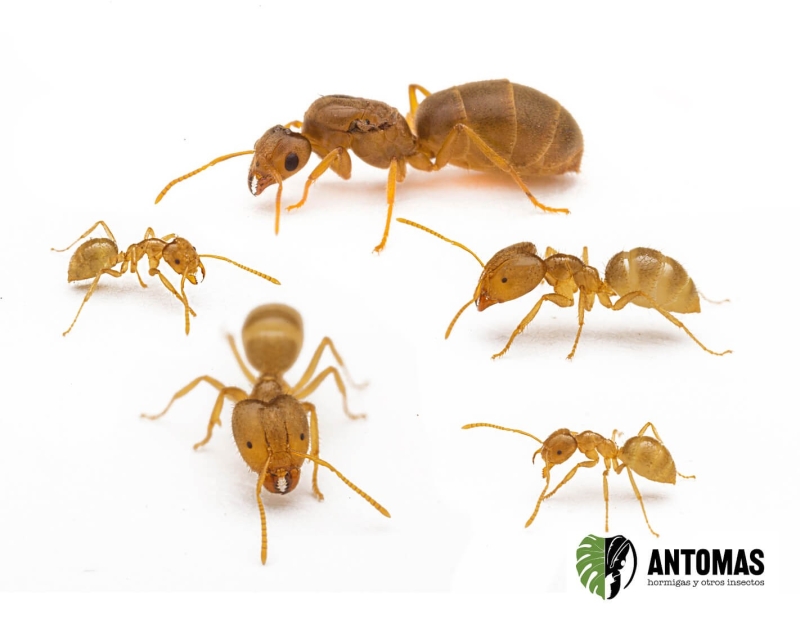
Crematogaster biroi Mayr, 1897 is one of those ants that make you lean in closer. Its workers are about 2 mm long, a clean, almost translucent yellow, and move in fast, orderly columns; the queen, by contrast, is several times larger, with a glossy brown gaster. When a worker feels threatened, it does what every Crematogaster does: it lifts its gaster, which is heart-shaped when seen from above, and points it at the intruder. In miniature, but with the same attitude as its larger relatives.
It lives in South Asia, from Sri Lanka to northern India and Pakistan, and unlike many Asian acrobat ants, which hang their nests from trees, it nests in the soil. It has no common name in English, and we are not going to invent one. Nor has much been written about it: almost everything we know comes from taxonomy, the science that describes, measures and classifies it. That is why, in this care sheet, we carefully separate what is documented for C. biroi, what is known about its genus, which completes the picture, and the hands-on experience of Antomas and other keepers. And we explain how to keep it at home, which has its knack: not because it is delicate, but because it is small.
Biology
A Hungarian name for an ant from Ceylon
The species was described in 1897 by the Austrian Gustav Mayr, from workers collected in Colombo, on what was then the island of Ceylon, now Sri Lanka. They had been collected by the Hungarian zoologist Lajos Bíró, a great traveller and insect collector, who stopped on the island on his way to New Guinea, and the name is dedicated to him. The specimens are still in the Hungarian Natural History Museum in Budapest. In 2016, the Japanese myrmecologists Shingo Hosoishi and Kazuo Ogata re-examined them and chose one of those workers as the lectotype, the reference specimen that fixes for ever what C. biroi is.
The same work put its history in order. In the early 20th century, the Swiss Auguste Forel had described two “varieties” of the species from ants collected in India: aitkenii, from Kanara, and smythiesii, from Dehra Dun, at the foot of the Himalayas. In 2003, a new species, C. urvijae, was also described from the Indian Punjab. After comparing them in detail, Hosoishi and Ogata concluded that all three were the same ant, and today they are synonyms of C. biroi.
A useful warning if you are looking for information: the Hungarian zoologist also gives his name to Ooceraea biroi, the famous laboratory “clonal raider ant”, which reproduces without males. They share a surname, but nothing else: they are ants from different subfamilies, with lives that have nothing in common. Many of the results that come up when you search for “biroi” are about the other one.
An acrobat from the oldest lineage
Crematogaster is one of the largest ant genera in the world, with around 500 species, and since the revision by the entomologist Bonnie Blaimer in 2012 it has been divided into just two subgenera. Our species belongs to the subgenus Orthocrema, that of the small, inconspicuous acrobat ants. Her phylogenetic study from the same year, with molecular data from more than a hundred species, placed the origin of the genus’s major lineages in South-East Asia, some 24–30 million years ago, and showed that it was precisely an Orthocrema lineage that was the first to leave Asia, heading for Africa, at around the same time. From there, acrobat ants colonised the entire planet.
Within Orthocrema, Hosoishi and Ogata recognised five species groups in Asia and named one of them after our ant: the C. biroi group, with about ten species spread from India to Japan and the Philippines, including C. osakensis, from Japan, and C. luzonensis, from Luzon. Their analysis indicates that the group is a natural branch of the evolutionary tree and that its ancestors crossed eastwards over Wallace’s Line, the invisible biological boundary that separates Asian from Australian fauna. C. biroi is, so to speak, the family’s western representative.
From the heat of Colombo to the winters of the Punjab
The 2016 revision only accepts as certain the records from India and Sri Lanka, with specimens from Colombo, Kanara, Dehra Dun, Chandigarh and Patiala. In 2019 it was recorded for the first time in Pakistan, in an updated checklist of the country’s ants, and recent Indian studies keep finding it in the Punjab, even on university campuses. There are also old records from China and Taiwan that the authors of the revision could not verify, and a 1942 record listing it as introduced to the island of Guam, in the Pacific, since 1911, based on an identification from that period that nobody has re-examined.
What is clear is that its range covers very different climates. In Sri Lanka and southern India it is hot all year round, with averages of 26–29 °C and high humidity. In the north, on the plains of the Punjab, the climate is monsoonal and much more extreme: a very hot summer, with highs approaching 40 °C before the rains, a monsoon from July to September and a cool, dry winter, with averages of around 12–15 °C in the coldest months and nights that drop to just a few degrees.
An acrobat of the soil
Many Asian acrobat ants are arboreal and build carton nests in the branches, like Crematogaster rogenhoferi, which we also have at Antomas. C. biroi goes its own way: according to the revision by Hosoishi and Ogata, it nests in the soil, and one of its series of specimens comes from an open site, not from forest. Some shops describe it as a species of twigs and cavities in wood; the scientific source says the opposite, and that is the one we follow. Bear in mind, though, that like almost all Crematogaster it is a nimble climber and goes up plants in search of food.
What has not been studied is its life in the wild: there are no published studies on its diet, the size of its colonies in the field or its annual cycle. From what is known about the genus, we can expect an omnivorous, opportunistic ant that hunts small arthropods, collects carcasses and makes use of honeydew, the sugary liquid excreted by aphids and scale insects. That is also what we see in captivity: it eats everything, and with great appetite.
The worker that is almost a queen
The most curious detail about C. biroi is hidden in a table of measurements. When reviewing the material, Hosoishi and Ogata found, alongside the normal workers, an intermediate worker: a wingless individual with a worker’s head but almost the size of the queen. Its head was 0.82 mm wide, compared with 0.44–0.55 mm in the workers, and its thorax, almost twice as long, was strongly convex on top, with a profile reminiscent of a queen’s.
What exactly is it? In ants, individuals “intermediate” between worker and queen occur in many species and can play a variety of roles, from storing reserves to laying eggs. In C. biroi their function has not been studied, and we are not going to invent one. But it is a good reason to look at your colony through a magnifying glass: among the tiny workers, a few clearly larger ones may turn up.
The heart-shaped gaster: warning and weapon
Crematogaster are called acrobat ants because of their defensive posture. Their gaster is not attached to the postpetiole at the front, as in most ants, but on its upper surface, which allows them to raise it above the thorax and even above the head. In that position they aim with the sting, which is not used for piercing: its tip is broadened into a spatula shape and smears the venom onto the enemy. In the Mediterranean acrobat ant, C. scutellaris, it has been shown experimentally that this secretion repels other ants and that the posture works both as a warning and as a weapon.
The defensive chemistry of C. biroi has not been analysed, but it shares the anatomy of the genus. For you, there is no sting to fear. For a mite, a small fly or a rival ant, on the other hand, a row of raised gasters is a very clear message.
Scent trails that come from the legs
Another oddity of the genus: many Crematogaster do not mark their trails with the gaster, like almost all ants, but with a gland in the hind legs, in the tibia. This was demonstrated in the North American acrobat ant C. ashmeadi: workers drag their hind legs when returning from a food source and leave a trail that their nestmates follow. It has not been studied in C. biroi, but in captivity you will see the typical acrobat-ant result: a scout finds a drop of nectar and, within a few minutes, there is a line of workers coming and going.
Small, numerous and well organised
Orthocrema are, in general, small and inconspicuous ants that go unnoticed and, precisely for that reason, have been little studied.
There are no published data on the size and organisation of C. biroi colonies in the wild. What we see in the colonies we keep at Antomas is a queen clearly larger than the rest, very small workers that work as a team and plenty of brood when the colony is well fed. With stable warmth and abundant protein, the colony grows at a good pace, and a large colony is a spectacle of constant movement.
Size and morphology
A tiny acrobat ant, yellow and quite hairy for its size, with spines on the thorax and a very distinctive petiole. To appreciate the details, you will need a magnifying glass.
- Colouration. Yellow workers, with all the antennal segments yellow too, according to the scientific description. In the Antomas colonies, the gaster tends to darken towards the tip, and the queen has a golden-yellow body and a glossy, dark brown gaster.
- Head. Almost as wide as it is long, with fine wrinkles near the back of the head, close to the occipital carinae: one of the features that set it apart within its group. Small eyes.
- Mandibles. With four teeth: the two at the tip large and the two at the base smaller.
- Thorax. With wrinkles on the pronotum and mesonotum and several pairs of long, erect hairs. At the rear, the propodeum bears two backward-pointing spines, longer than the diameter of the spiracle.
- Waist. This is the most striking feature under the magnifying glass: the petiole has a sort of keel underneath, an acute, well-developed subpetiolar process, and the postpetiole bears another process underneath, also acute. According to its revisers, these features make it “very distinct” within the C. biroi group.
- Gaster. Heart-shaped, attached to the postpetiole from above, as in all Crematogaster.
- Sting. Spatulate: it smears the venom rather than injecting it.
- Intermediate worker. Almost the size of the queen, wingless, with a strongly convex mesonotum (see “The worker that is almost a queen”).
- Queen. Much larger than the workers, with the robust thorax of winged queens and a bulky gaster. The queen of C. urvijae, now a synonym of C. biroi, was described in 2003, but her measurements are not available in the sources we have been able to consult.
Approximate measurements
The revision by Hosoishi and Ogata (2016) measured ten workers. These are the main measurements:
- Worker, head width: 0.44–0.55 mm
- Worker, head length: 0.45–0.52 mm
- Worker, thorax (mesosoma) length: 0.49–0.58 mm
- Worker, antennal scape length: 0.33–0.39 mm
- Worker, propodeal spine length: 0.09–0.12 mm
- Intermediate worker (one specimen): head 0.82 mm wide and thorax 0.98 mm long
- Queen and male: no accessible published measurements
Total length is not given in the revision. Adding up head, thorax, waist and gaster, a worker is around 2 mm: this is our own estimate, not a published measurement. The length figures circulating in shops do not come from any study, so we do not give them.
Keeping in captivity
Difficulty: 3/5 – Advanced
C. biroi is not a delicate ant: it eats everything, accepts sugar and protein without any trouble and does well at the temperature of a mild home with a little extra heat. If we class it as advanced, it is for one reason only, and it shapes everything: it is tiny. That has three consequences:
- Escapes. A 2 mm worker gets through the gap of a poorly fitting lid, through standard ventilation holes and through the space between a tube and its connector. And, like any good acrobat ant, it climbs with ease.
- Scale. It needs a small nest with fine galleries, small or cut-up prey and a feeder in which the workers cannot drown.
- Observation. To keep track of the queen, the brood and the health of the colony, you need to look closely and carefully, ideally with a magnifying glass.
If you have already kept a species or two and are willing to take care with the closures, it is a very rewarding, active and eye-catching ant, with the charm of seeing the whole life of a colony in miniature.
Recommended parameters
- Temperature: 24–28 °C in the nest. If the room is cool, apply gentle, thermostat-controlled heat to one side, so that the colony can choose the area that suits it.
- Humidity: moderate. One part of the nest slightly damp and the rest drier, to create a gradient; the foraging area, dry.
- Water: always available, in a test tube with water and tightly packed cotton wool.
- Ventilation: yes, but with ultra-fine mesh or with vents that a 2 mm worker cannot get through.
- Light: a dark area in the nest and a lit foraging area, with a normal day-night cycle.
- Diapause: not necessary (see “Diapause”).
Recommended formicaria
For a tiny, soil-nesting ant that appreciates a little humidity, at Antomas we recommend starting with the smallest formicarium in Anthouse’s plaster range, the Qbik Wild One P 1C. Plaster holds moisture in a stable, even way, and its small chambers make a colony of a few dozen workers feel protected and let you see the queen and brood clearly.
When the colony fills the nest, the natural next step is the Qbik Wild Duo P 2C, with two chambers: it lets you keep one damper and the other drier, exactly the gradient we are after.
Complete the set-up with a small, well-sealed foraging area, a water tube, a feeder for the sugar and a twig or small stone for them to explore. Before moving the colony in, check every joint, stopper and vent with the size of its workers in mind: if the tip of a pin fits through a gap, so does a C. biroi.
Humidity: neither puddle nor desert
As a soil-nesting ant from a monsoon climate, C. biroi is used to ground that gets soaked by the rains and dries out in the dry season, but keeps some moisture deeper down. In a plaster nest, that means moistening only one part and letting the colony choose. Watch for two signs: if the workers pile the brood up in the driest area or crowd at the exit, there is too much humidity; if they avoid it completely and keep seeking out the water tube, there is too little. A waterlogged nest brings mould and mites; in a bone-dry one, the brood dehydrates.
Arrival and moving in
At Antomas we sell colonies with a queen, workers and brood. When yours arrives, let it rest for a few hours somewhere warm, at 24–28 °C, and check that it has water. To move it into the formicarium, at Antomas we transfer it by tipping it out: open the tube inside the foraging area, next to the nest entrance, and tip the colony out (queen, workers and brood) with a few gentle taps. With this species, some specific tips:
- Work inside a tray that is light-coloured and roomy, with the edges coated in paraffin oil or petroleum jelly: a 2 mm yellow worker is hard to see on a table and gets lost in no time.
- Use a very fine paintbrush to move stragglers and any brood stuck to the tube; tweezers, even soft ones, are too clumsy for them.
- Have the barrier in place and the lid ready before opening the tube, so you can close up as soon as the colony is inside.
- Find the queen. She is much larger than the workers and easy to recognise: make sure she goes into the nest.
Afterwards, check the colony often during the first few days: the queen should be inside, the brood grouped together and the workers drinking and eating. If you ever need to move them to another formicarium, use the same method.
Feeding
Sugar, always available. Like other acrobat ants, C. biroi makes very good use of sugary liquids. Vary the sugars: at Antomas we recommend Blue Sugar nectar by Anthouse 4–5 times a week and another sugary liquid or nectar 1–2 times a week; you can also add a little protein to the nectar. Always offer it in a feeder and never on cotton wool, which goes mouldy and spoils the liquid in no time. Use a traditional or home-made feeder in which the drop stays “spread out” and accessible, and, with this species, keep the drop small: in a large drop or a puddle of honey, a tiny worker can get stuck and drown.
Protein: the more, the better. This is what makes the colony grow. If you do daily maintenance and remove leftovers, it is better to overfeed: the colony understands that it has more resources and grows faster and larger. If you will not be able to clean often, it is better not to overfeed, because whatever is left over rots and brings mould and mites. Switch insects from one week to the next, so that they do not always eat the same thing, and bear their size in mind: everything small, cut up or opened.
With large prey, open up the body so they can get in: you will see dozens of workers dismantling it from the inside, gasters raised. Remove leftovers within a day or two. Buy insects from a reliable supplier: insects treated with insecticides can kill the colony.
Colony growth
Your colony arrives already up and running, with a queen, workers and brood, so you skip the most delicate stage, the founding, and start with the best part: watching it grow. There are no published data on the development rate of C. biroi. In tropical Crematogaster, at 24–28 °C, development from egg to worker usually takes several weeks, and the pace depends above all on two things you control: temperature and protein. With stable warmth and plenty of food, you will see heaps of eggs and larvae next to the queen and new workers every few weeks.
Expand when the workers occupy the whole nest and start settling in corners of the foraging area, but do not jump the gun: in a nest that is too large for the colony, the spare chambers end up as rubbish dumps or fill with mould. Over the years, a large colony may produce alates, queens and males, which will try to fly off: in captivity they do not mate, and a good lid stops them from escaping.
Diapause
It does not need a diapause. In the south of its range there is no cold season, and in the north, in the Punjab, winter is cool but short and frost-free in the lowlands (see “From the heat of Colombo to the winters of the Punjab”). At Antomas we keep it active all year round, at 24–28 °C. If your home gets cold in winter, heat one side of the nest: a moderate drop, to about 20–22 °C for a few weeks, does it no harm and simply slows down egg-laying, but avoid leaving it for months below 18 °C, because the colony shuts down and the brood stalls. No fridge, and no rest period at 5–10 °C like the one European species get.
Behaviour in captivity
It is an active, fast and very team-minded ant. Scouts patrol the foraging area non-stop and, as soon as one finds food, a line of workers forms that does not break up until there is nothing left. When you open the lid or breathe nearby, you will see the genus’s typical gesture: gasters raised, pointing at you.
Watch without fear. At Antomas we believe ants are there to be enjoyed, observed and learned from, not kept hidden away. All you need is to leave them a dark area in the nest and a lit foraging area, and to look at them often and gently, ideally with a magnifying glass: with such a small species, it is the only way to really see what is going on. Checking on them frequently is also the best way to spot any problem in time: workers crowding on the lid or at the exits (too much humidity or an escape route), mould in the nest (forgotten leftovers or too much water), brood that is not developing (lack of protein or heat) or a water tube that has run dry.
Escapes and barriers
This is the key point with this species. C. biroi combines two things: tiny size and great climbing ability.
- 2 mm-proof closures. A tight-fitting lid, vents with ultra-fine mesh and connectors, stoppers and tubes that fit perfectly. Check the joints with a magnifying glass.
- A barrier of paraffin oil or petroleum jelly on the upper part of the foraging area walls, renewed whenever it gets dirty. PTFE (Fluon) stops many species, but acrobat ants often get past it; if you use it, make it a back-up rather than the only barrier.
- No bridges. Make sure no twig, tube, tweezers or drop of nectar touches the barrier or the lid.
- Take care when opening. This is the riskiest moment: open only as much as necessary, work quickly and close up when you have finished.
Handling and safety
Its sting is spatulate and does not pierce the skin, and its bite is barely noticeable: this species poses no risk at all to people. The care has to go the other way: they are the ones that need protecting. Always handle them with entomological tools, above all a fine paintbrush, never with your fingers, and work slowly so as not to crush any worker, let alone the queen. It is an exotic species: it must never be released into the wild.
What not to do
- Rely on lids, vents or connectors designed for large ants.
- Trust PTFE alone or leave bridges that get round the barrier.
- Give a small colony a large nest: they scatter and mould appears.
- Waterlog the nest or, conversely, let it dry out completely and the water tube run empty.
- Put the sugar on cotton wool, in large drops or in puddles of honey.
- Give them large whole prey, always the same insect, or leave leftovers uncleaned.
- Put them through a cold diapause or leave them for months at cold room temperature.
- Go days without looking at them: check the colony often, carefully and with a magnifying glass.
- Handle them with your fingers.
Scientific sources
This care sheet has been put together from the scientific literature on Crematogaster biroi and its genus, climate data from its range and the experience of Antomas. Where there are no data for the species, we say so and rely on what is known about the genus. Main references:
- Hosoishi, S. & Ogata, K. (2016). Systematics and biogeography of the ant genus Crematogaster Lund subgenus Orthocrema Santschi in Asia (Hymenoptera: Formicidae). Zoological Journal of the Linnean Society 176: 547–606. doi:10.1111/zoj.12330
- Blaimer, B. B. (2012). A subgeneric revision of Crematogaster and discussion of regional species-groups (Hymenoptera: Formicidae). Zootaxa 3482: 47–67. doi:10.11646/zootaxa.3482.1.3
- Blaimer, B. B. (2012). Acrobat ants go global – Origin, evolution and systematics of the genus Crematogaster (Hymenoptera: Formicidae). Molecular Phylogenetics and Evolution 65: 421–436. doi:10.1016/j.ympev.2012.06.028
- Rasheed, M. T., Bodlah, I., Gull e Fareen, A., Wachkoo, A. A., Huang, X. & Akbar, S. A. (2019). A checklist of ants (Hymenoptera: Formicidae) in Pakistan. Sociobiology 66: 426–439. doi:10.13102/sociobiology.v66i3.4330
- Bharti, H., Guénard, B., Bharti, M. & Economo, E. P. (2016). An updated checklist of the ants of India with their specific distributions in Indian states (Hymenoptera, Formicidae). ZooKeys 551: 1–83. doi:10.3897/zookeys.551.6767
- Marlier, J.-F., Quinet, Y. & de Biseau, J.-C. (2004). Defensive behaviour and biological activities of the abdominal secretion in the ant Crematogaster scutellaris (Hymenoptera: Myrmicinae). Behavioural Processes 67: 427–440. doi:10.1016/j.beproc.2004.07.003
- Leuthold, R. H. (1968). A tibial gland scent-trail and trail-laying behavior in the ant Crematogaster ashmeadi Mayr. Psyche 75: 233–248. doi:10.1155/1968/73761
- Mayr, G. (1897). Formiciden aus Ceylon und Singapur. Természetrajzi Füzetek 20: 420–436.
- Bharti, H. (2003). A new species of Crematogaster (Hymenoptera: Formicidae: Myrmicinae) from India. Entomon 28: 85–88.
- Swezey, O. H. (1942). Formicidae. In: Insects of Guam I. Bernice P. Bishop Museum Bulletin 172.