This website uses its own and third-party cookies to improve our services and show you advertising related to your preferences by analyzing your browsing habits. To give your consent to its use, press the Accept button.
Cookie preferences
| Cookie | Provider | Purpose | Expiry |
|---|---|---|---|
| PHP_SESSID | antomas.es | The PHPSESSID cookie is native to PHP and allows websites to store serialised status data. On the website it is used to establish a user session and to pass state data through a temporary cookie, which is commonly known as a session cookie. These Cookies will only remain on your computer until you close your browser. | Session |
| PrestaShop-# | antomas.es | This is a cookie used by Prestashop to store information and keep the user's session open. It stores information such as currency, language, customer ID, among other data necessary for the proper functioning of the shop. | 480 hours |
| rc::a | It is used to read and filter bot requests. | Persistent | |
| rc::c | It is used to read and filter bot requests. | Persistent |
| Cookie | Provider | Purpose | Expiry |
|---|---|---|---|
| _ga | Registers a unique ID that is used to generate statistical data on how the visitor uses the website. | 2 years | |
| _gat | Used by Google Analytics to throttle request rate | 1 day | |
| _gat_gtag_UA_# | Used to throttle request rate. | 1 minute | |
| _gd# | This is a Google Analytics Session cookie used to generate statistical data on how you use the website which is removed when you quit your browser. | Session | |
| _gid | Registers a unique ID that is used to generate statistical data on how the visitor uses the website. | 1 day |
Mystrium camillae – Dracula Ant
Biology
Mystrium camillae is one of the strangest and most specialized ants that can be kept in captivity. It belongs to the subfamily Amblyoponinae, an ancient lineage of predominantly predatory ants adapted to living hidden underground, among leaf litter and inside decaying wood.
It has an extraordinarily wide distribution across the Indo-Australian region, with populations attributed to M. camillae ranging from India and Myanmar to China, Vietnam, Malaysia, Indonesia, the Philippines, Papua New Guinea and Australia.
This enormous distribution should be interpreted with some caution: the material currently identified as M. camillae shows considerable morphological variability, and future revisions may ultimately separate some populations into different species.
Its lifestyle is cryptic and subterranean. It is not an ant designed to roam large open spaces like a Cataglyphis or a Myrmecia. It mainly explores narrow tunnels, rotten wood, deep layers of leaf litter and small cavities in the soil.
Interestingly, the workers are practically blind, but this is not a significant disadvantage in their world. For an ant that spends much of its life moving through dark galleries only a few millimetres wide, large eyes would be almost as useful as sunglasses inside a mine.
Its diet is fundamentally predatory. Ecological studies place M. camillae at very high trophic levels within tropical leaf-litter food webs, feeding on other predatory arthropods and small invertebrates.
In the laboratory, colonies have been maintained with live crickets and termites several times a week, in addition to water and sugar solutions. Therefore, in captivity they should receive an insect-rich diet, with small or medium-sized prey that they can subdue and carry to the larvae.
The fastest mandibles in the world
The most spectacular feature of Mystrium camillae is its mandibles.
Unlike the classic trap-jaw ants of the genus Odontomachus, which open their mandibles and snap them shut, Mystrium uses a completely different mechanism.
The ant brings the tips of both mandibles together and begins to apply pressure, slightly deforming them and storing elastic energy. When one mandible slips past the other, all that energy is released at once.
The mechanism works much like snapping your fingers: tension builds up slowly and is then released almost instantaneously.
Measurements using ultra-high-speed cameras recorded peaks close to 90 metres per second, equivalent to more than 320 km/h, and accelerations exceeding one million times the acceleration due to gravity.
The movement can be completed in just a few tens of microseconds. In other words, the strike is approximately one thousand times faster than a human finger snap and around five thousand times faster than a blink.
Workers use this mechanism against small arthropods and probably also for defence. In a narrow tunnel, where there is no room to open the mandibles widely, this system allows them to deliver an extremely fast strike from an almost closed position.
There is also a functional difference between sizes: small workers produce especially fast movements, while larger workers have heavier mandibles and deliver more powerful strikes.
Why is it called the Dracula Ant?
The name does not come from its coloration or its mandibles, but from one of the most unusual feeding behaviours of the Amblyoponinae.
Adults can engage in feeding on larval hemolymph. A worker carefully pierces the cuticle of a larva and consumes a small amount of hemolymph, the circulatory fluid of insects.
What is extraordinary is that the larva does not die. The wound heals and it can continue developing normally.
Despite the enormous physiological differences, it could be compared to having a small living "blood bank" within the colony: the larvae temporarily act as intermediaries between the solid food they consume and the liquid nutrients that the adults can use.
This form of non-destructive cannibalism is precisely what gives rise to the nickname "Dracula Ant".
This does not mean that we can feed a colony solely through its own larvae. The hemolymph ultimately comes from the nutrients the larvae receive, so a constant supply of insects remains essential.
Social organization
Contrary to what might be expected from such a specialized ant, colonies are not necessarily monogynous.
In a study of ten colonies from Java, between one and five mated queens per colony were found, demonstrating that M. camillae can exhibit natural polygyny.
Colony size is relatively small. The colonies studied had an average of around 58 workers, although there was considerable variation between nests.
We are therefore not dealing with a species destined to form societies of tens of thousands of individuals. Its appeal lies in the specialization of each individual and in a biology completely different from that of most commercially available ants.
Normal queens are winged before mating and have a mesosoma that is clearly more developed than that of the workers. Interestingly, one colony studied also contained females with abnormally short wings, or brachypterous females, probably incapable of normal flight.
In captivity, several queens can be kept together when they already belong to the same colony, but introducing queens that have been purchased, collected or raised independently is not recommended.
Colony founding
The exact founding biology of M. camillae is much less documented than the structure of established colonies.
We do not recommend treating it as a conventional claustral species and keeping the queen confined for months without the possibility of feeding.
The conservative option in captivity is semi-claustral founding, using a small chamber connected to a micro-foraging area.
The queen should have access to:
- a permanent water supply;
- micro-droplets of sugary liquid;
- small, freshly killed insects;
- darkness;
- high humidity;
- as little disturbance as possible.
Food should be placed very close to the chamber. The aim is not to force her to leave constantly, but to allow her to feed whenever necessary without having to travel long distances.
Size and morphology
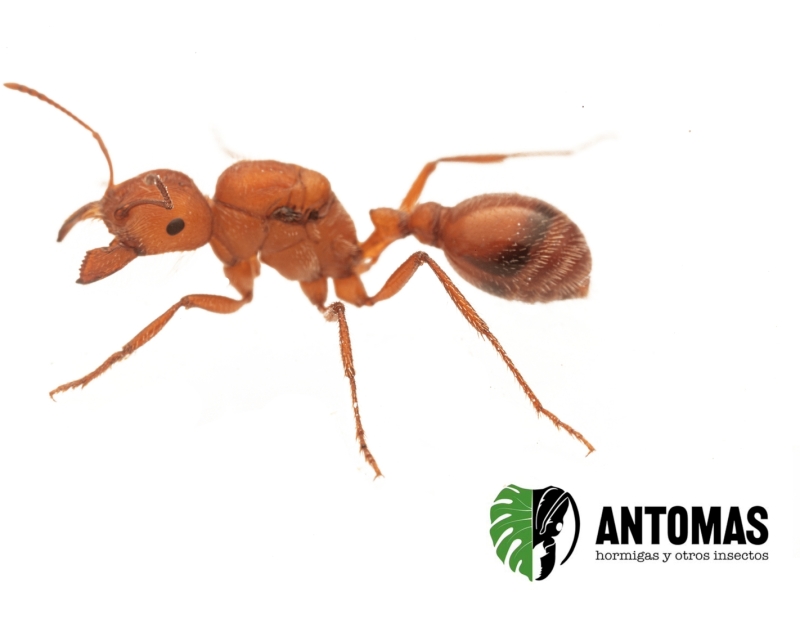
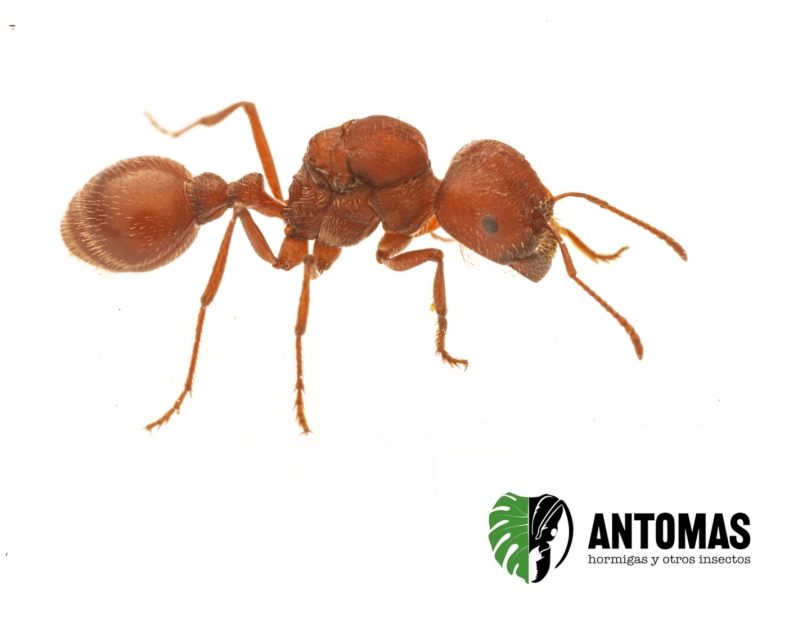
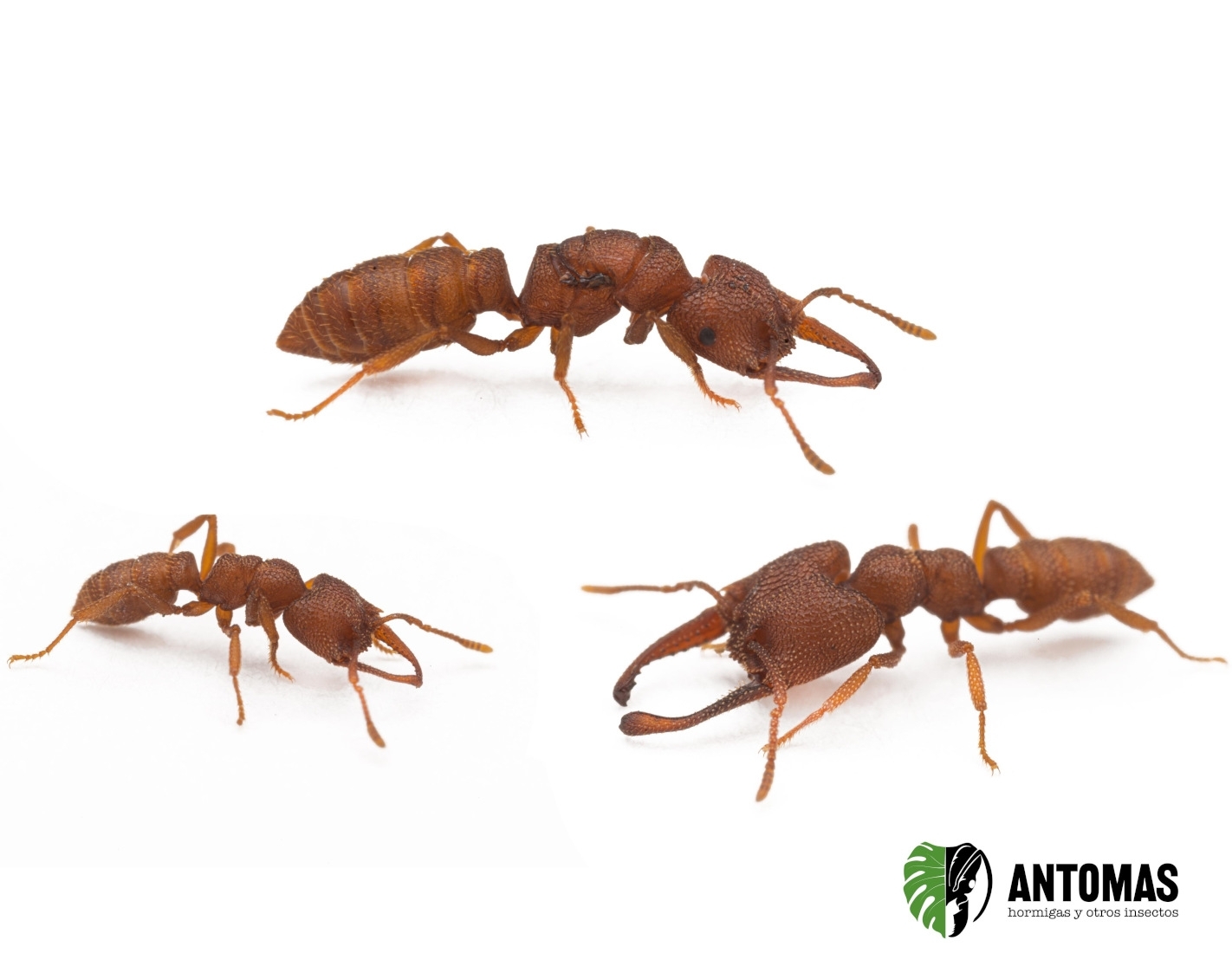
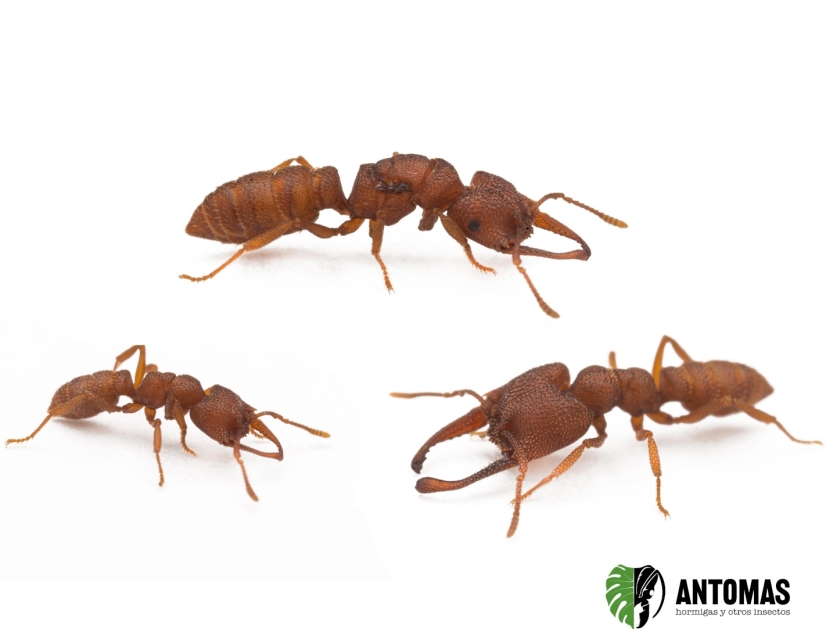
Mystrium camillae has a morphology that is difficult to confuse with that of most ants commonly kept in captivity.
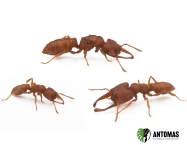
The head is extraordinarily broad and robust, while the mandibles are long, narrow and almost parallel, with a double row of small teeth along their inner margins.
The body has a strongly sculptured and rough surface, covered with numerous short, modified hairs.
Coloration generally ranges from reddish brown and chestnut to dark orange, although there is considerable geographical variation.
The workers exhibit continuous polymorphism. There are small individuals and others that are considerably larger, without forming a completely separate soldier caste.
This difference is not merely aesthetic. Larger workers are observed more frequently in foraging areas and have heavier mandibles, while smaller workers are better suited to delicate tasks involving the brood.
It can be compared to a toolbox in which all the tools share the same general design but are made in different sizes for different functions.
The eyes are extremely reduced or functionally absent, reflecting a life spent almost permanently in darkness.
Approximate measurements
- Workers: approximately 3.5–6 mm depending on size and population
- Queen: around 6 mm
The measurements should be considered approximate. Historical descriptions placed many workers between 3.3 and 4.5 mm, but modern studies show strong polymorphism among workers and considerable variability between populations currently grouped under the name M. camillae.
CAPTIVE CARE
Mystrium camillae should be considered a species of expert difficulty.
It is not particularly large and does not require enormous setups, but it demands very precise control of humidity, feeding and stability.
Its small size should not be mistaken for simplicity either. It is a cryptic, specialized species with relatively small colonies, so losing just a few workers can have a much greater impact than in a fast-growing Pheidole.
Recommended parameters
- Temperature: 24–27 °C
- Optional warm spot: approximately 27–28 °C
- Humidity: high, approximately 70–85% as a practical reference
- Nest: small, dark and with high moisture retention
- Ventilation: moderate, avoiding stagnant air
- Substrate: soil, clay, coconut fibre, decayed wood or natural mixtures.
In the laboratory, a colony used to study its mandibles was successfully maintained at 25 °C, using containers with moist plaster.
The priority is to maintain stable humidity. It should not alternate between periods of severe dryness and saturation.
The nest should remain moist, but not flooded. A slightly drier area allows the colony to move pupae and waste when necessary.
RECOMMENDED ANT NESTS
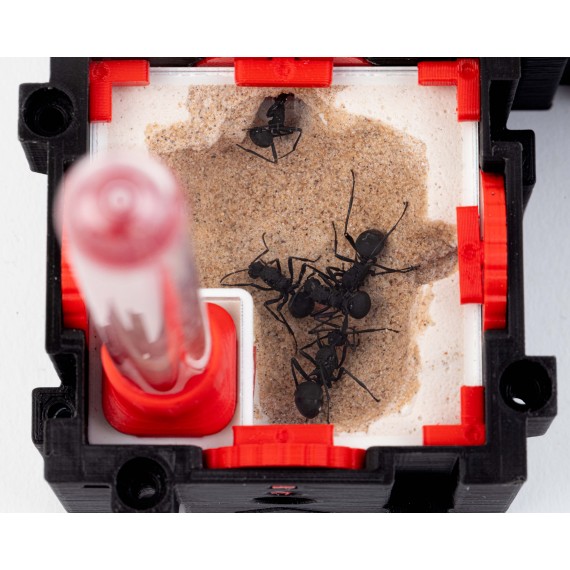
Due to its small size and natural preference for narrow cavities, compact naturalistic ant nests work particularly well.
For founding queens and very small colonies, we recommend:
It allows the queen and the first workers to be kept in a small, dark and humid space, without providing unnecessarily large chambers.
As the population increases, the following can be used:
Its substrate-based design makes it possible to better reproduce the small galleries and cavities that the species uses in leaf litter, soil and decaying wood.
Plaster or gypsum nests with small chambers also work well, provided they retain moisture effectively.
We do not recommend excessively large or dry ant nests, or nests with very open galleries. Mystrium is specifically adapted to moving through confined spaces.
Feeding
Protein
Protein should make up the most important part of the diet:
- termites;
- small crickets;
- young cockroaches;
- fruit flies;
- flies;
- small insect larvae;
- moths;
- silverfish
In laboratory studies, live crickets and termites were offered three times a week, providing a useful reference for established colonies.
Prey should be adapted to the size of the colony. A colony of ten workers does not need an entire adult cricket.
Young colonies do better with small, freshly killed or injured insects, while established colonies can be given live prey to observe their mandibles in action.
It is not advisable to immediately remove prey that they do not appear to be attacking. Their hunting behaviour can be much more discreet than that of Pheidole or Odontomachus.
Carbohydrates
Although it is a strongly predatory species, it has also been maintained in the laboratory with regular access to sugar solutions.
The following can be offered:
- nectar specifically formulated for ants;
- sugar water;
- very diluted honey.
Quantities should be small. This is not a species that needs large nectar feeders like a mature Camponotus colony.
There should always be separate access to clean water.
Diapause
No obligatory diapause is known for Mystrium camillae.
Populations commonly kept in captivity originate from tropical regions of Southeast Asia, where seasonality is expressed mainly through changes in rainfall rather than long, cold winters.
For this reason, it should be kept active throughout the year at approximately 23–27 °C.
A slight seasonal slowdown may occur in certain populations or lines, but refrigeration or keeping them for weeks at temperatures typical of temperate species is not recommended.
Behaviour in captivity
It is not a particularly visible species.
Workers prefer to remain underground or sheltered and may spend many hours without appearing in the foraging area. This is part of their biology and should not automatically be interpreted as a lack of activity.
The best way to enjoy observing this species is with a nest that allows the internal chambers to be seen.
Larger workers are the ones that most frequently leave the nest to search for food. Smaller workers remain more closely involved in brood care.
The colony may react to strong vibrations by remaining motionless or quickly taking shelter.
Its growth should be considered slow to moderate. A colony of a few dozen individuals already represents a well-developed and fully functional colony.
Handling and safety
It should not be handled directly with bare hands.
They do not climb smooth surfaces well, which greatly helps with their maintenance and escape prevention.
Maintenance tasks should be carried out using tweezers, tubes, auxiliary containers and a properly enclosed foraging area.
Rather than because of extraordinary aggressiveness, caution is necessary due to their small size, jumping power and the high biological value of each worker within a small colony.
- Dificultad
- Intermediate