Myrmecia piliventris | Golden-tailed Bull Ant | Antomas

Myrmecia piliventris - Golden-tailed Bull Ant

Last items in stock
€449.99
VAT included
Colony


Myrmecia piliventris – Golden-tailed Bull Ant

BIOLOGY

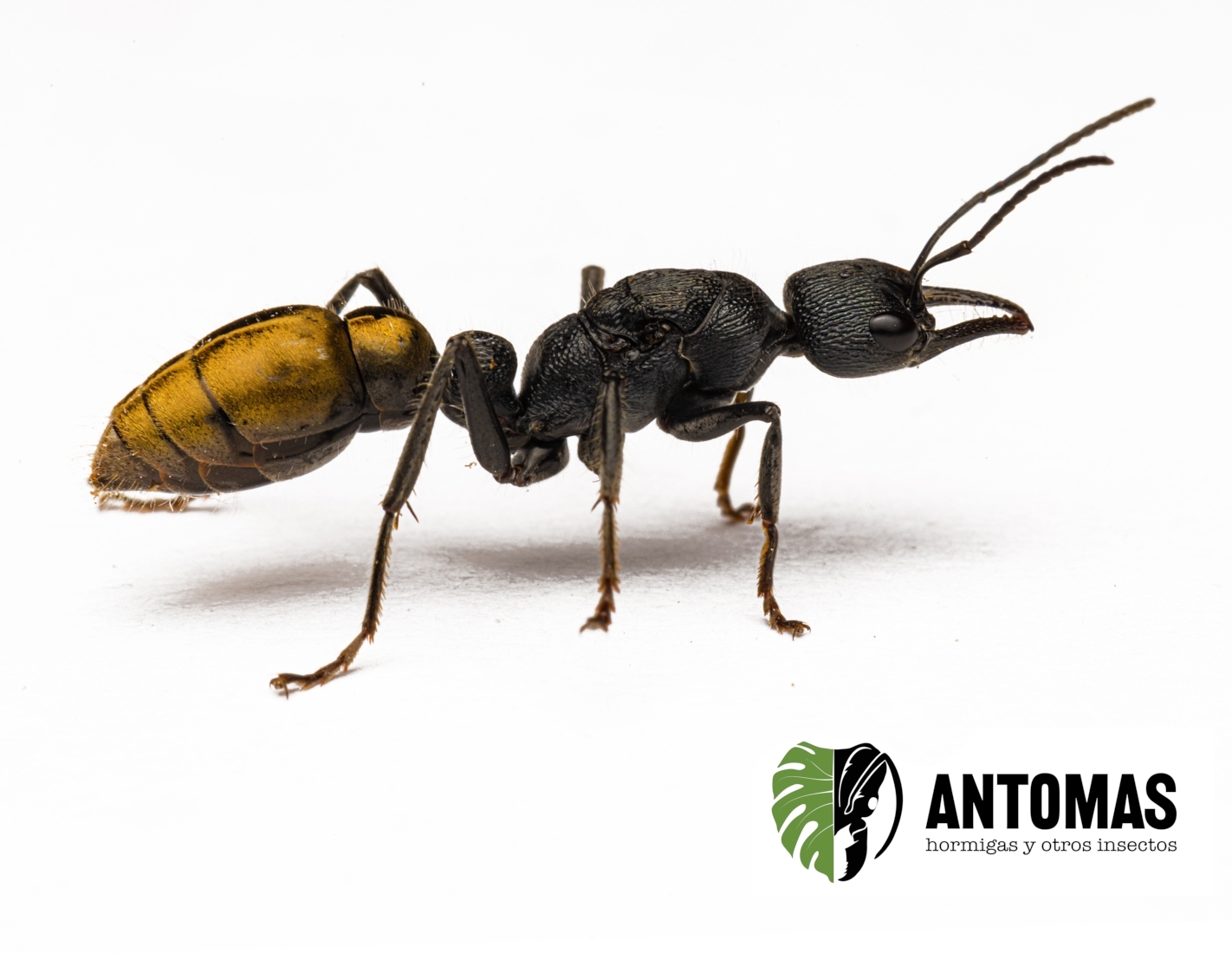
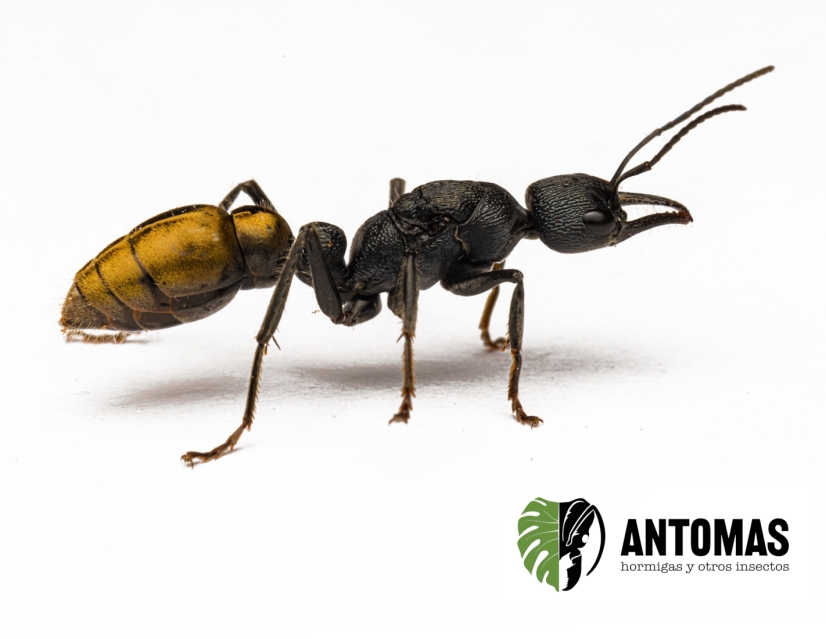
Myrmecia piliventris is an Australian bull ant described by Frederick Smith in 1858 and belonging to the mandibularis group. Its most widely used English common name is Golden-tailed Bull Ant, due to the dense yellow-golden pubescence covering much of the postpetiole and gaster, strongly contrasting with the predominantly dark rest of the body.

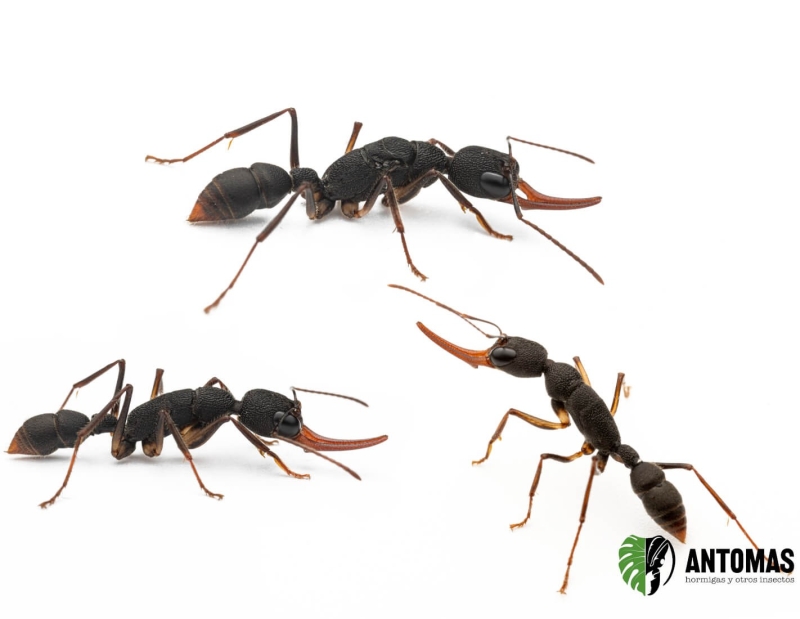
It is also part of the group of Myrmecia informally known in Australia as “toothless bull ants”. The name can be misleading: it is not literally toothless. Its mandibles are long, almost straight and bear only small teeth, concentrated mainly towards the tip, instead of the pronounced dentition found in other bull ants. The original description already mentioned these tiny backward-pointing teeth.

Its distribution is broad across southern and eastern Australia. Confirmed specimens exist from Stanthorpe, Queensland; Uralla and other localities in New South Wales; Canberra and the ACT; Victoria; South Australia and even Kangaroo Island. Compiled records place the species approximately between 24.8 and 37.7° S.

It therefore does not live in a single type of climate. Some populations occur in relatively temperate regions, while others endure inland winters with frequent frosts. This variation is important when designing diapause and makes knowing the origin of the commercial line especially useful.

Scientific collection specimens show a much more diverse ecology than is usually presented in commercial care sheets. M. piliventris has mainly been collected in dry sclerophyll forest, but also in wet sclerophyll forest, open eucalyptus woodland, wooded savanna and brigalow communities. Foragers have been recorded on the ground, among leaf litter, under stones and rocks, and climbing trees.

One Canberra record is particularly interesting: a worker was observed climbing the trunk of a yellow box eucalyptus, Eucalyptus melliodora. Another collection specimen was found in cavities of an old Nasutitermes termite mound at the base of Eucalyptus marginata, the well-known Australian jarrah.

This does not mean that M. piliventris is arboreal. Its nests are mainly terrestrial, but these observations show that workers actively explore both the ground and vegetation and that a completely flat arena limits part of their natural repertoire.

Recorded times also support mainly diurnal activity. Field material includes foragers collected at 9:00, 10:00 and 16:00, as well as numerous daytime sightings in Canberra. As with other Myrmecia, it has highly developed vision and actively uses visual landmarks while foraging.

In captivity I therefore recommend a clear light cycle, with about 11–13 hours of ambient light during the active phase. The inside of the nest does not need lighting; it is the arena that should experience a clear day/night alternation.

Feeding and hunting

It is an opportunistic predator. Bull ants capture whole arthropods and carry them to the nest mainly to feed their larvae, while adult workers supplement their diet with nectar, plant juices and other carbohydrate-rich liquids. Australian sources specifically dealing with M. piliventris recommend small cockroaches, crickets, fruit flies and pieces of mealworm in captivity, together with sugar water or small amounts of honey.

I would not turn these captive-bred insects into a list of proven “natural prey”. The specific literature on M. piliventris does not yet allow a detailed list of the species it captures in the wild.

In captivity it does seem to respond particularly well to small, mobile prey. Australian keepers recommend prey small enough during founding for the queen to subdue without excessive risk: micro-crickets, small cockroaches or fruit flies. Frequent protein feeding is particularly important while larvae are present.

As a purely hobby-related curiosity, an Australian keeper with an established M. piliventris colony described the workers as extremely active and observed good acceptance of ripe mango; he also noted that his queen laid especially consistently compared with other Myrmecia he kept. This is an individual observation, not a biological fact about the species, but it confirms that small portions of ripe fruit can occasionally be used as enrichment and an additional carbohydrate source.

I would not leave fruit for many hours because of the risk of fermentation and mites.

Social structure: an unconventional Myrmecia

One of the most interesting aspects of M. piliventris is its social structure.

In studied populations, between 1 and 4 queens per colony have been found, and reproductives also showed an extraordinarily high degree of polyandry: between 1 and 9 different males per queen were estimated, with effective values in some analyses even higher. The same population showed polydomy and a genetic pattern compatible with dependent colony founding, meaning the formation of new nests by splitting or budding a short distance from the original colony.

Queens of certain lineages have also been described as subapterous or ergatoid, with reduced wings and morphology much less specialised for long flights than the large winged queens of other Myrmecia.

These data must be interpreted cautiously.

M. piliventris shows extraordinary genetic and chromosomal diversity and probably conceals taxonomic complexity that has not yet been fully resolved. I would not assume that all populations are obligatorily polygynous or that any queen can be introduced into any colony.

The rule in captivity should be very simple: if a colony arrives established with several queens, do not separate them; but do not later add reproductives from another nest either.

One of the most chromosomally unusual ants known

The cytogenetics of M. piliventris deserves a brief mention because it is truly exceptional.

In two colonies collected at Black Mountain, Canberra, researchers found individuals morphologically assigned to M. piliventris with completely different karyotypes: one colony had n = 34, while another had only n = 2 / 2n = 4. The authors themselves noted that such an enormous difference probably concealed more than one biological species under very similar morphology.

Other chromosome numbers have subsequently been compiled for material identified as M. piliventris, including 2n = 6, 34 and 64.

This does not directly affect husbandry, but it explains why we must be cautious when extrapolating behaviour, colony structure or diapause between geographically distant populations.

Founding

In the wild, polydomy and the existence of subapterous queens indicate that some populations may found dependently by budding.

However, isolated reproductives are also kept in captivity and specialised Australian sources treat founding as semiclaustral: the queen needs access to food during development of the first generation.

She needs a secure chamber connected to a small foraging area.

During this phase I would offer small prey every few days according to consumption and larval development, as well as small drops of nectar or sugar water. Some Australian keepers offer protein every 1–2 days while brood is present, although I do not consider it necessary to make this frequency a rigid rule: feeding should be adjusted to actual consumption and leftovers removed.

Founding can be slow. Times reported among keepers vary greatly and there is no sufficiently robust species-specific scientific series to give an exact number of days from egg to worker. I would therefore not include a fixed timetable.

I would also keep disturbance to a minimum. The advantage of connecting a small arena is precisely that feeding can be done without opening or directly handling the queen's chamber.

SIZE AND MORPHOLOGY

Myrmecia piliventris is a medium-sized bull ant.

The original description gave workers a length of approximately 12–13 mm, and modern records frequently confirm animals around 12–15 mm.

In the Australian hobby, queens around 15–20 mm are sold, although there is considerable variation and I prefer not to set a narrower size until the Antomas line has been measured directly.

It has no differentiated soldier caste.

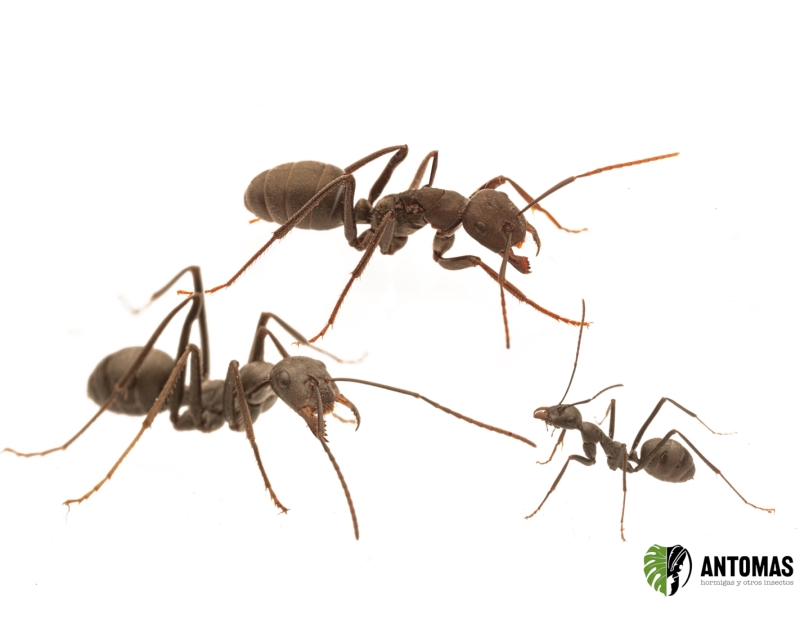
The body is predominantly black or very dark brown, with legs usually remaining dark or reddish brown. This helps distinguish it from Myrmecia fulvipes, whose legs normally show much more contrasting red or yellowish coloration.

The most characteristic visual feature is the gaster, covered by dense golden or pale-yellow pubescence that can partially hide the sculpture of the cuticle. Smith's original description already noted that the abdomen was covered with light golden pubescence.

The mandibles are long, narrow and almost straight, with very reduced dentition except towards the tip.

The eyes are large and prominent.

It has a fully functional sting.

Mature larvae form cocoons, an especially important point for husbandry because both humidity and substrate availability strongly influence successful pupation.

KEEPING IN CAPTIVITY

Difficulty: 5/5 – Expert

It is not especially fragile once established, and its size is considerably more manageable than Myrmecia gulosa, M. pavida or M. pyriformis. However, it combines semiclaustral founding, relatively slow growth, excellent vision, speed, a functional sting and pupation that requires good control of temperature, humidity and substrate.

Temperature, humidity and brood development

During the active phase I recommend approximately 22–26 °C, providing a gradient and avoiding uniform heating of the entire nest.

At Antomas we apply the same criterion to this species as to other Myrmecia: we avoid keeping mature larvae continuously above about 28 °C because we have observed problems with spinning and cocoon formation at higher temperatures.

I would not attribute this problem to a specific physiological mechanism that has not been demonstrated; it is a practical observation from captivity.

If we want to accelerate development, it is much safer to work at 24–26 °C than to keep the colony constantly at 29–30 °C.

Humidity should be clearly distributed in zones.

Eggs and young larvae need a moderately humid region. Australian keepers repeatedly recommend keeping small areas of substrate cool and slightly damp without saturating them.

Pupae and cocoons need exactly the opposite: a considerably drier area.

In Antomas' experience, a cocoon kept too wet can become saturated with water and the pupa may eventually die inside. For this reason we never recommend keeping the entire brood chamber continuously wet.

The colony must be able to move brood between a humid and a dry area depending on developmental stage.

This gradient is much more important than trying to achieve an exact ambient percentage.

Spinning substrate

A completely smooth, bare chamber is not the best option for a cocoon-forming Myrmecia.

Inside the nest I would always provide a mixture of materials with different particle sizes: fine sand, some coarser sand, mineral soil, small plant fibres and particles of dry substrate.

There is no need to fill the chamber.

The idea is that workers can carry the material and place it around mature larvae when they begin to spin.

This recommendation is especially important in acrylic or 3D-printed setups, where the larva would otherwise have very few support points.

Recommended nest

Its size makes it especially suitable for a queen, a founding colony or a young colony: it offers a chamber large enough for the reproductive and large larvae without oversizing the system, allows substrate to be added directly inside the nest, and remains small enough to control humidity, food and waste effectively.

In addition, the Wild format makes it possible to provide the type of substrate mixture we recommend for cocoon spinning.

I would not move a queen or a five-worker colony directly into a huge Nona.

As the population increases it can be expanded modularly and, if the colony becomes large, later moved to higher-capacity Wild systems.

Foraging area

Although the nest may start small, I would not make the arena completely bare.

Natural records include workers on the ground, leaf litter and eucalyptus trunks, so a few low branches, bark and stones greatly increase the opportunities to observe natural behaviour.

We do not need to build a complete terrarium.

In fact, an overly complex arena makes it harder to remove prey and check for escapes. It is enough to provide a few stable structures that can be used as visual landmarks.

I would keep these landmarks in the same place for quite a long time.

For a visual ant, rearranging all the decoration every week offers no advantage.

Feeding

Adults need regular access to liquid carbohydrates.

Ant nectar, sugar water or small amounts of diluted honey can be used, always in containers or drops where there is no risk of drowning.

Protein should be adjusted to the number of larvae.

Fruit flies, flies, small cockroaches, micro-crickets, moths and pieces of mealworm work especially well. For founding I would prefer small or injured prey that the queen can subdue without taking risks.

In an established colony we can use some live prey to observe hunting.

Australian guides specific to M. piliventris recommend substantially increasing protein while brood is growing and reducing it when the colony stops accepting it.

I would not use vitamin or calcium powder: with a varied insect diet there is no demonstrated need for supplementation.

Clean water should always be available.

Does it jump?

I would not market it as a “jumping ant”.

There is debate even among Australian keepers: some hobbyists claim to have observed small jumps in toothless bull ants, while other keepers who have maintained M. piliventris deny that it shows the typical jumping locomotion of M. pilosula or M. nigrocincta.

I have not found a morphofunctional study demonstrating in M. piliventris the jumping adaptations documented, for example, in M. nigrocincta.

I would therefore simply describe it as fast and highly visual, without using “jumper” as a characteristic of the species.

Diapause

The species needs clear winter seasonality, although we do not have sufficient evidence to speak of an obligatory physiological diapause with a universal thermal threshold.

The actual localities make this quite clear.

In Uralla, New South Wales, where historical records of M. piliventris exist, the average July maximum is only 11.8 °C.

In Stanthorpe, Queensland, another locality confirmed by museum specimens, the average July temperature is around 8.6 °C, and frosty nights occur regularly.

Canberra also contains numerous verified populations of the species and experiences a cold winter by Australian standards.

Therefore, I would not keep a temperate-line M. piliventris at 25–27 °C for twelve months.

In captivity I recommend a slowdown of about 8–12 weeks, approximately 12–17 °C for lines from the southeast or inland regions, gradually removing the hot spot.

I would not make an abrupt drop.

Australian husbandry guides also recommend progressively reducing temperature and feeding during winter and warming them slowly again in spring.

Water must remain available during the slowdown.

I would clearly reduce protein if the colony stops consuming it, but I would not impose absolute fasting if it still has active larvae.

I have found no reliable information determining at which brood stage M. piliventris spends winter. Therefore I would not claim that it enters winter with larvae, eggs, pupae or completely without brood.

The locality of origin of the line can substantially change the required intensity of this period.

Safety

It is a Myrmecia with a fully functional sting.

Bull ants can grip the skin with their mandibles, curve the gaster and sting repeatedly. Australian sources also warn of the possibility of severe allergic reactions in sensitised people.

I would not try to assign it a specific pain score obtained from another species.

What matters to the keeper is that the sting is painful and it should never be handled directly with the fingers.

I would use long tweezers to remove remains and feed when necessary, a secure lid and a reliable escape-proof barrier.

Maintenance operations should be carried out slowly. A visual Myrmecia can immediately detect hand movement and react before the keeper expects a response.

Dificultad
Advanced
No reviews

16 other products in the same category: