This website uses its own and third-party cookies to improve our services and show you advertising related to your preferences by analyzing your browsing habits. To give your consent to its use, press the Accept button.
Cookie preferences
| Cookie | Provider | Purpose | Expiry |
|---|---|---|---|
| PHP_SESSID | antomas.es | The PHPSESSID cookie is native to PHP and allows websites to store serialised status data. On the website it is used to establish a user session and to pass state data through a temporary cookie, which is commonly known as a session cookie. These Cookies will only remain on your computer until you close your browser. | Session |
| PrestaShop-# | antomas.es | This is a cookie used by Prestashop to store information and keep the user's session open. It stores information such as currency, language, customer ID, among other data necessary for the proper functioning of the shop. | 480 hours |
| rc::a | It is used to read and filter bot requests. | Persistent | |
| rc::c | It is used to read and filter bot requests. | Persistent |
| Cookie | Provider | Purpose | Expiry |
|---|---|---|---|
| _ga | Registers a unique ID that is used to generate statistical data on how the visitor uses the website. | 2 years | |
| _gat | Used by Google Analytics to throttle request rate | 1 day | |
| _gat_gtag_UA_# | Used to throttle request rate. | 1 minute | |
| _gd# | This is a Google Analytics Session cookie used to generate statistical data on how you use the website which is removed when you quit your browser. | Session | |
| _gid | Registers a unique ID that is used to generate statistical data on how the visitor uses the website. | 1 day |
Medauroidea extradentata – Vietnamese Stick Insect
Biology
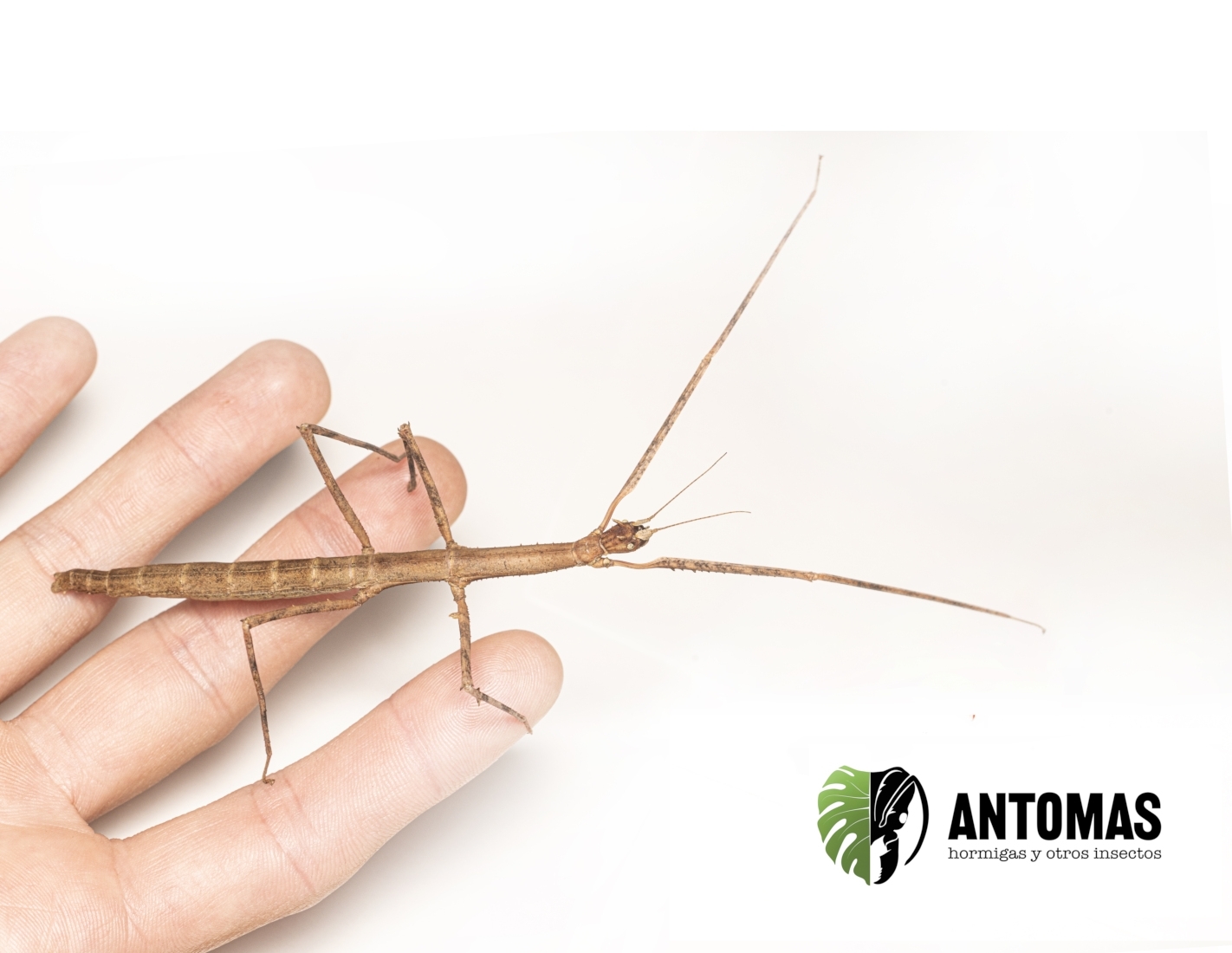
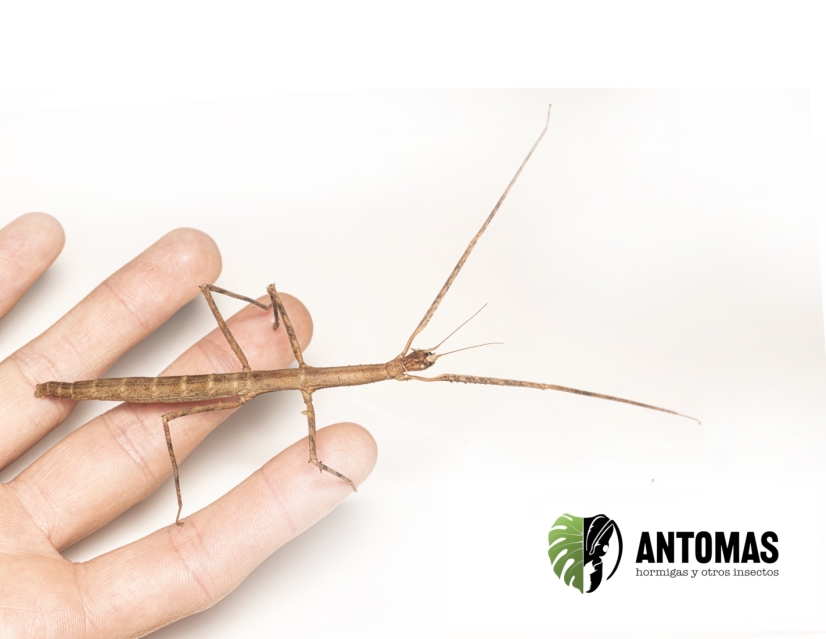
Medauroidea extradentata, known as the Vietnamese Stick Insect or Annam Stick Insect, is a phasmid native to Vietnam. It is associated with warm and humid environments with abundant vegetation.
Its main defense is camouflage. Its elongated body, narrow legs, and plant-like coloration make it difficult to distinguish from a small branch. When it remains still, it appears completely integrated into the vegetation.
It is a fundamentally nocturnal species. During the day it usually rests among the vegetation, while at dusk its activity increases, it moves around the terrarium, and begins to feed.
One of its most interesting aspects is reproduction. Many lines kept in captivity are capable of reproducing through parthenogenesis, so a female can produce offspring without being fertilized.
Males exist and the species can also reproduce sexually, but they are much less common in many European breeding lines. When only females are kept, parthenogenetic eggs usually produce only females.
The female does not build a nest or care for the eggs. She drops them individually onto the floor of the terrarium, where they remain until hatching. The incubation period can vary considerably depending on temperature and humidity.
This reproductive ease makes M. extradentata a very rewarding species, but it also requires controlling the number of eggs. A single female can quickly produce a large population.
It does not undergo a winter diapause comparable to that of species from temperate climates. It can remain active and reproduce throughout the year if it has stable temperatures and suitable food.
Size and Morphology
Medauroidea extradentata has an extremely elongated and narrow body, with no functional wings in either sex. Its appearance strongly resembles a dry twig.
Coloration may vary between green, beige, light brown, and dark brown. Some individuals also show different tones after each molt or depending on environmental conditions.
Females are notably larger, more robust, and heavier than males. Their abdomen is broad, especially when they are carrying eggs, and they have a more massive appearance.
Males, when present, are smaller and thinner. They have a light body and even more slender proportions, making them easy to distinguish from females.
Approximate measurements
- Females: around 10–12 cm
- Males: approximately 7–8 cm
- Newly hatched nymphs: approximately 1.5–2 cm
The legs are long and delicate. They are perfectly adapted to hold onto branches and leaves, but they can be damaged if the animal is grabbed or if an attempt is made to pull it off a surface.
Nymphs must complete several molts before reaching adulthood. During ecdysis they hang from vegetation and slowly emerge from the old exoskeleton.
Captive Care
Medauroidea extradentata can be considered an easy species, suitable for people starting out in phasmid keeping.
Its ease of care does not mean it can be kept without planning. Ventilation, vertical space, constant availability of fresh leaves, and egg control are essential.
Recommended parameters
- Temperature: 20–26 °C
- Night temperature: may drop to 18–20 °C
- Relative humidity: 60–80 %
- Terrarium: tall, ventilated, and with abundant branches
It does not need additional heating in a room kept within these values. Excessively high temperatures, especially above 30 °C, can be harmful.
The height of the terrarium should be at least three times the body length of the adult specimen. For a small group, a tall, well-ventilated enclosure is recommended.
The terrarium should be lightly misted every one or two days, adapting the frequency to ventilation and room climate. Droplets on the leaves allow the insects to drink.
The enclosure should not be kept constantly wet. The combination of high humidity, plant remains, and insufficient ventilation favors the appearance of fungi and mites.
Feeding
The most recommended plants are:
- Bramble
- Rose
- Oak
- Hawthorn
- Raspberry
- Ivy
Bramble is usually the most practical option, as it remains available for much of the year and is readily accepted.
All leaves must come from places free of pesticides, herbicides, urban treatments, and direct traffic pollution. Before placing them in the terrarium, it is advisable to wash them well.
Branches can be kept fresh inside a container with water. The opening must be covered with cotton, mesh, or perforated paper to prevent nymphs from drowning.
Leaves should be replaced when they begin to dry out. A plant that is no longer attractive may cause young specimens to spend too much time searching for food.
Reproduction and Incubation
Adult females drop the eggs onto the substrate. They can be collected periodically and moved to a ventilated incubation container.
Eggs should be kept on vermiculite, coconut fiber, clean sand, or slightly damp absorbent paper. The medium should never become soaked, as this increases the risk of mold.
A temperature close to 22–25 °C usually provides stable development. Moderate humidity should be maintained and the eggs should be checked periodically.
Because this is a very prolific species, it is not advisable to incubate all the eggs produced. Only the number of specimens that can be properly maintained should be selected.
Surplus eggs, nymphs, or adults should never be released into the natural environment. It is a hardy species with parthenogenetic reproduction, and irresponsible release could pose an ecological problem.
Behavior in Captivity
During the day it usually remains motionless, especially if the terrarium receives plenty of light. Its activity increases at nightfall, when it can be observed feeding and moving around.
It is not an aggressive species, does not bite significantly, and lacks a sting or dangerous defensive secretions. Its strategy consists mainly of remaining still and camouflaged.
It can be kept in groups as long as enough space and food are available. Overpopulation causes competition for the best molting areas, accumulation of eggs, and greater hygiene problems.
Handling and Safety
It can be handled carefully, allowing the insect to walk voluntarily onto the hand. It should never be grabbed or pulled by a leg, as it may detach as a defense mechanism.
Nymphs can partially regenerate some lost limbs during later molts, but adults no longer have this growth capacity.
It is harmless to humans, but physically delicate. The best way to enjoy it is to observe its behavior and allow it to move on its own when handling is necessary.