This website uses its own and third-party cookies to improve our services and show you advertising related to your preferences by analyzing your browsing habits. To give your consent to its use, press the Accept button.
Cookie preferences
| Cookie | Provider | Purpose | Expiry |
|---|---|---|---|
| PHP_SESSID | antomas.es | The PHPSESSID cookie is native to PHP and allows websites to store serialised status data. On the website it is used to establish a user session and to pass state data through a temporary cookie, which is commonly known as a session cookie. These Cookies will only remain on your computer until you close your browser. | Session |
| PrestaShop-# | antomas.es | This is a cookie used by Prestashop to store information and keep the user's session open. It stores information such as currency, language, customer ID, among other data necessary for the proper functioning of the shop. | 480 hours |
| rc::a | It is used to read and filter bot requests. | Persistent | |
| rc::c | It is used to read and filter bot requests. | Persistent |
| Cookie | Provider | Purpose | Expiry |
|---|---|---|---|
| _ga | Registers a unique ID that is used to generate statistical data on how the visitor uses the website. | 2 years | |
| _gat | Used by Google Analytics to throttle request rate | 1 day | |
| _gat_gtag_UA_# | Used to throttle request rate. | 1 minute | |
| _gd# | This is a Google Analytics Session cookie used to generate statistical data on how you use the website which is removed when you quit your browser. | Session | |
| _gid | Registers a unique ID that is used to generate statistical data on how the visitor uses the website. | 1 day |
Pheidole sp. Vietnam “Yellow” – Yellow Soldier Ant from Vietnam
Biology
This Vietnamese Pheidole stands out for a particularly attractive combination for observation: rapid growth, massive recruitment, marked caste division, and an extraordinary response to live prey.
Its exact species identification has not yet been confirmed, so it is prudently marketed as Pheidole sp. Vietnam “Yellow”. This designation allows the lineage to be distinguished without assigning it a scientific name that could be incorrect.
In captivity, it displays considerably more predatory and voracious behavior than its larger relative, Pheidole ocellata. While the latter appears to rely more heavily on seeds and other plant resources, this Vietnamese Pheidole reacts with particular intensity to flies, cockroaches, crickets, and other small invertebrates.
When a worker discovers prey, the information is rapidly transmitted to the rest of the colony. Within minutes, a solitary scout may find itself surrounded by dozens of nestmates, forming a genuine chain of workers between the nest and the food source. Their recruitment system works almost like a human emergency alarm: a single worker detects the resource and immediately mobilizes the entire available workforce.
Minor workers make up most of this workforce. They explore, follow chemical trails, transport food, and care for the brood. Majors, commonly known as soldiers, appear when the colony requires additional strength to immobilize prey, cut food into pieces, or defend the nest.
Their aggressiveness is not limited to defense. Even relatively small colonies can attack prey with remarkable coordination, holding it from multiple points while the majors use their mandibles to cut through the toughest parts. This combination of speed, numbers, and specialization makes each feeding session one of the species' main attractions.
Development is rapid when high temperatures and a regular protein supply are available. Young colonies can increase in size quickly, so it is advisable to plan expansions before the nest becomes overcrowded.
The number of queens tolerated, the maximum colony size, and their natural reproductive organization are still not known with certainty. As a precaution, queens originating from different colonies or captures should not be housed together.
A cold diapause is not recommended. Since the exact locality within Vietnam is unknown, a slight slowdown during winter can be allowed by moderately reducing temperature, but without exposing the colony to low temperatures.
Size and Morphology
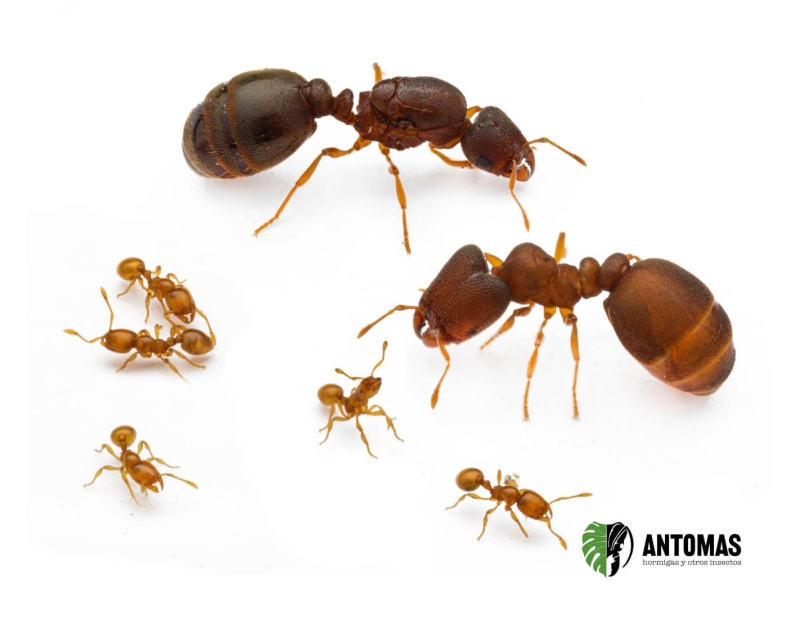
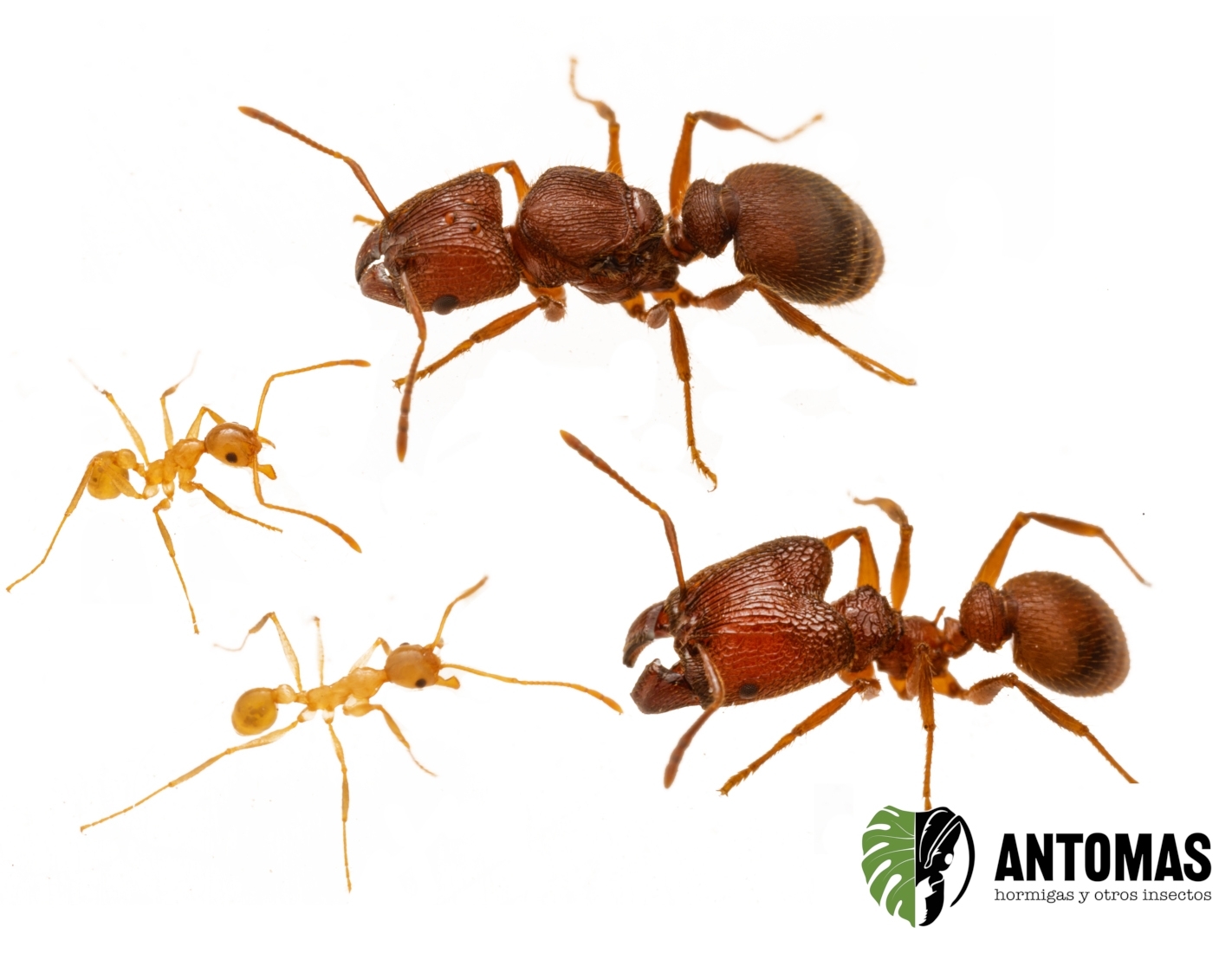
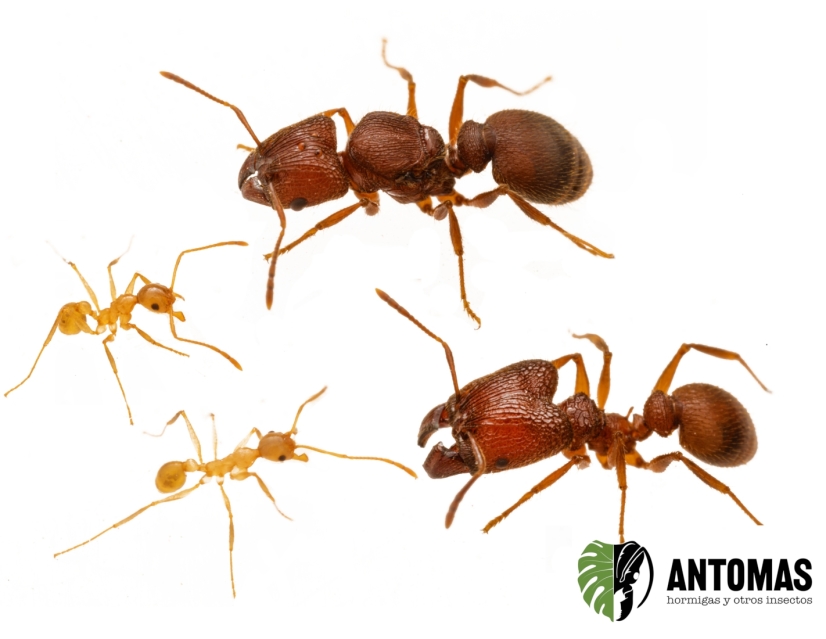
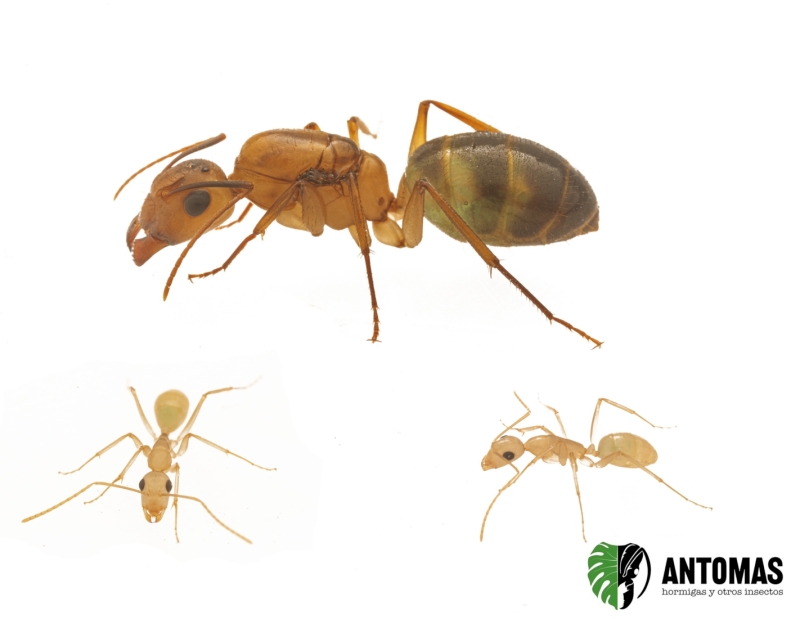
This line shows very marked dimorphism between minor and major workers. At first glance, both castes may appear to be completely different animals.
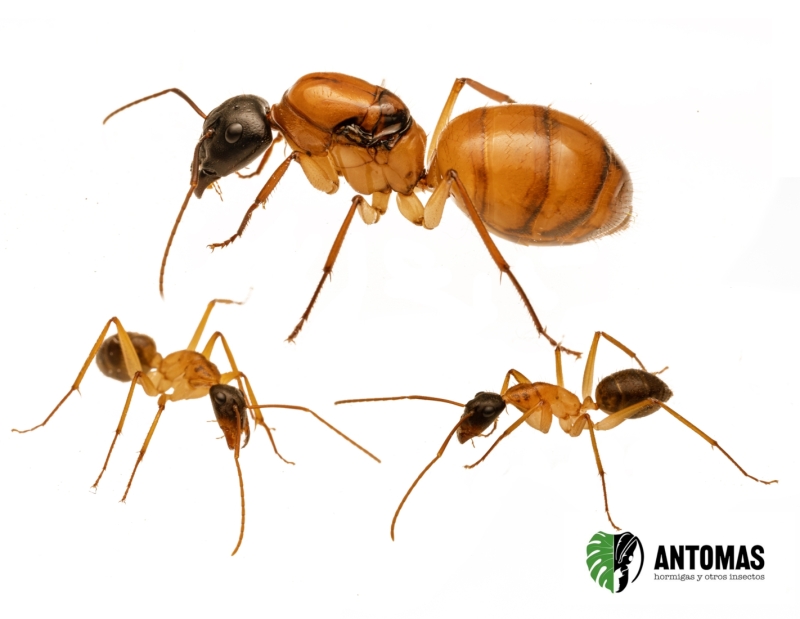
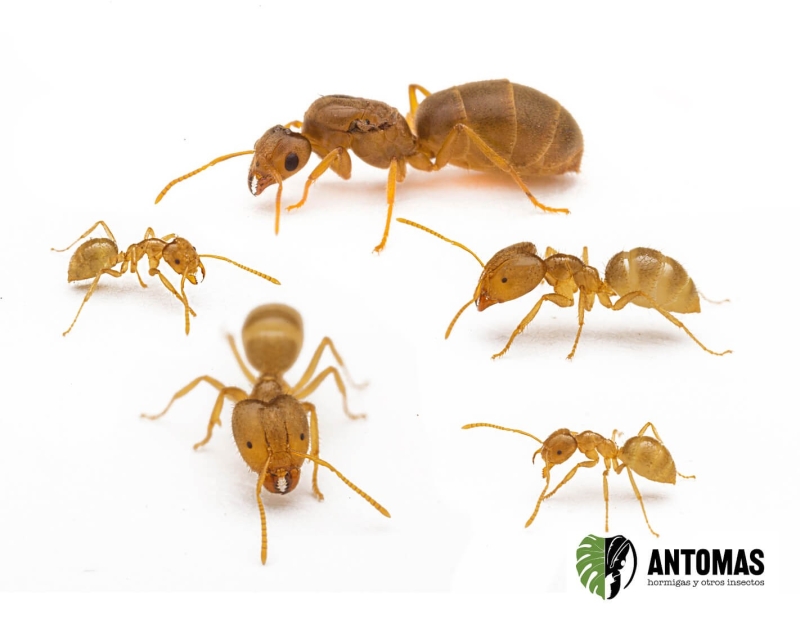
Minor workers show a very light yellow or yellow-orange coloration. They have a slender body, relatively long legs, and a proportionate head.
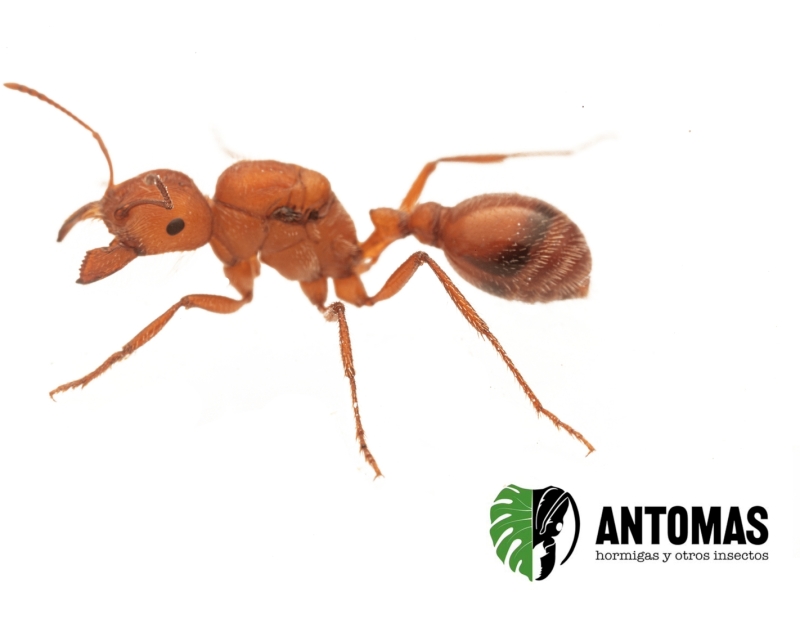
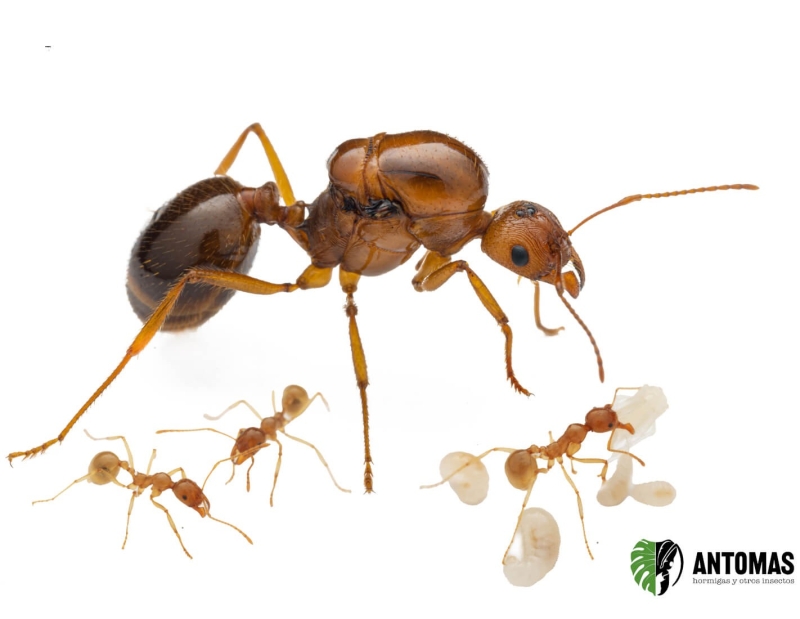
Majors or soldiers are much more robust. The head is disproportionately large, broad, and reddish-brown. It has deep sculpturing made up of grooves and rough textures.
Their mandibles are dark, thick, and much more powerful than those of the minors. The mesosoma maintains a reddish coloration and rough texture, while the gaster is darker.
The color contrast is especially striking: while the small workers form a yellow stream around food, the soldiers appear as darker and more robust figures within the group.
Majors reach approximately the same length as the queen, but their proportions are very different. The soldier’s head occupies a considerable part of its total body size.
Approximate measurements
- Minor workers: 3–4 mm
- Major workers or soldiers: 6–7 mm
- Queen: 6–7 mm
It does not have a continuous size series like some polymorphic species. The separation between the small workers and the large soldiers is visually very clear.
CAPTIVE CARE
Difficulty can be considered low-intermediate. It is a hardy ant with good growth, but its small size, strong recruitment, and rapid colony expansion require careful management.
Recommended parameters
- Temperature: 24–28 °C
- Warm spot: up to 28–29 °C
- Nest humidity: moderate-high, with a permanent humid area
- Nest: compact, well-sealed, and expandable
RECOMMENDED FORMICARIA
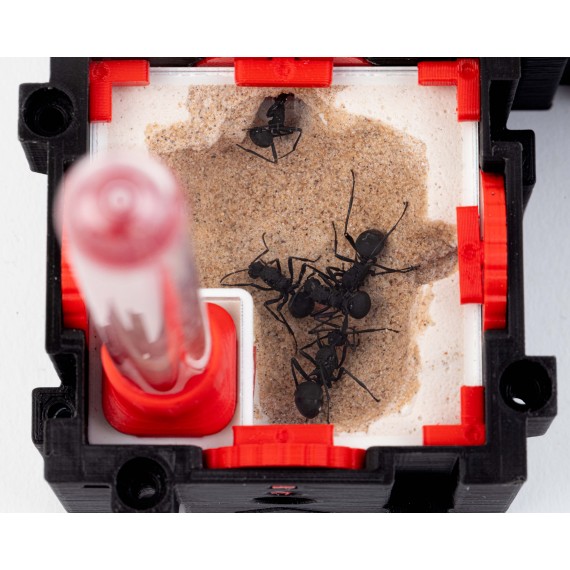
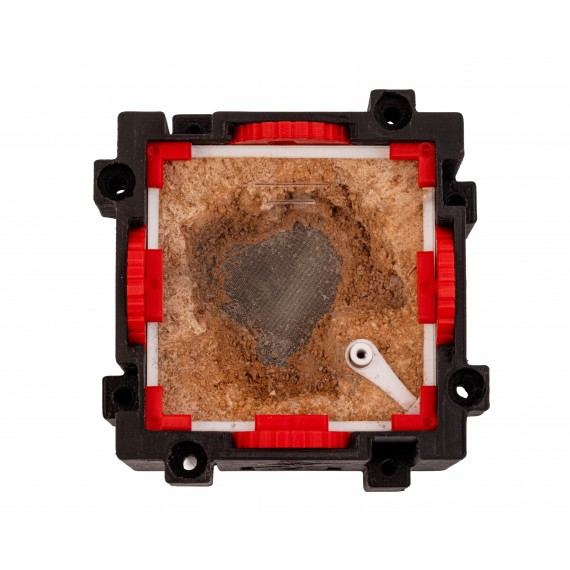
Due to the small size of the workers and their rapid growth, compact and expandable systems from the Qbik Wild range work especially well:
High temperature greatly accelerates development. However, heat also increases food consumption and the risk of dehydration, so humidity and water availability must be monitored carefully.
Feeding
Carbohydrates
- Ant-specific nectar
- Sugar water
- Diluted honey
- Carbohydrate syrups
- Small portions of ripe fruit
Carbohydrates should be available regularly. Microdrops should be small to prevent workers from becoming trapped.
Proteins
- Flies and fruit flies
- Small or chopped cockroaches
- Micro crickets
- Moths
- Mosquitoes
- Chopped mealworm
- Other small feeder insects
Protein is essential to take advantage of its growth speed. During periods with abundant larvae, it may accept food almost daily.
Although it may show interest in small seeds, they should not form the basis of its diet. Unlike Pheidole ocellata, this line stands out more for predatory feeding.
Live prey allows its full recruitment potential to be observed, but prey must be proportionate to the size of the colony. A small colony should not be exposed to excessively large or dangerous prey.
Behavior in Captivity
External activity increases noticeably as soon as food is offered. The first scouts quickly return to the nest and generate dense, well-defined routes toward the food source.
Minors can pass through extremely small spaces. Connections, lids, mesh, and joints must be checked carefully, and the foraging area must remain perfectly sealed.
Soldiers may remain hidden when the colony is calm and appear suddenly during feeding or when disturbed. This dynamic makes the species especially interesting to observe.
Handling and Safety
It is not considered dangerous to humans. Soldiers can grip with their mandibles, but their small size greatly limits any risk.
The main problem during maintenance is not aggression toward the keeper, but its ease of escaping and hiding. All interventions should be carried out carefully, slowly, and with escape barriers in place.
Direct handling of workers or the queen is not recommended.