Polyrhachis hookeri – Metallic Green Spiny Ant

Polyrhachis hookeri

Last items in stock
€119.99
VAT included
Colony


Polyrhachis hookeri – Metallic Green Spiny Ant

Biology

Polyrhachis hookeri is a small spiny ant native to Australia, mainly distributed across the eastern and southeastern regions of the continent. It has been recorded in New South Wales, Queensland, and around Canberra, inhabiting environments ranging from subtropical areas to temperate regions with distinctly cold winters.

It belongs to the subgenus Chariomyrma, composed mainly of terrestrial or subterranean species. Although its long legs and excellent climbing ability allow it to move easily across trunks, branches, and low vegetation, it should not be considered a strictly arboreal ant.

In the wild, it can establish its colonies in the ground and use protected spaces under stones, roots, fallen wood, or small cavities. This lifestyle fits well with its discreet behavior: workers explore outside, but much of the colony’s activity remains inside narrow, protected shelters.

Its diet combines sugary resources with small sources of animal protein. Adult workers obtain energy from nectar, plant secretions, and honeydew produced by sap-feeding insects, while the larvae are fed mainly with captured or scavenged insects.

In captivity, it readily accepts flies, fruit flies, small crickets, young cockroaches, and other suitably sized invertebrates. It is not exceptionally aggressive, but it can respond quickly to small prey and recruit several workers to restrain and transport it.

Young colonies usually display moderate external activity. The first workers make short, cautious foraging trips, but movement increases as the population grows and the colony becomes more established. Their behavior is especially interesting in naturalistic setups where they can be observed moving across both the ground and small branches.

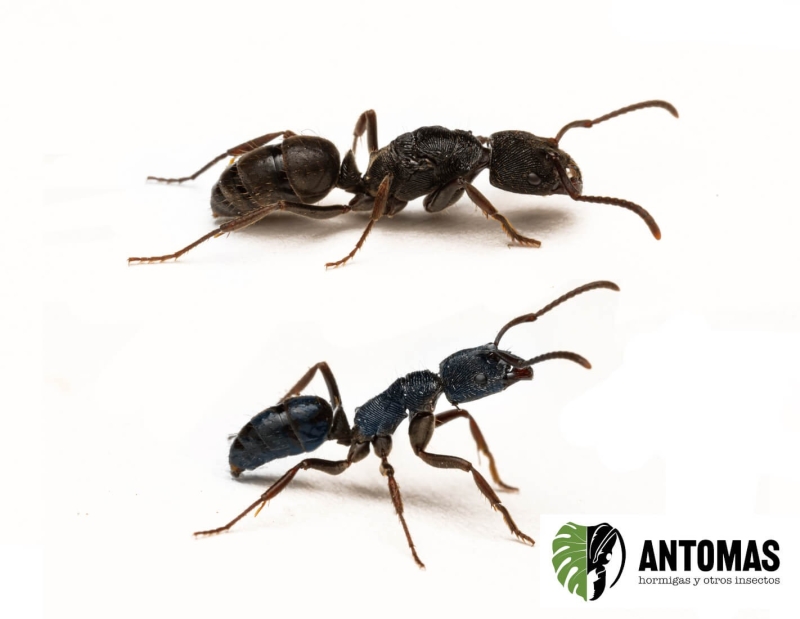
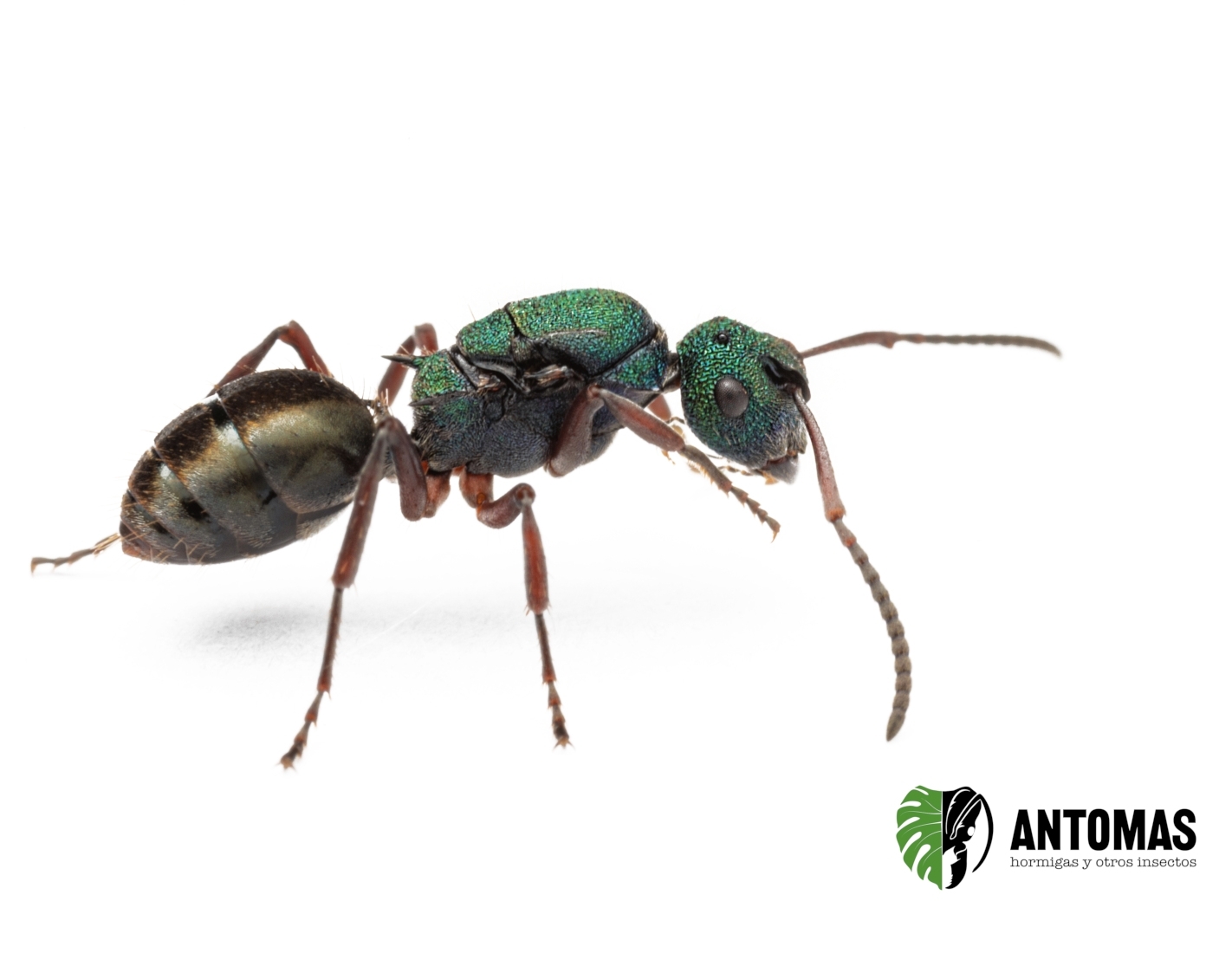
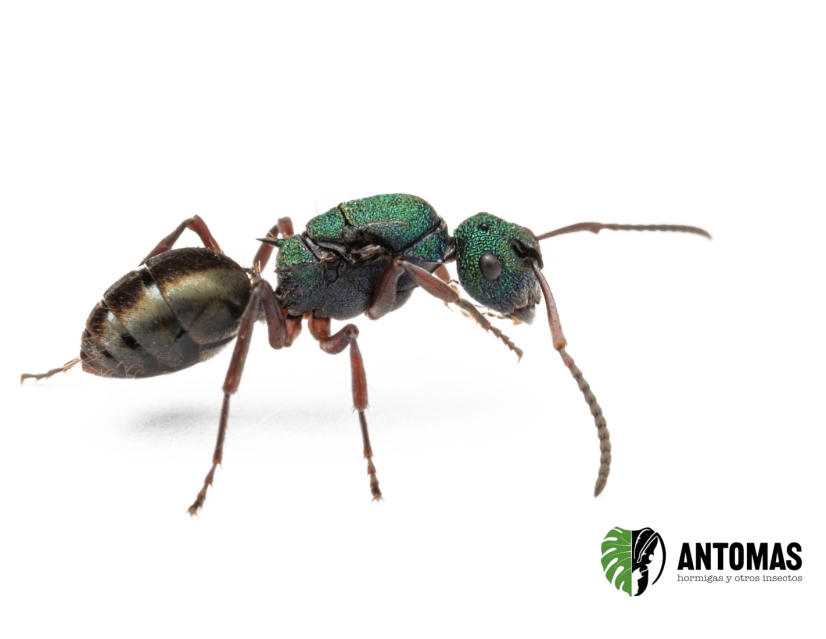
One of its main attractions is its metallic coloration. Depending on the lighting, the same worker may appear emerald green, bluish, coppery, or almost black. Its exoskeleton behaves visually like metallic automotive paint: the color seems to change as the angle of the light shifts.

The natural reproductive structure of P. hookeri has not been sufficiently documented to determine whether all populations are strictly monogynous or polygynous. As a precaution, only one queen per colony should be kept in captivity, and queens from different colonies or wild collections should never be introduced together.

In captivity, the safest method is to treat it as semi-claustral, providing access from the beginning to a small foraging area.

The queen should receive microdrops of nectar or sugar water and small portions of freshly killed insects. Food should be placed very close to the nest entrance to reduce stress and unnecessary movement.

The larvae form pupae protected by cocoons. It is advisable to provide fine sand, small plant fibers, or substrate particles that they can use during cocoon construction.

The maximum colony size is not precisely known. In captivity, it is usually more important to monitor the real occupation of the formicarium than to try to anticipate a fixed final size.

Size and Morphology

Polyrhachis hookeri is a small species with a slender body and a strongly armored appearance.

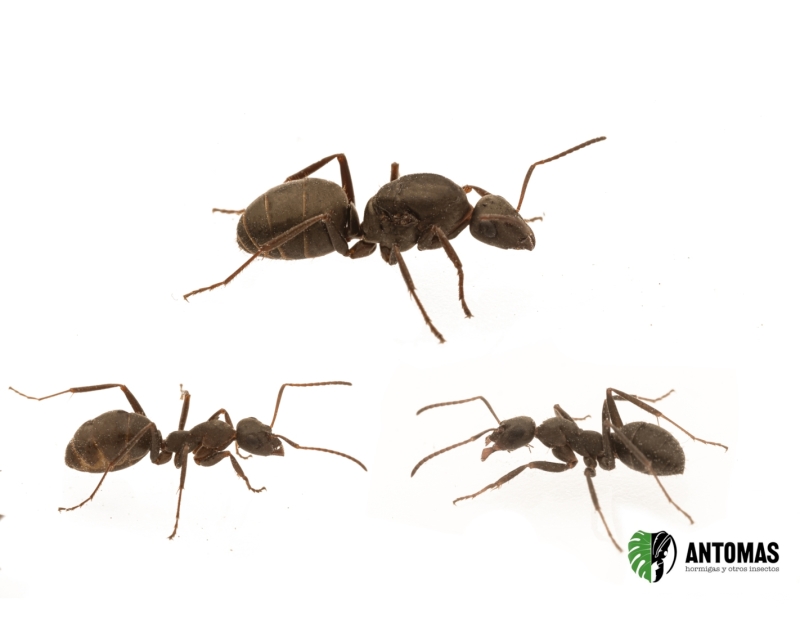
The head and mesosoma show an intense metallic green coloration. Depending on the maturity of the specimen, lighting, and viewing angle, it may also display bluish, turquoise, or coppery tones.

The legs and mandibles usually show brown or reddish tones, creating a very attractive contrast with the green areas of the body. The gaster is darker and may show metallic reflections.

The surface of the head and mesosoma is not completely smooth. It has fine sculpturing that disperses light and contributes to its characteristic metallic appearance.

The mesosoma and petiole are protected by several spines. These structures do not inject venom or function as a sting, but they make it harder for a predator to grab or swallow the ant.

There is no differentiated soldier caste. Workers maintain relatively uniform proportions, although some individual size variation may occur.

The legs are long and thin, providing great agility on soil, bark, branches, and vertical surfaces. Their mandibles are not as developed as those of predatory ants, but they are functional and effective.

As a member of the subfamily Formicinae, it lacks a functional sting. Instead, it has an acidopore at the end of the gaster, from which it can release formic acid as a defense.

Approximate measurements

  • Workers: around 4-6 mm
  • Queen: approximately 5-6 mm

The measurements should be considered approximate, especially for queens, due to the scarcity of published biometric data and possible differences between populations.

CAPTIVE CARE

The difficulty of Polyrhachis hookeri can be considered intermediate. Its small size and the absence of a dangerous sting make handling the enclosure easier, but founding, humidity, and escapes require attention.

Recommended parameters

  • Growth temperature: 23–27 °C
  • Optional warm spot: 27–28 °C
  • Nest humidity: 50–70 % with a gradient
  • Nest: compact, secure, and well ventilated

A humidity gradient should be maintained, with a moderately humid area for eggs and larvae and another drier, ventilated area for cocoons and resting workers.

The whole formicarium should not be soaked. Constant excessive humidity can encourage fungi, waste accumulation, and brood movement to less suitable areas.

During founding, the queen needs a small, protected chamber connected to a small arena where she can feed. Too much space can increase stress and make it harder to locate food.

RECOMMENDED FORMICARIA

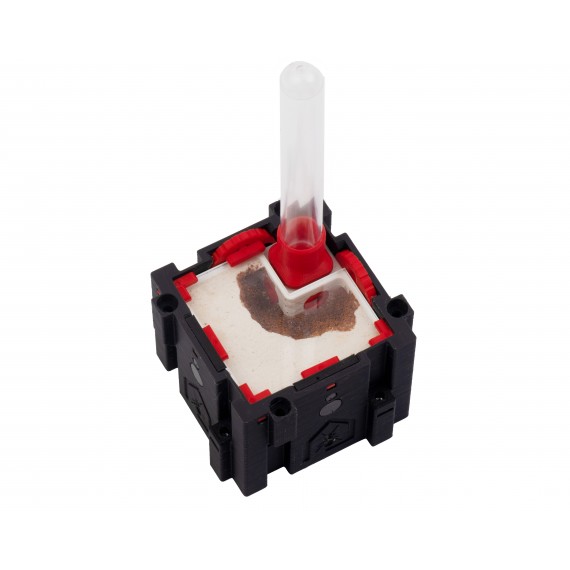
Due to the small size of the queen, workers, and first colonies, the most recommended system during founding is:

Its small galleries allow the queen and first workers to be kept in a proportionate space. The naturalized substrate also provides useful particles for cocoon spinning.

Expansion should only be carried out when the colony needs space. It is preferable to connect new modules gradually rather than introducing a small colony into an overly large nest.

Seasonal rest

The intensity of the rest period depends on the colony’s exact origin. P. hookeri is distributed across regions with very different winters, from subtropical areas to cold temperate zones.

Colonies from Canberra, southern New South Wales, or similar temperate regions should receive a marked winter pause, with temperatures gradually reduced for several weeks.

Populations from the coast of New South Wales or more northern areas can receive a more moderate rest, approximately between 15 and 18 °C.

During hibernation, water and small amounts of carbohydrates should always be available. Proteins can be reduced if the colony stops producing or maintaining larvae.

Outdoor frosts should not be directly reproduced. Natural nests are protected by soil, stones, or wood and experience more stable temperatures than open air.

Feeding

Carbohydrates

  • Ant-specific nectar
  • Sugar water
  • Diluted honey
  • Balanced carbohydrate syrups
  • Small portions of ripe fruit occasionally

Sugary liquids should be offered regularly. Due to the small size of the workers, it is preferable to use microdrops, small feeders, or safe drinking systems.

Proteins

  • Fruit flies
  • Micro crickets
  • Chopped cockroaches (dubia, runner)
  • Small moths
  • Chopped mealworm

During founding, very small and preferably freshly killed prey should be used. A solitary queen should not be exposed to insects capable of defending themselves.

Protein demand increases when large larvae are present. In periods dominated by eggs, pupae, or cocoons, interest in protein may temporarily decrease.

Behavior in Captivity

Small colonies may appear discreet and keep few workers outside the nest. This behavior is normal and does not necessarily indicate a lack of activity or hunger.

As the colony grows, the number of foragers increases and routes toward food become more visible. Workers make use of branches, bark, and naturalistic elements if available.

They climb easily on plastic, glass, silicone, and rough surfaces. The foraging area must have a properly maintained escape barrier.

Handling and Safety

Polyrhachis hookeri has no sting and represents no risk.

It may bite if trapped and release formic acid as a defense.

Direct handling of workers or the queen is not recommended. Transfers should be carried out using tubes, auxiliary containers, or suitable entomological aspirators.

No reviews

16 other products in the same category: